
Threat modelling how to approach security aspects in



- Slides: 33
Threat modelling: how to approach security aspects in IT projects Geneva, December 15 th 2014
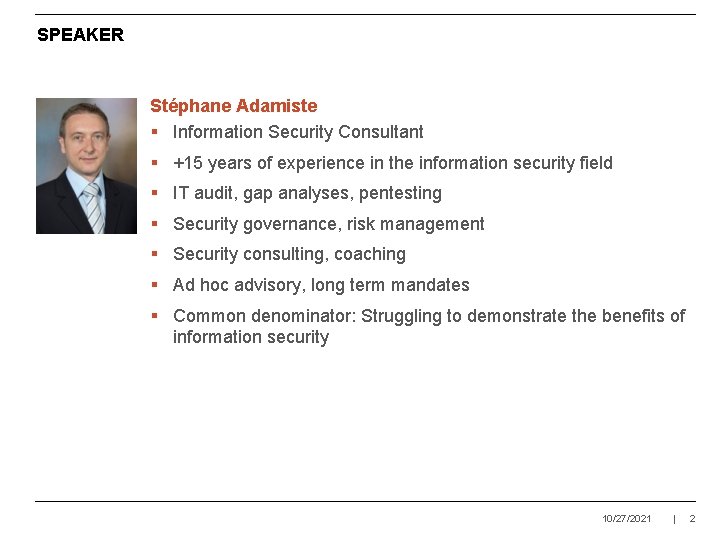
SPEAKER Stéphane Adamiste § Information Security Consultant § +15 years of experience in the information security field § IT audit, gap analyses, pentesting § Security governance, risk management § Security consulting, coaching § Ad hoc advisory, long term mandates § Common denominator: Struggling to demonstrate the benefits of information security 10/27/2021 | 2
AGENDA 1. Security challenges and common pitfalls in projects 2. Information security in a nutshell 3. Threat modelling explained 4. Case study 5. Questions 10/27/2021 | 3
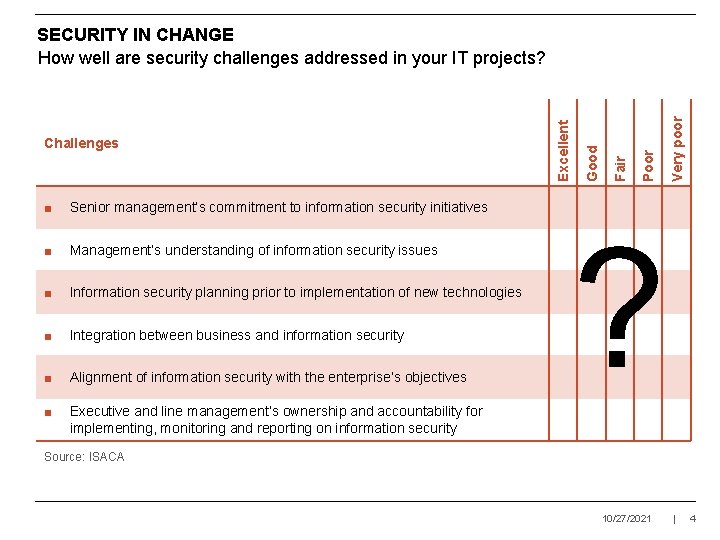
■ Senior management’s commitment to information security initiatives ■ Management’s understanding of information security issues ■ Information security planning prior to implementation of new technologies ■ Integration between business and information security ■ Alignment of information security with the enterprise’s objectives ■ Executive and line management’s ownership and accountability for implementing, monitoring and reporting on information security Very poor Poor Fair Good Challenges Excellent SECURITY IN CHANGE How well are security challenges addressed in your IT projects? ? Source: ISACA 10/27/2021 | 4
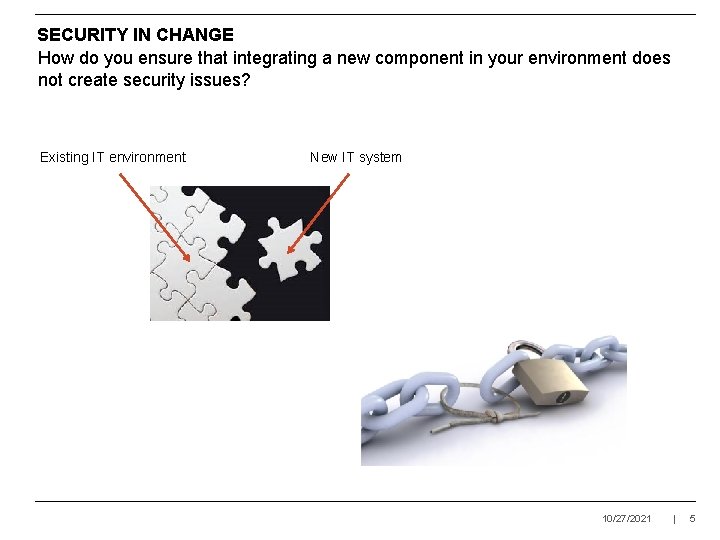
SECURITY IN CHANGE How do you ensure that integrating a new component in your environment does not create security issues? Existing IT environment New IT system 10/27/2021 | 5
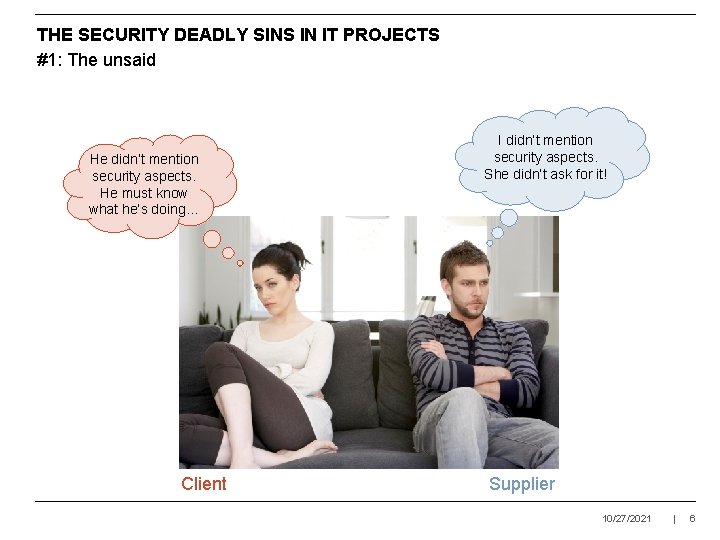
THE SECURITY DEADLY SINS IN IT PROJECTS #1: The unsaid He didn’t mention security aspects. He must know what he’s doing… Client I didn’t mention security aspects. She didn’t ask for it! Supplier 10/27/2021 | 6
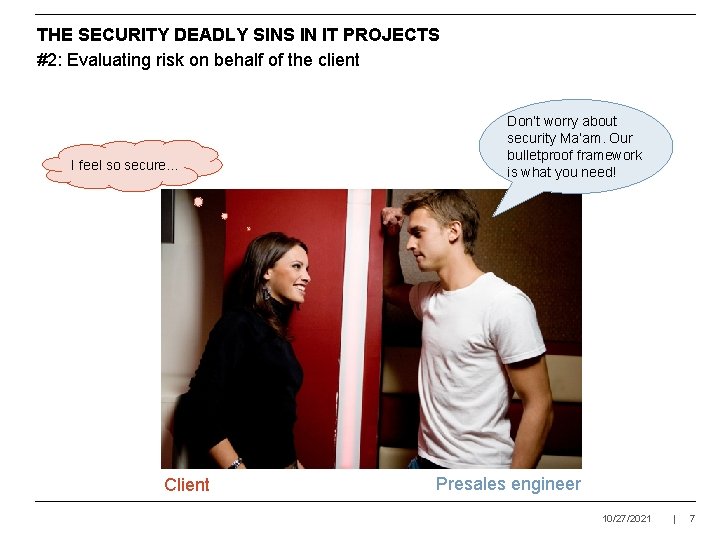
THE SECURITY DEADLY SINS IN IT PROJECTS #2: Evaluating risk on behalf of the client I feel so secure… Client Don’t worry about security Ma’am. Our bulletproof framework is what you need! Presales engineer 10/27/2021 | 7
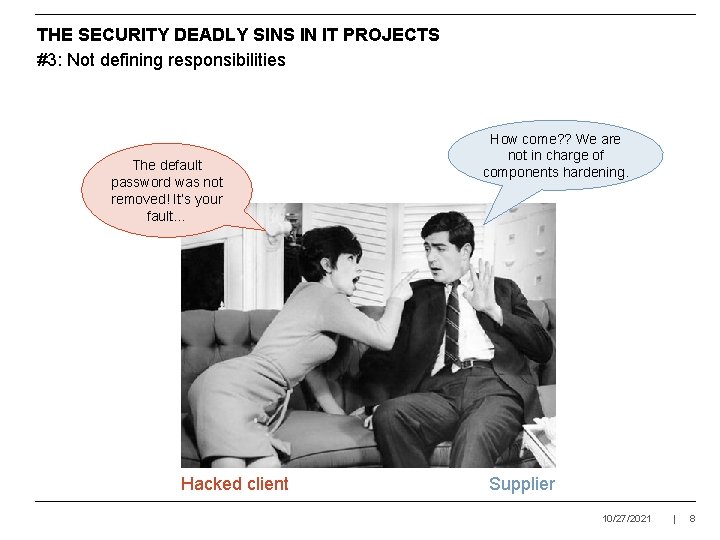
THE SECURITY DEADLY SINS IN IT PROJECTS #3: Not defining responsibilities The default password was not removed! It’s your fault… Hacked client How come? ? We are not in charge of components hardening. Supplier 10/27/2021 | 8
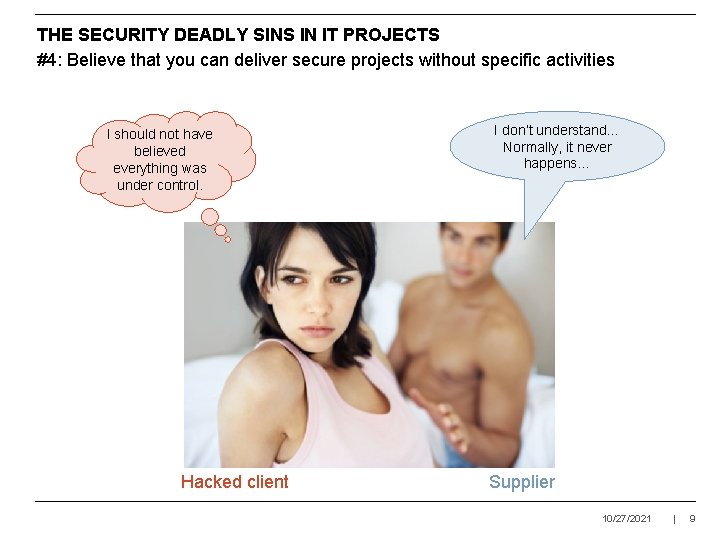
THE SECURITY DEADLY SINS IN IT PROJECTS #4: Believe that you can deliver secure projects without specific activities I should not have believed everything was under control. Hacked client I don’t understand… Normally, it never happens… Supplier 10/27/2021 | 9
AGENDA 1. Security challenges and common pitfalls in projects 2. Information security in a nutshell 3. Threat modelling explained 4. Case study 5. Questions 10/27/2021 | 10
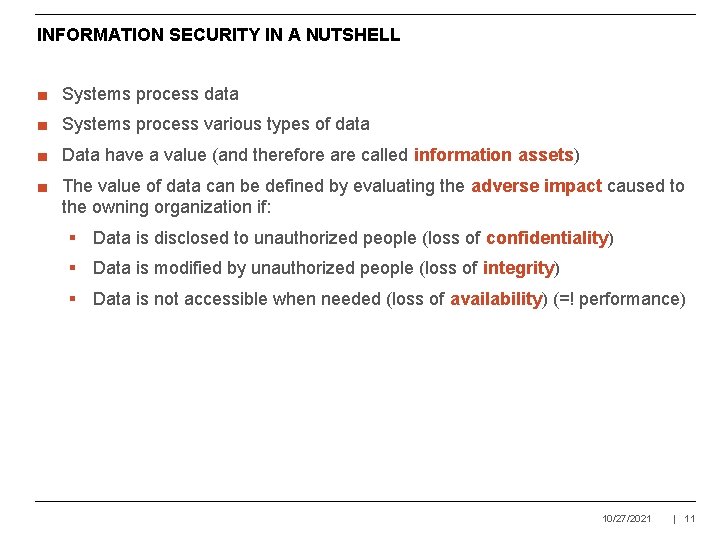
INFORMATION SECURITY IN A NUTSHELL ■ Systems process data ■ Systems process various types of data ■ Data have a value (and therefore are called information assets) ■ The value of data can be defined by evaluating the adverse impact caused to the owning organization if: § Data is disclosed to unauthorized people (loss of confidentiality) § Data is modified by unauthorized people (loss of integrity) § Data is not accessible when needed (loss of availability) (=! performance) 10/27/2021 | 11
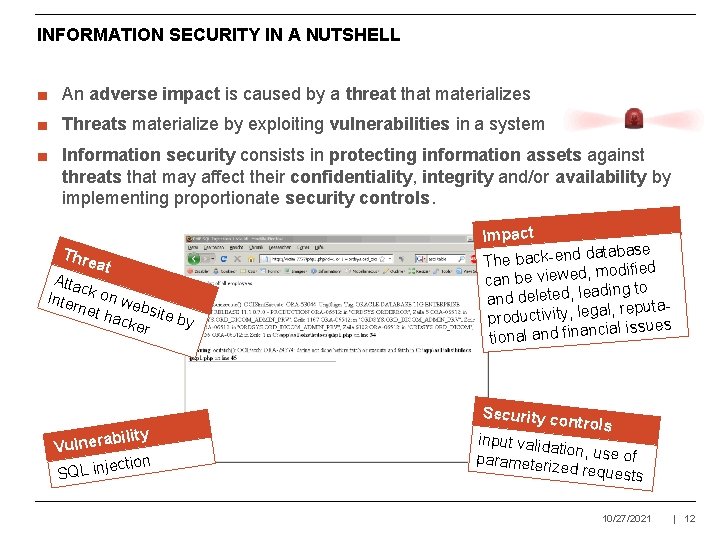
INFORMATION SECURITY IN A NUTSHELL ■ An adverse impact is caused by a threat that materializes ■ Threats materialize by exploiting vulnerabilities in a system ■ Information security consists in protecting information assets against threats that may affect their confidentiality, integrity and/or availability by implementing proportionate security controls. Thre at Atta c Inte k on we rnet b hack site by er bility a r e n l u V ction SQL inje Impact database The back-end , modified can be viewed ading to and deleted, le gal, reputale , y it v ti c u d ro p cial issues tional and finan Security c ontrols input valida tion, use of parameteriz ed requests 10/27/2021 | 12
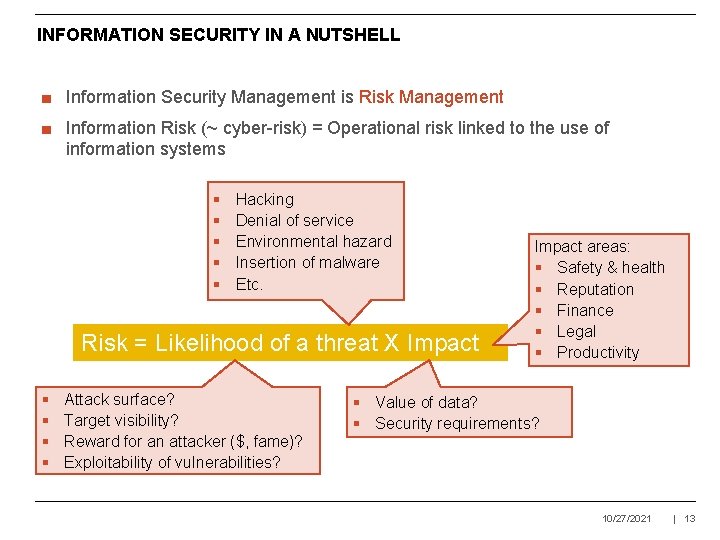
INFORMATION SECURITY IN A NUTSHELL ■ Information Security Management is Risk Management ■ Information Risk (~ cyber-risk) = Operational risk linked to the use of information systems § § § Hacking Denial of service Environmental hazard Insertion of malware Etc. Risk = Likelihood of a threat X Impact § § Attack surface? Target visibility? Reward for an attacker ($, fame)? Exploitability of vulnerabilities? Impact areas: § Safety & health § Reputation § Finance § Legal § Productivity § Value of data? § Security requirements? 10/27/2021 | 13
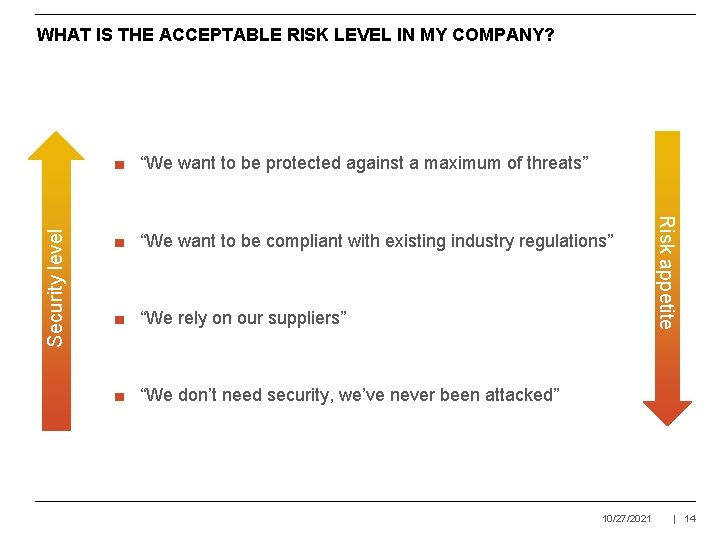
WHAT IS THE ACCEPTABLE RISK LEVEL IN MY COMPANY? ■ “We want to be compliant with existing industry regulations” ■ “We rely on our suppliers” Risk appetite Security level ■ “We want to be protected against a maximum of threats” ■ “We don’t need security, we’ve never been attacked” 10/27/2021 | 14
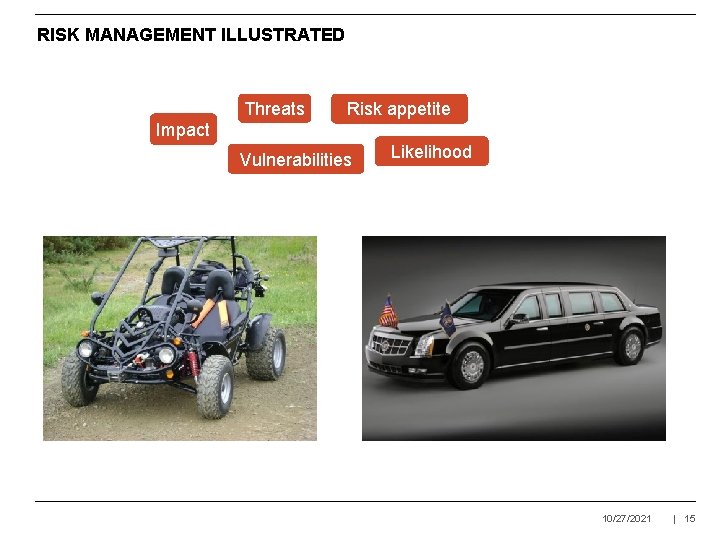
RISK MANAGEMENT ILLUSTRATED Threats Risk appetite Impact Vulnerabilities Likelihood 10/27/2021 | 15
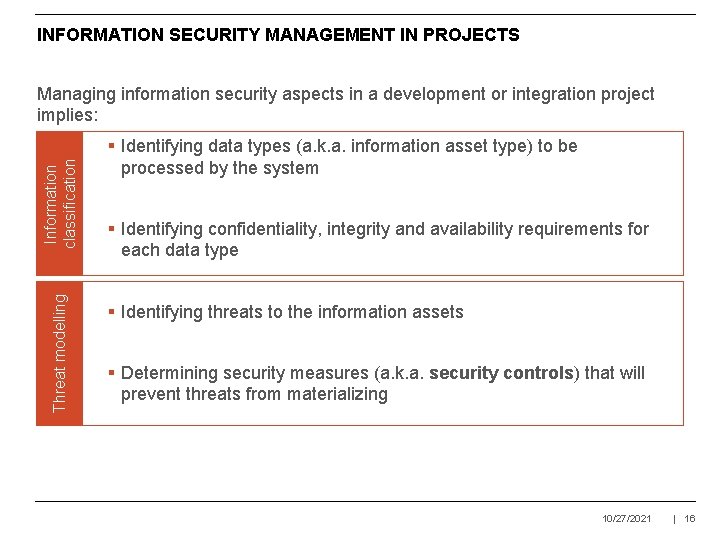
INFORMATION SECURITY MANAGEMENT IN PROJECTS Threat modelling Information classification Managing information security aspects in a development or integration project implies: § Identifying data types (a. k. a. information asset type) to be processed by the system § Identifying confidentiality, integrity and availability requirements for each data type § Identifying threats to the information assets § Determining security measures (a. k. a. security controls) that will prevent threats from materializing 10/27/2021 | 16
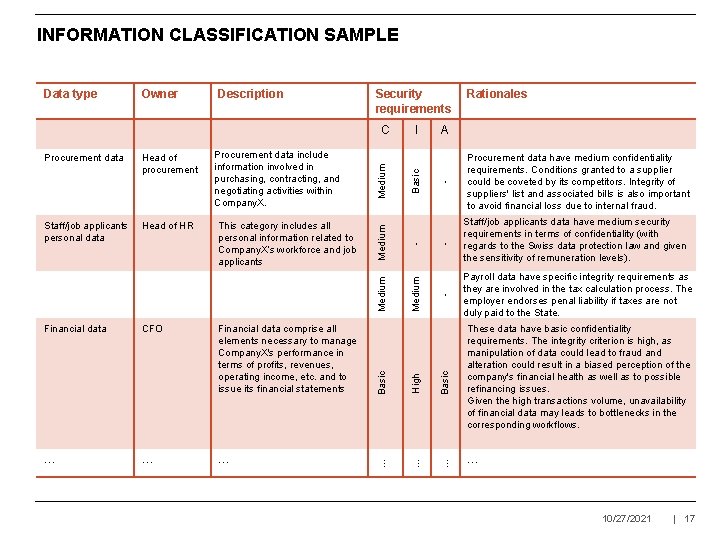
INFORMATION CLASSIFICATION SAMPLE Security requirements … … … - Procurement data have medium confidentiality requirements. Conditions granted to a supplier could be coveted by its competitors. Integrity of suppliers' list and associated bills is also important to avoid financial loss due to internal fraud. - Staff/job applicants data have medium security requirements in terms of confidentiality (with regards to the Swiss data protection law and given the sensitivity of remuneration levels). - Payroll data have specific integrity requirements as they are involved in the tax calculation process. The employer endorses penal liability if taxes are not duly paid to the State. Basic Financial data comprise all elements necessary to manage Company. X's performance in terms of profits, revenues, operating income, etc. and to issue its financial statements Basic CFO … Financial data Rationales A … This category includes all personal information related to Company. X’s workforce and job applicants Basic Head of HR I - Staff/job applicants personal data Procurement data include information involved in purchasing, contracting, and negotiating activities within Company. X. Medium Head of procurement Medium Procurement data Medium C Medium Description High Owner … Data type These data have basic confidentiality requirements. The integrity criterion is high, as manipulation of data could lead to fraud and alteration could result in a biased perception of the company's financial health as well as to possible refinancing issues. Given the high transactions volume, unavailability of financial data may leads to bottlenecks in the corresponding workflows. … 10/27/2021 | 17
AGENDA 1. Security challenges and common pitfalls in projects 2. Information security in a nutshell 3. Threat modelling explained 4. Case study 5. Questions 10/27/2021 | 18
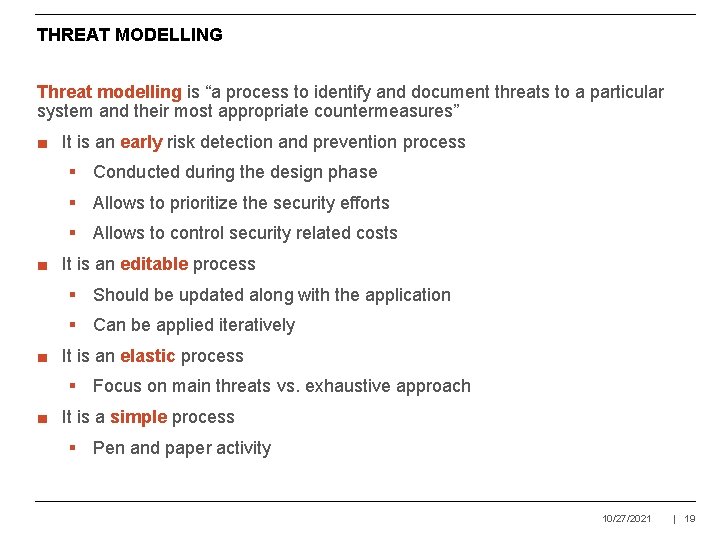
THREAT MODELLING Threat modelling is “a process to identify and document threats to a particular system and their most appropriate countermeasures” ■ It is an early risk detection and prevention process § Conducted during the design phase § Allows to prioritize the security efforts § Allows to control security related costs ■ It is an editable process § Should be updated along with the application § Can be applied iteratively ■ It is an elastic process § Focus on main threats vs. exhaustive approach ■ It is a simple process § Pen and paper activity 10/27/2021 | 19
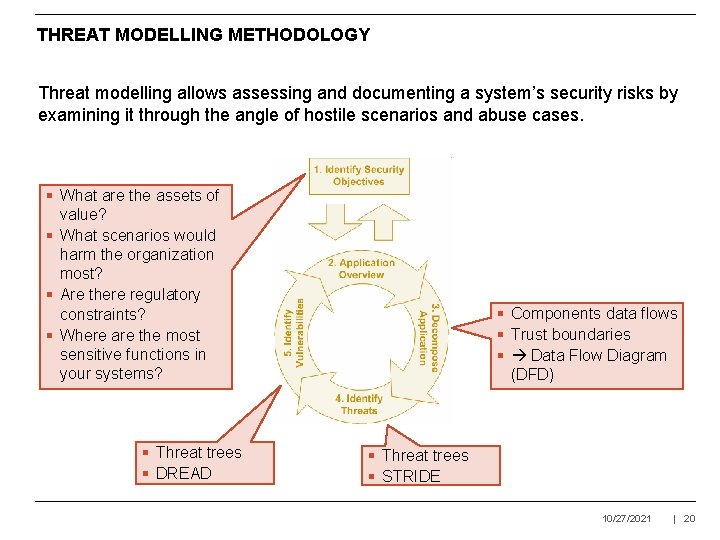
THREAT MODELLING METHODOLOGY Threat modelling allows assessing and documenting a system’s security risks by examining it through the angle of hostile scenarios and abuse cases. § What are the assets of value? § What scenarios would harm the organization most? § Are there regulatory constraints? § Where are the most sensitive functions in your systems? § Threat trees § DREAD § Components data flows § Trust boundaries § Data Flow Diagram (DFD) § Threat trees § STRIDE 10/27/2021 | 20
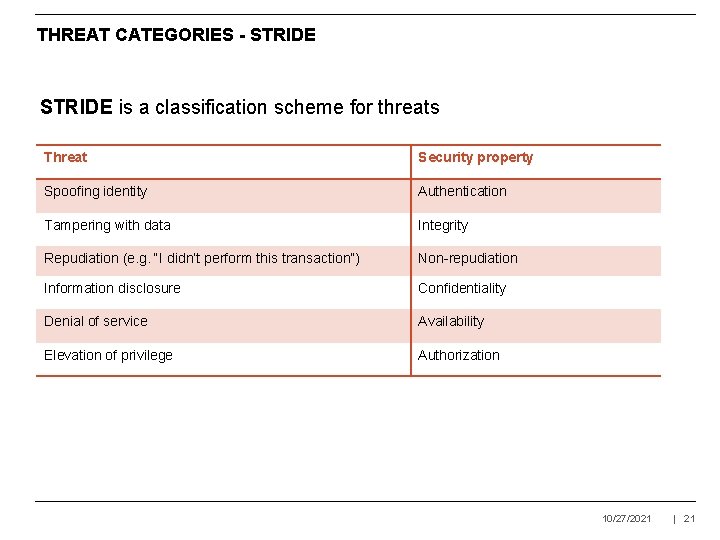
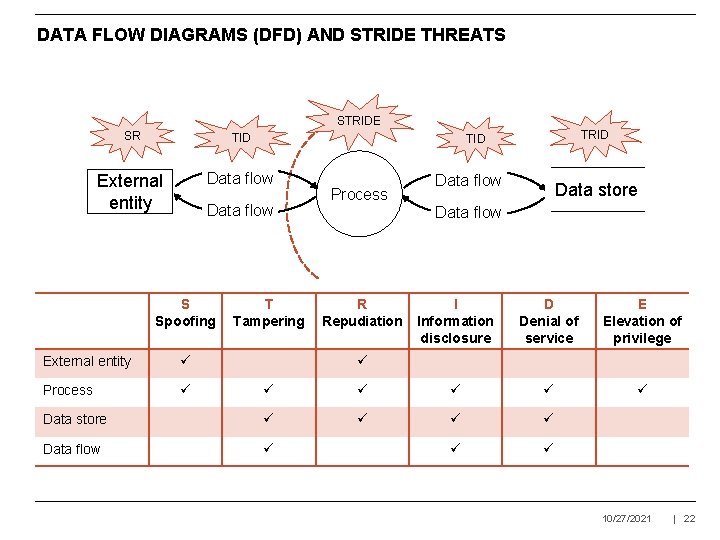
THREAT CATEGORIES - STRIDE is a classification scheme for threats Threat Security property Spoofing identity Authentication Tampering with data Integrity Repudiation (e. g. “I didn’t perform this transaction”) Non-repudiation Information disclosure Confidentiality Denial of service Availability Elevation of privilege Authorization 10/27/2021 | 21
DATA FLOW DIAGRAMS (DFD) AND STRIDE THREATS STRIDE SR TID External entity Data flow S Spoofing External entity Process TRID T Tampering Process Data flow Data store Data flow R Repudiation I Information disclosure D Denial of service E Elevation of privilege Data store Data flow 10/27/2021 | 22
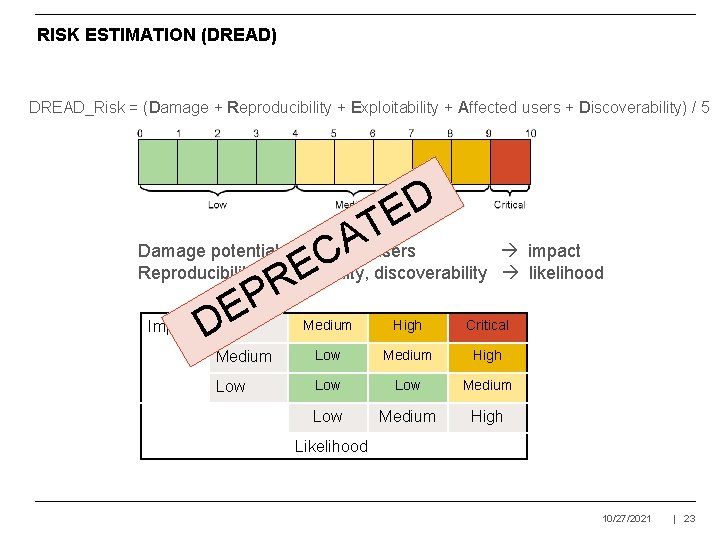
RISK ESTIMATION (DREAD) DREAD_Risk = (Damage + Reproducibility + Exploitability + Affected users + Discoverability) / 5 D E T A Damage potential & Affected users C discoverability Reproducibility, exploitability, E R P E Impact D High impact likelihood Medium High Critical Medium Low Medium High Low Low Medium High Likelihood 10/27/2021 | 23
AGENDA 1. Security challenges and common pitfalls in projects 2. Information security in a nutshell 3. Threat modelling explained 4. Case study 5. Questions 10/27/2021 | 24
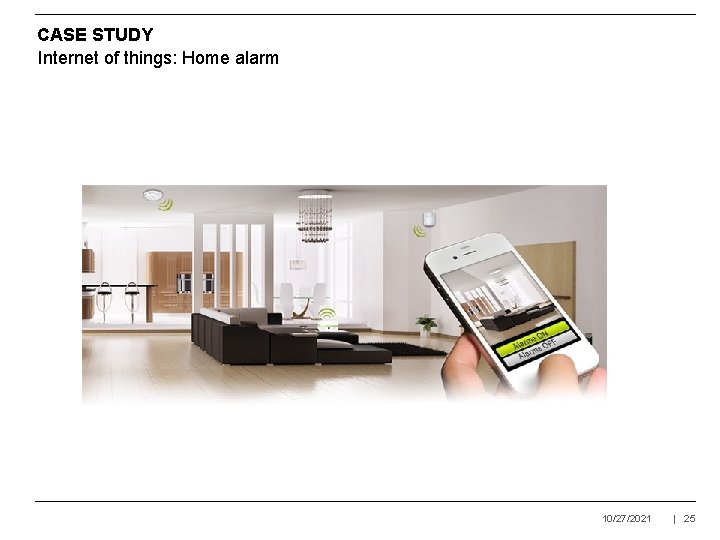
CASE STUDY Internet of things: Home alarm 10/27/2021 | 25
DATA FLOW DIAGRAM 10/27/2021 | 26
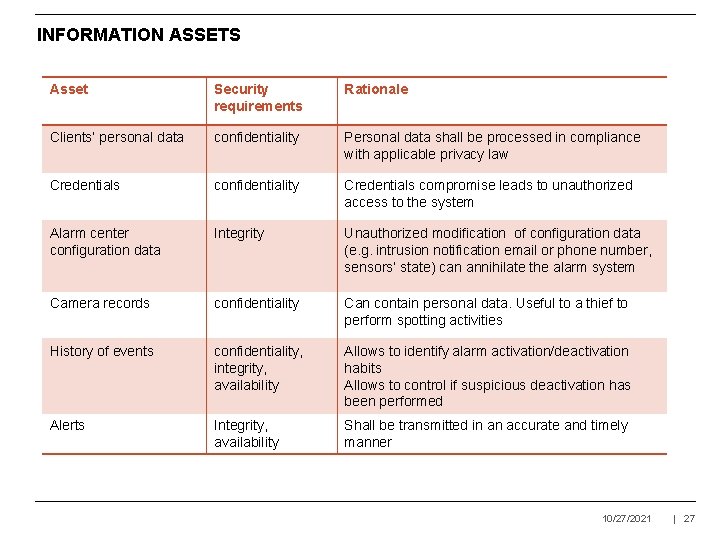
INFORMATION ASSETS Asset Security requirements Rationale Clients’ personal data confidentiality Personal data shall be processed in compliance with applicable privacy law Credentials confidentiality Credentials compromise leads to unauthorized access to the system Alarm center configuration data Integrity Unauthorized modification of configuration data (e. g. intrusion notification email or phone number, sensors’ state) can annihilate the alarm system Camera records confidentiality Can contain personal data. Useful to a thief to perform spotting activities History of events confidentiality, integrity, availability Allows to identify alarm activation/deactivation habits Allows to control if suspicious deactivation has been performed Alerts Integrity, availability Shall be transmitted in an accurate and timely manner 10/27/2021 | 27
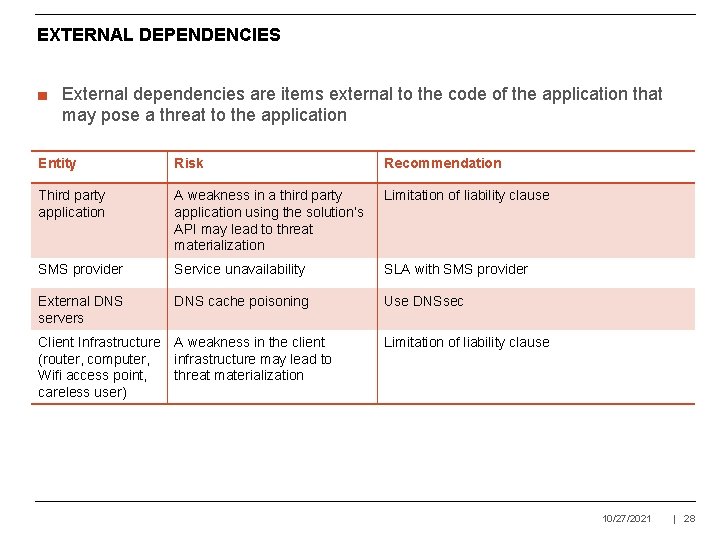
EXTERNAL DEPENDENCIES ■ External dependencies are items external to the code of the application that may pose a threat to the application Entity Risk Recommendation Third party application A weakness in a third party application using the solution’s API may lead to threat materialization Limitation of liability clause SMS provider Service unavailability SLA with SMS provider External DNS servers DNS cache poisoning Use DNSsec Client Infrastructure (router, computer, Wifi access point, careless user) A weakness in the client infrastructure may lead to threat materialization Limitation of liability clause 10/27/2021 | 28
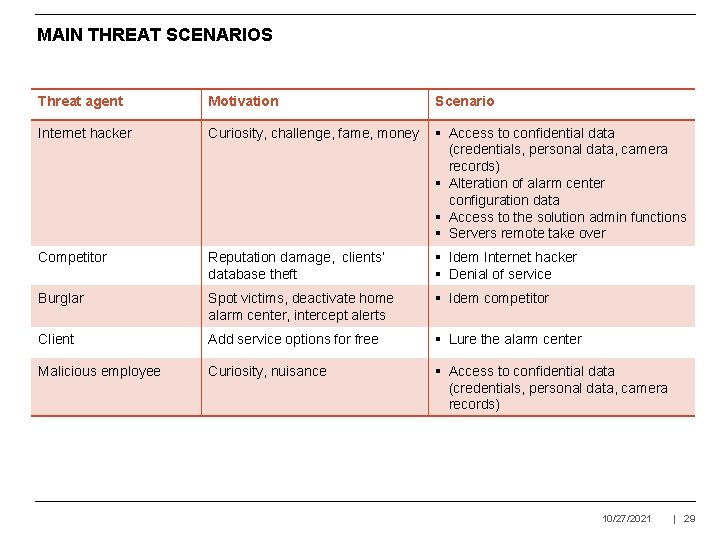
MAIN THREAT SCENARIOS Threat agent Motivation Scenario Internet hacker Curiosity, challenge, fame, money § Access to confidential data (credentials, personal data, camera records) § Alteration of alarm center configuration data § Access to the solution admin functions § Servers remote take over Competitor Reputation damage, clients’ database theft § Idem Internet hacker § Denial of service Burglar Spot victims, deactivate home alarm center, intercept alerts § Idem competitor Client Add service options for free § Lure the alarm center Malicious employee Curiosity, nuisance § Access to confidential data (credentials, personal data, camera records) 10/27/2021 | 29
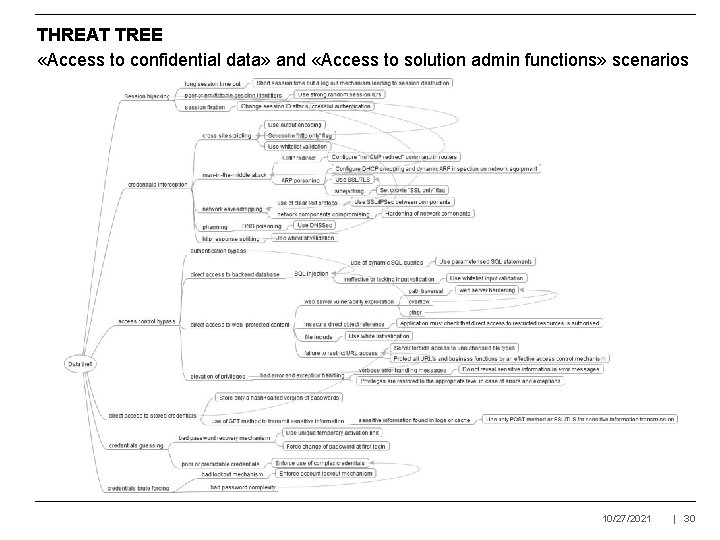
THREAT TREE «Access to confidential data» and «Access to solution admin functions» scenarios 10/27/2021 | 30
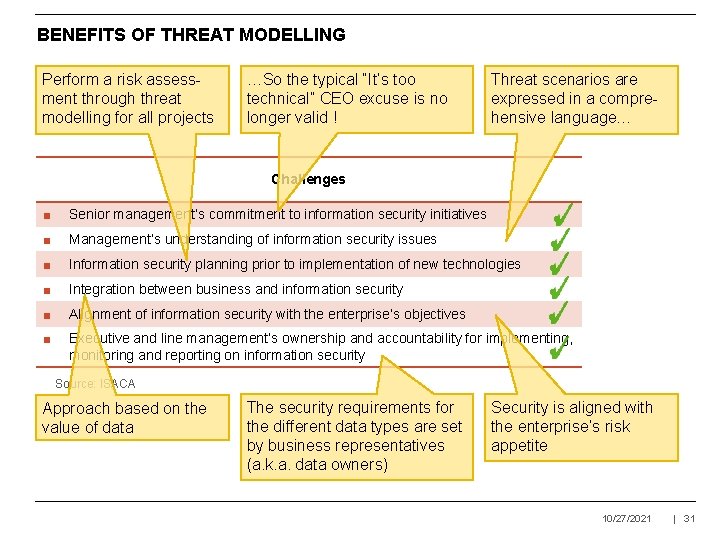
BENEFITS OF THREAT MODELLING Perform a risk assessment through threat modelling for all projects …So the typical “It’s too technical” CEO excuse is no longer valid ! Threat scenarios are expressed in a comprehensive language… Challenges ■ Senior management’s commitment to information security initiatives ■ Management’s understanding of information security issues ■ Information security planning prior to implementation of new technologies ■ Integration between business and information security ■ Alignment of information security with the enterprise’s objectives ■ Executive and line management’s ownership and accountability for implementing, monitoring and reporting on information security Source: ISACA Approach based on the value of data The security requirements for the different data types are set by business representatives (a. k. a. data owners) Security is aligned with the enterprise’s risk appetite 10/27/2021 | 31
AGENDA 1. Security challenges and common pitfalls in projects 2. Information security in a nutshell 3. Threat modelling explained 4. Case study 5. Questions 10/27/2021 | 32
QUESTIONS 10/27/2021 | 33