
Threads Today Why threads Thread model usage Implementing
- Slides: 22
Threads Today • • • Why threads Thread model & usage Implementing threads Scheduler activations Making single-threaded code multithreaded Next time • CPU Scheduling
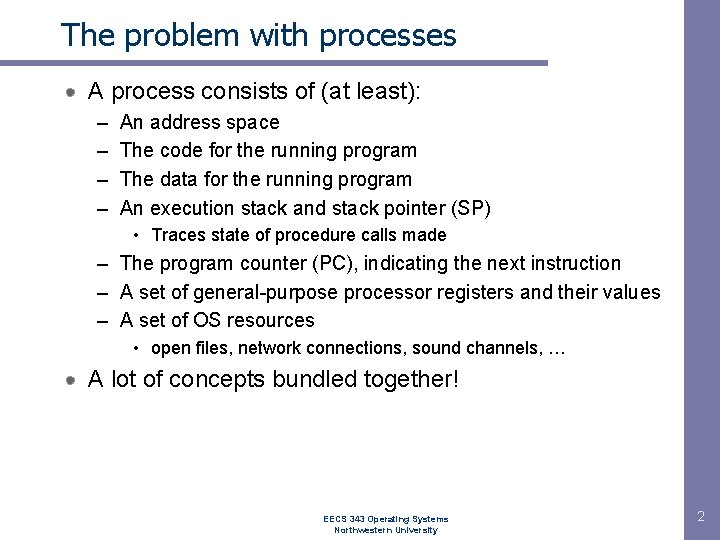
The problem with processes A process consists of (at least): – – An address space The code for the running program The data for the running program An execution stack and stack pointer (SP) • Traces state of procedure calls made – The program counter (PC), indicating the next instruction – A set of general-purpose processor registers and their values – A set of OS resources • open files, network connections, sound channels, … A lot of concepts bundled together! EECS 343 Operating Systems Northwestern University 2
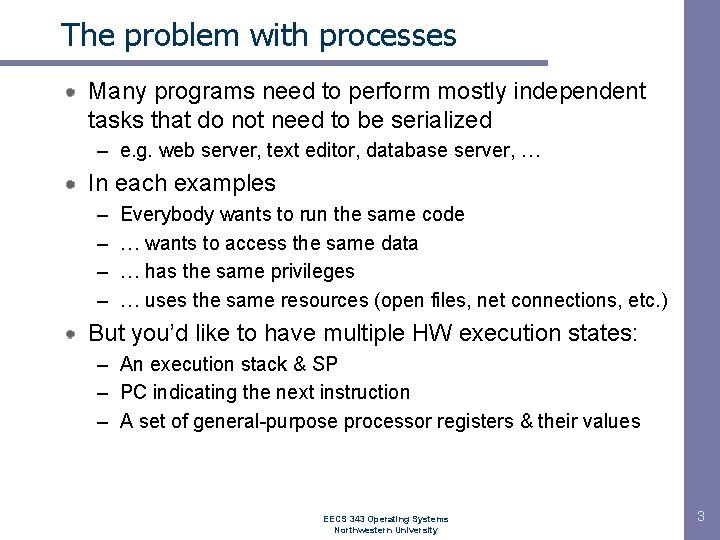
The problem with processes Many programs need to perform mostly independent tasks that do not need to be serialized – e. g. web server, text editor, database server, … In each examples – – Everybody wants to run the same code … wants to access the same data … has the same privileges … uses the same resources (open files, net connections, etc. ) But you’d like to have multiple HW execution states: – An execution stack & SP – PC indicating the next instruction – A set of general-purpose processor registers & their values EECS 343 Operating Systems Northwestern University 3
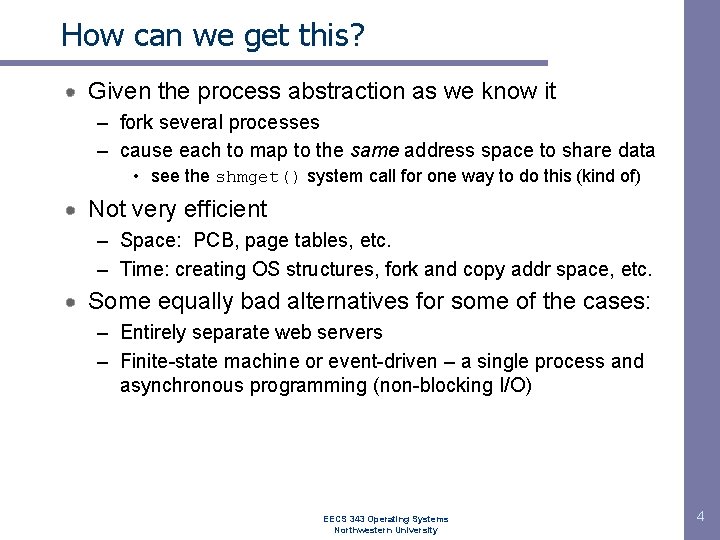
How can we get this? Given the process abstraction as we know it – fork several processes – cause each to map to the same address space to share data • see the shmget() system call for one way to do this (kind of) Not very efficient – Space: PCB, page tables, etc. – Time: creating OS structures, fork and copy addr space, etc. Some equally bad alternatives for some of the cases: – Entirely separate web servers – Finite-state machine or event-driven – a single process and asynchronous programming (non-blocking I/O) EECS 343 Operating Systems Northwestern University 4
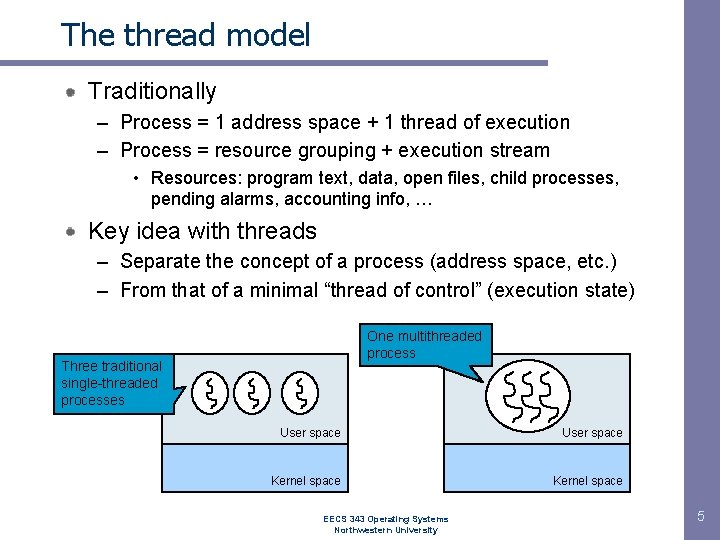
The thread model Traditionally – Process = 1 address space + 1 thread of execution – Process = resource grouping + execution stream • Resources: program text, data, open files, child processes, pending alarms, accounting info, … Key idea with threads – Separate the concept of a process (address space, etc. ) – From that of a minimal “thread of control” (execution state) One multithreaded process Three traditional single-threaded processes User space Kernel space EECS 343 Operating Systems Northwestern University 5
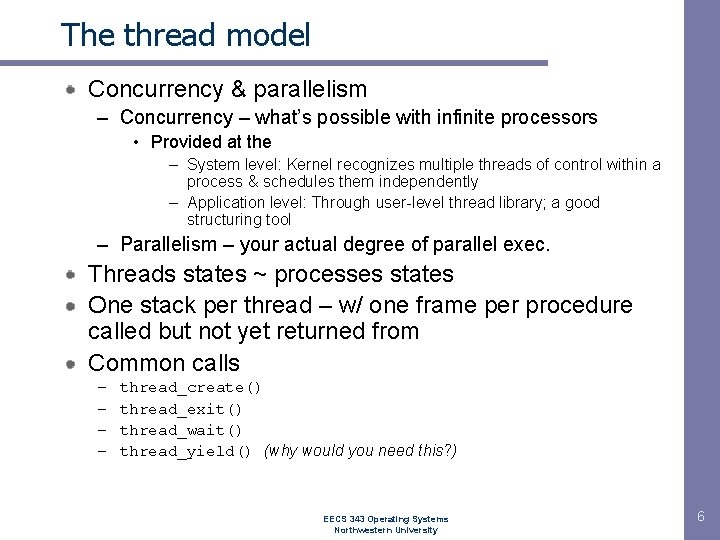
The thread model Concurrency & parallelism – Concurrency – what’s possible with infinite processors • Provided at the – System level: Kernel recognizes multiple threads of control within a process & schedules them independently – Application level: Through user-level thread library; a good structuring tool – Parallelism – your actual degree of parallel exec. Threads states ~ processes states One stack per thread – w/ one frame per procedure called but not yet returned from Common calls – – thread_create() thread_exit() thread_wait() thread_yield() (why would you need this? ) EECS 343 Operating Systems Northwestern University 6
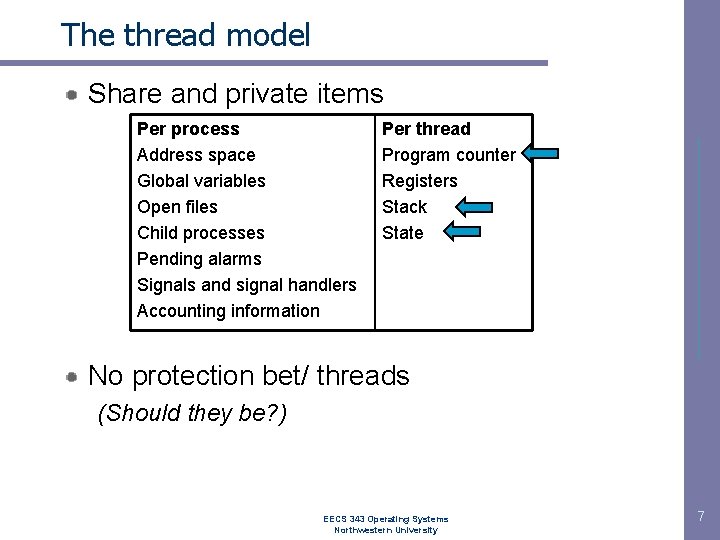
The thread model Share and private items Per process Address space Global variables Open files Child processes Pending alarms Signals and signal handlers Accounting information Per thread Program counter Registers Stack State No protection bet/ threads (Should they be? ) EECS 343 Operating Systems Northwestern University 7
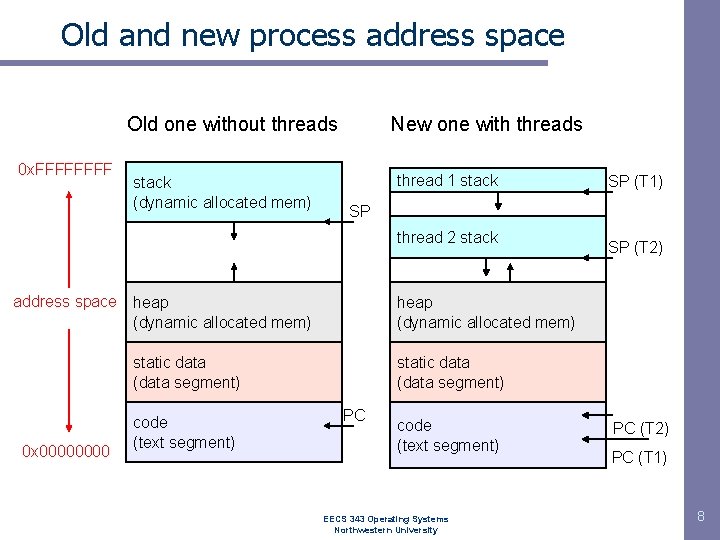
Old and new process address space Old one without threads 0 x. FFFF stack (dynamic allocated mem) New one with threads thread 1 stack SP thread 2 stack address space heap (dynamic allocated mem) 0 x 0000 SP (T 2) heap (dynamic allocated mem) static data (data segment) code (text segment) SP (T 1) static data (data segment) PC code (text segment) EECS 343 Operating Systems Northwestern University PC (T 2) PC (T 1) 8
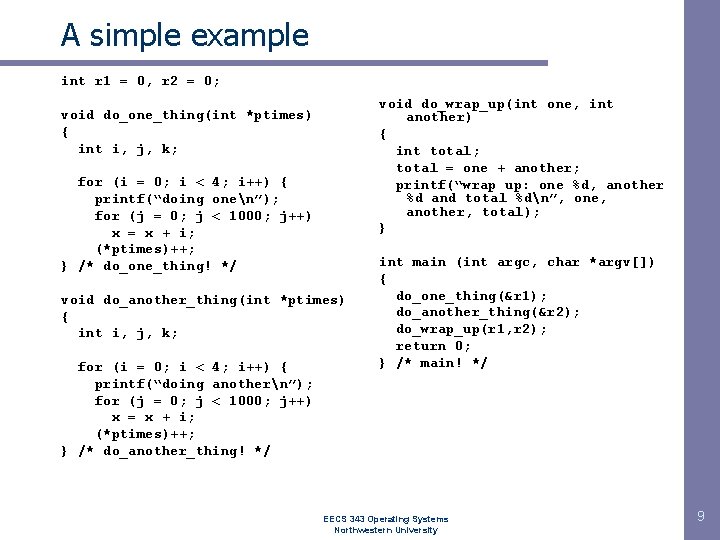
A simple example int r 1 = 0, r 2 = 0; void do_wrap_up(int one, int another) { int total; total = one + another; printf(“wrap up: one %d, another %d and total %dn”, one, another, total); } void do_one_thing(int *ptimes) { int i, j, k; for (i = 0; i < 4; i++) { printf(“doing onen”); for (j = 0; j < 1000; j++) x = x + i; (*ptimes)++; } /* do_one_thing! */ void do_another_thing(int *ptimes) { int i, j, k; for (i = 0; i < 4; i++) { printf(“doing anothern”); for (j = 0; j < 1000; j++) x = x + i; (*ptimes)++; } /* do_another_thing! */ int main (int argc, char *argv[]) { do_one_thing(&r 1); do_another_thing(&r 2); do_wrap_up(r 1, r 2); return 0; } /* main! */ EECS 343 Operating Systems Northwestern University 9
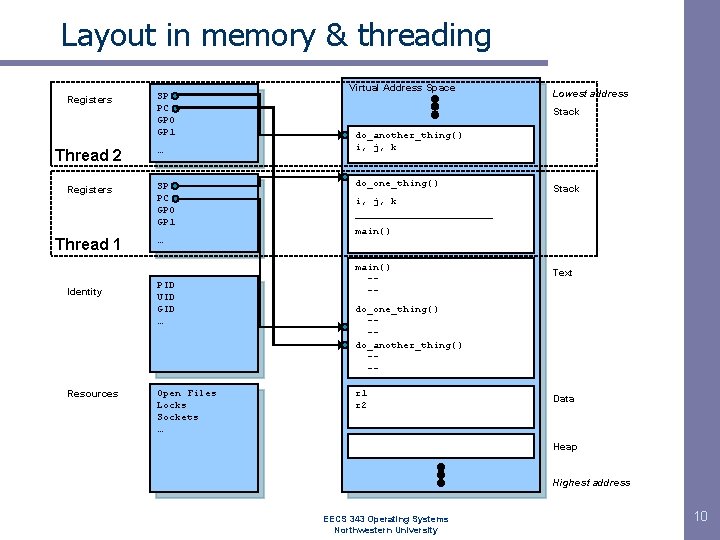
Layout in memory & threading Registers Thread 2 Registers Thread 1 Identity Resources SP PC GP 0 GP 1 … PID UID GID … Open Files Locks Sockets … Virtual Address Space Lowest address Stack do_another_thing() i, j, k do_one_thing() Stack i, j, k ____________ main() --- Text do_one_thing() --do_another_thing() --r 1 r 2 Data Heap Highest address EECS 343 Operating Systems Northwestern University 10
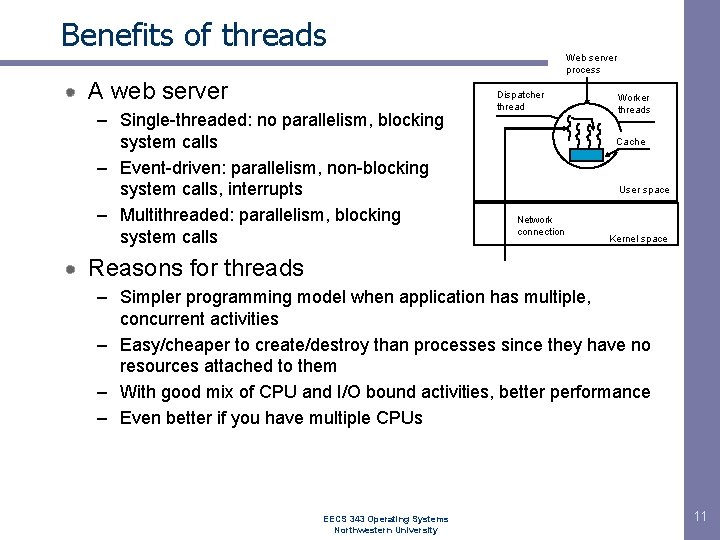
Benefits of threads Web server process A web server – Single-threaded: no parallelism, blocking system calls – Event-driven: parallelism, non-blocking system calls, interrupts – Multithreaded: parallelism, blocking system calls Dispatcher thread Worker threads Cache User space Network connection Kernel space Reasons for threads – Simpler programming model when application has multiple, concurrent activities – Easy/cheaper to create/destroy than processes since they have no resources attached to them – With good mix of CPU and I/O bound activities, better performance – Even better if you have multiple CPUs EECS 343 Operating Systems Northwestern University 11
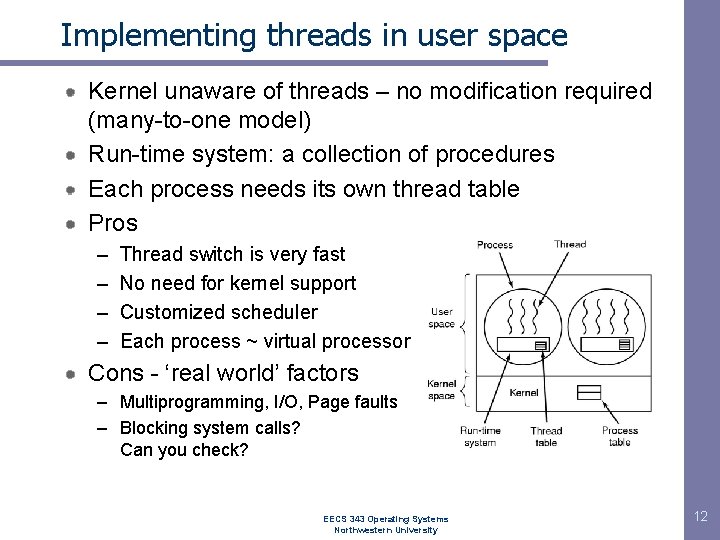
Implementing threads in user space Kernel unaware of threads – no modification required (many-to-one model) Run-time system: a collection of procedures Each process needs its own thread table Pros – – Thread switch is very fast No need for kernel support Customized scheduler Each process ~ virtual processor Cons - ‘real world’ factors – Multiprogramming, I/O, Page faults – Blocking system calls? Can you check? EECS 343 Operating Systems Northwestern University 12
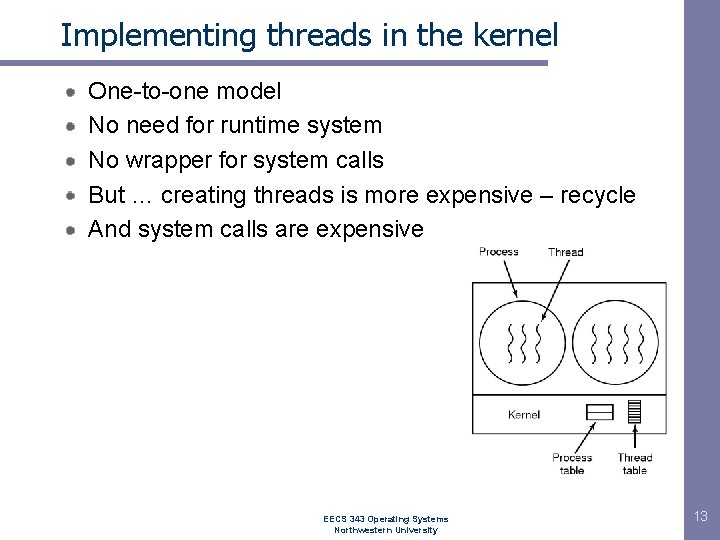
Implementing threads in the kernel One-to-one model No need for runtime system No wrapper for system calls But … creating threads is more expensive – recycle And system calls are expensive EECS 343 Operating Systems Northwestern University 13
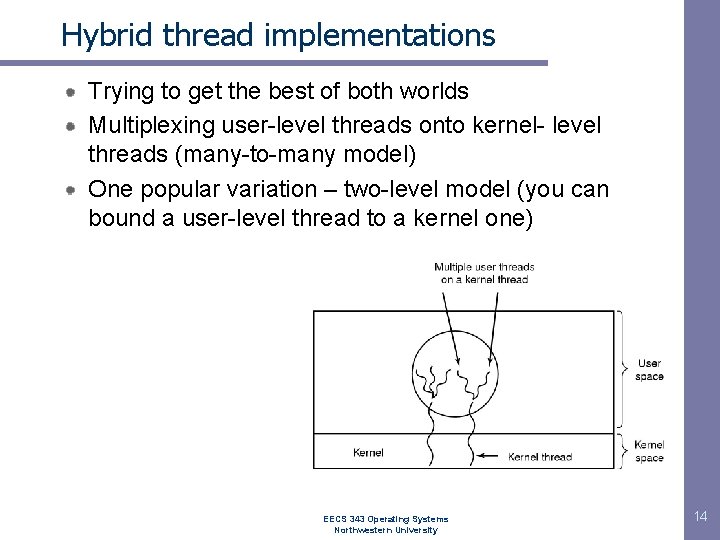
Hybrid thread implementations Trying to get the best of both worlds Multiplexing user-level threads onto kernel- level threads (many-to-many model) One popular variation – two-level model (you can bound a user-level thread to a kernel one) EECS 343 Operating Systems Northwestern University 14
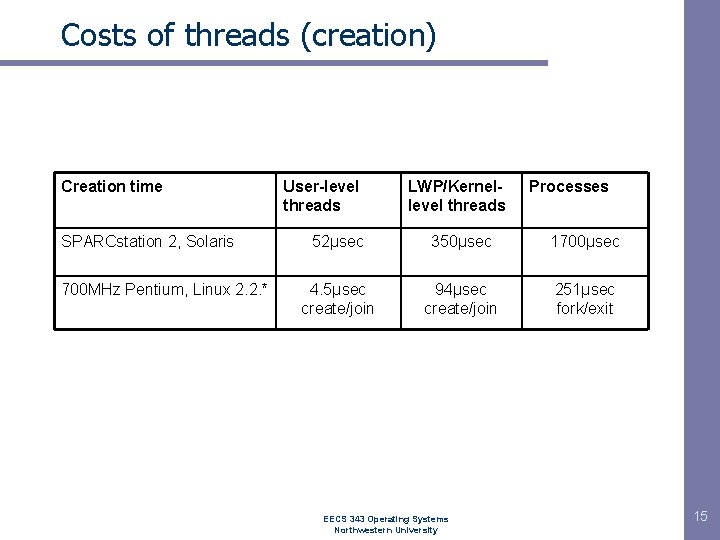
Costs of threads (creation) Creation time SPARCstation 2, Solaris 700 MHz Pentium, Linux 2. 2. * User-level threads LWP/Kernellevel threads Processes 52μsec 350μsec 1700μsec 4. 5μsec create/join 94μsec create/join 251μsec fork/exit EECS 343 Operating Systems Northwestern University 15
Scheduler activations* Goal – Functionality of kernel threads & – Performance of user-level threads – Without special non-blocking system calls Problem : needed control & scheduling information distributed bet/ kernel & each app’s address space Basic idea – When kernel finds out a thread is about to block, upcalls the runtime system (activates it at a known starting address) – When kernel finds out a thread can run again, upcalls again – Run-time system can now decide what to do Pros – fast & smart Cons – upcalls violate layering approach *Anderson et al. , “Scheduler Activations: effective Kernel Support for the User-level Management of Parallelism, ” SOSP, Oct. 1991. EECS 343 Operating Systems Northwestern University 16
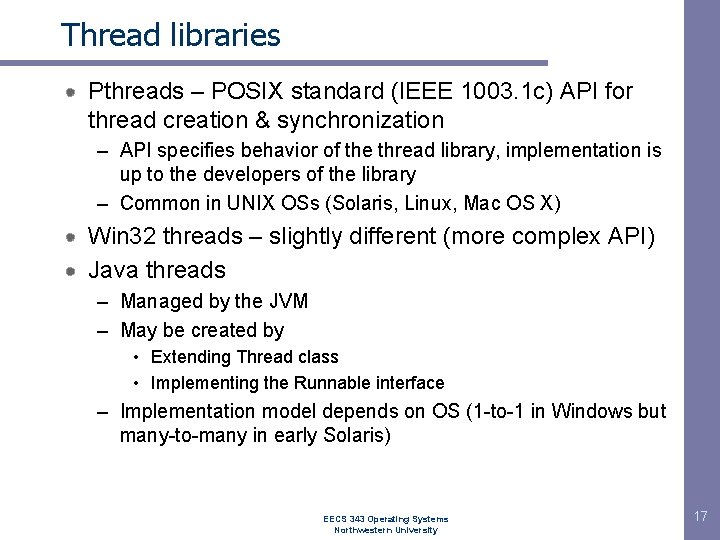
Thread libraries Pthreads – POSIX standard (IEEE 1003. 1 c) API for thread creation & synchronization – API specifies behavior of the thread library, implementation is up to the developers of the library – Common in UNIX OSs (Solaris, Linux, Mac OS X) Win 32 threads – slightly different (more complex API) Java threads – Managed by the JVM – May be created by • Extending Thread class • Implementing the Runnable interface – Implementation model depends on OS (1 -to-1 in Windows but many-to-many in early Solaris) EECS 343 Operating Systems Northwestern University 17
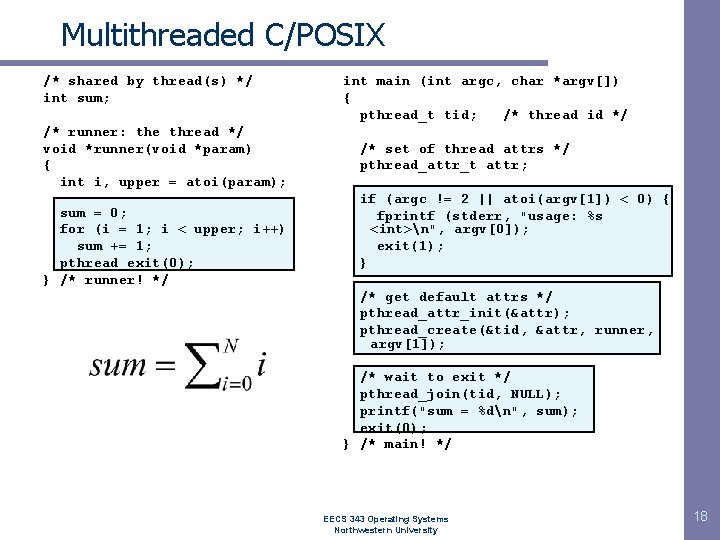
Multithreaded C/POSIX /* shared by thread(s) */ int sum; /* runner: the thread */ void *runner(void *param) { int i, upper = atoi(param); sum = 0; for (i = 1; i < upper; i++) sum += 1; pthread_exit(0); } /* runner! */ int main (int argc, char *argv[]) { pthread_t tid; /* thread id */ /* set of thread attrs */ pthread_attr_t attr; if (argc != 2 || atoi(argv[1]) < 0) { fprintf (stderr, "usage: %s <int>n", argv[0]); exit(1); } /* get default attrs */ pthread_attr_init(&attr); pthread_create(&tid, &attr, runner, argv[1]); /* wait to exit */ pthread_join(tid, NULL); printf("sum = %dn", sum); exit(0); } /* main! */ EECS 343 Operating Systems Northwestern University 18
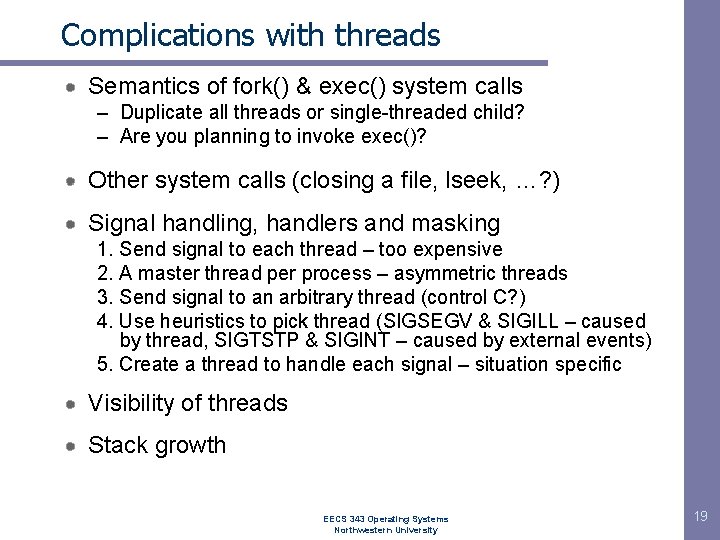
Complications with threads Semantics of fork() & exec() system calls – Duplicate all threads or single-threaded child? – Are you planning to invoke exec()? Other system calls (closing a file, lseek, …? ) Signal handling, handlers and masking 1. Send signal to each thread – too expensive 2. A master thread per process – asymmetric threads 3. Send signal to an arbitrary thread (control C? ) 4. Use heuristics to pick thread (SIGSEGV & SIGILL – caused by thread, SIGTSTP & SIGINT – caused by external events) 5. Create a thread to handle each signal – situation specific Visibility of threads Stack growth EECS 343 Operating Systems Northwestern University 19
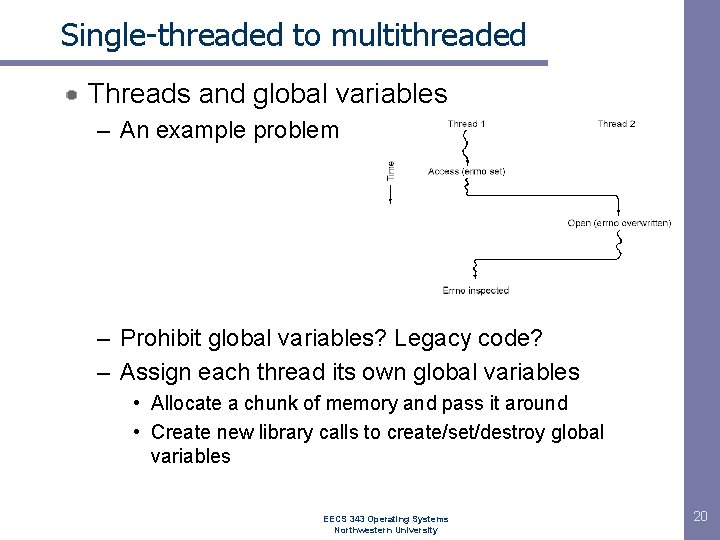
Single-threaded to multithreaded Threads and global variables – An example problem – Prohibit global variables? Legacy code? – Assign each thread its own global variables • Allocate a chunk of memory and pass it around • Create new library calls to create/set/destroy global variables EECS 343 Operating Systems Northwestern University 20
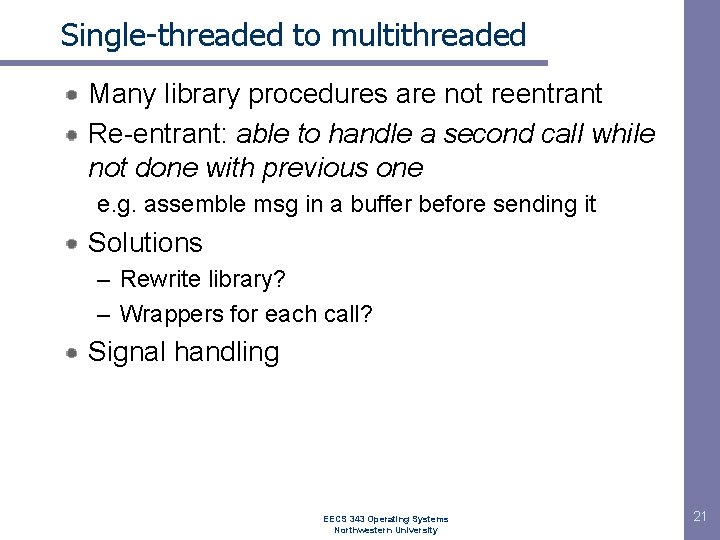
Single-threaded to multithreaded Many library procedures are not reentrant Re-entrant: able to handle a second call while not done with previous one e. g. assemble msg in a buffer before sending it Solutions – Rewrite library? – Wrappers for each call? Signal handling EECS 343 Operating Systems Northwestern University 21
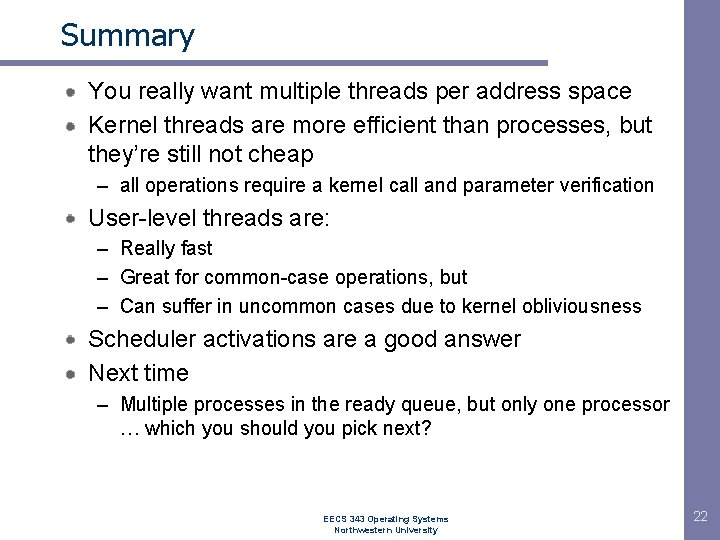
Summary You really want multiple threads per address space Kernel threads are more efficient than processes, but they’re still not cheap – all operations require a kernel call and parameter verification User-level threads are: – Really fast – Great for common-case operations, but – Can suffer in uncommon cases due to kernel obliviousness Scheduler activations are a good answer Next time – Multiple processes in the ready queue, but only one processor … which you should you pick next? EECS 343 Operating Systems Northwestern University 22