
Threads and screws Threads A thread is a
- Slides: 14
Threads and screws
Threads • A thread is a helical structure used to convert between rotary and linear movement or force. • Screws are the most common of all machine elements. A screwed connection is easy to assemble, and can be dis- and reassembled hundreds of times. http: //en. wikipedia. org/wiki/Screw_thread
Manufacturing threads • Threads are generally made by removing material from a cylinder, or less commonly, adding material onto a cylinder. • Threads can be made in many ways, including cutting, casting, forming, grinding, lapping and rolling. http: //en. wikipedia. org/wiki/Threading_(manuf acturing)
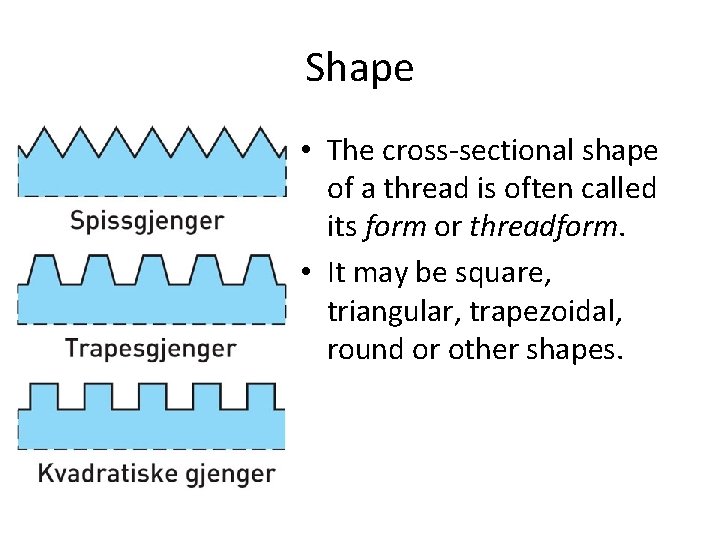
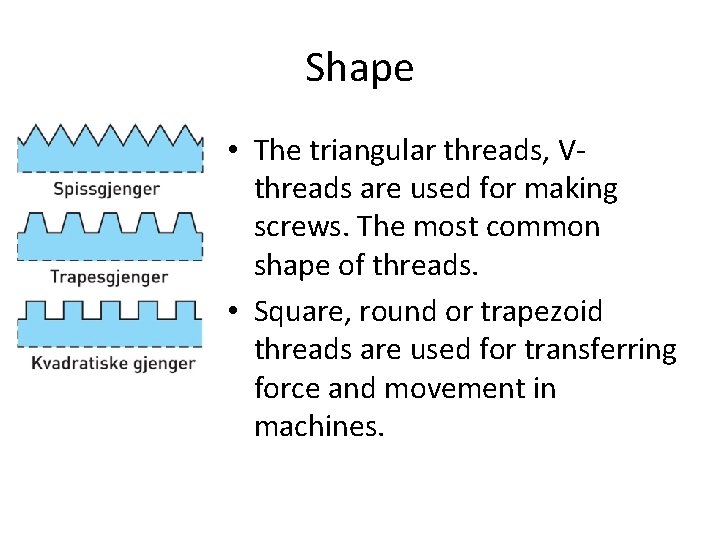
Shape • The cross-sectional shape of a thread is often called its form or threadform. • It may be square, triangular, trapezoidal, round or other shapes.
Shape • The triangular threads, Vthreads are used for making screws. The most common shape of threads. • Square, round or trapezoid threads are used for transferring force and movement in machines.
Handedness • The helix of a thread can twist in two possible directions. • Most threads are right-handed. The screw is tightened by turning it clockwise into the hole or nut. • For special applications, you need left-handed threads. For example when the rotation of a shaft would cause a conventional right-handed nut to loosen rather than to tighten due to fretting induced precession.
Angle • The angle characteristic of the cross-sectional shape is often called the thread angle. • For most V-threads, this is standardized as 60 degrees, but any angle can be used. • The thread angle for metric and unified threads is 60°. http: //en. wikipedia. org/wiki/Thread_angle
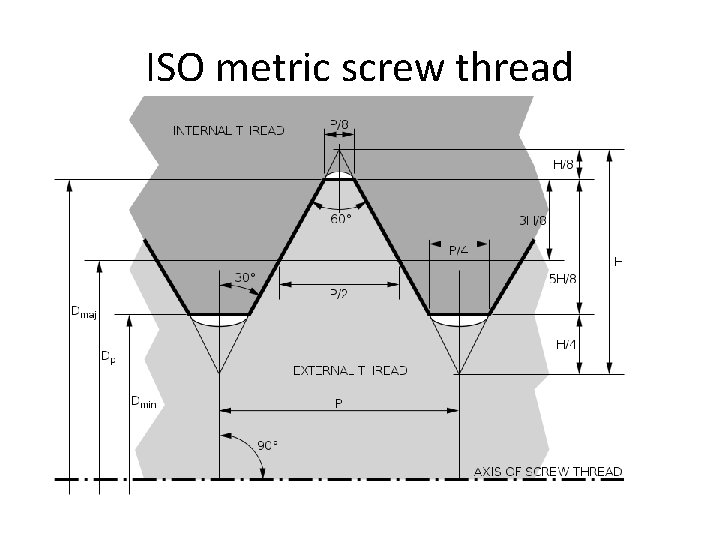
ISO metric screw threads • Metric threads are standardised by ISO. • Metric threads are classified by outer diameter and pitch. • The coarse metric thread (pitch is a standard “coarse” value) is designated by the letter M followed by the value of the nominal (outer) diameter: M 8 • http: //en. wikipedia. org/wiki/ISO_metric_scre w_thread
Fine metric threads • The fine metric thread is designated by the letter M followed by the value of the nominal diameter and the pitch: M 8 X 1, 25
ISO metric screw thread
Unified thread standard • The most common screw thread dimensioned in inches, used in USA and Canada. • Classified by outer diameter and pitch. • Pitch is measured in threads per inch. • Coarse threads, example: 9/16 -12 UNC • Fine threads, example: 9/16 -18 UNF • Also National Pipe Thread (NPT) http: //en. wikipedia. org/wiki/Unified_Thread_Stand ard
Other standards • • • British standard Whitworth British standard pipe thread British Association screw threads Power screw threads Many others
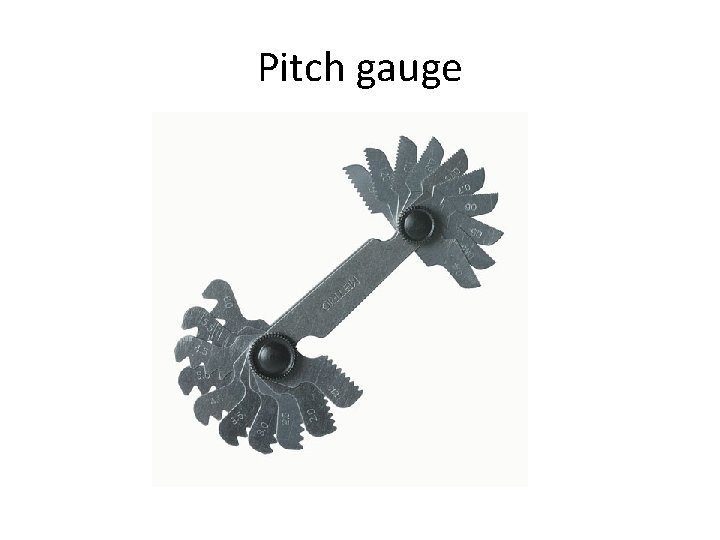
Measuring threads • If you do not know what size threads are, you will have to measure them. • You need to measure the major or minor diameter. Use caliper. • You also need to measure the pitch. Use pitch gauge.
Pitch gauge