
Thoughts and Rambles Journal An introduction to an
Thoughts and Rambles Journal An introduction to an invaluable tool for thinkers and non-thinkers alike (please don’t be a non-thinker…. our world is polluted with those!)
What’s the Purpose? This journal will be invaluable to you throughout the year, as it will be used for multiple tasks: • Obligatory “bell-ringer” assignments (although mine aren’t every day, and when assigned, they target something on the horizon for the class) • Personal reading log, particularly for highlighting observations and connections • Opportunity to vent and sharpen your ideas and beliefs (perhaps challenge some as well) • Practice with writing quickly and adeptly in this particular format
For my Returning Students (or to address rumors from earlier classes) • Yes, I have been slack on these types of assignments in the past…one of my primary goals for this year is to improve on this aspect of my teaching. Don’t gamble on this. • I am going to “assess” these assignments, but not traditionally, so make sure you stay caught up even if you don’t think I will check them, because I will (I know how I am going to do it, but I’m being purposefully vague). • You MUST do better about using in class time allotted for these assignments. I will deduct for those of you who choose to ignore this suggestion as has been the case in previous years (the ignoring the assignment, not the deducting part).
Pre-Class Warm-Ups • At various times during a week, I will give you a quote, picture, or question intended to generate some thought on a topic that will be upcoming. • You are expected to complete these with an appropriate and thoughtful response, not a brief sentence of generic nonsense. • I will often open class with a discussion on these warm-ups and I will ask you to share your responses, please don’t let me down!
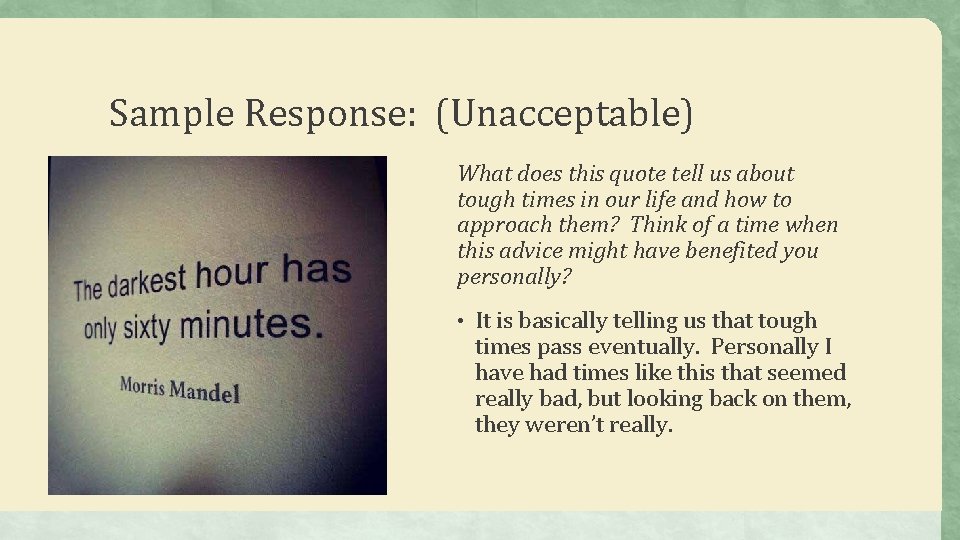
Sample Response: (Unacceptable) What does this quote tell us about tough times in our life and how to approach them? Think of a time when this advice might have benefited you personally? • It is basically telling us that tough times pass eventually. Personally I have had times like this that seemed really bad, but looking back on them, they weren’t really.
What was wrong with that? • Length: WAY too short (you should write a strong paragraph of 6 -8 sentences…this is to provide practice with expanding on ideas) • Interpretation: While this is a valid interpretation, it overly simplifies the concept, a major problem in all of my courses (remember, this isn’t math class, we aren’t trying to simplify to the smallest possible response). • Connection: There is no specificity in this response, it just indicates that the writer has been through bad times that passed…nothing that would make your response unique. You need to have unique responses!
Sample response (Acceptable): • This quote points out something that we all know but ignore when we are in the midst of struggles, that being that no matter how bad things may get, they will almost always pass. The writer uses a common image of an hour to show us this, because no matter how it may seem, every hour has the same amount of minutes, 60, inside it. No matter how great or miserable that hour may be, it will end. This is helpful for people like myself who have had to struggle, particularly financially. I went through a 3 month period of unemployment after college which was easily one of the darkest of my life considering I have worked ever since I was 15. During that time, I thought I would never find a job and ended up eventually having to settle for a job that was not what I intended (a butcher with an English degree? ), but it ended up being a very positive experience that taught me a lot about humility.
What’s the difference in those responses? • Length: Umm…. that one is obvious, right? Massive difference, right? By the way, it took about 5 minutes to write that while being distracted by the TV. You can produce quality in the time provided, I promise. • Interpretation: The interpretation is not much different than the previous response, but it is worded in a way that builds on the quote, not in a way that reduces it. • Connection: The connection provides a specific example from the life of the writer (true story for the record) that shows that the writer understands the point of the quote and shows reflection, not just repetition.
Personal Reading Log • When reading at home, something that is a bigger part of this course now, it is important to read with a highlighter and a notebook, something that the best readers do when reading for academic purposes. • What you highlight is your business (although I will provide some guidance), but your reading log is definitely my business. I would like you to include basic summary notes, questions you develop while reading, and connections you make to your own life or other works (even if it is a song or a tv show). • Initially you will have a very strict structure for this, but the reigns will be loosened when I see you are doing well with this.
Reading Excerpt: And as I sat there brooding on the old, unknown world, I thought of Gatsby's wonder when he first picked out the green light at the end of Daisy's dock. He had come a long way to this blue lawn, and his dream must have seemed so close that he could hardly fail to grasp it. He did not know that it was already behind him, somewhere back in that vast obscurity beyond the city, where the dark fields of the republic rolled on under the night. Gatsby believed in the green light, the orgastic future that year by year recedes before us. It eluded us then, but that's no matter—to-morrow we will run faster, stretch out our arms farther. . And one fine morning… So we beat on, boats against the current, borne back ceaselessly into the past.
• Summary: Nick is reminiscing about the thing that led to Gatsby’s downfall, his desire to recapture the past, a past that is uncapturable. Nick shifts from a third person pronoun, “he” and starts referring to “us” in the final sentences, indicating that this desire to attain a former state of things is a problem we all struggle with, and that it will meet with equally fruitless results (hopefully not death by bullet in a pool, though!). • Questions: - Is this a happy ending to the story? Do these final lines paint Gatsby as a tragic hero? Will Nick’s way of living alter based on this? Why the weird trailing off in the next to last paragraph? The very metaphorical final statement…what “hope” does it present readers? • Connections: - Fitzgerald seems to allude to a desire to capture the past, a problem that we all realize is pointless, but still proceed to seek after regardless. When looking at adults who “peaked in high school”, it is obvious that this is the case. Nothing is sadder than seeing a 40 year old, balding, fat guy trying to squeeze into his varsity football jacket and reliving his former glory days a la Al Bundy or Hank Hill.
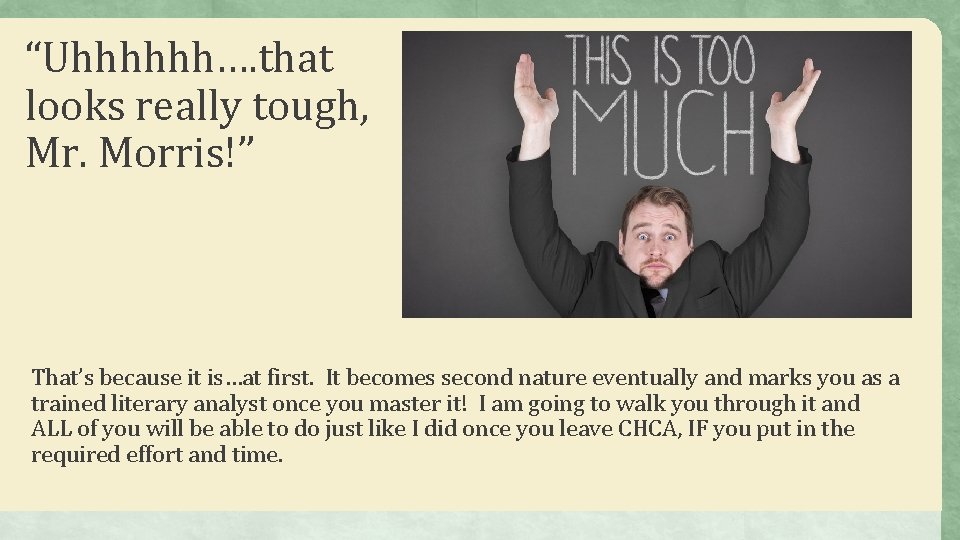
“Uhhhhhh…. that looks really tough, Mr. Morris!” That’s because it is…at first. It becomes second nature eventually and marks you as a trained literary analyst once you master it! I am going to walk you through it and ALL of you will be able to do just like I did once you leave CHCA, IF you put in the required effort and time.
“Friday” Free Rant • There will be certain days where we will have classroom disruptions. We might have a lot of student’s out for various reasons, or shortened classes for an assembly of sorts. Perhaps it is the last day before a break, and attempting another assignment would be as fruitless as Gatsby’s reach for the past! In these instances, we will practice a personal favorite of mine, the free rant (because in the immortal words of Ice Cube from Fist Fight, there are no free periods in my class!). • This is designed to get you better at two things, both of which are integral parts of college (one which is useful in the real world): • Timed writings • Discussion techniques
• Usually, you will be given about 20 minutes to write all you can about something that irritates you…I might give you a generic topic, but chances are that I will open it up for anything. • Your only goal during this time is to keep writing and try to find a way to generate discussion through your writing. You WILL NOT stop after a few minutes, you will use the entire time. • Afterwards, at random, students will be chosen to present their rant, and then we will open the class up for discussion. We will practice listening and responding during this time as well as hopefully learning about other opinions. • This can get a little crazy at times, but I want to remind you all that opinions are like armpits…we all have them (and often they stink). We are going to allow for all people to have a voice in my class. That being said, I hold the gavel and can end discussion when I feel it is becoming inappropriate for the environment of a Christian school.
When did our culture decide that music stores are no longer needed? At what point did the process of going to the CD store looking through the stacks of amazingly well-packaged albums with artwork going from puzzling to frightening with a mere few flips become cumbersome? Who decided that being able to discuss musical choices with complete strangers was unnecessary and should be replaced with downloading music suggested by your computer through Apple Music or Spotify? To me, a child of the 80 s and teen of the 90 s, this is completely repulsive. I use to love being able to hold CDs and look at the artwork for hours trying to pick something that was going to be on heavy rotation in my car for at least the next week. I would finally pick up my chosen record, purchase it and then listen to each track carefully analyzing the vocal stylings and guitar solos as if I was a critic for Rolling Stone. Now I have to sign on to Apple Music, let it guide me (since I can’t randomly browse CDs) and then purchase the album on Amazon for more than it would have previously cost me in store. I rarely listen as closely to my music, because it is sensory overload with millions of options in front of me. In my opinion, this shift has not opened the door for people to love more musicians and bands, it has closed the door on really learning about the music we “love” and reducing us to a bunch of pick and choose singles listeners who rarely listen to a full song, let alone an entire album. Oh big music stores, how I miss you and the way you guided me through my love of hair metal and hatred of grunge…you will be missed (Thank God there are 5 stores in the mall dedicated to hats, though…I guess we needed that garbage!)
In Summary… • Your journal is probably the most important thing you will have for my class. You need to have it daily. • If you are doing this right, I would consider having a new one for each quarter (I could easily fill one each quarter). • These are important artifacts of your sophomore / senior years (just like Mrs. Greenough’s journals can be a window into your freshman / junior years). Take them serious, and store them away after you finish, it is amazing to look back on them later in life and laugh at yourself. • Take these serious for the sake of improving your abilities at communicating, something most adults can’t do well…
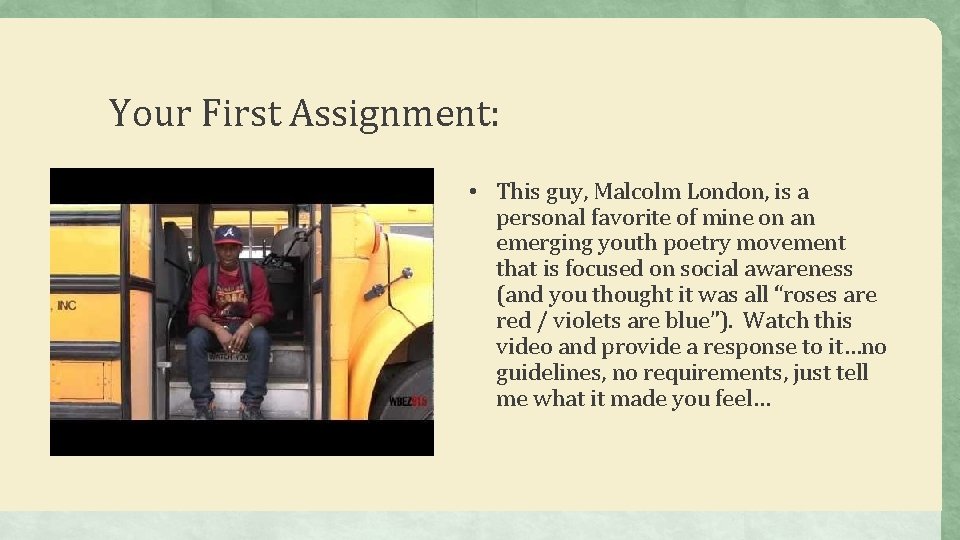
Your First Assignment: • This guy, Malcolm London, is a personal favorite of mine on an emerging youth poetry movement that is focused on social awareness (and you thought it was all “roses are red / violets are blue”). Watch this video and provide a response to it…no guidelines, no requirements, just tell me what it made you feel…
- Slides: 17