
Thought questions Why are sound waves able to
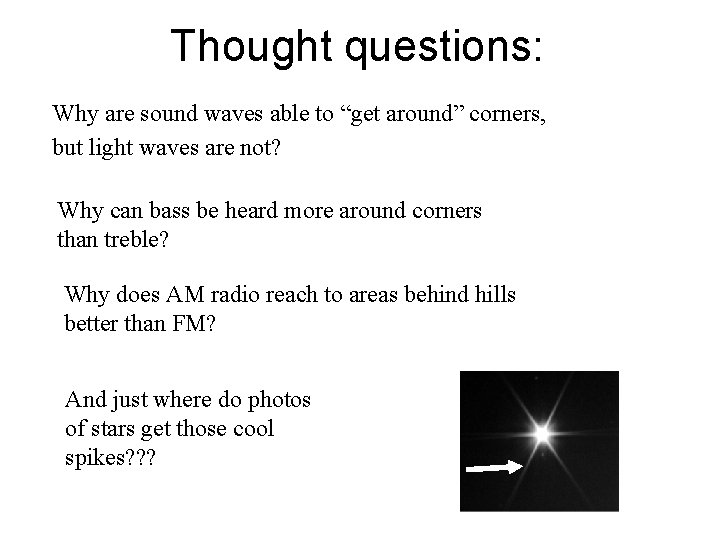
Thought questions: Why are sound waves able to “get around” corners, but light waves are not? Why can bass be heard more around corners than treble? Why does AM radio reach to areas behind hills better than FM? And just where do photos of stars get those cool spikes? ? ?
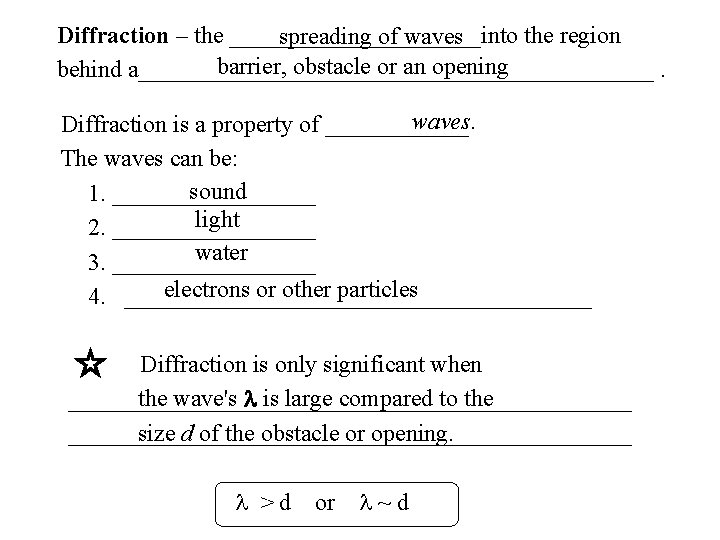
Diffraction – the ___________into the region spreading of waves barrier, obstacle or an opening behind a______________________. waves. Diffraction is a property of ______ The waves can be: sound 1. _________ light 2. _________ water 3. _________ electrons or other particles 4. ____________________ Diffraction is only significant when the wave's l is large compared to the ________________________ size d of the obstacle or opening. ________________________ l >d or l~d
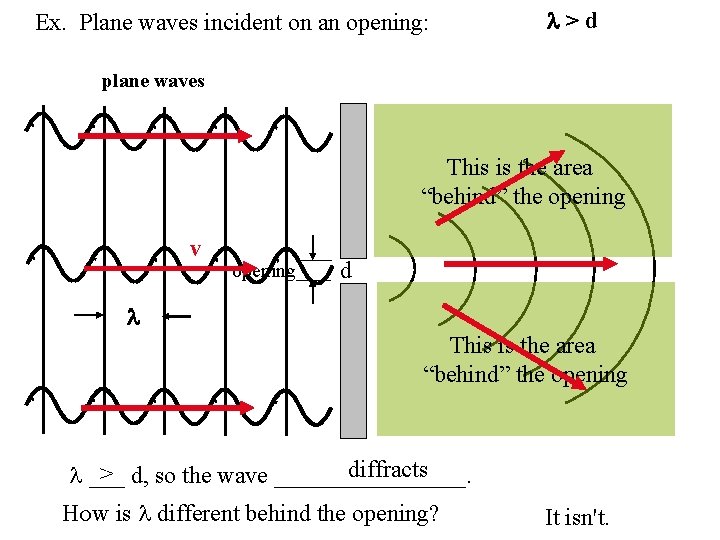
Ex. Plane waves incident on an opening: l>d plane waves This is the area “behind” the opening v opening d l This is the area “behind” the opening diffracts > d, so the wave ________. l ___ How is l different behind the opening? It isn't.
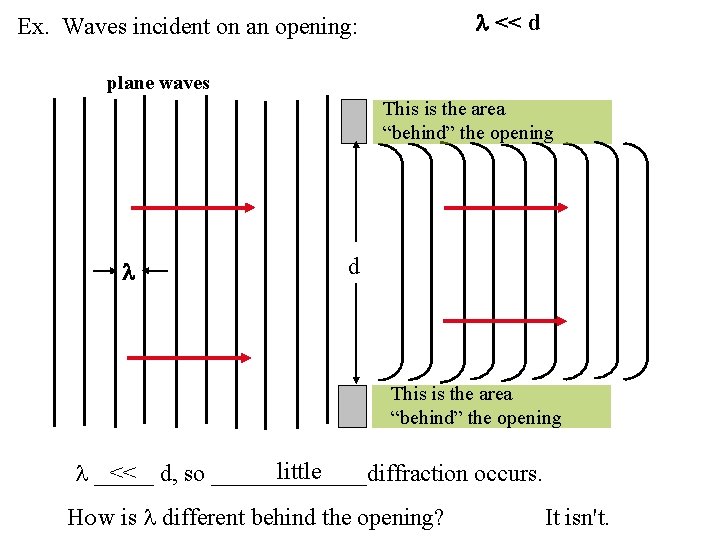
l << d Ex. Waves incident on an opening: plane waves This is the area “behind” the opening l d This is the area “behind” the opening little << d, so _______diffraction l _____ occurs. How is l different behind the opening? It isn't.

obstacle around a corner Ex. Plane waves diffracting ____________ area behind obstacle diffracted waves

Which example shows diffraction? l ____ << d A no obstacle bending Shadow of into shadow d l ~ d _______ l __ diffraction B d l into Shadowbending of obstacle shadow
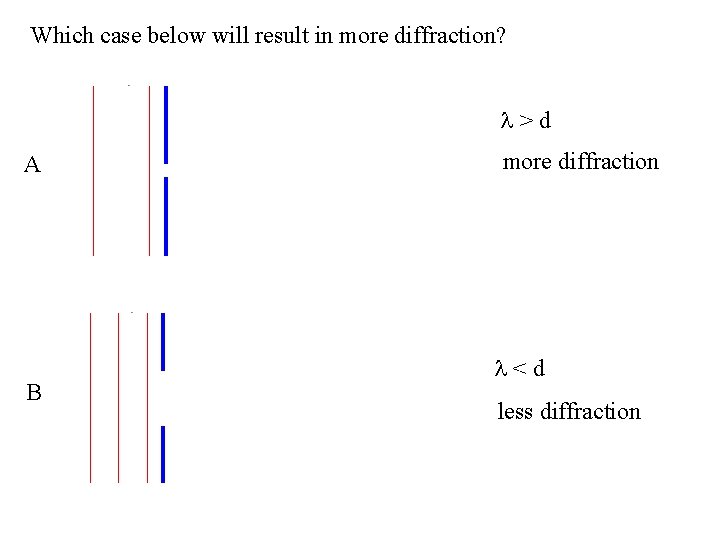
Which case below will result in more diffraction? l>d A B more diffraction l<d less diffraction
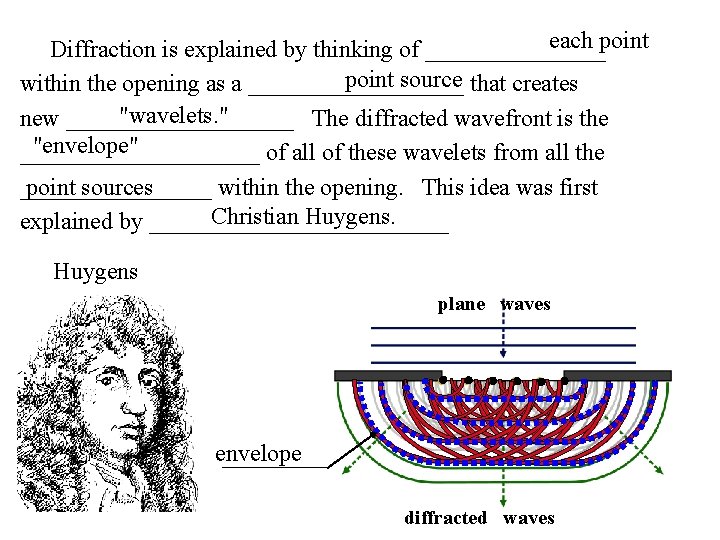
each point Diffraction is explained by thinking of ________ point source that creates within the opening as a _________ "wavelets. " new __________ The diffracted wavefront is the "envelope" __________ of all of these wavelets from all the ________ within the opening. This idea was first point sources Christian Huygens. explained by _____________ Huygens plane waves envelope diffracted waves

diffraction through an opening…
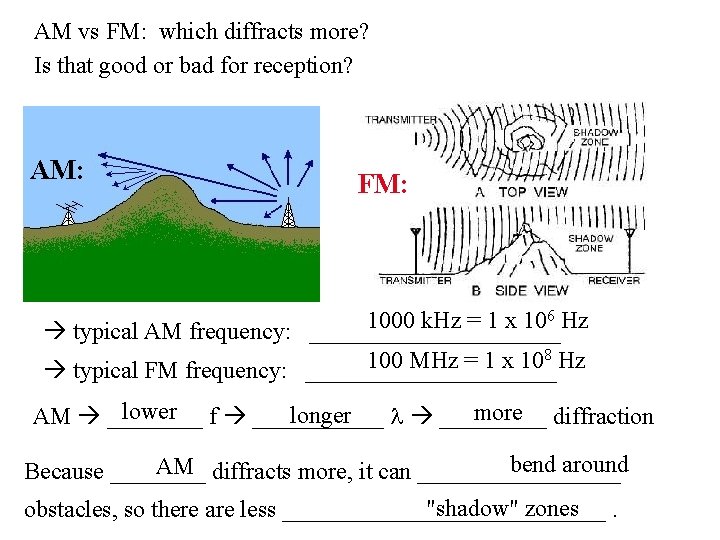
AM vs FM: which diffracts more? Is that good or bad for reception? AM: FM: 6 Hz 1000 k. Hz = 1 x 10 typical AM frequency: ___________ 8 Hz 100 MHz = 1 x 10 typical FM frequency: ___________ lower f ______ more diffraction longer AM ____ l _____ bend around AM diffracts more, it can _________ Because ____ "shadow" zones. obstacles, so there are less ______________
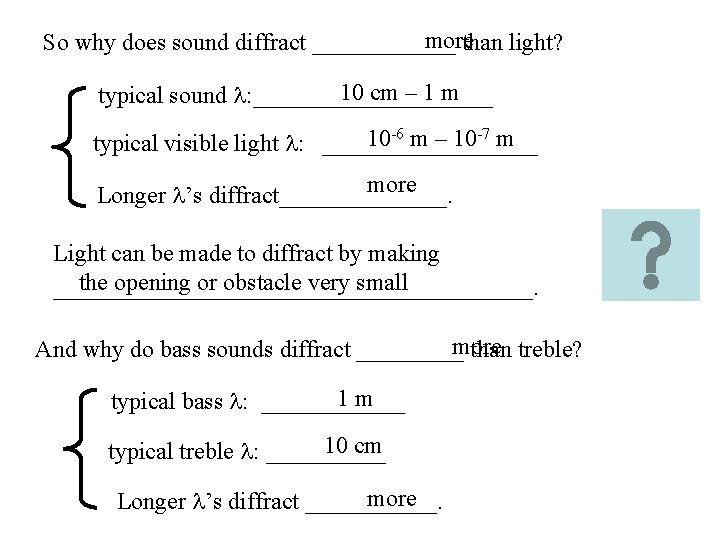
more So why does sound diffract ______ than light? 10 cm – 1 m typical sound l: __________ 10 -6 m – 10 -7 m typical visible light l: _________ more Longer l’s diffract_______. Light can be made to diffract by making the opening or obstacle very small ____________________. more And why do bass sounds diffract _____ than treble? 1 m typical bass l: ______ 10 cm typical treble l: _____ more Longer l’s diffract ______.
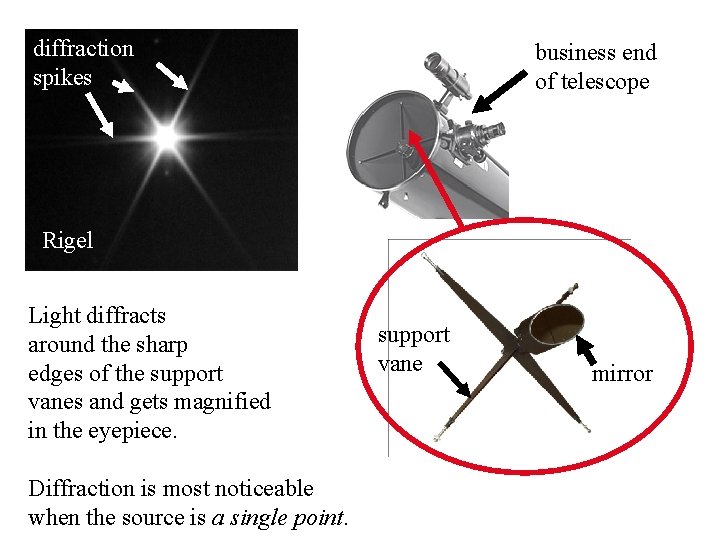
diffraction spikes business end of telescope Rigel Light diffracts around the sharp edges of the support vanes and gets magnified in the eyepiece. Diffraction is most noticeable when the source is a single point. support vane mirror
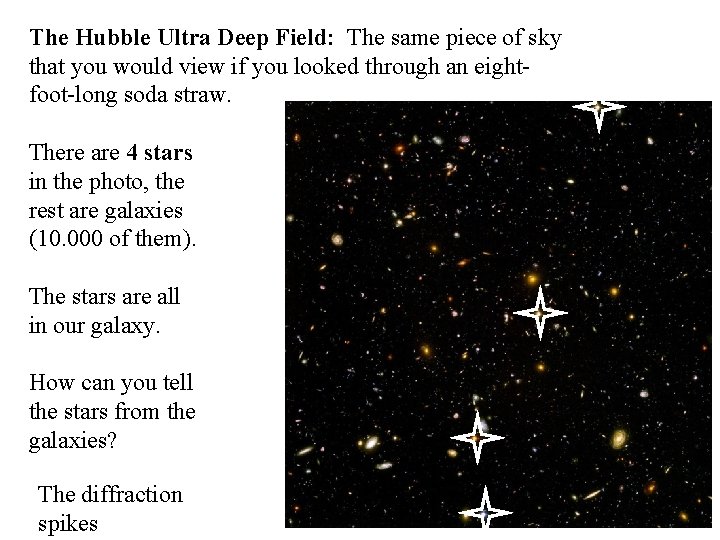
The Hubble Ultra Deep Field: The same piece of sky that you would view if you looked through an eightfoot-long soda straw. There are 4 stars in the photo, the rest are galaxies (10. 000 of them). The stars are all in our galaxy. How can you tell the stars from the galaxies? The diffraction spikes
- Slides: 13