
Thought in 2000 Magnetic helicity is an important
- Slides: 28
Thought in 2000: Magnetic helicity is an important theoretical concept but there is no way to estimate it from observations Pascal Démoulin
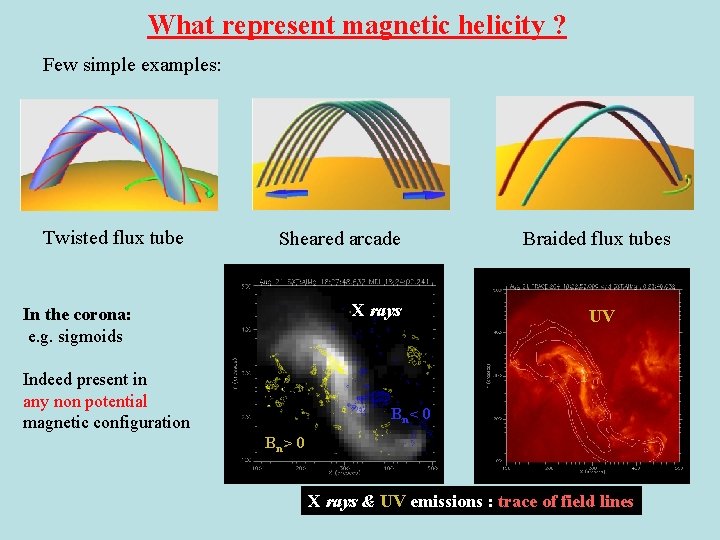
What represent magnetic helicity ? Few simple examples: Twisted flux tube Sheared arcade X rays In the corona: e. g. sigmoids Indeed present in any non potential magnetic configuration Braided flux tubes UV Bn < 0 Bn > 0 X rays & UV emissions : trace of field lines
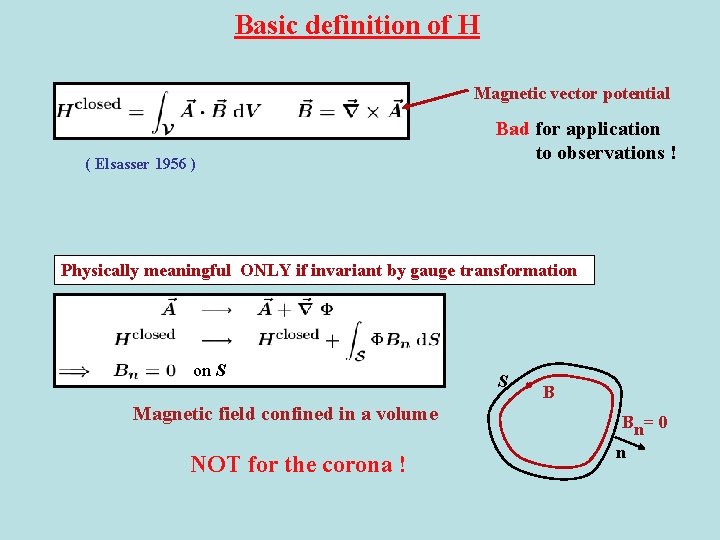
Basic definition of H Magnetic vector potential ( Elsasser 1956 ) Bad for application to observations ! Physically meaningful ONLY if invariant by gauge transformation on S Magnetic field confined in a volume NOT for the corona ! S B B n= 0 n
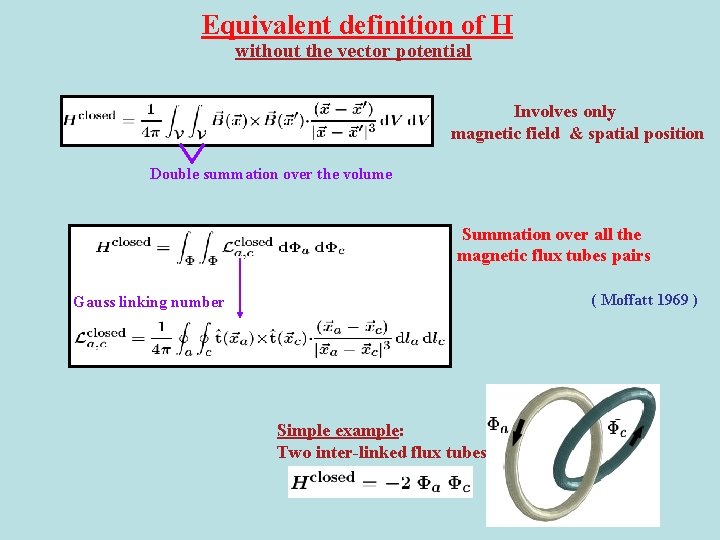
Equivalent definition of H without the vector potential Involves only magnetic field & spatial position Double summation over the volume Summation over all the magnetic flux tubes pairs ( Moffatt 1969 ) Gauss linking number Simple example: Two inter-linked flux tubes
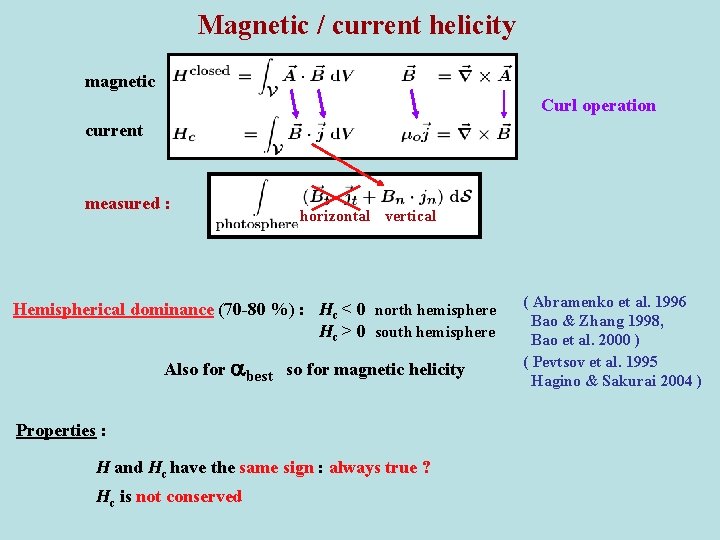
Magnetic / current helicity magnetic Curl operation current measured : horizontal vertical Hemispherical dominance (70 -80 %) : Hc < 0 north hemisphere Hc > 0 south hemisphere Also for best so for magnetic helicity Properties : H and Hc have the same sign : always true ? Hc is not conserved ( Abramenko et al. 1996 Bao & Zhang 1998, Bao et al. 2000 ) ( Pevtsov et al. 1995 Hagino & Sakurai 2004 )
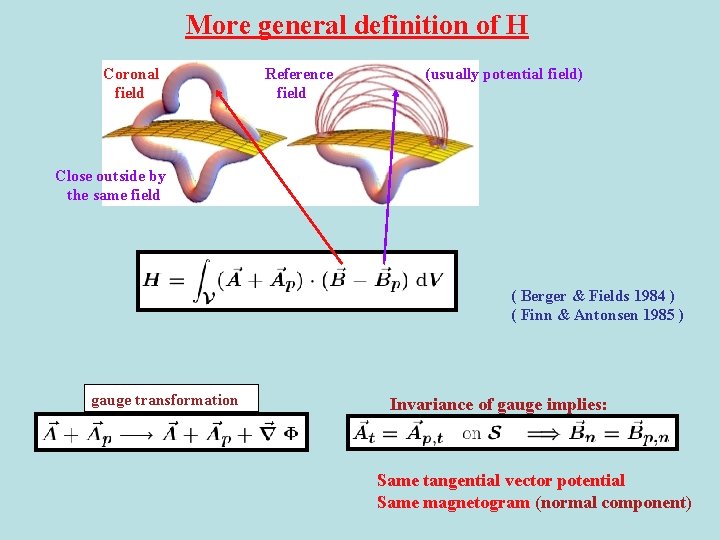
More general definition of H Coronal field Reference field (usually potential field) Close outside by the same field ( Berger & Fields 1984 ) ( Finn & Antonsen 1985 ) gauge transformation Invariance of gauge implies: Same tangential vector potential Same magnetogram (normal component)
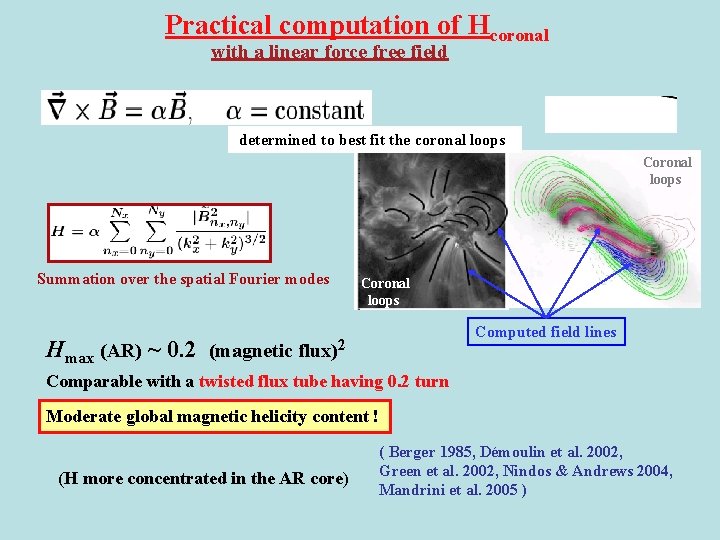
Practical computation of Hcoronal with a linear force free field determined to best fit the coronal loops Coronal loops Summation over the spatial Fourier modes Hmax (AR) ~ 0. 2 (magnetic Coronal loops Computed field lines flux)2 Comparable with a twisted flux tube having 0. 2 turn Moderate global magnetic helicity content ! (H more concentrated in the AR core) ( Berger 1985, Démoulin et al. 2002, Green et al. 2002, Nindos & Andrews 2004, Mandrini et al. 2005 )
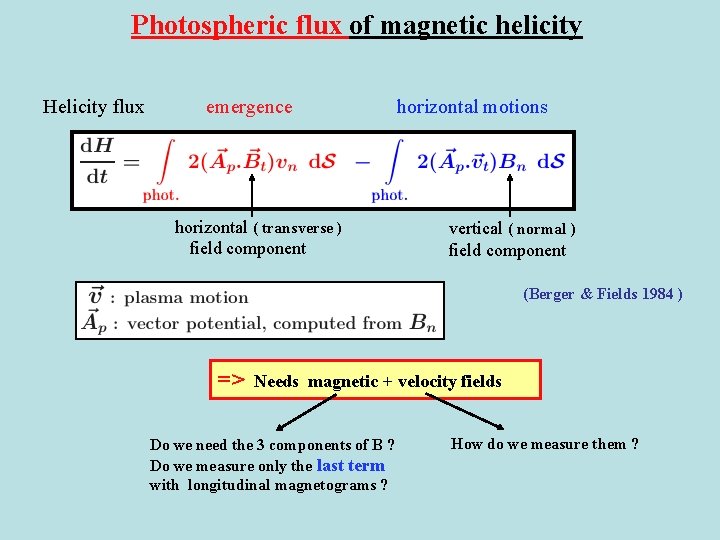
Photospheric flux of magnetic helicity Helicity flux emergence horizontal ( transverse ) field component horizontal motions vertical ( normal ) field component (Berger & Fields 1984 ) => Needs magnetic + velocity fields Do we need the 3 components of B ? Do we measure only the last term with longitudinal magnetograms ? How do we measure them ?
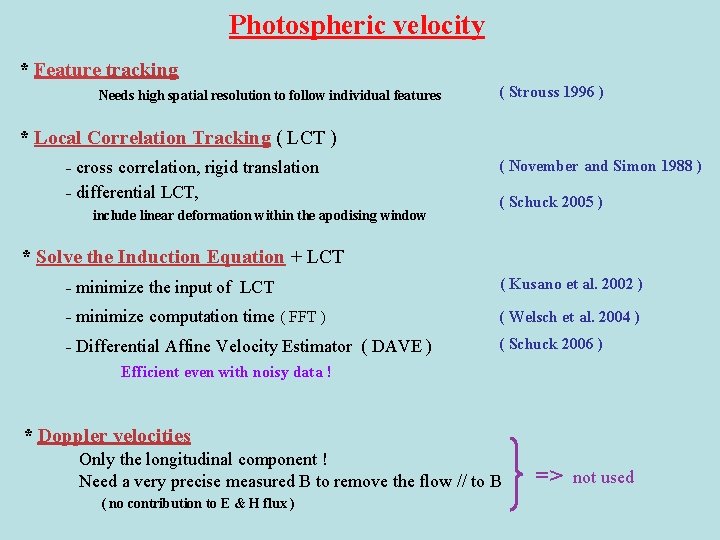
Photospheric velocity * Feature tracking Needs high spatial resolution to follow individual features ( Strouss 1996 ) * Local Correlation Tracking ( LCT ) - cross correlation, rigid translation - differential LCT, include linear deformation within the apodising window ( November and Simon 1988 ) ( Schuck 2005 ) * Solve the Induction Equation + LCT - minimize the input of LCT ( Kusano et al. 2002 ) - minimize computation time ( FFT ) ( Welsch et al. 2004 ) - Differential Affine Velocity Estimator ( DAVE ) ( Schuck 2006 ) Efficient even with noisy data ! * Doppler velocities Only the longitudinal component ! Need a very precise measured B to remove the flow // to B ( no contribution to E & H flux ) => not used
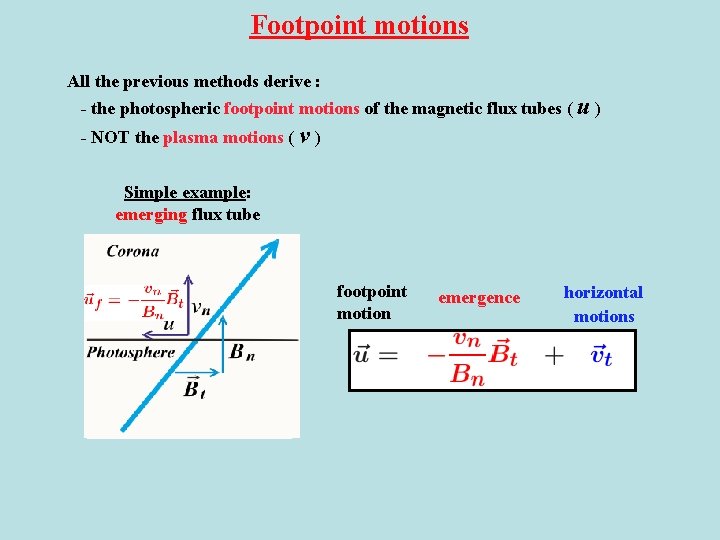
Footpoint motions All the previous methods derive : - the photospheric footpoint motions of the magnetic flux tubes ( u ) - NOT the plasma motions ( v ) Simple example: emerging flux tube Corona emergence Photosphere footpoint motion emergence horizontal motions
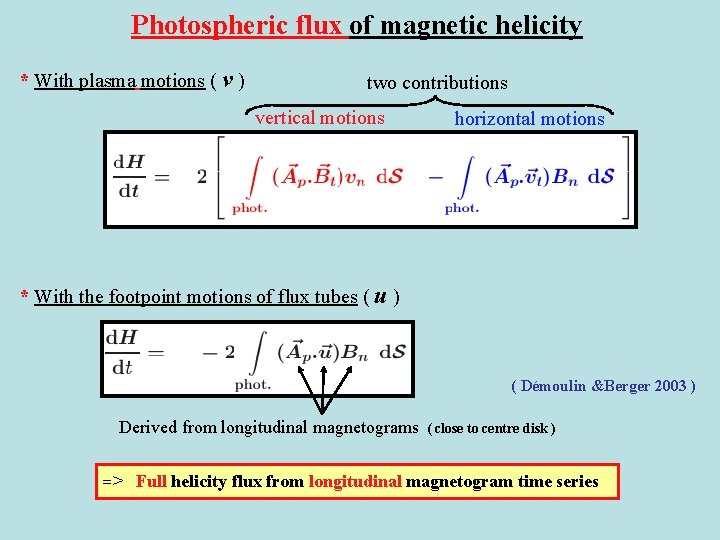
Photospheric flux of magnetic helicity * With plasma motions ( v ) two contributions vertical motions horizontal motions * With the footpoint motions of flux tubes ( u ) ( Démoulin &Berger 2003 ) Derived from longitudinal magnetograms ( close to centre disk ) => Full helicity flux from longitudinal magnetogram time series
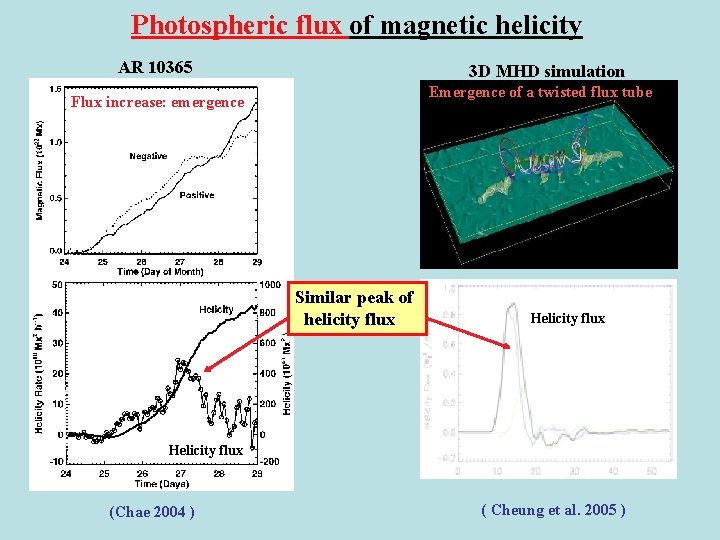
Photospheric flux of magnetic helicity AR 10365 3 D MHD simulation Emergence of a twisted flux tube Flux increase: emergence Similar peak of helicity flux Helicity flux (Chae 2004 ) ( Cheung et al. 2005 )
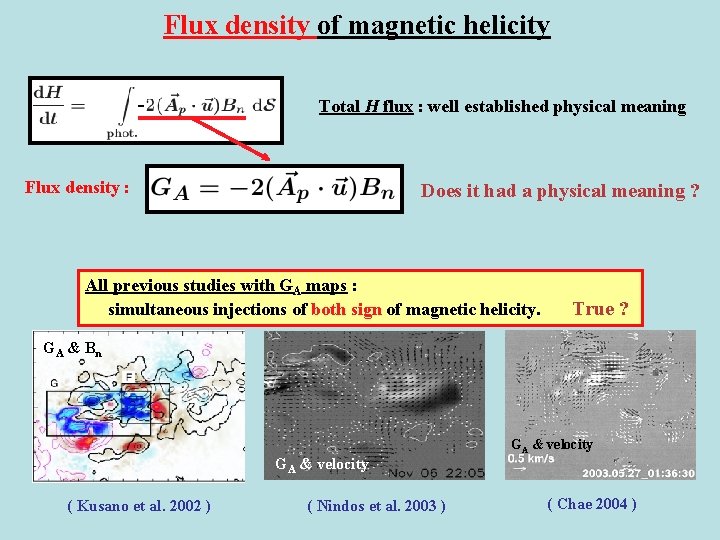
Flux density of magnetic helicity Total H flux : well established physical meaning Flux density : Does it had a physical meaning ? All previous studies with GA maps : simultaneous injections of both sign of magnetic helicity. True ? GA & Bn GA & velocity ( Kusano et al. 2002 ) ( Nindos et al. 2003 ) ( Chae 2004 )
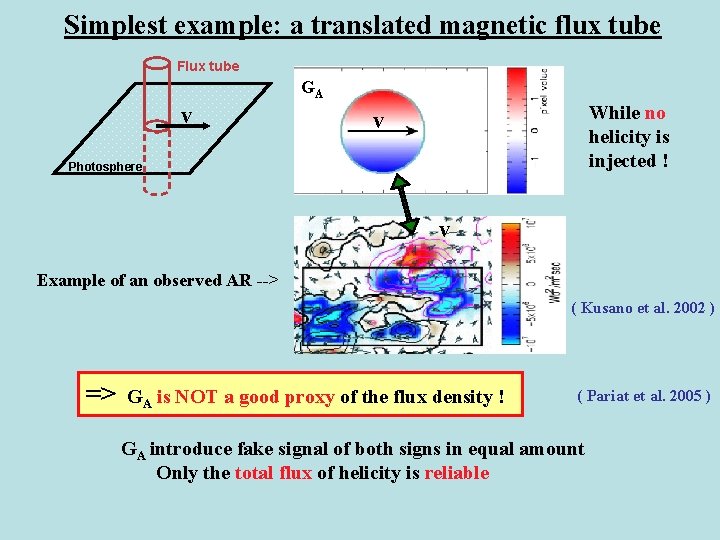
Simplest example: a translated magnetic flux tube Flux tube GA v While no helicity is injected ! v Photosphere v Example of an observed AR --> ( Kusano et al. 2002 ) => GA is NOT a good proxy of the flux density ! ( Pariat et al. 2005 ) GA introduce fake signal of both signs in equal amount Only the total flux of helicity is reliable
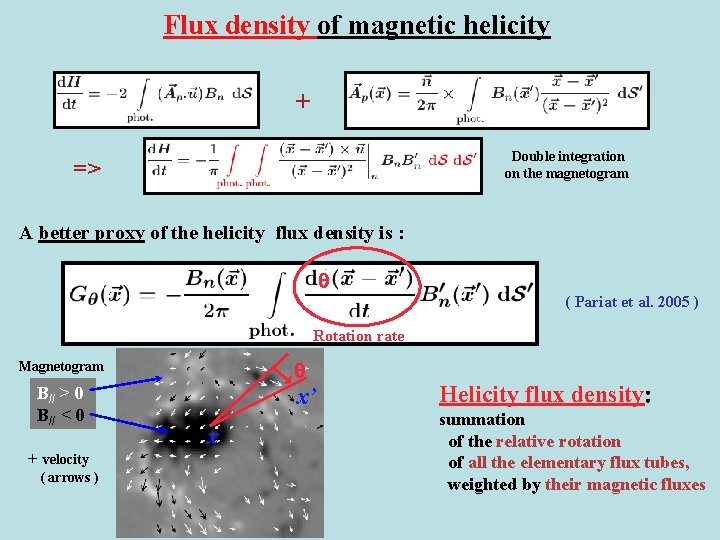
Flux density of magnetic helicity + Double integration on the magnetogram => A better proxy of the helicity flux density is : ( Pariat et al. 2005 ) Rotation rate Magnetogram B// > 0 B// < 0 + velocity ( arrows ) x’ x Helicity flux density: summation of the relative rotation of all the elementary flux tubes, weighted by their magnetic fluxes
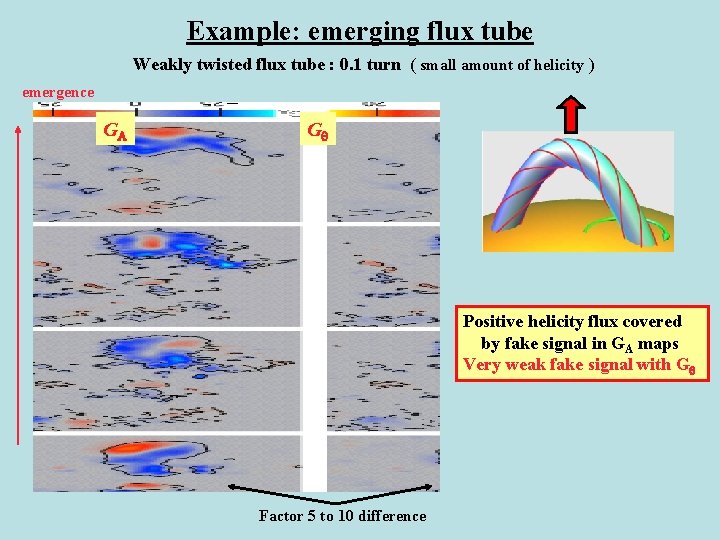
Example: emerging flux tube Weakly twisted flux tube : 0. 1 turn ( small amount of helicity ) emergence GA G Positive helicity flux covered by fake signal in GA maps Very weak fake signal with G Factor 5 to 10 difference
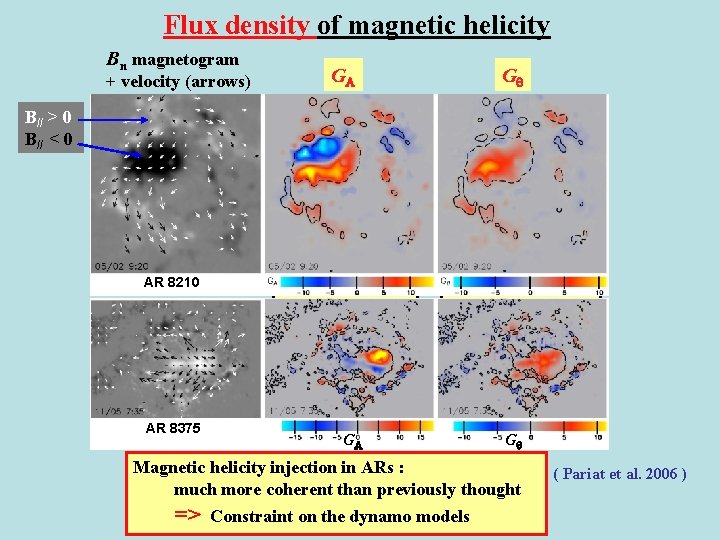
Flux density of magnetic helicity Bn magnetogram + velocity (arrows) GA G B// > 0 B// < 0 AR 8210 AR 8375 strong fake signal More homogeneous GA G Magnetic helicity injection in ARs : G much more coherent than previously thought => Constraint on the dynamo models ( Pariat et al. 2006 )
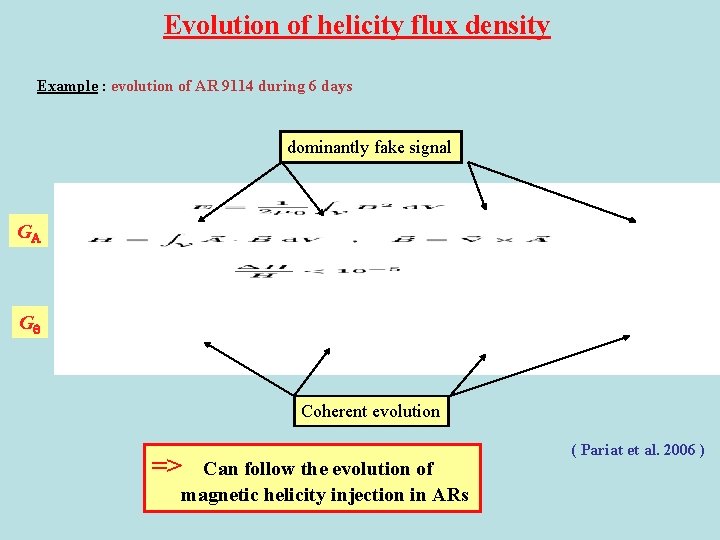
Evolution of helicity flux density Example : evolution of AR 9114 during 6 days dominantly fake signal GA G Coherent evolution => Can follow the evolution of magnetic helicity injection in ARs ( Pariat et al. 2006 )
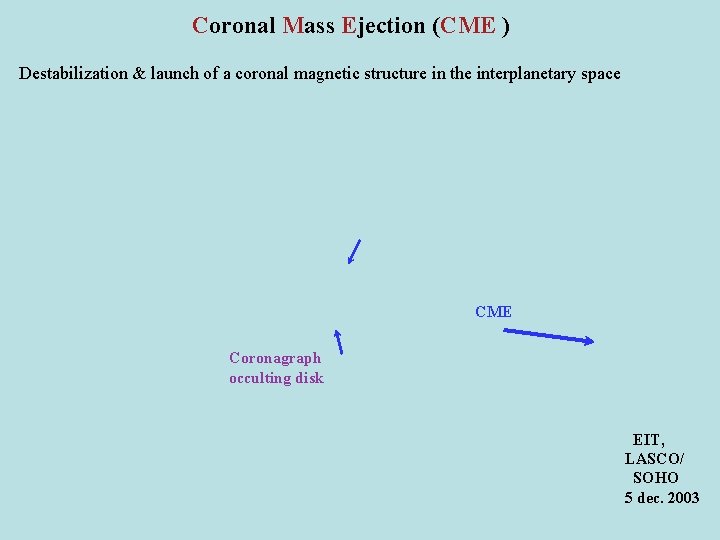
Coronal Mass Ejection (CME ) Destabilization & launch of a coronal magnetic structure in the interplanetary space CME Coronagraph occulting disk EIT, LASCO/ SOHO 5 dec. 2003
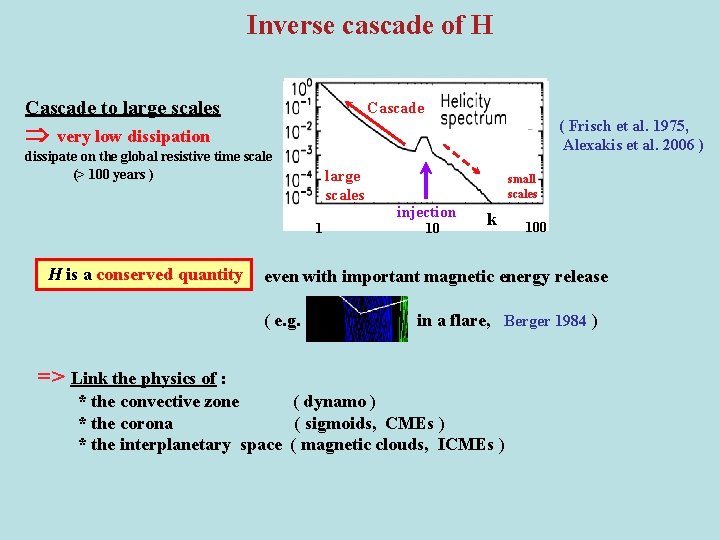
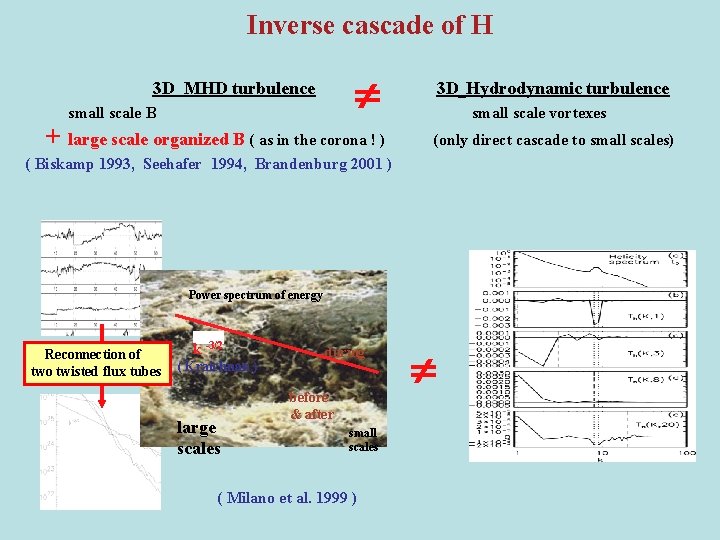
Inverse cascade of H Cascade to large scales Cascade ( Frisch et al. 1975, Alexakis et al. 2006 ) very low dissipation dissipate on the global resistive time scale (> 100 years ) large scales 1 H is a conserved quantity small scales injection 10 k 100 even with important magnetic energy release ( e. g. in a flare, Berger 1984 ) => Link the physics of : * the convective zone ( dynamo ) * the corona ( sigmoids, CMEs ) * the interplanetary space ( magnetic clouds, ICMEs )
Inverse cascade of H 3 D MHD turbulence small scale B + large scale organized B ( as in the corona ! ) 3 D Hydrodynamic turbulence small scale vortexes (only direct cascade to small scales) ( Biskamp 1993, Seehafer 1994, Brandenburg 2001 ) Power spectrum of energy Reconnection of two twisted flux tubes k -3/2 ( Kraichnan ) large scales during before & after small scales ( Milano et al. 1999 )
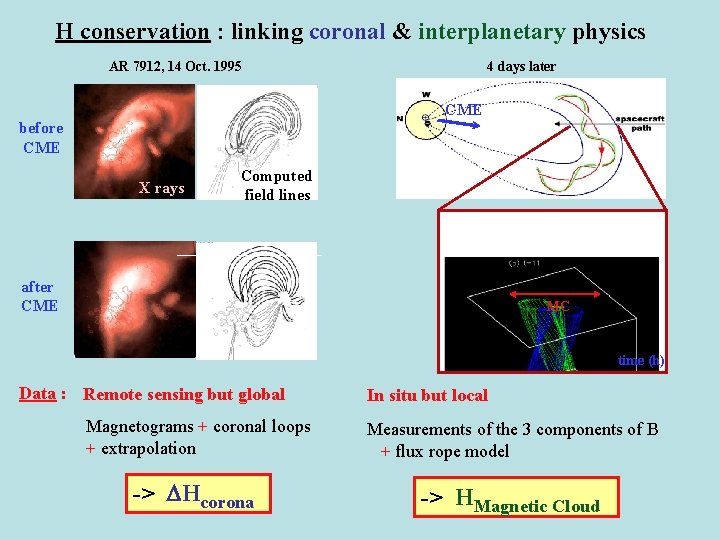
H conservation : linking coronal & interplanetary physics AR 7912, 14 Oct. 1995 4 days later CME before CME X rays Computed field lines after CME MC time (h) Data : Remote sensing but global In situ but local Magnetograms + coronal loops + extrapolation Measurements of the 3 components of B + flux rope model -> Hcorona -> HMagnetic Cloud
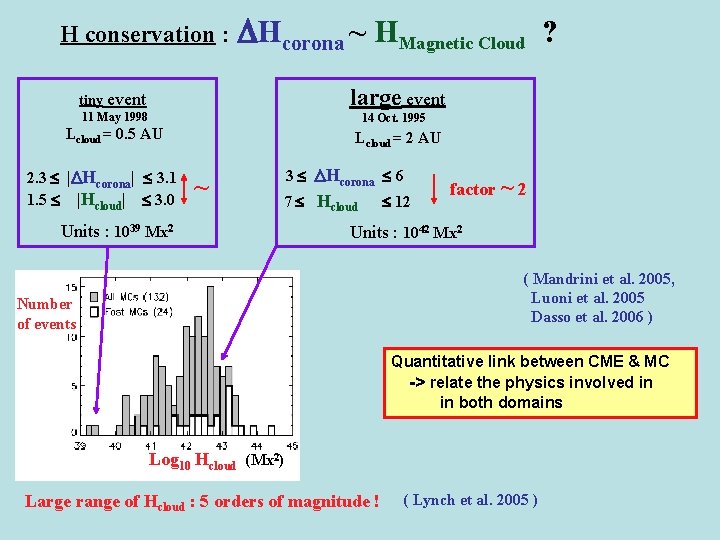
H conservation : tiny Hcorona ~ HMagnetic Cloud ? large event 11 May 1998 14 Oct. 1995 Lcloud = 0. 5 AU 2. 3 | Hcorona| 3. 1 1. 5 |Hcloud| 3. 0 Lcloud = 2 AU ~ 3 Hcorona 6 7 Hcloud Units : 1039 Mx 2 12 factor ~ 2 Units : 1042 Mx 2 ( Mandrini et al. 2005, Luoni et al. 2005 Dasso et al. 2006 ) Number of events Quantitative link between CME & MC -> relate the physics involved in in both domains Log 10 Hcloud (Mx 2) Large range of Hcloud : 5 orders of magnitude ! ( Lynch et al. 2005 )
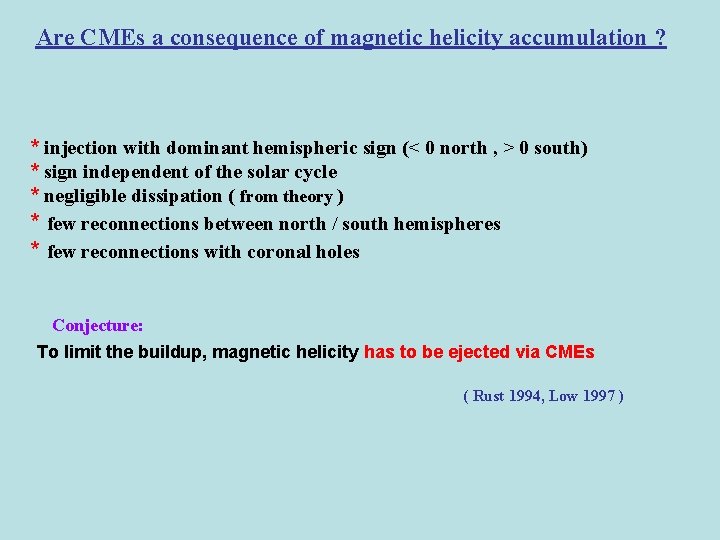
Are CMEs a consequence of magnetic helicity accumulation ? * injection with dominant hemispheric sign (< 0 north , > 0 south) * sign independent of the solar cycle * negligible dissipation ( from theory ) * few reconnections between north / south hemispheres * few reconnections with coronal holes Conjecture: To limit the buildup, magnetic helicity has to be ejected via CMEs ( Rust 1994, Low 1997 )
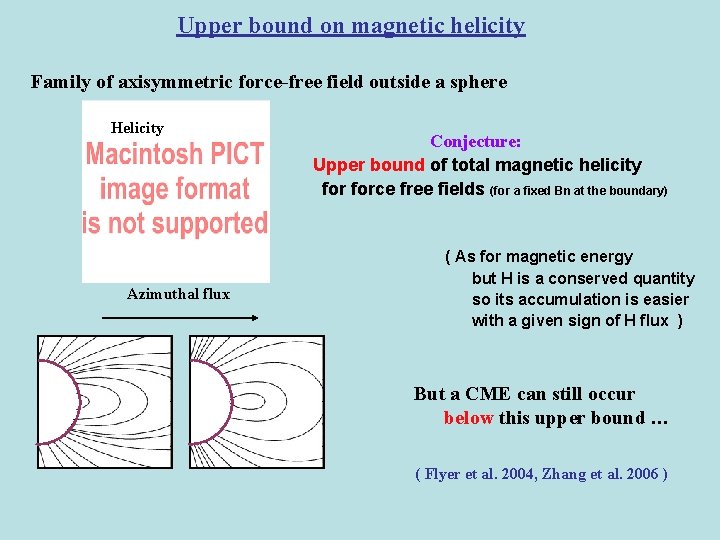
Upper bound on magnetic helicity Family of axisymmetric force-free field outside a sphere Helicity Azimuthal flux Conjecture: Upper bound of total magnetic helicity force free fields (for a fixed Bn at the boundary) ( As for magnetic energy but H is a conserved quantity so its accumulation is easier with a given sign of H flux ) But a CME can still occur below this upper bound … ( Flyer et al. 2004, Zhang et al. 2006 )
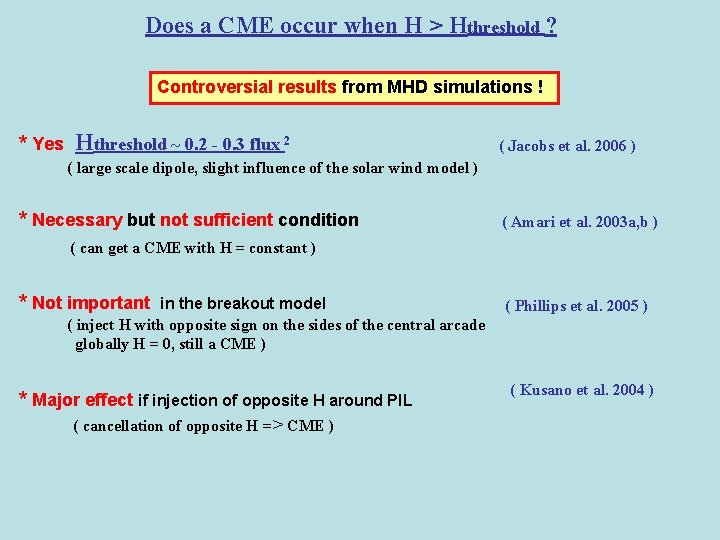
Does a CME occur when H > Hthreshold ? Controversial results from MHD simulations ! * Yes Hthreshold ~ 0. 2 - 0. 3 flux 2 ( Jacobs et al. 2006 ) ( large scale dipole, slight influence of the solar wind model ) * Necessary but not sufficient condition ( Amari et al. 2003 a, b ) ( can get a CME with H = constant ) * Not important in the breakout model ( inject H with opposite sign on the sides of the central arcade globally H = 0, still a CME ) * Major effect if injection of opposite H around PIL ( cancellation of opposite H => CME ) ( Phillips et al. 2005 ) ( Kusano et al. 2004 )
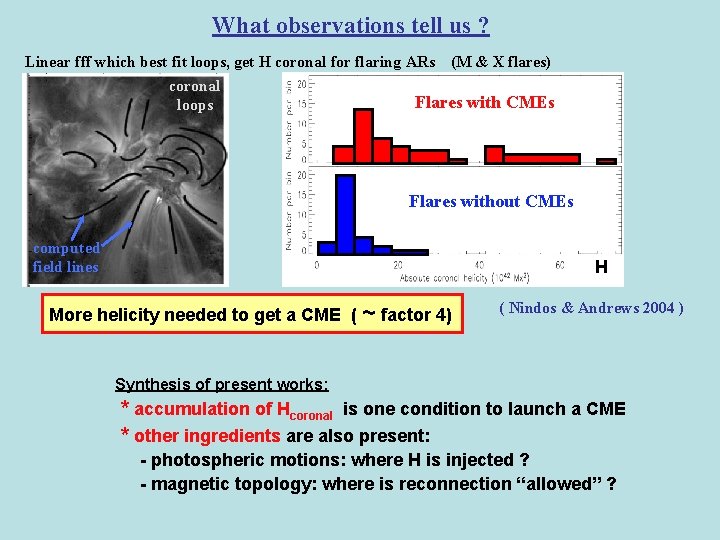
What observations tell us ? Linear fff which best fit loops, get H coronal for flaring ARs (M & X flares) coronal Flares with CMEs loops Flares without CMEs computed field lines H More helicity needed to get a CME ( ~ factor 4) ( Nindos & Andrews 2004 ) Synthesis of present works: * accumulation of Hcoronal is one condition to launch a CME * other ingredients are also present: - photospheric motions: where H is injected ? - magnetic topology: where is reconnection “allowed” ?
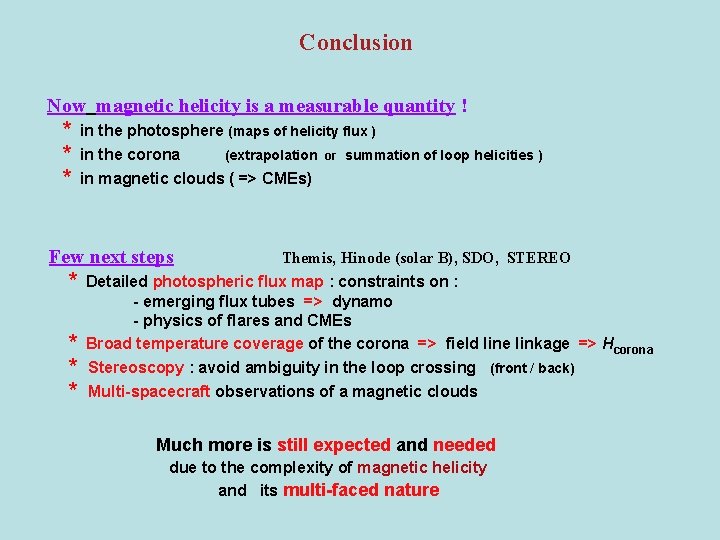
Conclusion Now magnetic helicity is a measurable quantity ! * in the photosphere (maps of helicity flux ) * in the corona (extrapolation or summation of loop helicities ) * in magnetic clouds ( => CMEs) Few next steps Themis, Hinode (solar B), SDO, * Detailed photospheric flux map : constraints on : * * * STEREO - emerging flux tubes => dynamo - physics of flares and CMEs Broad temperature coverage of the corona => field line linkage => Hcorona Stereoscopy : avoid ambiguity in the loop crossing (front / back) Multi-spacecraft observations of a magnetic clouds Much more is still expected and needed due to the complexity of magnetic helicity and its multi-faced nature