
THORACIC VOLUME PREDICTS PULMONARY FUNCTION RECOVERY IN SCOLIOSIS

- Slides: 12
THORACIC VOLUME PREDICTS PULMONARY FUNCTION RECOVERY IN SCOLIOSIS PATIENTS David Polly Jr. MD 1, Benjamin Rosenstein 2, Charles Ledonio, MD 1, Charles Johnston, MD 3, and David J Nuckley, Ph. D 2 1 Department of Orthopaedic Surgery and 2 Department of Physical Medicine and Rehabilitation; University of Minnesota, Minneapolis, MN. 3 Texas Scottish Rite Hospital for Children, Dallas, TX.
DISCLOSURES � The authors have no financial disclosures � Presenter: David W. Polly, Jr. , MD � Co-Authors: � Benjamin E. Rosenstein No relationship � Charles Gerald T. Ledonio, MD (a) SRS, POSNA, SRF, OREF, DOD, Medtronic � Charles E. Johnston, MD (b, d, e) Medtronic, Saunders/Mosby-Elsevier publishers � David J. Nuckley, Ph. D (a) Medtronic USCULOSKELETAL BIOMECHANICS RESEARCH LABORATORY (a) SRS, POSNA, SRF, OREF, DOD (b) Medtronic Spine & Navigation ended 10/1/09 & 6/28/10 a. b. c. d. e. Grants/Research Support Consultant Stock/Shareholder Speakers’ Bureau Other Financial Support
BACKGROUND While moderate scoliosis is present in 1 in 300 children its effects on pulmonary compromise is not well understood. � Scoliosis deformity has long been linked with deleterious effects on pulmonary function. � The causal relationship between spine/chest wall deformity and pulmonary function has yet to be fully defined. � It has been hypothesized that deformity correction improves pulmonary function by restoring both respiratory muscle efficiency and increasing the space available to the lungs. � USCULOSKELETAL BIOMECHANICS RESEARCH LABORATORY
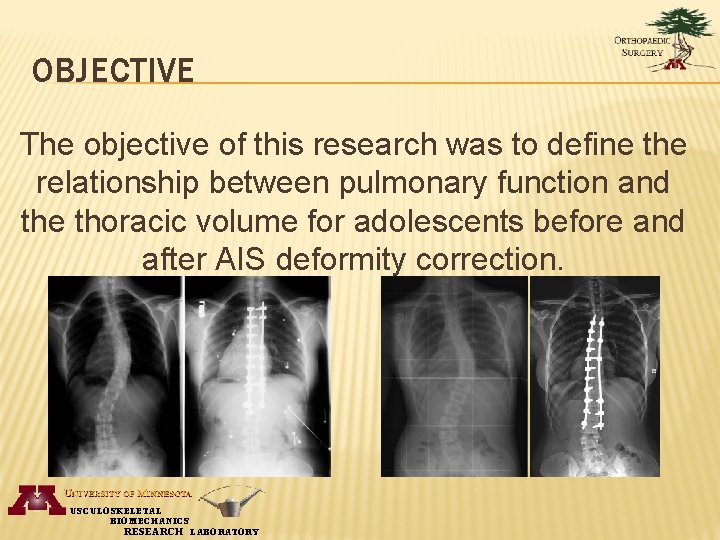
OBJECTIVE The objective of this research was to define the relationship between pulmonary function and the thoracic volume for adolescents before and after AIS deformity correction. USCULOSKELETAL BIOMECHANICS RESEARCH LABORATORY
METHODS Study Design. Retrospective case control correlational analysis of pulmonary function test (PFT) data and modeling reconstructions of thoracic volumes from plain x-rays. � AIS patients from a multicenter database (PPSS) were sorted by presurgery PFT as a % predicted value. � 10 patients with the highest and 10 with the lowest PFT values were analyzed. � Thoracic volume was modeled and correlated with PFT values before and after surgery (2 year followup) � USCULOSKELETAL BIOMECHANICS RESEARCH LABORATORY
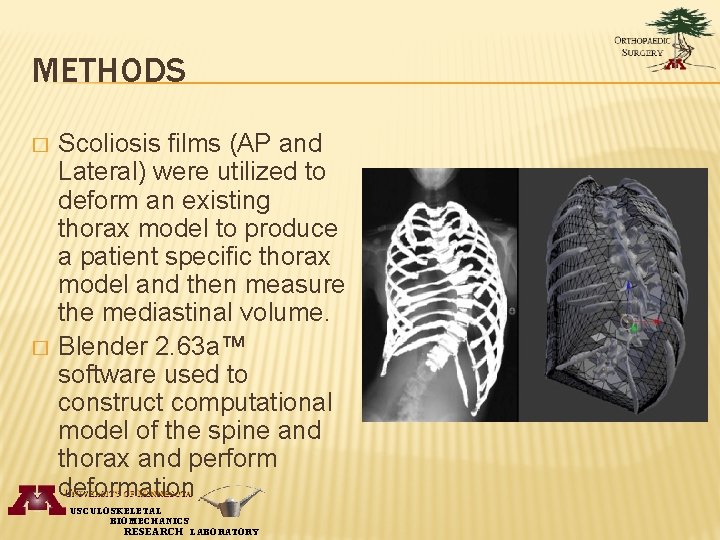
METHODS � � Scoliosis films (AP and Lateral) were utilized to deform an existing thorax model to produce a patient specific thorax model and then measure the mediastinal volume. Blender 2. 63 a™ software used to construct computational model of the spine and thorax and perform deformation USCULOSKELETAL BIOMECHANICS RESEARCH LABORATORY
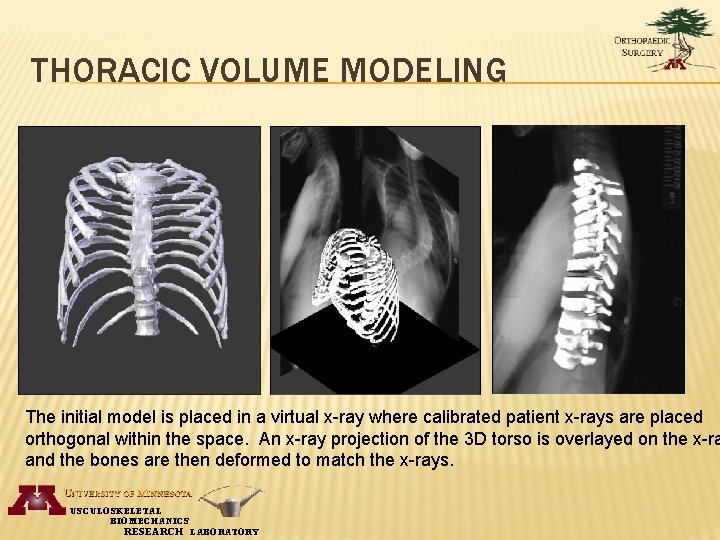
THORACIC VOLUME MODELING The initial model is placed in a virtual x-ray where calibrated patient x-rays are placed orthogonal within the space. An x-ray projection of the 3 D torso is overlayed on the x-ra and the bones are then deformed to match the x-rays. USCULOSKELETAL BIOMECHANICS RESEARCH LABORATORY
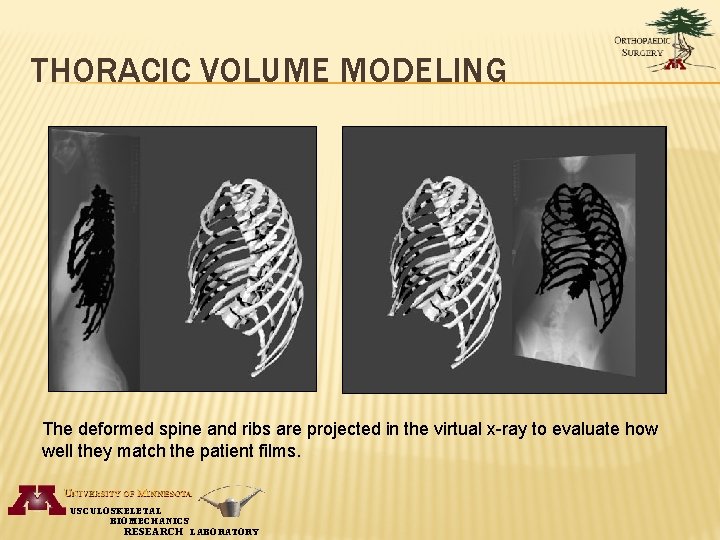
THORACIC VOLUME MODELING The deformed spine and ribs are projected in the virtual x-ray to evaluate how well they match the patient films. USCULOSKELETAL BIOMECHANICS RESEARCH LABORATORY
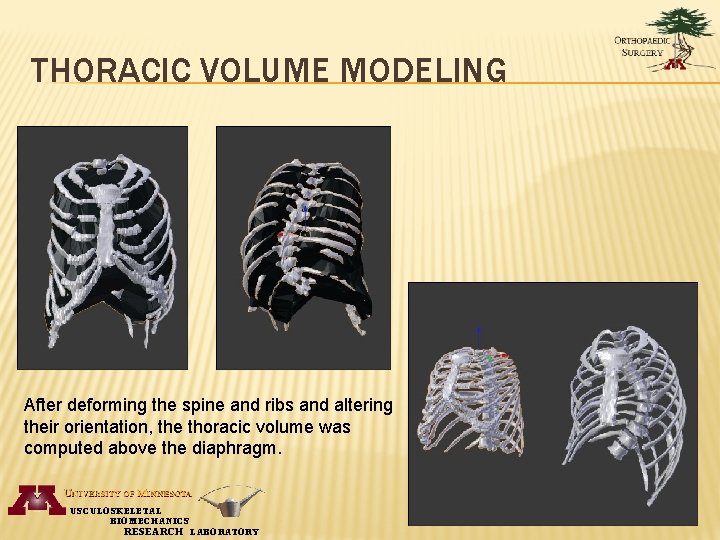
THORACIC VOLUME MODELING After deforming the spine and ribs and altering their orientation, the thoracic volume was computed above the diaphragm. USCULOSKELETAL BIOMECHANICS RESEARCH LABORATORY
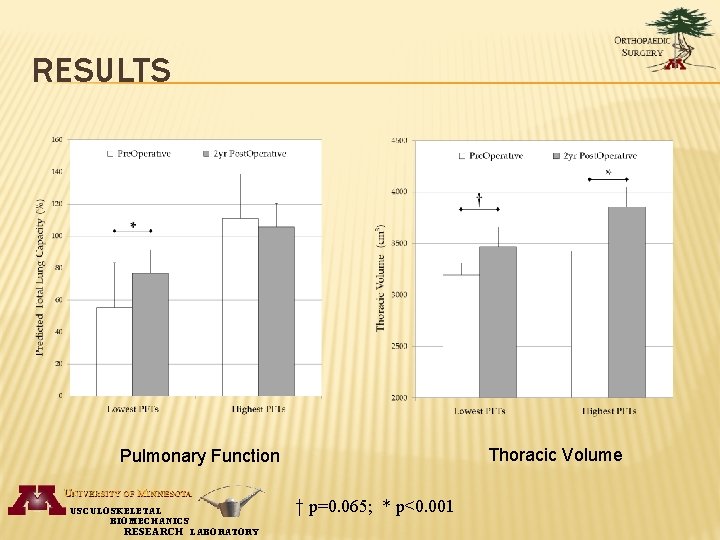
RESULTS Thoracic Volume Pulmonary Function USCULOSKELETAL BIOMECHANICS RESEARCH LABORATORY † p=0. 065; * p<0. 001
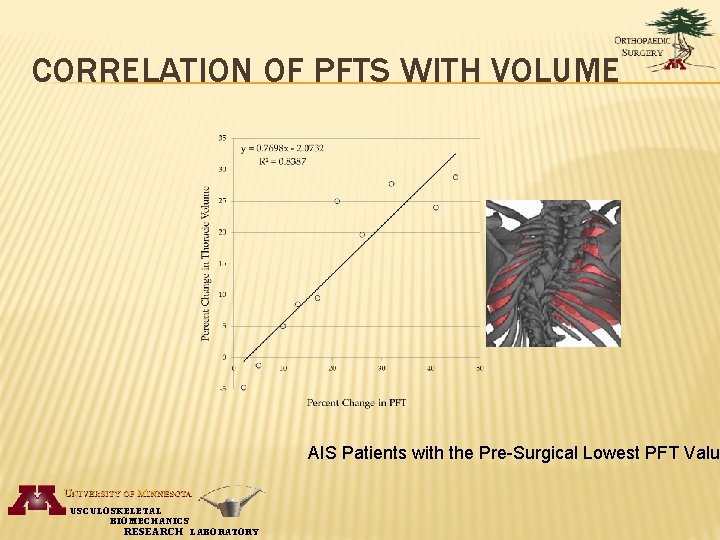
CORRELATION OF PFTS WITH VOLUME AIS Patients with the Pre-Surgical Lowest PFT Valu USCULOSKELETAL BIOMECHANICS RESEARCH LABORATORY
CONCLUSION � � Pre-operative thoracic volume was diminished in patients with the lowest PFT values (3194± 1358 cm 3) compared with the highest PFT values (3427± 874 cm 3) although the groups were not height matched (p=0. 085). The adolescents with the most severe pulmonary compromise prior to surgery exhibited a strong positive relationship between post-operative change in PFT and thoracic volume (r 2 = 0. 839; p<0. 001). The mean increase in thoracic volume (space available to the lungs) in this group was 373. 1 cm 3 (11. 7%) which corresponded to a 21. 2% improvement in PFTs. AIS surgical intervention was found to increase thoracic volume which was strongly correlated with improved pulmonary function in severe cases. USCULOSKELETAL BIOMECHANICS RESEARCH LABORATORY