
Thoracic injuries 1 2 3 Incidence 10mortality 25

- Slides: 29
Thoracic injuries Ø 1. 2. 3. Ø Incidence: 10%mortality (25% of traumatic deaths) <10% of blunt and 15 -30% of penetrating require thoracotomy mediastinal penetrating trauma: mortality 20%, 50% are hemodynamically unstable 40%mortality additional 30% positive diagnostic evaluation Patophysiology: hypoxia, hypercarbia, acidosis (hypovolemia, ventilation/perfusion mismatch, changes in intrathoracic pressures) Klinika Chirurgii Urazowej Paweł Grala
Thoracic injuries Ø 1. 2. 3. Ø Ø Ø Chest wall lacerations, l. communicating with pleural space open pneumothorax, rib frs with possible: pain, splinting, atelectasis, hypoxemia analgesia, pulmonary toilet, flail chest, indicative of possible internal inj. Sternal fractures (consider myocardial contusion) Tracheobronchial (respiratory distress, large air leak with subcutaneous emphysema) Esophageal (penetrating trauma, delayed recognotion →↑mortality – 3 fold if over 24 h, esophagoscopy with contrast studies – Gastrografin, butressed repair) Pulmonary: contusion, hemothorax, pneumothorax Great vessel Cardiac Klinika Chirurgii Urazowej Paweł Grala
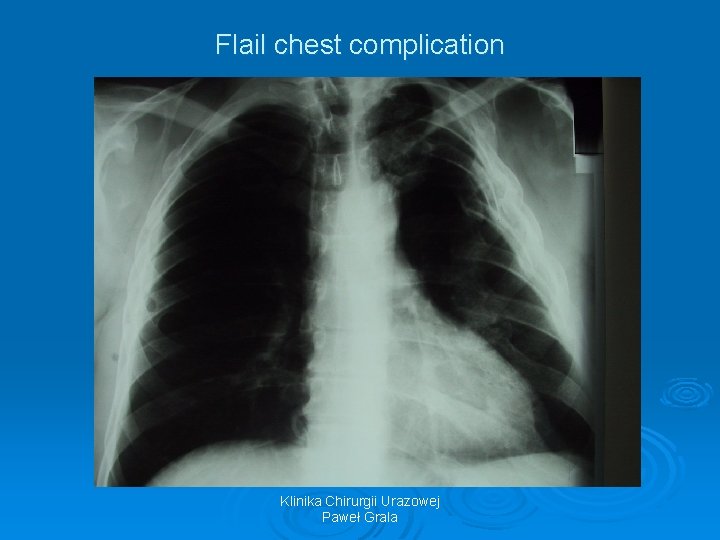
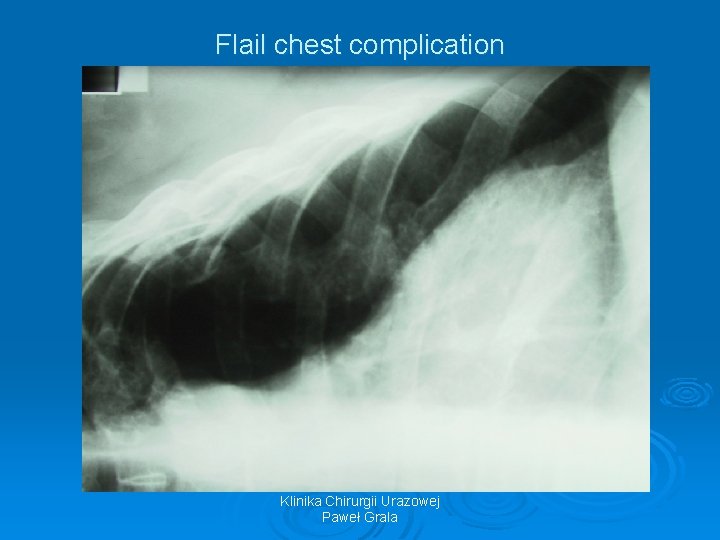
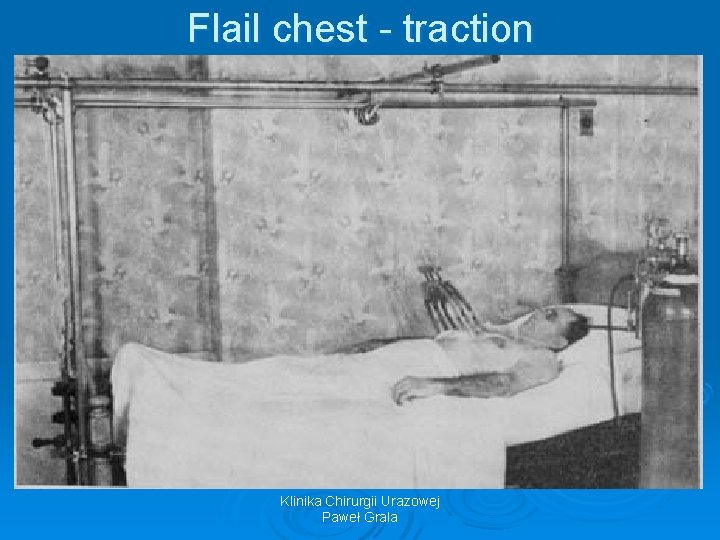
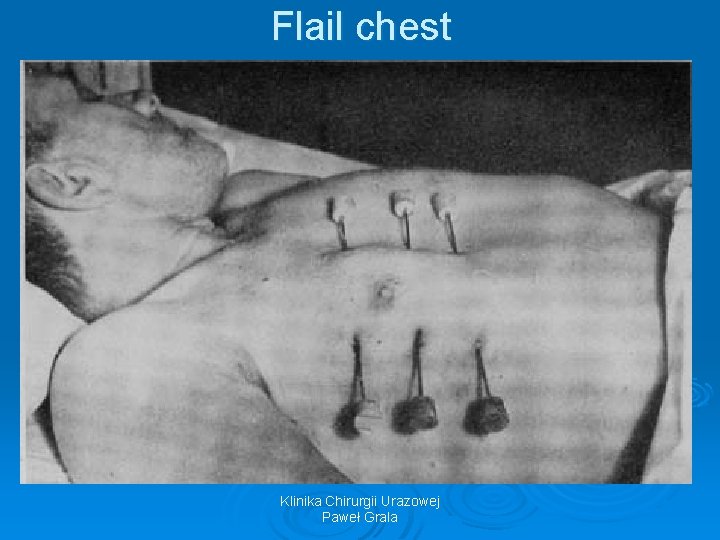
Rib fractures Ø Ø Ø Ø May be undetectable on chest X-ray (excludes other intrathoracic injuries) Majority IV-IX Anteroposterior compression midshaft fr. (outward bowing), direct blow fracture ends face inwards potential vessel or lung parenchymal injury X-XII suspect hepatosplenic injury I-III suspect great vessel injury Taping, rib belts – contraindicated Relief of pain (intercostal block, intrapleural analgesia, systemic analgetics), pulmonary toilet Flail chest – bony discontinuity of a chest fragment (>3): serious underlying lung inj. , paradoxical chest wall motion, pain, splinting (muscle spasm) hypoxia fluid restriction (if no hypovolemia), adequate ventilation with chest wall splinting mechanical ventilation Klinika Chirurgii Urazowej Paweł Grala
Flail chest complication Klinika Chirurgii Urazowej Paweł Grala
Flail chest complication Klinika Chirurgii Urazowej Paweł Grala
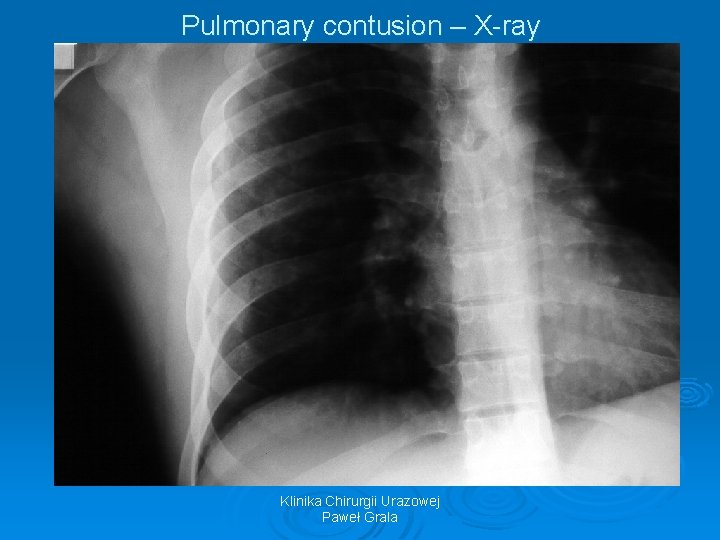
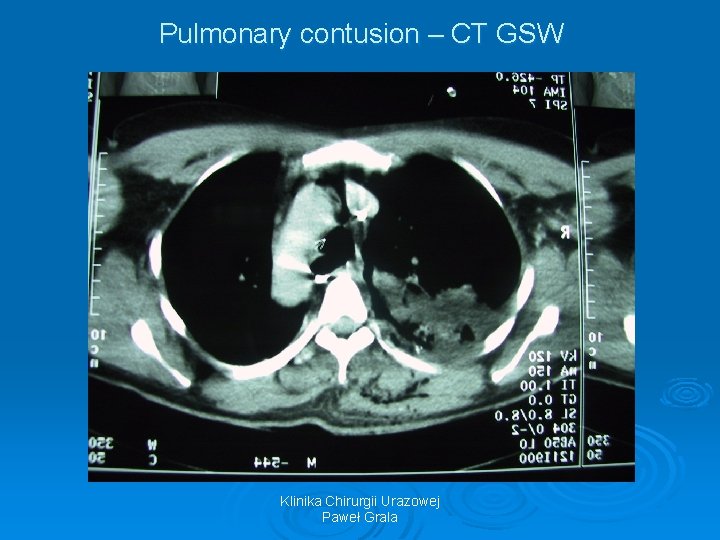
Pulmonary contusion Blunt (blast shock wawes, falls from heights) or penetrating trauma (high velocity GSW) “Spalling effect” – shearing or bursting effect occurring at the gas/liquid interface (large differences in density) “Inertial effect” – low-density alveolar tissue is stripped from heavier hilar structures as they accelerate at different rates. “Implosion effect” - rebound or overexpansion of gas bubbles after a pressure wave passes Ø Interstitial or alveolar inj. – edema, alveolar haemorrhage, parenchymal destruction Ø Adequate perfusion, inadequate ventilation (mismatch → hypoxemia) - ↑airway resistance, ↓compliance Ø Initial chest X-ray diagnostic – progress in density over 48 h (Chest x -ray 4 -6 hours /CT earlier/, resolves in 5 -7 days) ABGs, pulse oximetry, Ø Dyspnea, hemoptysis, chest pain, cough, tachypnea, rales, decreased breath sounds, tachycardia Ø Respiratory support with intubation and mechanical ventilation (often unusual ventilation modes), aggressive pulmonary toilet, positioning on uninvolved side, fluid restriction, no steroids or prophylactic antibiotics. Klinika Chirurgii Urazowej Ø Paweł Grala
Pulmonary contusion – X-ray Klinika Chirurgii Urazowej Paweł Grala
Pulmonary contusion – X-ray 5 h later: subcutaneous emphysema, pneumomediastinum Klinika Chirurgii Urazowej Paweł Grala
Pulmonary contusion – CT GSW Klinika Chirurgii Urazowej Paweł Grala
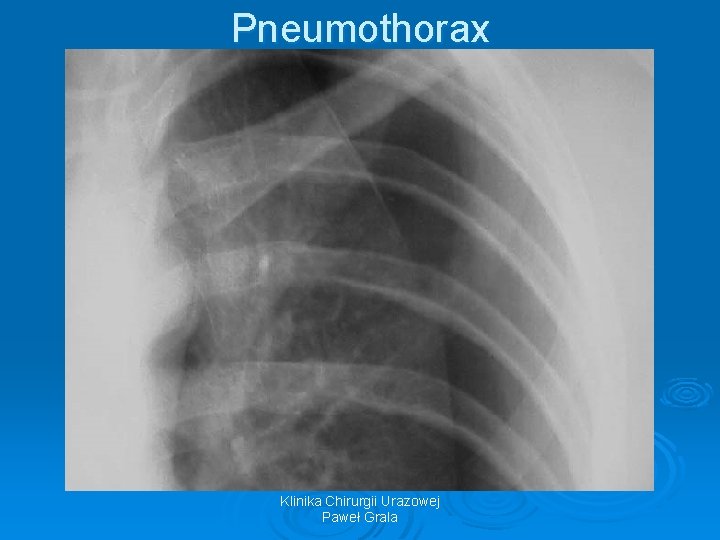
Pneumothorax Ø Ø Ø Ø Blunt or penetrating inj. Decreased breath sounds (>25% of the lung collapsed) Sucking chest wound (over 2/3 of tracheal diameter) preferential air flow occlusive dressing + chest tube Chest X-ray diagnostic In significant chest inj. + p. p. mechanical ventilation prophylactic tube thoracostomy (prevention of tension P. ) Chest tube into II or IIIrd intercostal space in midclavicular line Chest tube ineffictive tracheobronchial disruption diagnosis + thoracotomy Klinika Chirurgii Urazowej Paweł Grala
Pneumothorax Klinika Chirurgii Urazowej Paweł Grala
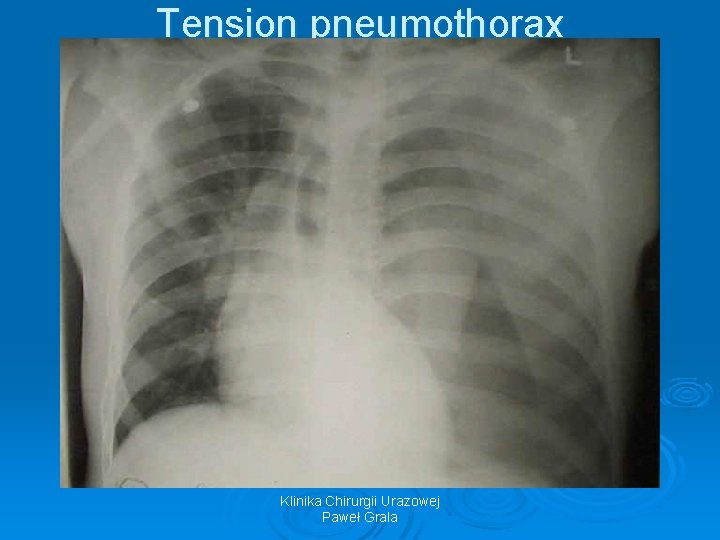
Tension pneumothorax Klinika Chirurgii Urazowej Paweł Grala
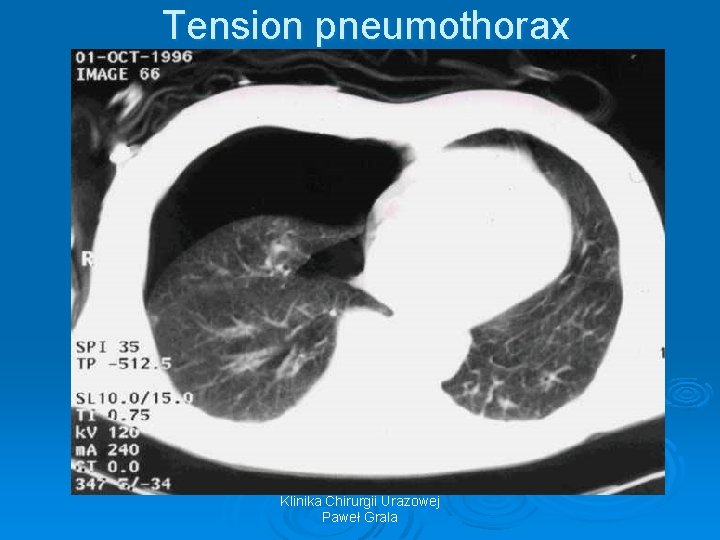
Tension pneumothorax Klinika Chirurgii Urazowej Paweł Grala
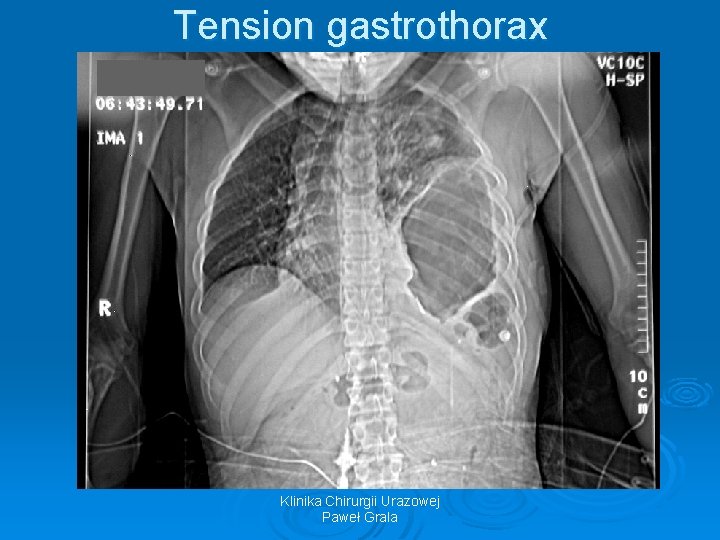
Tension gastrothorax Klinika Chirurgii Urazowej Paweł Grala
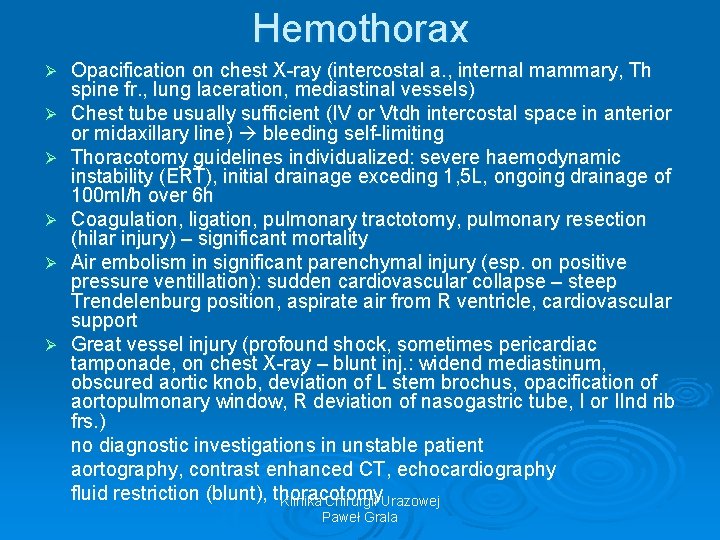
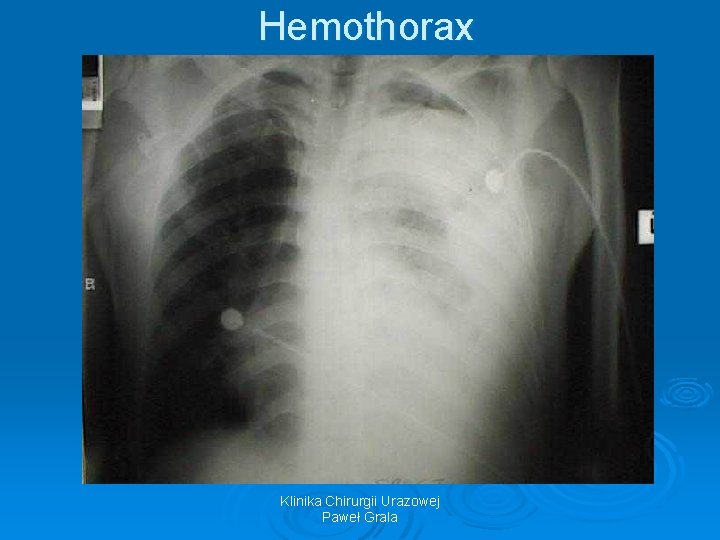
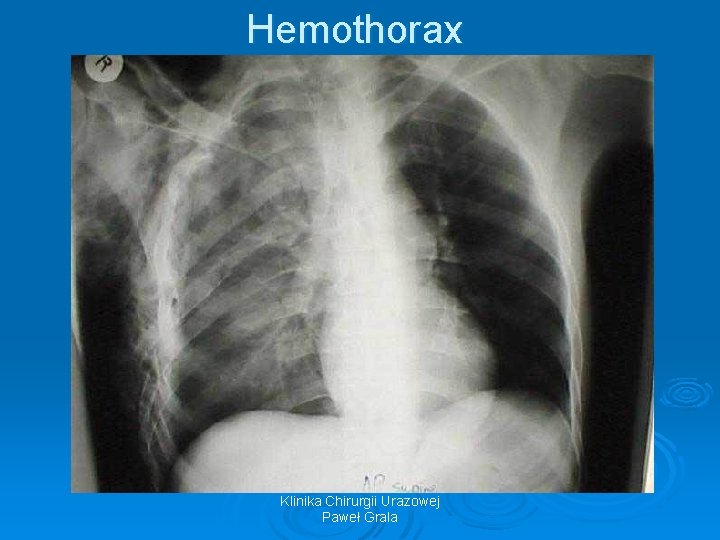
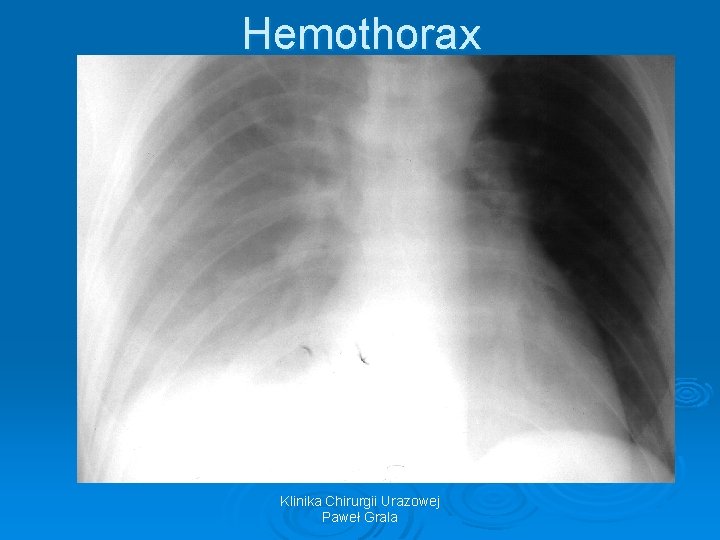
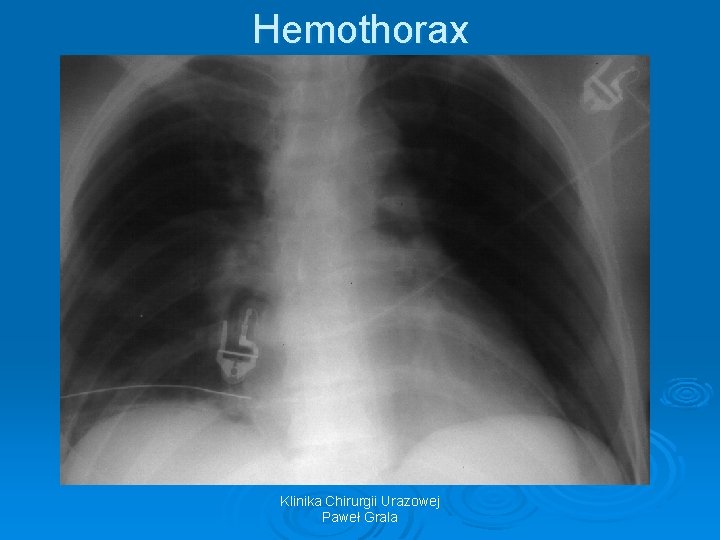
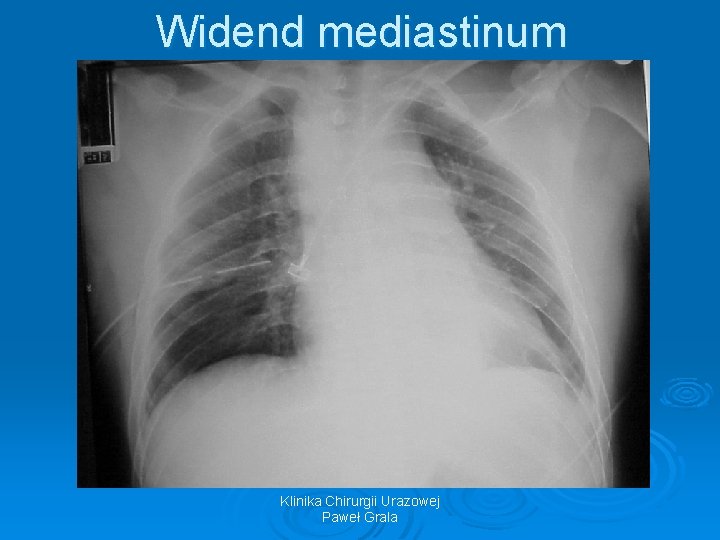
Hemothorax Ø Ø Ø Opacification on chest X-ray (intercostal a. , internal mammary, Th spine fr. , lung laceration, mediastinal vessels) Chest tube usually sufficient (IV or Vtdh intercostal space in anterior or midaxillary line) bleeding self-limiting Thoracotomy guidelines individualized: severe haemodynamic instability (ERT), initial drainage exceding 1, 5 L, ongoing drainage of 100 ml/h over 6 h Coagulation, ligation, pulmonary tractotomy, pulmonary resection (hilar injury) – significant mortality Air embolism in significant parenchymal injury (esp. on positive pressure ventillation): sudden cardiovascular collapse – steep Trendelenburg position, aspirate air from R ventricle, cardiovascular support Great vessel injury (profound shock, sometimes pericardiac tamponade, on chest X-ray – blunt inj. : widend mediastinum, obscured aortic knob, deviation of L stem brochus, opacification of aortopulmonary window, R deviation of nasogastric tube, I or IInd rib frs. ) no diagnostic investigations in unstable patient aortography, contrast enhanced CT, echocardiography fluid restriction (blunt), thoracotomy Klinika Chirurgii Urazowej Paweł Grala
Hemothorax Klinika Chirurgii Urazowej Paweł Grala
Hemothorax Klinika Chirurgii Urazowej Paweł Grala
Hemothorax Klinika Chirurgii Urazowej Paweł Grala
Hemothorax Klinika Chirurgii Urazowej Paweł Grala
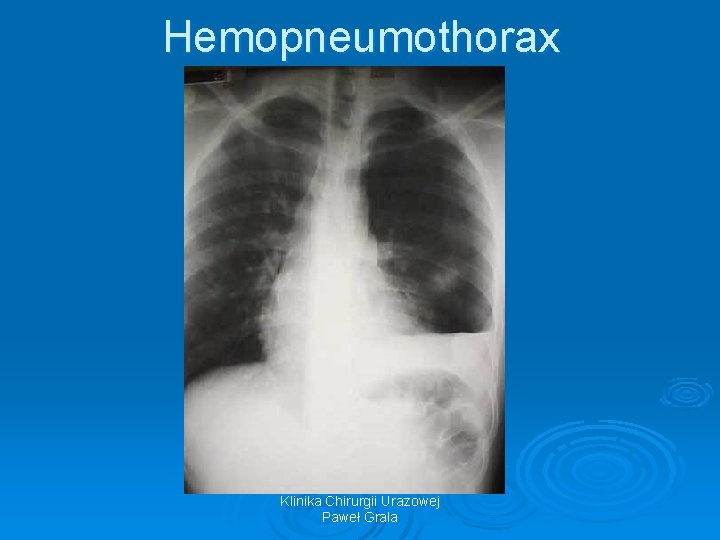
Hemopneumothorax Klinika Chirurgii Urazowej Paweł Grala
Widend mediastinum Klinika Chirurgii Urazowej Paweł Grala
Flail chest - traction Klinika Chirurgii Urazowej Paweł Grala
Flail chest Klinika Chirurgii Urazowej Paweł Grala
Empyema Ø Stages (not separated – continuum): l l l exsudative fibropurulent organizing Ø Chest X-ray, US, CT Ø Control of infection with appropriate antibiotics, drainage (ev. streptokinaze), obliteration of pleural space, thoracotomy with decortication and pleurodesis Klinika Chirurgii Urazowej Paweł Grala
Cardiac injury usually penetrating inj. between midclavicular lines Ø pericardiac tamponade: shock, distended neck veins, diminished heart sounds (Beck`s triad), j. v. distension ↑ with inspiration (Kussmaul`s sign) warrants operation (often ERT) Ø blunt c. inj. : history, inappropriate cardiovascular response to injury (EKG – normal excludes, abnormal cardiac monitoring, echocardiography) advanced cardiac life support protocols operation for myocardial or valvular rupture, ventricular aneurysm Ø Klinika Chirurgii Urazowej Paweł Grala
Ø Commotio cordis – fatality due to blunt thoracic injury, without gross structural damage to the heart or other intrathoracic organs. Death attributed to cardiac arrhythmia aggravated by traumatic apnea. Most vulnerable phase of the cardiac cycle: T – wave heart partially depolarized and then repolarized (electrically unstable) Klinika Chirurgii Urazowej Paweł Grala
Klinika Chirurgii Urazowej Paweł Grala
Thoracotomy Klinika Chirurgii Urazowej Paweł Grala
Pitfalls Ø Ø Ø Simple hemothorax retained, clotted hemothorax with lung entrapement or empyema (if infected) Diaphragmatic inj. are often overlooked respiratory compromise, early or late entrapement and strangulation of abd. Contents Evaluation of widend mediastinum requires cardiothoracic surgical capabilities Underestimation of severe pathophysiology of rib frs. esp. in the elderly (aggressive pain control with no resp. depression) underestimation of blunt pulmonary injury severety (pulmonary contusion is not always correlated with X-ray findings) Klinika Chirurgii Urazowej Paweł Grala