
Thoracic compressive myelopathy secondary to skeletal fluorosis Dr
- Slides: 1
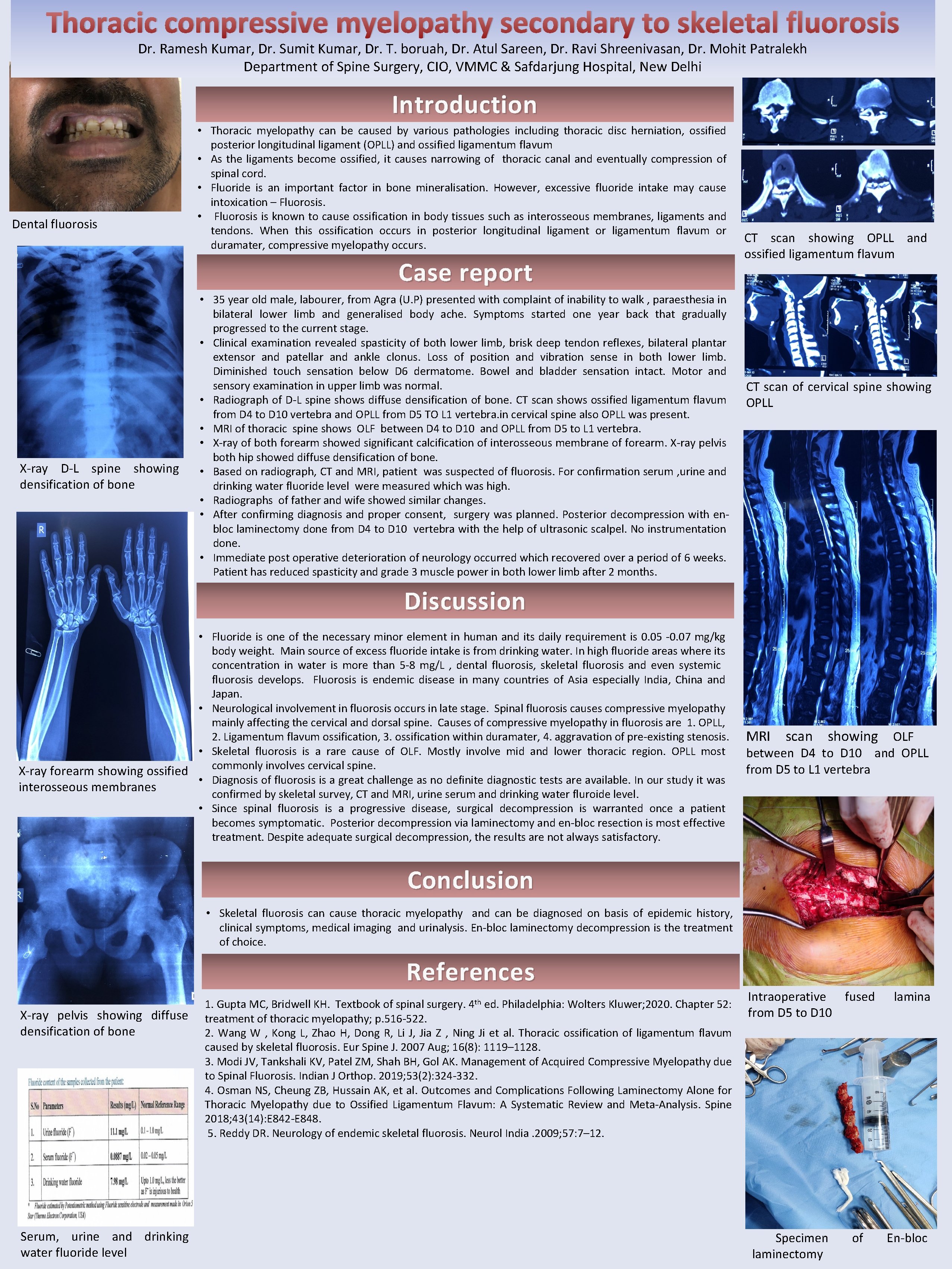
Thoracic compressive myelopathy secondary to skeletal fluorosis Dr. Ramesh Kumar, Dr. Sumit Kumar, Dr. T. boruah, Dr. Atul Sareen, Dr. Ravi Shreenivasan, Dr. Mohit Patralekh Department of Spine Surgery, CIO, VMMC & Safdarjung Hospital, New Delhi Introduction Dental fluorosis • Thoracic myelopathy can be caused by various pathologies including thoracic disc herniation, ossified posterior longitudinal ligament (OPLL) and ossified ligamentum flavum • As the ligaments become ossified, it causes narrowing of thoracic canal and eventually compression of spinal cord. • Fluoride is an important factor in bone mineralisation. However, excessive fluoride intake may cause intoxication – Fluorosis. • Fluorosis is known to cause ossification in body tissues such as interosseous membranes, ligaments and tendons. When this ossification occurs in posterior longitudinal ligament or ligamentum flavum or duramater, compressive myelopathy occurs. Case report X-ray D-L spine showing densification of bone • 35 year old male, labourer, from Agra (U. P) presented with complaint of inability to walk , paraesthesia in bilateral lower limb and generalised body ache. Symptoms started one year back that gradually progressed to the current stage. • Clinical examination revealed spasticity of both lower limb, brisk deep tendon reflexes, bilateral plantar extensor and patellar and ankle clonus. Loss of position and vibration sense in both lower limb. Diminished touch sensation below D 6 dermatome. Bowel and bladder sensation intact. Motor and sensory examination in upper limb was normal. • Radiograph of D-L spine shows diffuse densification of bone. CT scan shows ossified ligamentum flavum from D 4 to D 10 vertebra and OPLL from D 5 TO L 1 vertebra. in cervical spine also OPLL was present. • MRI of thoracic spine shows OLF between D 4 to D 10 and OPLL from D 5 to L 1 vertebra. • X-ray of both forearm showed significant calcification of interosseous membrane of forearm. X-ray pelvis both hip showed diffuse densification of bone. • Based on radiograph, CT and MRI, patient was suspected of fluorosis. For confirmation serum , urine and drinking water fluoride level were measured which was high. • Radiographs of father and wife showed similar changes. • After confirming diagnosis and proper consent, surgery was planned. Posterior decompression with enbloc laminectomy done from D 4 to D 10 vertebra with the help of ultrasonic scalpel. No instrumentation done. • Immediate post operative deterioration of neurology occurred which recovered over a period of 6 weeks. Patient has reduced spasticity and grade 3 muscle power in both lower limb after 2 months. CT scan showing OPLL and ossified ligamentum flavum CT scan of cervical spine showing OPLL Discussion • Fluoride is one of the necessary minor element in human and its daily requirement is 0. 05 -0. 07 mg/kg body weight. Main source of excess fluoride intake is from drinking water. In high fluoride areas where its concentration in water is more than 5 -8 mg/L , dental fluorosis, skeletal fluorosis and even systemic fluorosis develops. Fluorosis is endemic disease in many countries of Asia especially India, China and Japan. • Neurological involvement in fluorosis occurs in late stage. Spinal fluorosis causes compressive myelopathy mainly affecting the cervical and dorsal spine. Causes of compressive myelopathy in fluorosis are 1. OPLL, 2. Ligamentum flavum ossification, 3. ossification within duramater, 4. aggravation of pre-existing stenosis. • Skeletal fluorosis is a rare cause of OLF. Mostly involve mid and lower thoracic region. OPLL most commonly involves cervical spine. X-ray forearm showing ossified • Diagnosis of fluorosis is a great challenge as no definite diagnostic tests are available. In our study it was interosseous membranes confirmed by skeletal survey, CT and MRI, urine serum and drinking water fluroide level. • Since spinal fluorosis is a progressive disease, surgical decompression is warranted once a patient becomes symptomatic. Posterior decompression via laminectomy and en-bloc resection is most effective treatment. Despite adequate surgical decompression, the results are not always satisfactory. MRI scan showing OLF between D 4 to D 10 and OPLL from D 5 to L 1 vertebra Conclusion • Skeletal fluorosis can cause thoracic myelopathy and can be diagnosed on basis of epidemic history, clinical symptoms, medical imaging and urinalysis. En-bloc laminectomy decompression is the treatment of choice. References X-ray pelvis showing diffuse densification of bone Serum, urine and drinking water fluoride level 1. Gupta MC, Bridwell KH. Textbook of spinal surgery. 4 th ed. Philadelphia: Wolters Kluwer; 2020. Chapter 52: treatment of thoracic myelopathy; p. 516 -522. 2. Wang W , Kong L, Zhao H, Dong R, Li J, Jia Z , Ning Ji et al. Thoracic ossification of ligamentum flavum caused by skeletal fluorosis. Eur Spine J. 2007 Aug; 16(8): 1119– 1128. 3. Modi JV, Tankshali KV, Patel ZM, Shah BH, Gol AK. Management of Acquired Compressive Myelopathy due to Spinal Fluorosis. Indian J Orthop. 2019; 53(2): 324 -332. 4. Osman NS, Cheung ZB, Hussain AK, et al. Outcomes and Complications Following Laminectomy Alone for Thoracic Myelopathy due to Ossified Ligamentum Flavum: A Systematic Review and Meta-Analysis. Spine 2018; 43(14): E 842 -E 848. 5. Reddy DR. Neurology of endemic skeletal fluorosis. Neurol India. 2009; 57: 7– 12. Intraoperative fused lamina from D 5 to D 10 Specimen laminectomy of En-bloc