
THOMAS STEARNS ELIOT Grando Asia 5 ALS TABLE
THOMAS STEARNS ELIOT Grando Asia 5 ALS
TABLE OF CONTENT �Who was T. S. Eliot �The Waste Land �Mythical method
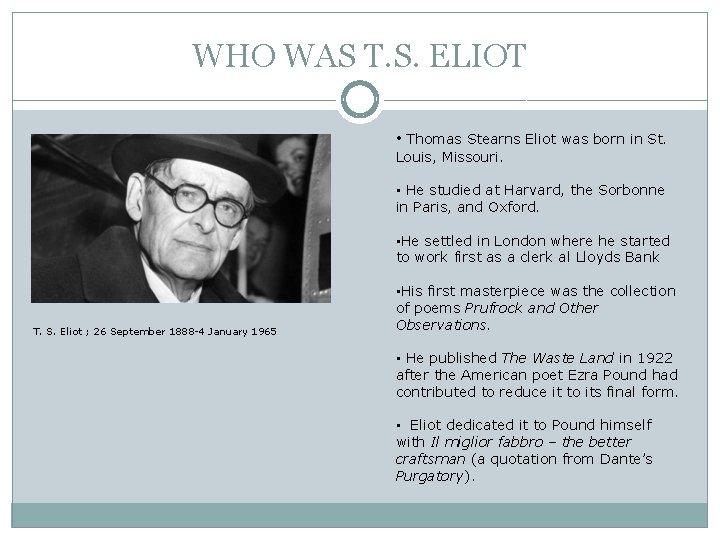
WHO WAS T. S. ELIOT • Thomas Stearns Eliot was born in St. Louis, Missouri. • He studied at Harvard, the Sorbonne in Paris, and Oxford. • He settled in London where he started to work first as a clerk al Lloyds Bank T. S. Eliot ; 26 September 1888 -4 January 1965 • His first masterpiece was the collection of poems Prufrock and Other Observations. • He published The Waste Land in 1922 after the American poet Ezra Pound had contributed to reduce it to its final form. • Eliot dedicated it to Pound himself with Il miglior fabbro – the better craftsman (a quotation from Dante’s Purgatory).
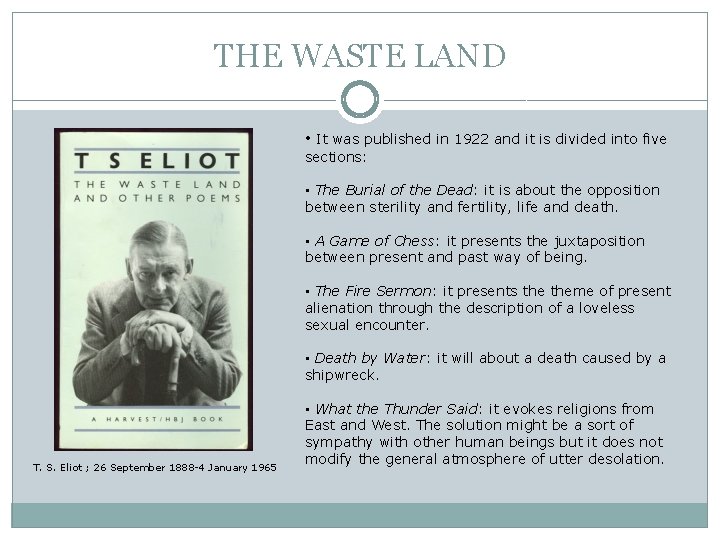
THE WASTE LAND • It was published in 1922 and it is divided into five sections: • The Burial of the Dead: it is about the opposition between sterility and fertility, life and death. • A Game of Chess: it presents the juxtaposition between present and past way of being. • The Fire Sermon: it presents theme of present alienation through the description of a loveless sexual encounter. • Death by Water: it will about a death caused by a shipwreck. T. S. Eliot ; 26 September 1888 -4 January 1965 • What the Thunder Said: it evokes religions from East and West. The solution might be a sort of sympathy with other human beings but it does not modify the general atmosphere of utter desolation.

THE MYTHICAL METHOD • Mythical allusions convey the contrast between the present and the past. • Fragmentary: mixture of different poetic styles such as blank verse, the ode, the quatrain and free verse stand for the chaos of modern civilization. • Metaphors and symbols replace direct statements. • Technique of the “objective correlative” which is the attempt at communicating philosophical reflections and feelings. • Technique of juxtaposition for example between trivial elements with sublime ones. . T. S. Eliot ; Ezra Pound • It is simply a way of controlling, of ordering, of giving a shape and a significance to the immense panorama of utility and anarchy which is contemporary history. Ulysses, Order and Myth
THE END
- Slides: 6