
Thomas Jefferson National Accelerator Facility Jefferson Lab Newport
Thomas Jefferson National Accelerator Facility (Jefferson Lab) Newport News, Virginia Simulation, Measurement and Analysis of Photoemission from Dispenser Cathodes, Metals and Coated Materials K. L. Jensen Code 6841, ESTD Naval Research Laboratory Washington, DC 20375 -5347 EM: kevin. jensen@nrl. navy. mil D. W. Feldman, P. G. O’Shea, N. Moody, D. Demske Inst. for Res. in El. & Appl. Phys. U. of Maryland, College Park, MD 20742 http: //www. ipr. umd. edu/ JLAB CASA Seminar 10: 30 - 11: 30 AM October 1, 2004 Host: Carlos Hernandez Garcia Jefferson Lab 12000 Jefferson Ave MS 6 A Newport News, VA 23606 We gratefully acknowledge funding by the Joint Technology Office and the Office of Naval Research JLAB 1
HISTORY The ability to predict QE of pure metals / materials is hard. Fowler Du. Bridge Theory: R. H. Fowler, Phys. Rev. 38, 45 (1931); L. A. Du. Bridge, Phys. Rev. 43, 727 (1933). If coatings are involved, it is far harder. Consider: A. H. Sommer, “The Element of Luck in Research - Photocathodes 1930 to 1980” (Gaede-Langmuir Award), J. Vac. Sci. Technol. A 1, 119 (1983). “Six photocathode materials were developed during the period from 1930 to 1963 to provide the spectral response and other characteristics needed for such applications as photometry, television, scintillation counters, and night vision devices. The history and the essential properties of these materials are reviewed and it is shown that all the cathodes resulted from lucky accidents and not from the application of scientific insight. The period of empirical innovation came to an end in the late 1960’s when negative electron affinity (NEA) materials became the first photocathodes that were developed on a strictly scientifc basis. ” What is involved? Is a predictive model possible? JLAB 2
INTRODUCTION Photocathodes: Sources for Electron Beams, From Free Electron Lasers (FELs) to Accelerator Applications Due to the High Quality Electron Beams Ideal Photocathode Has High QE at Longest Possible Wavelength, Capable of in Situ Repair or Rehabilitation, Demonstrates Good Lifetime To meet particular needs of a megawatt (MW) class FEL, a photocathode… …should produce 1 n. C of charge in a 10 -50 ps pulse every ns (100 A peak and 1 A average current) in 10 -50 MV/m and 0. 01 m. Torr for several seconds. Even if such a photocathode were available… Making predictions of performance is complex: Useful models must account for cathode surface conditions and material properties, as well as drive laser parameters. surface conditions (coating, field enhancement, reflectivity), laser parameters (duration, intensity, wavelength), and material characteristics (reflectivity, laser penetration depth, scattering) Focus: dispenser photocathodes, but also discuss other photocathodes PRESENT PROGRAM: Develop and validate with experiment a predictive and quantitative theory of photoemission & quantum efficiency. JLAB 3
PHOTOCATHODES DRIVE LASER • Reliability <=> System Reliability: UV Unsuitable for Hi-duty • Non-linear Crystals Decrease l by 2 -4; Efficiency Very Low for UV • Conversion by 2 From IR to Green ok: Seek High QE Photocathode in Visible PHOTOCATHODE Bulk & Surface of Complex Materials Produced by Empirical Techniques; Short Lifetime, Complex Replacement Process. Cathode Selection Influences Drive Laser Chosen (e. g. , l, spot bandwith, laser energy, QE) METALLIC: Hi ave power, drive laser w/ 5 - 500 µJ/pulse req. Rugged but require UV, have lower QE (≤ 0. 01%). For low duty factor, low rep rate UV pulses Fast response time (fs-structure On Laser Appears on Beam) DIRECT BAND-GAP P-TYPE SEMICONDUCTORS: Highest QE photocathodes alkali antimonides (Cs 3 Sb, K 2 Cs. Sb); visible, PEA, RF gun alkali tellurides (Cs 2 Te, KCs. Te) UV, PEA, RF gun Bulk III-V w. Cs + oxidant (O or F); IR - visible, NEA, DC guns Emission time is long (10 -20 ps) for NEA sources: insufficiently responsive for pulse shaping. ALL chemically reactive: Easily poisoned by H 20 & C 02 (Protection at expense of QE); “Harmless" H 2 & CH 4 damage by ion back bombardment (greater issue for DC guns) JLAB 4
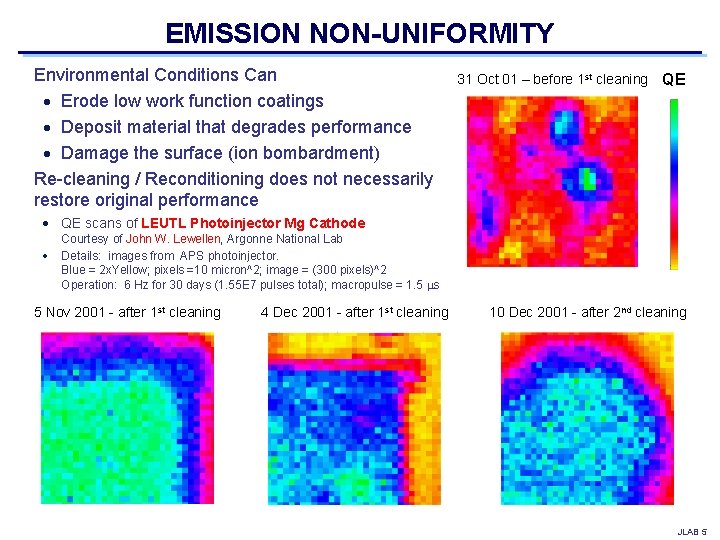
EMISSION NON-UNIFORMITY Environmental Conditions Can Erode low work function coatings Deposit material that degrades performance Damage the surface (ion bombardment) Re-cleaning / Reconditioning does not necessarily restore original performance 31 Oct 01 – before 1 st cleaning QE scans of LEUTL Photoinjector Mg Cathode Courtesy of John W. Lewellen, Argonne National Lab Details: images from APS photoinjector. Blue = 2 x. Yellow; pixels =10 micron^2; image = (300 pixels)^2 Operation: 6 Hz for 30 days (1. 55 E 7 pulses total); macropulse = 1. 5 ms 5 Nov 2001 - after 1 st cleaning 4 Dec 2001 - after 1 st cleaning 10 Dec 2001 - after 2 nd cleaning JLAB 5
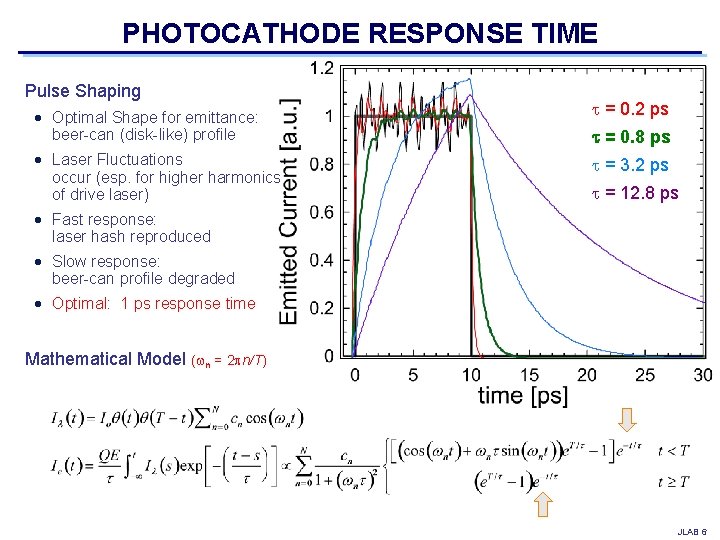
PHOTOCATHODE RESPONSE TIME Pulse Shaping Optimal Shape for emittance: beer-can (disk-like) profile Laser Fluctuations occur (esp. for higher harmonics of drive laser) t = 0. 2 ps t = 0. 8 ps t = 3. 2 ps t = 12. 8 ps Fast response: laser hash reproduced Slow response: beer-can profile degraded Optimal: 1 ps response time Mathematical Model (wn = 2 pn/T) JLAB 6
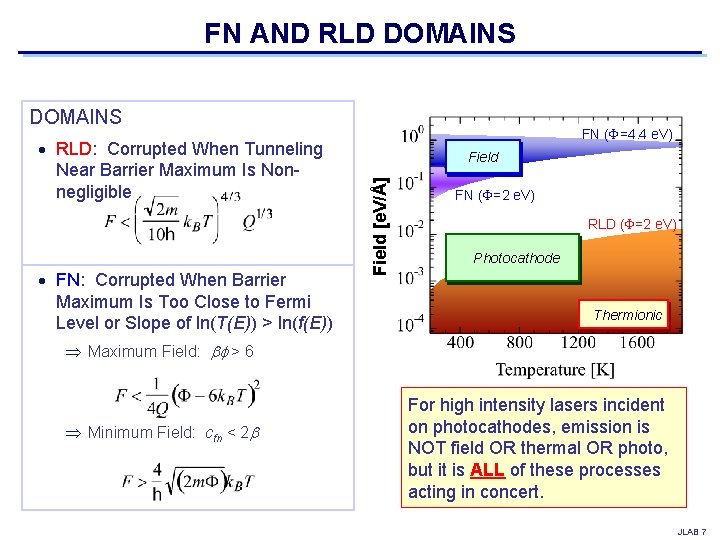
FN AND RLD DOMAINS FN: Corrupted When Barrier Maximum Is Too Close to Fermi Level or Slope of ln(T(E)) > ln(f(E)) Field [e. V/Å] RLD: Corrupted When Tunneling Near Barrier Maximum Is Nonnegligible FN (F=4. 4 e. V) FN (F=2 e. V) RLD (F=2 e. V) Photocathode Thermionic Maximum Field: bf > 6 Minimum Field: cfn < 2 b For high intensity lasers incident on photocathodes, emission is NOT field OR thermal OR photo, but it is ALL of these processes acting in concert. JLAB 7
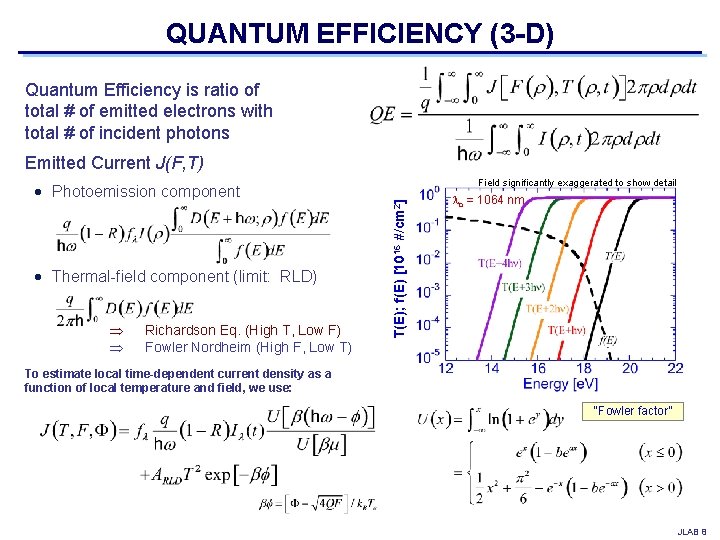
QUANTUM EFFICIENCY (3 -D) Quantum Efficiency is ratio of total # of emitted electrons with total # of incident photons Emitted Current J(F, T) Thermal-field component (limit: RLD) Richardson Eq. (High T, Low F) Fowler Nordheim (High F, Low T) Field significantly exaggerated to show detail T(E); f(E) [1016 #/cm 2] Photoemission component lo = 1064 nm To estimate local time-dependent current density as a function of local temperature and field, we use: “Fowler factor” JLAB 8
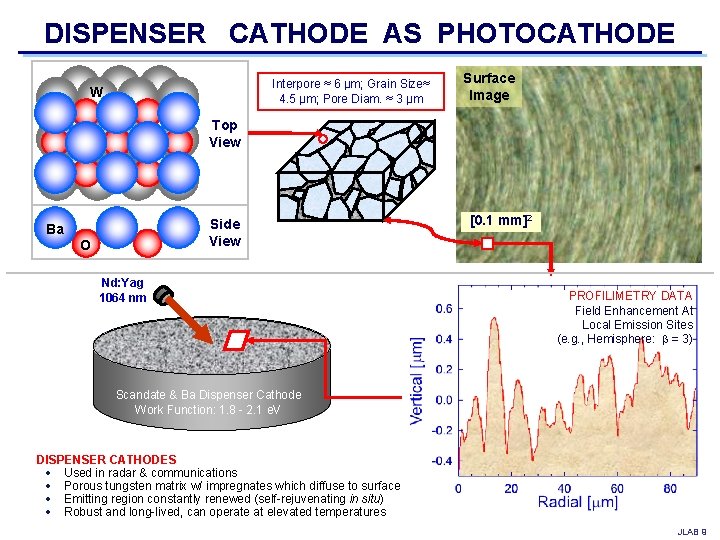
DISPENSER CATHODE AS PHOTOCATHODE Interpore ≈ 6 µm; Grain Size≈ 4. 5 µm; Pore Diam. ≈ 3 µm W Surface Image Top View Side View Ba O Nd: Yag 1064 nm [0. 1 mm]2 PROFILIMETRY DATA Field Enhancement At Local Emission Sites (e. g. , Hemisphere: b = 3) Scandate & Ba Dispenser Cathode Work Function: 1. 8 - 2. 1 e. V DISPENSER CATHODES Used in radar & communications Porous tungsten matrix w/ impregnates which diffuse to surface Emitting region constantly renewed (self-rejuvenating in situ) Robust and long-lived, can operate at elevated temperatures JLAB 9
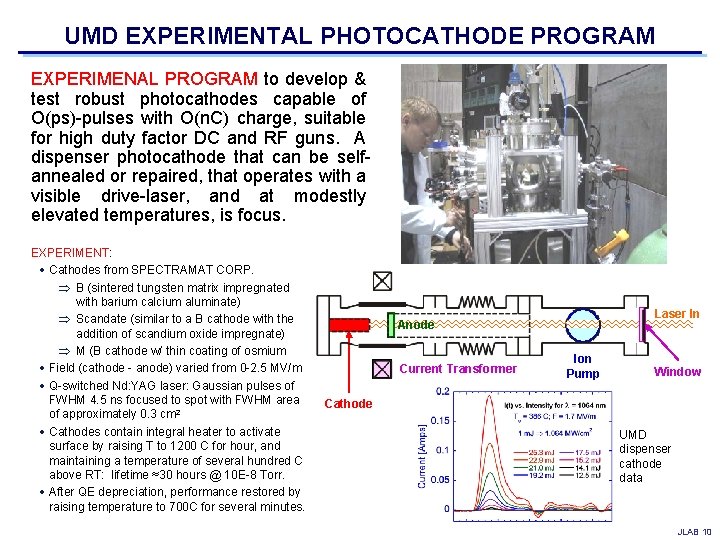
UMD EXPERIMENTAL PHOTOCATHODE PROGRAM EXPERIMENAL PROGRAM to develop & test robust photocathodes capable of O(ps)-pulses with O(n. C) charge, suitable for high duty factor DC and RF guns. A dispenser photocathode that can be selfannealed or repaired, that operates with a visible drive-laser, and at modestly elevated temperatures, is focus. EXPERIMENT: Cathodes from SPECTRAMAT CORP. B (sintered tungsten matrix impregnated with barium calcium aluminate) Scandate (similar to a B cathode with the addition of scandium oxide impregnate) M (B cathode w/ thin coating of osmium Field (cathode - anode) varied from 0 -2. 5 MV/m Q-switched Nd: YAG laser: Gaussian pulses of FWHM 4. 5 ns focused to spot with FWHM area of approximately 0. 3 cm 2 Cathodes contain integral heater to activate surface by raising T to 1200 C for hour, and maintaining a temperature of several hundred C above RT: lifetime ≈30 hours @ 10 E-8 Torr. After QE depreciation, performance restored by raising temperature to 700 C for several minutes. Laser In Anode Current Transformer Ion Pump Window Cathode UMD dispenser cathode data JLAB 10
![RAW EXP. DATA (Dispenser Cathode) EXP. VARIATION PARAMETERS Anode Va [k. V] 0 -15](http://slidetodoc.com/presentation_image_h2/461ba4fb3ec006e803f2b550fa1dca5c/image-11.jpg "RAW EXP. DATA (Dispenser Cathode) EXP. VARIATION PARAMETERS Anode Va [k. V] 0 -15")
RAW EXP. DATA (Dispenser Cathode) EXP. VARIATION PARAMETERS Anode Va [k. V] 0 -15 Bulk To [K] 297 -1040 Laser Energy [m. J] 4. 87 - 22 MATERIAL (Tungsten +Coatings) Chemical Potential 18. 08 e. V Laser Wavelength 1064 nm Coatings (monolayer) 1. 8 - 2. 1 e. V Illumination Radius 0. 525 cm 0. 125 cm THEORY: COMPLICATIONS TO 1 -D MODEL Laser intensity is Gaussian in cylindrical coordinate r: FWHM area = 0. 3 cm 2 Field Variation across surface: Cathode = 1. 27 cm Diameter. Anode: Tube w/ 1. 27 cm ID / 2. 54 cm OD Anode-cathode Separation = 0. 4 Cm. 1 k. V Anode = 0. 17 Mv/m @ center Electron Temperature Greatest Where Laser Strongest (Center of Beam) Emitted Charge [n. C] based on integration of Gaussian fit to numerical data… but: what is base-line current? What about circuit ringing? Work function variation with coverage Reflectivity & absorption depth depend on l UMD DISPENSER CATHODE DATA JLAB 11
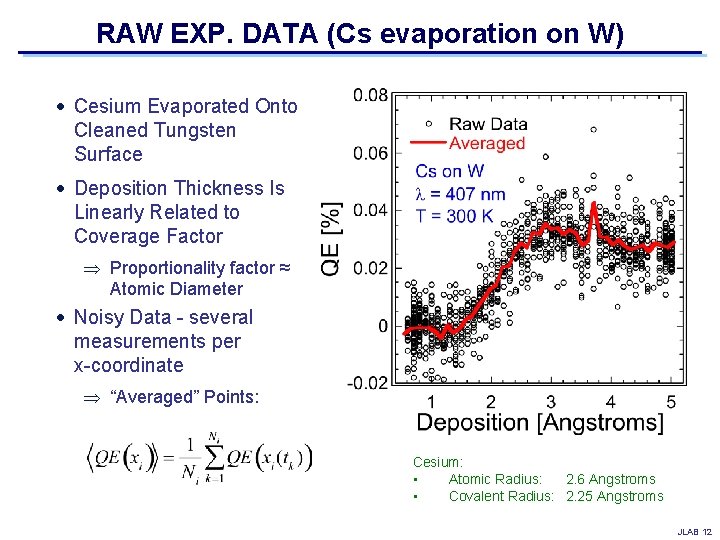
RAW EXP. DATA (Cs evaporation on W) Cesium Evaporated Onto Cleaned Tungsten Surface Deposition Thickness Is Linearly Related to Coverage Factor Proportionality factor ≈ Atomic Diameter Noisy Data - several measurements per x-coordinate “Averaged” Points: Cesium: • Atomic Radius: 2. 6 Angstroms • Covalent Radius: 2. 25 Angstroms JLAB 12
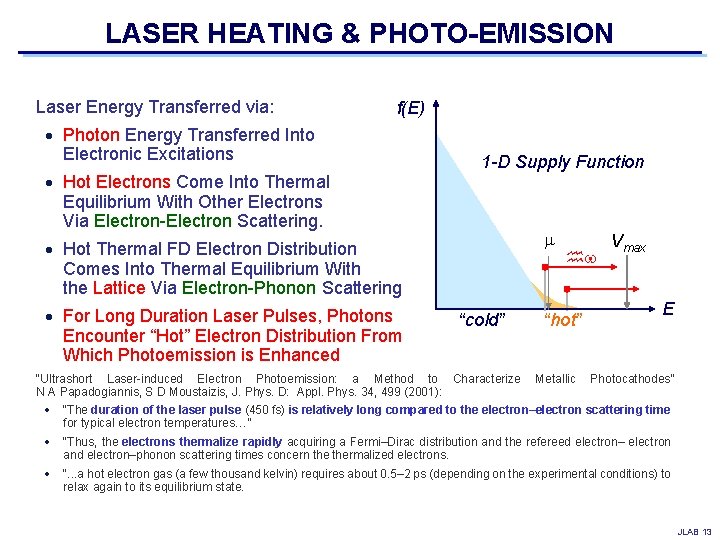
LASER HEATING & PHOTO-EMISSION Laser Energy Transferred via: f(E) Photon Energy Transferred Into Electronic Excitations Hot Electrons Come Into Thermal Equilibrium With Other Electrons Via Electron-Electron Scattering. 1 -D Supply Function m Hot Thermal FD Electron Distribution Comes Into Thermal Equilibrium With the Lattice Via Electron-Phonon Scattering For Long Duration Laser Pulses, Photons Encounter “Hot” Electron Distribution From Which Photoemission is Enhanced “cold” “Ultrashort Laser-induced Electron Photoemission: a Method to Characterize N A Papadogiannis, S D Moustaizis, J. Phys. D: Appl. Phys. 34, 499 (2001): hw “hot” Metallic Vmax E Photocathodes” “The duration of the laser pulse (450 fs) is relatively long compared to the electron–electron scattering time for typical electron temperatures…” “Thus, the electrons thermalize rapidly acquiring a Fermi–Dirac distribution and the refereed electron– electron and electron–phonon scattering times concern thermalized electrons. “. . . a hot electron gas (a few thousand kelvin) requires about 0. 5– 2 ps (depending on the experimental conditions) to relax again to its equilibrium state. JLAB 13
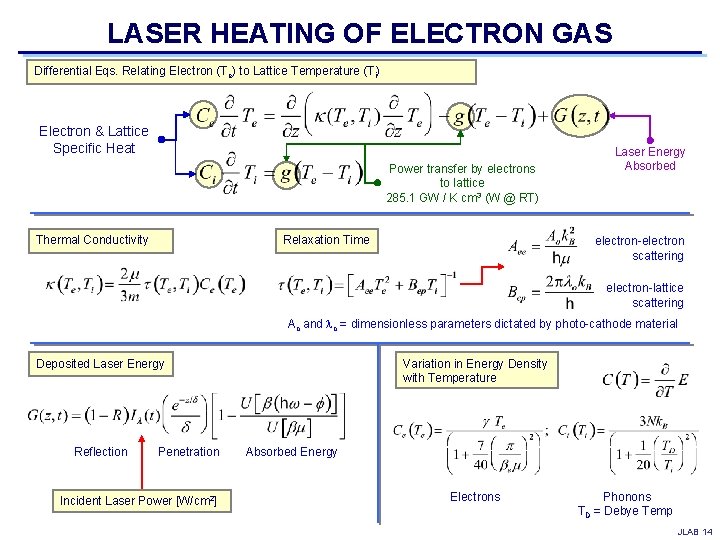
LASER HEATING OF ELECTRON GAS Differential Eqs. Relating Electron (Te) to Lattice Temperature (Ti) Electron & Lattice Specific Heat Power transfer by electrons to lattice 285. 1 GW / K cm 3 (W @ RT) Thermal Conductivity Relaxation Time Laser Energy Absorbed electron-electron scattering electron-lattice scattering Ao and lo = dimensionless parameters dictated by photo-cathode material Deposited Laser Energy Reflection Penetration Incident Laser Power [W/cm 2] Variation in Energy Density with Temperature Absorbed Energy Electrons Phonons TD = Debye Temp JLAB 14
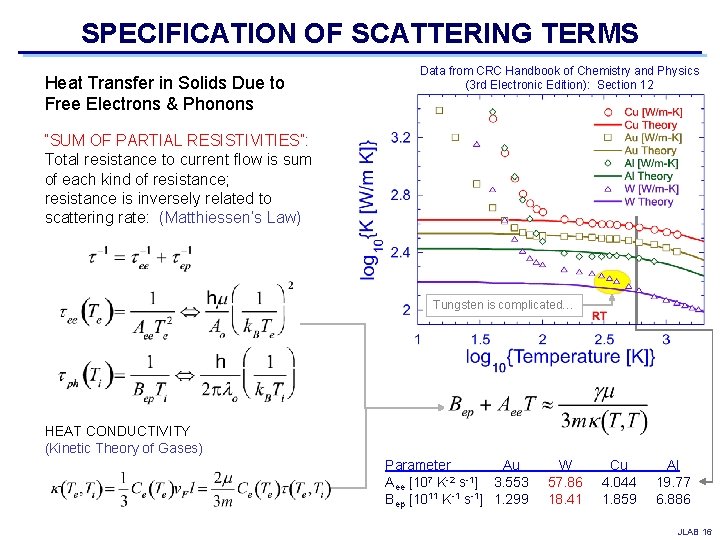
SPECIFICATION OF SCATTERING TERMS Heat Transfer in Solids Due to Free Electrons & Phonons Data from CRC Handbook of Chemistry and Physics (3 rd Electronic Edition): Section 12 “SUM OF PARTIAL RESISTIVITIES”: Total resistance to current flow is sum of each kind of resistance; resistance is inversely related to scattering rate: (Matthiessen’s Law) Tungsten is complicated… HEAT CONDUCTIVITY (Kinetic Theory of Gases) Parameter Au 7 -2 -1 Aee [10 K s ] 3. 553 Bep [1011 K-1 s-1] 1. 299 W 57. 86 18. 41 Cu 4. 044 1. 859 Al 19. 77 6. 886 JLAB 16
![DETERMINATION OF R[%] & d Algorithm: Spline-fit experimental optical data (e. g. , CRC,](http://slidetodoc.com/presentation_image_h2/461ba4fb3ec006e803f2b550fa1dca5c/image-16.jpg "DETERMINATION OF R[%] & d Algorithm: Spline-fit experimental optical data (e. g. , CRC,")
DETERMINATION OF R[%] & d Algorithm: Spline-fit experimental optical data (e. g. , CRC, AIP Handbook) for index of refraction (n), damping constant (k) Designate incident angle = q Use Equations to determine Reflectance R[%] and penetration depth of laser for given wavelength Consider W, Cu, Au… …other metals in database JLAB 17
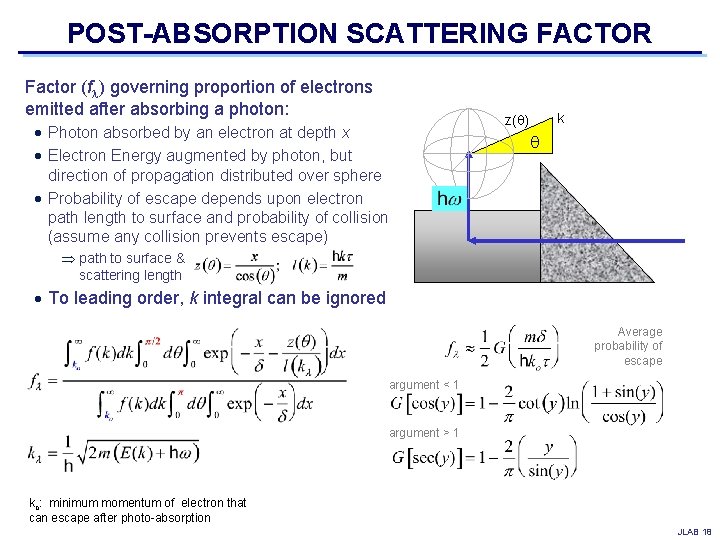
POST-ABSORPTION SCATTERING FACTOR Factor (fl) governing proportion of electrons emitted after absorbing a photon: Photon absorbed by an electron at depth x Electron Energy augmented by photon, but direction of propagation distributed over sphere Probability of escape depends upon electron path length to surface and probability of collision (assume any collision prevents escape) k z(q) q path to surface & scattering length To leading order, k integral can be ignored Average probability of escape argument < 1 argument > 1 ko: minimum momentum of electron that can escape after photo-absorption JLAB 18
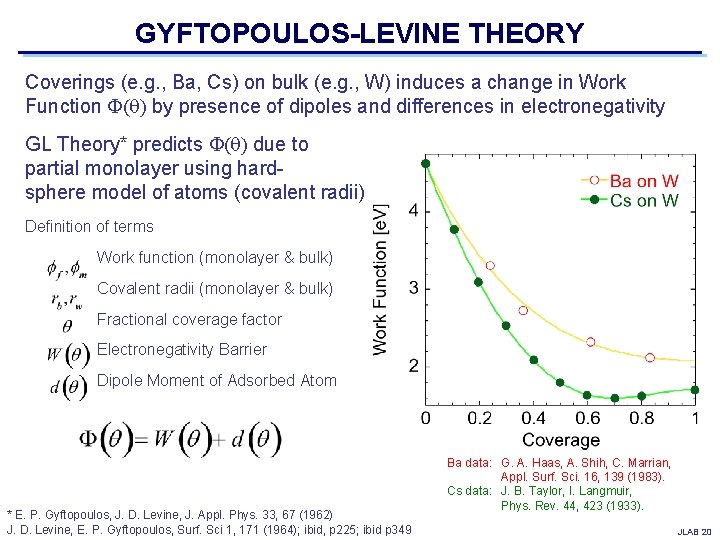
GYFTOPOULOS-LEVINE THEORY Coverings (e. g. , Ba, Cs) on bulk (e. g. , W) induces a change in Work Function F(q) by presence of dipoles and differences in electronegativity GL Theory* predicts F(q) due to partial monolayer using hardsphere model of atoms (covalent radii) Definition of terms Work function (monolayer & bulk) Covalent radii (monolayer & bulk) Fractional coverage factor Electronegativity Barrier Dipole Moment of Adsorbed Atom * E. P. Gyftopoulos, J. D. Levine, J. Appl. Phys. 33, 67 (1962) J. D. Levine, E. P. Gyftopoulos, Surf. Sci 1, 171 (1964); ibid, p 225; ibid p 349 Ba data: G. A. Haas, A. Shih, C. Marrian, Appl. Surf. Sci. 16, 139 (1983). Cs data: J. B. Taylor, I. Langmuir, Phys. Rev. 44, 423 (1933). JLAB 20
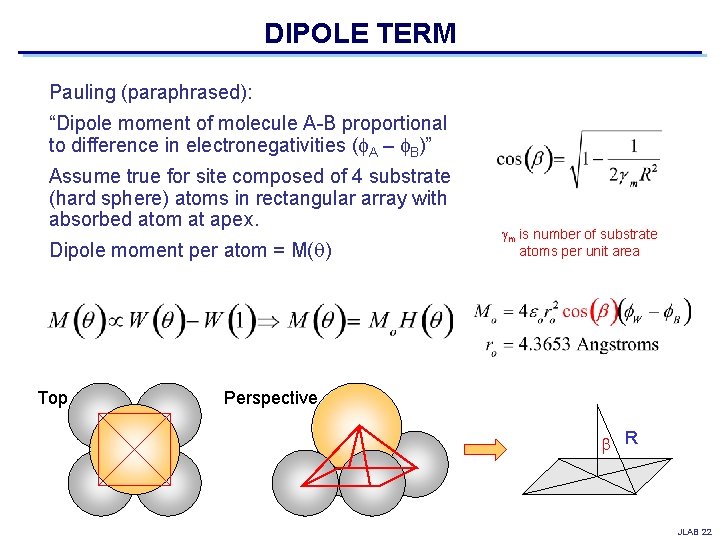
DIPOLE TERM Pauling (paraphrased): “Dipole moment of molecule A-B proportional to difference in electronegativities (f. A – f. B)” Assume true for site composed of 4 substrate (hard sphere) atoms in rectangular array with absorbed atom at apex. Dipole moment per atom = M(q) Top gm is number of substrate atoms per unit area Perspective b R JLAB 22
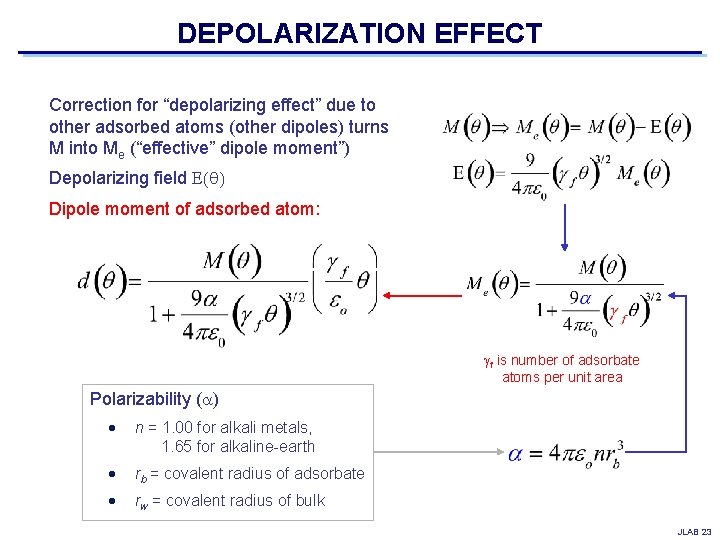
DEPOLARIZATION EFFECT Correction for “depolarizing effect” due to other adsorbed atoms (other dipoles) turns M into Me (“effective” dipole moment”) Depolarizing field E(q) Dipole moment of adsorbed atom: gf is number of adsorbate atoms per unit area Polarizability (a) n = 1. 00 for alkali metals, 1. 65 for alkaline-earth rb = covalent radius of adsorbate rw = covalent radius of bulk JLAB 23
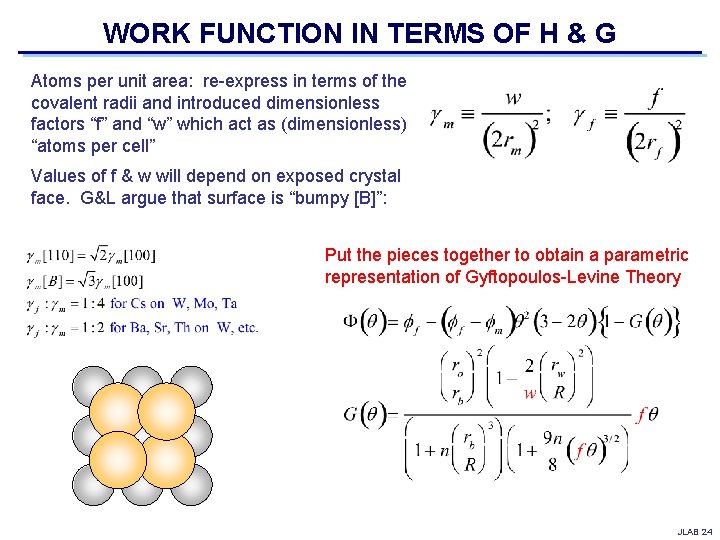
WORK FUNCTION IN TERMS OF H & G Atoms per unit area: re-express in terms of the covalent radii and introduced dimensionless factors “f” and “w” which act as (dimensionless) “atoms per cell” Values of f & w will depend on exposed crystal face. G&L argue that surface is “bumpy [B]”: Put the pieces together to obtain a parametric representation of Gyftopoulos-Levine Theory JLAB 24
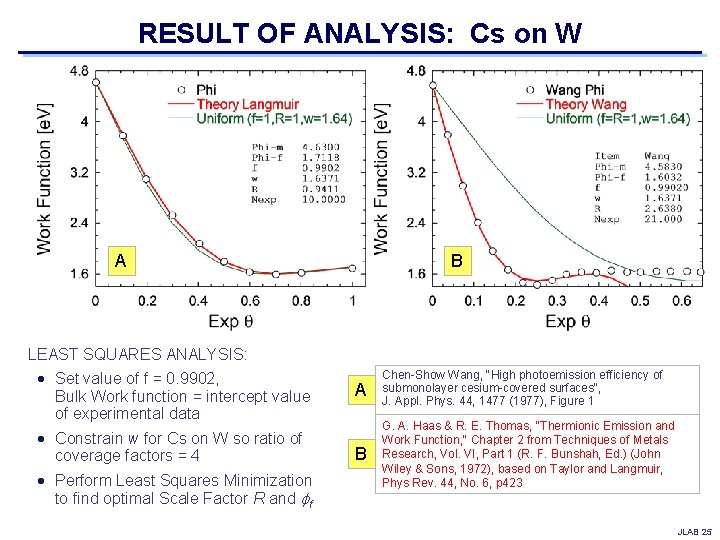
RESULT OF ANALYSIS: Cs on W A B LEAST SQUARES ANALYSIS: Set value of f = 0. 9902, Bulk Work function = intercept value of experimental data A Chen-Show Wang, "High photoemission efficiency of submonolayer cesium-covered surfaces", J. Appl. Phys. 44, 1477 (1977), Figure 1 Constrain w for Cs on W so ratio of coverage factors = 4 B G. A. Haas & R. E. Thomas, "Thermionic Emission and Work Function, " Chapter 2 from Techniques of Metals Research, Vol. VI, Part 1 (R. F. Bunshah, Ed. ) (John Wiley & Sons, 1972), based on Taylor and Langmuir, Phys Rev. 44, No. 6, p 423 Perform Least Squares Minimization to find optimal Scale Factor R and ff JLAB 25
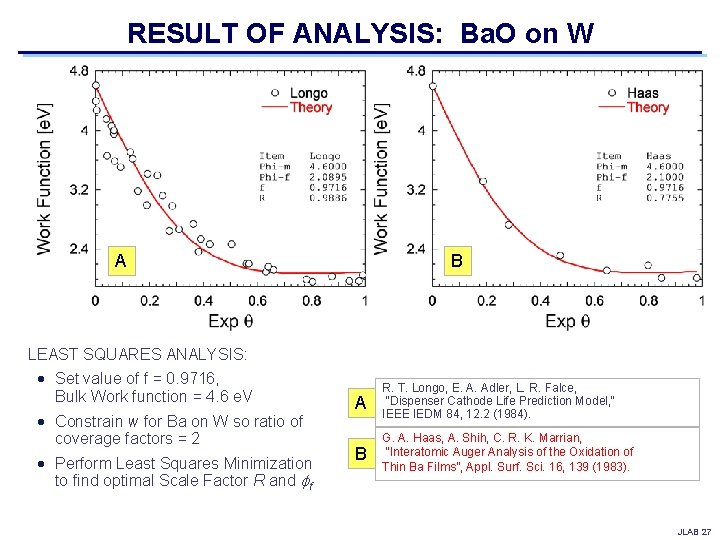
RESULT OF ANALYSIS: Ba. O on W A B LEAST SQUARES ANALYSIS: Set value of f = 0. 9716, Bulk Work function = 4. 6 e. V Constrain w for Ba on W so ratio of coverage factors = 2 Perform Least Squares Minimization to find optimal Scale Factor R and ff A R. T. Longo, E. A. Adler, L. R. Falce, "Dispenser Cathode Life Prediction Model, " IEEE IEDM 84, 12. 2 (1984). B G. A. Haas, A. Shih, C. R. K. Marrian, "Interatomic Auger Analysis of the Oxidation of Thin Ba Films”, Appl. Surf. Sci. 16, 139 (1983). JLAB 27
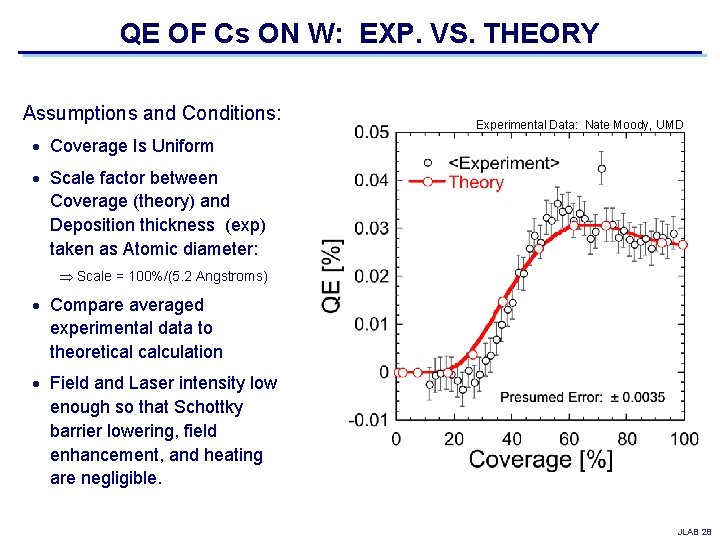
QE OF Cs ON W: EXP. VS. THEORY Assumptions and Conditions: Experimental Data: Nate Moody, UMD Coverage Is Uniform Scale factor between Coverage (theory) and Deposition thickness (exp) taken as Atomic diameter: Scale = 100%/(5. 2 Angstroms) Compare averaged experimental data to theoretical calculation Field and Laser intensity low enough so that Schottky barrier lowering, field enhancement, and heating are negligible. JLAB 28
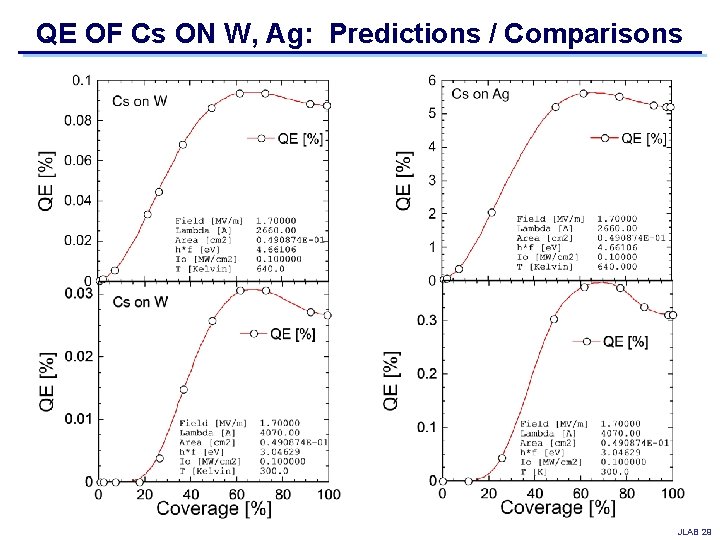
QE OF Cs ON W, Ag: Predictions / Comparisons JLAB 29
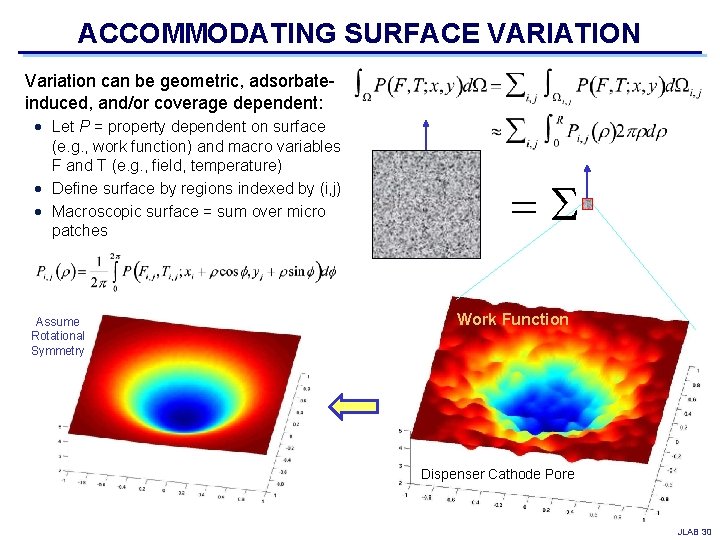
ACCOMMODATING SURFACE VARIATION Variation can be geometric, adsorbateinduced, and/or coverage dependent: Let P = property dependent on surface (e. g. , work function) and macro variables F and T (e. g. , field, temperature) Define surface by regions indexed by (i, j) Macroscopic surface = sum over micro patches Assume Rotational Symmetry =S Work Function Dispenser Cathode Pore JLAB 30
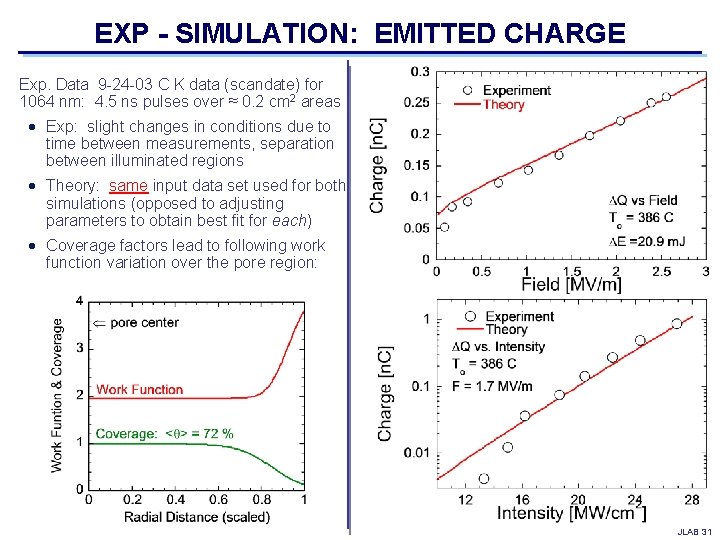
EXP - SIMULATION: EMITTED CHARGE Exp. Data 9 -24 -03 C K data (scandate) for 1064 nm: 4. 5 ns pulses over ≈ 0. 2 cm 2 areas Exp: slight changes in conditions due to time between measurements, separation between illuminated regions Theory: same input data set used for both simulations (opposed to adjusting parameters to obtain best fit for each) Coverage factors lead to following work function variation over the pore region: JLAB 31
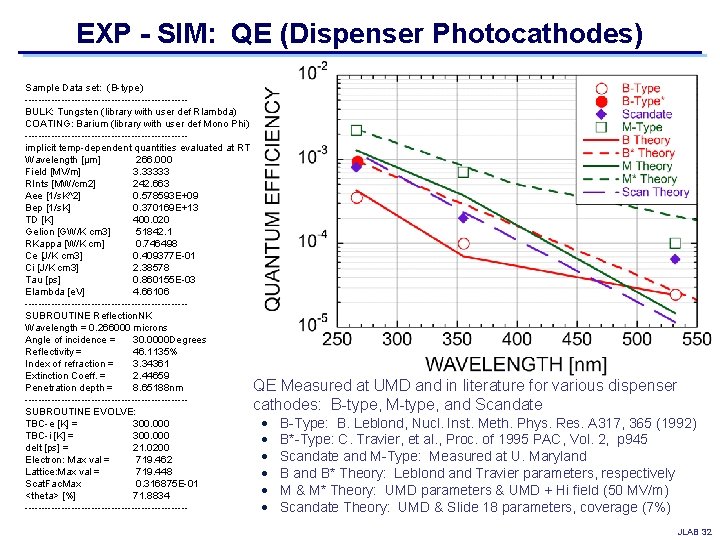
EXP - SIM: QE (Dispenser Photocathodes) Sample Data set: (B-type) ------------------------BULK: Tungsten (library with user def Rlambda) COATING: Barium (library with user def Mono Phi) ------------------------implicit temp-dependent quantities evaluated at RT Wavelength [µm] 266. 000 Field [MV/m] 3. 33333 RInts [MW/cm 2] 242. 663 Aee [1/s. K^2] 0. 578593 E+09 Bep [1/s. K] 0. 370169 E+13 TD [K] 400. 020 Gelion [GW/K cm 3] 51842. 1 RKappa [W/K cm] 0. 746498 Ce [J/K cm 3] 0. 409377 E-01 Ci [J/K cm 3] 2. 38578 Tau [ps] 0. 860155 E-03 Elambda [e. V] 4. 66106 ------------------------SUBROUTINE Reflection. NK Wavelength = 0. 266000 microns Angle of incidence = 30. 0000 Degrees Reflectivity = 46. 1135% Index of refraction = 3. 34361 Extinction Coeff. = 2. 44659 Penetration depth = 8. 65188 nm ------------------------SUBROUTINE EVOLVE: TBC-e [K] = 300. 000 TBC-i [K] = 300. 000 delt [ps] = 21. 0200 Electron: Max val = 719. 462 Lattice: Max val = 719. 448 Scat. Fac. Max 0. 316875 E-01 <theta> [%] 71. 8834 ------------------------- QE Measured at UMD and in literature for various dispenser cathodes: B-type, M-type, and Scandate B-Type: B. Leblond, Nucl. Inst. Meth. Phys. Res. A 317, 365 (1992) B*-Type: C. Travier, et al. , Proc. of 1995 PAC, Vol. 2, p 945 Scandate and M-Type: Measured at U. Maryland B* Theory: Leblond and Travier parameters, respectively M & M* Theory: UMD parameters & UMD + Hi field (50 MV/m) Scandate Theory: UMD & Slide 18 parameters, coverage (7%) JLAB 32
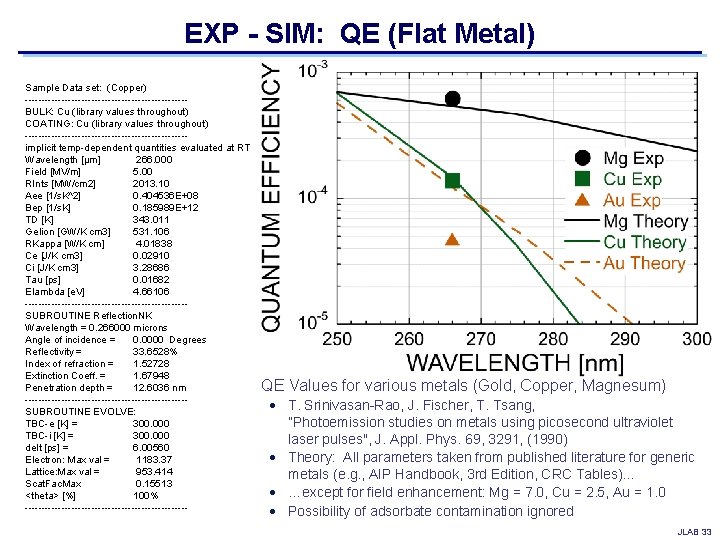
EXP - SIM: QE (Flat Metal) Sample Data set: (Copper) ------------------------BULK: Cu (library values throughout) COATING: Cu (library values throughout) ------------------------implicit temp-dependent quantities evaluated at RT Wavelength [µm] 266. 000 Field [MV/m] 5. 00 RInts [MW/cm 2] 2013. 10 Aee [1/s. K^2] 0. 404536 E+08 Bep [1/s. K] 0. 185989 E+12 TD [K] 343. 011 Gelion [GW/K cm 3] 531. 106 RKappa [W/K cm] 4. 01838 Ce [J/K cm 3] 0. 02910 Ci [J/K cm 3] 3. 28686 Tau [ps] 0. 01682 Elambda [e. V] 4. 66106 ------------------------SUBROUTINE Reflection. NK Wavelength = 0. 266000 microns Angle of incidence = 0. 0000 Degrees Reflectivity = 33. 6528% Index of refraction = 1. 52728 Extinction Coeff. = 1. 67948 Penetration depth = 12. 6036 nm ------------------------SUBROUTINE EVOLVE: TBC-e [K] = 300. 000 TBC-i [K] = 300. 000 delt [ps] = 6. 00560 Electron: Max val = 1183. 37 Lattice: Max val = 953. 414 Scat. Fac. Max 0. 15513 <theta> [%] 100% ------------------------- QE Values for various metals (Gold, Copper, Magnesum) T. Srinivasan-Rao, J. Fischer, T. Tsang, ”Photoemission studies on metals using picosecond ultraviolet laser pulses", J. Appl. Phys. 69, 3291, (1990) Theory: All parameters taken from published literature for generic metals (e. g. , AIP Handbook, 3 rd Edition, CRC Tables)… …except for field enhancement: Mg = 7. 0, Cu = 2. 5, Au = 1. 0 Possibility of adsorbate contamination ignored JLAB 33
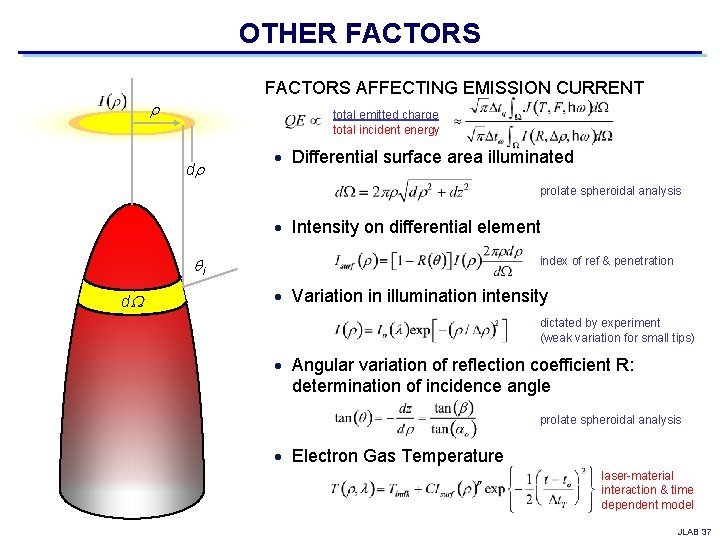
OTHER FACTORS AFFECTING EMISSION CURRENT r total emitted charge total incident energy dr Differential surface area illuminated prolate spheroidal analysis Intensity on differential element qi d. W index of ref & penetration Variation in illumination intensity dictated by experiment (weak variation for small tips) Angular variation of reflection coefficient R: determination of incidence angle prolate spheroidal analysis Electron Gas Temperature laser-material interaction & time dependent model JLAB 37
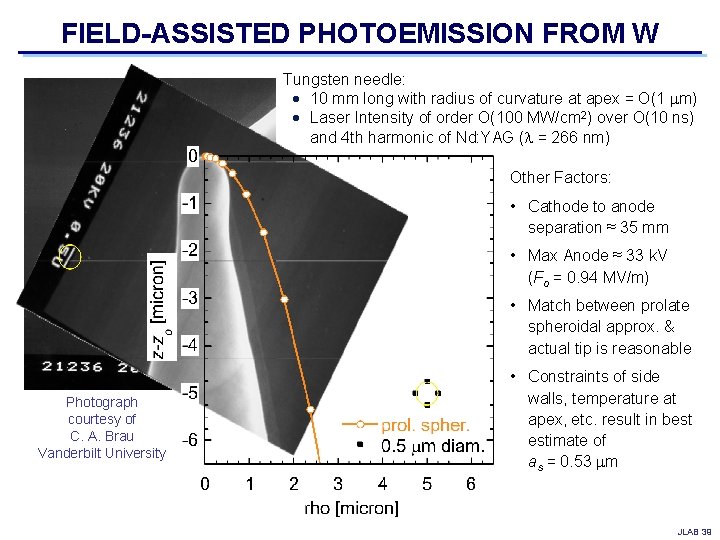
FIELD-ASSISTED PHOTOEMISSION FROM W Tungsten needle: 10 mm long with radius of curvature at apex = O(1 mm) Laser Intensity of order O(100 MW/cm 2) over O(10 ns) and 4 th harmonic of Nd: YAG (l = 266 nm) Other Factors: • Cathode to anode separation ≈ 35 mm • Max Anode ≈ 33 k. V (Fo = 0. 94 MV/m) • Match between prolate spheroidal approx. & actual tip is reasonable Photograph courtesy of C. A. Brau Vanderbilt University • Constraints of side walls, temperature at apex, etc. result in best estimate of as = 0. 53 mm JLAB 39
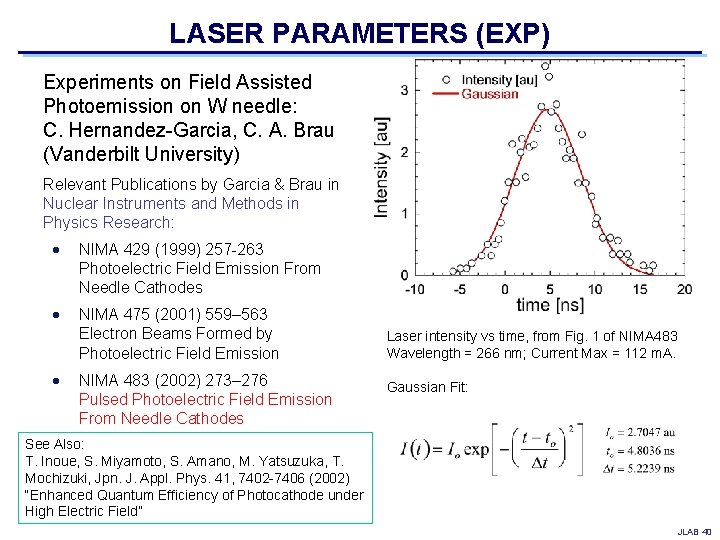
LASER PARAMETERS (EXP) Experiments on Field Assisted Photoemission on W needle: C. Hernandez-Garcia, C. A. Brau (Vanderbilt University) Relevant Publications by Garcia & Brau in Nuclear Instruments and Methods in Physics Research: NIMA 429 (1999) 257 -263 Photoelectric Field Emission From Needle Cathodes NIMA 475 (2001) 559– 563 Electron Beams Formed by Photoelectric Field Emission NIMA 483 (2002) 273– 276 Pulsed Photoelectric Field Emission From Needle Cathodes Laser intensity vs time, from Fig. 1 of NIMA 483 Wavelength = 266 nm; Current Max = 112 m. A. Gaussian Fit: See Also: T. Inoue, S. Miyamoto, S. Amano, M. Yatsuzuka, T. Mochizuki, Jpn. J. Appl. Phys. 41, 7402 -7406 (2002) “Enhanced Quantum Efficiency of Photocathode under High Electric Field” JLAB 40
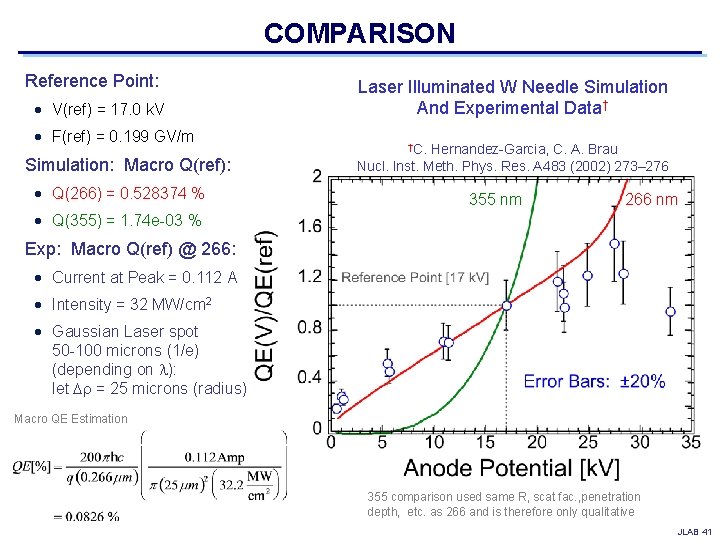
COMPARISON Reference Point: V(ref) = 17. 0 k. V F(ref) = 0. 199 GV/m Simulation: Macro Q(ref): Q(266) = 0. 528374 % Laser Illuminated W Needle Simulation And Experimental Data† †C. Hernandez-Garcia, C. A. Brau Nucl. Inst. Meth. Phys. Res. A 483 (2002) 273– 276 355 nm 266 nm Q(355) = 1. 74 e-03 % Exp: Macro Q(ref) @ 266: Current at Peak = 0. 112 A Intensity = 32 MW/cm 2 Gaussian Laser spot 50 -100 microns (1/e) (depending on l): let Dr = 25 microns (radius) Macro QE Estimation 355 comparison used same R, scat fac. , penetration depth, etc. as 266 and is therefore only qualitative JLAB 41
SUMMARY Photoinjectors are, or are becoming, important electron sources for… Synchrotron Light Sources Free Electron Lasers X-ray Sources, etc. …due to high quality beams that can be achieved: Generating a High Quality Beam Right From the Start Is Important Collaborative Exp. / Theory (NRL & UMD) Research Program: (EXP) investigate photocathode technologies and behavior of dispenser cathodes as photoemitters in particular; quantify emitter surface and photoemissive properties (quantum efficiency, emission, etc. ); custom design photocathodes (THEORY) photoemission theory & photocathode code treating (i) emitter surface (ii) emitted distribution & beam characteristics (iii) factors which modify surface IMPORTANCE OF PRESENT PHOTOCATHODE PROGRAM Megawatt-class FEL’s need development of long-lived, robust, in situ repairable, low emittance, high rep rate photocathodes: Such cathodes are presently unavailable. To develop such cathodes, a time-dependent model, validated and coupled to experiment, is necessary to predict and characterize temporal response, quantum efficiency, behavior, etc JLAB 42
- Slides: 34