
Thomas Jefferson A Republican Takes Office 1 Inauguration
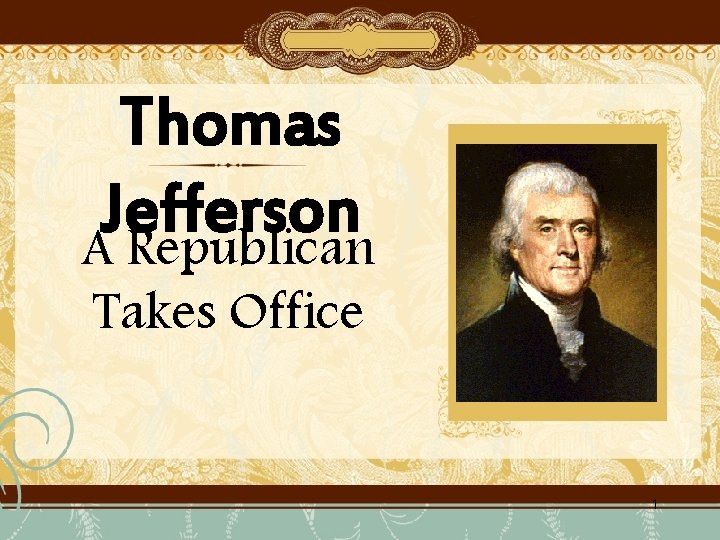
Thomas Jefferson A Republican Takes Office 1

Inauguration Day v. March 4, 1801: Inauguration of our 3 rd President. v. First President to be Inaugurated at the Capitol Building which was still unfinished. v. Jefferson was a man of the people and wanted a simple Inauguration so he walked to and from the event. v. He wanted the Inauguration to be a low-key affair because he believed the nation’s strength came from ordinary people. 2
Democratic Style Jefferson was determined to make the government more democratic. Democratic- ensuring that all people have the same rights. He was an ordinary citizen: ØCasual clothes ØPreferred quiet dinners ØGreeted by shaking hands, not bowing ØInformal manner These qualities showed that even though he was President, Jefferson was an ordinary citizen. 3
Federalists Were Worried Federalists were worried about Jefferson’s democratic beliefs. Support of the French Revolution caused fear that might bring revolutionary change to the United States. Afraid of punishment for Alien & Sedition Acts that jailed Republicans. 4
A Smaller Role for the Federal Government Although Republicans were the majority, they would not treat Federalists harshly; however, Jefferson did want to change their policies. “We are all Republicans, we are all Federalists. ” What do you think this statement means? Federalists had made the national government too large and too powerful. Why did Jefferson oppose a powerful national government? 5
New Economic Policies Jefferson wanted to reduce government power by reducing the federal budget. This would keep the federal debt low. Jefferson believed in the economic idea of laissez faire. Laissez Faire – “let alone” government should play as small as possible role in economic affairs. Free Market was an idea of laissez faire. Free Market – allows goods & services exchanged with little regulation. 6
• Tries to cut federal budget & reduce federal debt • Promotes laissez faire policies in economic affairs • Decreases the size of government departments • Reduces the size of army & navy • Asks Congress to repeal the whisky tax Reduce size of government -------------------Reconcile party differences • Retains the Bank of the United States • Continues to pay off state debts using federal moneys • Allows many Federalists to keep their government jobs 7
Strengthening the Supreme Court üBefore Jefferson was inaugurated, Congress increased the number of federal judges. üPresident Adams appointed Federalists to fill these positions. üThe framers of the Constitution expected courts to balance the powers of President and Congress. üJohn Marshall appointed Chief Justice by Adams. 8
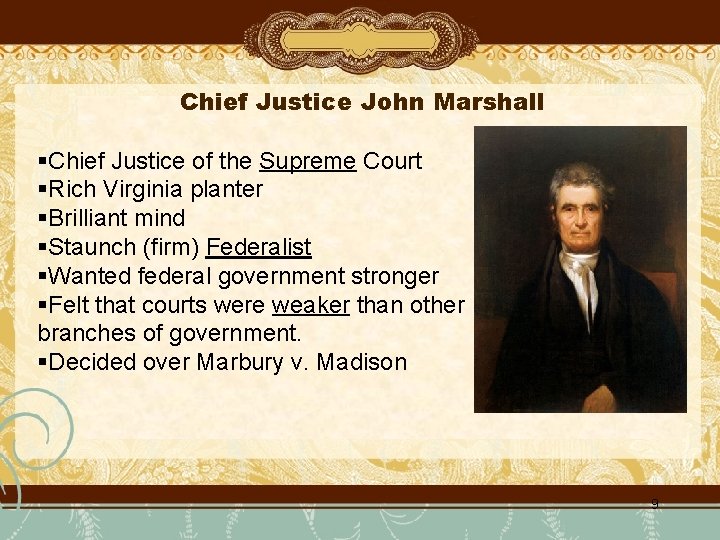
Chief Justice John Marshall §Chief Justice of the Supreme Court §Rich Virginia planter §Brilliant mind §Staunch (firm) Federalist §Wanted federal government stronger §Felt that courts were weaker than other branches of government. §Decided over Marbury v. Madison 9
Marbury v. Madison §Case involved William Marbury, a judge appointed by Adams on his last night as President. §Republicans were angry and refused to accept “midnight judge”. Why do you think Republicans felt this way? §They accused Federalists of using unfair tactics to keep control of courts. §Jefferson ordered Secretary of State James Madison not to deliver papers confirming Marbury’s appointment. 10
Marbury sued Madison. Due to the Judiciary Act of 1789, only the Supreme Court could decide a case that was brought against a federal official. Supreme Court ruled against Marbury. The Judiciary Act was unconstitutional. The Constitution did not give the court the right to decide cases against federal officials. A precedent was set with the ruling. It gave the Supreme Court the power to decide whether laws passed by Congress were constitutional or unconstitutional. What do you think the precedent set was? 11
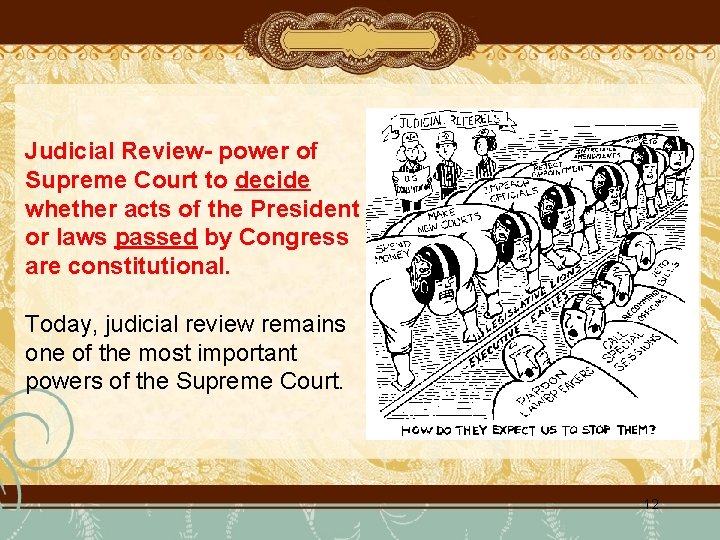
Judicial Review- power of Supreme Court to decide whether acts of the President or laws passed by Congress are constitutional. Today, judicial review remains one of the most important powers of the Supreme Court. 12
REVIEW • Jefferson wanted a more Democratic government • Federalists were worried about democratic beliefs • Smaller role for government • New economic policies • Strengthening of the Supreme Court • John Marshall • Marbury v. Madison • Judicial Review 13
- Slides: 13