
Thomas Heskia The Impact of Culture on Social
- Slides: 17
Thomas Heskia The Impact of Culture on Social Development and General Well-Being: Is it quantifiable? The Audiovisual Sector as an Example
Approaches to Measure Culture in Relation to Well-being • What is being produced (inputs) – GDP contribution – Employment – Industrial classification • What is being consumed (output) • What is perceived (outcome) Approach of happiness research concentrates on the perceived well-being of individuals.
The World of Television as a central cultural instance in the last decades Decreasing importance because of media convergence and non linear services • US Dominance of corporate media – „Networks“ – Public service Broadcasting as a non competing additional offer • Europe Dual system of private and public service TV – Tradition of PSB as a democratic institution – Strong private production – Co-finances cinema production
The Bipolar Field of Film Production • Hollywood (MGM, Warner Bros. etc. ) Privately financed – Worldwide Distribution – Reciprocal adaption of consumer choices – Up to 85% market share in Western Europe • European production – Small domestic markets, difficult distribution abroad – production costs do not find recoupment in the market Dependent on public subsidies
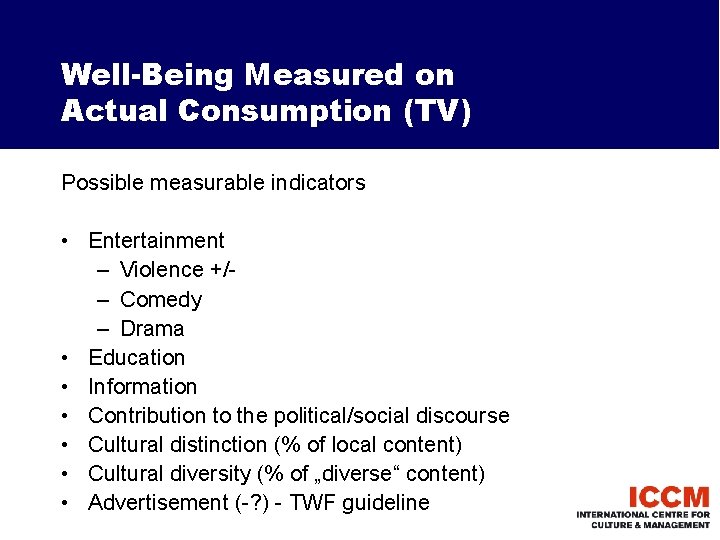
Well-Being Measured on Actual Consumption (TV) Possible measurable indicators • Entertainment – Violence +/– Comedy – Drama • Education • Information • Contribution to the political/social discourse • Cultural distinction (% of local content) • Cultural diversity (% of „diverse“ content) • Advertisement (-? ) - TWF guideline
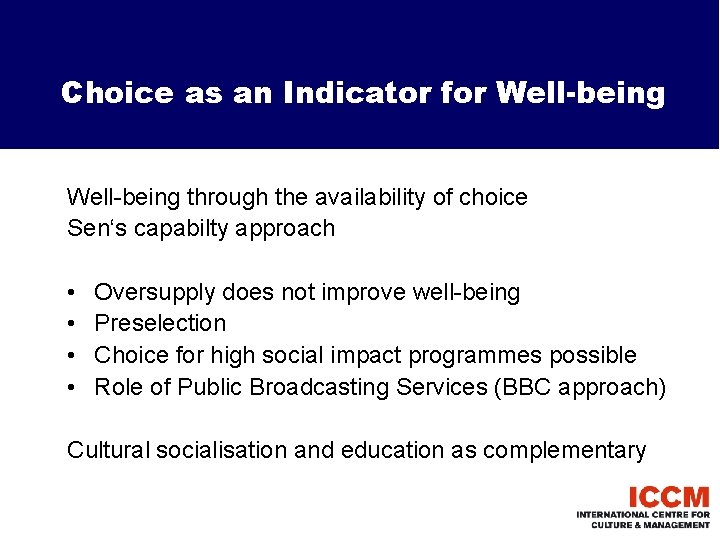
Choice as an Indicator for Well-being through the availability of choice Sen‘s capabilty approach • • Oversupply does not improve well-being Preselection Choice for high social impact programmes possible Role of Public Broadcasting Services (BBC approach) Cultural socialisation and education as complementary
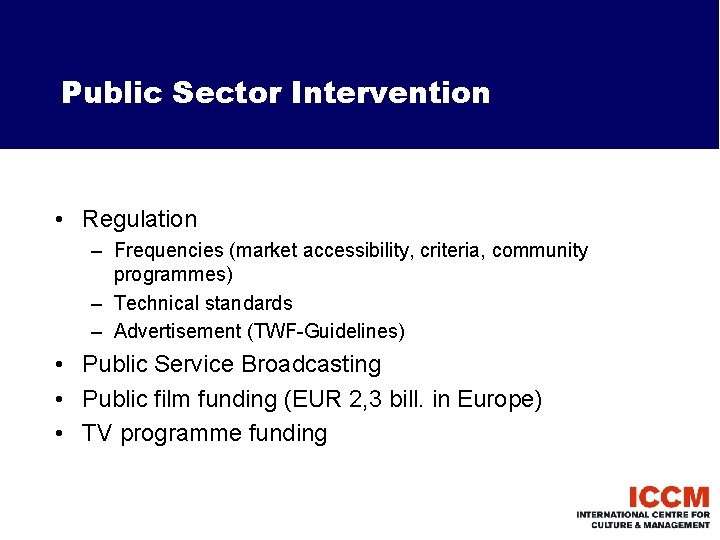
Public Sector Intervention • Regulation – Frequencies (market accessibility, criteria, community programmes) – Technical standards – Advertisement (TWF-Guidelines) • Public Service Broadcasting • Public film funding (EUR 2, 3 bill. in Europe) • TV programme funding
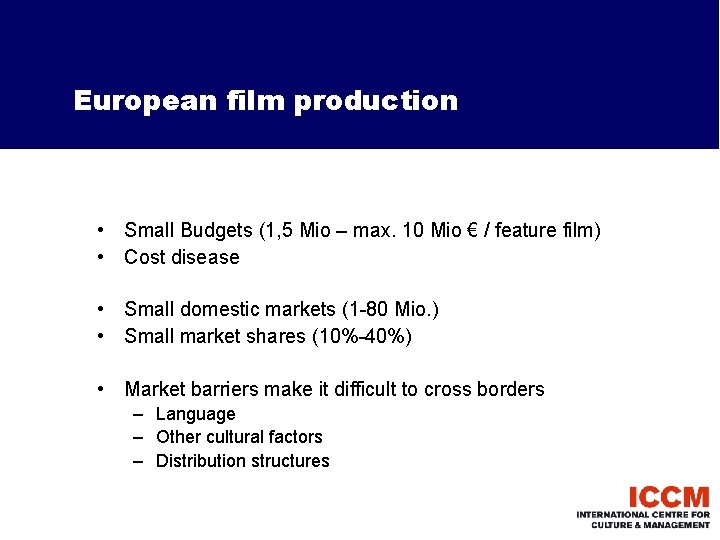
European film production • Small Budgets (1, 5 Mio – max. 10 Mio € / feature film) • Cost disease • Small domestic markets (1 -80 Mio. ) • Small market shares (10%-40%) • Market barriers make it difficult to cross borders – Language – Other cultural factors – Distribution structures
Film as Cultural AND (? ) Commercial good • Film as art of ist own („ 7 th art“) • Contribution to cultural diversity For that – Justification for public funding – Film funding as a permitted state aid under the exception culturelle but – High share of non creative work (on the set, postproduction, processing laboratories) – Contribution to regional economic development
European Film Finance • • Own investment of the producer (often below 10%) Broadcasters (pre-sales, licenses, subsidies) Direct subsidies (national, regional, European, cultural funds) Indirect subsidies through tax incentives Growing budgets lead to an ever growing share of international (i. e. inter-European) co-productions + advantage of a 2 nd home market! Statistics available by the European Audiovisual obeservatory (COE)
Benefits • National/Regional Culture/s • Cultural diversity • Social benefits • Economic Impact
Economic Impact of Film Subsidies • Regional effects: – Supposed multiplier – No inputs deducted • Employment; – Sector grows and shrinks with the amount of public subsidies
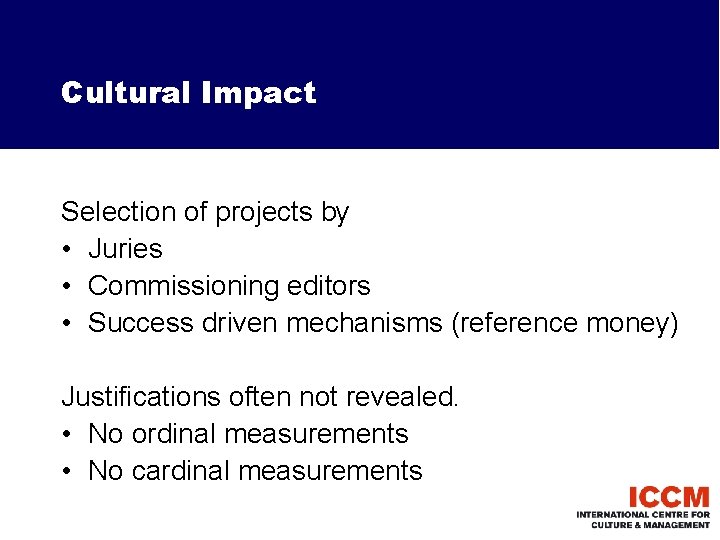
Cultural Impact Selection of projects by • Juries • Commissioning editors • Success driven mechanisms (reference money) Justifications often not revealed. • No ordinal measurements • No cardinal measurements
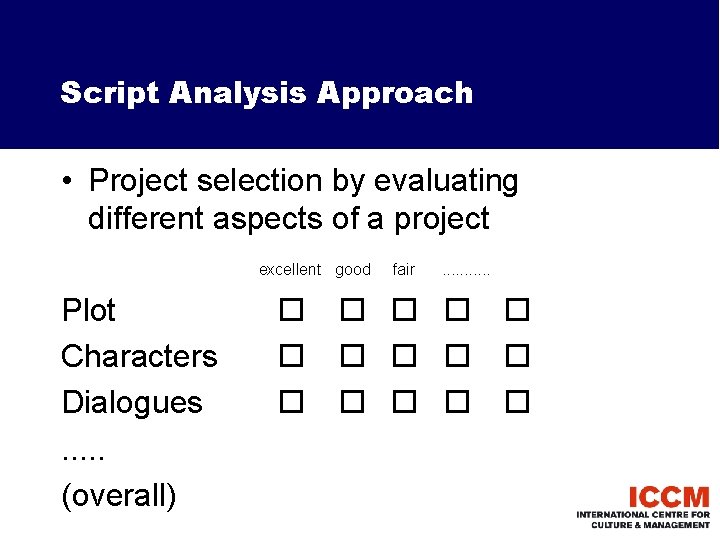
Script Analysis Approach • Project selection by evaluating different aspects of a project excellent good Plot Characters Dialogues. . . (overall) fair . . .
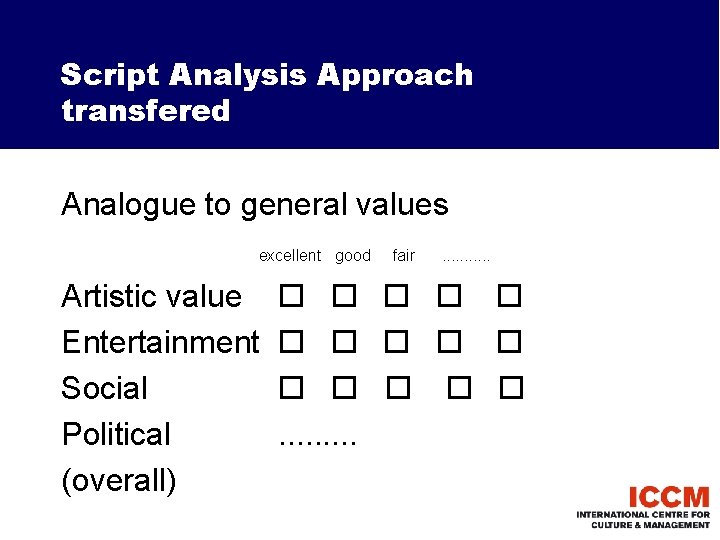
Script Analysis Approach transfered Analogue to general values excellent good Artistic value Entertainment Social Political (overall) fair . . . . .
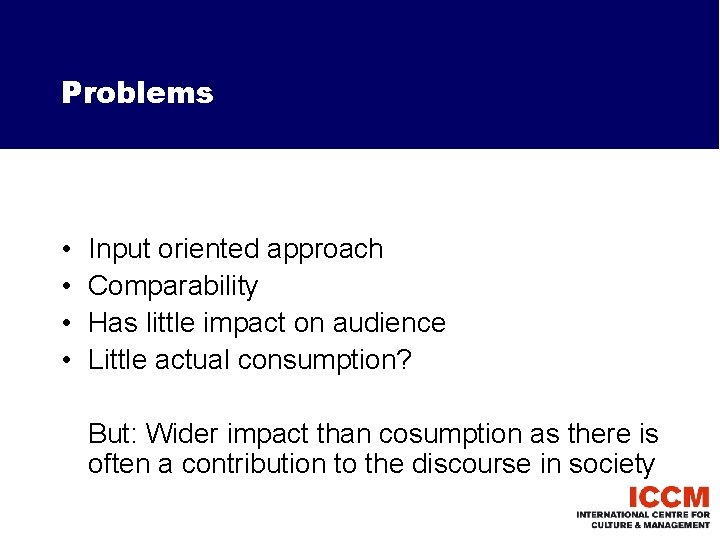
Problems • • Input oriented approach Comparability Has little impact on audience Little actual consumption? But: Wider impact than cosumption as there is often a contribution to the discourse in society
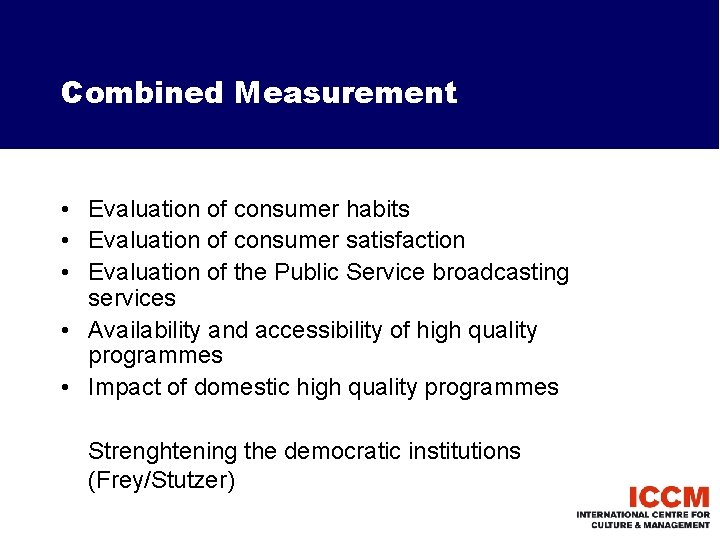
Combined Measurement • Evaluation of consumer habits • Evaluation of consumer satisfaction • Evaluation of the Public Service broadcasting services • Availability and accessibility of high quality programmes • Impact of domestic high quality programmes Strenghtening the democratic institutions (Frey/Stutzer)