
This work is licensed under a Creative Commons


- Slides: 18
This work is licensed under a Creative Commons Attribution-Share. Alike 4. 0 International License. This presentation is released under Creative Commons. A 6 ribute, on 4. 0 License. You are free to use, distribute and modify it , including for commercial purposes, provided you acknowledge the source.
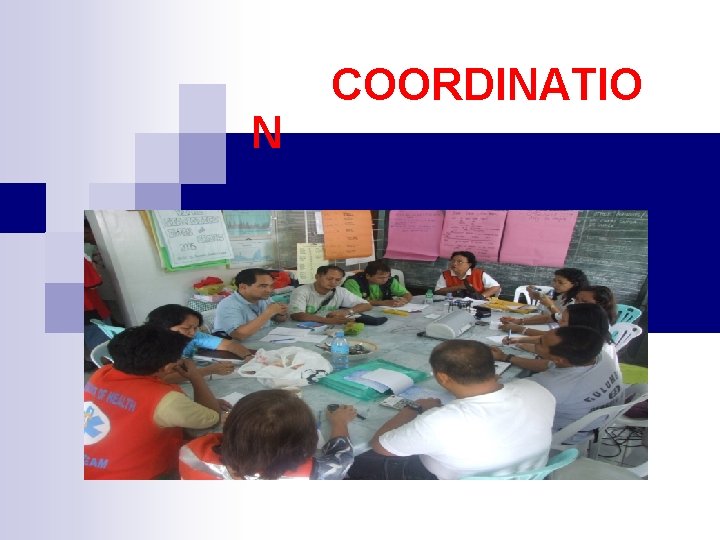
N COORDINATIO
COORDINATION n According to Henry Fayol “ to co-ordinate is to harmonize all the activities of a concern so as to facilitate its working and its success”
INTRODUCTION TO COORDINATION Ø Meaning: 1. the act or state of coordinating or of being coordinated. 2. proper order or relationship. 3. harmonious combination or interaction, as of functions or parts.
WHY COORDINATION? "Coordination" Must Exist or There's No Organization -- Only an "Experience"
PRINCIPLES OF COORDINATION 1) DIRECT PERSONAL CONTACT Coordination is best achieved through direct personal contact with people. Direct face to face contact communication is most effective. 2) EARLY BEGINNING n Coordination can be achieved more easily in early stages of planning and policy making. n Plans should be based on mutual participation. Early coordination also improves the quality of plans. n
3) RECIPROCITY It states that all factors in a given situation are interdependent and interrelated. n When People appreciate reciprocity of relations, they avoid unilateral action and coordination becomes easier. 4) CONTINUITY n It is an on-going or never ending process. Sound coordination resolves conflicts as it arises. n
NATURE AND CHARACTERISTIC OF COORDINATION n co-ordination is not a distinct function but the very essence of management. n It is a basic responsibility of management. n Co-ordination does not arises spontaneously or by force. n Heart of co-ordination is the unity of purpose. n Co-ordination is a continuous or an on going process. n Co-ordination is required in group efforts not in individual effort. n Co-ordination is the responsibility of each and every manager.
NEED AND IMPORTANCE OF COORDINATION EFFECIENCY AND EFFECTIVENESS Coordination helps to improve the efficiency of operations by avoiding overlapping efforts and duplication of work. Quality of coordination determines the effectiveness of organized efforts. UNITY OF DIRECTION n Coordination helps to ensure unity of action in the face of disruptive forces. It helps unity of action and helps to avoid conflicts between line and staff elements n
HUMAN RELATION n Coordination helps to improve team spirit and morale of employees. In a well coordinated organization, organizational goals and personal goals of people are reconciled. ESSENCE OF MANAGEMENT n Coordination is all inclusive concept and the end result of management process. n Coordination helps in the accomplishment of organizational goals.
TECHNIQUES OF COORDINATION
SOUND PLANNING n Planning is the ideal stage for coordination. Clear cut objectives, harmonized policies and unified procedures and rules ensure uniformity of action. SIMPLIFIED ORGANISATION n A simple and sound organization is an important means of coordination. n Clear cut authority relationships help to reduce conflicts and to hold people responsible.
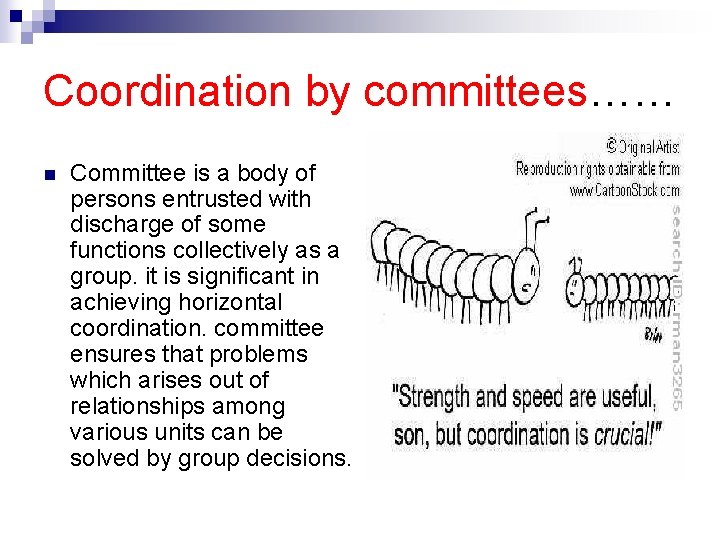
Coordination by committees…… n Committee is a body of persons entrusted with discharge of some functions collectively as a group. it is significant in achieving horizontal coordination. committee ensures that problems which arises out of relationships among various units can be solved by group decisions.
Self Coordination………. n Modification of functioning of department in such a way that each department coordinates with other departments. it can be done by horizontal communication.
EFFECTIVE COMMUNICATION n Open and regular communication is the key to coordination. n Effective interchange of opinions and information helps in resolving difference and in creation mutual understanding. EFFECTIVE LEADERSHIP AND SUPERVISION n Effective leadership ensures coordination both at the planning and the execution stage. n Sound leadership can influence subordinates to have identity of interest and too adopt a common outlook.
CHAIN OF COMMAND n Authority is the supreme coordinating power in an organization. n Exercise of authority through the chain of command or hierarchy is the traditional means of coordination.
Barriers to coordination 1. 2. 3. 4. 5. 6. 7. 8. 9. Competition for resources Threats to autonomy Disagreement on objectives Differing expectations of coordination Lack of trust Cost/benefit perceived as unsatisfactory Unilateral donor actions and agendas Rapid staff turnover Poor transition preparations
CONCLUSION A good Coordinator is a good Leader and A good Leader is a good Manager