
This work is licensed under a Creative Commons
- Slides: 29
This work is licensed under a Creative Commons Attribution-Non. Commercial-Share. Alike License. Your use of this material constitutes acceptance of that license and the conditions of use of materials on this site. Copyright 2006, The Johns Hopkins University and William Brieger. All rights reserved. Use of these materials permitted only in accordance with license rights granted. Materials provided “AS IS”; no representations or warranties provided. User assumes all responsibility for use, and all liability related thereto, and must independently review all materials for accuracy and efficacy. May contain materials owned by others. User is responsible for obtaining permissions for use from third parties as needed.
Theory of Reasoned Action William R. Brieger, MPH, CHES, Dr. Ph Johns Hopkins University 2
Section A Theory of Reasoned Action 3
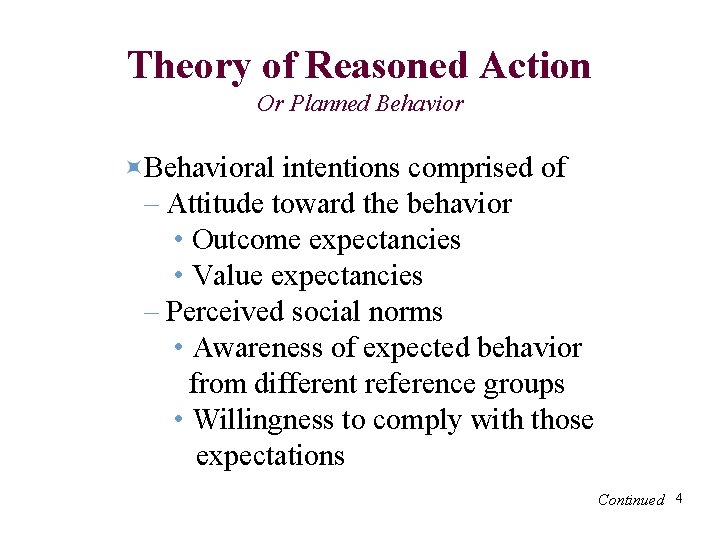
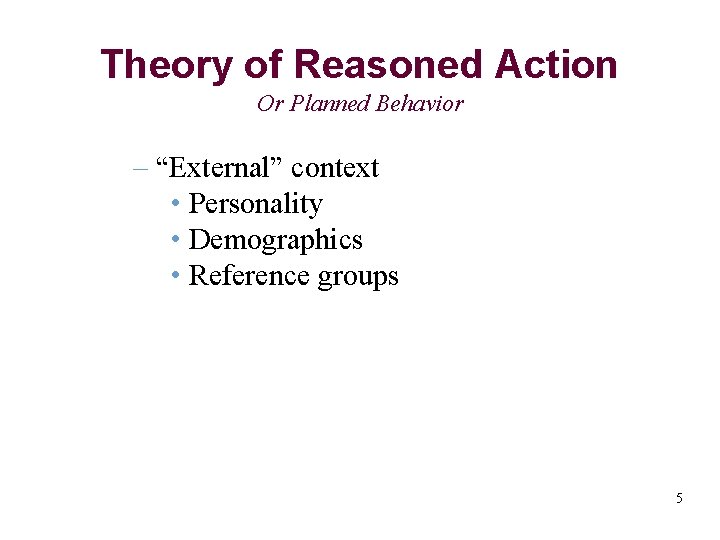
Theory of Reasoned Action Or Planned Behavioral intentions comprised of – Attitude toward the behavior • Outcome expectancies • Value expectancies – Perceived social norms • Awareness of expected behavior from different reference groups • Willingness to comply with those expectations Continued 4
Theory of Reasoned Action Or Planned Behavior – “External” context • Personality • Demographics • Reference groups 5
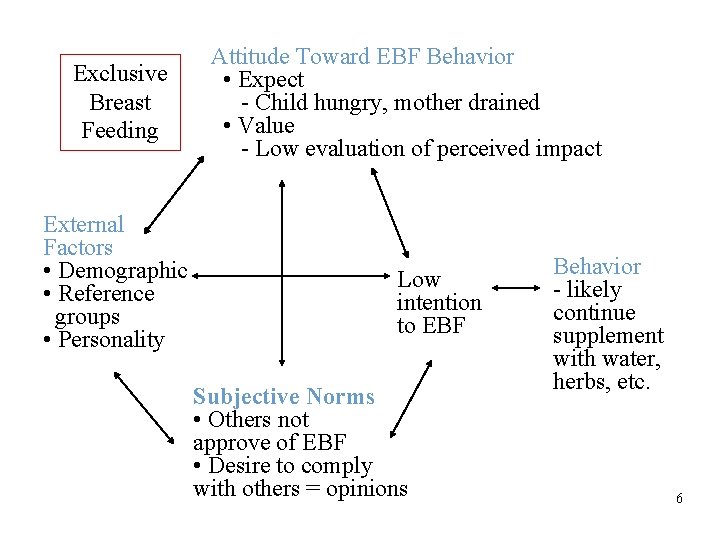
Exclusive Breast Feeding External Factors • Demographic • Reference groups • Personality Attitude Toward EBF Behavior • Expect - Child hungry, mother drained • Value - Low evaluation of perceived impact Low intention to EBF Subjective Norms • Others not approve of EBF • Desire to comply with others = opinions Behavior - likely continue supplement with water, herbs, etc. 6
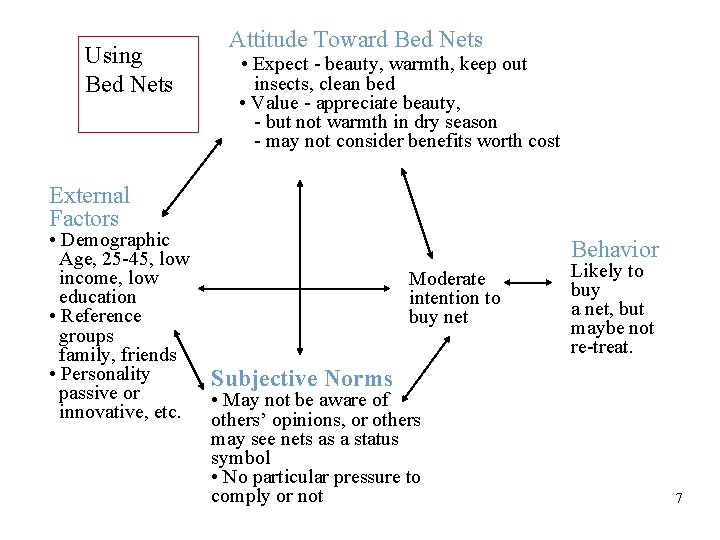
Using Bed Nets Attitude Toward Bed Nets • Expect - beauty, warmth, keep out insects, clean bed • Value - appreciate beauty, - but not warmth in dry season - may not consider benefits worth cost External Factors • Demographic Age, 25 -45, low income, low education • Reference groups family, friends • Personality passive or innovative, etc. Behavior Moderate intention to buy net Likely to buy a net, but maybe not re-treat. Subjective Norms • May not be aware of others’ opinions, or others may see nets as a status symbol • No particular pressure to comply or not 7
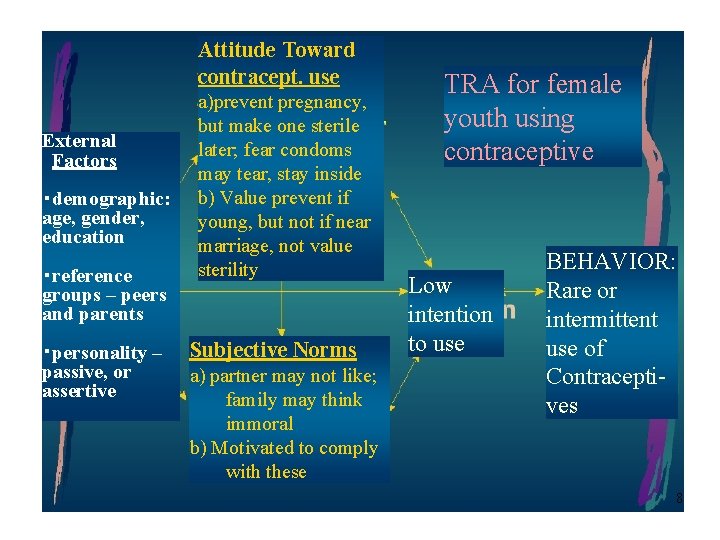
Attitude Toward contracept. use External Factors ‧demographic: age, gender, education ‧reference groups – peers and parents ‧personality – passive, or assertive a)prevent pregnancy, but make one sterile later; fear condoms may tear, stay inside b) Value prevent if young, but not if near marriage, not value sterility Subjective Norms a) partner may not like; family may think immoral b) Motivated to comply with these TRA for female youth using contraceptive Low intention to use BEHAVIOR: Rare or intermittent use of Contraceptives 8
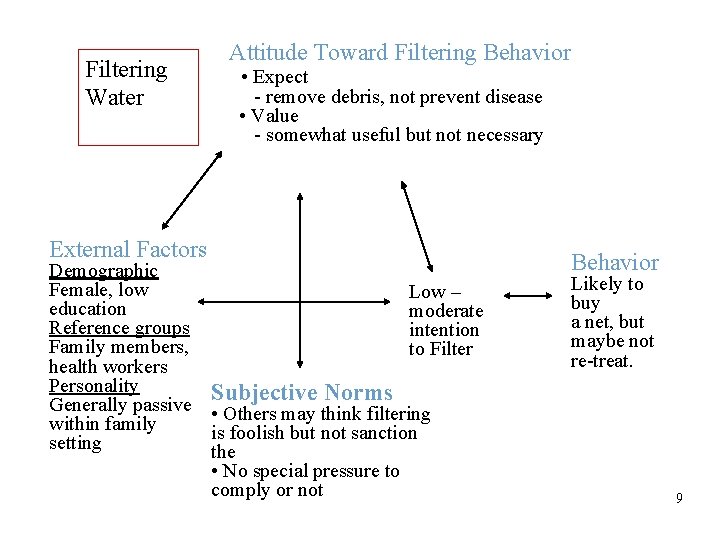
Filtering Water External Factors Attitude Toward Filtering Behavior • Expect - remove debris, not prevent disease • Value - somewhat useful but not necessary Demographic Female, low Low – education moderate Reference groups intention Family members, to Filter health workers Personality Subjective Norms Generally passive • Others may think filtering within family is foolish but not sanction setting the • No special pressure to comply or not Behavior Likely to buy a net, but maybe not re-treat. 9
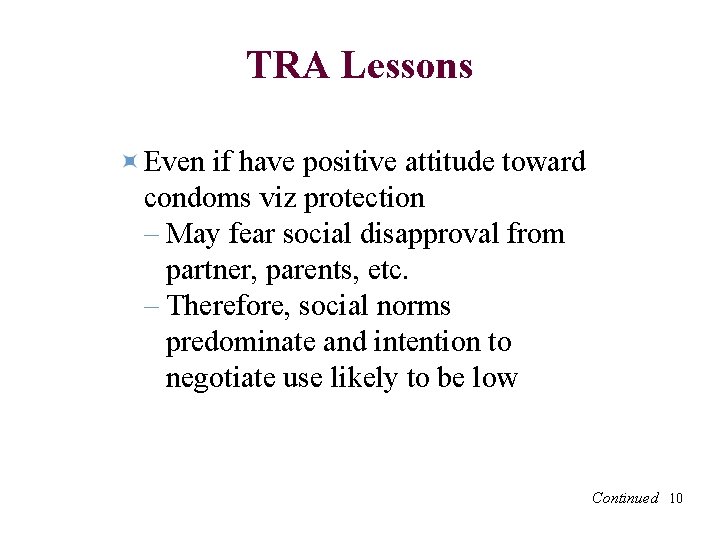
TRA Lessons Even if have positive attitude toward condoms viz protection – May fear social disapproval from partner, parents, etc. – Therefore, social norms predominate and intention to negotiate use likely to be low Continued 10
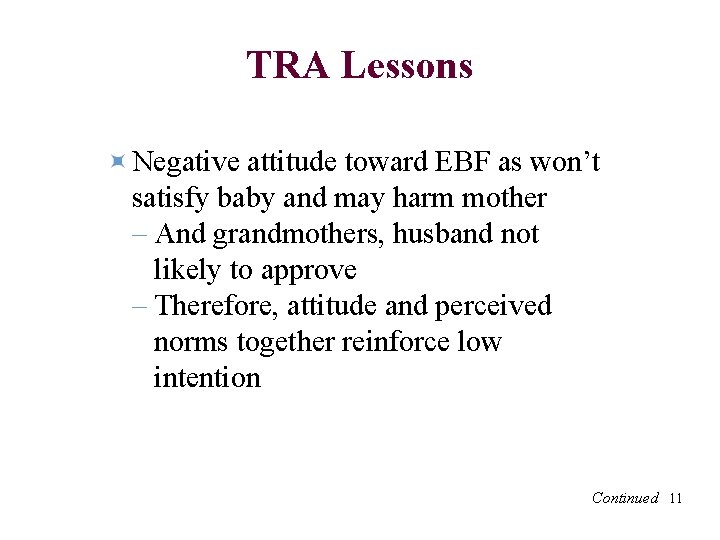
TRA Lessons Negative attitude toward EBF as won’t satisfy baby and may harm mother – And grandmothers, husband not likely to approve – Therefore, attitude and perceived norms together reinforce low intention Continued 11
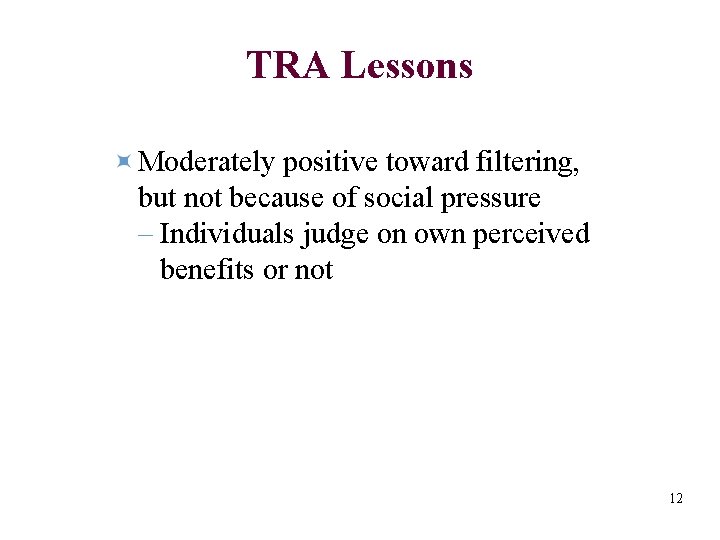
TRA Lessons Moderately positive toward filtering, but not because of social pressure – Individuals judge on own perceived benefits or not 12
Section B Comparisons 13
Behavioral-Influencing Variables HBM: Concept of threat SLT: Self efficacy or perceived confidence TRA: Intentions and balancing of attitudes 14
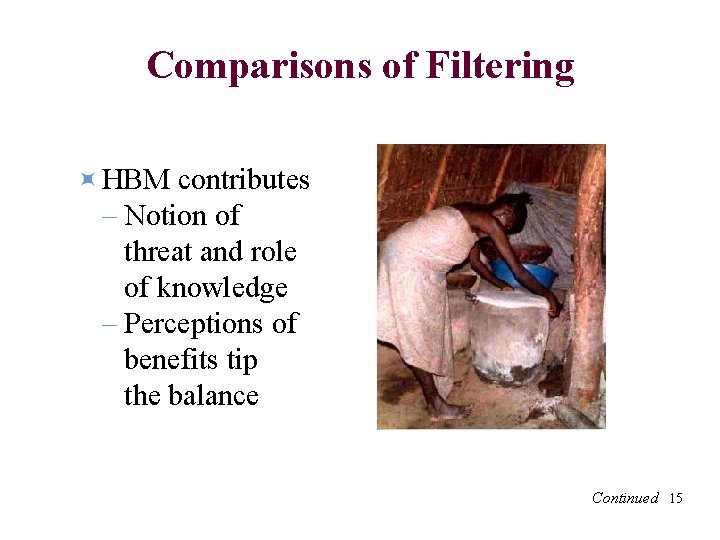
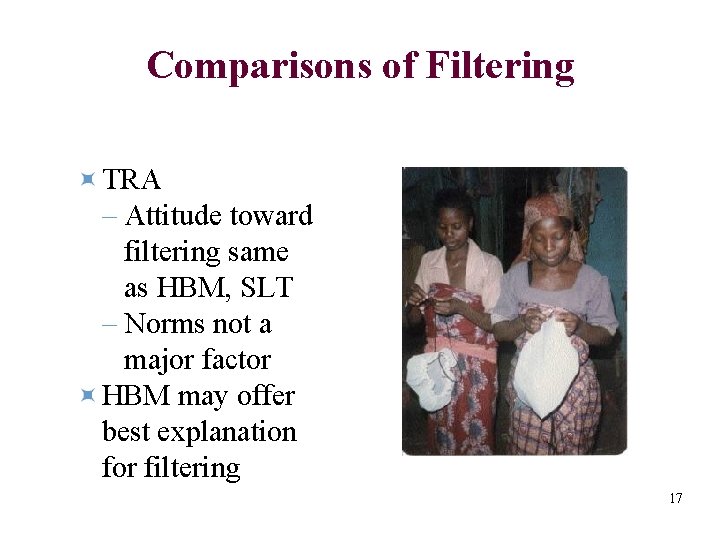
Comparisons of Filtering HBM contributes – Notion of threat and role of knowledge – Perceptions of benefits tip the balance Continued 15
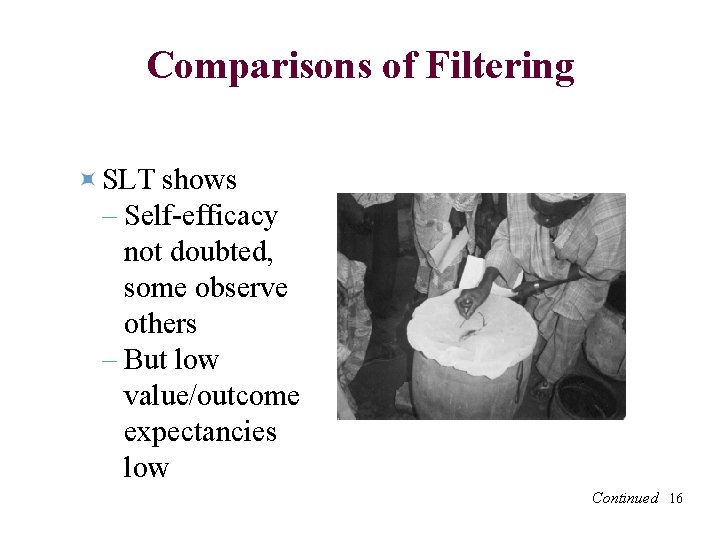
Comparisons of Filtering SLT shows – Self-efficacy not doubted, some observe others – But low value/outcome expectancies low Continued 16
Comparisons of Filtering TRA – Attitude toward filtering same as HBM, SLT – Norms not a major factor HBM may offer best explanation for filtering 17
Comparisons: EBF TRA contributes – Attitude toward behavior negative reinforced by – Perceived social disapproval – Predicts low intention Continued 18
Comparisons: EBF SLT – Outcome expectations negative— negatively valued – No role models to observe – Perceived efficacy for BF generally, but not every time—EBF Both models help explain 19
Comparisons: Bed Nets HBM—malaria not a threat—a minor indisposition – See intrinsic benefits of nets (warmth, better sleep, beauty, but – Consider cost and no connection with malaria which is caused by sun, heat, overwork, and dust Continued 20
Comparisons: Bed Nets TRA – Major factor is attitude toward behavior—same as benefits/constraints of HBM – If some see nets as status symbol, may think others would approve Continued 21
Comparisons: Bed Nets SLT—few others to observe using – Positive valuation, use efficacy not in question – But cost—a factor of individual income and general community economic status (environment) 22
Statistical Tests: EBF Variables Operationalized Attitude toward EBF – What do you think would be the effect of EBF on a mother? (Code: good effect, bad effect, uncertain) – What do you think would be the effect of EBF on the child? (Code: good effect, bad effect, uncertain) Continued 23
Statistical Tests: EBF Variables Operationalized Intention – Do you intend to practice EBF with your next child? Continued 24
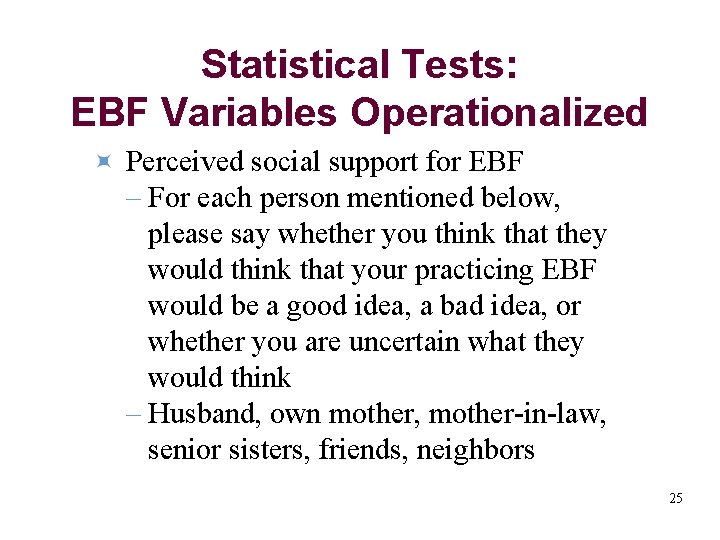
Statistical Tests: EBF Variables Operationalized Perceived social support for EBF – For each person mentioned below, please say whether you think that they would think that your practicing EBF would be a good idea, a bad idea, or whether you are uncertain what they would think – Husband, own mother, mother-in-law, senior sisters, friends, neighbors 25
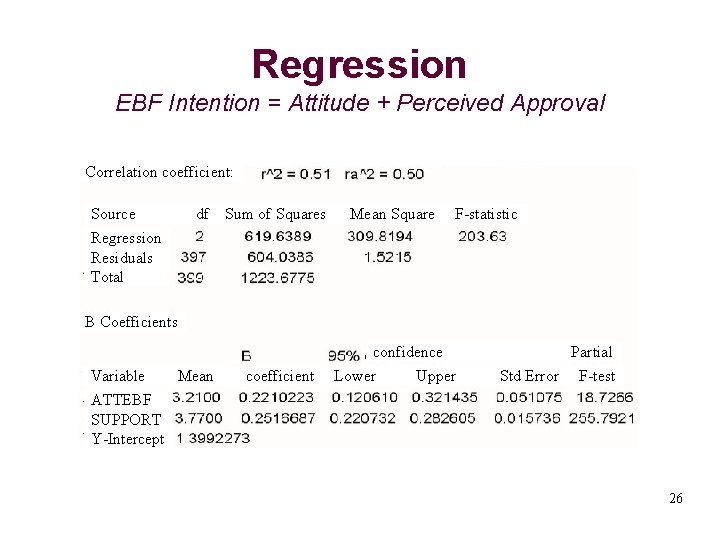
Regression EBF Intention = Attitude + Perceived Approval Correlation coefficient: Source Regression Residuals Total df Sum of Squares Mean Square F-statistic coefficient confidence Lower Upper B Coefficients Variable Mean ATTEBF SUPPORT Y-Intercept Partial Std Error F-test 26
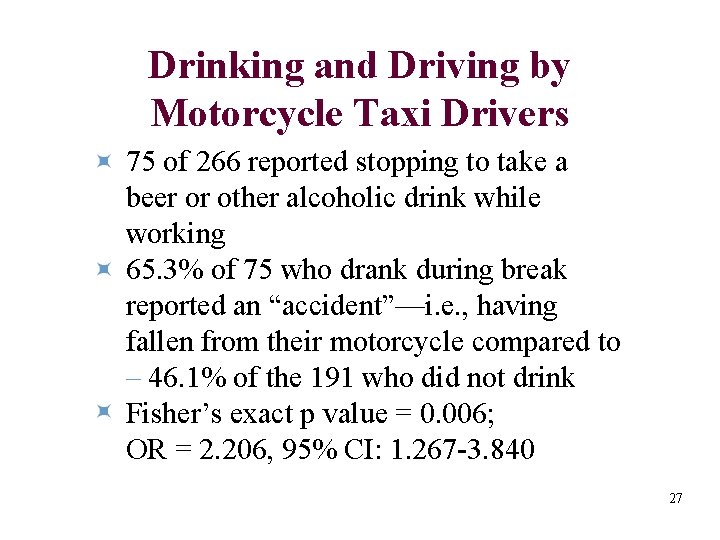
Drinking and Driving by Motorcycle Taxi Drivers 75 of 266 reported stopping to take a beer or other alcoholic drink while working 65. 3% of 75 who drank during break reported an “accident”—i. e. , having fallen from their motorcycle compared to – 46. 1% of the 191 who did not drink Fisher’s exact p value = 0. 006; OR = 2. 206, 95% CI: 1. 267 -3. 840 27
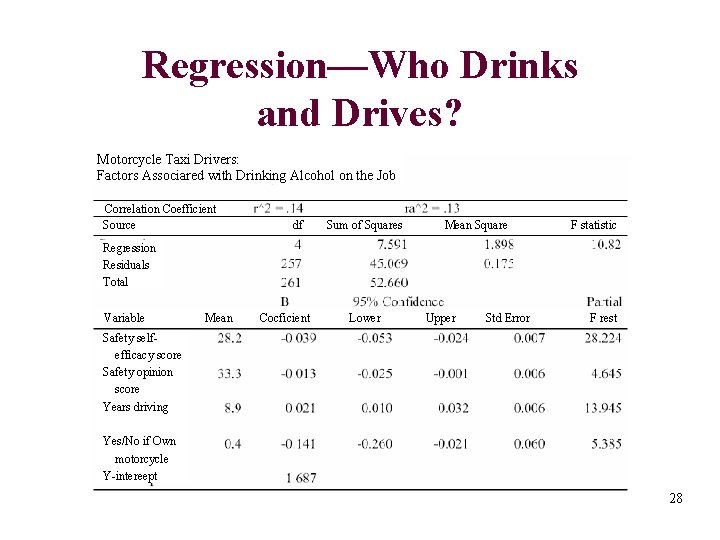
Regression—Who Drinks and Drives? Motorcycle Taxi Drivers: Factors Associared with Drinking Alcohol on the Job Correlation Coefficient Source df Sum of Squares Mean Square F statistic Regression Residuals Total Variable Mean Cocficient Lower Upper Std Error F rest Safety selfefficacy score Safety opinion score Years driving Yes/No if Own motorcycle Y-intereept 28
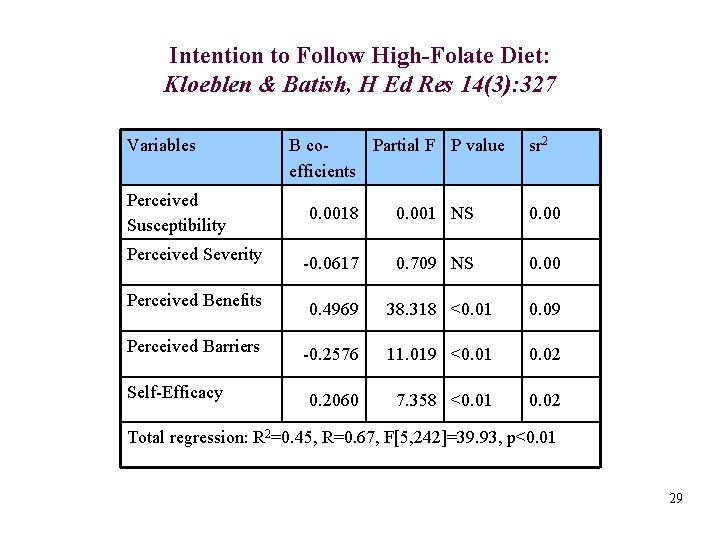
Intention to Follow High-Folate Diet: Kloeblen & Batish, H Ed Res 14(3): 327 Variables Perceived Susceptibility B co. Partial F P value efficients sr 2 0. 0018 0. 001 NS 0. 00 Perceived Severity -0. 0617 0. 709 NS 0. 00 Perceived Benefits 0. 4969 38. 318 <0. 01 0. 09 Perceived Barriers -0. 2576 11. 019 <0. 01 0. 02 0. 2060 7. 358 <0. 01 0. 02 Self-Efficacy Total regression: R 2=0. 45, R=0. 67, F[5, 242]=39. 93, p<0. 01 29