
This Weeks Objectives Establish Dynamic Models of System
This Week’s Objectives • Establish Dynamic Models of System to be Controlled – Second Order Systems • Obtain Solutions using La. Place Transforms • Create Simulink Model and Generate Simulated Results
Modeling of a Spring-Mass. Damper System (Modeling of a Second Order System)
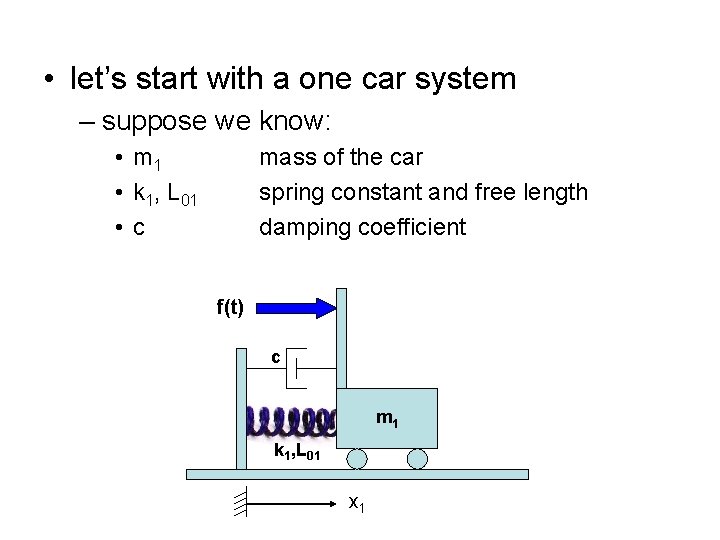
• let’s start with a one car system – suppose we know: • m 1 • k 1, L 01 • c mass of the car spring constant and free length damping coefficient f(t) c m 1 k 1, L 01 x 1
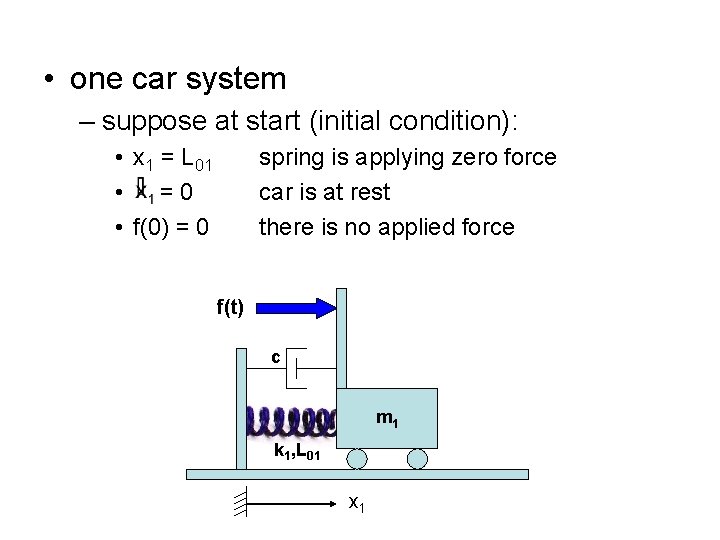
• one car system – suppose at start (initial condition): • x 1 = L 01 • =0 • f(0) = 0 spring is applying zero force car is at rest there is no applied force f(t) c m 1 k 1, L 01 x 1
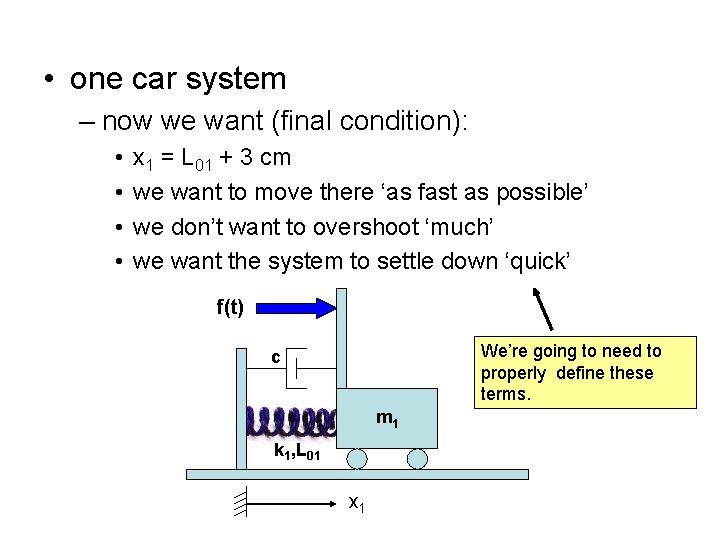
• one car system – now we want (final condition): • • x 1 = L 01 + 3 cm we want to move there ‘as fast as possible’ we don’t want to overshoot ‘much’ we want the system to settle down ‘quick’ f(t) We’re going to need to properly define these terms. c m 1 k 1, L 01 x 1
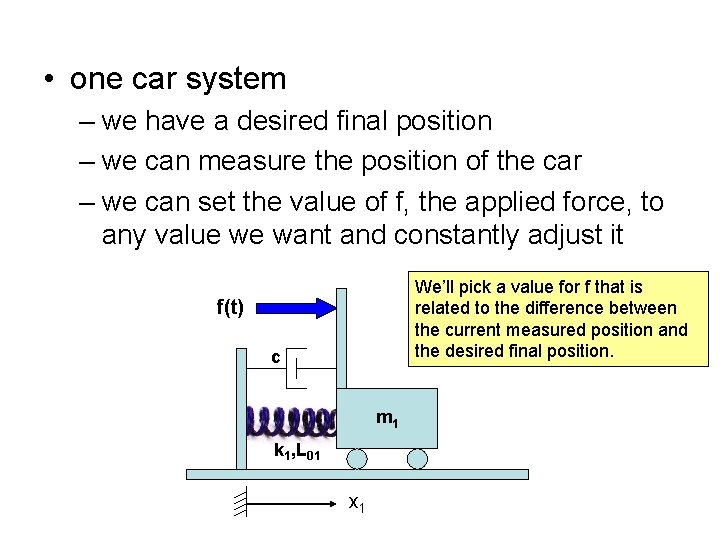
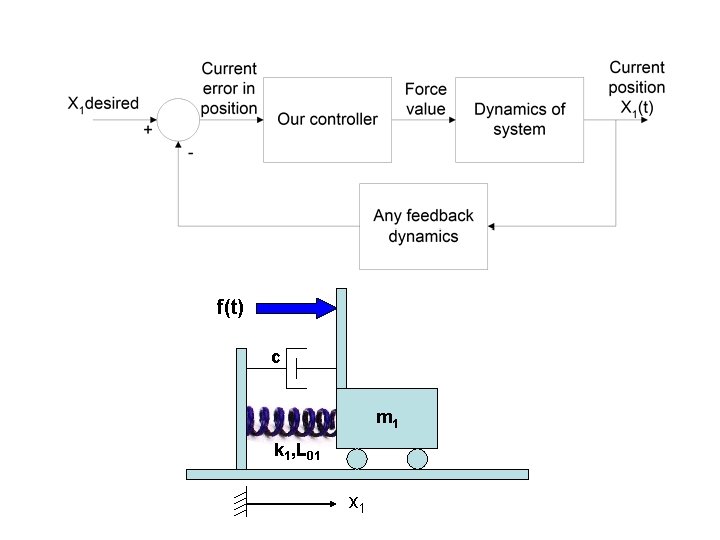
• one car system – we have a desired final position – we can measure the position of the car – we can set the value of f, the applied force, to any value we want and constantly adjust it We’ll pick a value for f that is related to the difference between the current measured position and the desired final position. f(t) c m 1 k 1, L 01 x 1
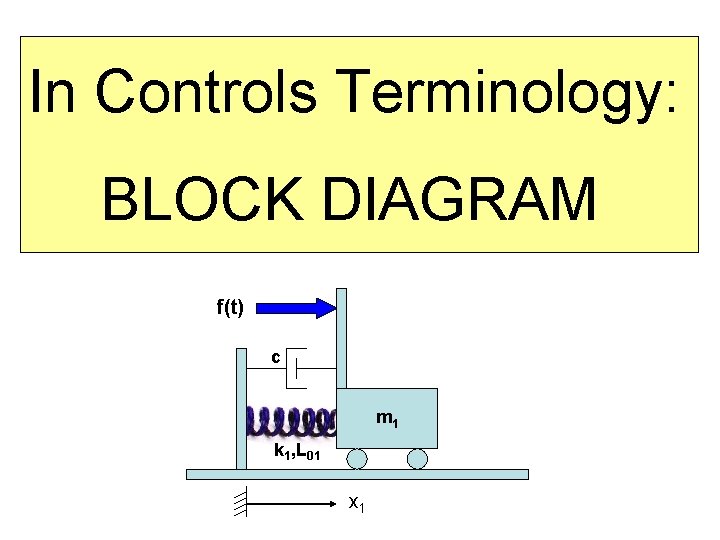
In Controls Terminology: BLOCK DIAGRAM f(t) c m 1 k 1, L 01 x 1
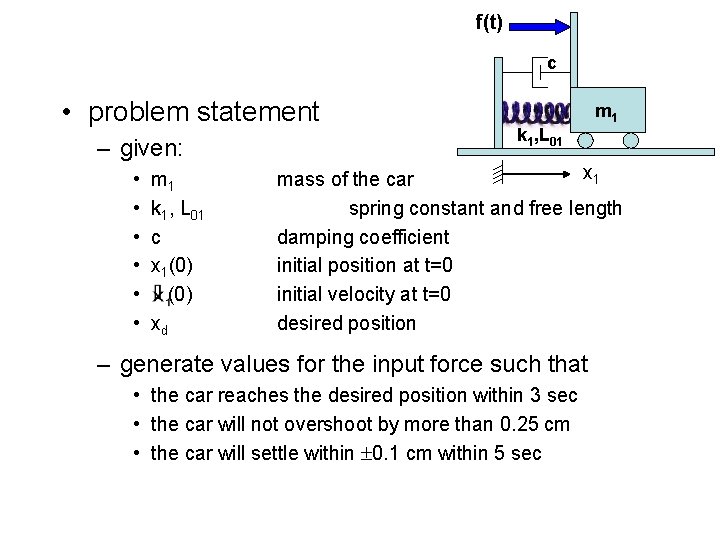
f(t) c • problem statement – given: • • • m 1 k 1, L 01 c x 1(0) xd m 1 k 1, L 01 x 1 mass of the car spring constant and free length damping coefficient initial position at t=0 initial velocity at t=0 desired position – generate values for the input force such that • the car reaches the desired position within 3 sec • the car will not overshoot by more than 0. 25 cm • the car will settle within 0. 1 cm within 5 sec
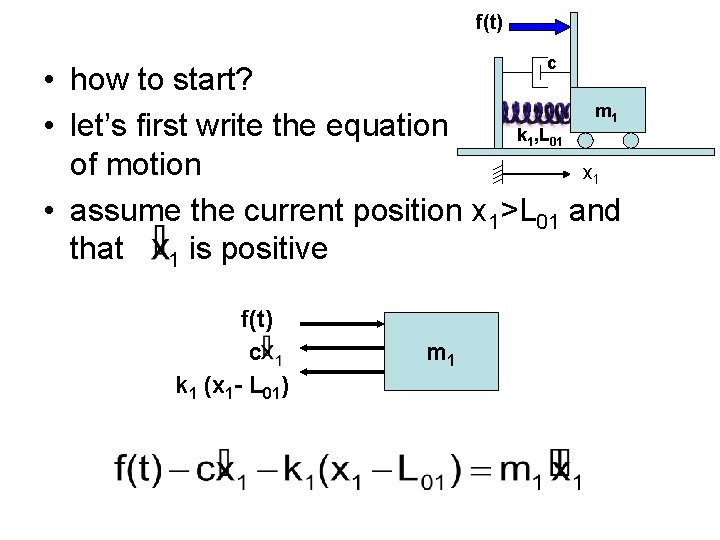
f(t) c • how to start? m • let’s first write the equation k , L of motion x 1 • assume the current position x 1>L 01 and that 1 is positive 1 1 f(t) c k 1 (x 1 - L 01) m 1 01
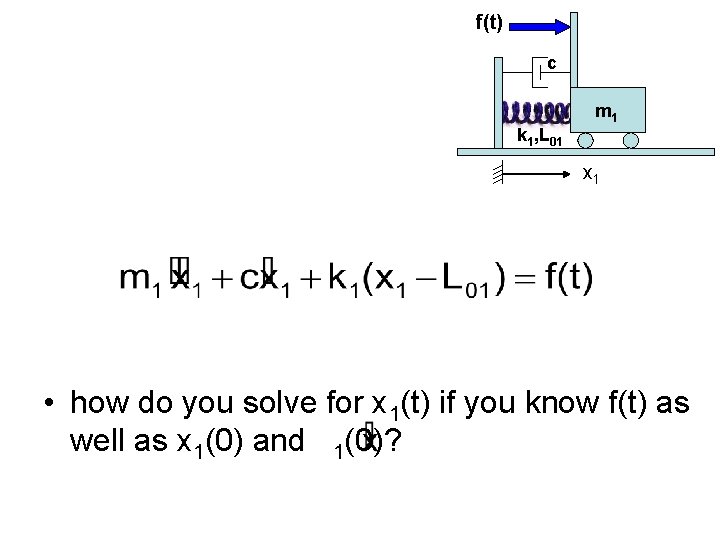
f(t) c m 1 k 1, L 01 x 1 • how do you solve for x 1(t) if you know f(t) as well as x 1(0) and 1(0)?
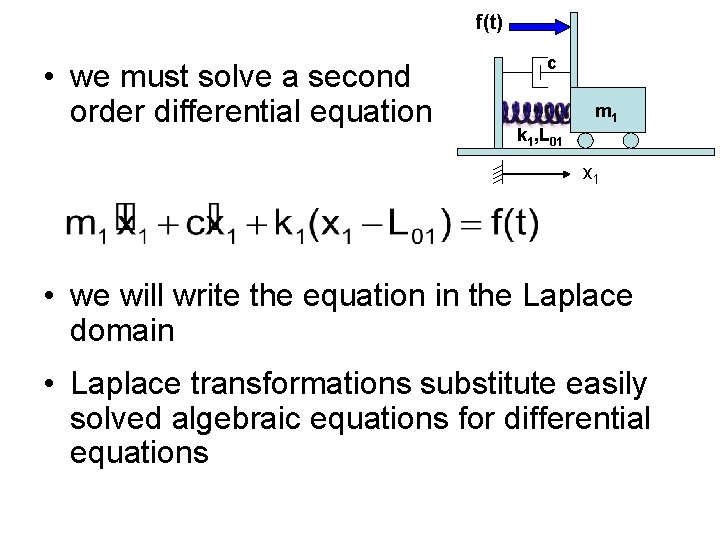
f(t) • we must solve a second order differential equation c m 1 k 1, L 01 x 1 • we will write the equation in the Laplace domain • Laplace transformations substitute easily solved algebraic equations for differential equations
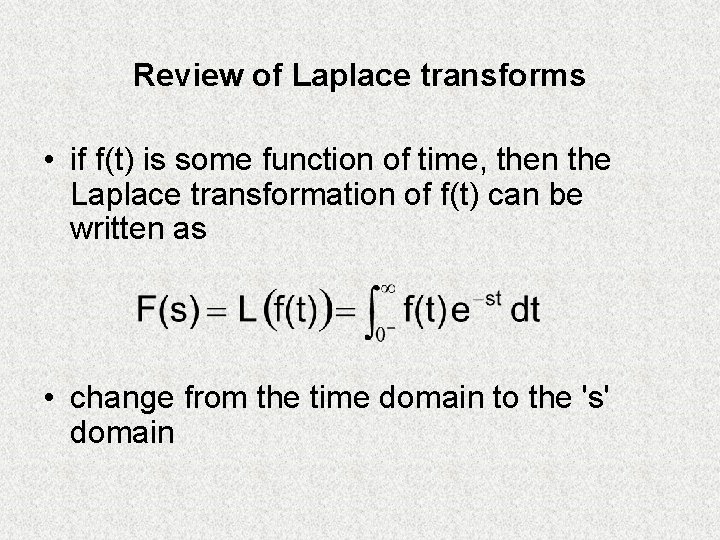
Review of Laplace transforms • if f(t) is some function of time, then the Laplace transformation of f(t) can be written as • change from the time domain to the 's' domain
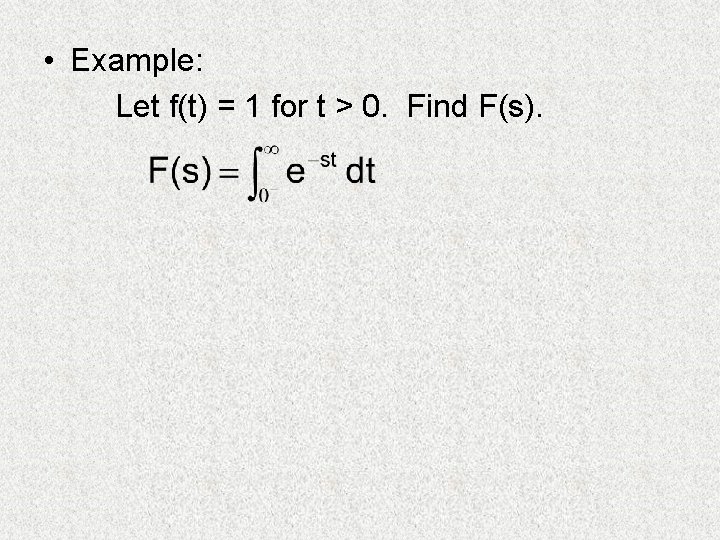
• Example: Let f(t) = 1 for t > 0. Find F(s).
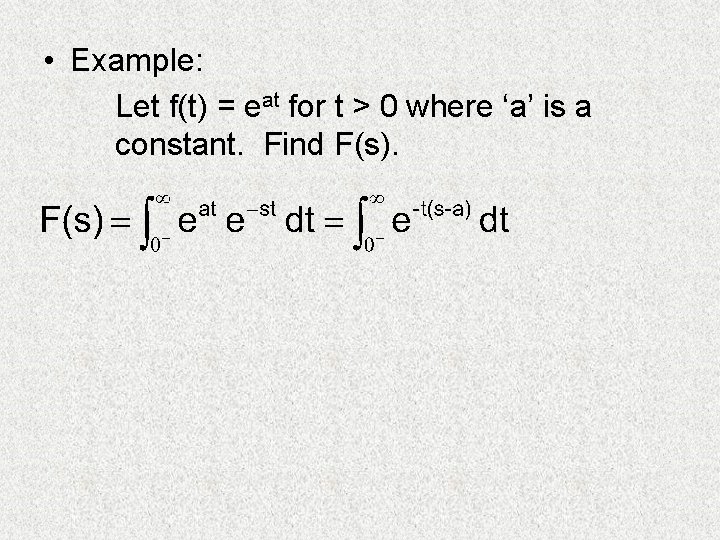
• Example: Let f(t) = eat for t > 0 where ‘a’ is a constant. Find F(s).
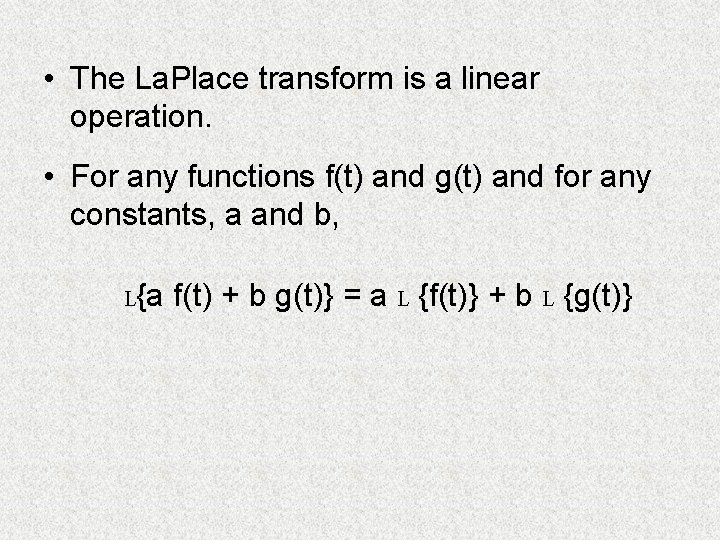
• The La. Place transform is a linear operation. • For any functions f(t) and g(t) and for any constants, a and b, L{a f(t) + b g(t)} = a L {f(t)} + b L {g(t)}
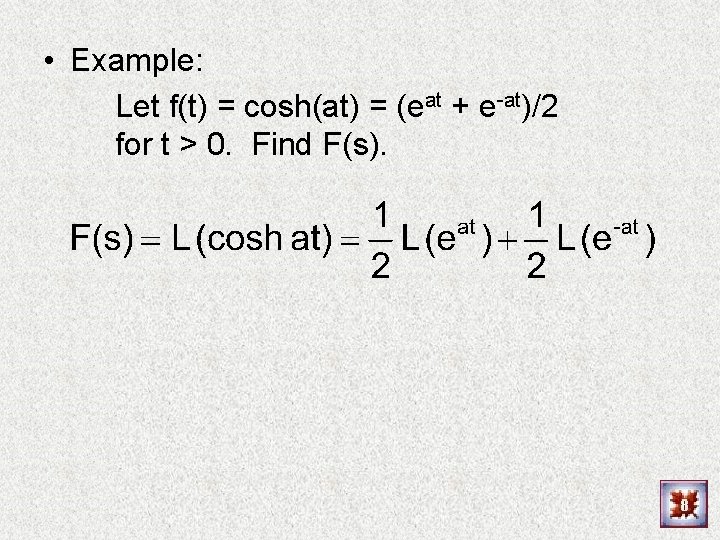
• Example: Let f(t) = cosh(at) = (eat + e-at)/2 for t > 0. Find F(s).
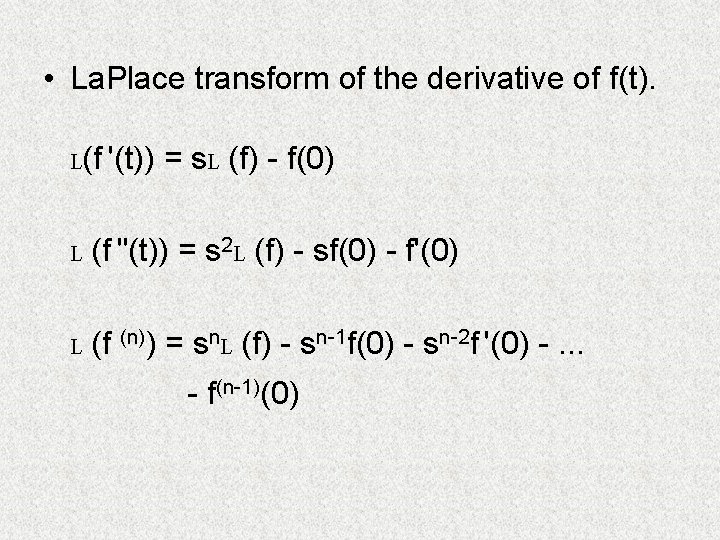
• La. Place transform of the derivative of f(t). L(f '(t)) = s. L (f) - f(0) L (f "(t)) = s 2 L (f) - sf(0) - f'(0) L (f (n)) = sn. L (f) - sn-1 f(0) - sn-2 f '(0) -. . . - f(n-1)(0)
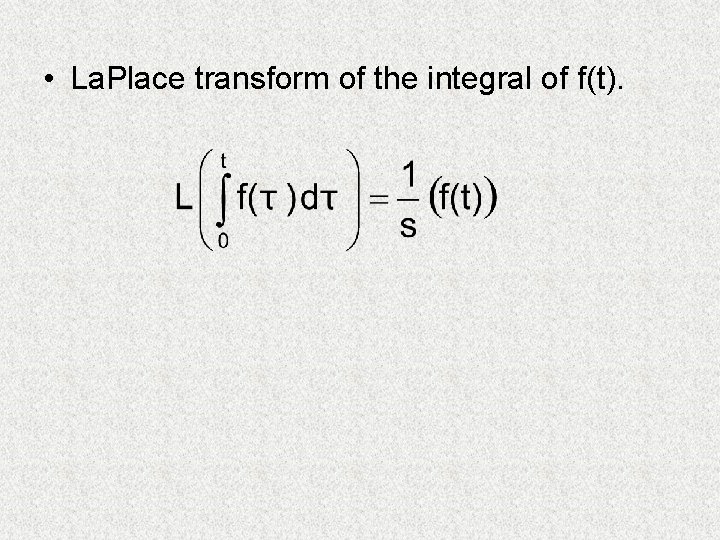
• La. Place transform of the integral of f(t).
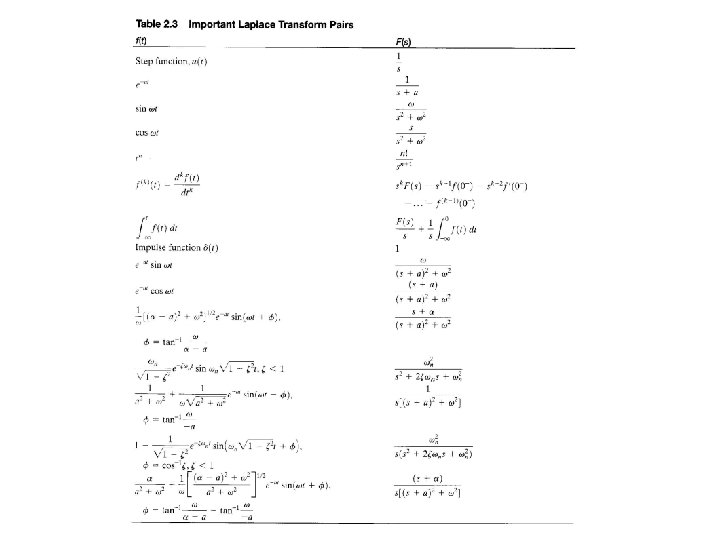
• Laplace transforms have been calculated for a large variety of functions. Sampling of these are listed in Table 2. 3 of the text – Modern Control Systems, 9 th ed. , R. C. Dorf and R. H. Bishop, Prentice Hall, 2001.
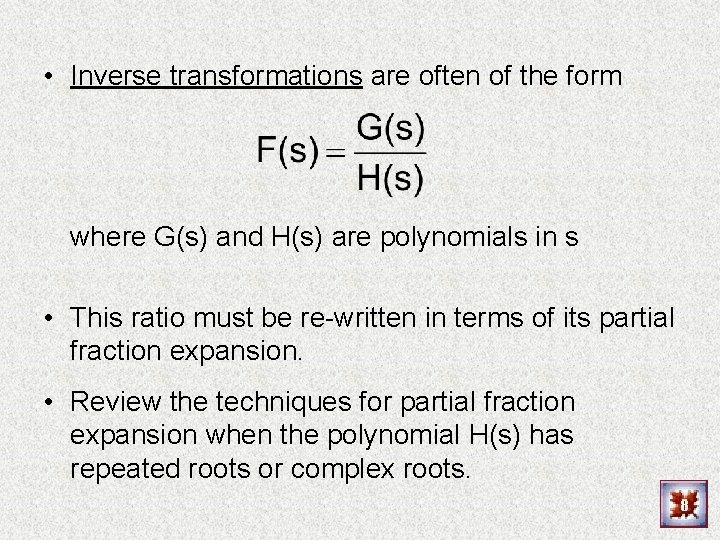
• Inverse transformations are often of the form where G(s) and H(s) are polynomials in s • This ratio must be re-written in terms of its partial fraction expansion. • Review the techniques for partial fraction expansion when the polynomial H(s) has repeated roots or complex roots.
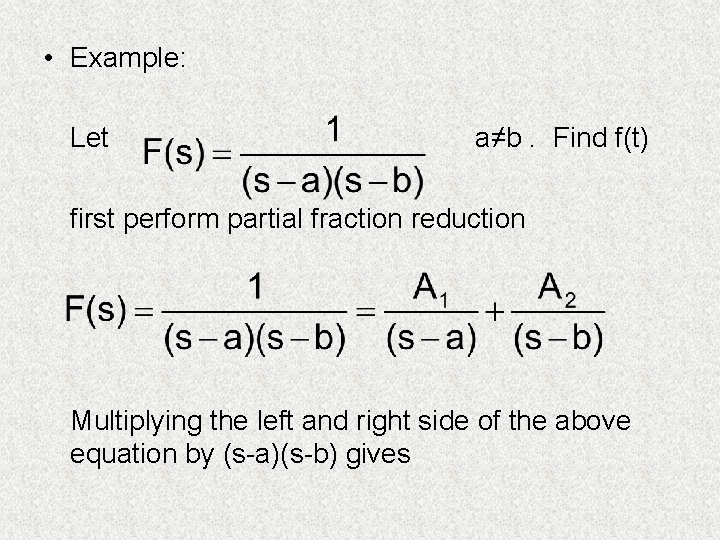
• Example: Let a≠b. Find f(t) first perform partial fraction reduction Multiplying the left and right side of the above equation by (s-a)(s-b) gives
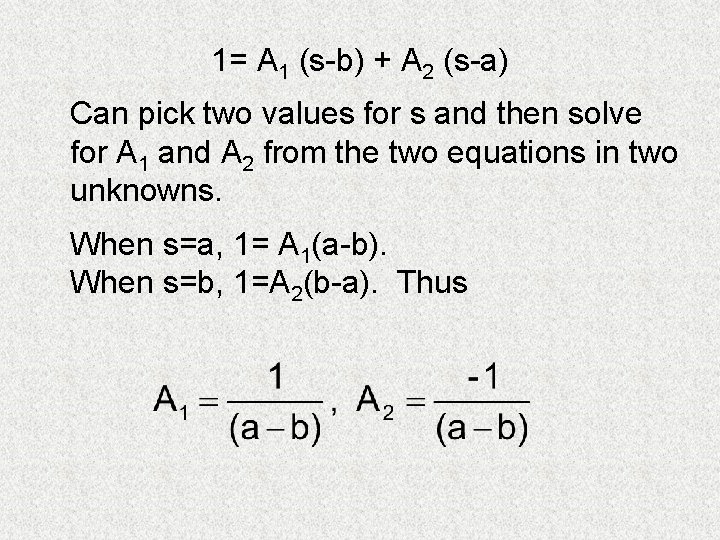
1= A 1 (s-b) + A 2 (s-a) Can pick two values for s and then solve for A 1 and A 2 from the two equations in two unknowns. When s=a, 1= A 1(a-b). When s=b, 1=A 2(b-a). Thus
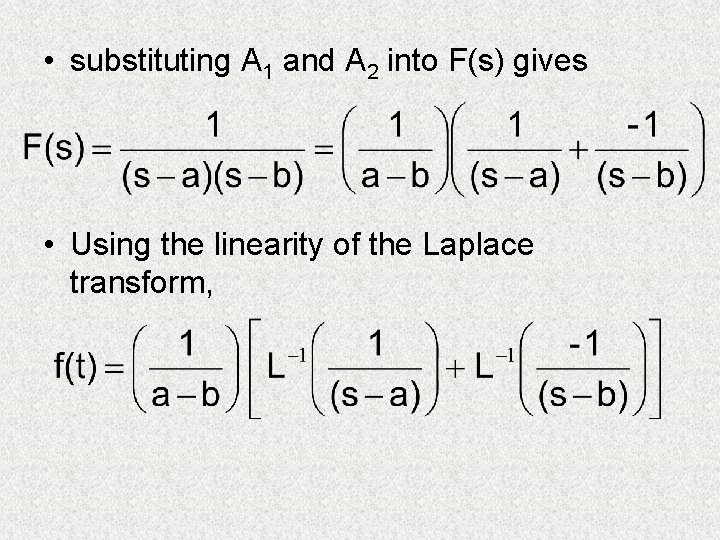
• substituting A 1 and A 2 into F(s) gives • Using the linearity of the Laplace transform,
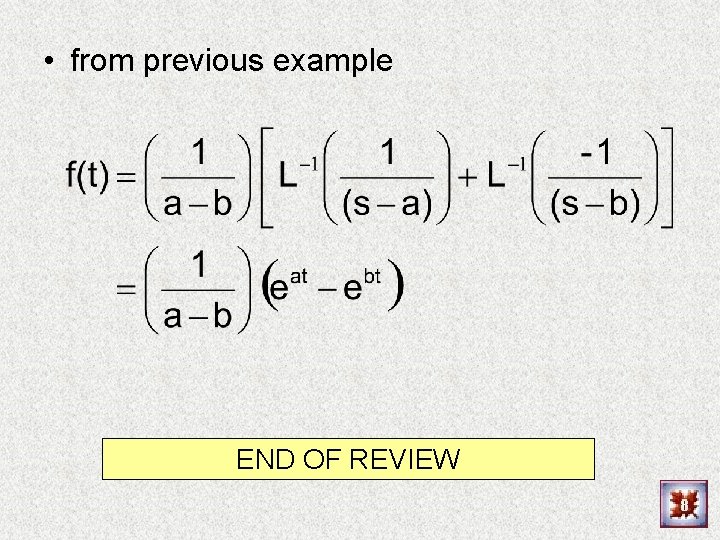
• from previous example END OF REVIEW
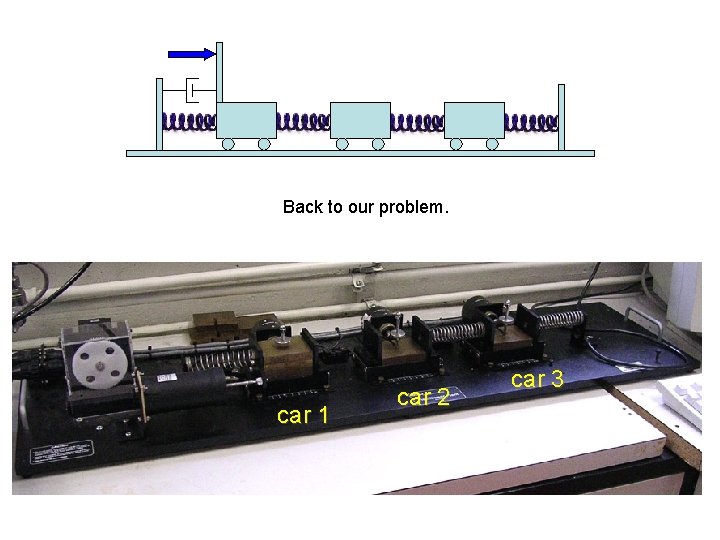
Back to our problem. car 1 car 2 car 3
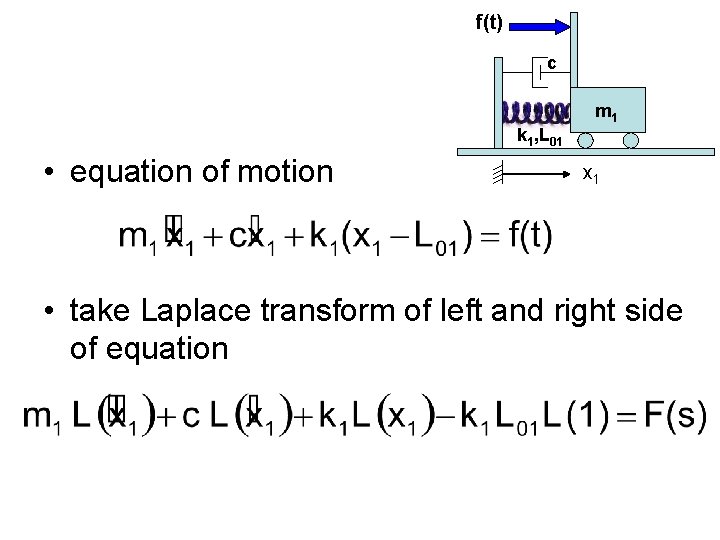
f(t) c m 1 k 1, L 01 • equation of motion x 1 • take Laplace transform of left and right side of equation
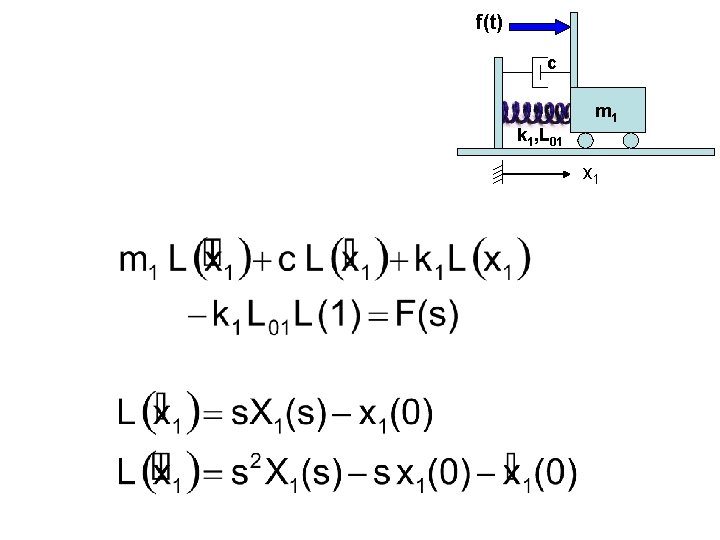
f(t) c m 1 k 1, L 01 x 1
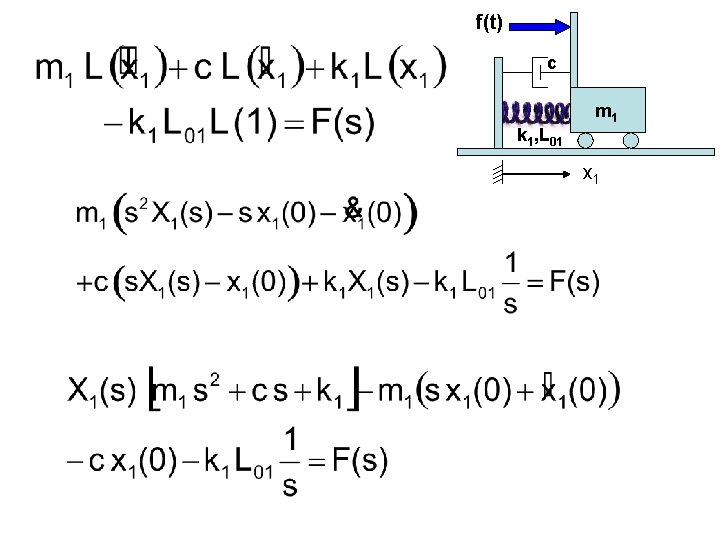
f(t) c m 1 k 1, L 01 x 1
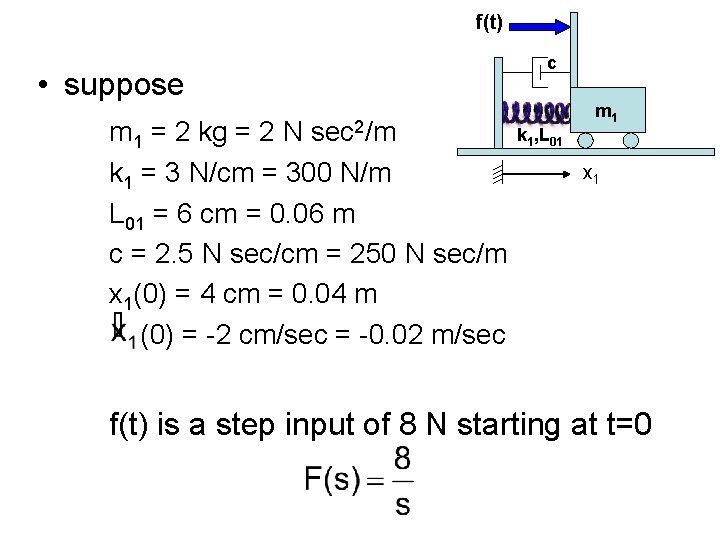
f(t) • suppose m 1 = 2 kg = 2 N sec 2/m k 1 = 3 N/cm = 300 N/m L 01 = 6 cm = 0. 06 m c = 2. 5 N sec/cm = 250 N sec/m x 1(0) = 4 cm = 0. 04 m (0) = -2 cm/sec = -0. 02 m/sec c m 1 k 1, L 01 x 1 f(t) is a step input of 8 N starting at t=0
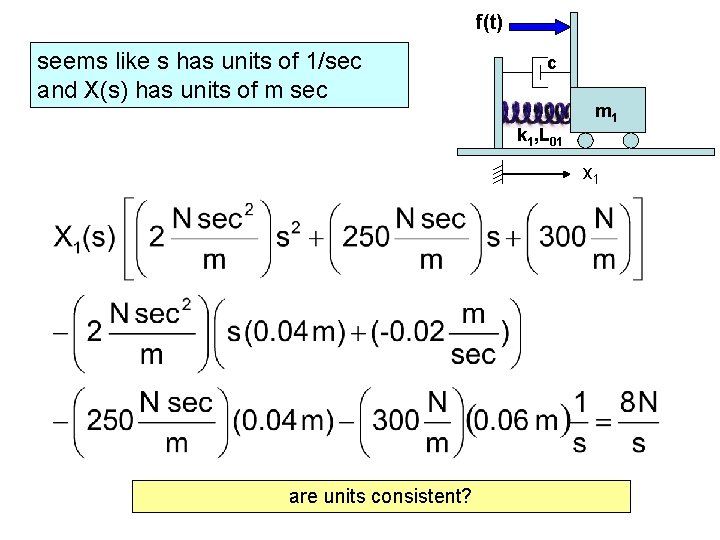
f(t) seems like s has units of 1/sec and X(s) has units of m sec c m 1 k 1, L 01 x 1 are units consistent?
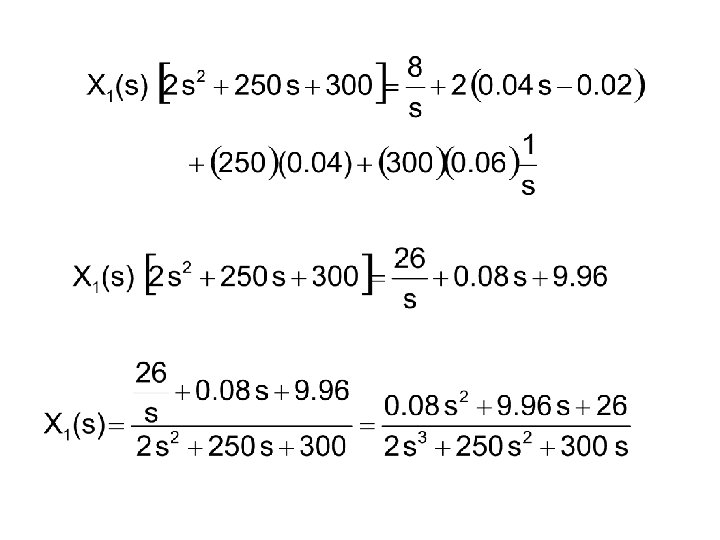
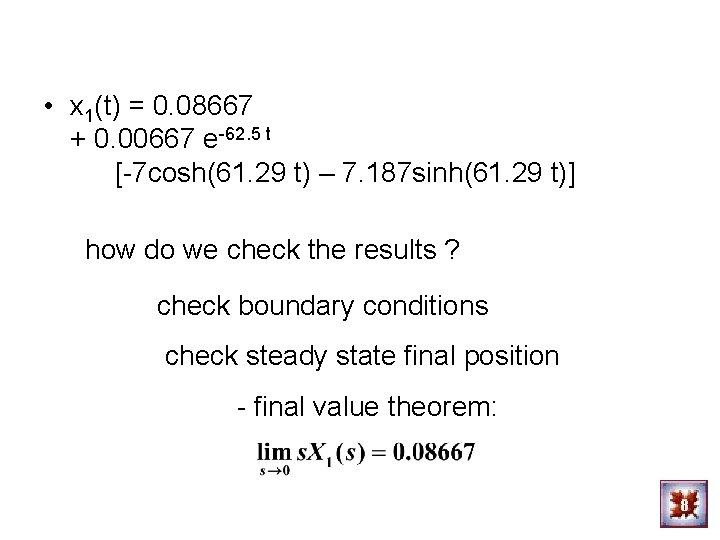
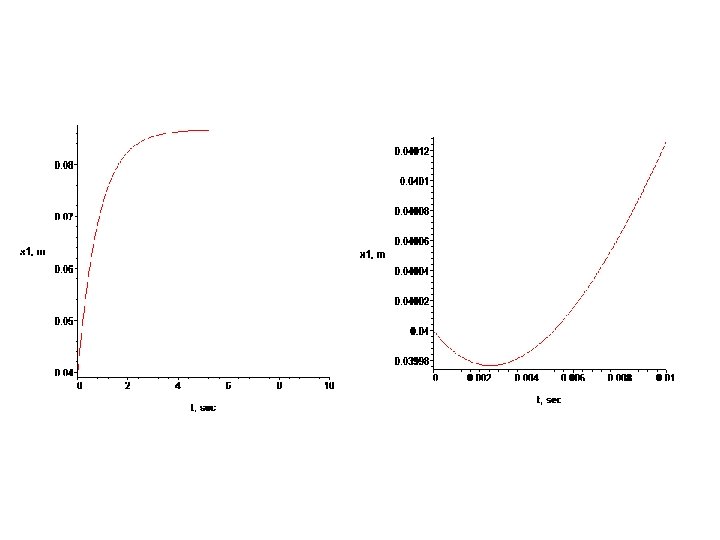
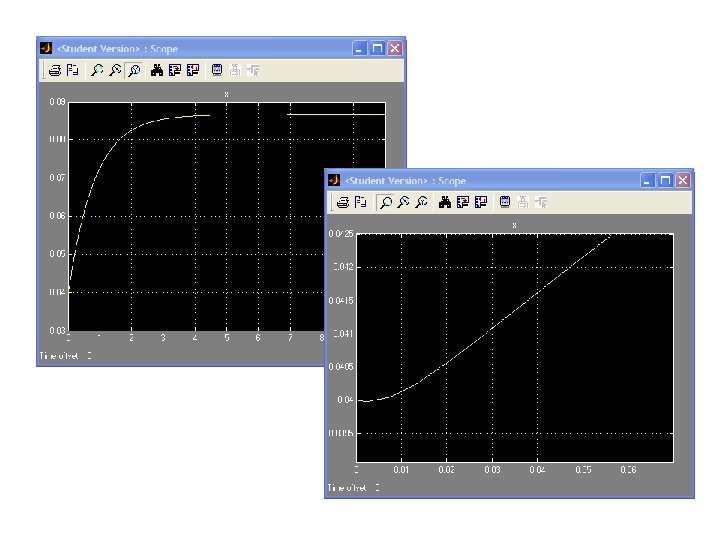
• x 1(t) = 0. 08667 + 0. 00667 e-62. 5 t [-7 cosh(61. 29 t) – 7. 187 sinh(61. 29 t)] how do we check the results ? check boundary conditions check steady state final position - final value theorem:
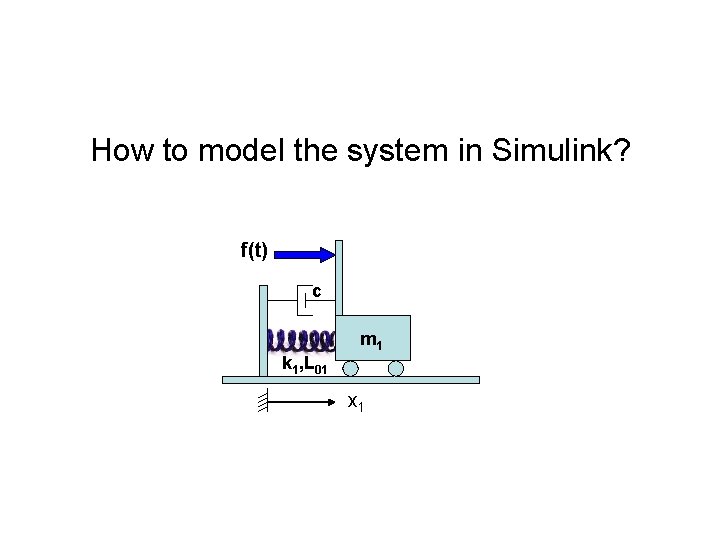
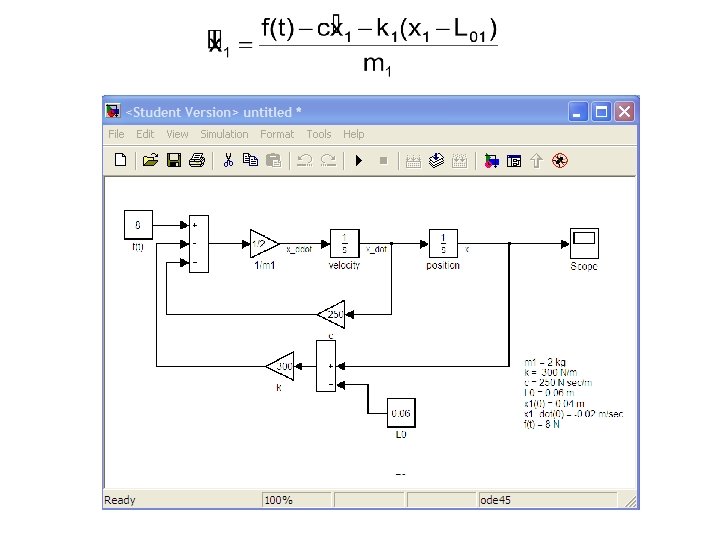
How to model the system in Simulink? f(t) c m 1 k 1, L 01 x 1
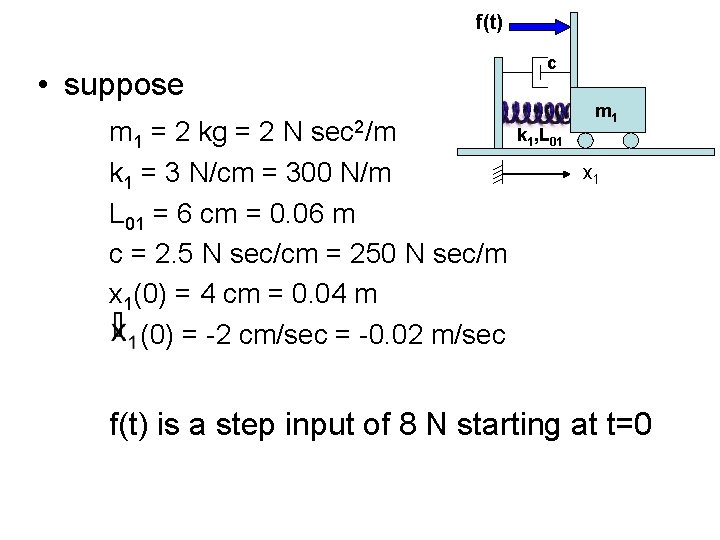
f(t) • suppose m 1 = 2 kg = 2 N sec 2/m k 1 = 3 N/cm = 300 N/m L 01 = 6 cm = 0. 06 m c = 2. 5 N sec/cm = 250 N sec/m x 1(0) = 4 cm = 0. 04 m (0) = -2 cm/sec = -0. 02 m/sec c m 1 k 1, L 01 x 1 f(t) is a step input of 8 N starting at t=0
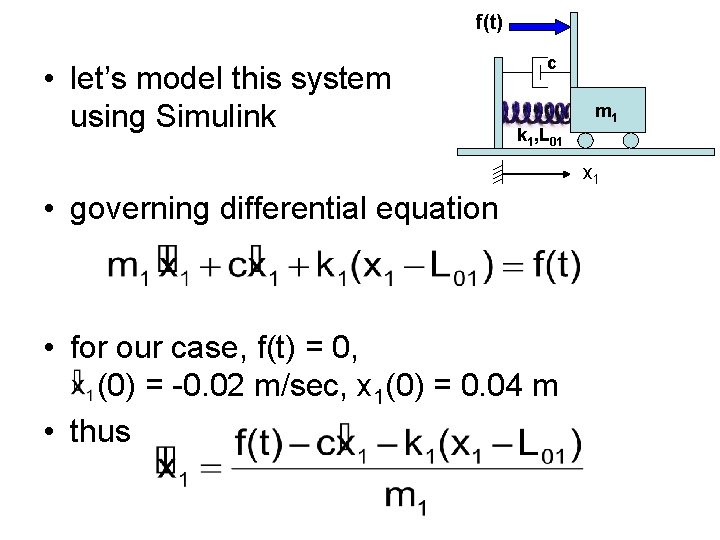
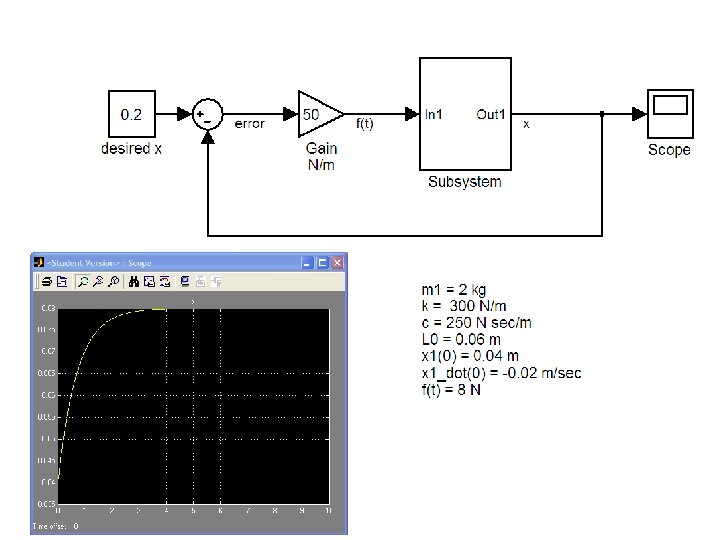
f(t) • let’s model this system using Simulink c m 1 k 1, L 01 x 1 • governing differential equation • for our case, f(t) = 0, (0) = -0. 02 m/sec, x 1(0) = 0. 04 m • thus
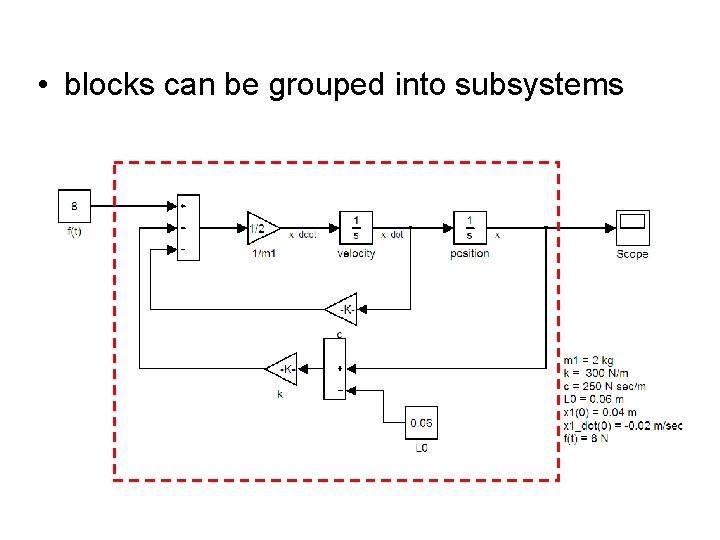
• blocks can be grouped into subsystems
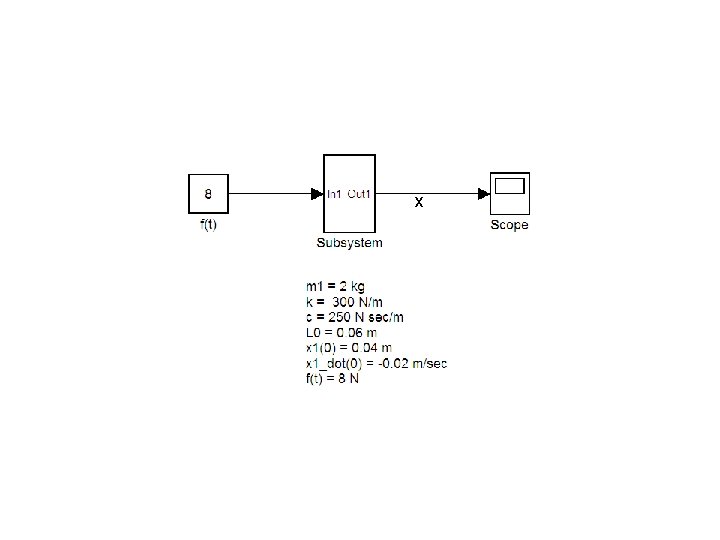
x
f(t) c m 1 k 1, L 01 x 1
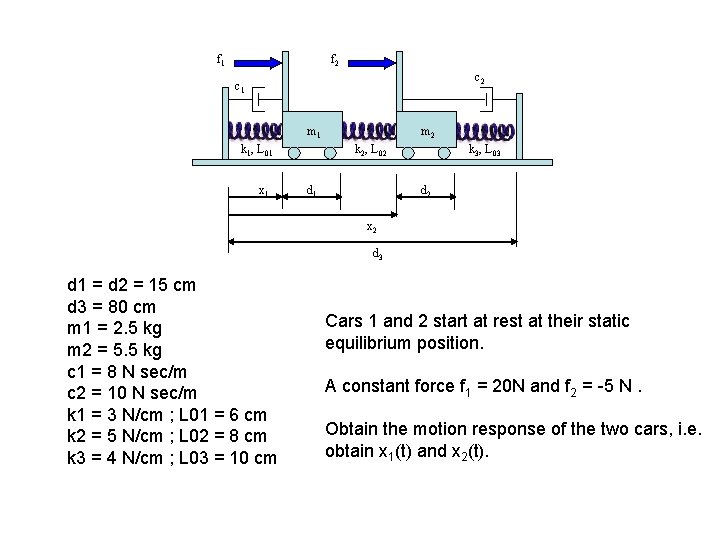
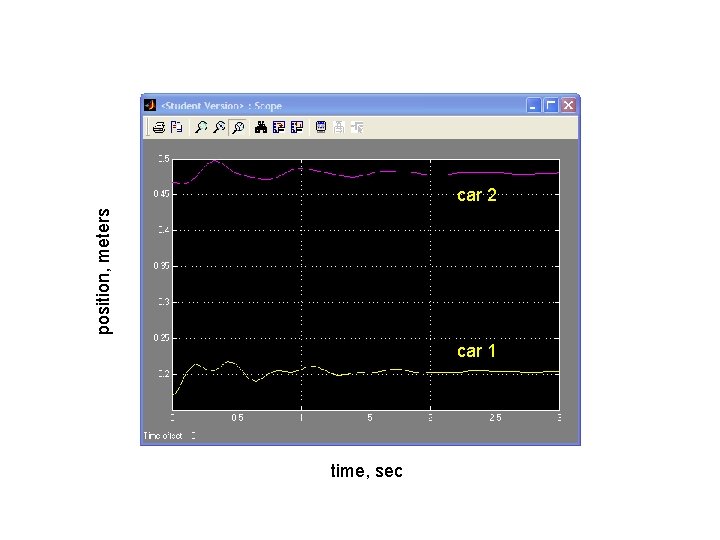
f 1 f 2 c 1 m 1 k 1, L 01 x 1 m 2 k 2, L 02 d 1 k 3, L 03 d 2 x 2 d 3 d 1 = d 2 = 15 cm d 3 = 80 cm m 1 = 2. 5 kg m 2 = 5. 5 kg c 1 = 8 N sec/m c 2 = 10 N sec/m k 1 = 3 N/cm ; L 01 = 6 cm k 2 = 5 N/cm ; L 02 = 8 cm k 3 = 4 N/cm ; L 03 = 10 cm Cars 1 and 2 start at rest at their static equilibrium position. A constant force f 1 = 20 N and f 2 = -5 N. Obtain the motion response of the two cars, i. e. obtain x 1(t) and x 2(t).
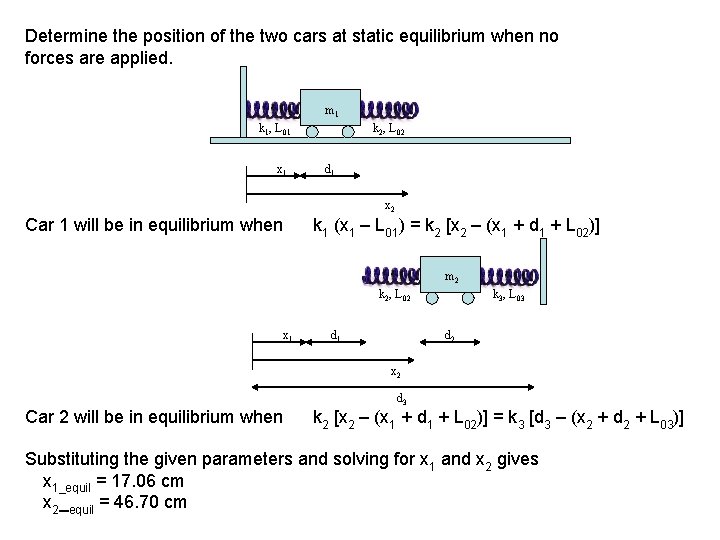
Determine the position of the two cars at static equilibrium when no forces are applied. m 1 k 1, L 01 x 1 k 2, L 02 d 1 x 2 Car 1 will be in equilibrium when k 1 (x 1 – L 01) = k 2 [x 2 – (x 1 + d 1 + L 02)] m 2 k 2, L 02 x 1 d 1 k 3, L 03 d 2 x 2 Car 2 will be in equilibrium when d 3 k 2 [x 2 – (x 1 + d 1 + L 02)] = k 3 [d 3 – (x 2 + d 2 + L 03)] Substituting the given parameters and solving for x 1 and x 2 gives x 1_equil = 17. 06 cm x 2_equil = 46. 70 cm
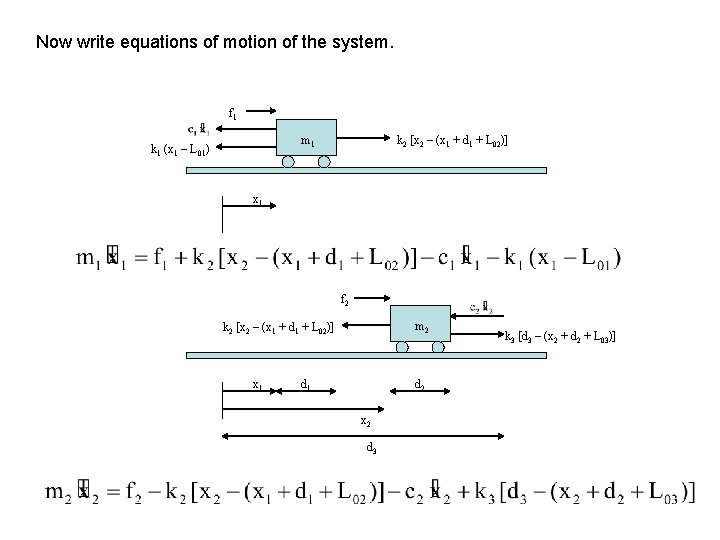
Now write equations of motion of the system. f 1 m 1 k 1 (x 1 – L 01) k 2 [x 2 – (x 1 + d 1 + L 02)] x 1 f 2 m 2 k 2 [x 2 – (x 1 + d 1 + L 02)] x 1 d 2 x 2 d 3 k 3 [d 3 – (x 2 + d 2 + L 03)]
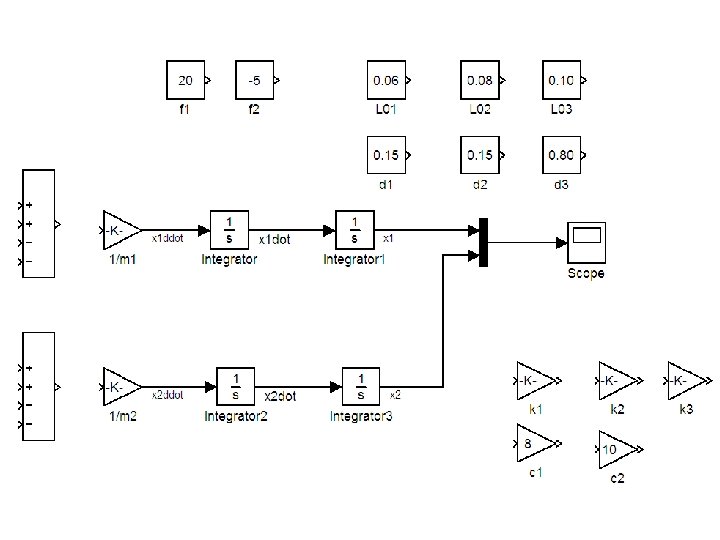
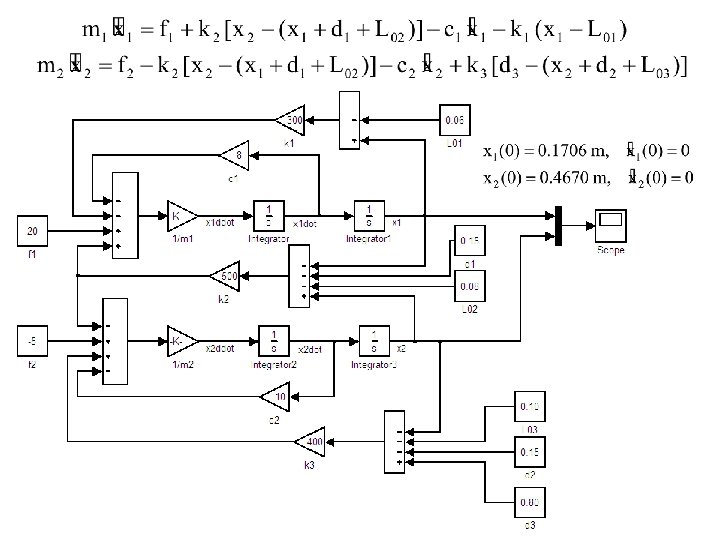
position, meters car 2 car 1 time, sec
This Week’s Objectives • Establish Dynamic Models of System to be Controlled – Second Order Systems • Obtain Solutions using La. Place Transforms • Create Simulink Model and Generate Simulated Results
- Slides: 50