
This Week v Fission and fusion What made


- Slides: 37
This Week v Fission and fusion What made our world v Atomic and Hydrogen bombs Big bangs in small packages v Nuclear power plants The solution to the energy problem? v Enrichment What does it mean and why is it necessary? v Toxic Disposal v Radiation in everyday life Limit your exposure (same for the stock market) v Fusion: The Holy Grail 11/23/2020 Physics 214 Fall 2010 1
Fission and fusion If we make an atom from it’s constituents energy is released. This is called the binding energy. Iron is the most tightly bound so if we can make elements up to Iron by the fusion of light elements energy is released. Similarly if we can break a very heavy atom into lighter elements we also have energy release. E = mc 2 Mass is another form of energy a nucleus is lighter than the sum of the constituent particle masses 11/23/2020 Fusion processes are how the sun produces energy and fission processes are how nuclear reactors produce energy Physics 214 Fall 2010 2
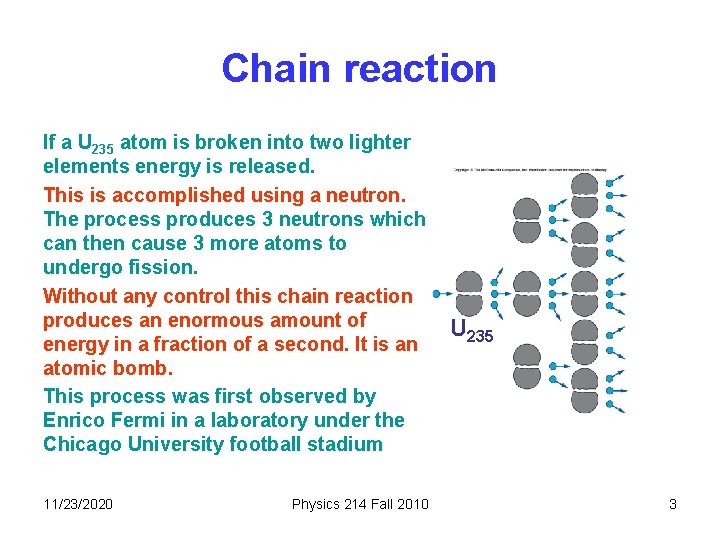
Chain reaction If a U 235 atom is broken into two lighter elements energy is released. This is accomplished using a neutron. The process produces 3 neutrons which can then cause 3 more atoms to undergo fission. Without any control this chain reaction produces an enormous amount of energy in a fraction of a second. It is an atomic bomb. This process was first observed by Enrico Fermi in a laboratory under the Chicago University football stadium 11/23/2020 Physics 214 Fall 2010 U 235 3
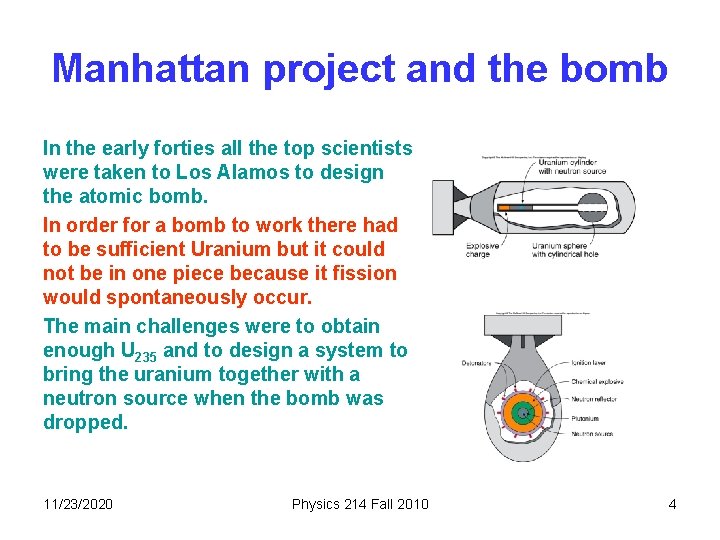
Manhattan project and the bomb In the early forties all the top scientists were taken to Los Alamos to design the atomic bomb. In order for a bomb to work there had to be sufficient Uranium but it could not be in one piece because it fission would spontaneously occur. The main challenges were to obtain enough U 235 and to design a system to bring the uranium together with a neutron source when the bomb was dropped. 11/23/2020 Physics 214 Fall 2010 4
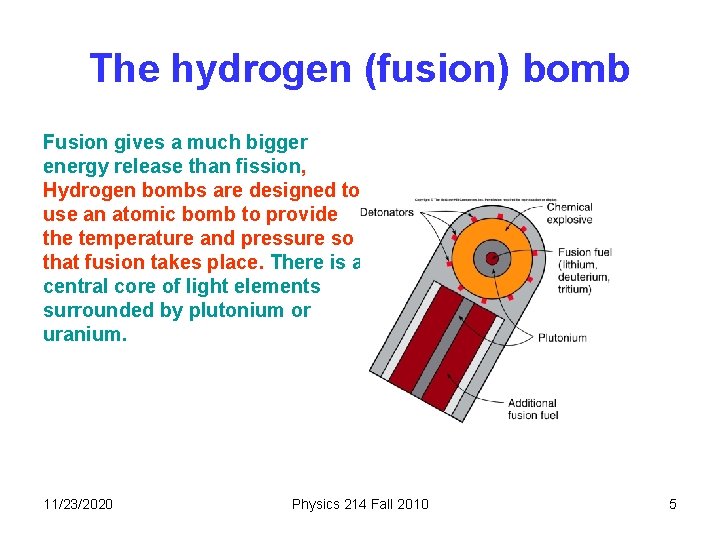
The hydrogen (fusion) bomb Fusion gives a much bigger energy release than fission, Hydrogen bombs are designed to use an atomic bomb to provide the temperature and pressure so that fusion takes place. There is a central core of light elements surrounded by plutonium or uranium. 11/23/2020 Physics 214 Fall 2010 5
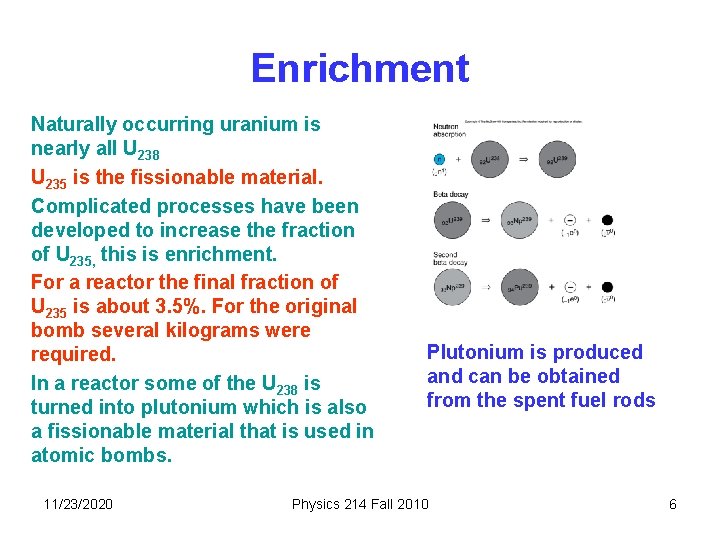
Enrichment Naturally occurring uranium is nearly all U 238 U 235 is the fissionable material. Complicated processes have been developed to increase the fraction of U 235, this is enrichment. For a reactor the final fraction of U 235 is about 3. 5%. For the original bomb several kilograms were required. In a reactor some of the U 238 is turned into plutonium which is also a fissionable material that is used in atomic bombs. 11/23/2020 Plutonium is produced and can be obtained from the spent fuel rods Physics 214 Fall 2010 6
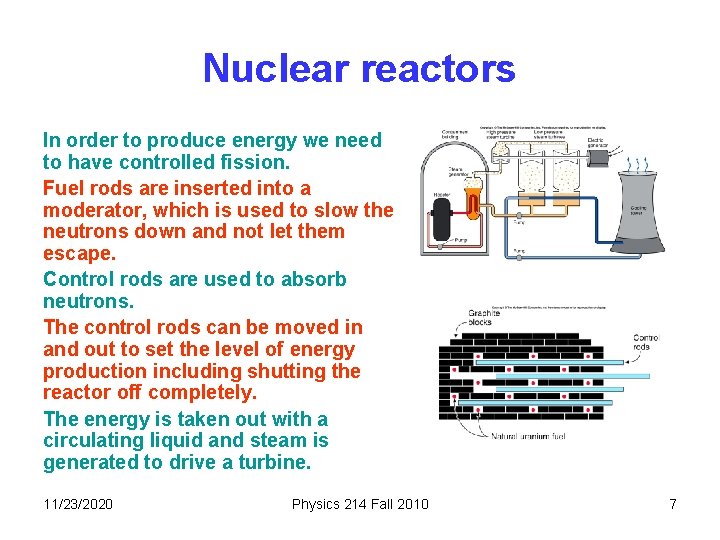
Nuclear reactors In order to produce energy we need to have controlled fission. Fuel rods are inserted into a moderator, which is used to slow the neutrons down and not let them escape. Control rods are used to absorb neutrons. The control rods can be moved in and out to set the level of energy production including shutting the reactor off completely. The energy is taken out with a circulating liquid and steam is generated to drive a turbine. 11/23/2020 Physics 214 Fall 2010 7
Toxic disposal Most of the elements produced in the fission process are highly radioactive. All materials inside the containment vessel also become highly radioactive. Disposal of this toxic nuclear waste is a very big problem since it must not enter the environment. There is controversy over a proposed waste disposal site at Yucca mountain. In 1986 operator error at the Chernobyl nuclear plant caused an uncontrolled chain reaction. The resulting release of radiation had effects over almost all the northern hemisphere and thyroid cancer rates have increased 10 fold in the Ukraine 11/23/2020 Physics 214 Fall 2010 8
Radiation in everyday life We are exposed to radiation at low levels from a number of sources v. Cosmic rays v. Radon and other natural radioactivity v. Medical imaging v. Consumer products fire alarms Radiation is also used vto treat cancer v. PET scans v. All kinds of medical tracers e. g. radioactive iodine v. Used in industry to control thickness of rolled steel and paper v. Sterilization of food 11/23/2020 Physics 214 Fall 2010 9
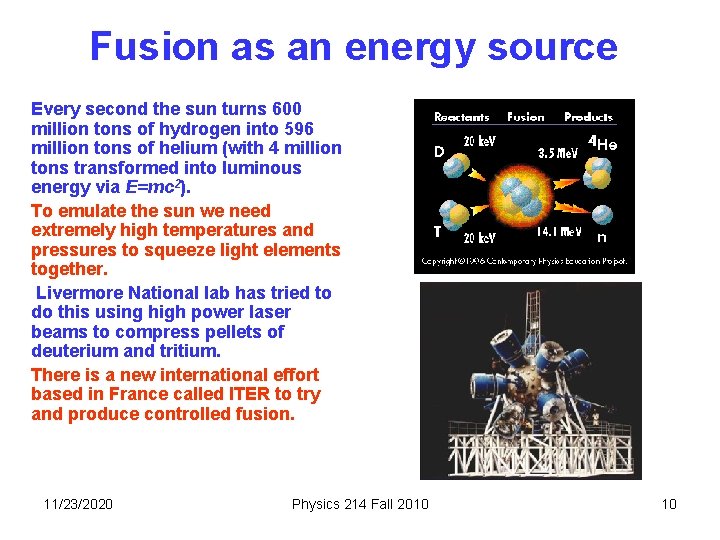
Fusion as an energy source Every second the sun turns 600 million tons of hydrogen into 596 million tons of helium (with 4 million tons transformed into luminous energy via E=mc 2). To emulate the sun we need extremely high temperatures and pressures to squeeze light elements together. Livermore National lab has tried to do this using high power laser beams to compress pellets of deuterium and tritium. There is a new international effort based in France called ITER to try and produce controlled fusion. 11/23/2020 Physics 214 Fall 2010 10
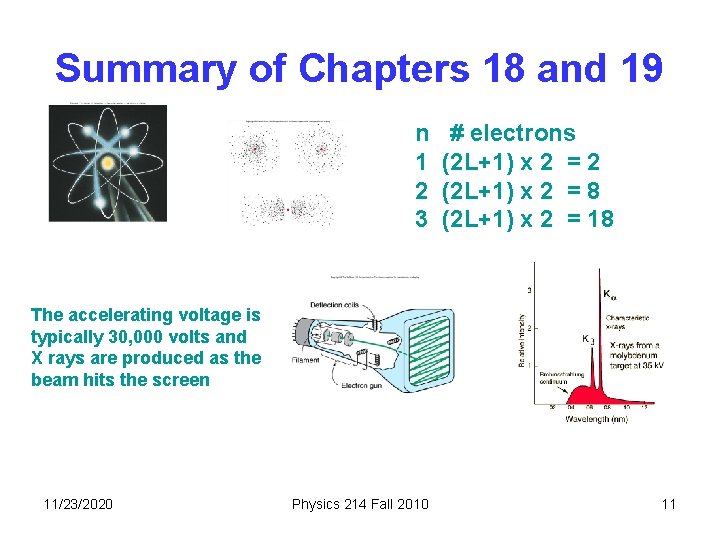
Summary of Chapters 18 and 19 n 1 2 3 # electrons (2 L+1) x 2 = 2 (2 L+1) x 2 = 8 (2 L+1) x 2 = 18 The accelerating voltage is typically 30, 000 volts and X rays are produced as the beam hits the screen 11/23/2020 Physics 214 Fall 2010 11
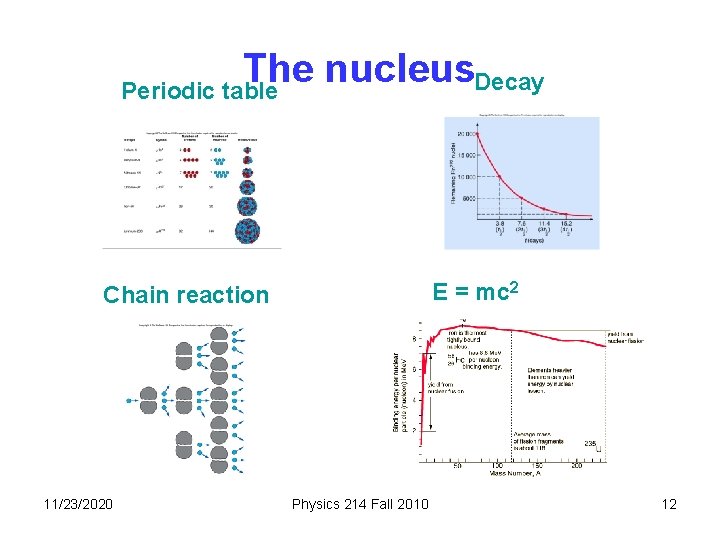
The nucleus Decay Periodic table E = mc 2 Chain reaction 11/23/2020 Physics 214 Fall 2010 12
Questions Chapter 18 Q 11 Assuming that cathode rays are a beam of charged particles, how could you demonstrate that these particles are negatively charged? By deflection in a magnetic field Q 13 Would you expect X rays to be produced by a television picture tube? Yes the accelerated electrons hitting the screen do produce X rays 11/23/2020 Physics 214 Fall 2010 13
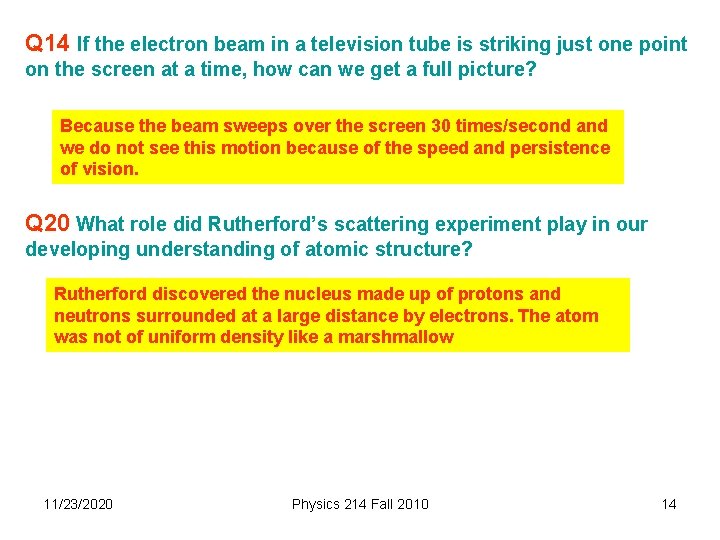
Q 14 If the electron beam in a television tube is striking just one point on the screen at a time, how can we get a full picture? Because the beam sweeps over the screen 30 times/second and we do not see this motion because of the speed and persistence of vision. Q 20 What role did Rutherford’s scattering experiment play in our developing understanding of atomic structure? Rutherford discovered the nucleus made up of protons and neutrons surrounded at a large distance by electrons. The atom was not of uniform density like a marshmallow 11/23/2020 Physics 214 Fall 2010 14
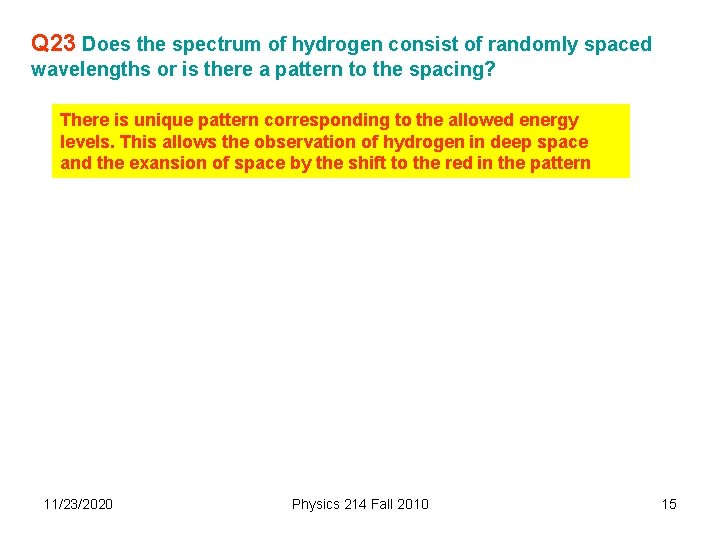
Q 23 Does the spectrum of hydrogen consist of randomly spaced wavelengths or is there a pattern to the spacing? There is unique pattern corresponding to the allowed energy levels. This allows the observation of hydrogen in deep space and the exansion of space by the shift to the red in the pattern 11/23/2020 Physics 214 Fall 2010 15
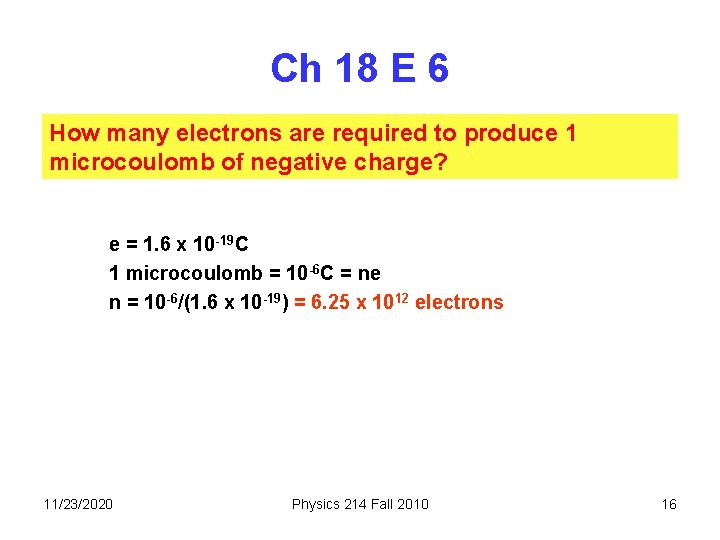
Ch 18 E 6 How many electrons are required to produce 1 microcoulomb of negative charge? e = 1. 6 x 10 -19 C 1 microcoulomb = 10 -6 C = ne n = 10 -6/(1. 6 x 10 -19) = 6. 25 x 1012 electrons 11/23/2020 Physics 214 Fall 2010 16
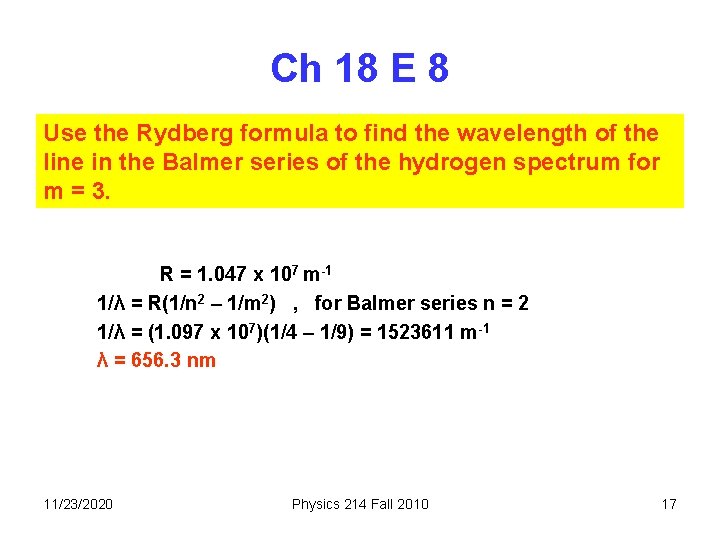
Ch 18 E 8 Use the Rydberg formula to find the wavelength of the line in the Balmer series of the hydrogen spectrum for m = 3. R = 1. 047 x 107 m-1 1/λ = R(1/n 2 – 1/m 2) , for Balmer series n = 2 1/λ = (1. 097 x 107)(1/4 – 1/9) = 1523611 m-1 λ = 656. 3 nm 11/23/2020 Physics 214 Fall 2010 17
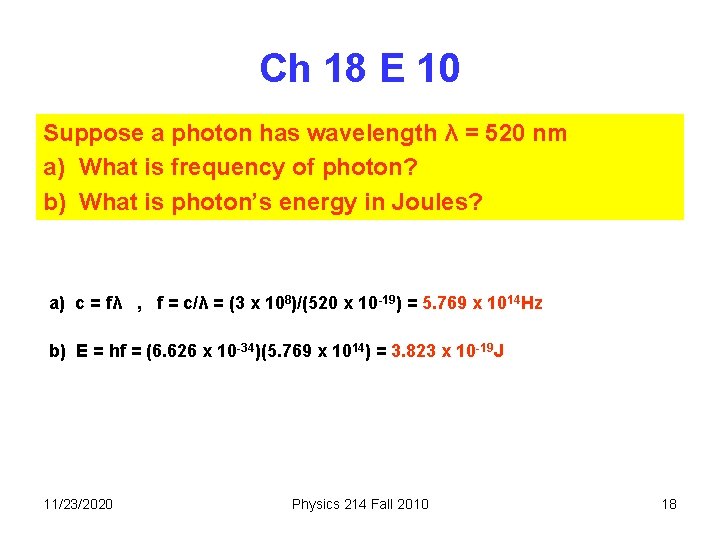
Ch 18 E 10 Suppose a photon has wavelength λ = 520 nm a) What is frequency of photon? b) What is photon’s energy in Joules? a) c = fλ , f = c/λ = (3 x 10⁸)/(520 x 10 -19) = 5. 769 x 1014 Hz b) E = hf = (6. 626 x 10 -34)(5. 769 x 1014) = 3. 823 x 10 -19 J 11/23/2020 Physics 214 Fall 2010 18
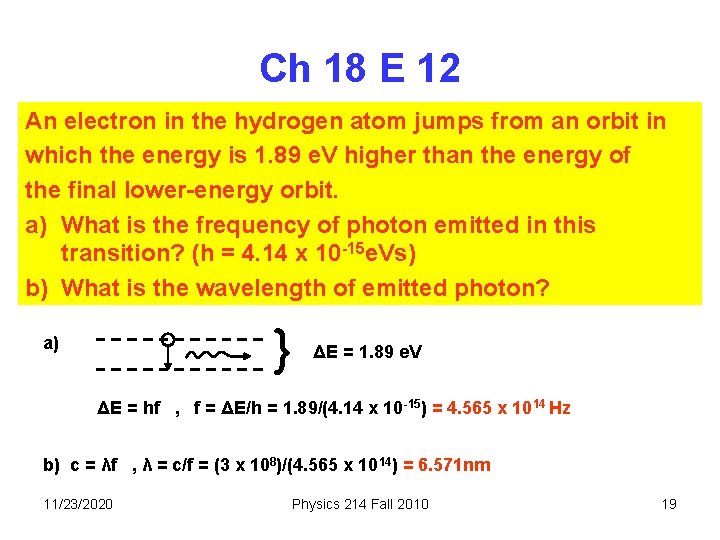
Ch 18 E 12 An electron in the hydrogen atom jumps from an orbit in which the energy is 1. 89 e. V higher than the energy of the final lower-energy orbit. a) What is the frequency of photon emitted in this transition? (h = 4. 14 x 10 -15 e. Vs) b) What is the wavelength of emitted photon? } a) ΔE = 1. 89 e. V ΔE = hf , f = ΔE/h = 1. 89/(4. 14 x 10 -15) = 4. 565 x 1014 Hz b) c = λf , λ = c/f = (3 x 10⁸)/(4. 565 x 1014) = 6. 571 nm 11/23/2020 Physics 214 Fall 2010 19
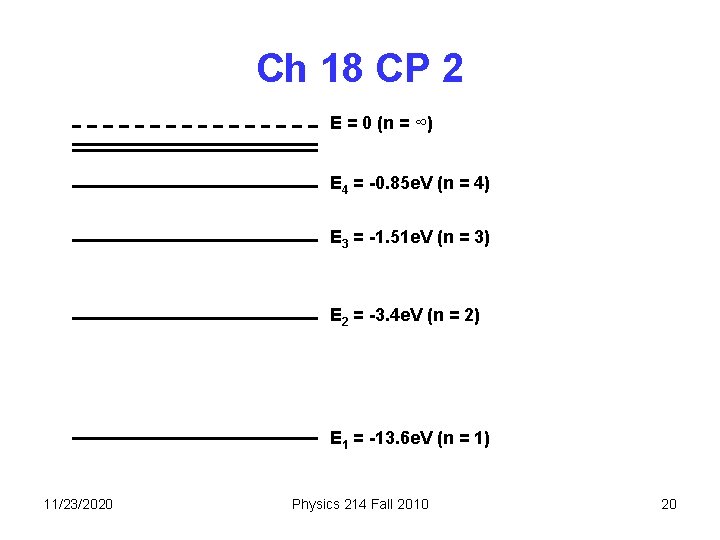
Ch 18 CP 2 E = 0 (n = ∞) E 4 = -0. 85 e. V (n = 4) E 3 = -1. 51 e. V (n = 3) E 2 = -3. 4 e. V (n = 2) E 1 = -13. 6 e. V (n = 1) 11/23/2020 Physics 214 Fall 2010 20
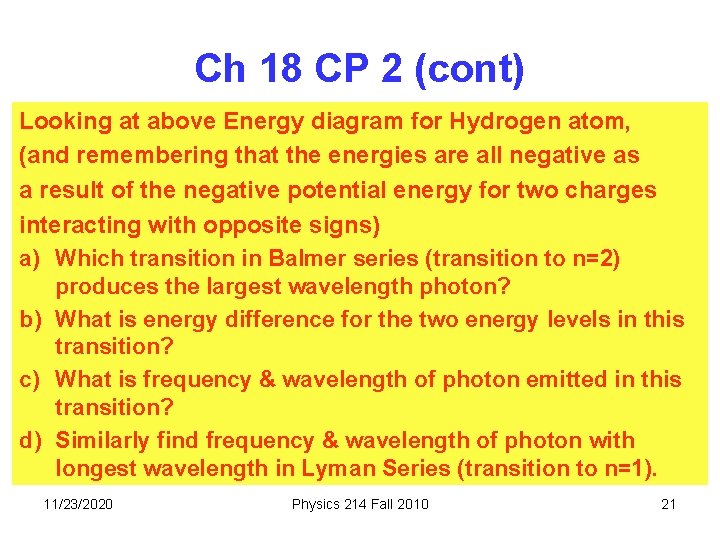
Ch 18 CP 2 (cont) Looking at above Energy diagram for Hydrogen atom, (and remembering that the energies are all negative as a result of the negative potential energy for two charges interacting with opposite signs) a) Which transition in Balmer series (transition to n=2) produces the largest wavelength photon? b) What is energy difference for the two energy levels in this transition? c) What is frequency & wavelength of photon emitted in this transition? d) Similarly find frequency & wavelength of photon with longest wavelength in Lyman Series (transition to n=1). 11/23/2020 Physics 214 Fall 2010 21
Ch 18 CP 2 (cont) a) 1/λ = R(1/n 2 – 1/m 2) , Balmer: n=2 1/λ = R(1/4 – 1/m 2) , We want λ to be largest possible, that means 1/λ is smallest possible. Compare m=3 and m=4. m=3: 1/4 – 1/32 = 1/4 -1/9 = 5/36 m=4: 1/4 – 1/42 = 1/4 – 1/16 = 3/16 } 5/36 < 3/16 b) E 3 = -1. 51 e. V & E 2 = -3. 4 e. V ΔE = -1. 89 e. V (the electron loses this energy) c) The electron loses 1. 89 e. V. By energy conservation the photon gains 1. 89 e. V. E = hf , f = E/h = 1. 89/(4. 14 x 10 -15) = 4. 565 x 1014 Hz c = λf , λ = c/f = (3 x 10⁸)/(4. 565 x 1014) = 657. 1 nm 11/23/2020 Physics 214 Fall 2010 22
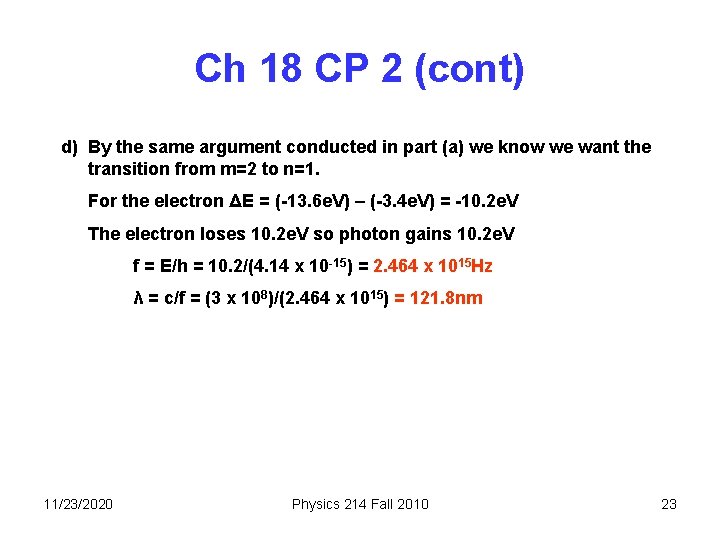
Ch 18 CP 2 (cont) d) By the same argument conducted in part (a) we know we want the transition from m=2 to n=1. For the electron ΔE = (-13. 6 e. V) – (-3. 4 e. V) = -10. 2 e. V The electron loses 10. 2 e. V so photon gains 10. 2 e. V f = E/h = 10. 2/(4. 14 x 10 -15) = 2. 464 x 1015 Hz λ = c/f = (3 x 10⁸)/(2. 464 x 1015) = 121. 8 nm 11/23/2020 Physics 214 Fall 2010 23
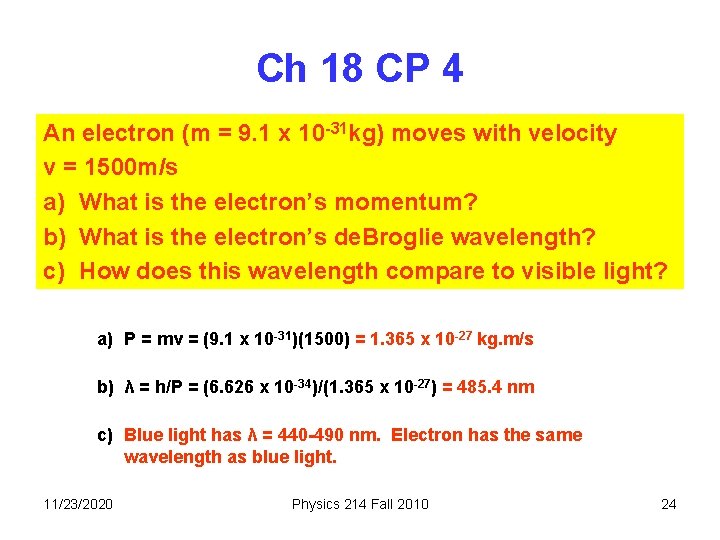
Ch 18 CP 4 An electron (m = 9. 1 x 10 -31 kg) moves with velocity v = 1500 m/s a) What is the electron’s momentum? b) What is the electron’s de. Broglie wavelength? c) How does this wavelength compare to visible light? a) P = mv = (9. 1 x 10 -31)(1500) = 1. 365 x 10 -27 kg. m/s b) λ = h/P = (6. 626 x 10 -34)/(1. 365 x 10 -27) = 485. 4 nm c) Blue light has λ = 440 -490 nm. Electron has the same wavelength as blue light. 11/23/2020 Physics 214 Fall 2010 24
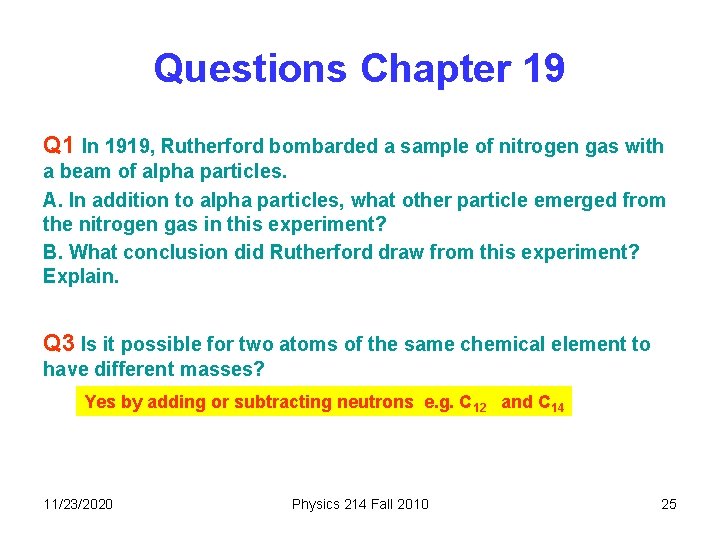
Questions Chapter 19 Q 1 In 1919, Rutherford bombarded a sample of nitrogen gas with a beam of alpha particles. A. In addition to alpha particles, what other particle emerged from the nitrogen gas in this experiment? B. What conclusion did Rutherford draw from this experiment? Explain. Q 3 Is it possible for two atoms of the same chemical element to have different masses? Yes by adding or subtracting neutrons e. g. C 12 and C 14 11/23/2020 Physics 214 Fall 2010 25
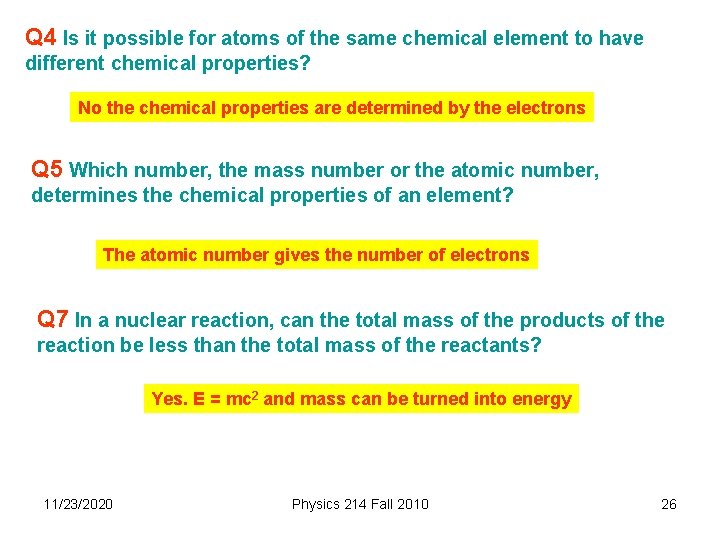
Q 4 Is it possible for atoms of the same chemical element to have different chemical properties? No the chemical properties are determined by the electrons Q 5 Which number, the mass number or the atomic number, determines the chemical properties of an element? The atomic number gives the number of electrons Q 7 In a nuclear reaction, can the total mass of the products of the reaction be less than the total mass of the reactants? Yes. E = mc 2 and mass can be turned into energy 11/23/2020 Physics 214 Fall 2010 26
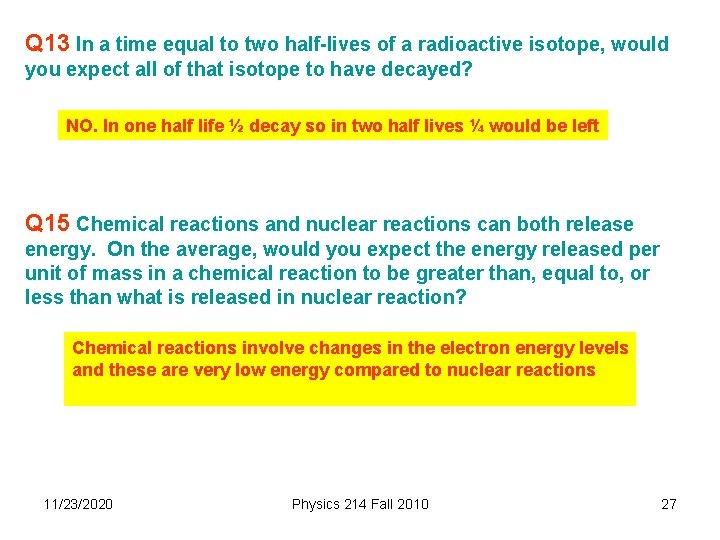
Q 13 In a time equal to two half-lives of a radioactive isotope, would you expect all of that isotope to have decayed? NO. In one half life ½ decay so in two half lives ¼ would be left Q 15 Chemical reactions and nuclear reactions can both release energy. On the average, would you expect the energy released per unit of mass in a chemical reaction to be greater than, equal to, or less than what is released in nuclear reaction? Chemical reactions involve changes in the electron energy levels and these are very low energy compared to nuclear reactions 11/23/2020 Physics 214 Fall 2010 27
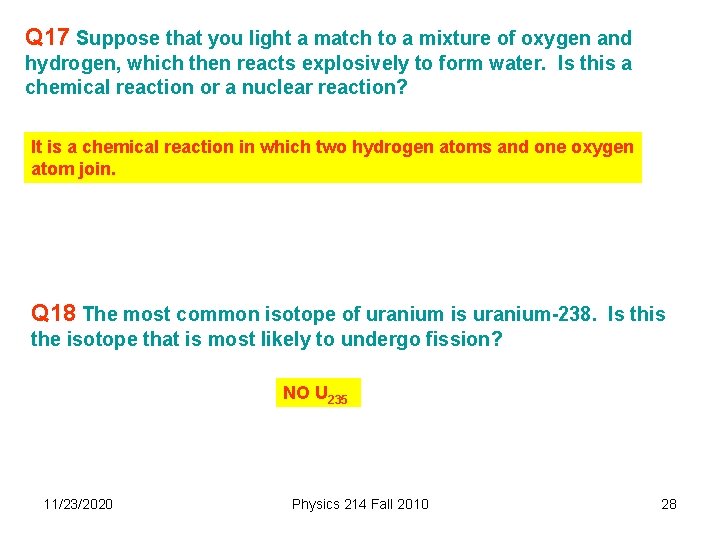
Q 17 Suppose that you light a match to a mixture of oxygen and hydrogen, which then reacts explosively to form water. Is this a chemical reaction or a nuclear reaction? It is a chemical reaction in which two hydrogen atoms and one oxygen atom join. Q 18 The most common isotope of uranium is uranium-238. Is this the isotope that is most likely to undergo fission? NO U 235 11/23/2020 Physics 214 Fall 2010 28
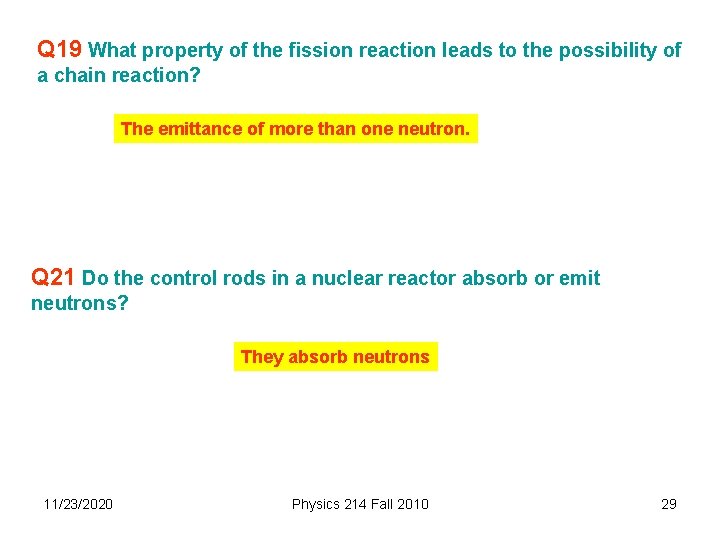
Q 19 What property of the fission reaction leads to the possibility of a chain reaction? The emittance of more than one neutron. Q 21 Do the control rods in a nuclear reactor absorb or emit neutrons? They absorb neutrons 11/23/2020 Physics 214 Fall 2010 29
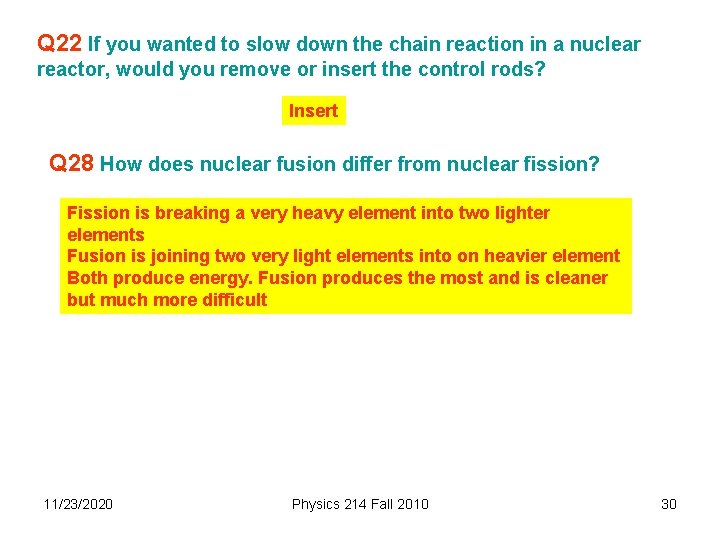
Q 22 If you wanted to slow down the chain reaction in a nuclear reactor, would you remove or insert the control rods? Insert Q 28 How does nuclear fusion differ from nuclear fission? Fission is breaking a very heavy element into two lighter elements Fusion is joining two very light elements into on heavier element Both produce energy. Fusion produces the most and is cleaner but much more difficult 11/23/2020 Physics 214 Fall 2010 30
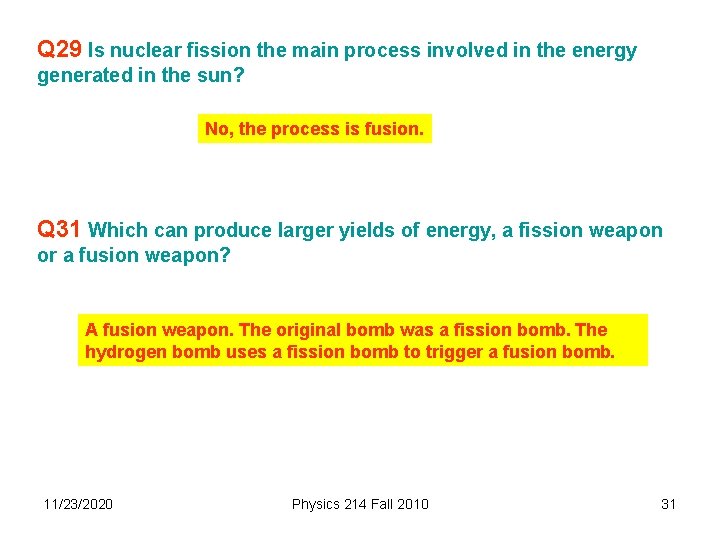
Q 29 Is nuclear fission the main process involved in the energy generated in the sun? No, the process is fusion. Q 31 Which can produce larger yields of energy, a fission weapon or a fusion weapon? A fusion weapon. The original bomb was a fission bomb. The hydrogen bomb uses a fission bomb to trigger a fusion bomb. 11/23/2020 Physics 214 Fall 2010 31
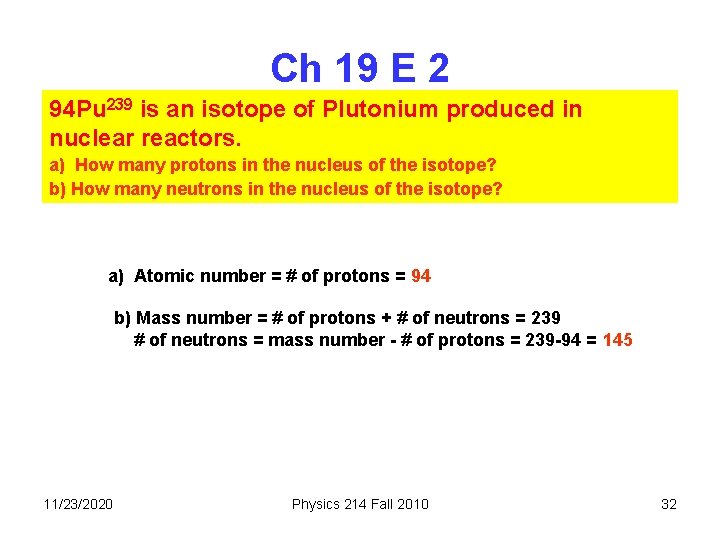
Ch 19 E 2 94 Pu 239 is an isotope of Plutonium produced in nuclear reactors. a) How many protons in the nucleus of the isotope? b) How many neutrons in the nucleus of the isotope? a) Atomic number = # of protons = 94 b) Mass number = # of protons + # of neutrons = 239 # of neutrons = mass number - # of protons = 239 -94 = 145 11/23/2020 Physics 214 Fall 2010 32
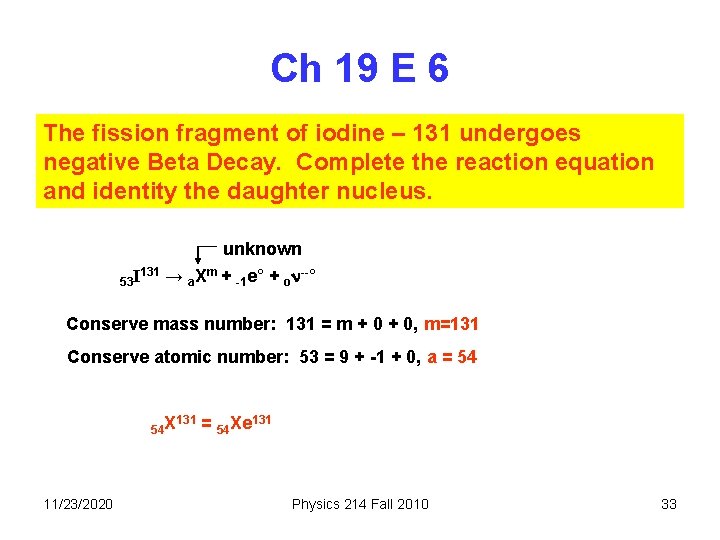
Ch 19 E 6 The fission fragment of iodine – 131 undergoes negative Beta Decay. Complete the reaction equation and identity the daughter nucleus. unknown 131 → Xm + e° + --° 53 I a -1 o Conserve mass number: 131 = m + 0, m=131 Conserve atomic number: 53 = 9 + -1 + 0, a = 54 54 X 11/23/2020 131 = 54 Xe 131 Physics 214 Fall 2010 33
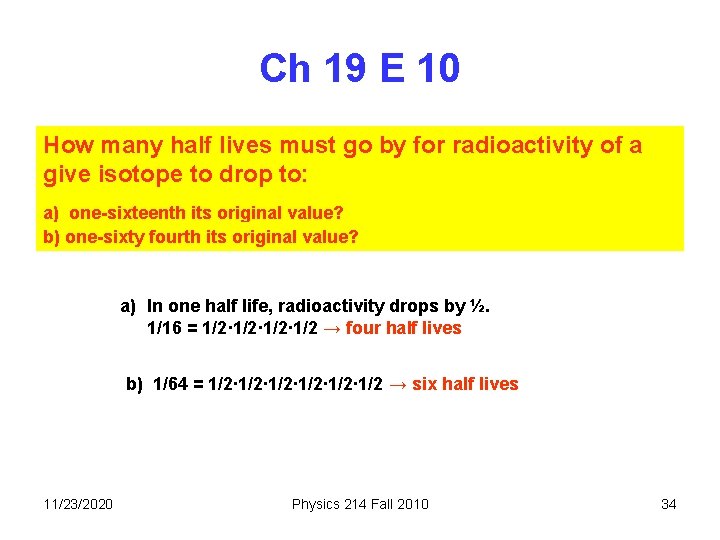
Ch 19 E 10 How many half lives must go by for radioactivity of a give isotope to drop to: a) one-sixteenth its original value? b) one-sixty fourth its original value? a) In one half life, radioactivity drops by ½. 1/16 = 1/2∙ 1/2 → four half lives b) 1/64 = 1/2∙ 1/2∙ 1/2 → six half lives 11/23/2020 Physics 214 Fall 2010 34
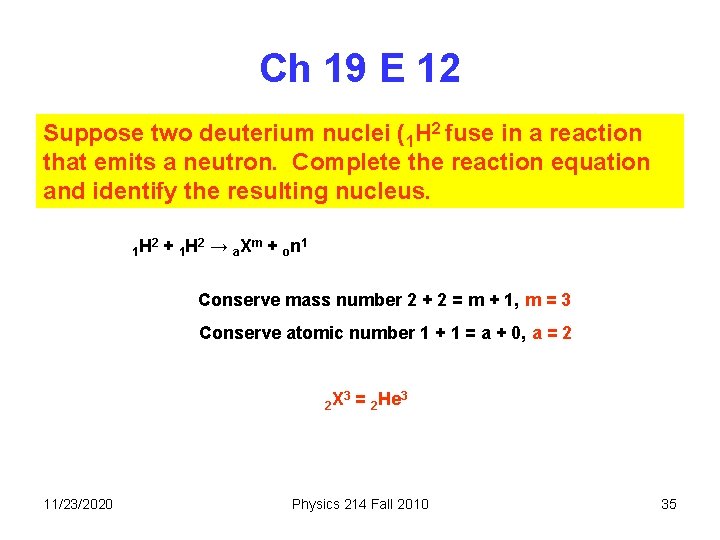
Ch 19 E 12 Suppose two deuterium nuclei (1 H 2 fuse in a reaction that emits a neutron. Complete the reaction equation and identify the resulting nucleus. 1 H 2 + 1 H 2 → a X m + on 1 Conserve mass number 2 + 2 = m + 1, m = 3 Conserve atomic number 1 + 1 = a + 0, a = 2 2 X 11/23/2020 3 = 2 He 3 Physics 214 Fall 2010 35
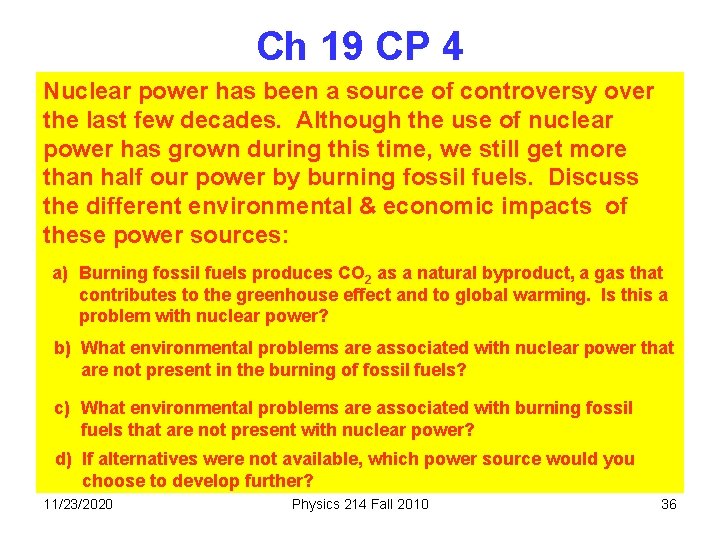
Ch 19 CP 4 Nuclear power has been a source of controversy over the last few decades. Although the use of nuclear power has grown during this time, we still get more than half our power by burning fossil fuels. Discuss the different environmental & economic impacts of these power sources: a) Burning fossil fuels produces CO 2 as a natural byproduct, a gas that contributes to the greenhouse effect and to global warming. Is this a problem with nuclear power? b) What environmental problems are associated with nuclear power that are not present in the burning of fossil fuels? c) What environmental problems are associated with burning fossil fuels that are not present with nuclear power? d) If alternatives were not available, which power source would you choose to develop further? 11/23/2020 Physics 214 Fall 2010 36
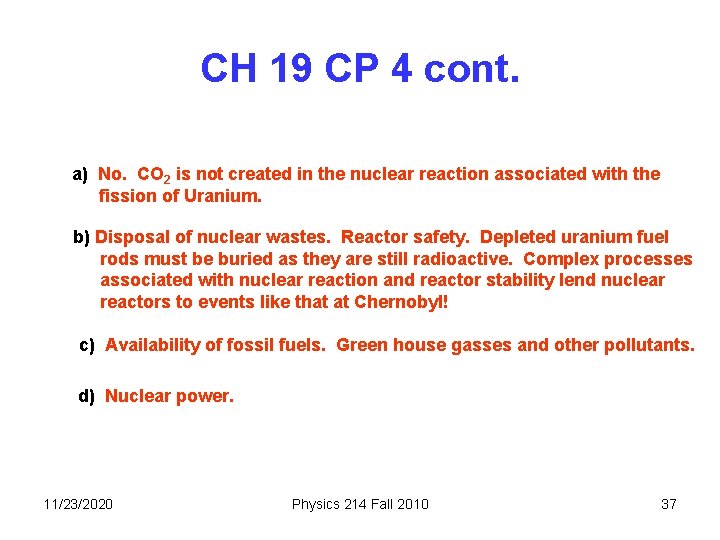
CH 19 CP 4 cont. a) No. CO 2 is not created in the nuclear reaction associated with the fission of Uranium. b) Disposal of nuclear wastes. Reactor safety. Depleted uranium fuel rods must be buried as they are still radioactive. Complex processes associated with nuclear reaction and reactor stability lend nuclear reactors to events like that at Chernobyl! c) Availability of fossil fuels. Green house gasses and other pollutants. d) Nuclear power. 11/23/2020 Physics 214 Fall 2010 37