
This term include antibiotics and chemically synthesized drugs
This term include antibiotics and chemically synthesized drugs
General Characteristics of Antimicrobial Drugs
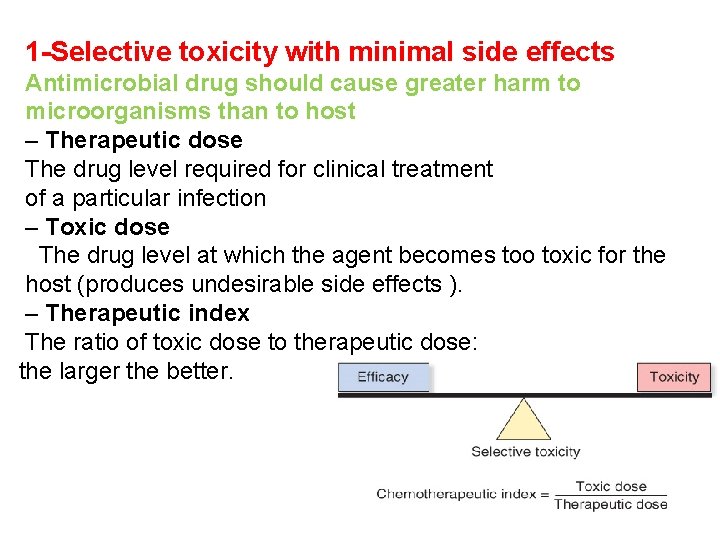
1 -Selective toxicity with minimal side effects Antimicrobial drug should cause greater harm to microorganisms than to host – Therapeutic dose The drug level required for clinical treatment of a particular infection – Toxic dose The drug level at which the agent becomes too toxic for the host (produces undesirable side effects ). – Therapeutic index The ratio of toxic dose to therapeutic dose: the larger the better.
2 -Broad spectrum activity (activity against a wide variety of pathogens) is more desirable than narrow spectrum activity. 3 - Drug can be cidal or Static Bacteriocidal (able to kill) Bicteriostatic (able to reversibly inhibit growth) 3 - Antimicrobial agents can occur naturally or be synthetic or semi- synthetic (chemical modifications of naturally occurring antibiotics)

Antibiotic spectrum of activity
Determining the Level of Antimicrobial Activity
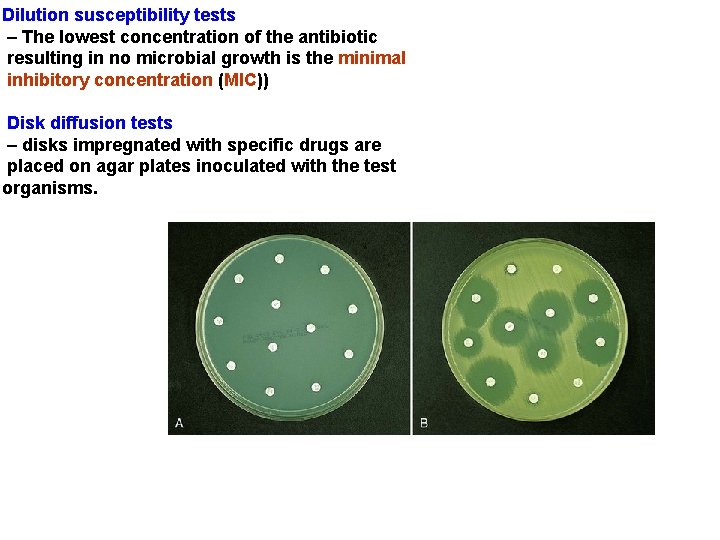
Dilution susceptibility tests – The lowest concentration of the antibiotic resulting in no microbial growth is the minimal inhibitory concentration (MIC)) Disk diffusion tests – disks impregnated with specific drugs are placed on agar plates inoculated with the test organisms.
Mechanisms of Action of Antimicrobial Agents 1 • Inhibition of cell wall synthesis 2 • Inhibition of protein synthesis 3 • Inhibition of nucleic acid synthesis 4 • Disruption of cell membranes 5 • Inhibition of metabolic activities
1 • Inhibition of cell wall synthesis This is the mode of action of the following antimicrobial agents: -Beta lactam containing antibiotics such as penicilin and cephalosporins (stop synthesis of wall by preventing cross linking of peptidoglycan units). -Vancomycin -Cycloserine 2 • Inhibition of protein synthesis: -Aminoglycosides (streptomycin, neomycin, Gentamicin, and kanamycin) -Tetracyclines -Macrolides (Erythromycin, Clithramycin, Azthromycin) -Chloramphenicol Due to differences in ribosomes. Prokaryotic cells have (50 S + 30 S subunits) ribosomes. Chloramphenicol, Macrolides and Clindamycin bind to the 50 S subunit. Tetracyclines and Aminoglycosides bind to the 30 S subunit.
3 • Inhibition of nucleic acid synthesis Stop DNA replication in : -Qunilones and fluoroquinolones(such as ciprofloxacin) -Rifampicin or Stop RNA synthesis in : -Metronidazole 4 • Disruption of cell membranes Inhibition of functions of cellular membrane (the cytoplasmic membrane). -Polymyxins can selectively combine with phosphatide in the cell membrane and cause the increase of membranous permeability. As the result, some important materials will outflow from bacterial cells and result in death of bacteria
5 • Inhibition of metabolic activities (Antimetabolites) A drug mimics a normal metabolite and acts as a competitive inhibitor. Enzyme of cell recognizes the drug instead of the normal metabolite. Pathway stops. -Sulfonamides (Sulpha drugs) and trimethoprim (inhibit folic acid synthesis).
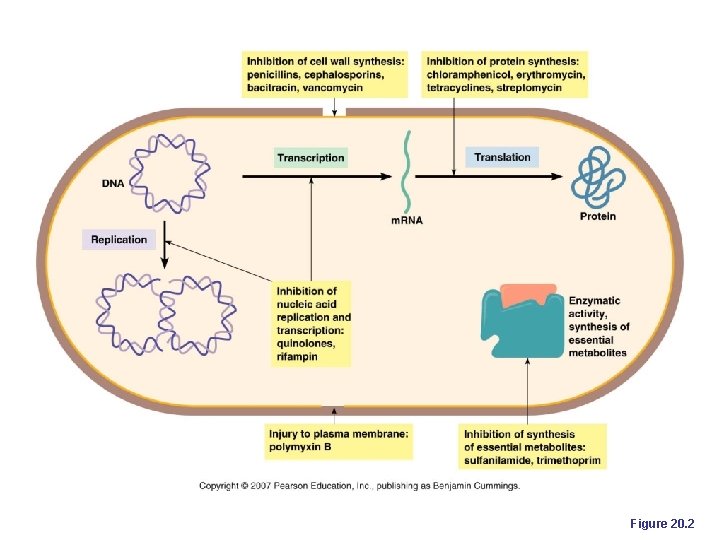
Figure 20. 2
Factors Influencing the Effectiveness of Antimicrobial Drugs 1 - Factors influencing a drug’s ability to reach the site of Infection. 2 - Factors influencing drug concentration in the body. 3 - The nature of the pathogen
1 - Factors influencing a drug’s ability to reach the site of Infection: a– Mode of administration • Oral • Topical • Parenteral (injection) b– Susceptibility to various bodily defense mechanisms (e. g. , penicillin is rapidly degraded in the stomach, but the penicillin derivative ampicillin is more acid stable)
2 - Factors influencing drug concentration in the body. Drug concentration must exceed the pathogen’s MIC for the drug to be effective. This will depend on a– Amount of drug administered b– Route of administration c– Speed of uptake d– Rate of clearance (elimination) from the body
3 - The nature of the pathogen, This includes: a- Inherent susceptibility of the pathogen and the presence of its active growth. b- Drug resistance (This has become an increasing problem) Bacteria had developed a number of mechanisms to protect themselves from the action of antibiotics.
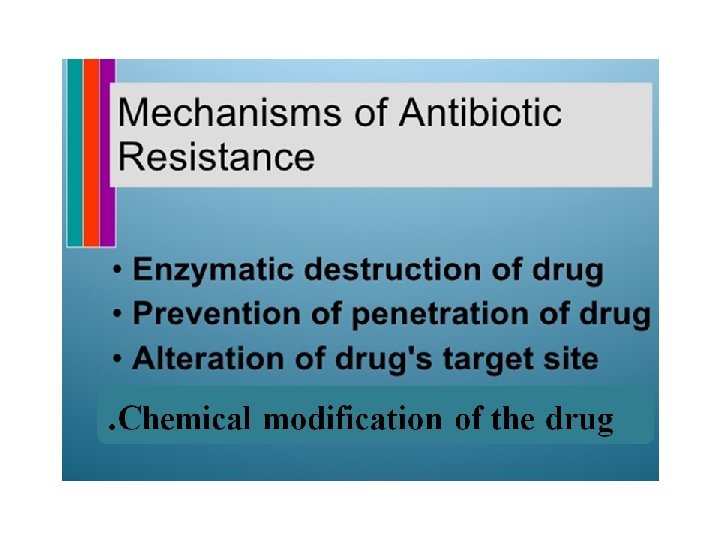
1 -Enzymatic Destruction (inactivation ) of the drug Antibiotic hydrolysis by bacterial cellular enzymes renders it inactive. An example includes the penicillinases and other beta lactamases that cleave the beta-lactam ring of pencillins and cephalosporins. 2 -Prevention of penetration of drug Alterations that affect permeability which can involve a decreased influx or an increased efflux from the bacterial cell.
3 -Alteration of the drug‘s target site through mutation. An example is streptomycin resistance. Streptomycin binds to bacterial ribosome and acts through prevention of protein synthesis. In resistant bacteria , alteration of a single amino acid in bacterial ribosomal protein will prevent streptomycin binding to ribosome and thus will not affect bacterial protein synthesis. 4 -Chemical modification of drug: By acetylation, phosphorylation or adenylation of the antibiotic by bacteria results in inactivation of the antibiotic
• The origin and transmission of drug resistance involve chromosomal or plasmid genes for drug resistance
Rules for the Nomenclature of Microorganisms • There is only one correct name for an organism. • Names that cause error or confusion should be rejected. • All names in Latin or are latinized. – The first word (genus) is always capitalized. – The second word (species or specific epithet) is not capitalized. – Both genus and species name, together referred to as species, are either underlined or italicized when appearing in print.
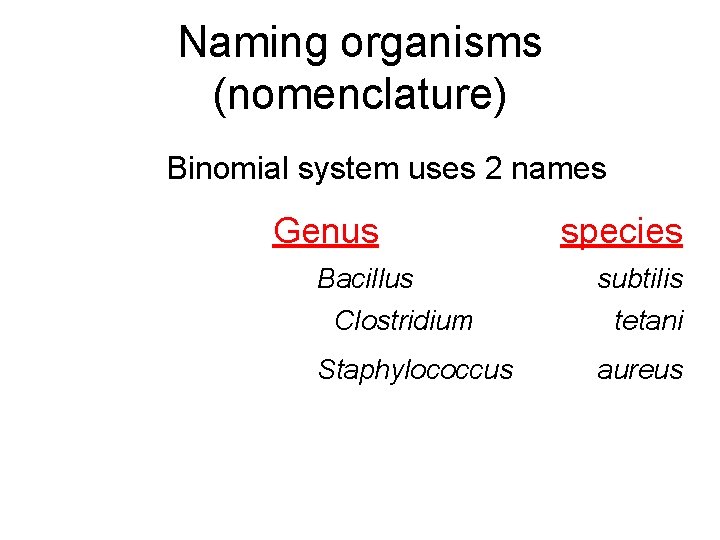
Naming organisms (nomenclature) Binomial system uses 2 names Genus Bacillus Clostridium Staphylococcus species subtilis tetani aureus
- Slides: 22