
This Shows That Noun Clauses LeadIns Basic Writing
This Shows That Noun Clauses Lead-Ins Basic Writing Principles
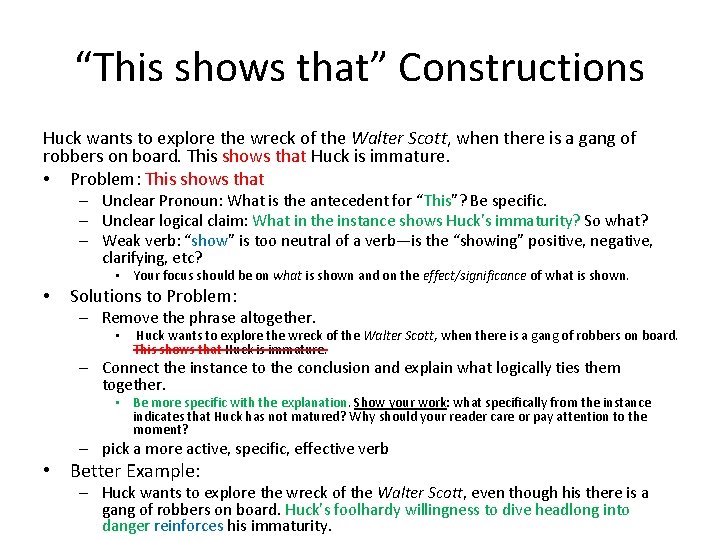
“This shows that” Constructions Huck wants to explore the wreck of the Walter Scott, when there is a gang of robbers on board. This shows that Huck is immature. • Problem: This shows that – Unclear Pronoun: What is the antecedent for “This”? Be specific. – Unclear logical claim: What in the instance shows Huck’s immaturity? So what? – Weak verb: “show” is too neutral of a verb—is the “showing” positive, negative, clarifying, etc? • Your focus should be on what is shown and on the effect/significance of what is shown. • Solutions to Problem: – Remove the phrase altogether. • Huck wants to explore the wreck of the Walter Scott, when there is a gang of robbers on board. This shows that Huck is immature. – Connect the instance to the conclusion and explain what logically ties them together. • Be more specific with the explanation. Show your work: what specifically from the instance indicates that Huck has not matured? Why should your reader care or pay attention to the moment? – pick a more active, specific, effective verb • Better Example: – Huck wants to explore the wreck of the Walter Scott, even though his there is a gang of robbers on board. Huck’s foolhardy willingness to dive headlong into danger reinforces his immaturity.
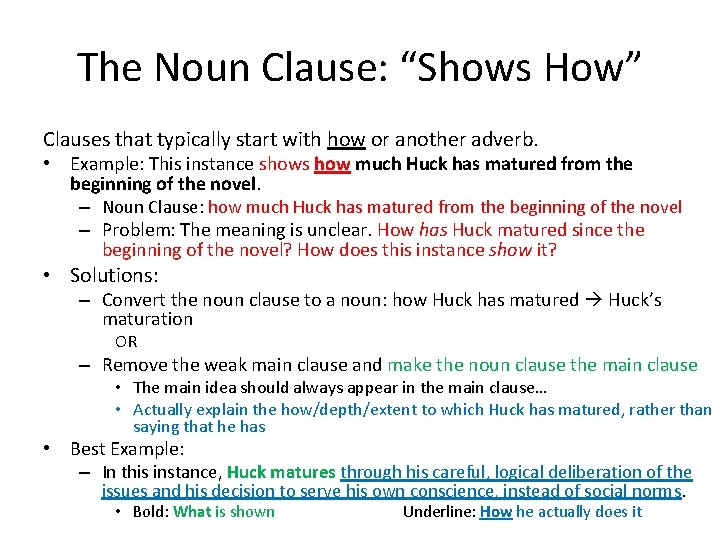
The Noun Clause: “Shows How” Clauses that typically start with how or another adverb. • Example: This instance shows how much Huck has matured from the beginning of the novel. – Noun Clause: how much Huck has matured from the beginning of the novel – Problem: The meaning is unclear. How has Huck matured since the beginning of the novel? How does this instance show it? • Solutions: – Convert the noun clause to a noun: how Huck has matured Huck’s maturation OR – Remove the weak main clause and make the noun clause the main clause • The main idea should always appear in the main clause… • Actually explain the how/depth/extent to which Huck has matured, rather than saying that he has • Best Example: – In this instance, Huck matures through his careful, logical deliberation of the issues and his decision to serve his own conscience, instead of social norms. • Bold: What is shown Underline: How he actually does it
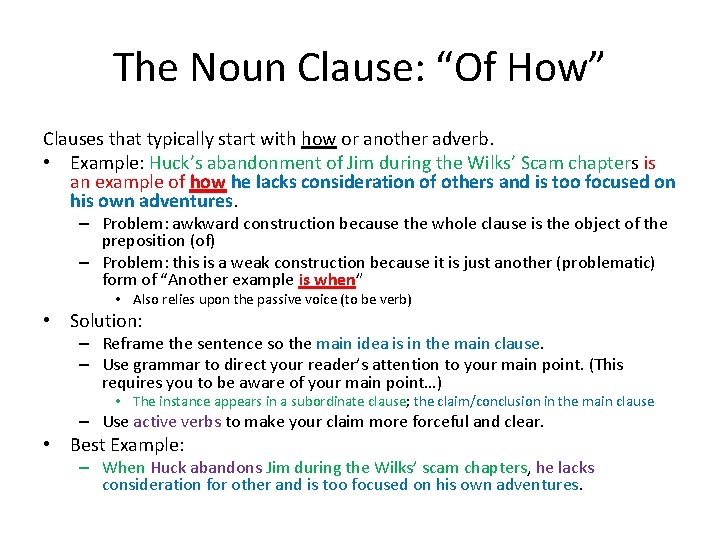
The Noun Clause: “Of How” Clauses that typically start with how or another adverb. • Example: Huck’s abandonment of Jim during the Wilks’ Scam chapters is an example of how he lacks consideration of others and is too focused on his own adventures. – Problem: awkward construction because the whole clause is the object of the preposition (of) – Problem: this is a weak construction because it is just another (problematic) form of “Another example is when” • Also relies upon the passive voice (to be verb) • Solution: – Reframe the sentence so the main idea is in the main clause. – Use grammar to direct your reader’s attention to your main point. (This requires you to be aware of your main point…) • The instance appears in a subordinate clause; the claim/conclusion in the main clause – Use active verbs to make your claim more forceful and clear. • Best Example: – When Huck abandons Jim during the Wilks’ scam chapters, he lacks consideration for other and is too focused on his own adventures.
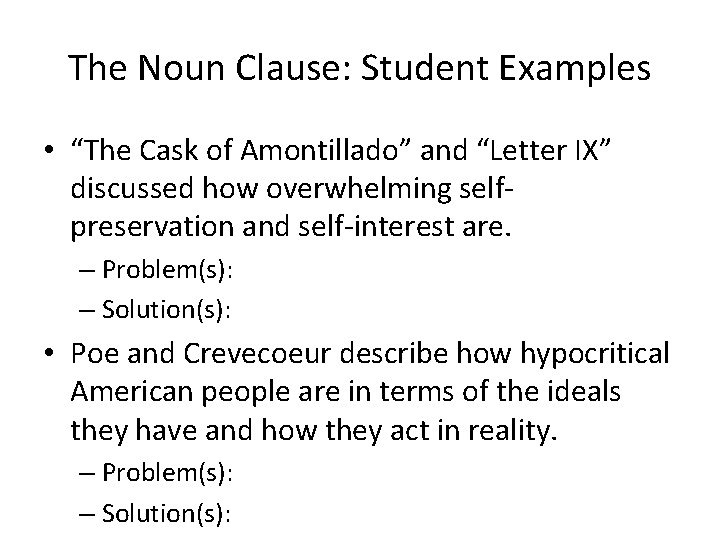
The Noun Clause: Student Examples • “The Cask of Amontillado” and “Letter IX” discussed how overwhelming selfpreservation and self-interest are. – Problem(s): – Solution(s): • Poe and Crevecoeur describe how hypocritical American people are in terms of the ideals they have and how they act in reality. – Problem(s): – Solution(s):
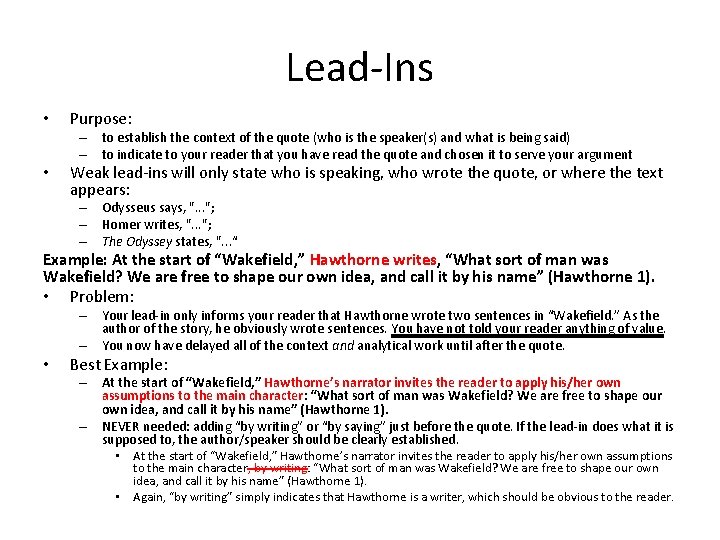
Lead-Ins • Purpose: – to establish the context of the quote (who is the speaker(s) and what is being said) – to indicate to your reader that you have read the quote and chosen it to serve your argument • Weak lead-ins will only state who is speaking, who wrote the quote, or where the text appears: – Odysseus says, ". . . "; – Homer writes, ". . . "; – The Odyssey states, ". . . “ Example: At the start of “Wakefield, ” Hawthorne writes, “What sort of man was Wakefield? We are free to shape our own idea, and call it by his name” (Hawthorne 1). • Problem: – Your lead-in only informs your reader that Hawthorne wrote two sentences in “Wakefield. ” As the author of the story, he obviously wrote sentences. You have not told your reader anything of value. – You now have delayed all of the context and analytical work until after the quote. • Best Example: – At the start of “Wakefield, ” Hawthorne’s narrator invites the reader to apply his/her own assumptions to the main character: “What sort of man was Wakefield? We are free to shape our own idea, and call it by his name” (Hawthorne 1). – NEVER needed: adding “by writing” or “by saying” just before the quote. If the lead-in does what it is supposed to, the author/speaker should be clearly established. • At the start of “Wakefield, ” Hawthorne’s narrator invites the reader to apply his/her own assumptions to the main character, by writing: “What sort of man was Wakefield? We are free to shape our own idea, and call it by his name” (Hawthorne 1). • Again, “by writing” simply indicates that Hawthorne is a writer, which should be obvious to the reader.
- Slides: 6