
This presentation is prepared by LOCOMOTION AND MOVEMENT

This presentation is prepared by
LOCOMOTION AND MOVEMENT bankofbiology. blogspot. com
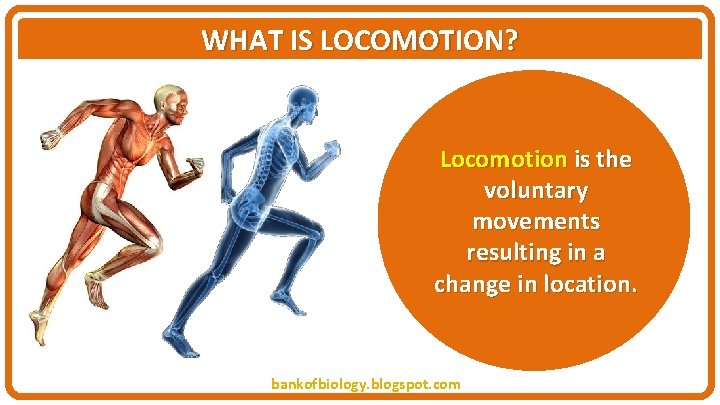
WHAT IS LOCOMOTION? Locomotion is the voluntary movements resulting in a change in location. bankofbiology. blogspot. com
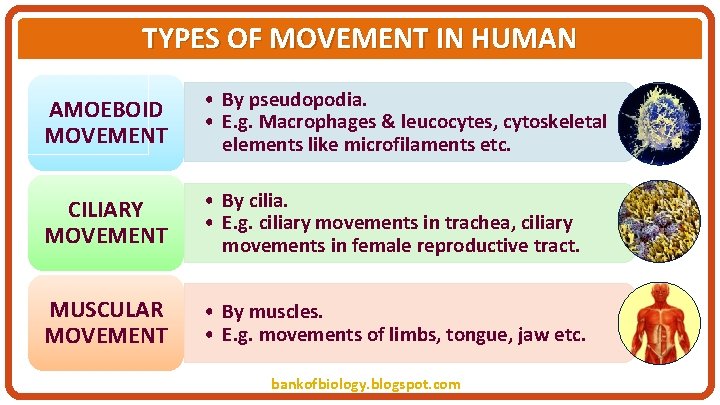
TYPES OF MOVEMENT IN HUMAN AMOEBOID MOVEMENT • By pseudopodia. • E. g. Macrophages & leucocytes, cytoskeletal elements like microfilaments etc. CILIARY MOVEMENT • By cilia. • E. g. ciliary movements in trachea, ciliary movements in female reproductive tract. MUSCULAR MOVEMENT • By muscles. • E. g. movements of limbs, tongue, jaw etc. bankofbiology. blogspot. com
HUMAN MUSCULAR SYSTEM bankofbiology. blogspot. com
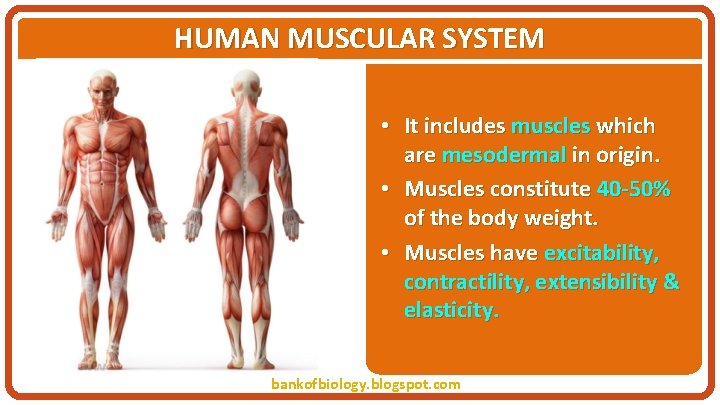
HUMAN MUSCULAR SYSTEM • It includes muscles which are mesodermal in origin. • Muscles constitute 40 -50% of the body weight. • Muscles have excitability, contractility, extensibility & elasticity. bankofbiology. blogspot. com
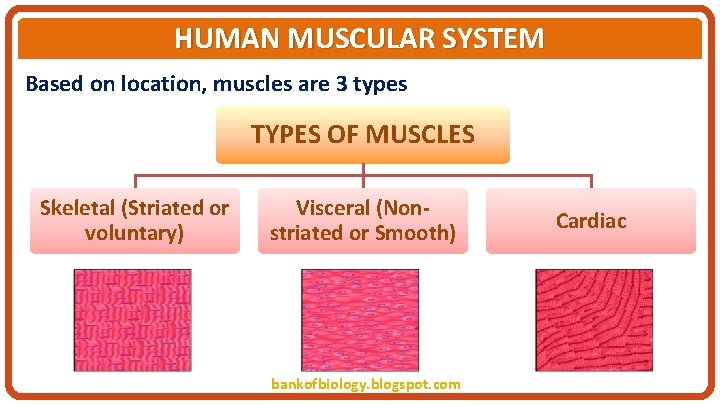
HUMAN MUSCULAR SYSTEM Based on location, muscles are 3 types TYPES OF MUSCLES Skeletal (Striated or voluntary) Visceral (Nonstriated or Smooth) bankofbiology. blogspot. com Cardiac
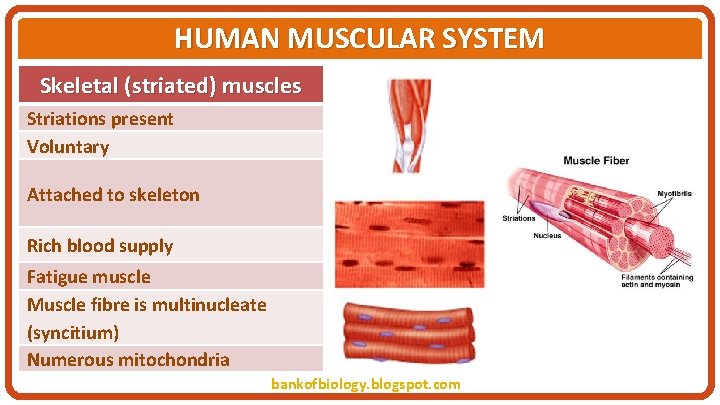
HUMAN MUSCULAR SYSTEM Skeletal (striated) muscles Striations present Voluntary Attached to skeleton Rich blood supply Fatigue muscle Muscle fibre is multinucleate (syncitium) Numerous mitochondria bankofbiology. blogspot. com
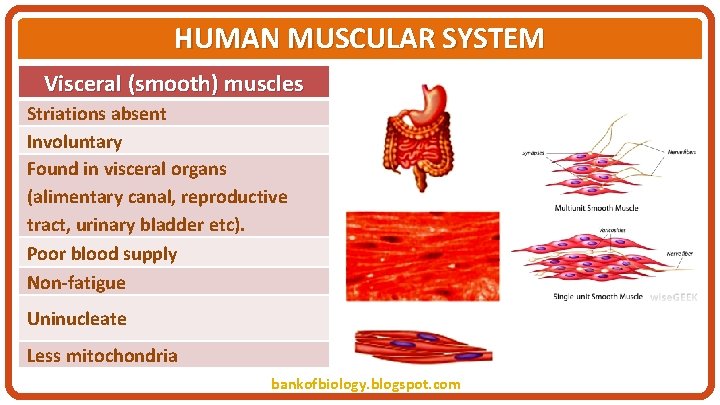
HUMAN MUSCULAR SYSTEM Visceral (smooth) muscles Striations absent Involuntary Found in visceral organs (alimentary canal, reproductive tract, urinary bladder etc). Poor blood supply Non-fatigue Uninucleate Less mitochondria bankofbiology. blogspot. com
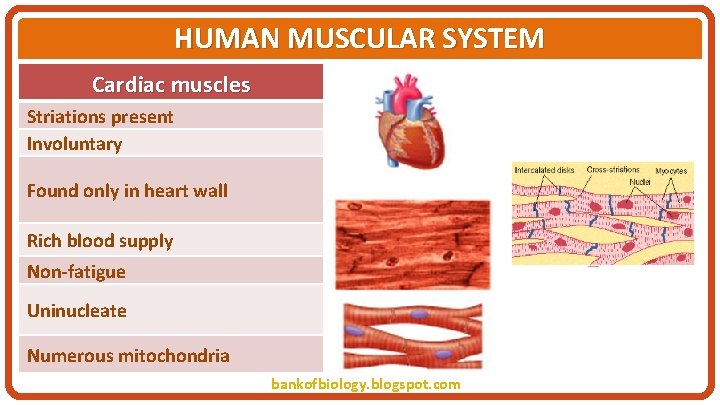
HUMAN MUSCULAR SYSTEM Cardiac muscles Striations present Involuntary Found only in heart wall Rich blood supply Non-fatigue Uninucleate Numerous mitochondria bankofbiology. blogspot. com
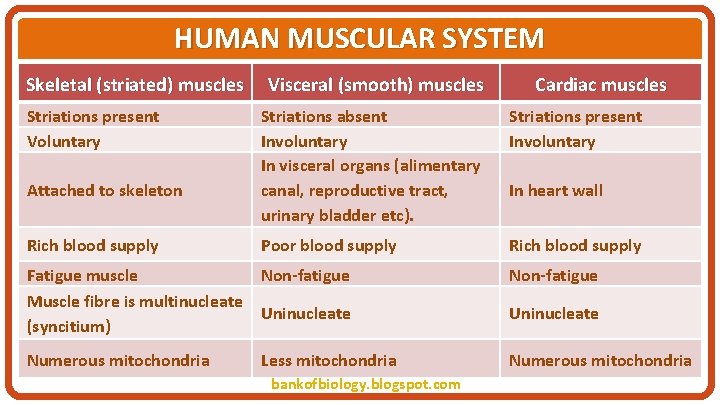
HUMAN MUSCULAR SYSTEM Skeletal (striated) muscles Striations present Voluntary Attached to skeleton Rich blood supply Visceral (smooth) muscles Cardiac muscles Striations absent Involuntary In visceral organs (alimentary canal, reproductive tract, urinary bladder etc). Striations present Involuntary Poor blood supply Rich blood supply In heart wall Fatigue muscle Non-fatigue Muscle fibre is multinucleate Uninucleate (syncitium) Non-fatigue Numerous mitochondria Less mitochondria bankofbiology. blogspot. com Uninucleate
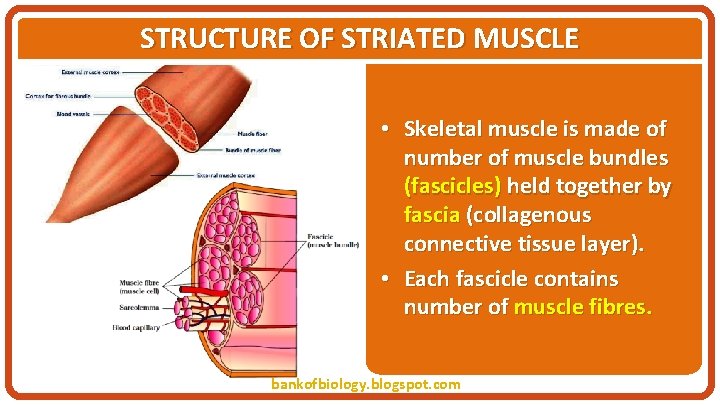
STRUCTURE OF STRIATED MUSCLE • Skeletal muscle is made of number of muscle bundles (fascicles) held together by fascia (collagenous connective tissue layer). • Each fascicle contains number of muscle fibres. bankofbiology. blogspot. com
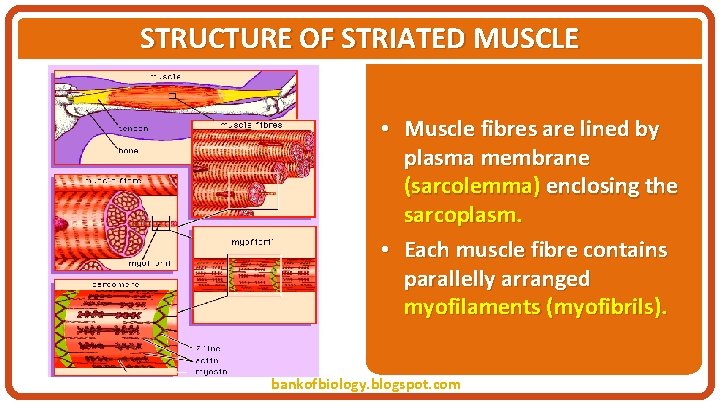
STRUCTURE OF STRIATED MUSCLE • Muscle fibres are lined by plasma membrane (sarcolemma) enclosing the sarcoplasm. • Each muscle fibre contains parallelly arranged myofilaments (myofibrils). bankofbiology. blogspot. com
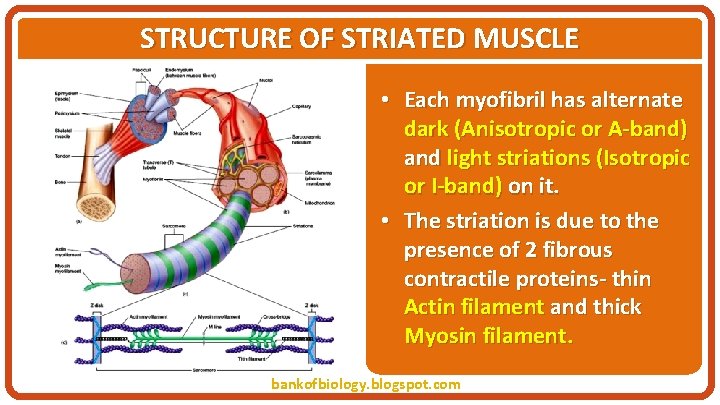
STRUCTURE OF STRIATED MUSCLE • Each myofibril has alternate dark (Anisotropic or A-band) and light striations (Isotropic or I-band) on it. • The striation is due to the presence of 2 fibrous contractile proteins- thin Actin filament and thick Myosin filament. bankofbiology. blogspot. com
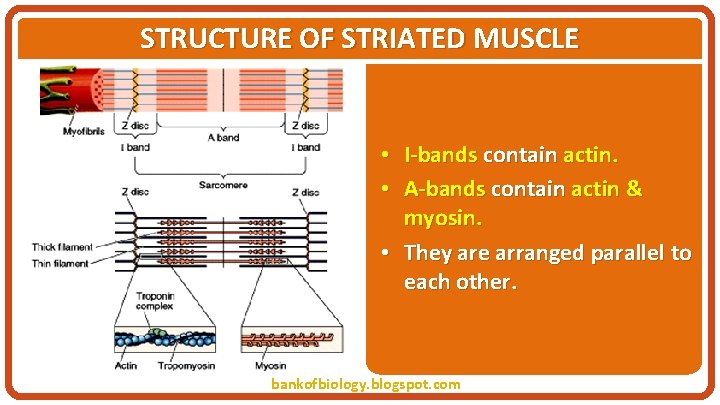
STRUCTURE OF STRIATED MUSCLE • I-bands contain actin. • A-bands contain actin & myosin. • They are arranged parallel to each other. bankofbiology. blogspot. com
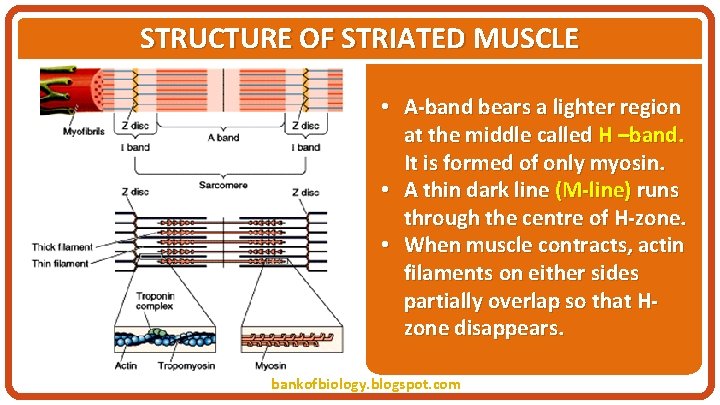
STRUCTURE OF STRIATED MUSCLE • A-band bears a lighter region at the middle called H –band. It is formed of only myosin. • A thin dark line (M-line) runs through the centre of H-zone. • When muscle contracts, actin filaments on either sides partially overlap so that Hzone disappears. bankofbiology. blogspot. com
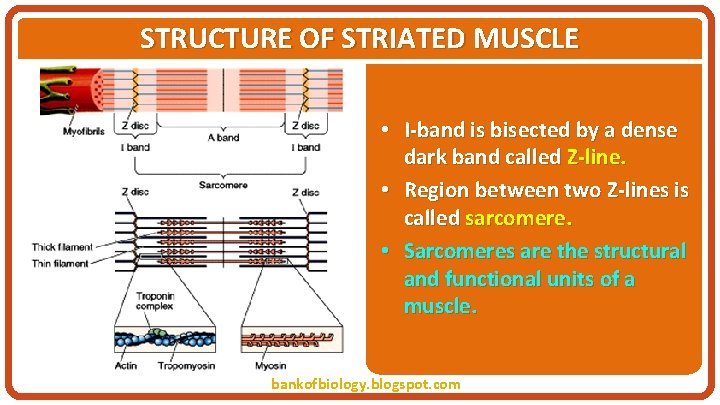
STRUCTURE OF STRIATED MUSCLE • I-band is bisected by a dense dark band called Z-line. • Region between two Z-lines is called sarcomere. • Sarcomeres are the structural and functional units of a muscle. bankofbiology. blogspot. com
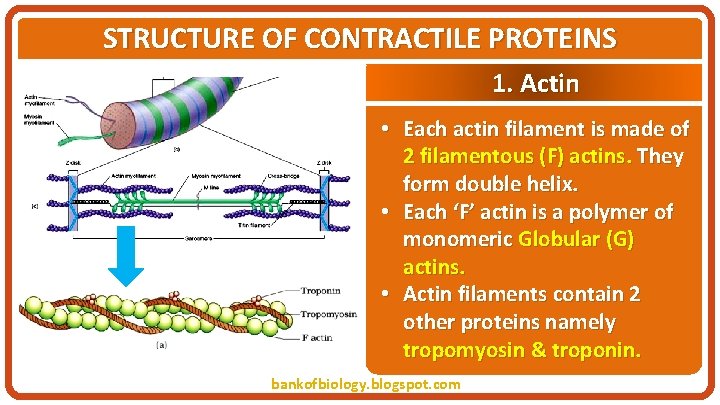
STRUCTURE OF CONTRACTILE PROTEINS 1. Actin • Each actin filament is made of 2 filamentous (F) actins. They form double helix. • Each ‘F’ actin is a polymer of monomeric Globular (G) actins. • Actin filaments contain 2 other proteins namely tropomyosin & troponin. bankofbiology. blogspot. com
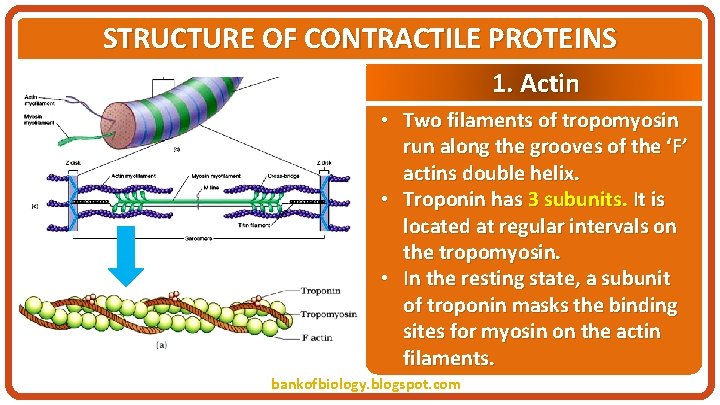
STRUCTURE OF CONTRACTILE PROTEINS 1. Actin • Two filaments of tropomyosin run along the grooves of the ‘F’ actins double helix. • Troponin has 3 subunits. It is located at regular intervals on the tropomyosin. • In the resting state, a subunit of troponin masks the binding sites for myosin on the actin filaments. bankofbiology. blogspot. com
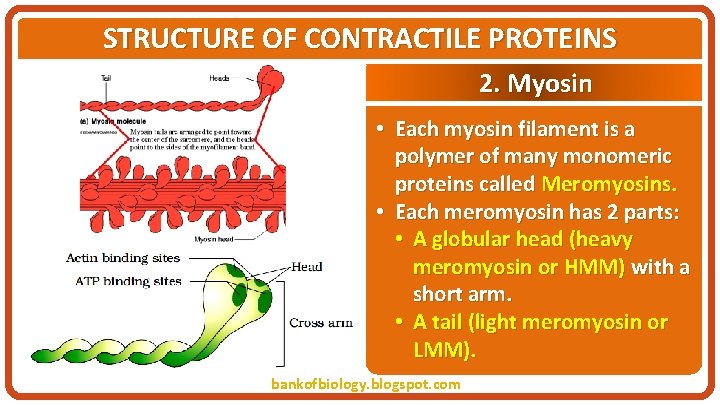
STRUCTURE OF CONTRACTILE PROTEINS 2. Myosin • Each myosin filament is a polymer of many monomeric proteins called Meromyosins. • Each meromyosin has 2 parts: • A globular head (heavy meromyosin or HMM) with a short arm. • A tail (light meromyosin or LMM). bankofbiology. blogspot. com
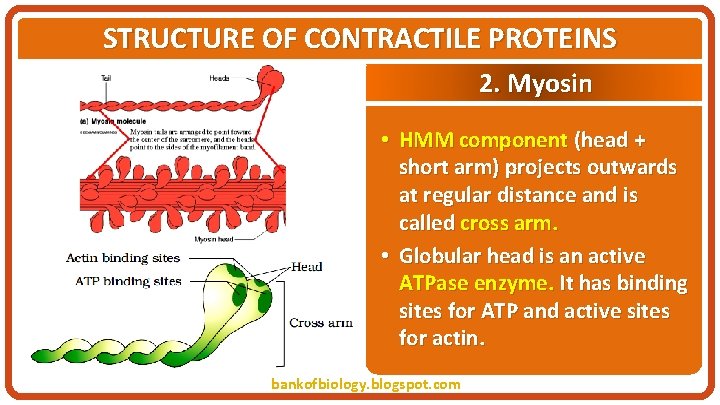
STRUCTURE OF CONTRACTILE PROTEINS 2. Myosin • HMM component (head + short arm) projects outwards at regular distance and is called cross arm. • Globular head is an active ATPase enzyme. It has binding sites for ATP and active sites for actin. bankofbiology. blogspot. com
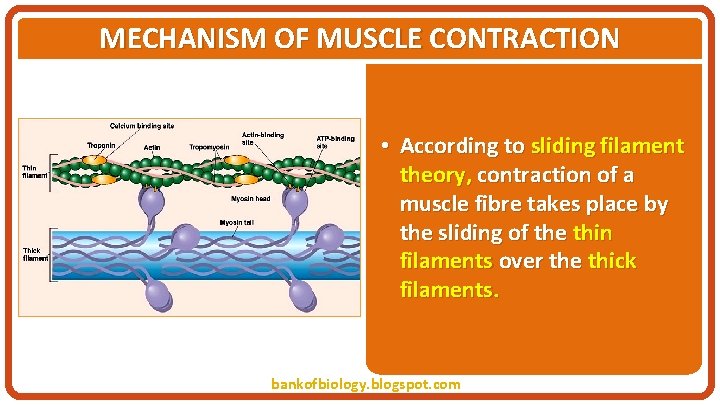
MECHANISM OF MUSCLE CONTRACTION • According to sliding filament theory, contraction of a muscle fibre takes place by the sliding of the thin filaments over the thick filaments. bankofbiology. blogspot. com
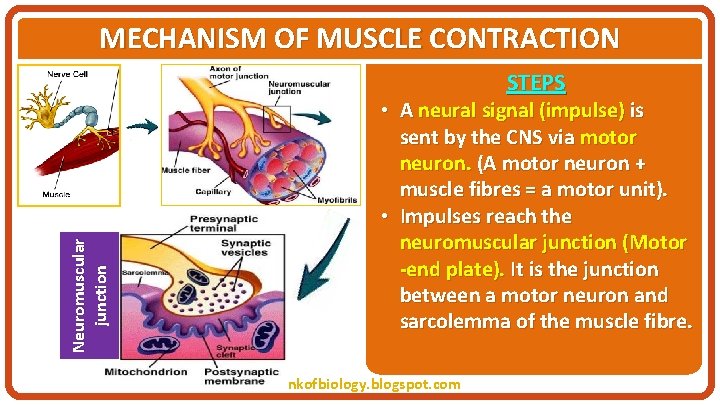
MECHANISM OF MUSCLE CONTRACTION Neuromuscular junction STEPS • A neural signal (impulse) is sent by the CNS via motor neuron. (A motor neuron + muscle fibres = a motor unit). • Impulses reach the neuromuscular junction (Motor -end plate). It is the junction between a motor neuron and sarcolemma of the muscle fibre. bankofbiology. blogspot. com
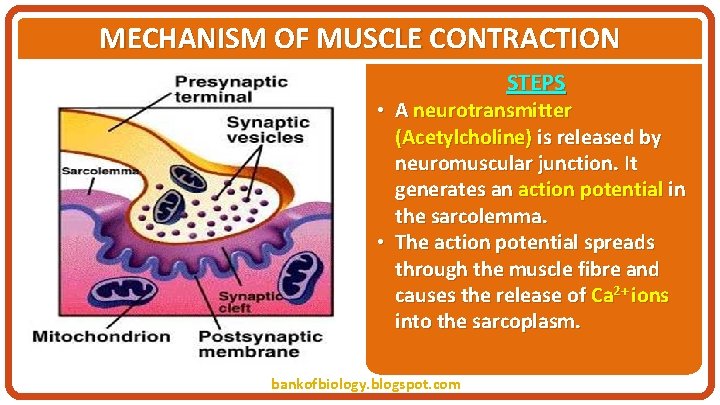
MECHANISM OF MUSCLE CONTRACTION STEPS • A neurotransmitter (Acetylcholine) is released by neuromuscular junction. It generates an action potential in the sarcolemma. • The action potential spreads through the muscle fibre and causes the release of Ca 2+ ions into the sarcoplasm. bankofbiology. blogspot. com
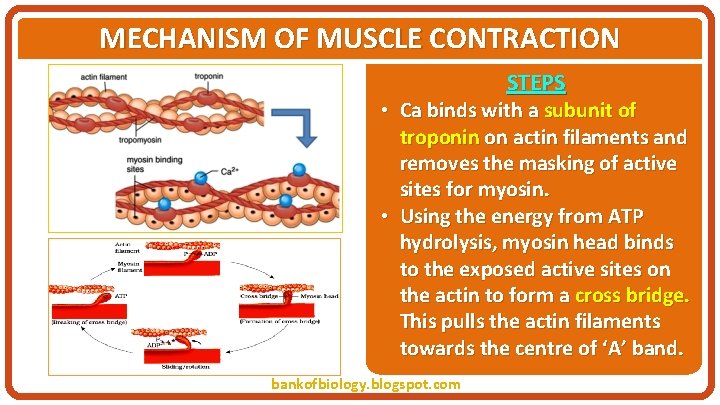
MECHANISM OF MUSCLE CONTRACTION STEPS • Ca binds with a subunit of troponin on actin filaments and removes the masking of active sites for myosin. • Using the energy from ATP hydrolysis, myosin head binds to the exposed active sites on the actin to form a cross bridge. This pulls the actin filaments towards the centre of ‘A’ band. bankofbiology. blogspot. com
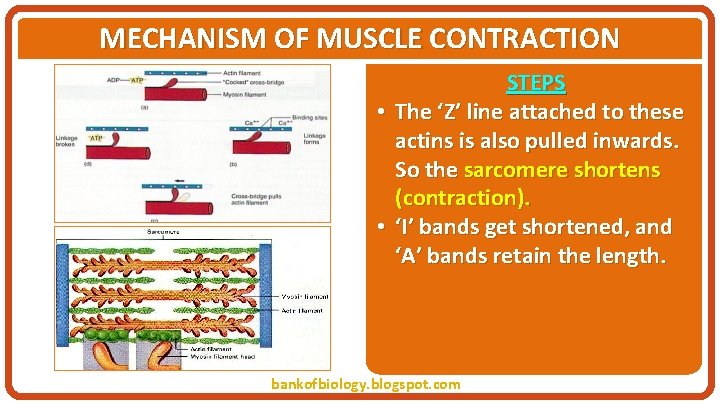
MECHANISM OF MUSCLE CONTRACTION STEPS • The ‘Z’ line attached to these actins is also pulled inwards. So the sarcomere shortens (contraction). • ‘I’ bands get shortened, and ‘A’ bands retain the length. bankofbiology. blogspot. com
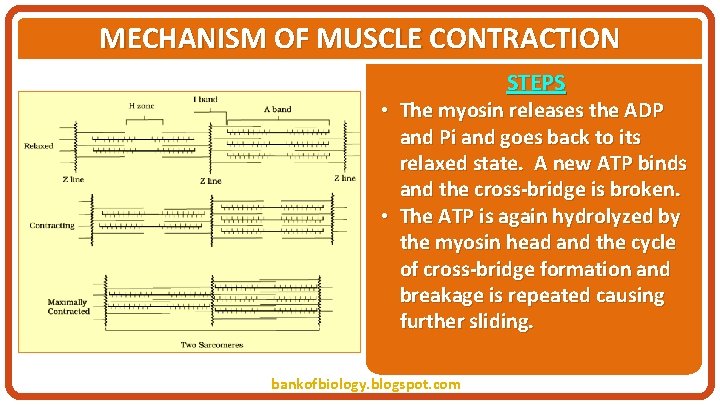
MECHANISM OF MUSCLE CONTRACTION STEPS • The myosin releases the ADP and Pi and goes back to its relaxed state. A new ATP binds and the cross-bridge is broken. • The ATP is again hydrolyzed by the myosin head and the cycle of cross-bridge formation and breakage is repeated causing further sliding. bankofbiology. blogspot. com
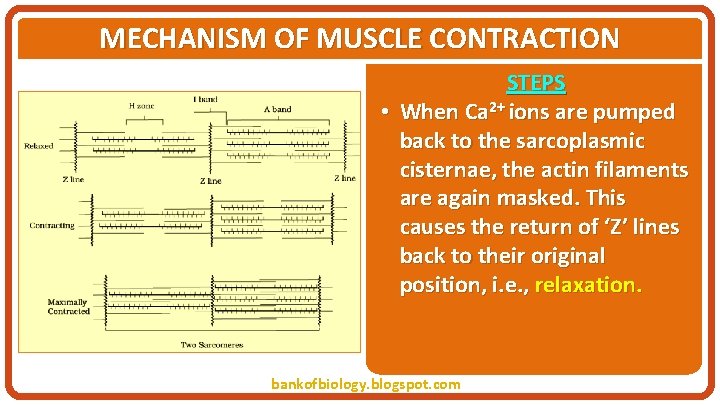
MECHANISM OF MUSCLE CONTRACTION STEPS • When Ca 2+ ions are pumped back to the sarcoplasmic cisternae, the actin filaments are again masked. This causes the return of ‘Z’ lines back to their original position, i. e. , relaxation. bankofbiology. blogspot. com
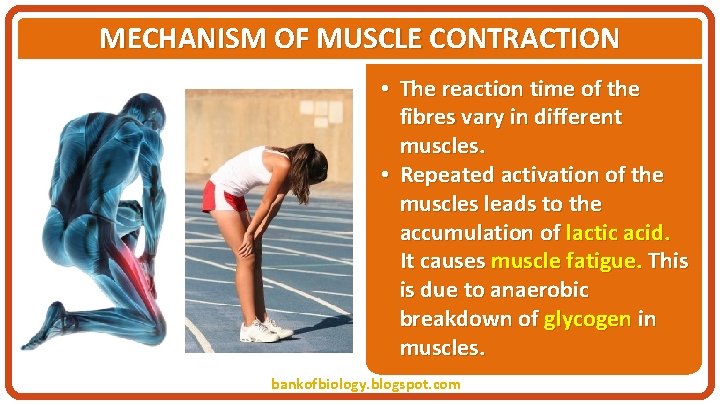
MECHANISM OF MUSCLE CONTRACTION • The reaction time of the fibres vary in different muscles. • Repeated activation of the muscles leads to the accumulation of lactic acid. It causes muscle fatigue. This is due to anaerobic breakdown of glycogen in muscles. bankofbiology. blogspot. com
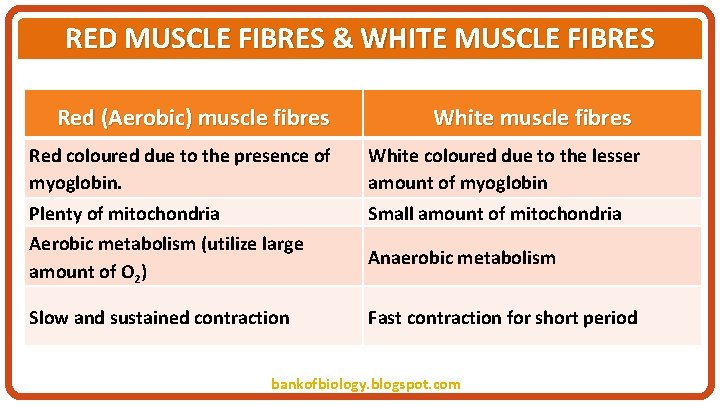
RED MUSCLE FIBRES & WHITE MUSCLE FIBRES Red (Aerobic) muscle fibres White muscle fibres Red coloured due to the presence of myoglobin. White coloured due to the lesser amount of myoglobin Plenty of mitochondria Small amount of mitochondria Aerobic metabolism (utilize large amount of O 2) Anaerobic metabolism Slow and sustained contraction Fast contraction for short period bankofbiology. blogspot. com
bankofbiology. blogspot. com
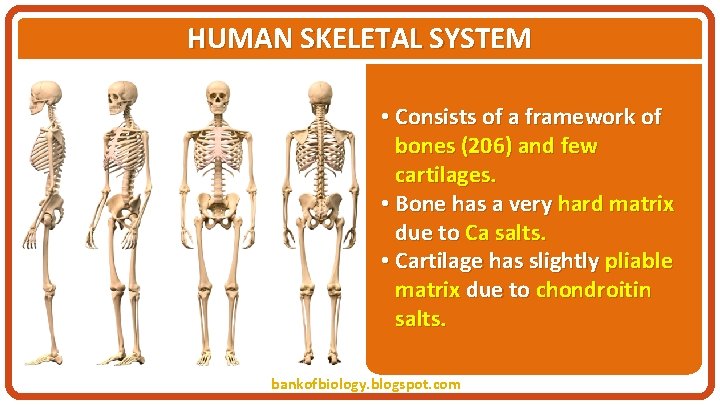
HUMAN SKELETAL SYSTEM • Consists of a framework of bones (206) and few cartilages. • Bone has a very hard matrix due to Ca salts. • Cartilage has slightly pliable matrix due to chondroitin salts. bankofbiology. blogspot. com
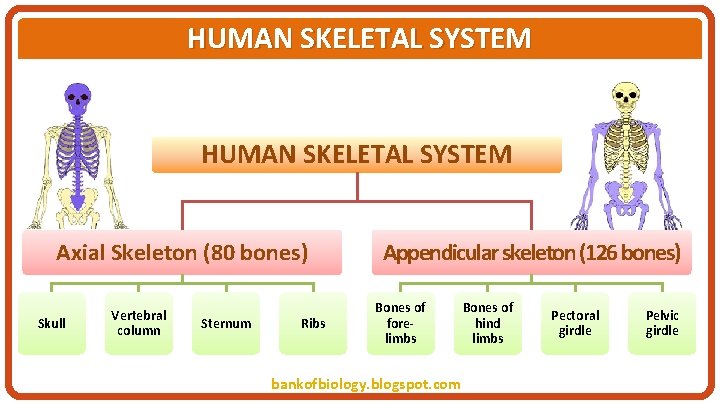
HUMAN SKELETAL SYSTEM Axial Skeleton (80 bones) Skull Vertebral column Sternum Ribs Appendicular skeleton (126 bones) Bones of forelimbs bankofbiology. blogspot. com Bones of hind limbs Pectoral girdle Pelvic girdle
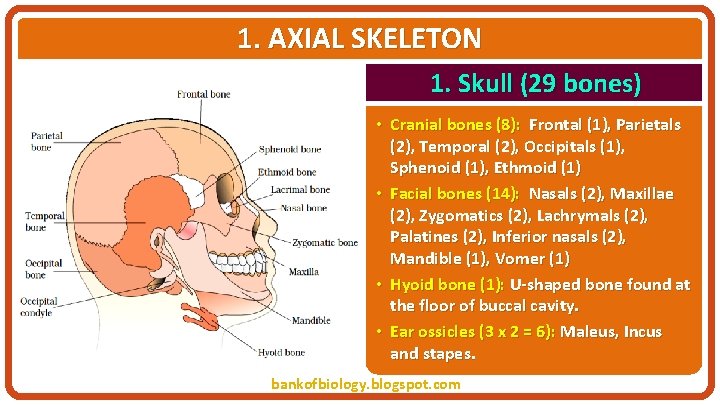
1. AXIAL SKELETON 1. Skull (29 bones) • Cranial bones (8): Frontal (1), Parietals (2), Temporal (2), Occipitals (1), Sphenoid (1), Ethmoid (1) • Facial bones (14): Nasals (2), Maxillae (2), Zygomatics (2), Lachrymals (2), Palatines (2), Inferior nasals (2), Mandible (1), Vomer (1) • Hyoid bone (1): U-shaped bone found at the floor of buccal cavity. • Ear ossicles (3 x 2 = 6): Maleus, Incus and stapes. bankofbiology. blogspot. com
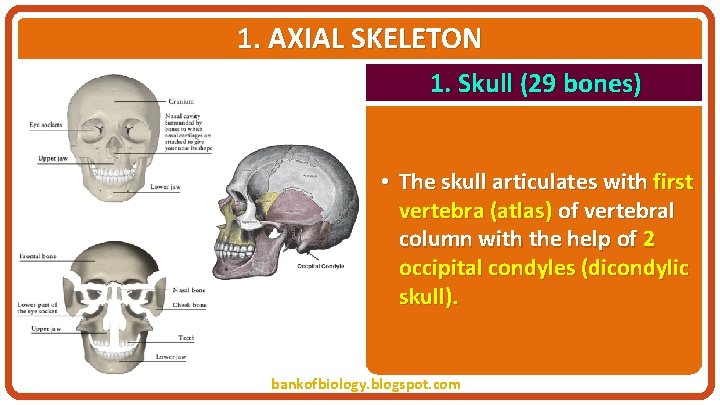
1. AXIAL SKELETON 1. Skull (29 bones) • The skull articulates with first vertebra (atlas) of vertebral column with the help of 2 occipital condyles (dicondylic skull). bankofbiology. blogspot. com
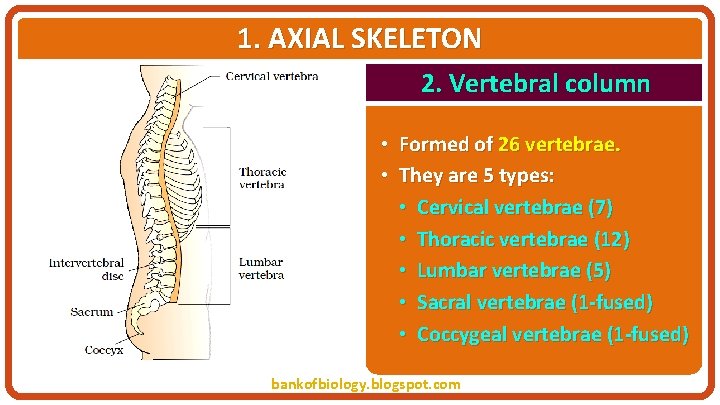
1. AXIAL SKELETON 2. Vertebral column • Formed of 26 vertebrae. • They are 5 types: • Cervical vertebrae (7) • Thoracic vertebrae (12) • Lumbar vertebrae (5) • Sacral vertebrae (1 -fused) • Coccygeal vertebrae (1 -fused) bankofbiology. blogspot. com
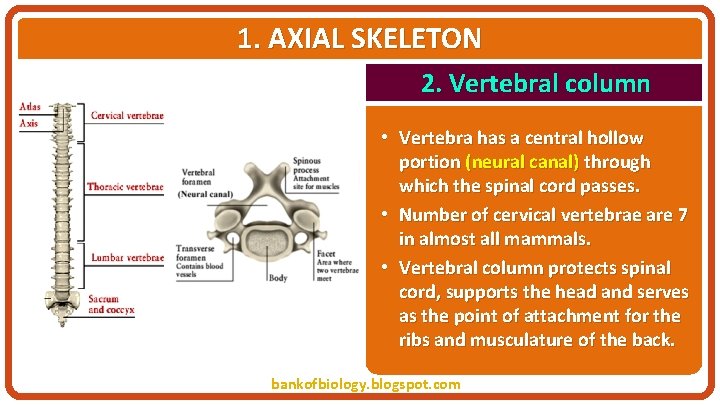
1. AXIAL SKELETON 2. Vertebral column • Vertebra has a central hollow portion (neural canal) through which the spinal cord passes. • Number of cervical vertebrae are 7 in almost all mammals. • Vertebral column protects spinal cord, supports the head and serves as the point of attachment for the ribs and musculature of the back. bankofbiology. blogspot. com
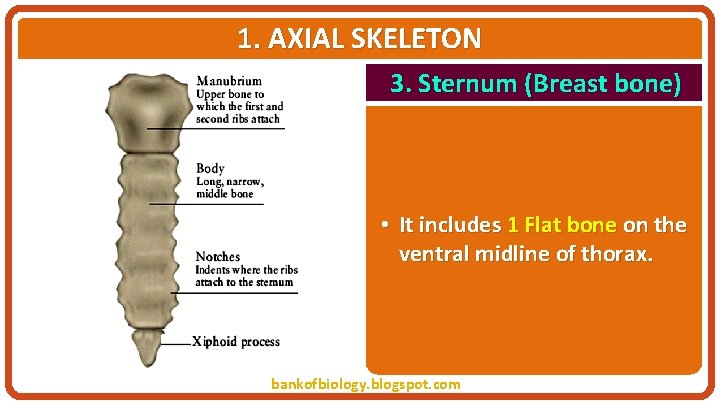
1. AXIAL SKELETON 3. Sternum (Breast bone) • It includes 1 Flat bone on the ventral midline of thorax. bankofbiology. blogspot. com
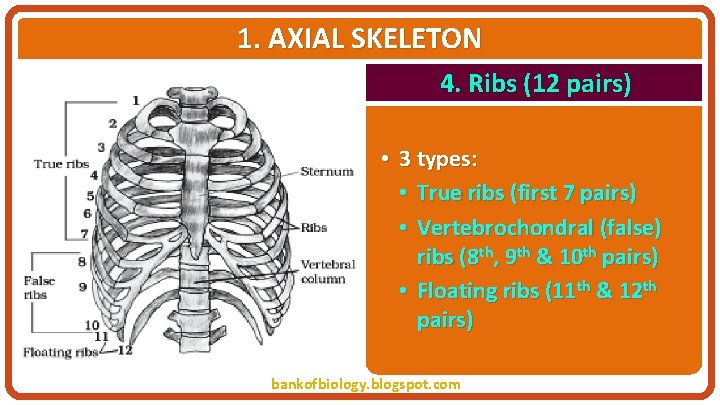
1. AXIAL SKELETON 4. Ribs (12 pairs) • 3 types: • True ribs (first 7 pairs) • Vertebrochondral (false) ribs (8 th, 9 th & 10 th pairs) • Floating ribs (11 th & 12 th pairs) bankofbiology. blogspot. com
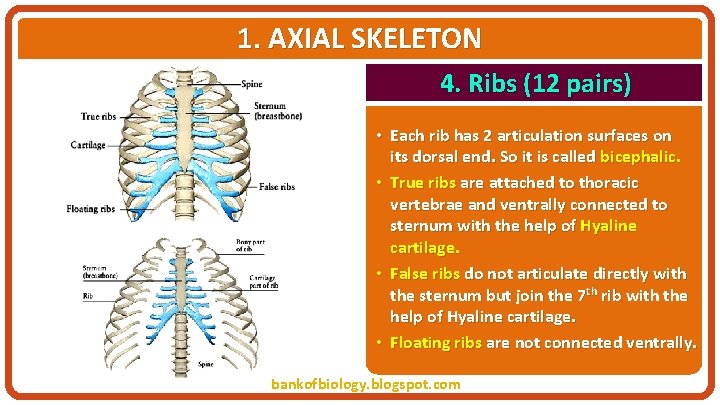
1. AXIAL SKELETON 4. Ribs (12 pairs) • Each rib has 2 articulation surfaces on its dorsal end. So it is called bicephalic. • True ribs are attached to thoracic vertebrae and ventrally connected to sternum with the help of Hyaline cartilage. • False ribs do not articulate directly with the sternum but join the 7 th rib with the help of Hyaline cartilage. • Floating ribs are not connected ventrally. bankofbiology. blogspot. com
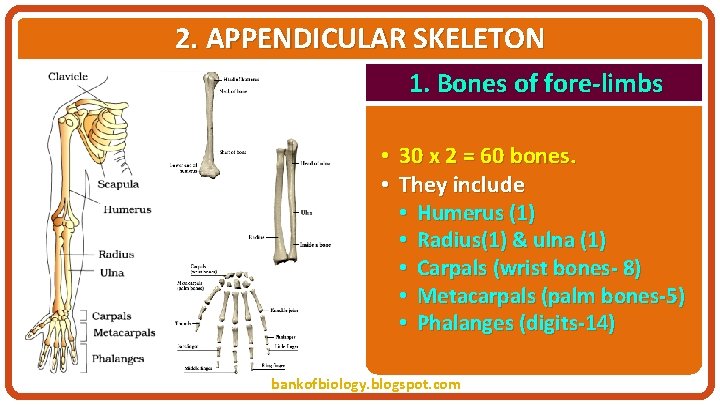
2. APPENDICULAR SKELETON 1. Bones of fore-limbs • • 30 x 2 = 60 bones. They include • Humerus (1) • Radius(1) & ulna (1) • Carpals (wrist bones- 8) • Metacarpals (palm bones-5) • Phalanges (digits-14) bankofbiology. blogspot. com
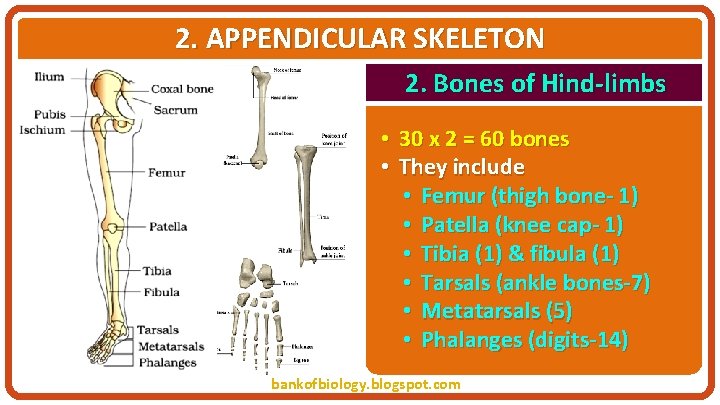
2. APPENDICULAR SKELETON 2. Bones of Hind-limbs • 30 x 2 = 60 bones • They include • Femur (thigh bone- 1) • Patella (knee cap- 1) • Tibia (1) & fibula (1) • Tarsals (ankle bones-7) • Metatarsals (5) • Phalanges (digits-14) bankofbiology. blogspot. com
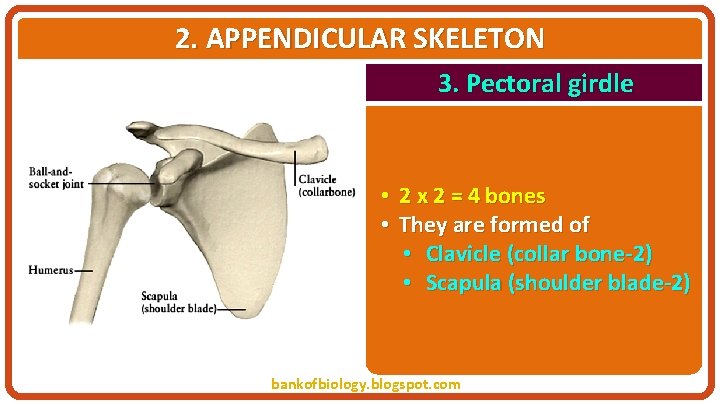
2. APPENDICULAR SKELETON 3. Pectoral girdle • 2 x 2 = 4 bones • They are formed of • Clavicle (collar bone-2) • Scapula (shoulder blade-2) bankofbiology. blogspot. com
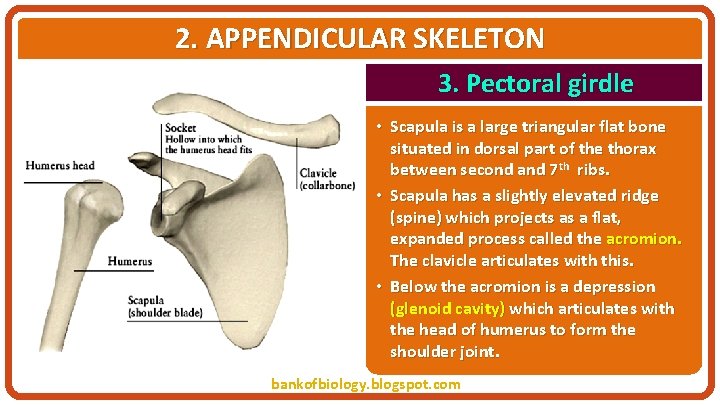
2. APPENDICULAR SKELETON 3. Pectoral girdle • Scapula is a large triangular flat bone situated in dorsal part of the thorax between second and 7 th ribs. • Scapula has a slightly elevated ridge (spine) which projects as a flat, expanded process called the acromion. The clavicle articulates with this. • Below the acromion is a depression (glenoid cavity) which articulates with the head of humerus to form the shoulder joint. bankofbiology. blogspot. com
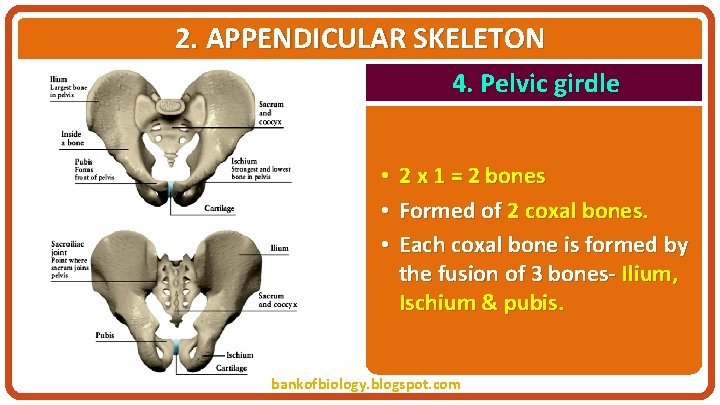
2. APPENDICULAR SKELETON 4. Pelvic girdle • • • 2 x 1 = 2 bones Formed of 2 coxal bones. Each coxal bone is formed by the fusion of 3 bones- Ilium, Ischium & pubis. bankofbiology. blogspot. com
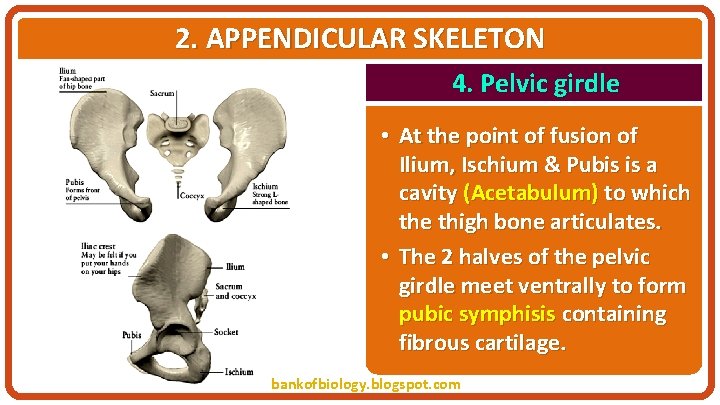
2. APPENDICULAR SKELETON 4. Pelvic girdle • At the point of fusion of Ilium, Ischium & Pubis is a cavity (Acetabulum) to which the thigh bone articulates. • The 2 halves of the pelvic girdle meet ventrally to form pubic symphisis containing fibrous cartilage. bankofbiology. blogspot. com
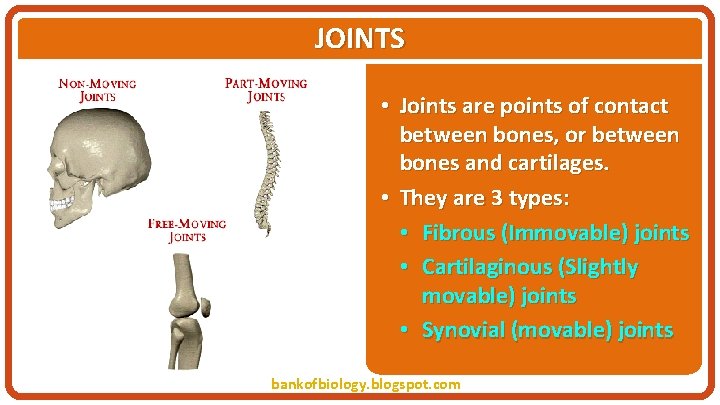
JOINTS • Joints are points of contact between bones, or between bones and cartilages. • They are 3 types: • Fibrous (Immovable) joints • Cartilaginous (Slightly movable) joints • Synovial (movable) joints bankofbiology. blogspot. com
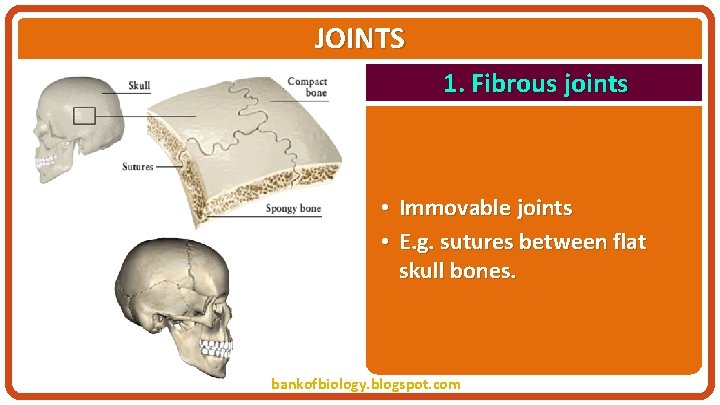
JOINTS 1. Fibrous joints • Immovable joints • E. g. sutures between flat skull bones. bankofbiology. blogspot. com
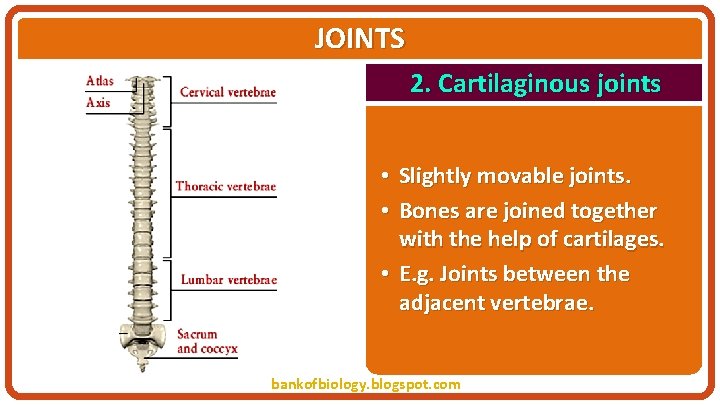
JOINTS 2. Cartilaginous joints • Slightly movable joints. • Bones are joined together with the help of cartilages. • E. g. Joints between the adjacent vertebrae. bankofbiology. blogspot. com
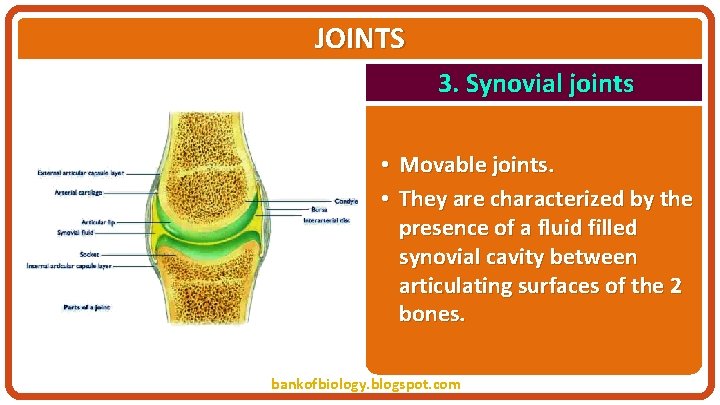
JOINTS 3. Synovial joints • Movable joints. • They are characterized by the presence of a fluid filled synovial cavity between articulating surfaces of the 2 bones. bankofbiology. blogspot. com
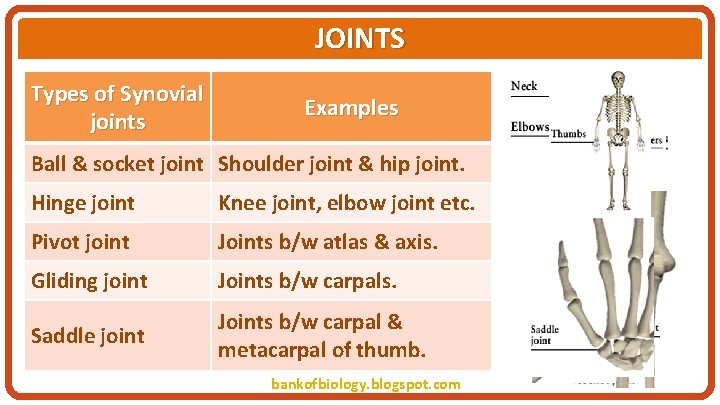
JOINTS Types of Synovial joints Examples Ball & socket joint Shoulder joint & hip joint. Hinge joint Knee joint, elbow joint etc. Pivot joint Joints b/w atlas & axis. Gliding joint Joints b/w carpals. Saddle joint Joints b/w carpal & metacarpal of thumb. bankofbiology. blogspot. com
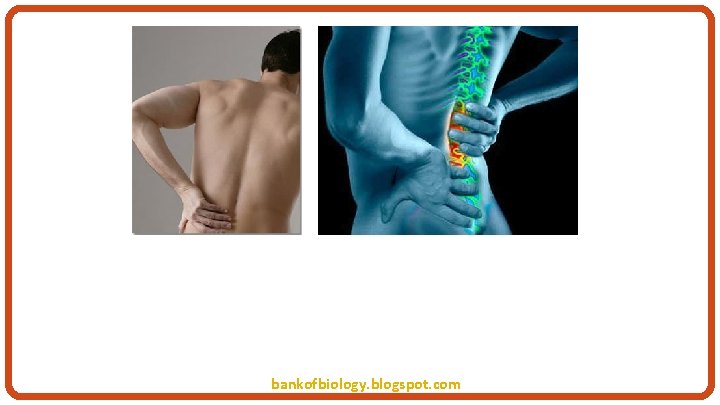
DISORDERS OF MUSCULAR AND SKELETAL SYSTEMS bankofbiology. blogspot. com
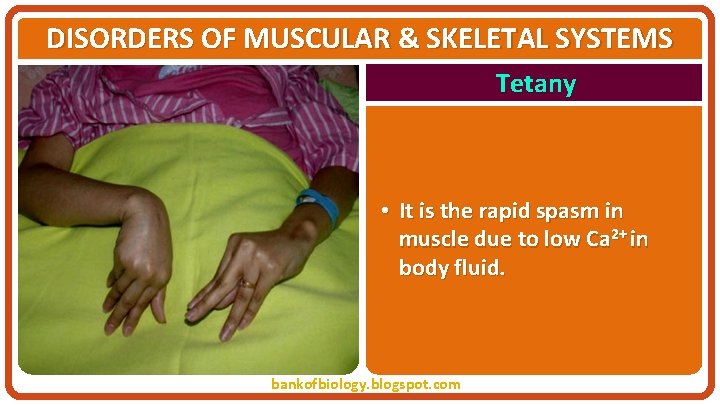
DISORDERS OF MUSCULAR & SKELETAL SYSTEMS Tetany • It is the rapid spasm in muscle due to low Ca 2+ in body fluid. bankofbiology. blogspot. com
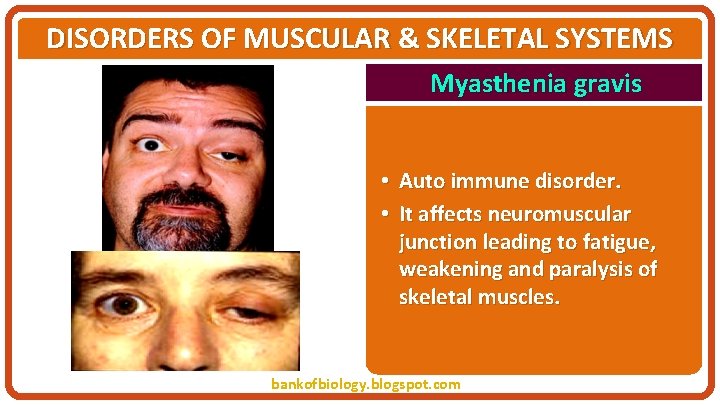
DISORDERS OF MUSCULAR & SKELETAL SYSTEMS Myasthenia gravis • Auto immune disorder. • It affects neuromuscular junction leading to fatigue, weakening and paralysis of skeletal muscles. bankofbiology. blogspot. com
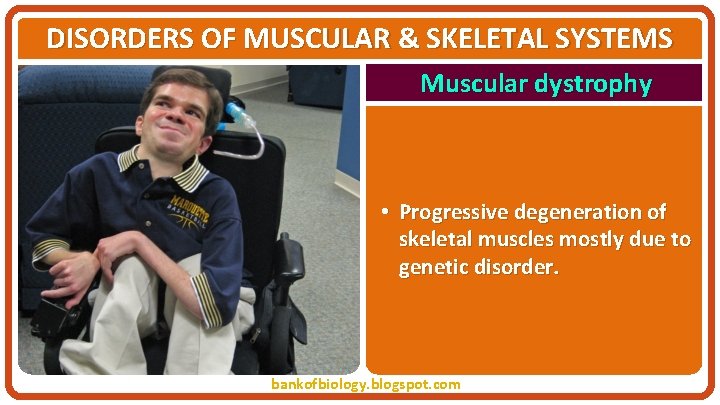
DISORDERS OF MUSCULAR & SKELETAL SYSTEMS Muscular dystrophy • Progressive degeneration of skeletal muscles mostly due to genetic disorder. bankofbiology. blogspot. com
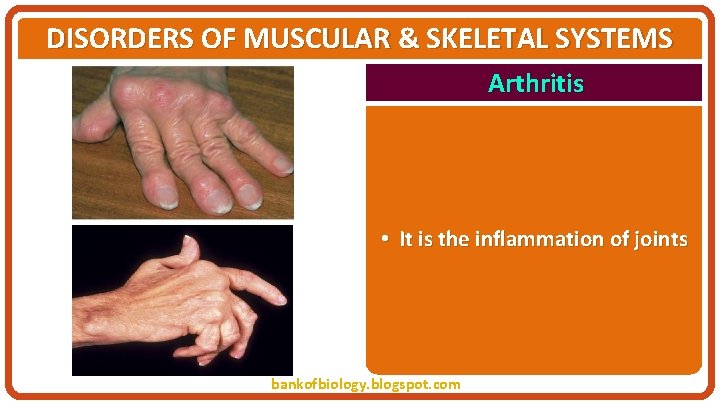
DISORDERS OF MUSCULAR & SKELETAL SYSTEMS Arthritis • It is the inflammation of joints bankofbiology. blogspot. com
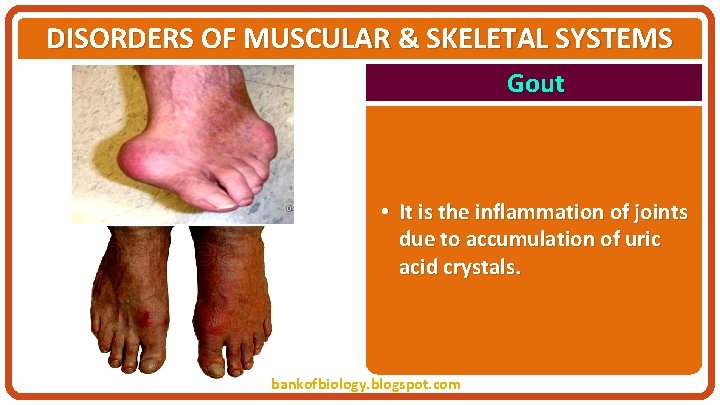
DISORDERS OF MUSCULAR & SKELETAL SYSTEMS Gout • It is the inflammation of joints due to accumulation of uric acid crystals. bankofbiology. blogspot. com
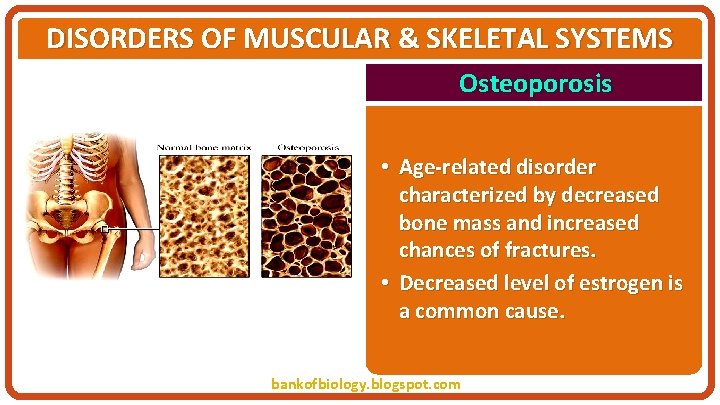
DISORDERS OF MUSCULAR & SKELETAL SYSTEMS Osteoporosis • Age-related disorder characterized by decreased bone mass and increased chances of fractures. • Decreased level of estrogen is a common cause. bankofbiology. blogspot. com
THE END

Prepared by: K. C. MUHAMMED ALI Visit: bankofbiology. blogspot. com
- Slides: 60