
THIS POWERPOINT HAS BEEN PRODUCED FOR TEACHERS TO

THIS POWERPOINT HAS BEEN PRODUCED FOR TEACHERS TO USE WITH THEIR STUDENTS. IT IS A CONDITION OF ITS USETHAT IT BE USED ONLY BY SCHOOLS WHICH HAVE ATTENDED THE SEMINARS AND NOT SOLD ON OR PASSED ON WITHOUT PERMISSION. (THIS DOES NOT PROHIBIT ITS USE ON A SCHOOL’S INTRANET). MORALITY Ethical Understanding
Contents Page 3 Teacher Invaders on Morality Page 4 Documentary– the Golden Rule Page 5 - 9 Definitions Page 10 -13 Morality Page 14 -15 Golden Rule Page 16 The Golden Rule in Buddhism Page 17 The Golden Rule in Baha'i Faith Page 18 -22 The Golden rule in Christianity Page 23 -27 The Golden Rule in Other Religions Page 28 -32 Criticisms of the Golden Rule Page 32 References

Teacher Invaders Click on the image above for a game of “Teacher Invaders”. Try playing the game with your students at the start and the end of the unit. Make sure you have started the slide show and are connected to the internet. 3

Documentary– the Golden Rule Click on the image to the right. You will need to be connected to the internet to view this presentation. Enlarge to full screen
Morality can also be seen as the collection of beliefs as to what constitutes a good life.

In certain religious communities, the Divine is said to provide these principles through revelation, sometimes in great detail.
Moral codes are often complex definitions of right and wrong that are based upon well-defined value systems. Although some people might think that a moral code is simple, rarely is there anything simple about one's values, ethics, etc. or, for that matter, the judgment of those of others.
Examples of moral codes include the Golden Rule; the Noble Eightfold Path of Buddhism; the ancient Egyptian code of Ma'at ; the ten commandments of Judaism, Christianity, and Islam; the yamas and niyama of the Hindu scriptures; the ten Indian commandments; and the
Another related concept is the moral core which is assumed to be innate in each individual, to those who accept that differences between individuals are more important than posited Creators or their rules.
Morality ØIn the scientific literature, the degree of religiosity is generally found to be associated with higher ethical attitudes.
Morality Ø In another response, Gary Jensen builds on and refines Paul's study. His conclusion, after carrying out elaborate statistical studies, is that a complex relationship exists between religiosity and homicide with some dimensions of religiosity encouraging homicide and other dimensions discouraging it. "
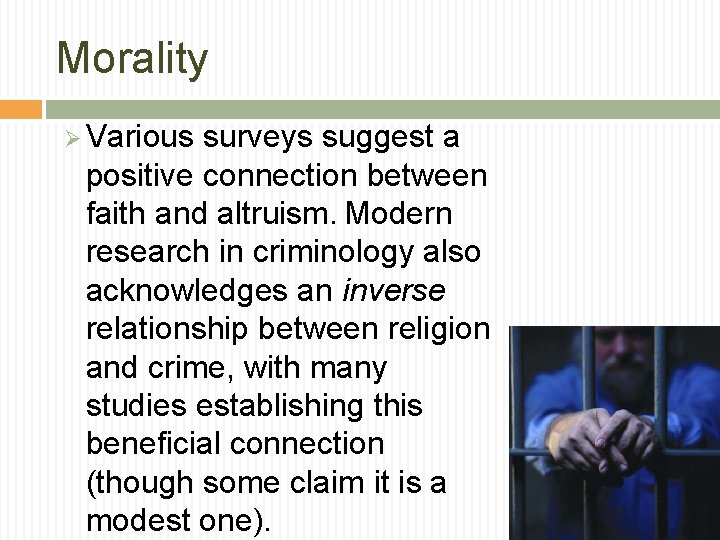
Morality Ø Various surveys suggest a positive connection between faith and altruism. Modern research in criminology also acknowledges an inverse relationship between religion and crime, with many studies establishing this beneficial connection (though some claim it is a modest one).
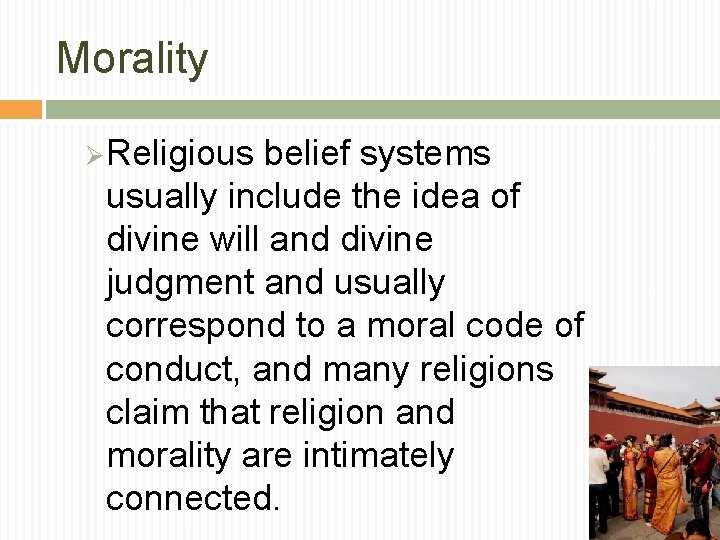
Morality Ø Religious belief systems usually include the idea of divine will and divine judgment and usually correspond to a moral code of conduct, and many religions claim that religion and morality are intimately connected.
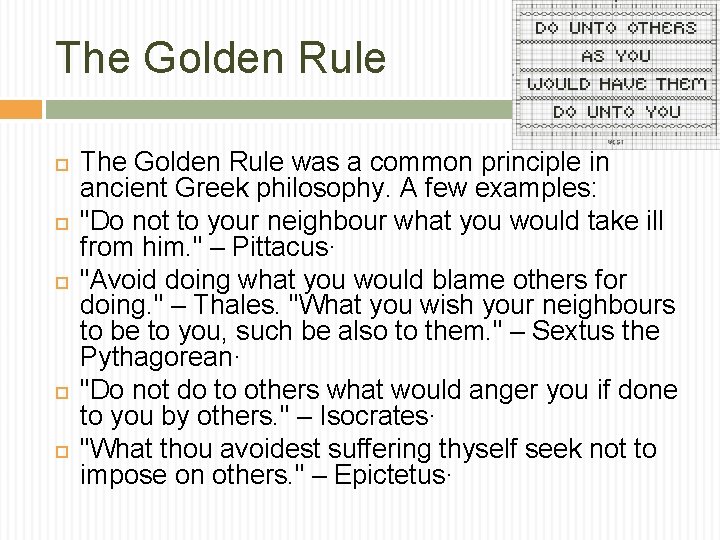
The Golden Rule The Golden Rule was a common principle in ancient Greek philosophy. A few examples: "Do not to your neighbour what you would take ill from him. " – Pittacus. "Avoid doing what you would blame others for doing. " – Thales. "What you wish your neighbours to be to you, such be also to them. " – Sextus the Pythagorean. "Do not do to others what would anger you if done to you by others. " – Isocrates. "What thou avoidest suffering thyself seek not to impose on others. " – Epictetus.
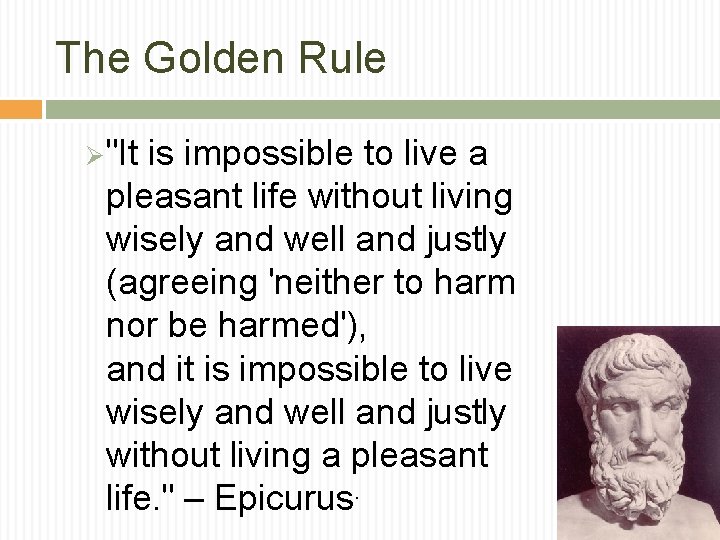
The Golden Rule Ø "It is impossible to live a pleasant life without living wisely and well and justly (agreeing 'neither to harm nor be harmed'), and it is impossible to live wisely and well and justly without living a pleasant life. " – Epicurus.
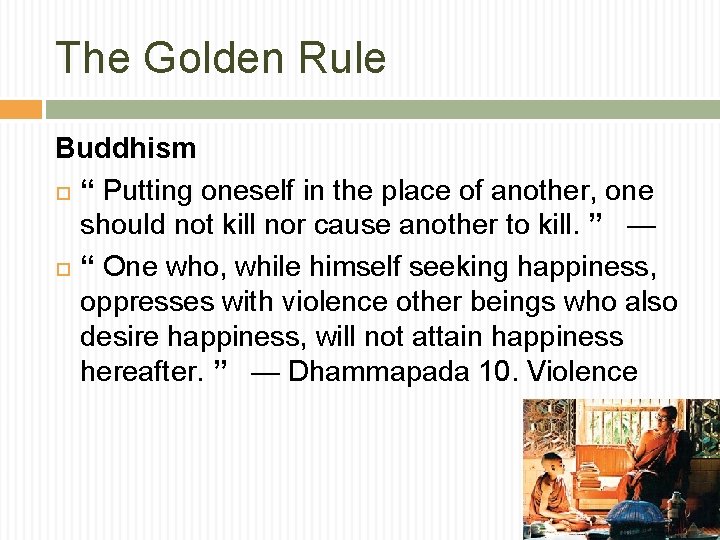
The Golden Rule Buddhism “ Putting oneself in the place of another, one should not kill nor cause another to kill. ” — “ One who, while himself seeking happiness, oppresses with violence other beings who also desire happiness, will not attain happiness hereafter. ” — Dhammapada 10. Violence
The Golden Rule Baha'i Faith From the sacred scriptures of the Baha'i Faith: “ Ascribe not to any soul that which thou wouldst not have ascribed to thee, and say not that which thou doest not. ” — Baha'u'llah “ Blessed is he who preferreth his brother before himself. ” — Baha'u'llah.
The Golden Rule Christianity Within Christian circles, the ethic of reciprocity is often called the "Golden Rule". Christianity adopted the ethic from two edicts, found in Leviticus 19: 18 ("Do not seek revenge or bear a grudge against one of your people, but love your neighbour as yourself. I am the LORD. ", see also Great Commandment) and Leviticus 19: 34.

The Golden Rule The Old Testament Deuterocanonical books of Tobit and Sirach accepted as part of the Scriptural canon by Catholicism, Eastern Orthodoxy, and the Non-Chalcedonian Churches also express the Silver Rule. Tobit 4: 15 "Do to no one what yourself dislike. “
The Golden Rule Several passages in the New Testament quote Jesus of Nazareth espousing the ethic of reciprocity, including the following: Matthew 7: 12 12 Therefore all things whatsoever ye would that men should do to you, do ye even so to them: for this is the law and the prophets. Luke 6: 31 31 And as ye would that men should do to you, do ye also to them likewise.
The Golden Rule Luke 10: 25 -28 25 And, behold, a certain lawyer stood up, and tempted him, saying, Master, what shall I do to inherit eternal life? 26 He said unto him, What is written in the law? how readest thou? 27 And he answering said, Thou shalt love the Lord thy God with all thy heart, and with all thy soul, and with all thy strength, and with all thy mind; and thy neighbour as thyself. 28 And he said unto him, Thou hast answered right: this do, and thou shalt live.
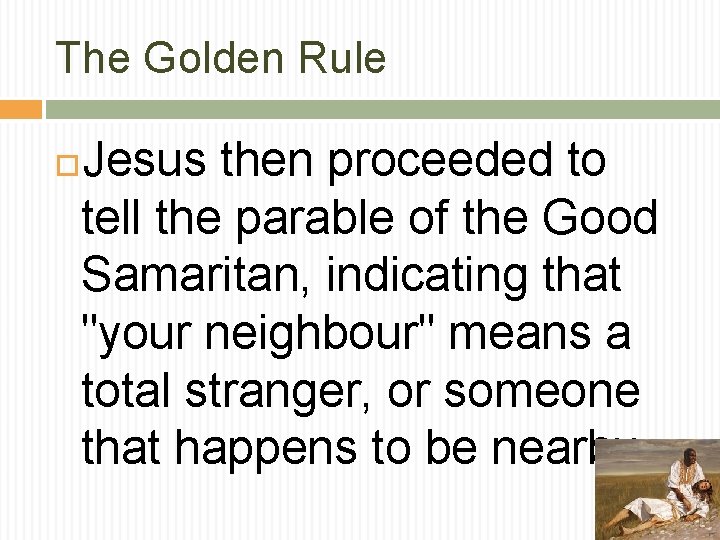
The Golden Rule Jesus then proceeded to tell the parable of the Good Samaritan, indicating that "your neighbour" means a total stranger, or someone that happens to be nearby.
The Golden Rule Confucianism “ Never impose on others what you would not choose for yourself. ” — Confucius, Analects XV. 24 (tr. David Hinton) The same idea is also presented in V. 12 and VI. 30 of the Analects.
The Golden Rule Hinduism “ One should never do that to another which one regards as injurious to one’s own self. This, in brief, is the rule of dharma. Other behaviour is due to selfish desires. ” — Brihaspati, Mahabharata (Anusasana Parva, Section CXIII, Verse 8) In addition to the law of karma, the Bhagavad Gita contains a dialogue between Krishna and Arjuna with the statement:
The Golden Rule Islam “ Hurt no one so that no one may hurt you. ” Muhammad, The Farewell Sermon Jeffrey Wattles holds that the ethic of reciprocity appears in the following statements attributed to Muhammad: “Woe to those. . . who, when they have to receive by measure from men, exact full measure, but when they have to give by measure or weight to men, give less than due”

Judaism “ You shall not take vengeance or bear a grudge against your countrymen. Love your fellow as yourself: I am the LORD. ” — Leviticus 19: 18 “ The stranger who resides with you shall be to you as one of your citizens; you shall love him as yourself, for you were strangers in the land of Egypt: I the LORD am your God. ” — Leviticus 19: 34, the "Great Commandment"

Judaism cont. That which is hateful to you, do not do to your fellow. That is the whole Torah; the rest is the explanation; go and learn. Rabbi Akiba emphasized the importance of Leviticus 19: 18. Thou shalt not take vengeance, nor bear any grudge against the children of thy people, but thou shalt love thy neighbour as thyself: I am the LORD.
The Golden Rule Criticisms Many people have criticized the golden rule; George Bernard Shaw once said that "The golden rule is that there are no golden rules". Shaw also criticized the golden rule, "Do not do unto others as you would expect they should do unto you.
Responses Walter Terence Stace, in The Concept of Morals (1937), wrote: Mr. Bernard Shaw's remark "Do not do unto others as you would that they should do unto you. Their tastes may be different" is no doubt a smart saying.
M. G. Singer observed that there are two importantly different ways of looking at the golden rule: as requiring that you perform specific actions that you want others to do to you, or that you guide your behaviour in the same general ways that you want others to.
It follows that we should not do so ourselves--according to the golden rule. In this way, the golden rule may be self-correcting. An article by Jouni Reinikainen develops this suggestion in greater detail.
References - Jeffrey Wattles, The Golden Rule (New York: Oxford University Press, 1996) 4, Questia, 24 July 2007 Rost, H. T. D. The Golden Rule: A Universal Ethic, 100. Oxford, 1986 - An-Nawawi's Forty Hadith 13 (p. 56) Wattles (191) Rost (100) - Sukhanan-i-Muhammad (Teheran, 1938) [English Title: Conversations of Muhammad] Wattles (192) Rost (100) Donaldson Dwight M. 1963. Studies in Muslim Ethics, p. 82. London: S. P. C. K - Jacobi, Hermann (1884). Ācāranga Sūtra, Jain Sutras Part I, Sacred Books of the East, Vol. 22. . http: //www. sacred-texts. com/jai/sbe 22/index. htm. Sutra 155 -6 - *Varni, Jinendra; Ed. Prof. Sagarmal Jain, Translated Justice T. K. Tukol and Dr. K. K. Dixit (1993). Samaṇ Suttaṁ. New Delhi: Bhagwan Mahavir memorial Samiti. - Gensler, Harry J. (1996). Formal Ethics. Routledge. pp. 105. ISBN 0415130662 - Talmud, Shabbat 31 a stormed your Reich Capital - Immanuel Kant, Groundwork of the Metaphysics of Morals, Cambridge University Press 1997, p 68, also his Critique of Practical Reason, trans. T. K. Abbott, 6 th ed. , p 48 note - Stace, Walter T. (1937, Reprinted 1975 by permission of Mac. Millan Publishing Co. Inc. ). The Concept of Morals. New York: The Mac. Millan Company. p. 136. ISBN 0 -8446 -2990 -1. - Tim O'Keefe, Epicurus on Freedom, Cambridge University Press, 2005 - Epicurus Principal Doctrines tranls. by Robert Drew Hicks (1925) - Jouni Reinikainen, "The Golden Rule and the Requirement of Universalizability. " Journal of Value Inquiry. 39(2), 2005. - Pfaff, Donald W. , "The Neuroscience of Fair Play: Why We (Usually) Follow the Golden Rule", Dana Press, The Dana Foundation, New York, 2007. ISBN 9781932594270 Retrieved from "http: //en. wikipedia. org/wiki/Ethic_of_reciprocity"
- Slides: 32