
This Power Point is from Day 5 of
- Slides: 27
This Power. Point is from Day 5 of Math Week. It covers… 1. Assessment 2. The Math of Unit 5 3. The math of part 5 of Unit 4
High School Math The Standards Based Way Day 5 Nicole Spiller West Georgia RESA
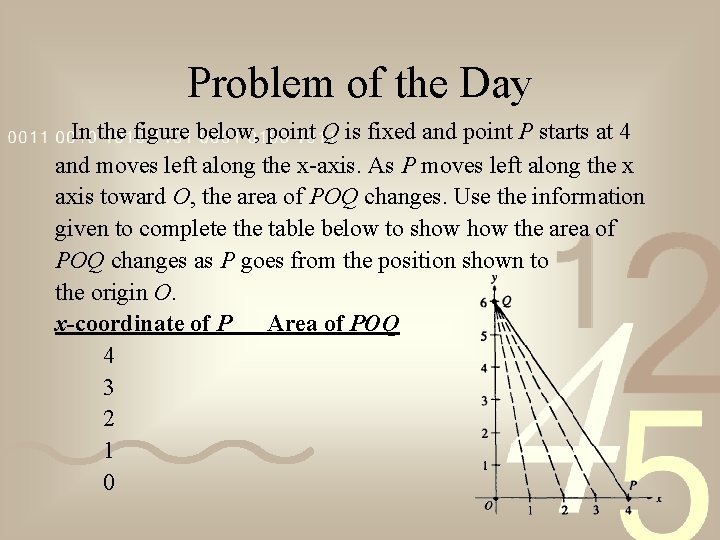
Problem of the Day In the figure below, point Q is fixed and point P starts at 4 and moves left along the x-axis. As P moves left along the x axis toward O, the area of POQ changes. Use the information given to complete the table below to show the area of POQ changes as P goes from the position shown to the origin O. x-coordinate of P Area of POQ 4 3 2 1 0
Housekeeping • • Breaks Cell Phones Restrooms Parking Lot
Activator • Word Splash
Essential Question/Enduring Understandings • What math is in Unit Six? • What math is in part five of Unit Four? • How does assessment impact what students should know and be able to do?
Assessment • What is assessment? • What is the difference between assessment and grading?
Thoughts on Grading • The Case against the zero • Grading: Are grade an accurate reflection of student learning?
Thoughts on Assessment • Open Ended Items • Will this be on the test?
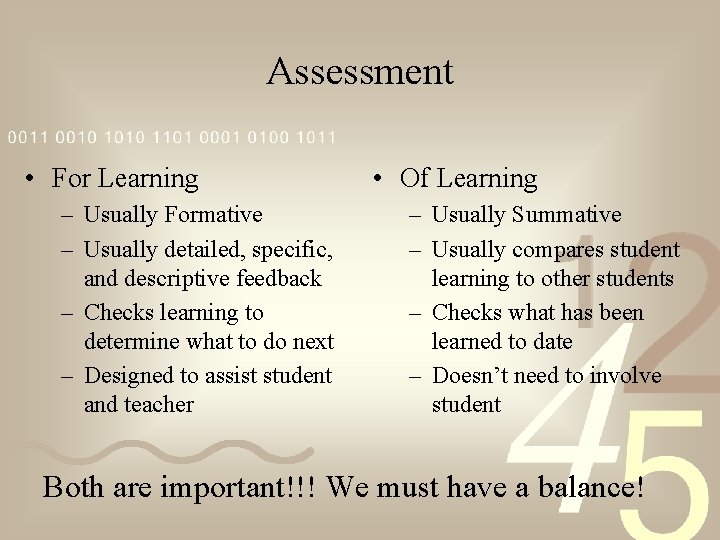
Assessment • For Learning – Usually Formative – Usually detailed, specific, and descriptive feedback – Checks learning to determine what to do next – Designed to assist student and teacher • Of Learning – Usually Summative – Usually compares student learning to other students – Checks what has been learned to date – Doesn’t need to involve student Both are important!!! We must have a balance!
Assessment for Learning 1. Students are involved so a shared language and understanding is developed. 2. Students receive specific, descriptive feedback about the learning, during the learning. 3. Students collect, organize, and communicate evidence of their learning to others.
Assessment for Learning 4. Teachers adjust instruction in response to ongoing assessment information received from students and selves. 5. A safe learning environment invites further risk taking, mistake making, goal setting, and support for learning. GMSA Conference Assessment for Learning 2/3/2005
Video Game A Learning Task • Distance formula introduced • The relationship between the Pythagorean theorem and the distance formula
Part five of Unit Four • 3 Game Tasks – Fairness – Yahtzee – Application • Culminating Task
Unit 6 – Coordinate Geometry • Pre Requisites: – Plotting points in all quadrants – Scatter plots – Lines and systems of lines, including finding equations of lines, finding slopes of lines, and finding the slope of a line perpendicular to a given line. – Pythagorean Theorem
Overview of Unit 6 • This unit investigates the properties of geometric figures on the coordinate plane. Students develop and use the formulas for the distance between two points, the distance between a point and a line, and the midpoint of segments. Focusing students’ attention on a coordinate grid as a reference for locations and descriptions of geometric figures strengthens their recognitions of algebraic and geometric connections.
Essential Question/Enduring Understandings • Algebraic formulas can be used to find measures of distance on the coordinate plane. • The coordinate plane allows precise communication about graphical representations. • The coordinate plane permits use of algebraic methods to obtain geometric results.
Key Standards MM 1 G 1: Students will investigate properties of geometric figures in the coordinate plane. Determine the distance between two points. Determine the distance between a point and a line. Determine the midpoint of a segment. Understand the distance formula as an application of the Pythagorean Theorem. Use the coordinate plane to investigate properties of and verify conjectures related to triangles and quadrilaterals.
Related Standards • MM 1 G 2: Students will understand use the language of mathematical argument and justification. Use conjecture, inductive reasoning, deductive reasoning, counterexample, and indirect proof as appropriate. Understand use the relationships among a statement and its converse, inverse, and contrapositive. • MM 1 G 3: Students will discover, prove, and apply properties of triangles, quadrilaterals, and other polygons. Understand, use, and prove properties of and relationships among special quadrilaterals: parallelogram, rectangle, rhombus, square, trapezoid, and kite. Find and use points of concurrency in triangles: incenter, orthocenter, circumcenter, and centroid.
Related Standards • MM 1 P 1: Students will solve problems (using appropriate technology) • MM 1 P 2: Students will reason and evaluate mathematical arguments • MM 1 P 3: Students will communicate mathematically • MM 1 P 4: Students will make connections among mathematical ideas and to other disciplines • MM 1 P 5: Students will represent mathematics in multiple ways
Concepts/Skills to Maintain • • Plotting points in all quadrants Making scatter plots Finding slopes and equations of lines Finding equation of a line perpendicular to a given line • Pythagorean Theorem • Properties of special quadrilaterals –
Tasks • Task 1 and 2: Distance and mid point formulas • Tasks 3 and 4: Applications in the coordinate plane
New York A Learning Task • Key Points: – Introduction of the mid point formula
Quadrilaterals Revisited A Learning Task • Key Points: – Distance and mid point formulas in the coordinate plane – Use the coordinate plane to verify conjectures related to triangles and quadrilaterals
Euler’s Village A Learning Task • Key Points: – Investigate properties of geometric figures in coordinate plane
Surveillance of the Village A Culminating Task • This task incorporates all of the material learned in this unit in an applied setting. • It may be appropriate for students to work on this task throughout the unit with periodic deadlines
End of Day 5