
THIS IS With Your Host Digestion Vocabulary Digestion

THIS IS

With Your Host. . .
Digestion Vocabulary Digestion 2 Digestion 3 100 100 100 200 200 200 300 300 300 400 400 400 500 500 500
The building blocks of protein are known as: A 100
Amino Acids A 100
Name all six nutrients your body receives from food. A 200
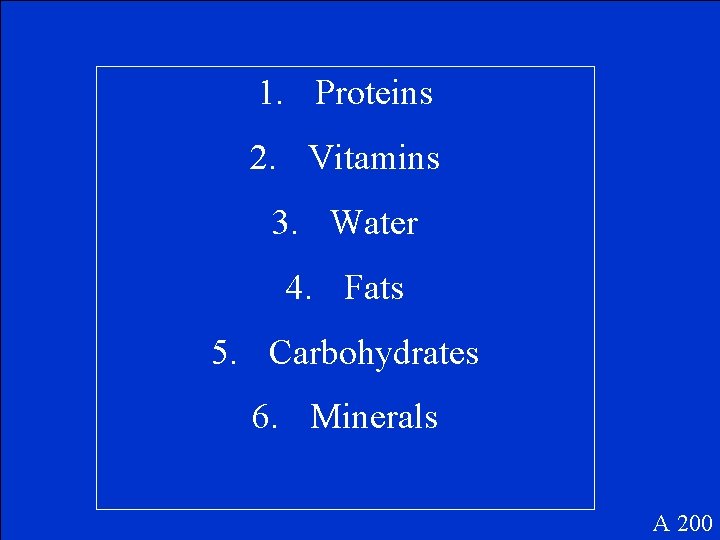
1. Proteins 2. Vitamins 3. Water 4. Fats 5. Carbohydrates 6. Minerals A 200
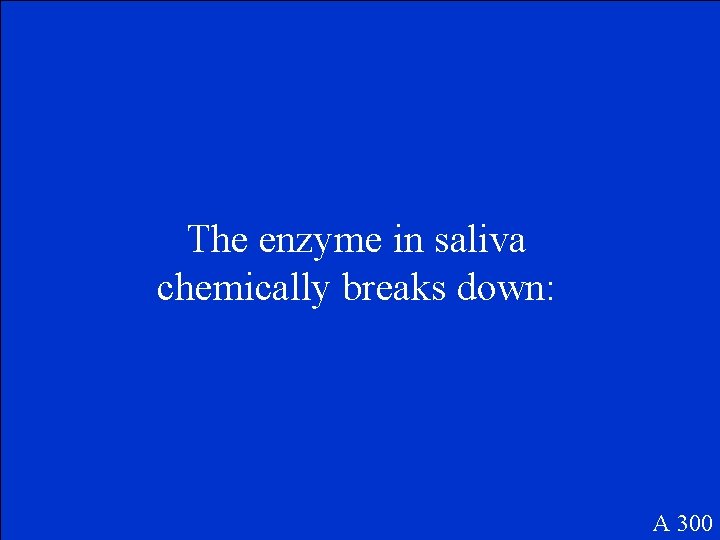
The enzyme in saliva chemically breaks down: A 300
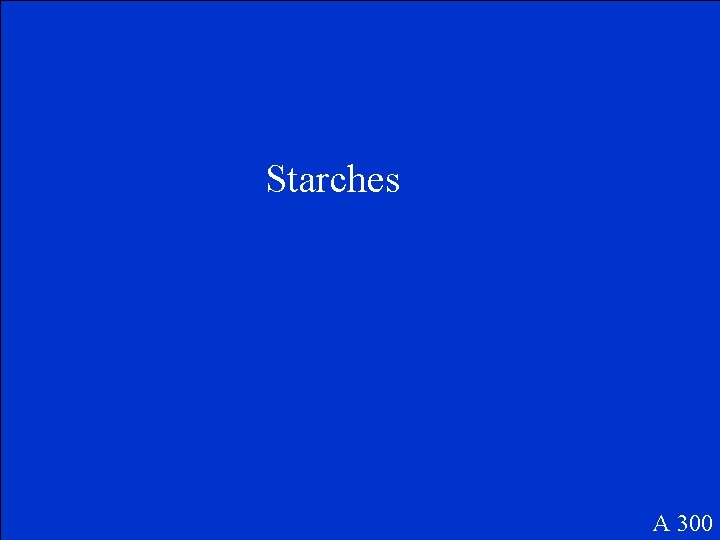
Starches A 300
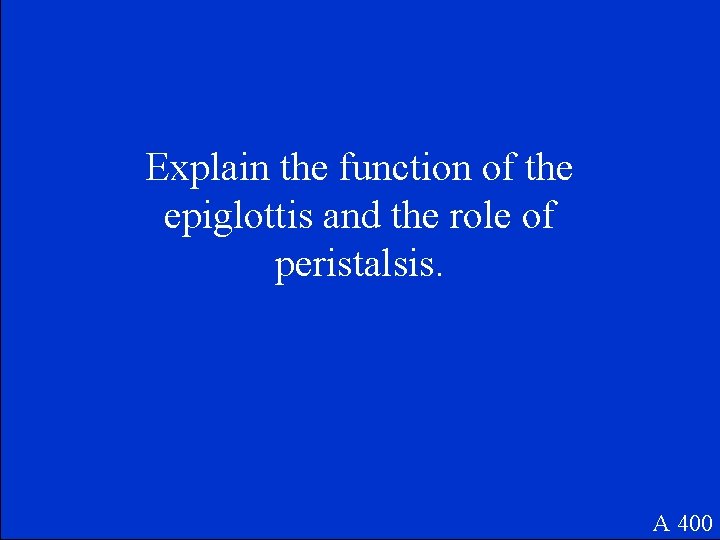
Explain the function of the epiglottis and the role of peristalsis. A 400
Epiglottis is located in the back of your mouth and seals off your windpipe when you swallow to prevent food from entering. Peristalsis pushes food and undigested material through the digestive system. A 400
Before winter, animals that hibernate often prepare by eating foods high in fat. How is this behavior helpful? A 500
Fat provides more than twice the energy of carbohydrates or proteins. The fat will be stored as an energy source to be used when the animal is hibernating and not taking in food as energy. A 500
What is digestion? B 100
Process by which your body breaks down food into small nutrient molecules. B 100
What is absorption? What happens to materials that are not absorbed? B 200
Absorption is the process by which nutrient molecules pass through the wall of your digestive system into your blood. Materials that are not absorbed are removed from the body. B 200
What is the difference between chemical and mechanical digestion? Provide examples for each. B 300
Mechanical digestion- Food is physically broken down into smaller pieces. Ex: Mouth Chemical digestion- Chemicals produced by the body break foods into their smaller chemical building blocks. Ex: Stomach B 300
How is energy in food measured? What kinds of information are found in food pyramids and on food labels. B 400
Calories Food pyramids classify foods into six groups Food label contains nutritional information about food. B 400
Bile is produced by the: Which organ allows most materials to be absorbed into the blood stream? B 500
Bile is produced in the liver. Small intestine B 500
Most mechanical digestion takes place in the: C 100
Stomach C 100
What role does bacteria play in the large intestine? C 200
Bacteria in the large intestine make certain vitamins, including vitamin K. C 200
How does the Pancreas aid in digestion? C 300
The Pancreas produces enzymes that help break down starches, proteins and fats. C 300

DAILY Place A Wager DOUBLE C 400
What is Pepsin? C 400
Pepsin is an enzyme that is part of the digestive juice. It breaks down protein into short chains of amino acids. C 400
What is cholesterol and why is it important to monitor? C 500
A waxy, fatlike substance found only in animal products. Can lead to heart disease which can lead to heart attack or death. C 500

How is food removed? D 100
Through the large intestine, to the rectum where food is removed through the anus. D 100
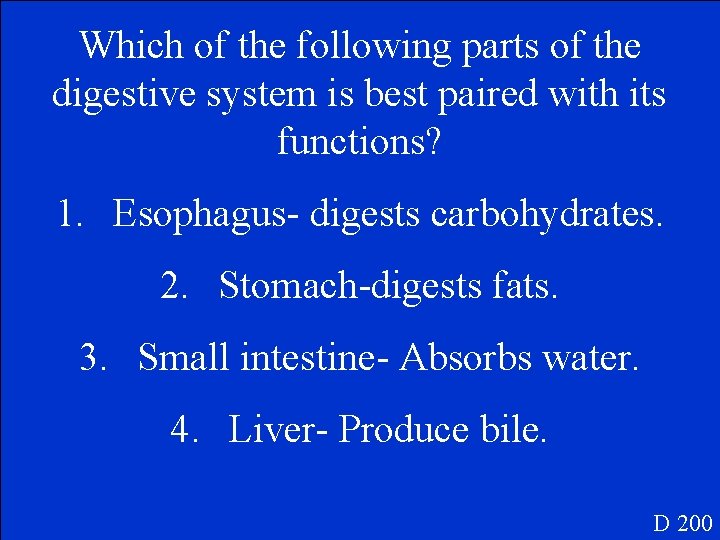
Which of the following parts of the digestive system is best paired with its functions? 1. Esophagus- digests carbohydrates. 2. Stomach-digests fats. 3. Small intestine- Absorbs water. 4. Liver- Produce bile. D 200
Liver-Produces bile D 200
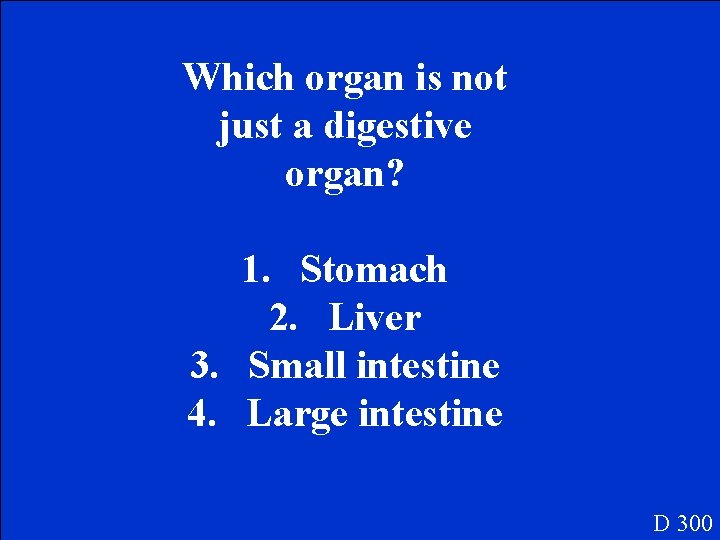
Which organ is not just a digestive organ? 1. Stomach 2. Liver 3. Small intestine 4. Large intestine D 300
Liver D 300
Compare and contrast your digestive system to an assembly line. D 400
Similarities: Both perform specific jobs in a sequence of events. Differences: Assembly line. Something is constructed from many small parts in many steps. Digestion- something is broken down into smaller parts step by step. D 400
What could happen if your body didn’t produce enough mucus? Explain D 500
The stomach lining would become irritated and might develop sores from the acid produced by the stomach. D 500
What are the 4 processes when becoming a sedimentary rock? E 100
Erosion, Deposition, Compaction, Cementation. E 100
Many sedimentary rocks have visible layers because of the process of ? You’ll find the oldest sedimentary rocks in which layer? E 200
Deposition and in the lowest layer E 200
What are three types of sedimentary rocks? E 300
Organic, Clastic and Chemical Rock E 300
Explain the three types of sedimentary rocks. E 400
Organic Rock- Forms where the remains of plants and animals are deposited in thick layers Chemical Rock- When minerals dissolve in a solution and crystallize Clastic Rock- Forms when rock fragments are squeezed together E 400
Describe the four processes in becoming a sedimentary rock. E 500
Erosion- running water, wind, or ice loosen and carry away fragments of rock Deposition- process by which sediment settles out of the water or wind carrying it. Compaction- process that pushes sediments together Cementation- process by which dissolved minerals crystallize and glue particles of sediment together. E 500
How are metamorphic rocks classified? F 100
According to the arrangement of the grains that make up the rocks F 100
How are metamorphic rocks formed and what are the two types of metamorphic rocks? F 200
Heat and pressure deep beneath the Earth’s surface change any rock into metamorphic rock. Two types: Foliated and nonfoliated. F 200
Describe Foliated and Nonfoliated rocks F 300
Foliated- Metamorphic rocks that have their grains arranged in parallel layers or bands Nonfoliated- Metamorphic rocks which have mineral grains arranged randomly. F 300
What are the sources of the heat that helps metamorphic rocks form? F 400
Forces inside the Earth push rock deeper where temperature is higher. Magma rising through the crust also provides heat that can produce metamorphic rock. F 400

How can metamorphic rock turn into sedimentary rock? **Hint think Rock Cycle** F 500
Erosion and Deposition F 500

The Final Jeopardy Category is: Bones, Muscles, Tissues, Skin Please record your wager. Click on screen to begin
What is melanin? Explain why certain people produce more melanin than others. Where can you find the people who produce the most melanin? What is the largest organ in the human body? Identify levels of organization in the human body from smallest to largest: Why does an adult have less bones than a baby. How many bones for each? Click on screen to continue
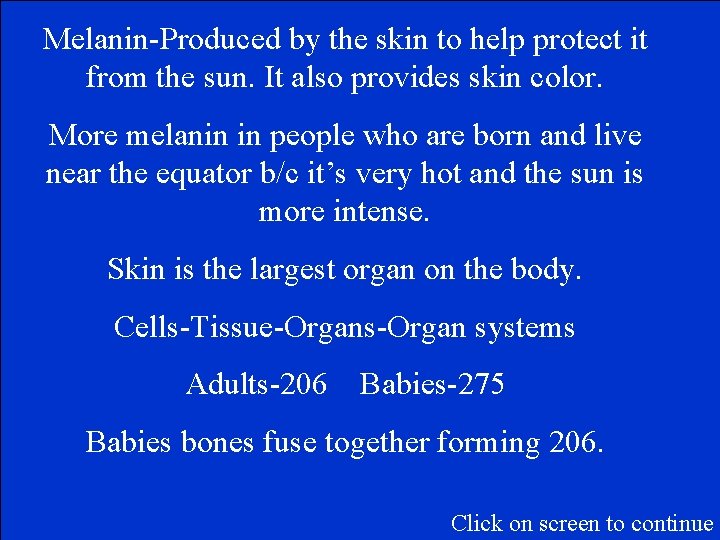
Melanin-Produced by the skin to help protect it from the sun. It also provides skin color. More melanin in people who are born and live near the equator b/c it’s very hot and the sun is more intense. Skin is the largest organ on the body. Cells-Tissue-Organs-Organ systems Adults-206 Babies-275 Babies bones fuse together forming 206. Click on screen to continue

Thank You for Playing Jeopardy! Game Designed By C. Harr-MAIT
- Slides: 68