
This is the first slide The UC Project
![Sustainability Learning Outcomes 21. Articulate Commoner’s laws of ecology: [16] l “Everything is connected](https://slidetodoc.com/presentation_image_h2/c0c260b239d6dc492f5a41e0f68ca686/image-14.jpg "Sustainability Learning Outcomes 21. Articulate Commoner’s laws of ecology: [16] l “Everything is connected")


- Slides: 41
This is the first slide The UC Project Management Institute is a Registered Provider with The American Institute of Architects Continuing Education Systems. Credit earned on completion of this program will be reported to CES Records for AIA members. Certificates of Completion for non-AIA members are available upon request (emily. montan@ucop. edu). This program is registered with the AIA-CES for continuing professional education. As such, it does not include content that may be deemed or construed to be an approval or endorsement by the AIA of any material of construction or any method or manner of handling, using, distributing, or dealing in any material or product. Questions related to specific materials, methods and services will be addressed at the conclusion of this presentation.
Teaching Sustainability in Electrical Engineering Lab Courses l Sustainability Definitions l Assessment results l Weekly Assignments http: //sustainability-and. ICs. pbwiki. com/ David Braun – Electrical Engineering California Polytechnic State University, San Luis Obispo Aug. 1, 2008
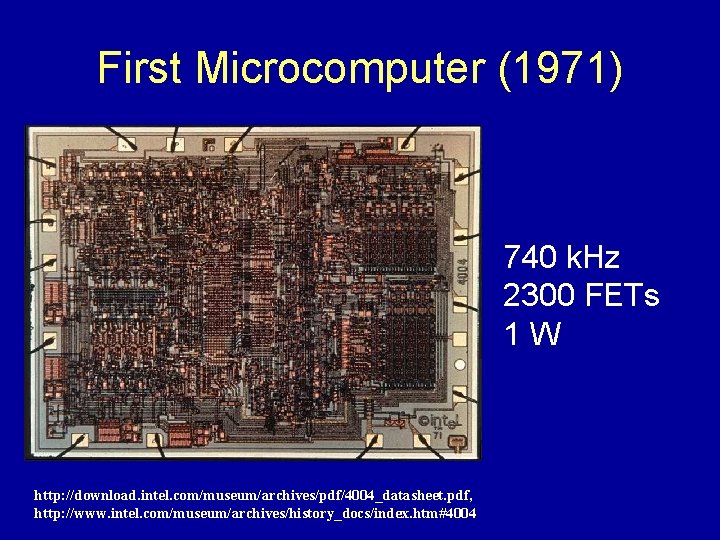
First Microcomputer (1971) 740 k. Hz 2300 FETs 1 W http: //download. intel. com/museum/archives/pdf/4004_datasheet. pdf, http: //www. intel. com/museum/archives/history_docs/index. htm#4004
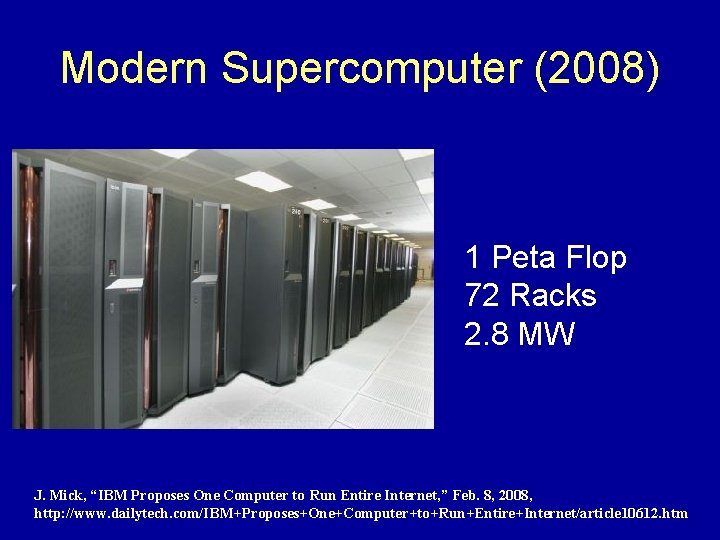
Modern Supercomputer (2008) 1 Peta Flop 72 Racks 2. 8 MW J. Mick, “IBM Proposes One Computer to Run Entire Internet, ” Feb. 8, 2008, http: //www. dailytech. com/IBM+Proposes+One+Computer+to+Run+Entire+Internet/article 10612. htm
How should we define sustainability? Aug. 1, 2008
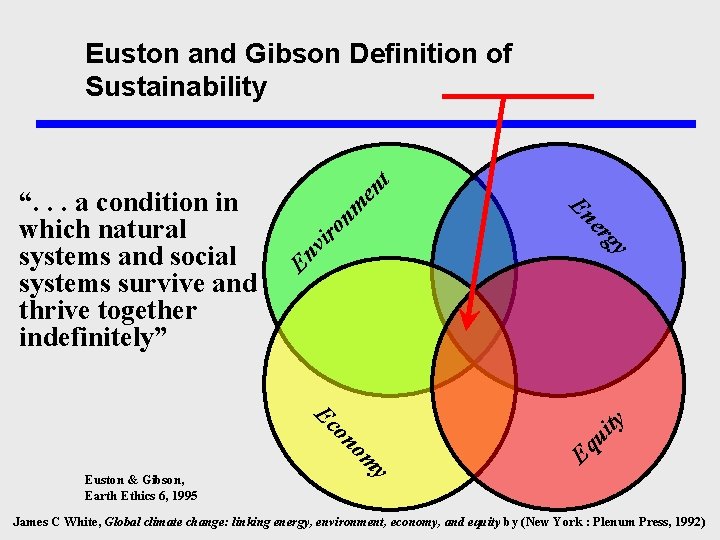
ro nm y En vi g er En y m no ui ty o Ec Euston & Gibson, Earth Ethics 6, 1995 Eq “. . . a condition in which natural systems and social systems survive and thrive together indefinitely” en t Euston and Gibson Definition of Sustainability James C White, Global climate change: linking energy, environment, economy, and equity by (New York : Plenum Press, 1992)
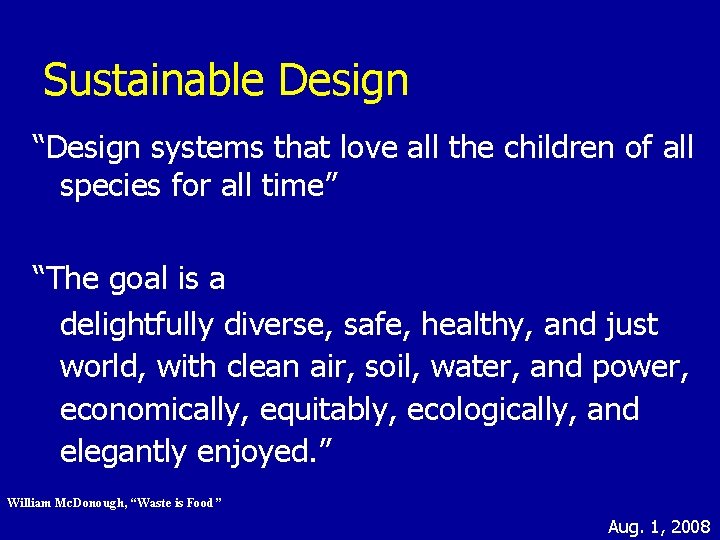
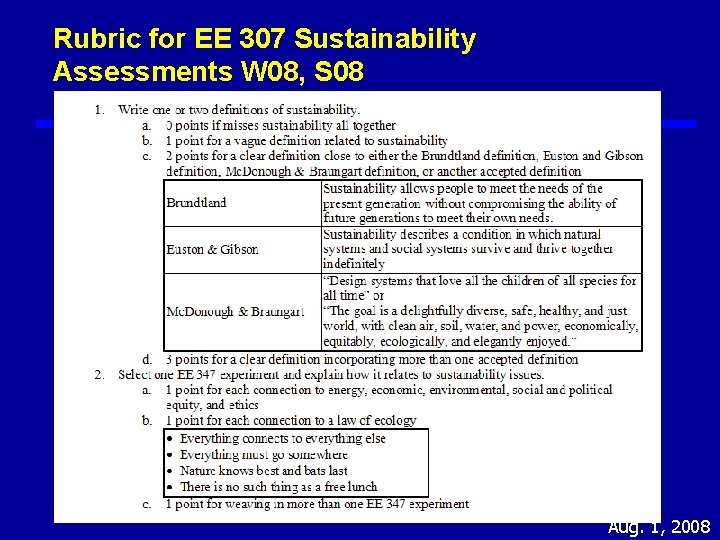
Sustainable Design “Design systems that love all the children of all species for all time” “The goal is a delightfully diverse, safe, healthy, and just world, with clean air, soil, water, and power, economically, equitably, ecologically, and elegantly enjoyed. ” William Mc. Donough, “Waste is Food” Aug. 1, 2008
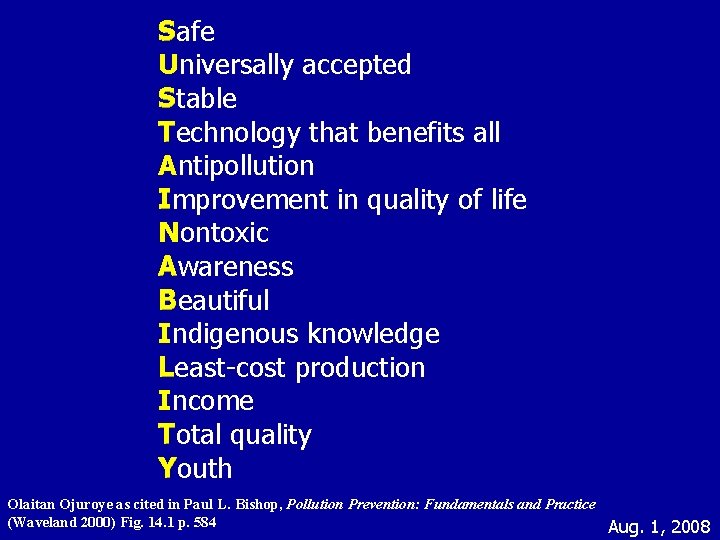
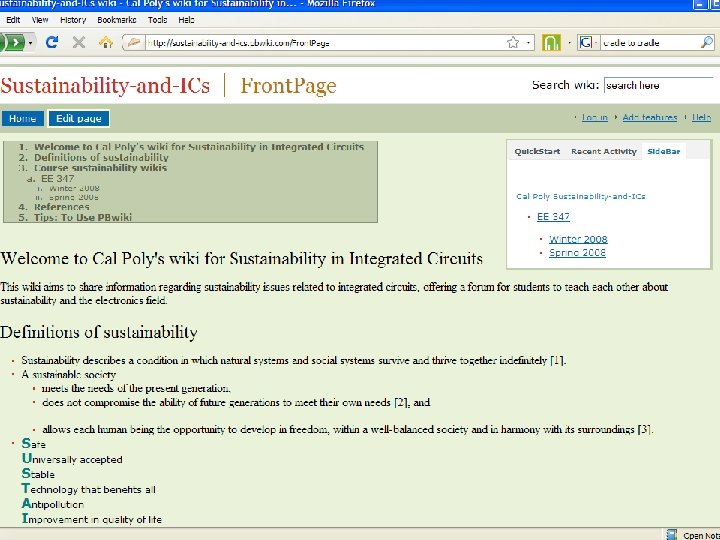
Safe Universally accepted Stable Technology that benefits all Antipollution Improvement in quality of life Nontoxic Awareness Beautiful Indigenous knowledge Least-cost production Income Total quality Youth Olaitan Ojuroye as cited in Paul L. Bishop, Pollution Prevention: Fundamentals and Practice (Waveland 2000) Fig. 14. 1 p. 584 Aug. 1, 2008
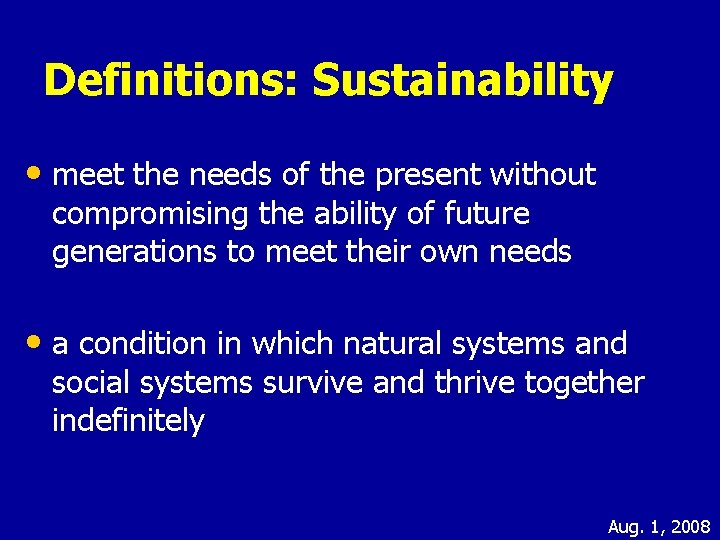
Definitions: Sustainability • meet the needs of the present without compromising the ability of future generations to meet their own needs • a condition in which natural systems and social systems survive and thrive together indefinitely Aug. 1, 2008
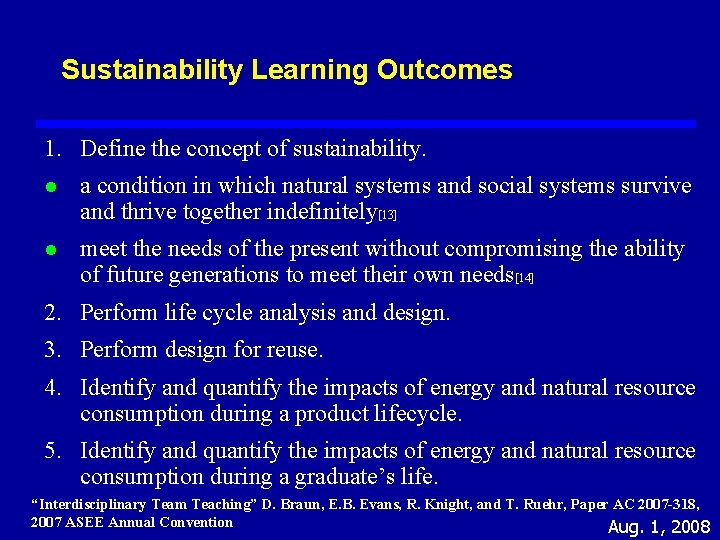
Sustainability Learning Outcomes 1. Define the concept of sustainability. l a condition in which natural systems and social systems survive and thrive together indefinitely[13] l meet the needs of the present without compromising the ability of future generations to meet their own needs[14] 2. Perform life cycle analysis and design. 3. Perform design for reuse. 4. Identify and quantify the impacts of energy and natural resource consumption during a product lifecycle. 5. Identify and quantify the impacts of energy and natural resource consumption during a graduate’s life. “Interdisciplinary Team Teaching” D. Braun, E. B. Evans, R. Knight, and T. Ruehr, Paper AC 2007 -318, 2007 ASEE Annual Convention Aug. 1, 2008
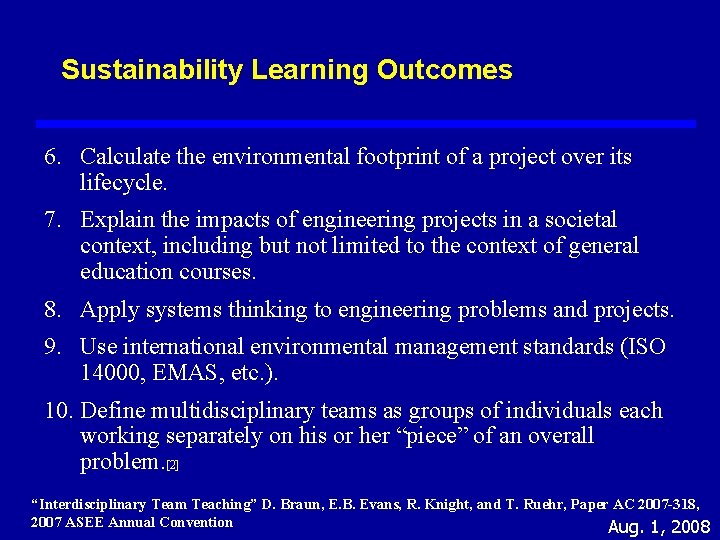
Sustainability Learning Outcomes 6. Calculate the environmental footprint of a project over its lifecycle. 7. Explain the impacts of engineering projects in a societal context, including but not limited to the context of general education courses. 8. Apply systems thinking to engineering problems and projects. 9. Use international environmental management standards (ISO 14000, EMAS, etc. ). 10. Define multidisciplinary teams as groups of individuals each working separately on his or her “piece” of an overall problem. [2] “Interdisciplinary Team Teaching” D. Braun, E. B. Evans, R. Knight, and T. Ruehr, Paper AC 2007 -318, 2007 ASEE Annual Convention Aug. 1, 2008
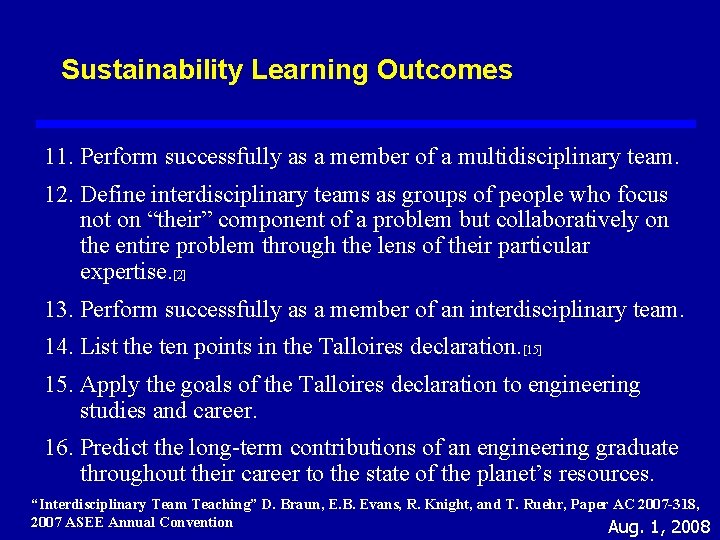
Sustainability Learning Outcomes 11. Perform successfully as a member of a multidisciplinary team. 12. Define interdisciplinary teams as groups of people who focus not on “their” component of a problem but collaboratively on the entire problem through the lens of their particular expertise. [2] 13. Perform successfully as a member of an interdisciplinary team. 14. List the ten points in the Talloires declaration. [15] 15. Apply the goals of the Talloires declaration to engineering studies and career. 16. Predict the long-term contributions of an engineering graduate throughout their career to the state of the planet’s resources. “Interdisciplinary Team Teaching” D. Braun, E. B. Evans, R. Knight, and T. Ruehr, Paper AC 2007 -318, 2007 ASEE Annual Convention Aug. 1, 2008
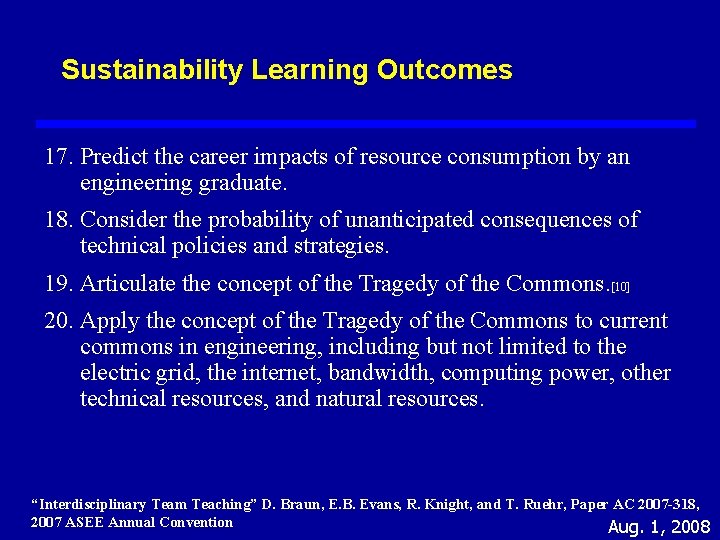
Sustainability Learning Outcomes 17. Predict the career impacts of resource consumption by an engineering graduate. 18. Consider the probability of unanticipated consequences of technical policies and strategies. 19. Articulate the concept of the Tragedy of the Commons. [10] 20. Apply the concept of the Tragedy of the Commons to current commons in engineering, including but not limited to the electric grid, the internet, bandwidth, computing power, other technical resources, and natural resources. “Interdisciplinary Team Teaching” D. Braun, E. B. Evans, R. Knight, and T. Ruehr, Paper AC 2007 -318, 2007 ASEE Annual Convention Aug. 1, 2008
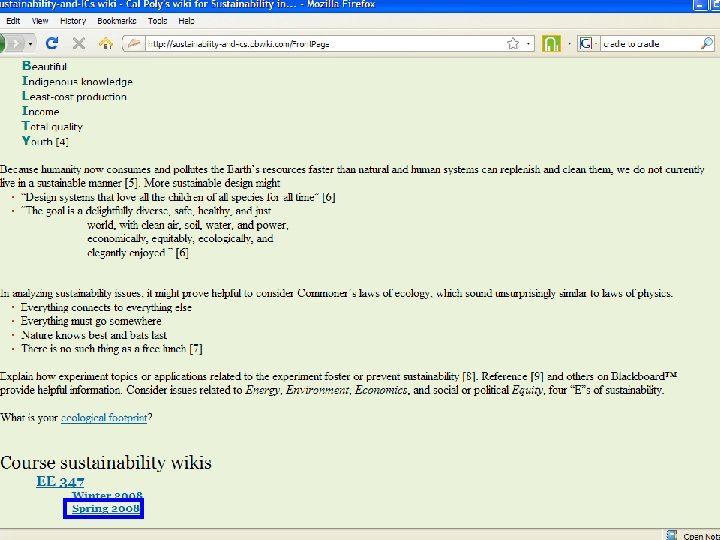
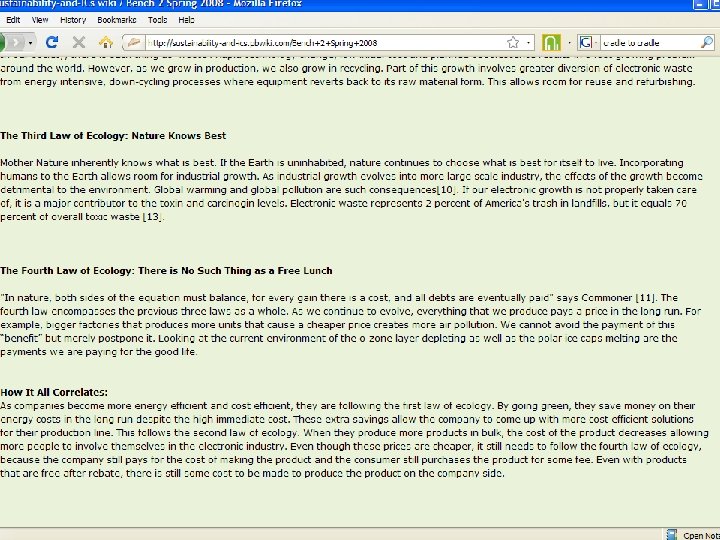
Sustainability Learning Outcomes 21. Articulate Commoner’s laws of ecology: [16] l “Everything is connected to everything else l Everything must go somewhere l Nature know best l There is no such thing as a free lunch”[16] (waste equals food) 22. List the five “E”s of sustainability: Environment, Economy, Energy, Equity, Ethics 23. Define ecosystem services as the benefits people obtain from ecosystems. [17] “Interdisciplinary Team Teaching” D. Braun, E. B. Evans, R. Knight, and T. Ruehr, Paper AC 2007 -318, 2007 ASEE Annual Convention Aug. 1, 2008
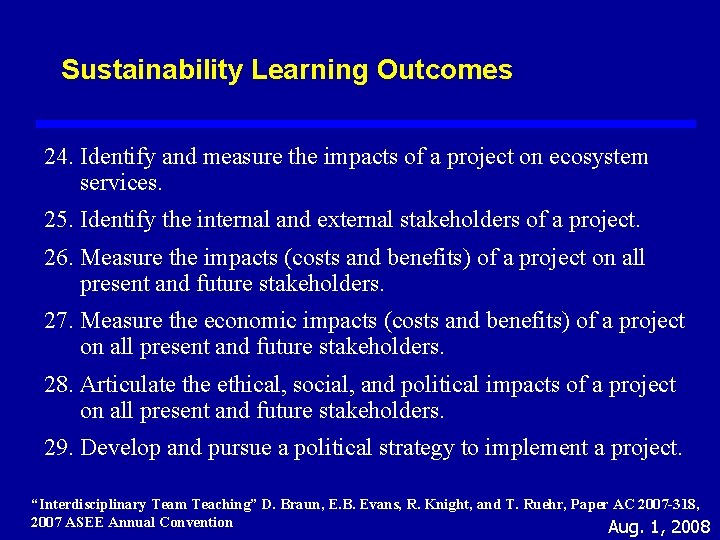
Sustainability Learning Outcomes 24. Identify and measure the impacts of a project on ecosystem services. 25. Identify the internal and external stakeholders of a project. 26. Measure the impacts (costs and benefits) of a project on all present and future stakeholders. 27. Measure the economic impacts (costs and benefits) of a project on all present and future stakeholders. 28. Articulate the ethical, social, and political impacts of a project on all present and future stakeholders. 29. Develop and pursue a political strategy to implement a project. “Interdisciplinary Team Teaching” D. Braun, E. B. Evans, R. Knight, and T. Ruehr, Paper AC 2007 -318, 2007 ASEE Annual Convention Aug. 1, 2008
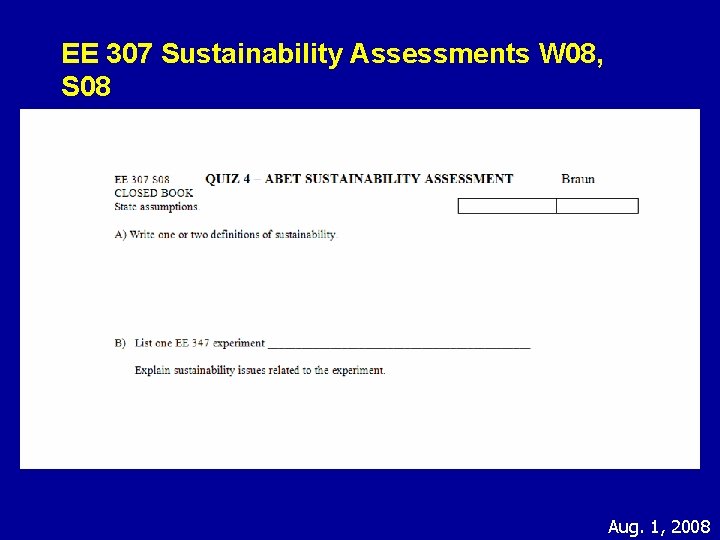
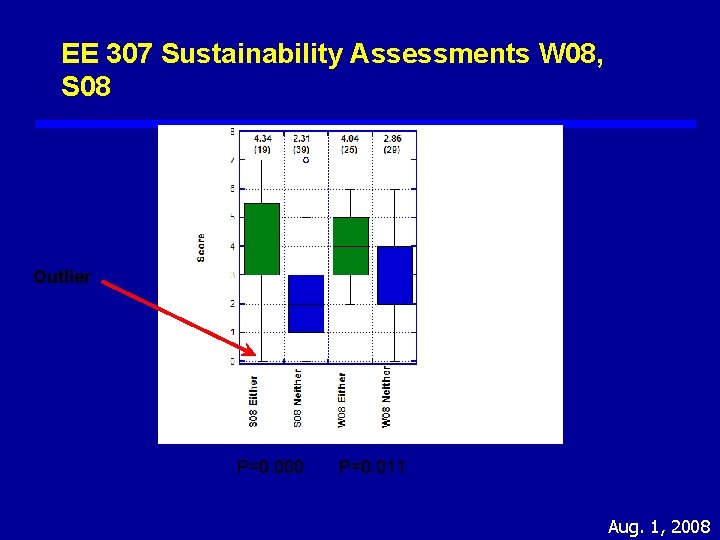
EE 307 Sustainability Assessments W 08, S 08 Aug. 1, 2008
Rubric for EE 307 Sustainability Assessments W 08, S 08 Aug. 1, 2008
EE 307 Sustainability Assessments W 08, S 08 Outlier P=0. 000 P=0. 011 Aug. 1, 2008
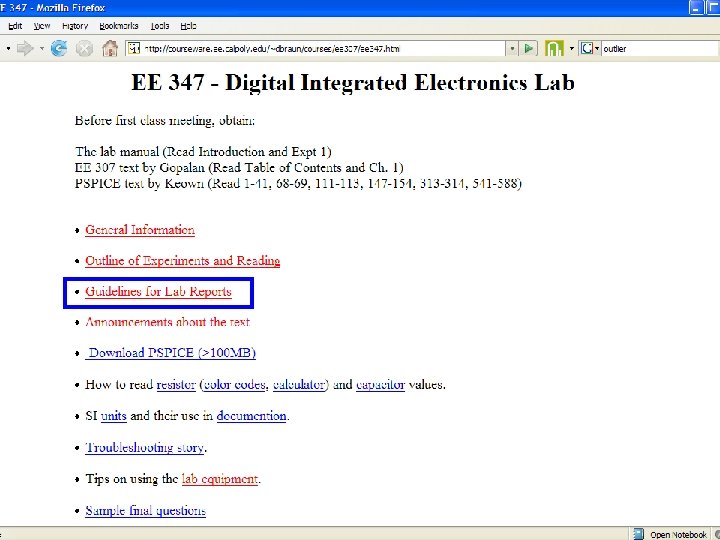
EE 347 Lab Reports W 08, S 08
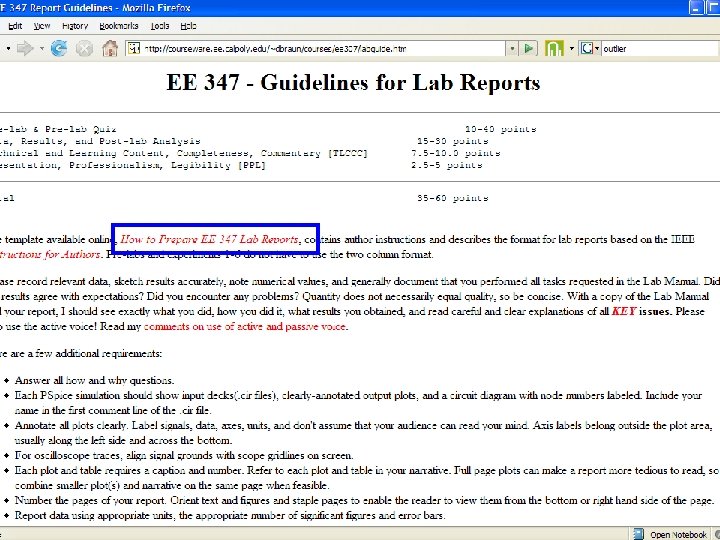
EE 347 Lab Reports W 08, S 08
EE 347 Lab Reports W 08, S 08
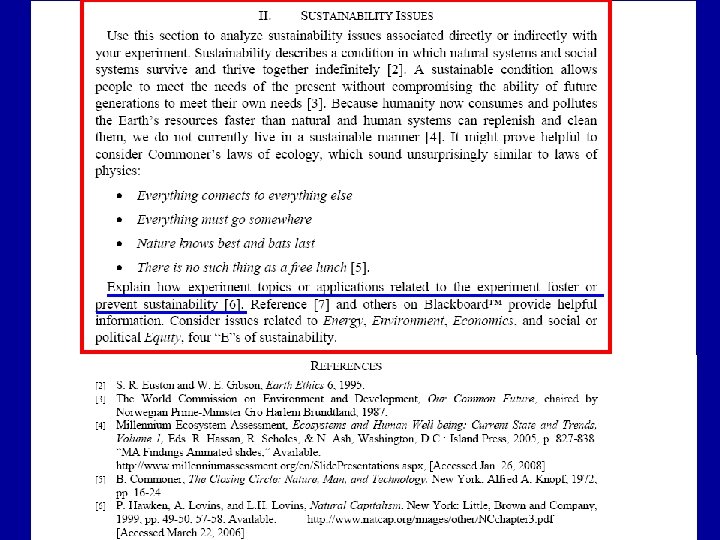
EE 347 Lab Reports Section II
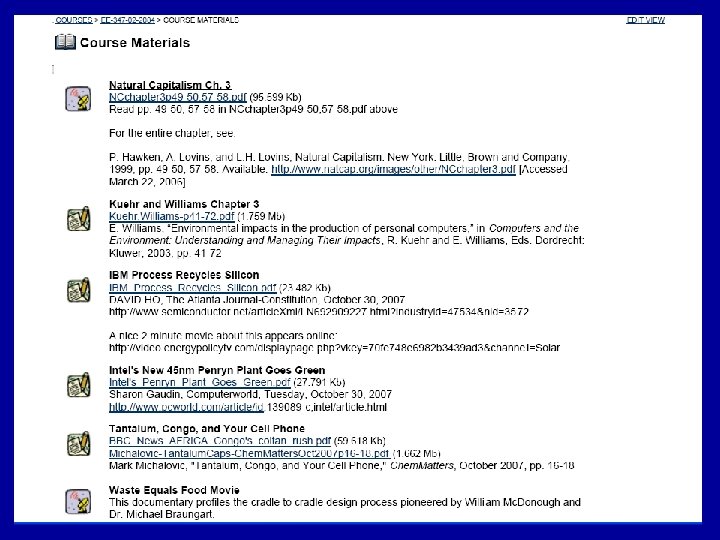
Sustainability Materials on Black. Board
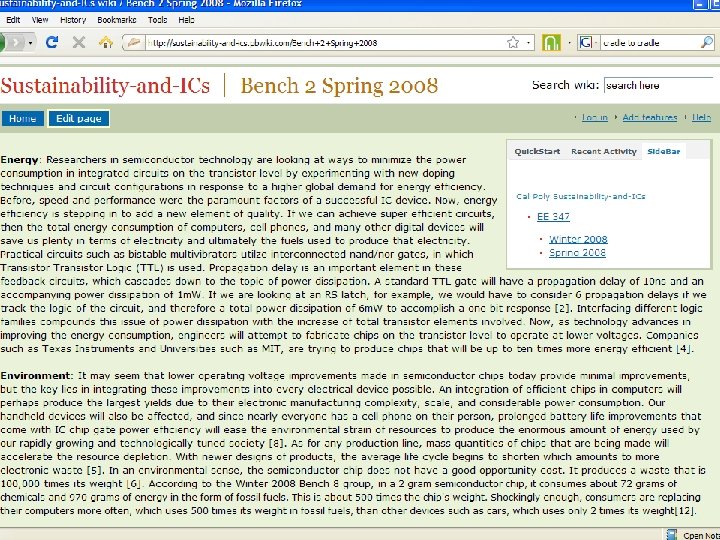
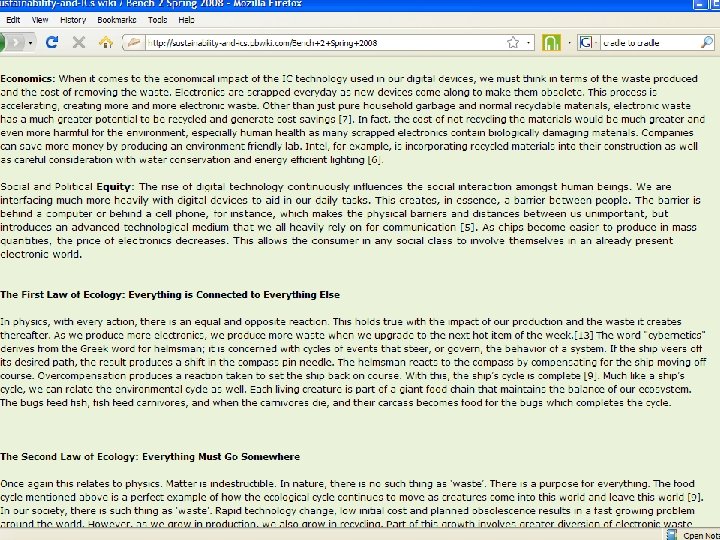
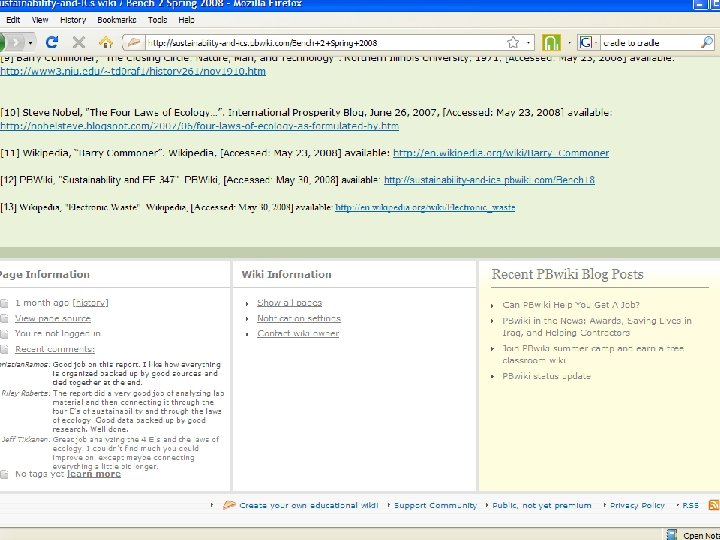
http: //sustainability-andics. pbwiki. com/
http: //sustainability-andics. pbwiki. com/
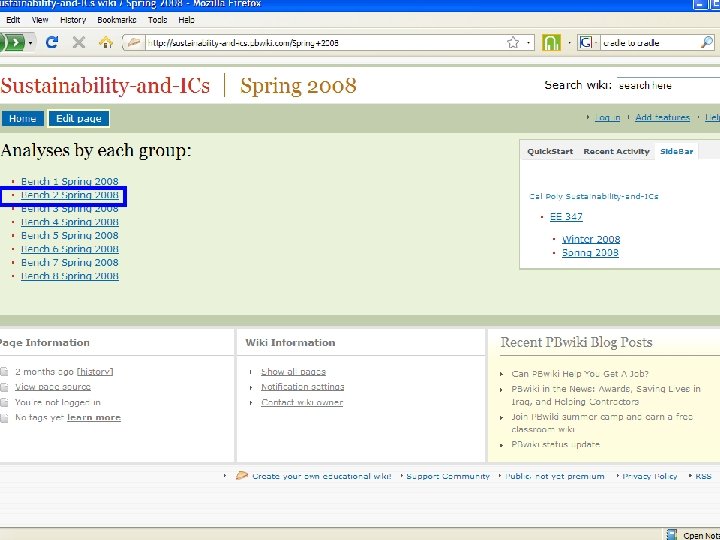
http: //sustainability-andics. pbwiki. com/
http: //sustainability-andics. pbwiki. com/
http: //sustainability-andics. pbwiki. com/
http: //sustainability-andics. pbwiki. com/
http: //sustainability-andics. pbwiki. com/
http: //sustainability-andics. pbwiki. com/
http: //sustainability-and. ICs. pbwiki. com/ Aug. 1, 2008
Teaching Sustainability in Electrical Engineering Lab Courses l Expose a sustainability teaching technique the audience might use in their courses l Provide the url of the wiki containing examples of collaborative student work, http: //sustainability-and-ICs. pbwiki. com/ David Braun – Electrical Engineering http: //www. ee. calpoly. edu/faculty/dbraun/ California Polytechnic State University, San Luis Obispo Aug. 1, 2008
QUESTIONS? This concludes the American Institute of Architects Continuing Education Systems Program. http: //www. ee. calpoly. edu/faculty/dbraun/ http: //sustainability-and-ICs. pbwiki. com/ dbraun@calpoly. edu
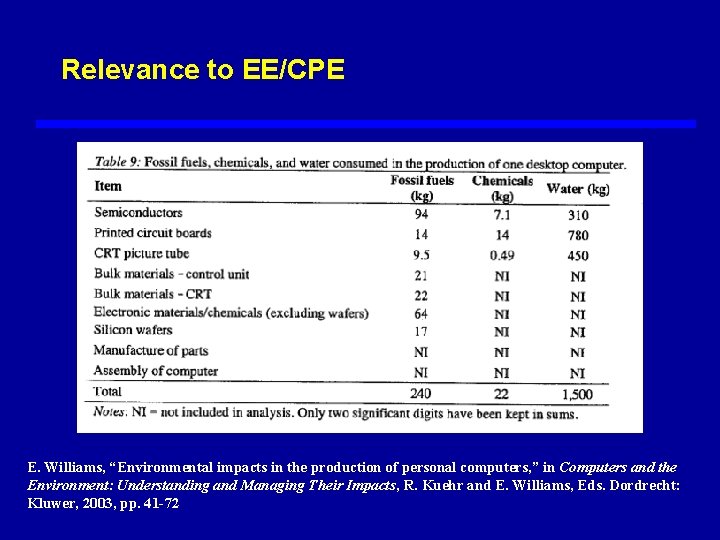
Relevance to EE/CPE E. Williams, “Environmental impacts in the production of personal computers, ” in Computers and the Environment: Understanding and Managing Their Impacts, R. Kuehr and E. Williams, Eds. Dordrecht: Kluwer, 2003, pp. 41 -72
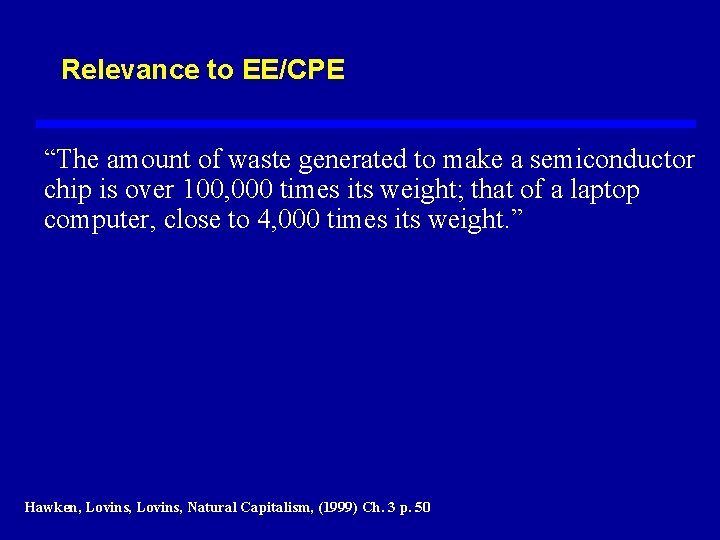
Relevance to EE/CPE “The amount of waste generated to make a semiconductor chip is over 100, 000 times its weight; that of a laptop computer, close to 4, 000 times its weight. ” Hawken, Lovins, Natural Capitalism, (1999) Ch. 3 p. 50
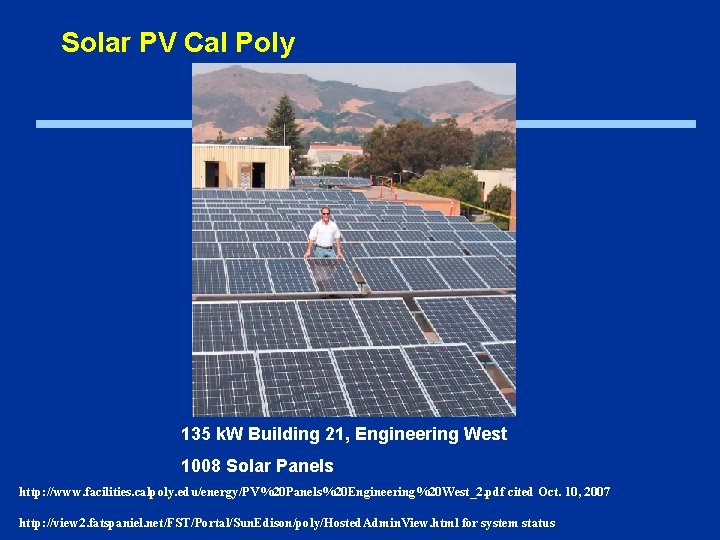
Solar PV Cal Poly 135 k. W Building 21, Engineering West 1008 Solar Panels http: //www. facilities. calpoly. edu/energy/PV%20 Panels%20 Engineering%20 West_2. pdf cited Oct. 10, 2007 http: //view 2. fatspaniel. net/FST/Portal/Sun. Edison/poly/Hosted. Admin. View. html for system status
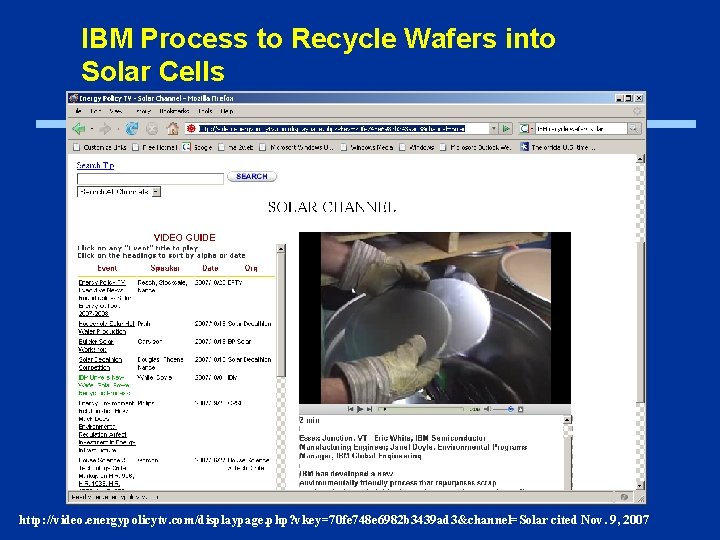
IBM Process to Recycle Wafers into Solar Cells http: //video. energypolicytv. com/displaypage. php? vkey=70 fe 748 e 6982 b 3439 ad 3&channel=Solar cited Nov. 9, 2007
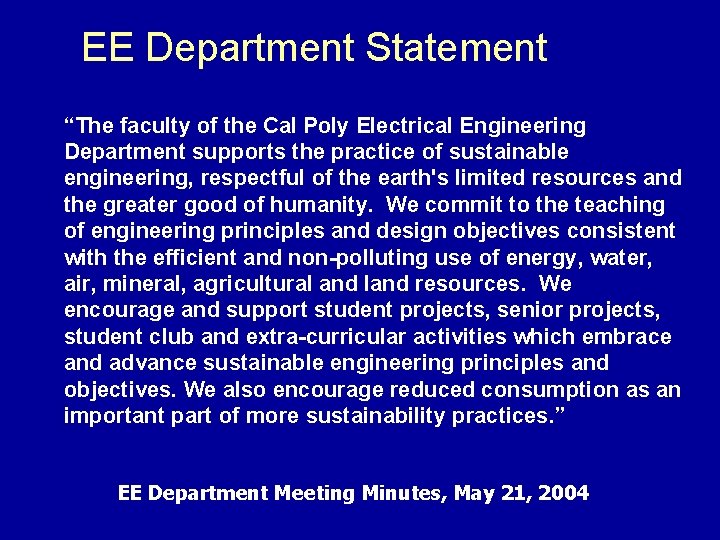
EE Department Statement “The faculty of the Cal Poly Electrical Engineering Department supports the practice of sustainable engineering, respectful of the earth's limited resources and the greater good of humanity. We commit to the teaching of engineering principles and design objectives consistent with the efficient and non-polluting use of energy, water, air, mineral, agricultural and land resources. We encourage and support student projects, senior projects, student club and extra-curricular activities which embrace and advance sustainable engineering principles and objectives. We also encourage reduced consumption as an important part of more sustainability practices. ” EE Department Meeting Minutes, May 21, 2004
QUESTIONS? This concludes the American Institute of Architects Continuing Education Systems Program. http: //www. ee. calpoly. edu/faculty/dbraun/ http: //sustainability-and-ICs. pbwiki. com/ dbraun@calpoly. edu