
This is Jeopardy Sound 1 Characteristics of Sound

- Slides: 28
This is Jeopardy Sound 1
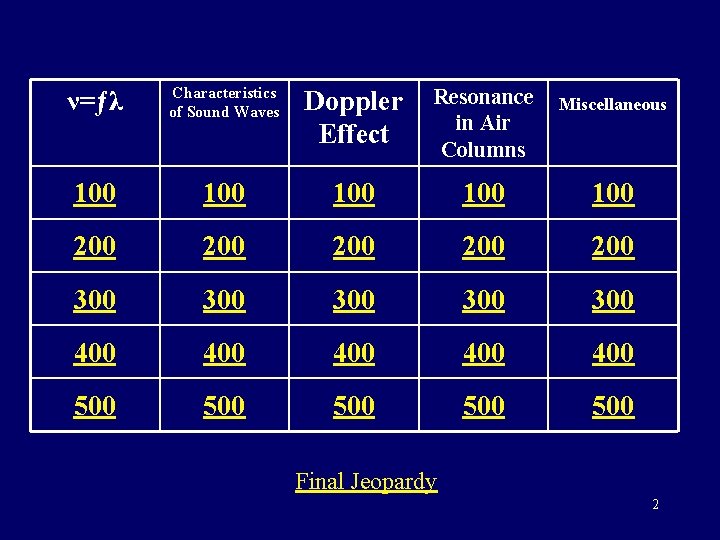
ν=ƒλ Characteristics of Sound Waves Doppler Effect Resonance in Air Columns 100 100 100 200 200 200 300 300 300 400 400 400 500 500 500 Miscellaneous Final Jeopardy 2
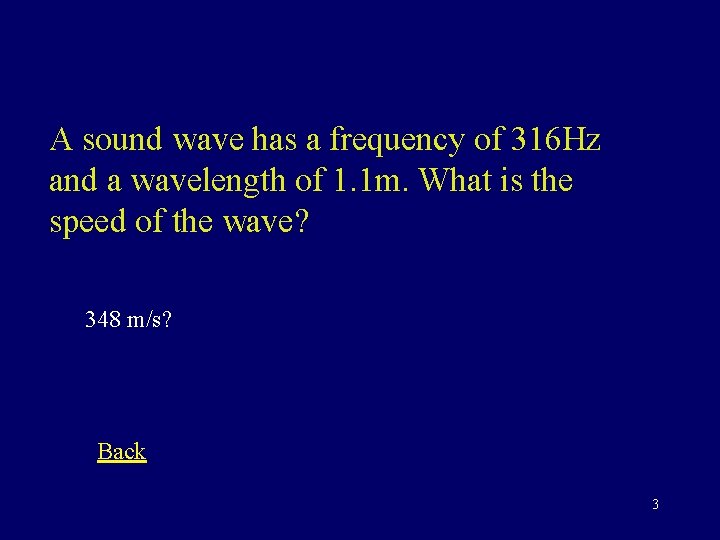
A sound wave has a frequency of 316 Hz and a wavelength of 1. 1 m. What is the speed of the wave? 348 m/s? Back 3
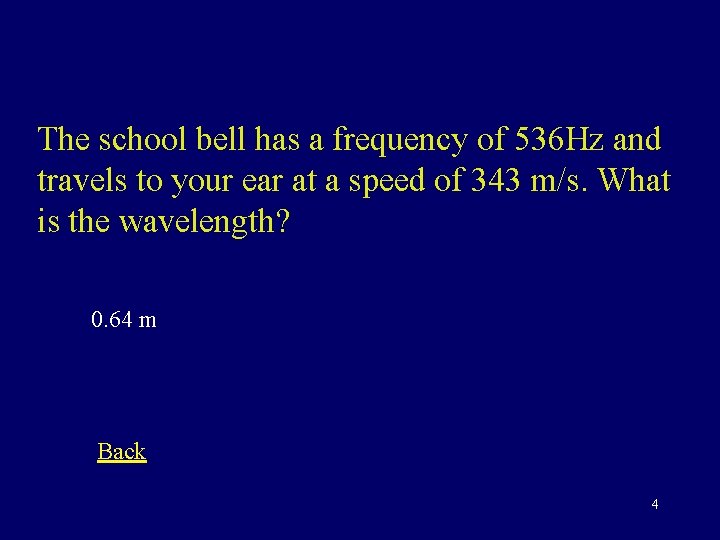
The school bell has a frequency of 536 Hz and travels to your ear at a speed of 343 m/s. What is the wavelength? 0. 64 m Back 4
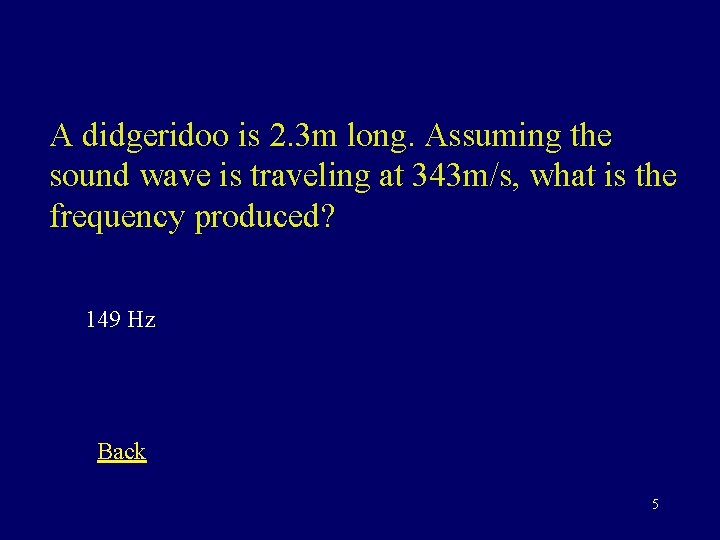
A didgeridoo is 2. 3 m long. Assuming the sound wave is traveling at 343 m/s, what is the frequency produced? 149 Hz Back 5
A sound wave with a period of 0. 005 sec travels at 351 m/s. What is the wavelength of the wave? 1. 75 m Back 6
A wave pulses 8 times every 0. 03 sec. If the wavelength is 1. 8 m long how fast is the wave traveling? 480 m/s Back 7
What type of wave is a sound wave? Longitudinal Back 8
What unit is used to measure the amplitude of a sound wave? Decibels Back 9
Describe how sound waves are detected by a microphone? The kinetic energy of the air molecules is converted into electrical impulses. Back 10
How is sound produced? Sound is produced by vibrating objects creating pressure variations in the air. A sound wave is described as areas of high and low pressure. Back 11
The speed of sound at 20°C is 343 m/s. At 25°C it increases to 346 m/s. Why is this? As the temperature of the air increases, the kinetic energy of the molecules in the air also increases. Molecules with greater kinetic energy travel faster. Back 12
Explain a Doppler shift. The apparent change in the frequency of a sound wave caused by relative motion between the source of the wave and the observer Back 13
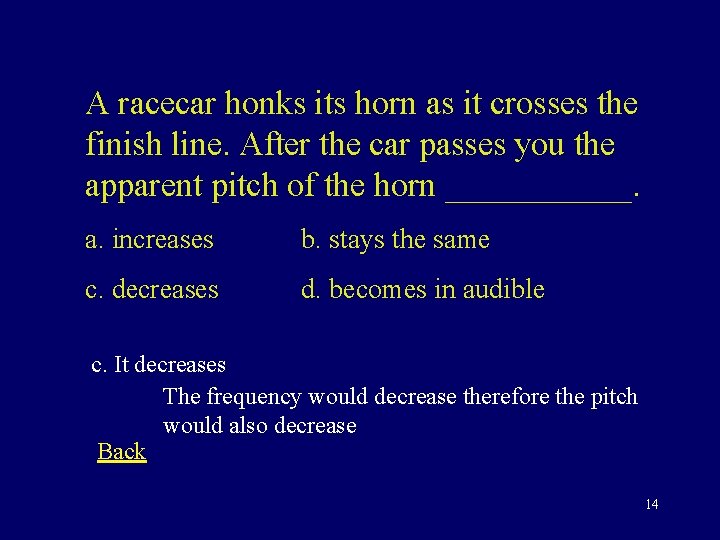
A racecar honks its horn as it crosses the finish line. After the car passes you the apparent pitch of the horn ______. a. increases b. stays the same c. decreases d. becomes in audible c. It decreases The frequency would decrease therefore the pitch would also decrease Back 14
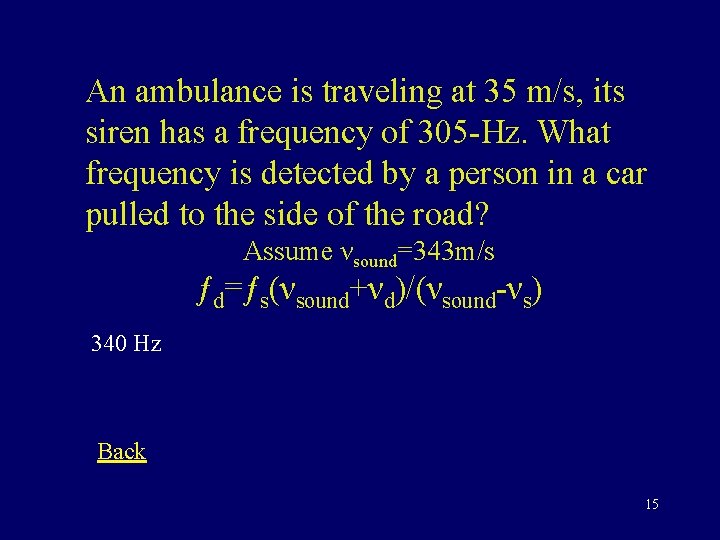
An ambulance is traveling at 35 m/s, its siren has a frequency of 305 -Hz. What frequency is detected by a person in a car pulled to the side of the road? Assume νsound=343 m/s ƒd=ƒs(νsound+νd)/(νsound-νs) 340 Hz Back 15
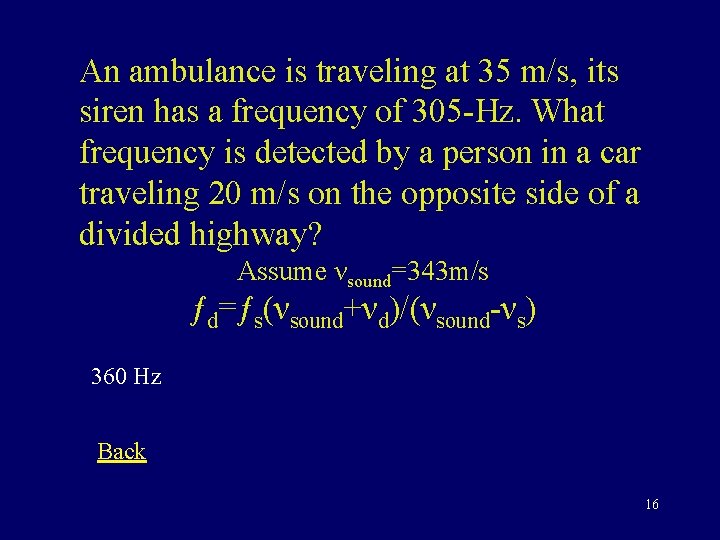
An ambulance is traveling at 35 m/s, its siren has a frequency of 305 -Hz. What frequency is detected by a person in a car traveling 20 m/s on the opposite side of a divided highway? Assume νsound=343 m/s ƒd=ƒs(νsound+νd)/(νsound-νs) 360 Hz Back 16
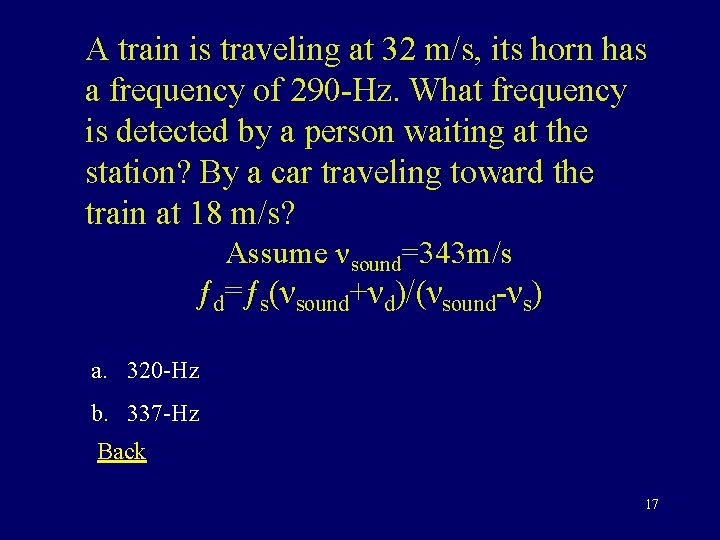
A train is traveling at 32 m/s, its horn has a frequency of 290 -Hz. What frequency is detected by a person waiting at the station? By a car traveling toward the train at 18 m/s? Assume νsound=343 m/s ƒd=ƒs(νsound+νd)/(νsound-νs) a. 320 -Hz b. 337 -Hz Back 17
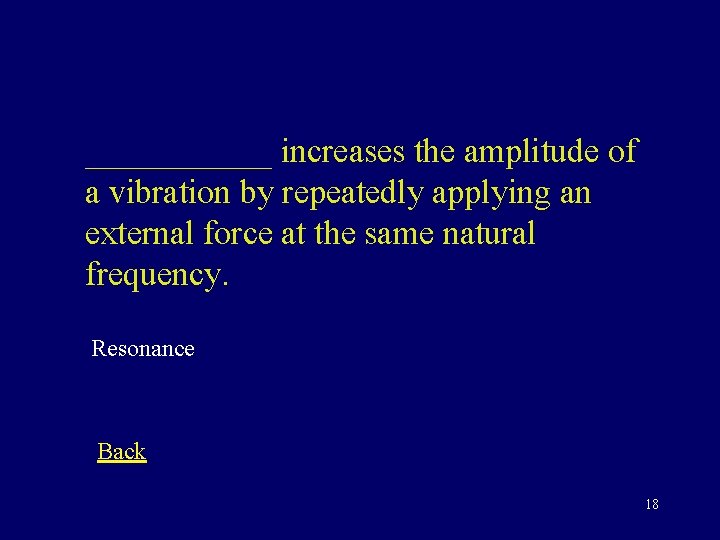
______ increases the amplitude of a vibration by repeatedly applying an external force at the same natural frequency. Resonance Back 18
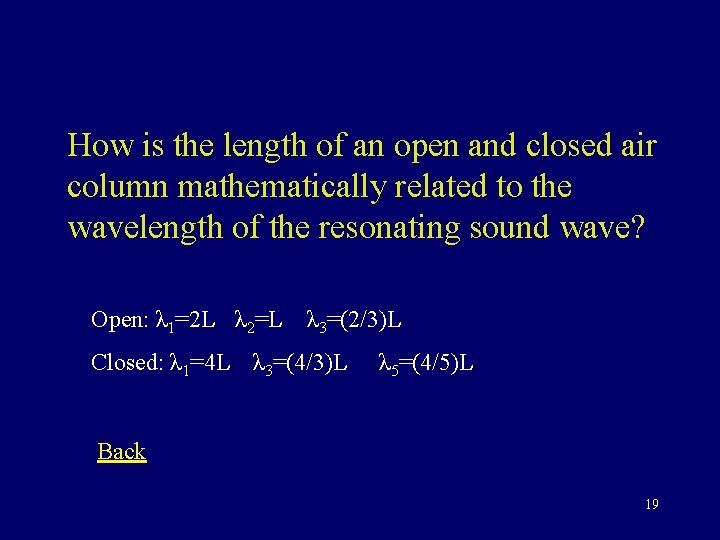
How is the length of an open and closed air column mathematically related to the wavelength of the resonating sound wave? Open: λ 1=2 L λ 2=L λ 3=(2/3)L Closed: λ 1=4 L λ 3=(4/3)L λ 5=(4/5)L Back 19
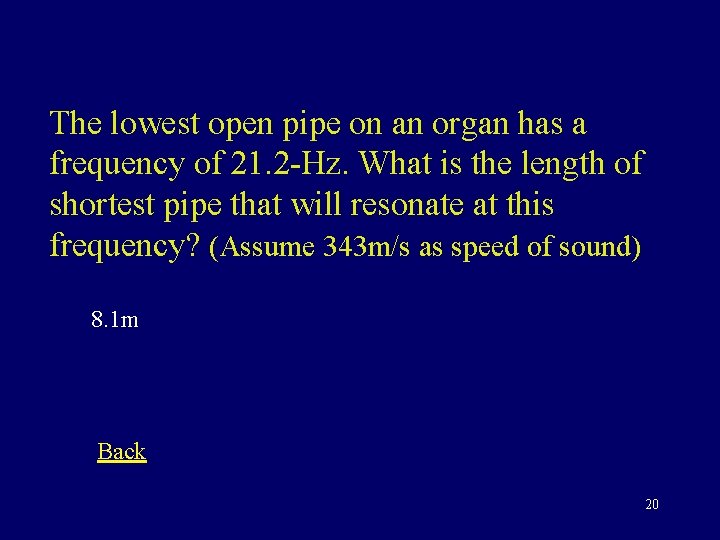
The lowest open pipe on an organ has a frequency of 21. 2 -Hz. What is the length of shortest pipe that will resonate at this frequency? (Assume 343 m/s as speed of sound) 8. 1 m Back 20
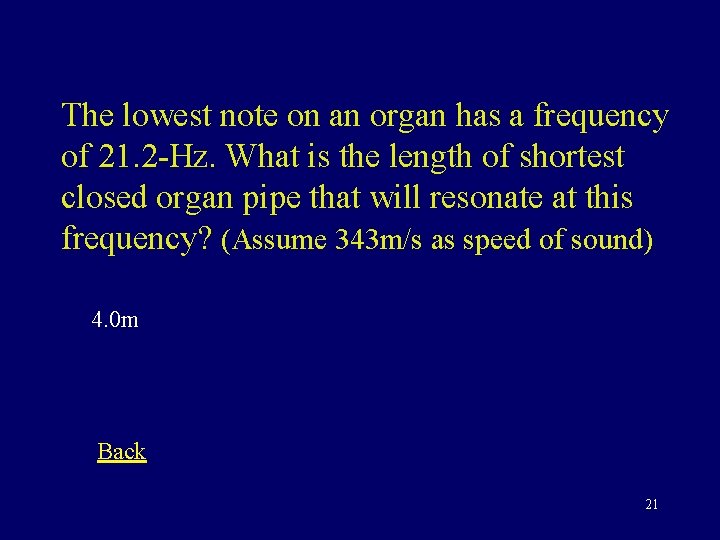
The lowest note on an organ has a frequency of 21. 2 -Hz. What is the length of shortest closed organ pipe that will resonate at this frequency? (Assume 343 m/s as speed of sound) 4. 0 m Back 21
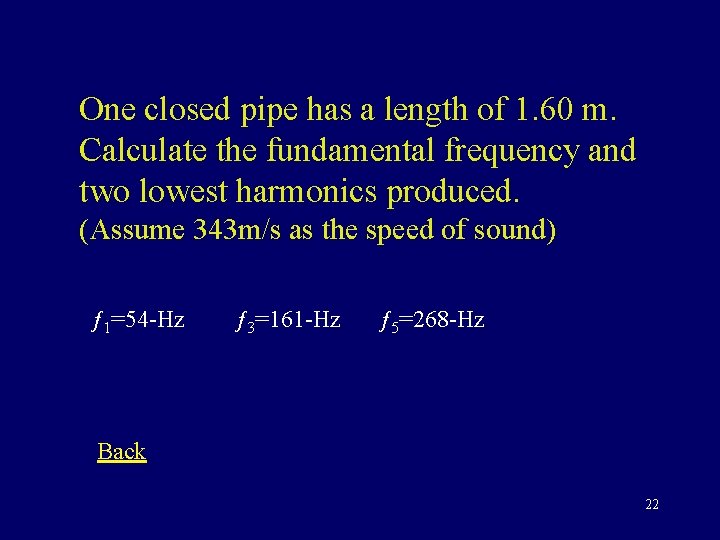
One closed pipe has a length of 1. 60 m. Calculate the fundamental frequency and two lowest harmonics produced. (Assume 343 m/s as the speed of sound) ƒ 1=54 -Hz ƒ 3=161 -Hz ƒ 5=268 -Hz Back 22
If a piano plays a note with a frequency of 76 -Hz, what frequency is the note one octave higher? 152 -Hz Back 23
A tuning fork has a frequency of 234 -Hz is played at the same time as a second tuning fork with a frequency of 242 -Hz. What is the frequency of the beat produced? 8 -Hz Back 24
Two tuning forks are played at the same time to produce a beat with a frequency of 14 -Hz. One tuning fork has a frequency of 234 -Hz, what are the possible frequencies of the second tuning fork? 248 -Hz and 220 -Hz Back 25
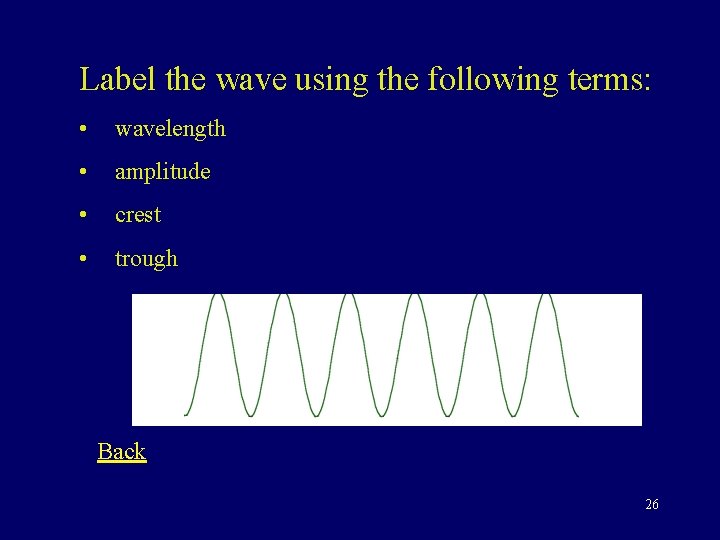
Label the wave using the following terms: • wavelength • amplitude • crest • trough Back 26
Why can’t sound waves travel in a vacuum? There are no molecules or particles in a vacuum to move and collide Back 27
Destructive and constructive interference occur when creating a beat, or superimposing two sound waves. Describe the effect each interference has on the amplitude and frequency of the generated wave. Frequency: no chance Destructive: amplitude decreases Constructive: amplitude increases Back End Game 28