
THIS IS Good Luck With Scientific Method Experiments


- Slides: 69
THIS IS
Good Luck With
Scientific Method Experiments Microscopes Labeling Microscope Life Characteristics Anything goes 100 100 100 200 200 200 300 300 300 400 400 400 500 500 500
This is the first step in the scientific method. A 100
What is asking a question? Or What is stating the problem? Etc. A 100
This should be done after asking a question. A 200
What is a do research? A 200
During the experiment, observations are made. Which type of observation does not involve numbers? A 300
What is a qualitative observation? A 300
This happens to data before forming a conclusion about the hypothesis? (Hint: In the same step) A 400
What is analyze the data? A 400
What is an “If – Then” statement relating the independent and the dependent variables? A 500
What is the hypothesis? A 500
An experiment is designed to test this. B 100
What is the hypothesis? B 100
This is the manipulated variable. B 200
What is the Independent variable? B 200
The is the responsive variable. B 300
What is the dependent variable? B 300
This is a repeated portion of an experiment. B 400
What is a trial? B 400
This sometimes referred to as a fake medicine in an experiment. B 500
What is a placebo? B 500
This word refers to how much larger the apparent size of a specimen can increase when viewed through the microscope. C 100
What is magnification? C 100
This refers to a microscope’s ability to show clarity of details. C 200
What is resolution? C 200
This decreases as total magnification increases. C 300
What is field of view? C 300
DAILY DOUBLE C 400
This is the ability to focus through layers. C 400
What is depth of field? C 400
This means that if focused under the scanning lens, the image will also be focused when switched to the low power lens. C 500
What is parafocal? C 500
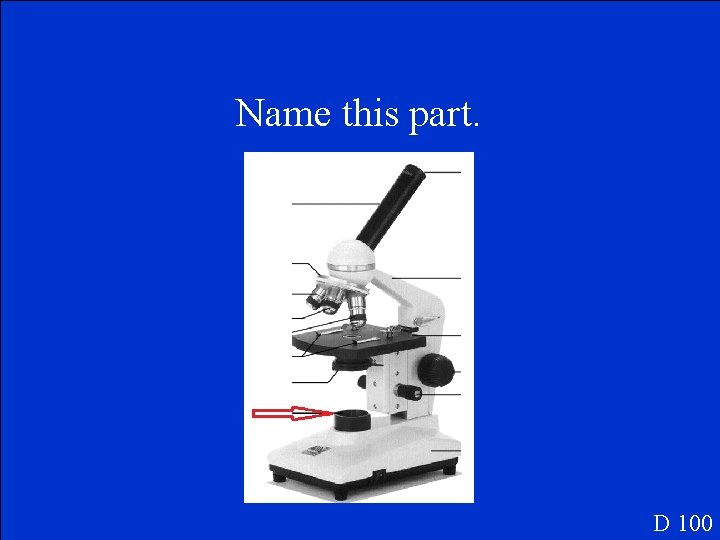
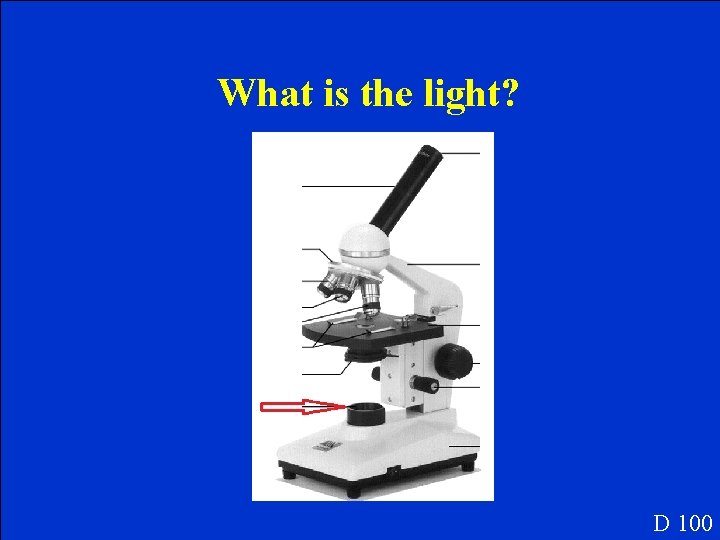
Name this part. D 100
What is the light? D 100
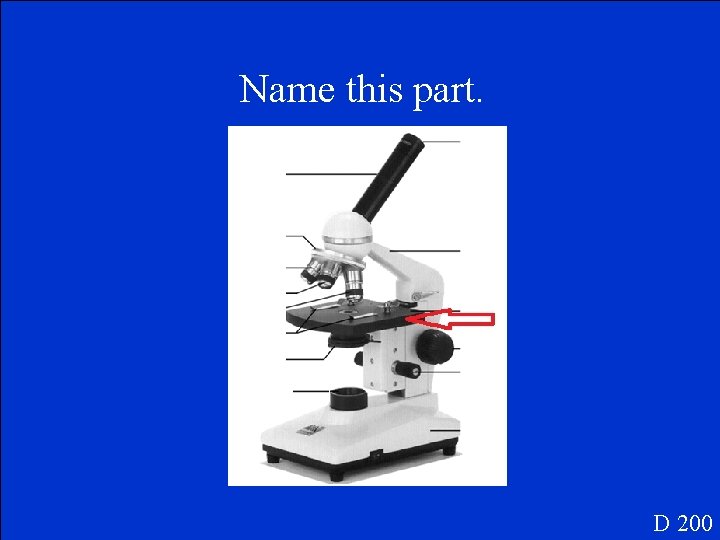
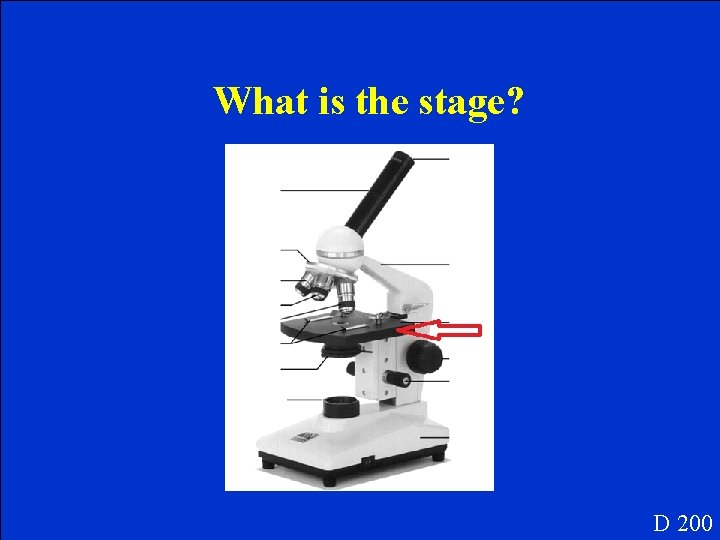
Name this part. D 200
What is the stage? D 200
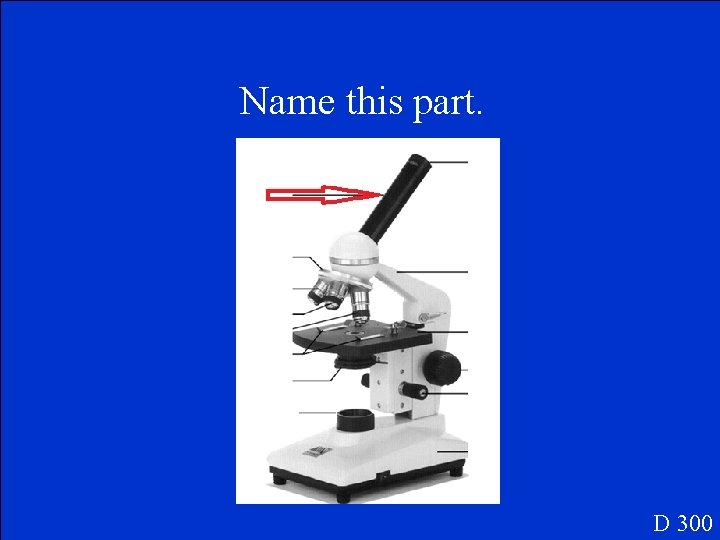
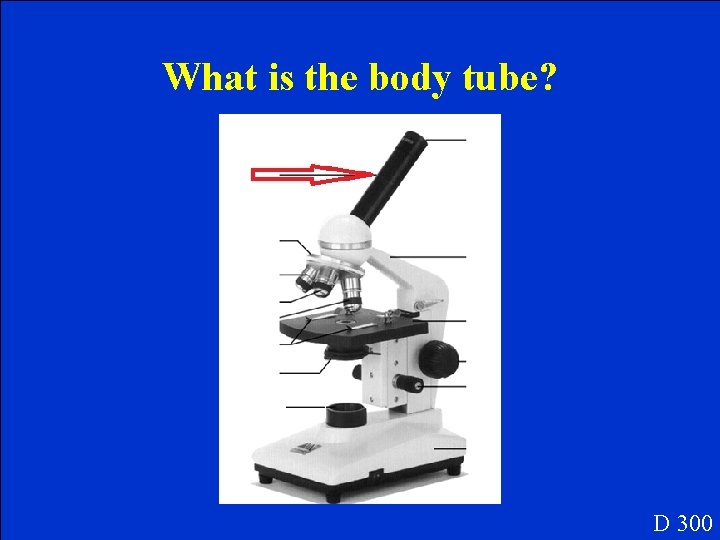
Name this part. D 300
What is the body tube? D 300
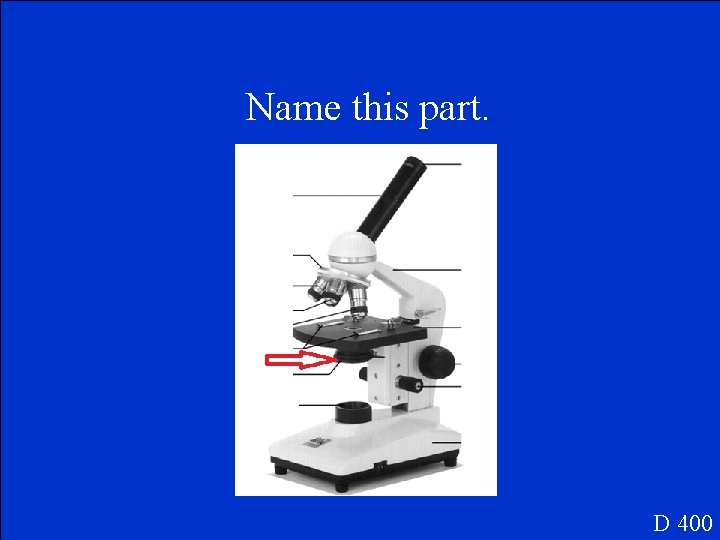
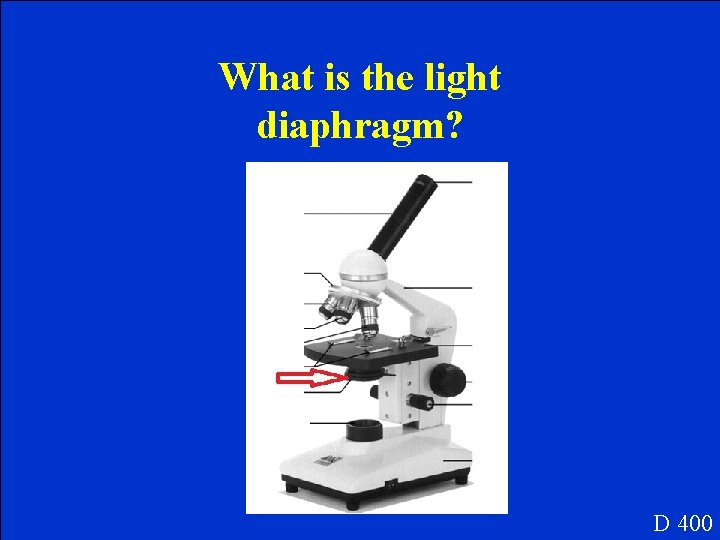
Name this part. D 400
What is the light diaphragm? D 400
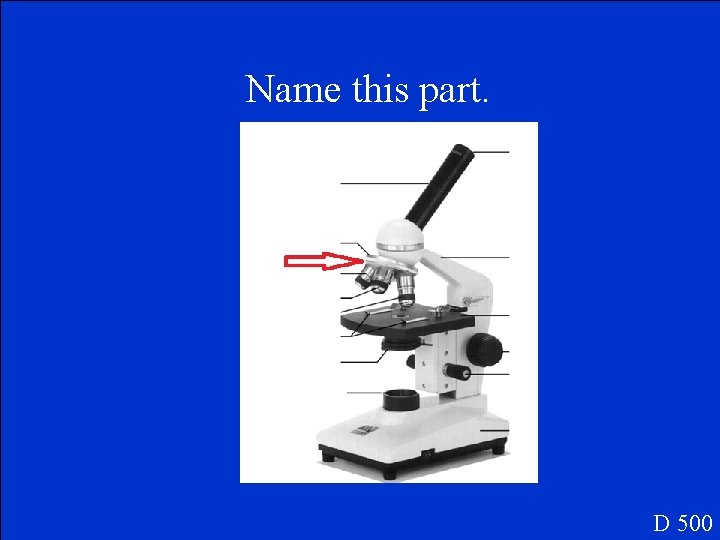
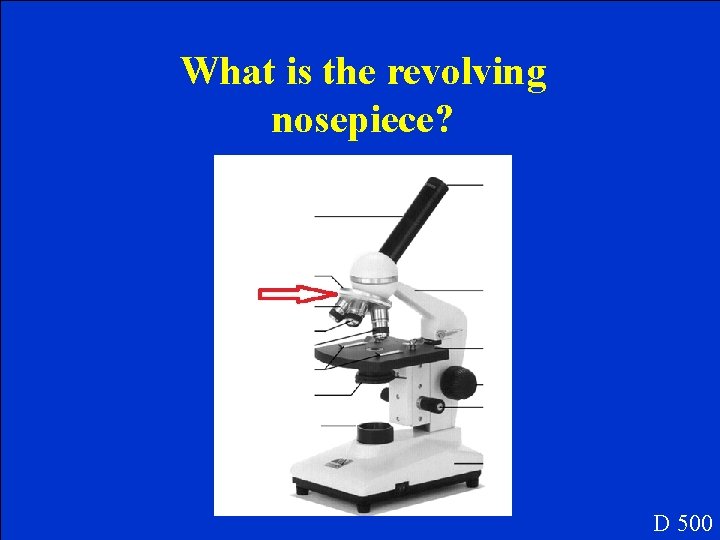
Name this part. D 500
What is the revolving nosepiece? D 500
This is the correct statement about cells and living organisms. E 100
What is : “Living things are made up of one or more cells. ” E 100
Living things grow and _______. E 200
What is develop? E 200
Living things ____? ____ to their environment. E 300
What is respond? E 300
This word refers to the maintenance of a stable internal environment. E 400
What is homeostasis? E 400
A cell that becomes specialized is said to be d_____? _______. E 500
What is differentiated? E 500
The “Father of Microscopy” F 100
Who was Anton van Leuwenhoek? F 100
This is the procedure to calculate total magnification. F 200
What is multiple eyepiece (ocular) magnification by the objective magnification? F 200
This is the electron microscope that produces a two-dimensional image. F 300
What is the transmission electron microscope (TEM)? F 300
This is a broad comprehensive statement, supported by many facts & , experimentation, and may tie together several hypotheses. F 400
What is a Theory? F 400
This is why an electron microscope can view smaller things than a light microscope. F 500
What is the electron beam it uses can reflect from much smaller things than a wavelength of light? F 500
The Final Jeopardy Category is: The Discovery of Penicillin. Please record your wager. Click on screen to begin
Fleming’s bacterial dish was contaminated with mold spores from the laboratory one floor below his lab. The scientists in that lab were studying fungi. The name of “the study of fungi” is called m_____. Click on screen to continue
What is mycology? Click on screen to continue
Thank You for Playing Jeopardy! Game Designed By C. Harr-MAIT