
This is due at the end of class
- Slides: 44
This is due at the end of class o Warm up question: List the 4 layers of the atmosphere and explain the differences Exit: What is reflection 10/2/2020 describe the layers of the atmosphere
Essential Question Explain how radiant energy reaches the earth. Homework Read pages 455 -462 : answer questions on page 462 Vocabulary page 474 ; define and give one fact Read page 463 -468 ; answer questions on page 468 Study for vocabulary quiz on Friday 10/2/2020 describe the layers of the atmosphere
Chapter 23 standards n n Energy enters the Earth system primarily as solar radiation and eventually escapes as heat. As a basis for understanding this concept: Heating of Earth's surface and atmosphere by the sun drives convection within the atmosphere and oceans, producing winds and ocean currents. As a basis for understanding this concept: Climate is the long-term average of a region's weather and depends on many factors. As a basis for understanding this concept: Life has changed Earth's atmosphere, and changes in the atmosphere affect conditions for life. As a basis for understanding this concept: 10/2/2020 describe the layers of the atmosphere
Chapter 23 Section 1 notes o Characteristics of the Atmosphere ; page 455 o o 10/2/2020 Atmosphere is a layer of gases and particles that surround the earth. Meteorologist – study climate and weather describe the layers of the atmosphere
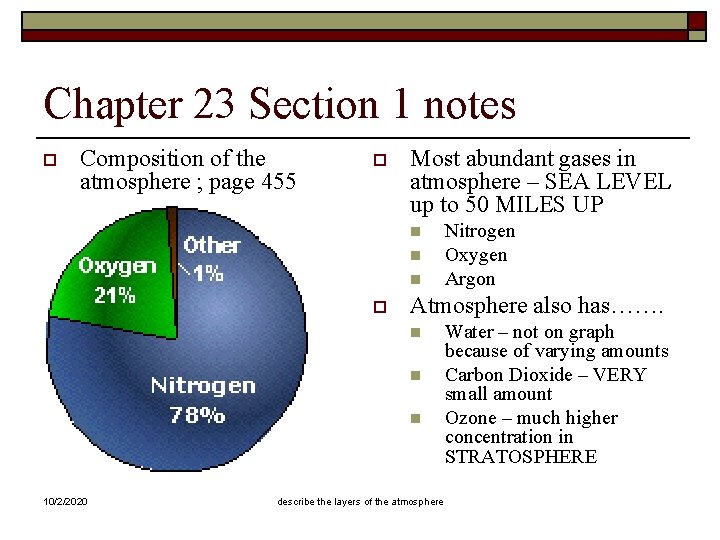
Chapter 23 Section 1 notes o Composition of the atmosphere ; page 455 o Most abundant gases in atmosphere – SEA LEVEL up to 50 MILES UP n n n o Atmosphere also has……. n n n 10/2/2020 Nitrogen Oxygen Argon describe the layers of the atmosphere Water – not on graph because of varying amounts Carbon Dioxide – VERY small amount Ozone – much higher concentration in STRATOSPHERE
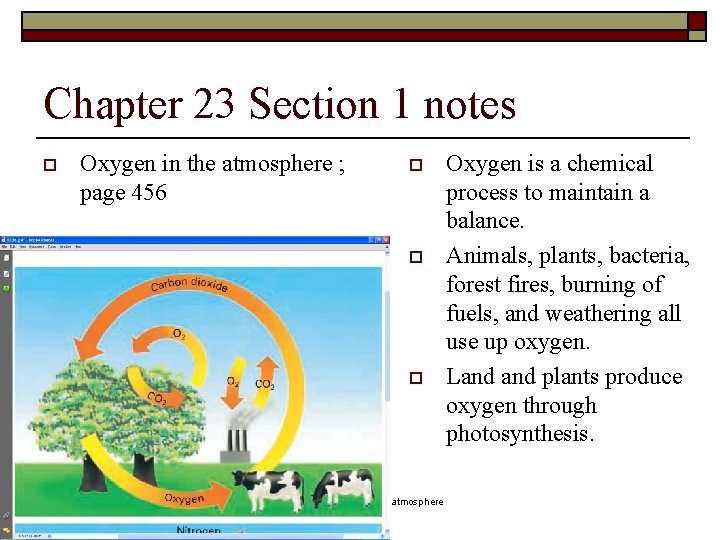
Chapter 23 Section 1 notes o Oxygen in the atmosphere ; page 456 o o o 10/2/2020 describe the layers of the atmosphere Oxygen is a chemical process to maintain a balance. Animals, plants, bacteria, forest fires, burning of fuels, and weathering all use up oxygen. Land plants produce oxygen through photosynthesis.
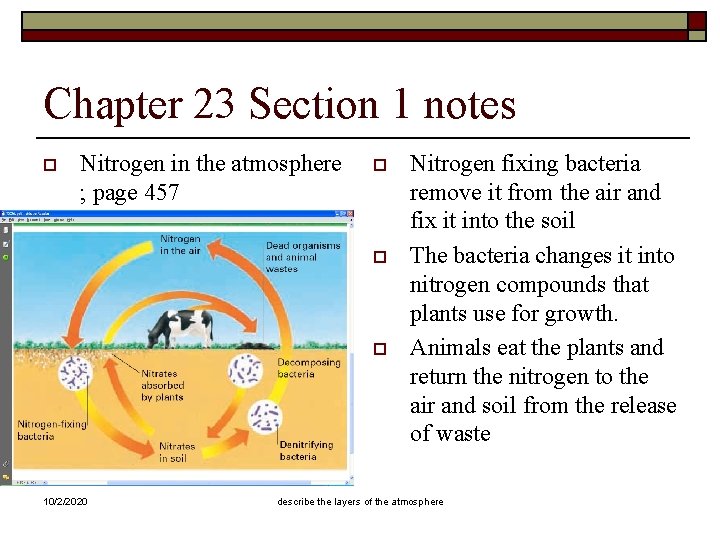
Chapter 23 Section 1 notes o Nitrogen in the atmosphere ; page 457 o o o 10/2/2020 Nitrogen fixing bacteria remove it from the air and fix it into the soil The bacteria changes it into nitrogen compounds that plants use for growth. Animals eat the plants and return the nitrogen to the air and soil from the release of waste describe the layers of the atmosphere
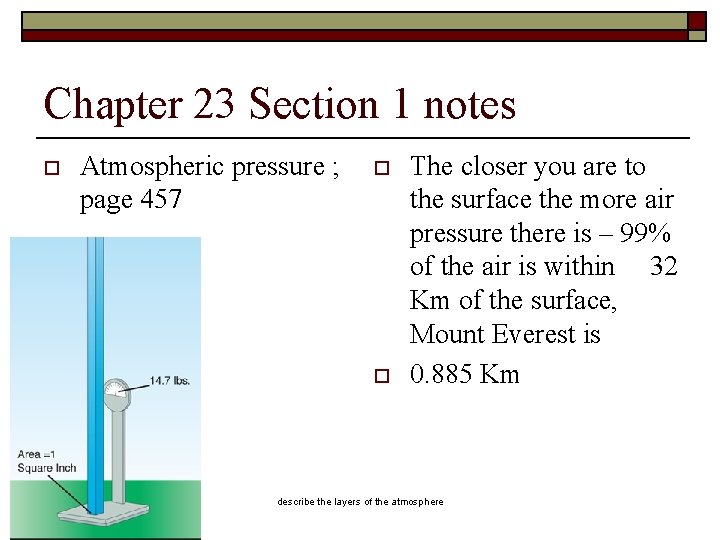
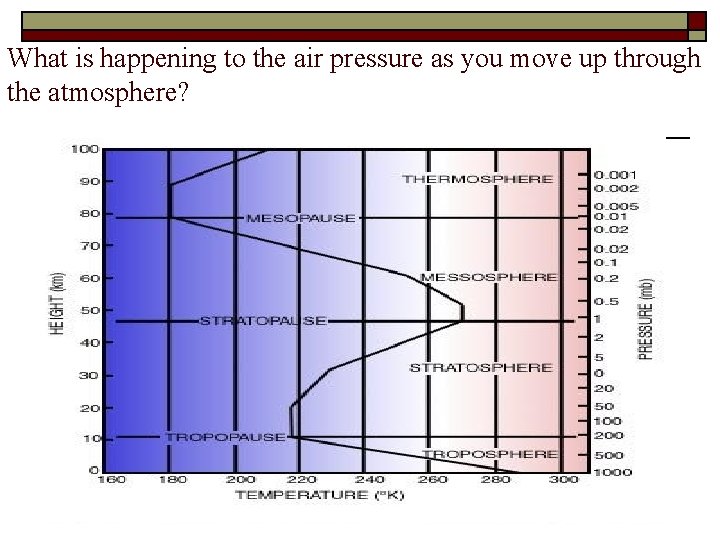
Chapter 23 Section 1 notes o Atmospheric pressure ; page 457 o o 10/2/2020 The closer you are to the surface the more air pressure there is – 99% of the air is within 32 Km of the surface, Mount Everest is 0. 885 Km describe the layers of the atmosphere
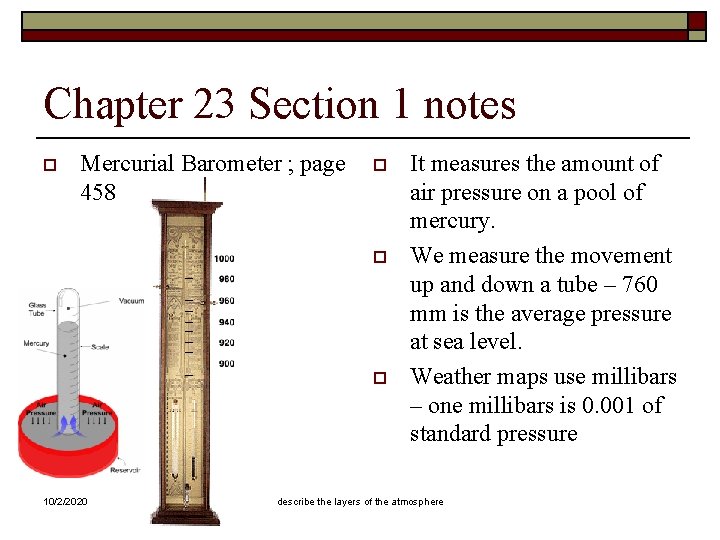
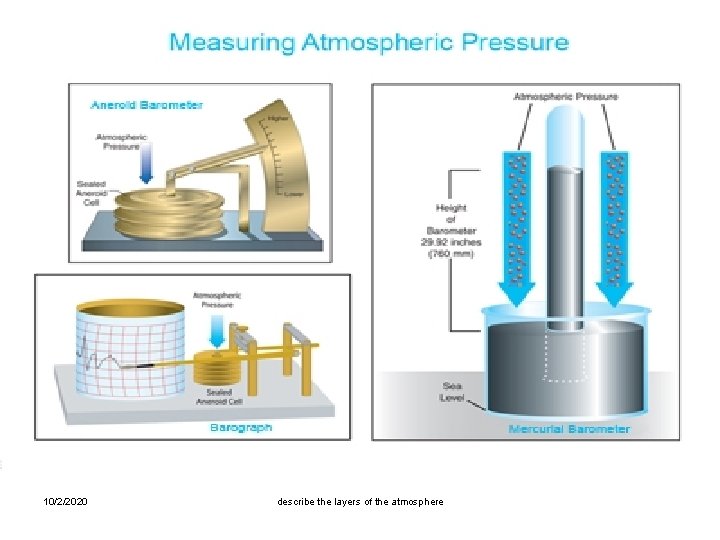
Chapter 23 Section 1 notes o Mercurial Barometer ; page 458 o o o 10/2/2020 It measures the amount of air pressure on a pool of mercury. We measure the movement up and down a tube – 760 mm is the average pressure at sea level. Weather maps use millibars – one millibars is 0. 001 of standard pressure describe the layers of the atmosphere
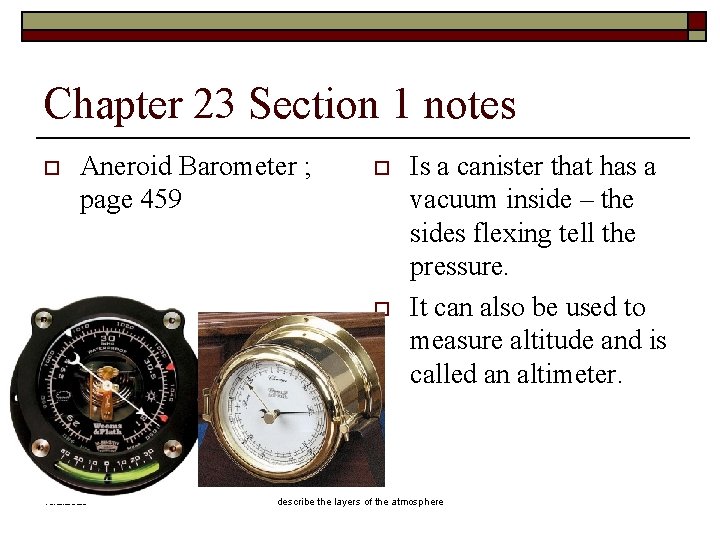
Chapter 23 Section 1 notes o Aneroid Barometer ; page 459 o o 10/2/2020 Is a canister that has a vacuum inside – the sides flexing tell the pressure. It can also be used to measure altitude and is called an altimeter. describe the layers of the atmosphere
10/2/2020 describe the layers of the atmosphere
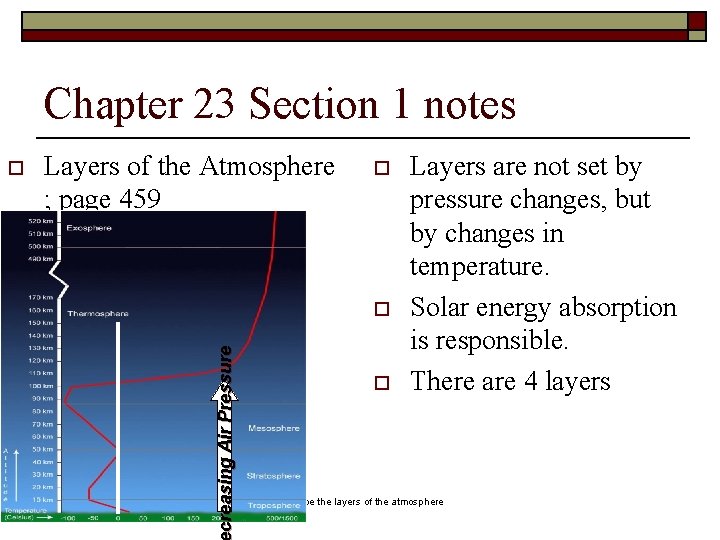
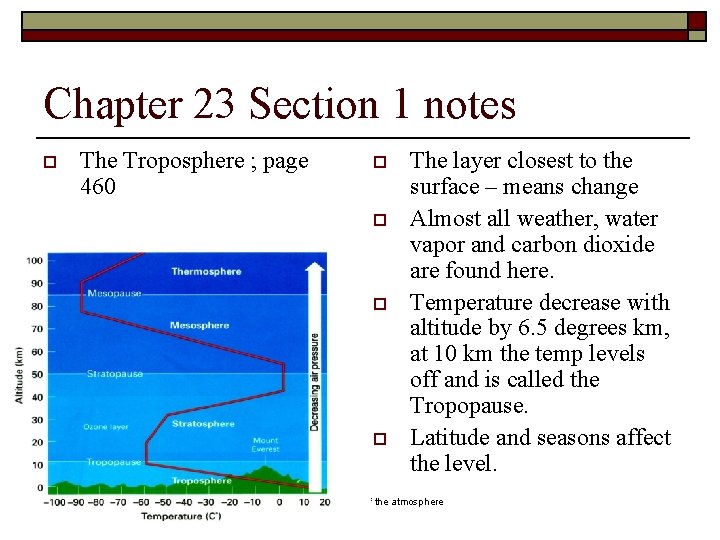
Chapter 23 Section 1 notes Layers of the Atmosphere ; page 459 o o 10/2/2020 creasi n g Ai r P ressu re o o Layers are not set by pressure changes, but by changes in temperature. Solar energy absorption is responsible. There are 4 layers describe the layers of the atmosphere
Chapter 23 Section 1 notes o The Troposphere ; page 460 o o 10/2/2020 The layer closest to the surface – means change Almost all weather, water vapor and carbon dioxide are found here. Temperature decrease with altitude by 6. 5 degrees km, at 10 km the temp levels off and is called the Tropopause. Latitude and seasons affect the level. describe the layers of the atmosphere
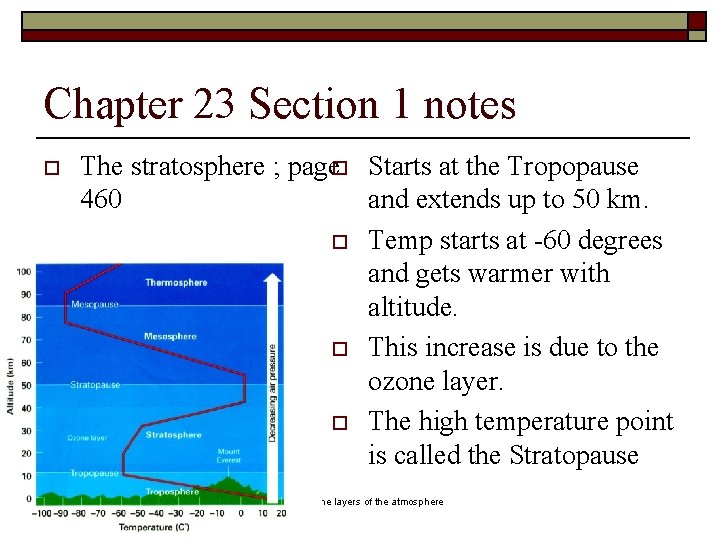
Chapter 23 Section 1 notes o The stratosphere ; pageo Starts at the Tropopause 460 and extends up to 50 km. o Temp starts at -60 degrees and gets warmer with altitude. o This increase is due to the ozone layer. o The high temperature point is called the Stratopause 10/2/2020 describe the layers of the atmosphere
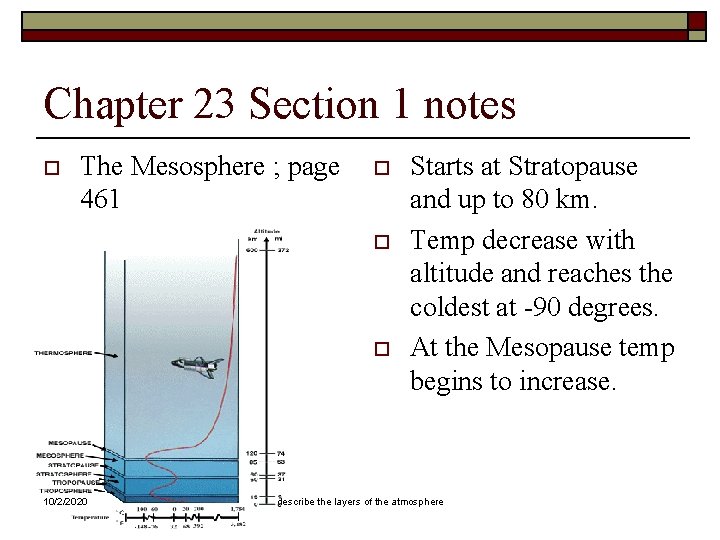
Chapter 23 Section 1 notes o The Mesosphere ; page 461 o o o 10/2/2020 Starts at Stratopause and up to 80 km. Temp decrease with altitude and reaches the coldest at -90 degrees. At the Mesopause temp begins to increase. describe the layers of the atmosphere
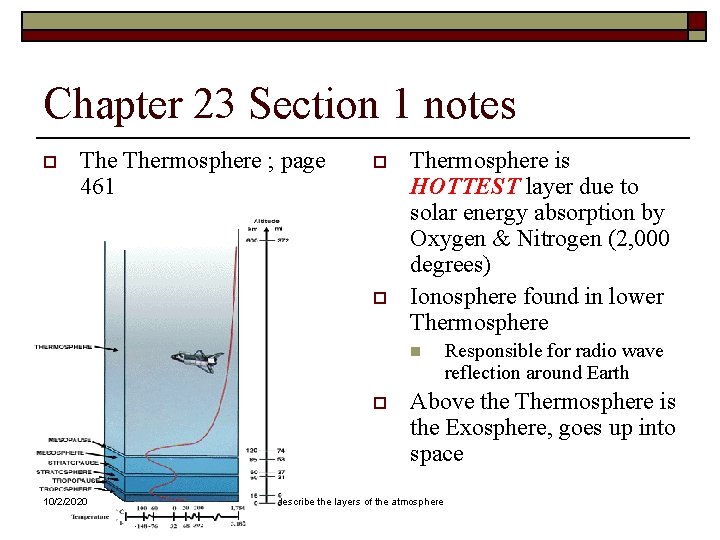
Chapter 23 Section 1 notes o Thermosphere ; page 461 o o Thermosphere is HOTTEST layer due to solar energy absorption by Oxygen & Nitrogen (2, 000 degrees) Ionosphere found in lower Thermosphere n o 10/2/2020 Responsible for radio wave reflection around Earth Above the Thermosphere is the Exosphere, goes up into space describe the layers of the atmosphere
What is happening to the air pressure as you move up through the atmosphere? 10/2/2020 describe the layers of the atmosphere
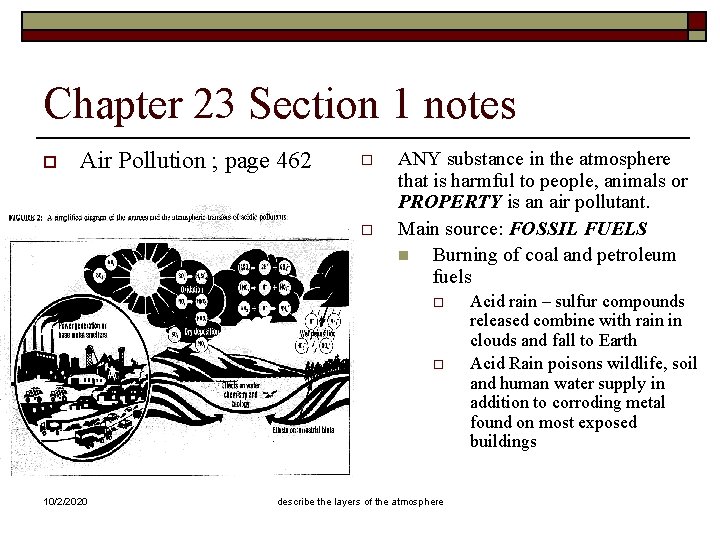
Chapter 23 Section 1 notes o Air Pollution ; page 462 o o ANY substance in the atmosphere that is harmful to people, animals or PROPERTY is an air pollutant. Main source: FOSSIL FUELS n Burning of coal and petroleum fuels o o 10/2/2020 describe the layers of the atmosphere Acid rain – sulfur compounds released combine with rain in clouds and fall to Earth Acid Rain poisons wildlife, soil and human water supply in addition to corroding metal found on most exposed buildings
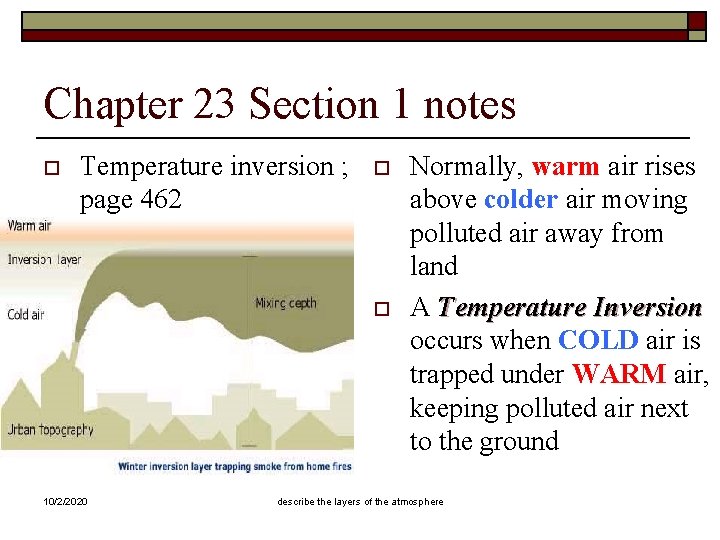
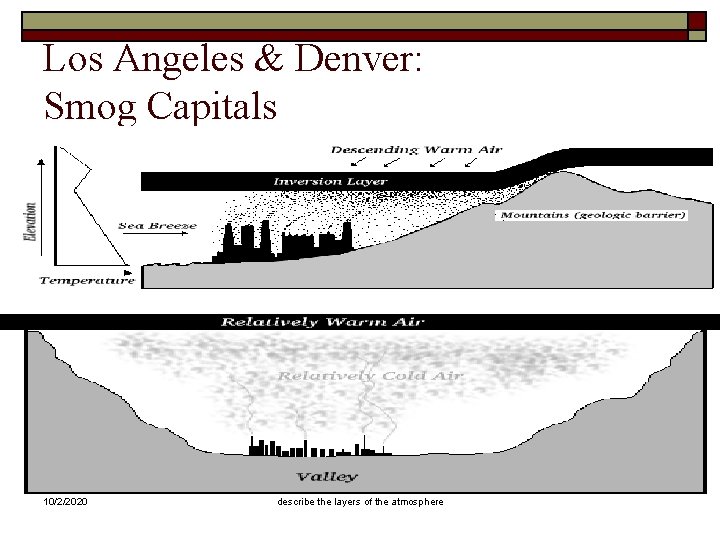
Chapter 23 Section 1 notes o Temperature inversion ; page 462 o o 10/2/2020 Normally, warm air rises above colder air moving polluted air away from land A Temperature Inversion occurs when COLD air is trapped under WARM air, keeping polluted air next to the ground describe the layers of the atmosphere
Los Angeles & Denver: Smog Capitals 10/2/2020 describe the layers of the atmosphere
Chapter 23 Section 2 notes o Solar Energy and the Atmosphere o o 10/2/2020 The earth is heated by energy being absorbed by certain gases in the atmosphere. It is also heated by radiated heat from the oceans and land describe the layers of the atmosphere
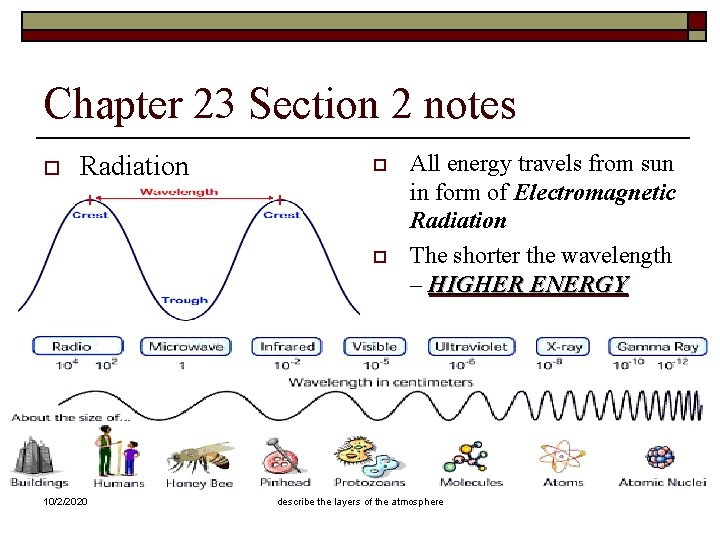
Chapter 23 Section 2 notes o Radiation o o 10/2/2020 All energy travels from sun in form of Electromagnetic Radiation The shorter the wavelength – HIGHER ENERGY describe the layers of the atmosphere
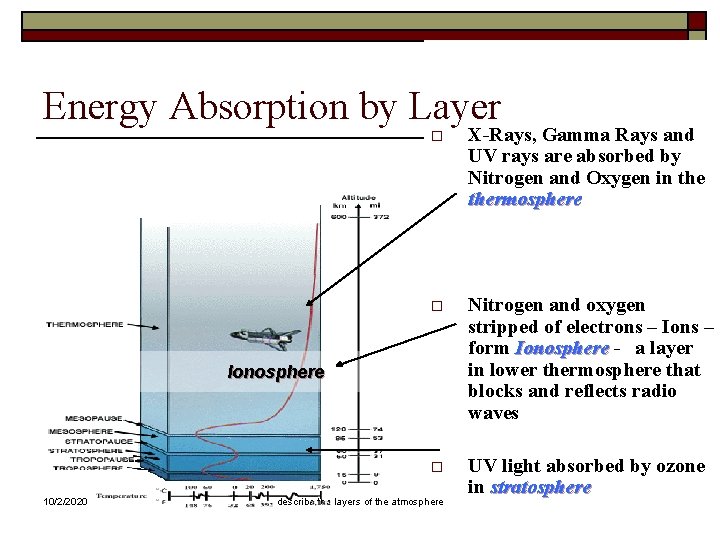
Energy Absorption by Layer o X-Rays, Gamma Rays and UV rays are absorbed by Nitrogen and Oxygen in thermosphere o Nitrogen and oxygen stripped of electrons – Ions – form Ionosphere - a layer in lower thermosphere that blocks and reflects radio waves o UV light absorbed by ozone in stratosphere Ionosphere 10/2/2020 describe the layers of the atmosphere
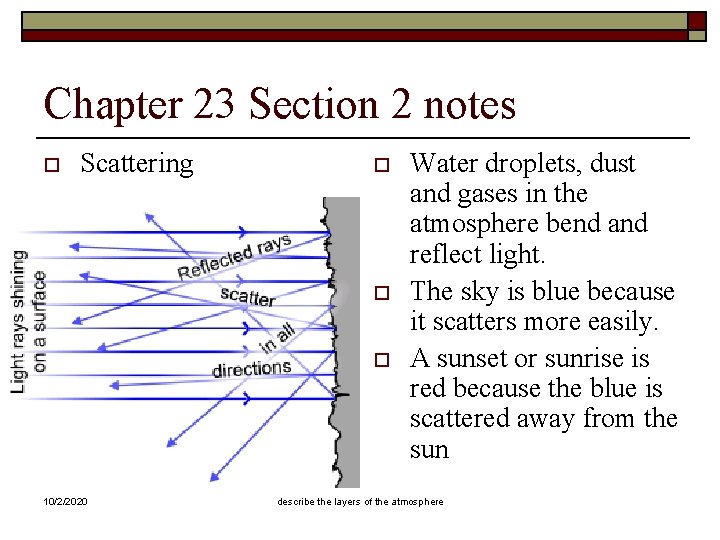
Chapter 23 Section 2 notes o Scattering o o o 10/2/2020 Water droplets, dust and gases in the atmosphere bend and reflect light. The sky is blue because it scatters more easily. A sunset or sunrise is red because the blue is scattered away from the sun describe the layers of the atmosphere
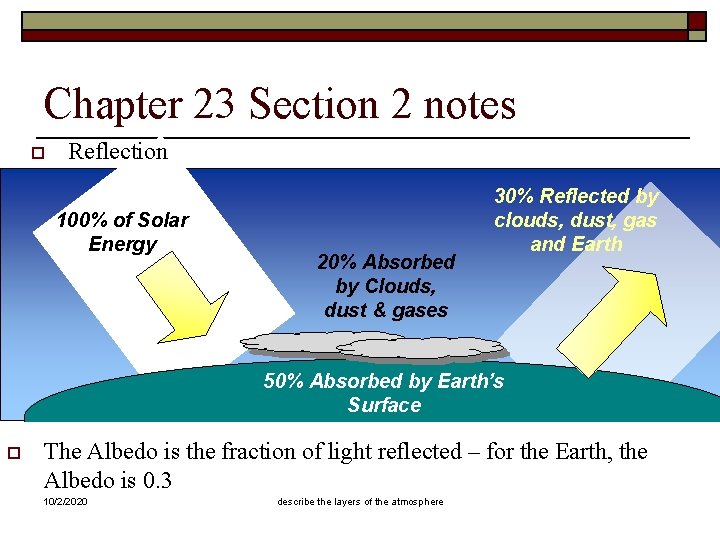
Chapter 23 Section 2 notes o Reflection 100% of Solar Energy 20% Absorbed by Clouds, dust & gases 30% Reflected by clouds, dust, gas and Earth 50% Absorbed by Earth’s Surface o Oceans The Albedo is the fraction of. Land light&reflected – for the Earth, the Albedo is 0. 3 10/2/2020 describe the layers of the atmosphere
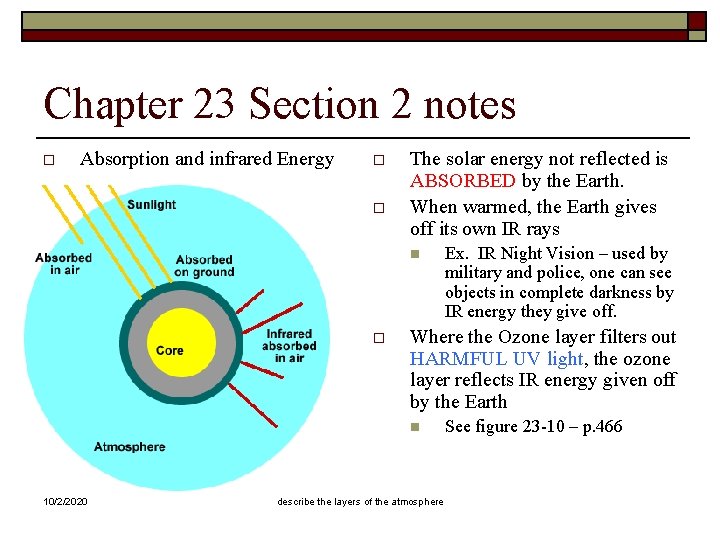
Chapter 23 Section 2 notes o Absorption and infrared Energy o o The solar energy not reflected is ABSORBED by the Earth. When warmed, the Earth gives off its own IR rays n o Where the Ozone layer filters out HARMFUL UV light, the ozone layer reflects IR energy given off by the Earth n 10/2/2020 Ex. IR Night Vision – used by military and police, one can see objects in complete darkness by IR energy they give off. describe the layers of the atmosphere See figure 23 -10 – p. 466
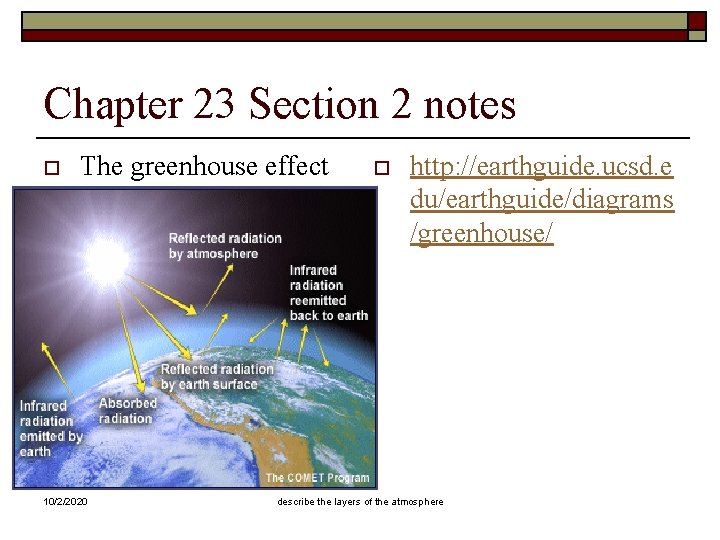
Chapter 23 Section 2 notes o The greenhouse effect 10/2/2020 o http: //earthguide. ucsd. e du/earthguide/diagrams /greenhouse/ describe the layers of the atmosphere
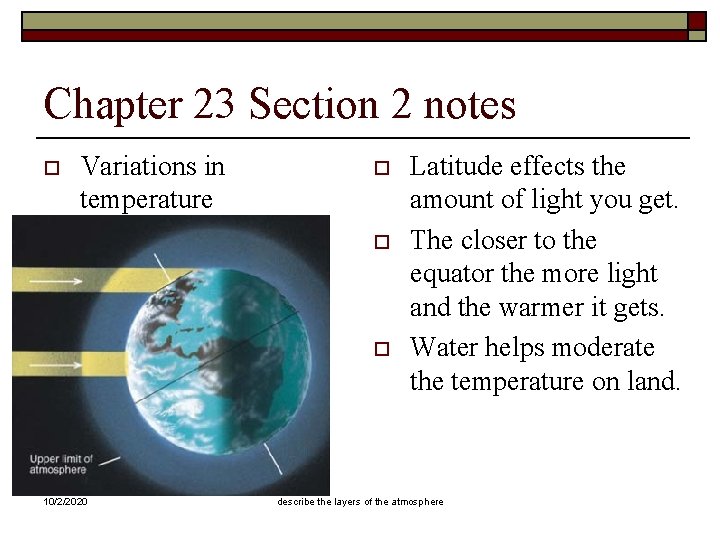
Chapter 23 Section 2 notes o Variations in temperature o o o 10/2/2020 Latitude effects the amount of light you get. The closer to the equator the more light and the warmer it gets. Water helps moderate the temperature on land. describe the layers of the atmosphere
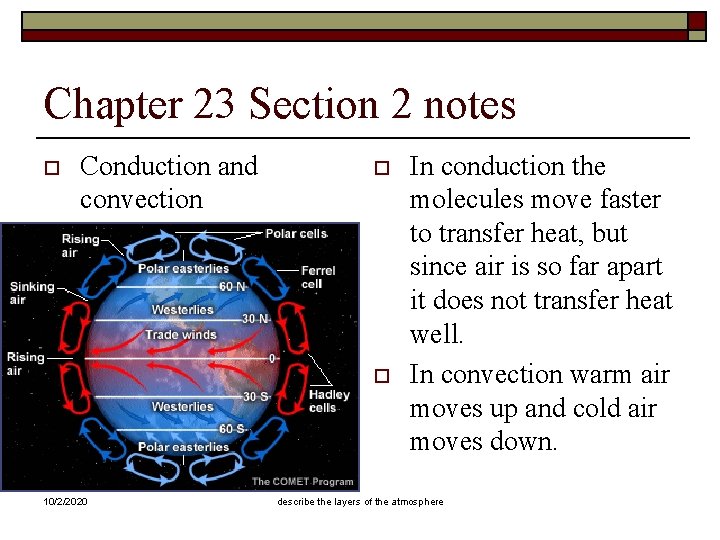
Chapter 23 Section 2 notes o Conduction and convection o o 10/2/2020 In conduction the molecules move faster to transfer heat, but since air is so far apart it does not transfer heat well. In convection warm air moves up and cold air moves down. describe the layers of the atmosphere
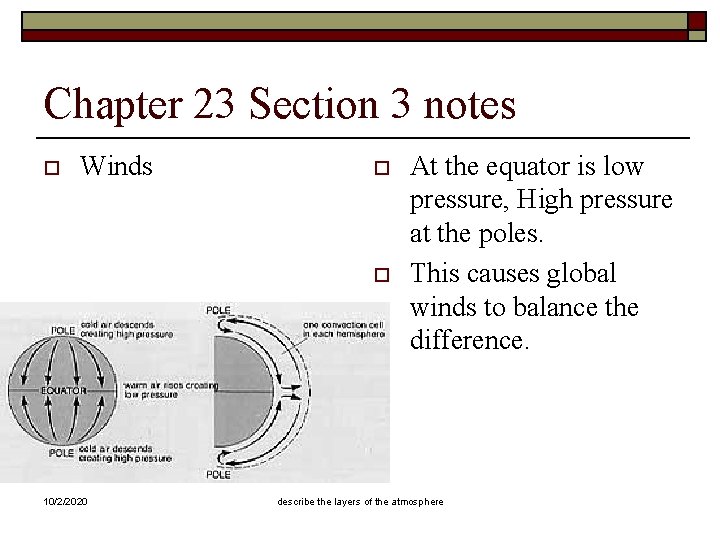
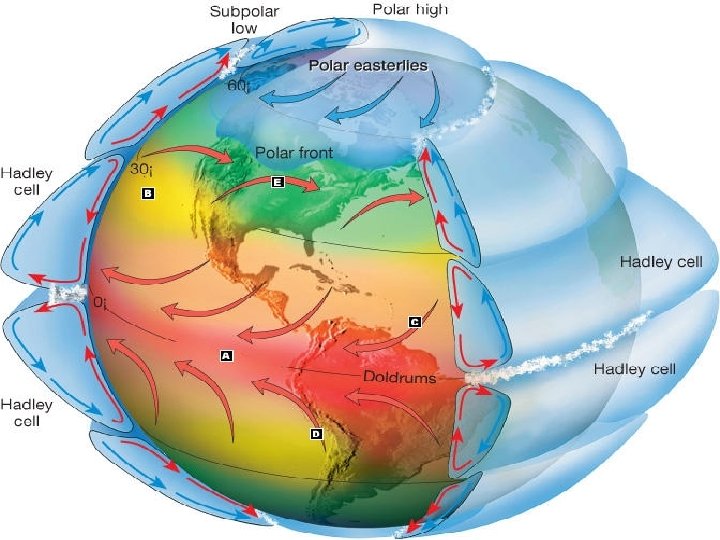
Chapter 23 Section 3 notes o Winds o o 10/2/2020 At the equator is low pressure, High pressure at the poles. This causes global winds to balance the difference. describe the layers of the atmosphere
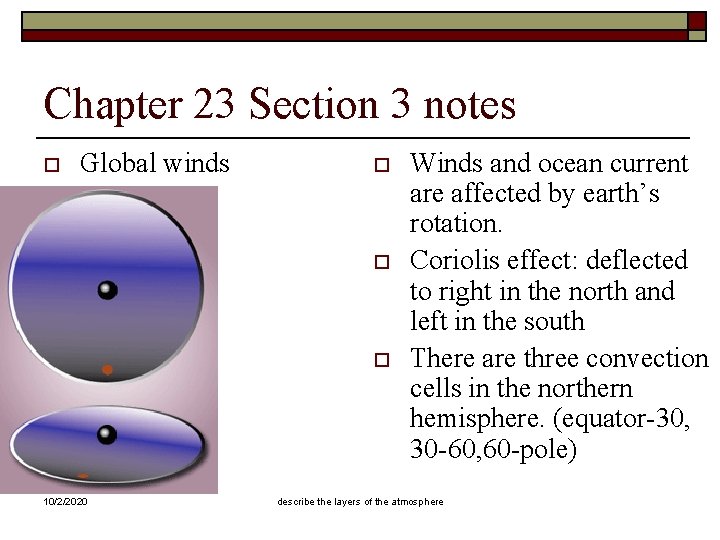
Chapter 23 Section 3 notes o Global winds o o o 10/2/2020 Winds and ocean current are affected by earth’s rotation. Coriolis effect: deflected to right in the north and left in the south There are three convection cells in the northern hemisphere. (equator-30, 30 -60, 60 -pole) describe the layers of the atmosphere
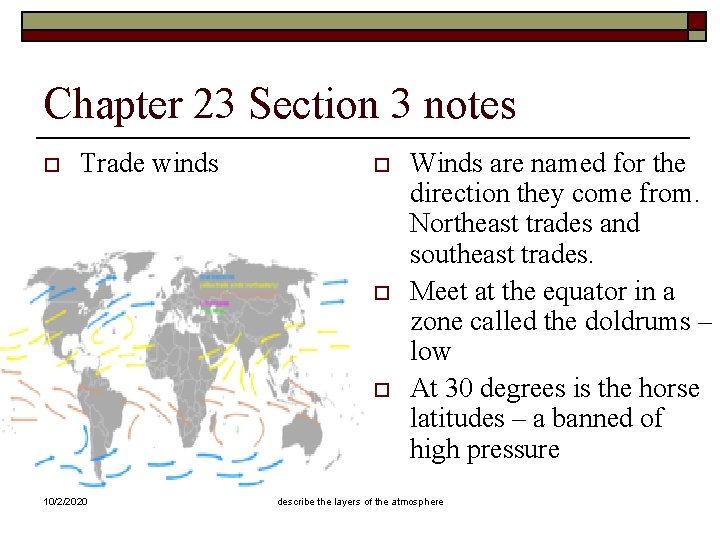
Chapter 23 Section 3 notes o Trade winds o o o 10/2/2020 Winds are named for the direction they come from. Northeast trades and southeast trades. Meet at the equator in a zone called the doldrums – low At 30 degrees is the horse latitudes – a banned of high pressure describe the layers of the atmosphere
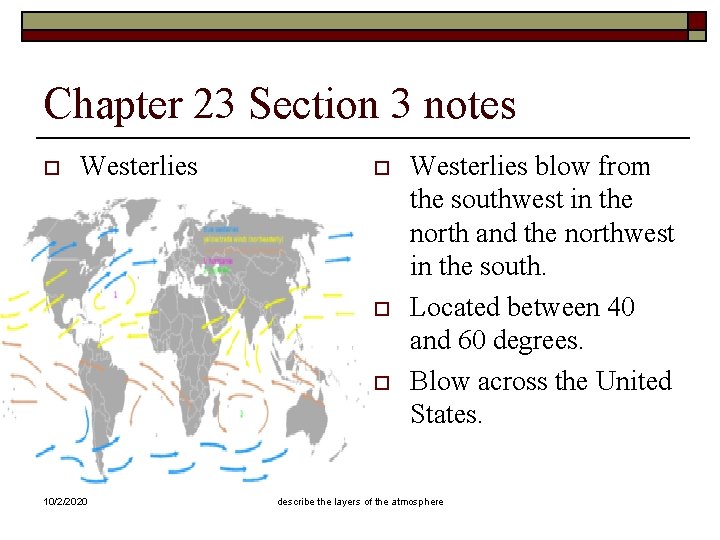
Chapter 23 Section 3 notes o Westerlies o o o 10/2/2020 Westerlies blow from the southwest in the north and the northwest in the south. Located between 40 and 60 degrees. Blow across the United States. describe the layers of the atmosphere
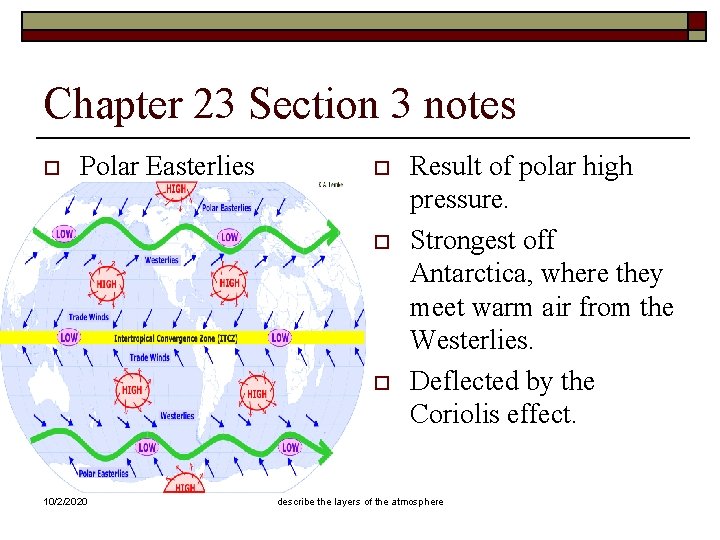
Chapter 23 Section 3 notes o Polar Easterlies o o o 10/2/2020 Result of polar high pressure. Strongest off Antarctica, where they meet warm air from the Westerlies. Deflected by the Coriolis effect. describe the layers of the atmosphere
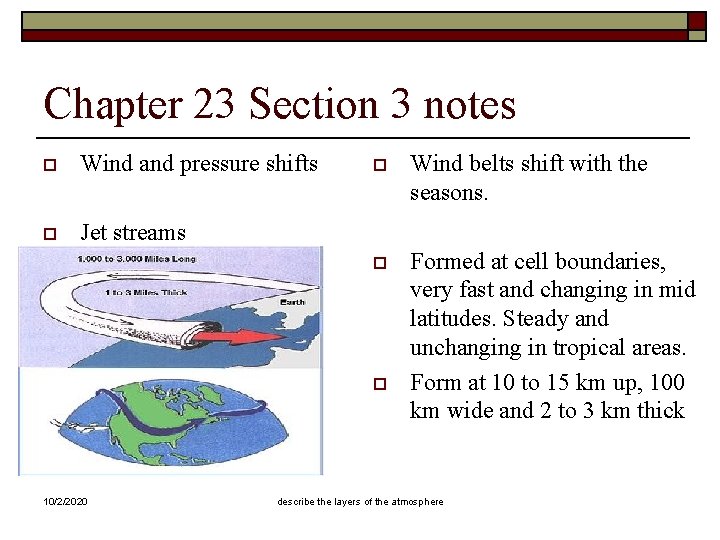
Chapter 23 Section 3 notes o Wind and pressure shifts o Jet streams o Wind belts shift with the seasons. o Formed at cell boundaries, very fast and changing in mid latitudes. Steady and unchanging in tropical areas. Form at 10 to 15 km up, 100 km wide and 2 to 3 km thick o 10/2/2020 describe the layers of the atmosphere
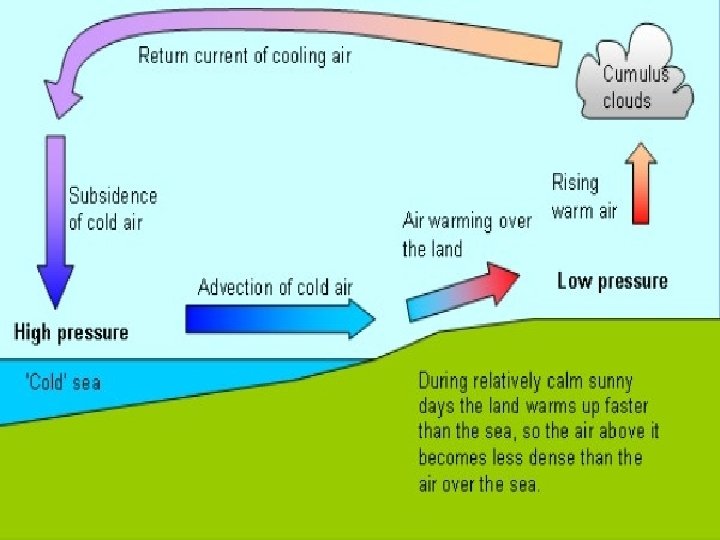
Chapter 23 Section 3 notes o Local Winds o Cover a distance of less then 100 km or breezes. o Land sea breezes o Uneven heating of land water cause breezes to form, inland during the day and out to sea at night. 10/2/2020 describe the layers of the atmosphere
10/2/2020 describe the layers of the atmosphere
Chapter 23 Section 3 notes o Mountain and Valley breezes 10/2/2020 o Warm valley air moves up the mountains during the day, the mountain air cools faster after sunset and descends back into the valley. describe the layers of the atmosphere
10/2/2020 describe the layers of the atmosphere
Chapter 23 extra credit opportunities Write questions and answers out completely. 1. 2. 10/2/2020 Pages 474 – 475 Review questions 1 – 12 describe the layers of the atmosphere
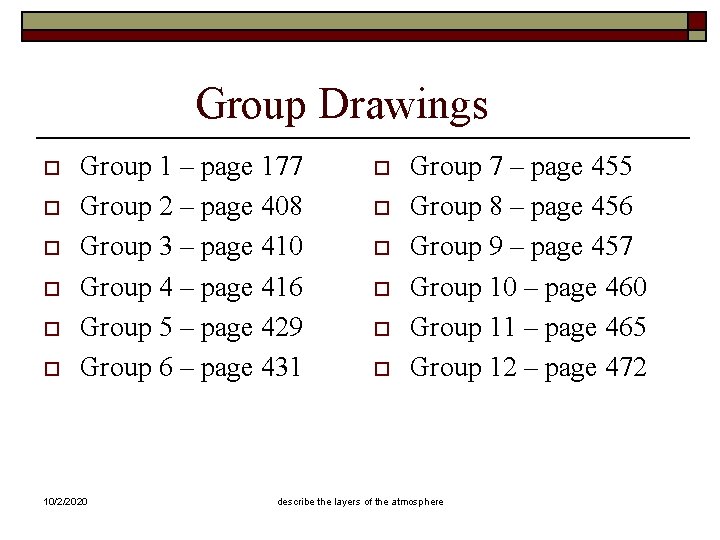
Group Drawings o o o Group 1 – page 177 Group 2 – page 408 Group 3 – page 410 Group 4 – page 416 Group 5 – page 429 Group 6 – page 431 10/2/2020 o o o Group 7 – page 455 Group 8 – page 456 Group 9 – page 457 Group 10 – page 460 Group 11 – page 465 Group 12 – page 472 describe the layers of the atmosphere
How to phrase your statement o I believe the ______ will ______. 10/2/2020 describe the layers of the atmosphere
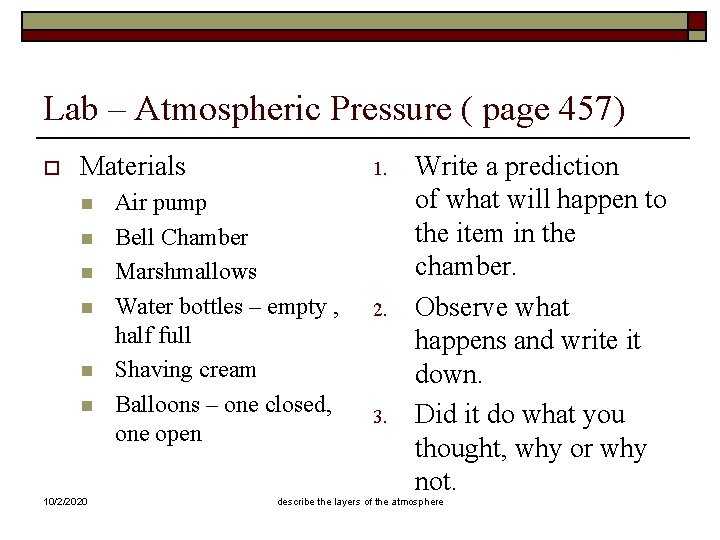
Lab – Atmospheric Pressure ( page 457) o Materials n n n 10/2/2020 1. Air pump Bell Chamber Marshmallows Water bottles – empty , half full Shaving cream Balloons – one closed, one open 2. 3. Write a prediction of what will happen to the item in the chamber. Observe what happens and write it down. Did it do what you thought, why or why not. describe the layers of the atmosphere
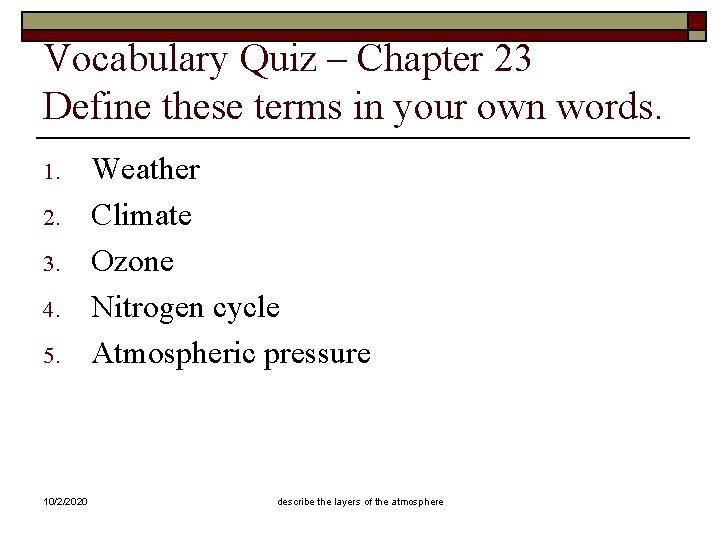
Vocabulary Quiz – Chapter 23 Define these terms in your own words. 1. 2. 3. 4. 5. 10/2/2020 Weather Climate Ozone Nitrogen cycle Atmospheric pressure describe the layers of the atmosphere