
This is an archived document Treatment of Latent
- Slides: 12
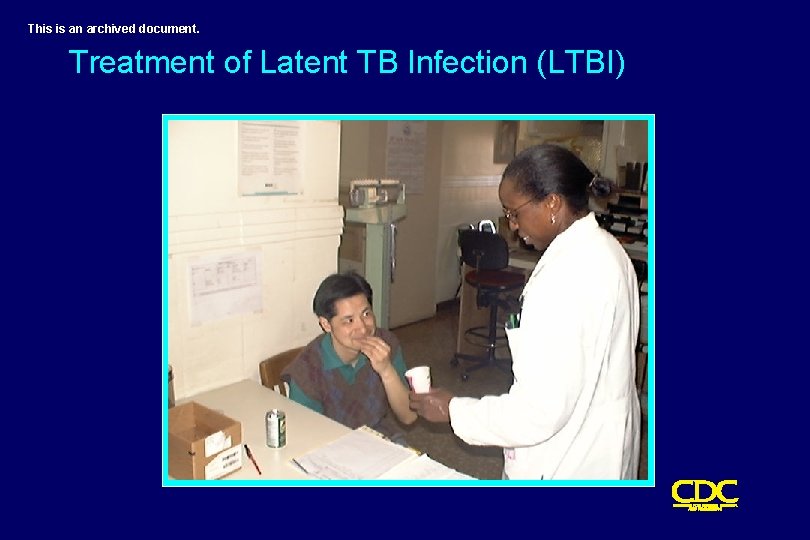
This is an archived document. Treatment of Latent TB Infection (LTBI)
Candidates for Treatment of LTBI Positive skin test result $5 mm • HIV-positive persons • Recent contacts of a TB case • Persons with fibrotic changes on chest radiograph consistent with old TB • Patients with organ transplants and other immunosuppressed patients
Candidates for Treatment of LTBI (cont. ) Positive skin test result $10 mm • Recent arrivals from high-prevalence countries • Injection drug users • Residents and employees of high-risk congregate settings • Mycobacteriology laboratory personnel • Persons with clinical conditions that make them high-risk • Children < 4 years of age, or children and adolescents exposed to adults in high-risk categories
Candidates for Treatment of LTBI (cont. ) Positive skin test result $15 mm • Persons with no known risk factors for TB may be considered • Targeted skin testing programs should only be conducted among high-risk groups
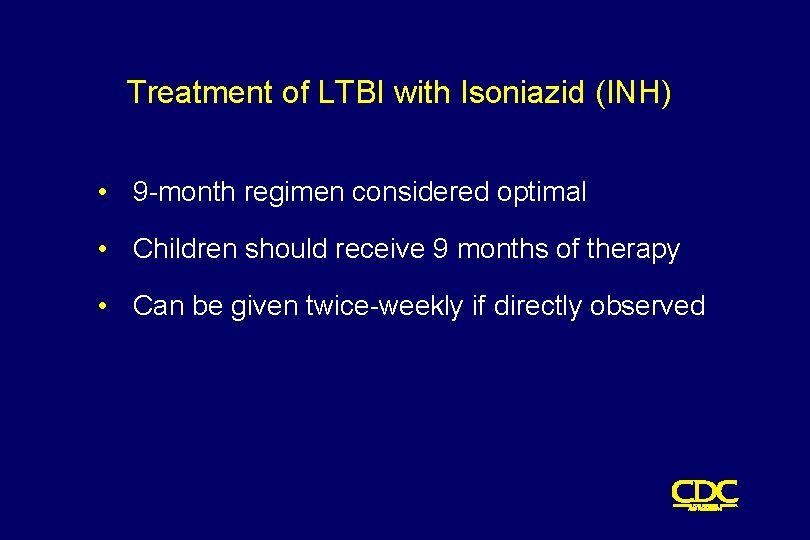
Treatment of LTBI with Isoniazid (INH) • 9 -month regimen considered optimal • Children should receive 9 months of therapy • Can be given twice-weekly if directly observed
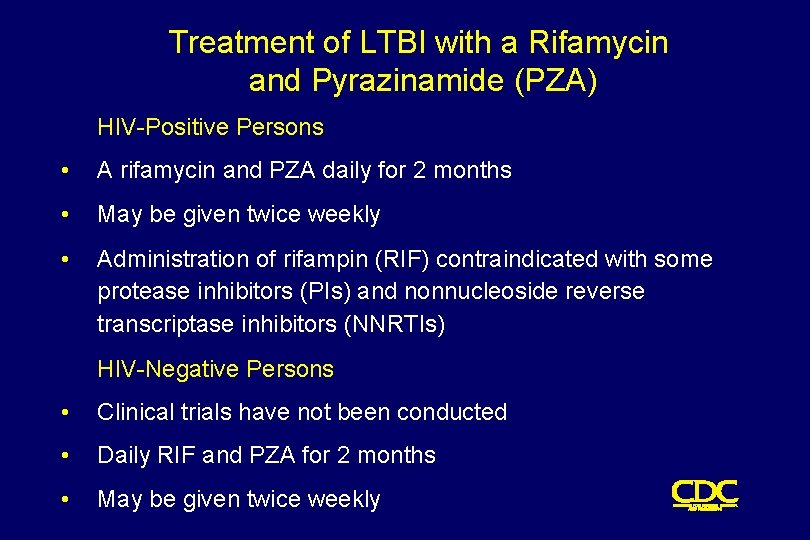
Treatment of LTBI with a Rifamycin and Pyrazinamide (PZA) HIV-Positive Persons • A rifamycin and PZA daily for 2 months • May be given twice weekly • Administration of rifampin (RIF) contraindicated with some protease inhibitors (PIs) and nonnucleoside reverse transcriptase inhibitors (NNRTIs) HIV-Negative Persons • Clinical trials have not been conducted • Daily RIF and PZA for 2 months • May be given twice weekly
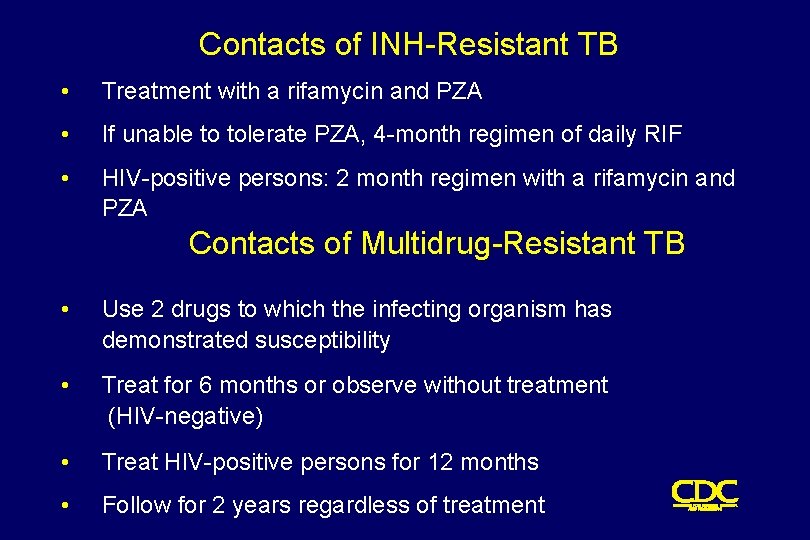
Contacts of INH-Resistant TB • Treatment with a rifamycin and PZA • If unable to tolerate PZA, 4 -month regimen of daily RIF • HIV-positive persons: 2 month regimen with a rifamycin and PZA Contacts of Multidrug-Resistant TB • Use 2 drugs to which the infecting organism has demonstrated susceptibility • Treat for 6 months or observe without treatment (HIV-negative) • Treat HIV-positive persons for 12 months • Follow for 2 years regardless of treatment
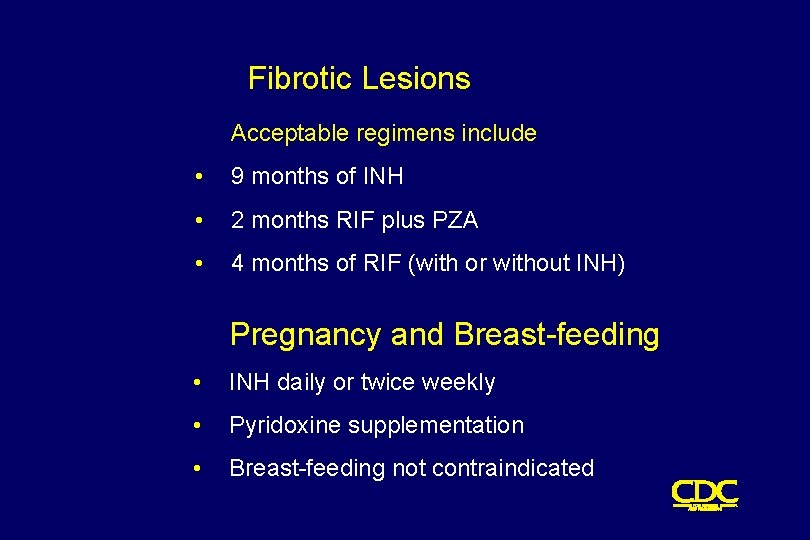
Fibrotic Lesions Acceptable regimens include • 9 months of INH • 2 months RIF plus PZA • 4 months of RIF (with or without INH) Pregnancy and Breast-feeding • INH daily or twice weekly • Pyridoxine supplementation • Breast-feeding not contraindicated
Monitoring Patients Before treatment for LTBI is started, clinicians should • Rule out possibility of TB disease • Determine history of treatment for LTBI or disease • Determine contraindications to treatment • Obtain information about current and previous drug therapy • Recommend HIV testing if risk factors are present
Monitoring Patients (cont. ) Establish rapport with patient and emphasize • Benefits of treatment • Importance of adherence to treatment regimen • Possible adverse side effects of regimen • Establishment of optimal follow-up plan
Monitoring Patients (cont. ) Baseline laboratory testing • Not routinely indicated • Baseline hepatic measurements for - Patients whose initial evaluation suggests a liver disorder - Patients with HIV infection - Pregnant women and those in immediate postpartum period - Patients with history of chronic liver disorder
Monitoring Patients (cont. ) At least monthly, evaluate for • Adherence to prescribed regimen • Signs and symptoms of active TB disease • Signs and symptoms of hepatitis (if receiving isoniazid alone, and at 2, 4, and 8 weeks if receiving RIF and PZA)