
This is a powerpoint to teach number sense

This is a powerpoint to teach number sense tricks. Credit goes to Jeff Boyd for its creation and placement in the public domain. Edited by pthornton 52@hotmail. com on Nov. 3, 2017
NUMBER SENSE AT A FLIP
NUMBER SENSE AT A FLIP
Number Sense is memorization and practice. The secret to getting good at number sense is to learn how to recognize and then do the rules accurately. Then learn how to do them quickly. Every practice should be under a time limit.
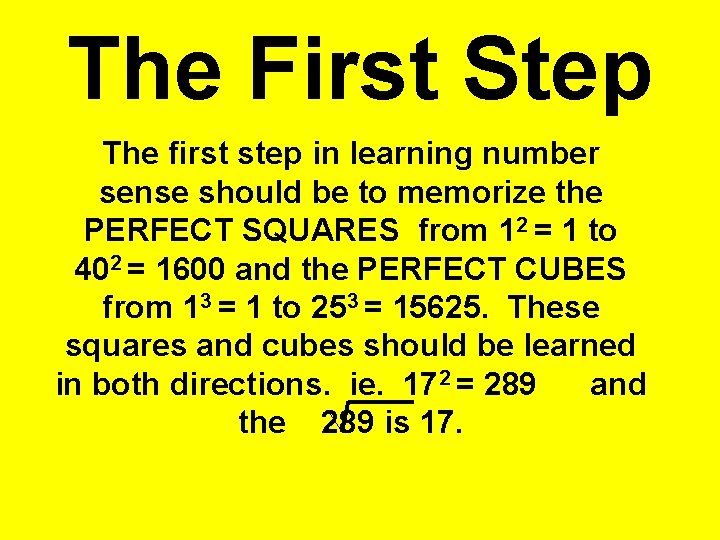
The First Step The first step in learning number sense should be to memorize the PERFECT SQUARES from 12 = 1 to 402 = 1600 and the PERFECT CUBES from 13 = 1 to 253 = 15625. These squares and cubes should be learned in both directions. ie. 172 = 289 and the 289 is 17.

The Rainbow Method 2 x 2 Foil (LIOF) Work Backwards 23 x 12 Used when you forget a rule about 2 x 2 multiplication 1. 4. The last number is the units digit of the product of the unit’s digits 2. Multiply the outside, multiply the inside 3. Add the outside and the inside together plus any carry and write down the units digit Multiply the first digits together and add carry. Write down the number 2(1) 2(2)+3(1) 3(2) 2 7 6 276 and
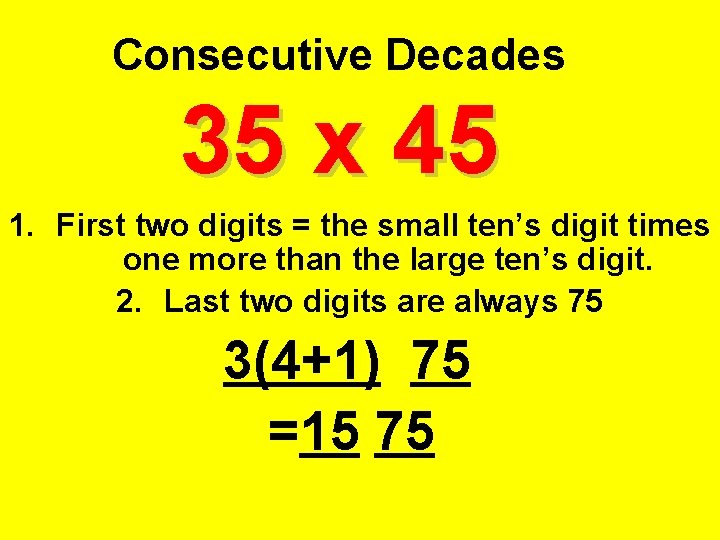
Consecutive Decades 35 x 45 1. First two digits = the small ten’s digit times one more than the large ten’s digit. 2. Last two digits are always 75 3(4+1) 75 =15 75
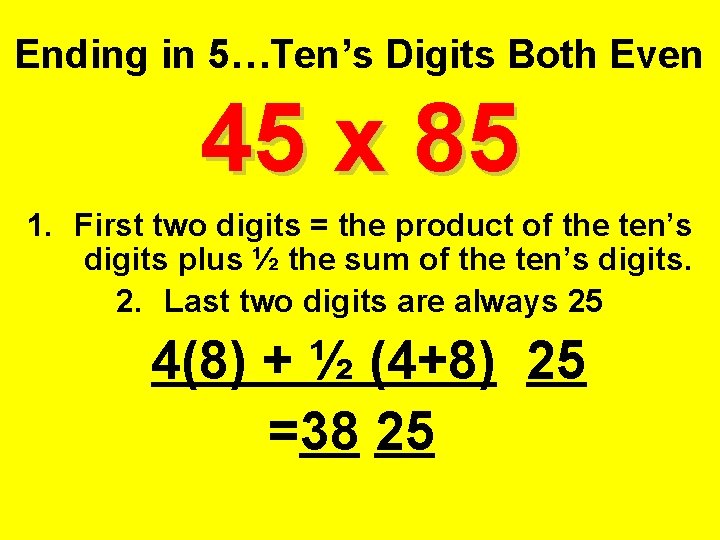
Ending in 5…Ten’s Digits Both Even 45 x 85 1. First two digits = the product of the ten’s digits plus ½ the sum of the ten’s digits. 2. Last two digits are always 25 4(8) + ½ (4+8) 25 =38 25
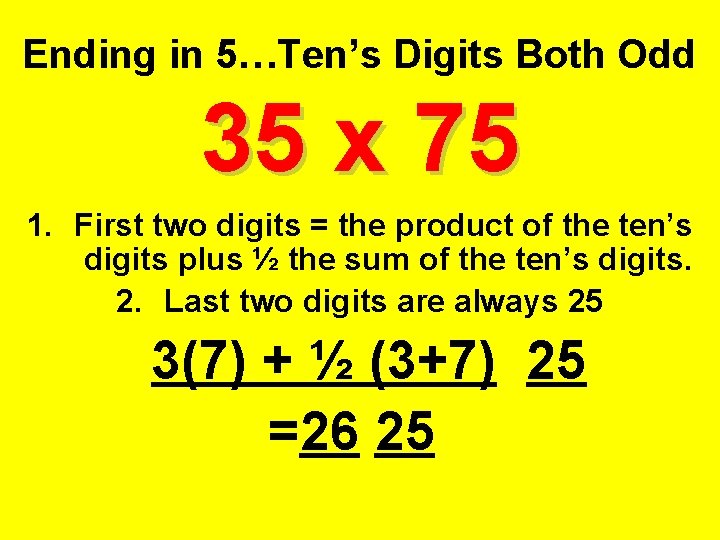
Ending in 5…Ten’s Digits Both Odd 35 x 75 1. First two digits = the product of the ten’s digits plus ½ the sum of the ten’s digits. 2. Last two digits are always 25 3(7) + ½ (3+7) 25 =26 25
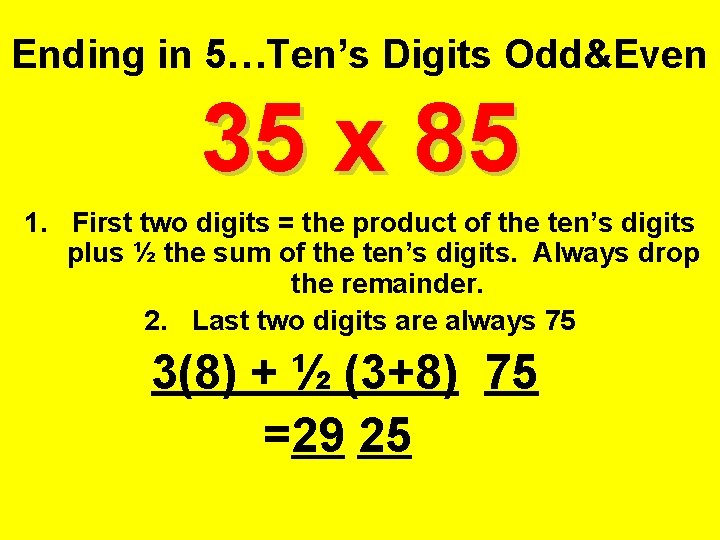
Ending in 5…Ten’s Digits Odd&Even 35 x 85 1. First two digits = the product of the ten’s digits plus ½ the sum of the ten’s digits. Always drop the remainder. 2. Last two digits are always 75 3(8) + ½ (3+8) 75 =29 25
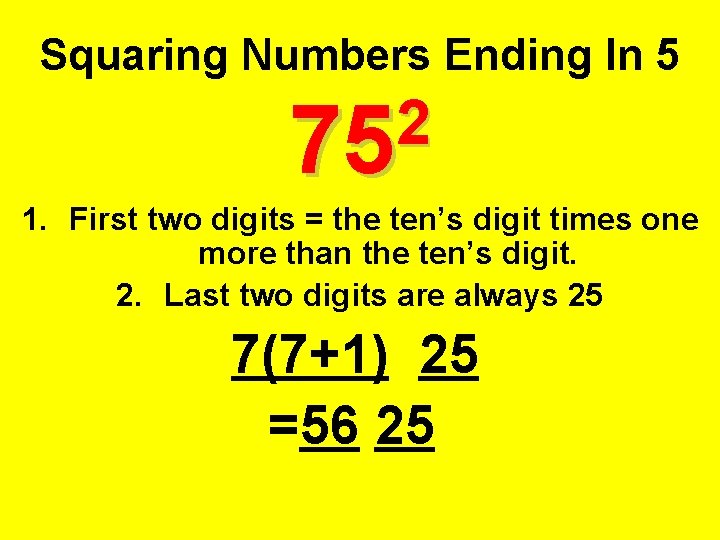
Squaring Numbers Ending In 5 2 75 1. First two digits = the ten’s digit times one more than the ten’s digit. 2. Last two digits are always 25 7(7+1) 25 =56 25
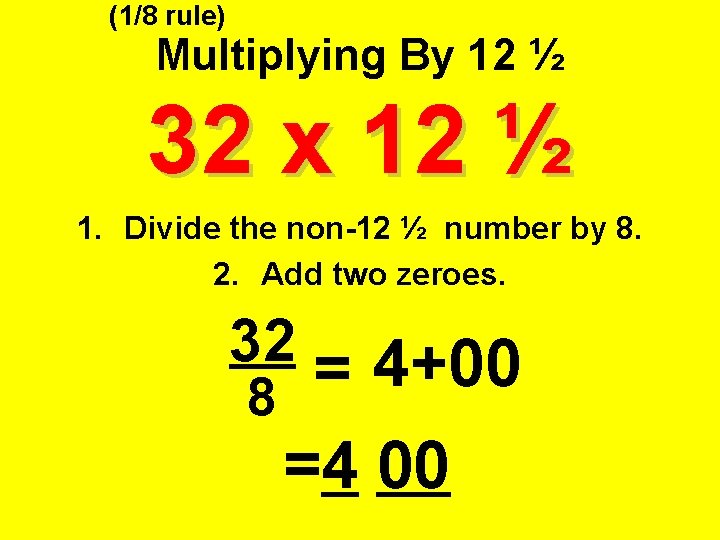
(1/8 rule) Multiplying By 12 ½ 32 x 12 ½ 1. Divide the non-12 ½ number by 8. 2. Add two zeroes. 32 4+00 = 8 =4 00
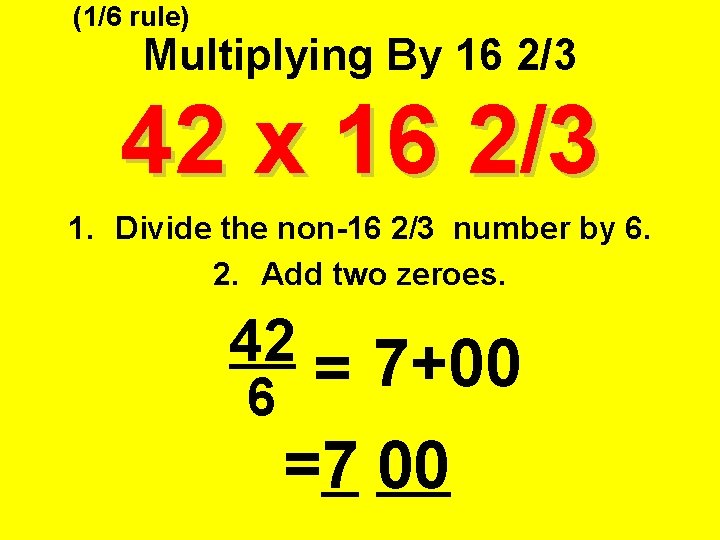
(1/6 rule) Multiplying By 16 2/3 42 x 16 2/3 1. Divide the non-16 2/3 number by 6. 2. Add two zeroes. 42 7+00 = 6 =7 00
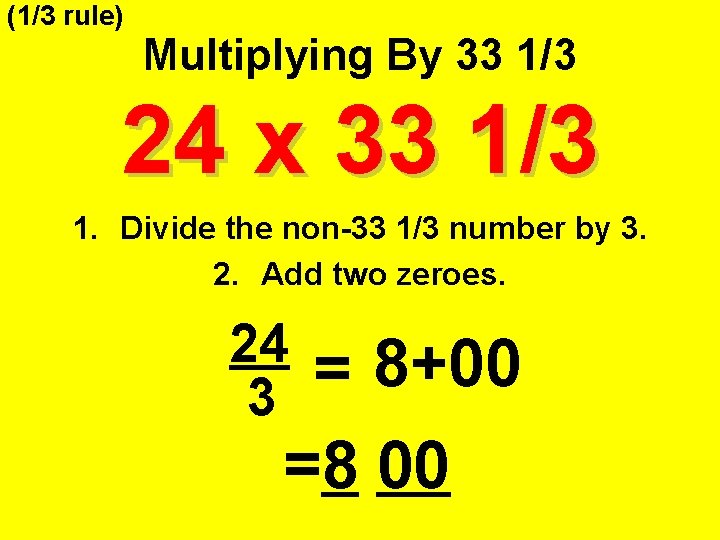
(1/3 rule) Multiplying By 33 1/3 24 x 33 1/3 1. Divide the non-33 1/3 number by 3. 2. Add two zeroes. 24 3 = 8+00 =8 00
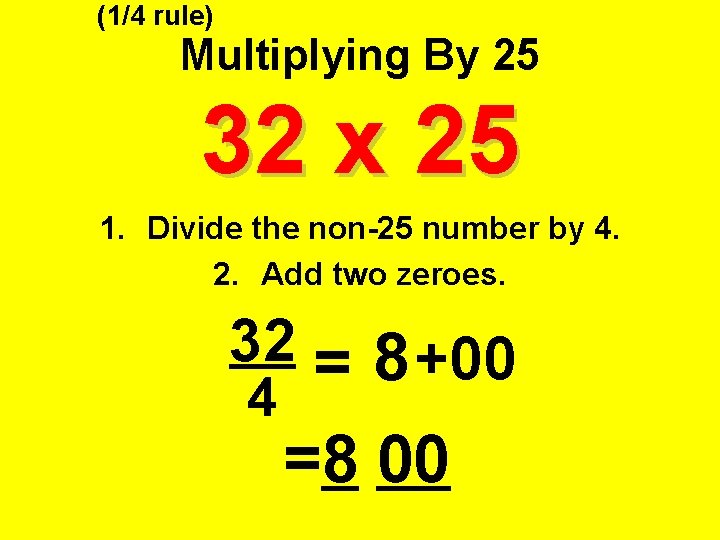
(1/4 rule) Multiplying By 25 32 x 25 1. Divide the non-25 number by 4. 2. Add two zeroes. 32 = 8 +00 4 =8 00
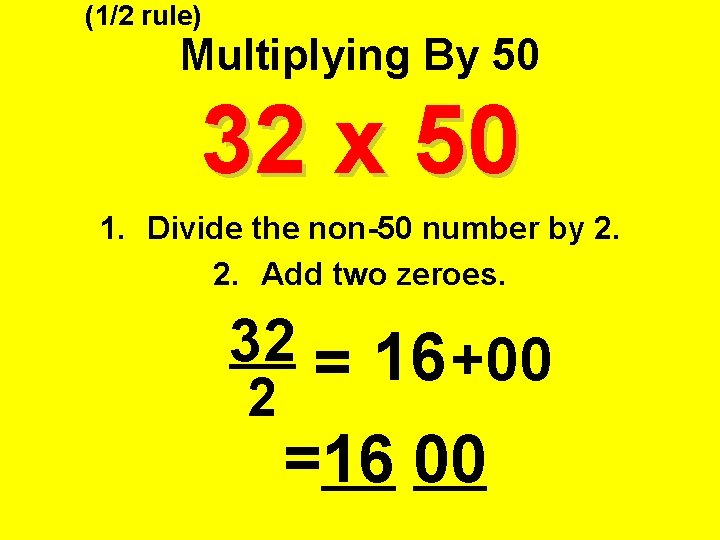
(1/2 rule) Multiplying By 50 32 x 50 1. Divide the non-50 number by 2. 2. Add two zeroes. 32 = 16 +00 2 =16 00
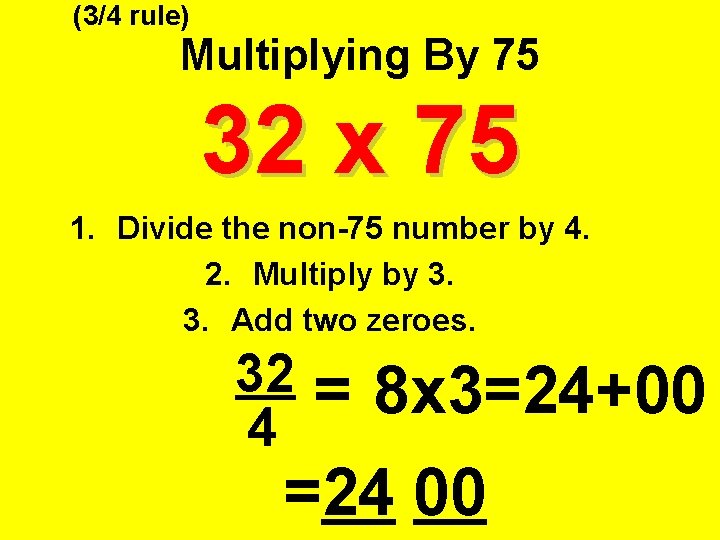
(3/4 rule) Multiplying By 75 32 x 75 1. Divide the non-75 number by 4. 2. Multiply by 3. 3. Add two zeroes. 32 4 = 8 x 3=24+00 =24 00
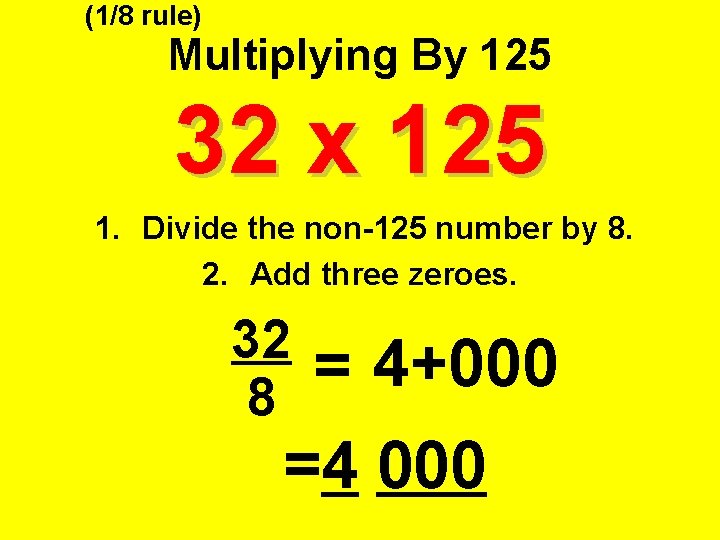
(1/8 rule) Multiplying By 125 32 x 125 1. Divide the non-125 number by 8. 2. Add three zeroes. 32 8 = 4+000 =4 000
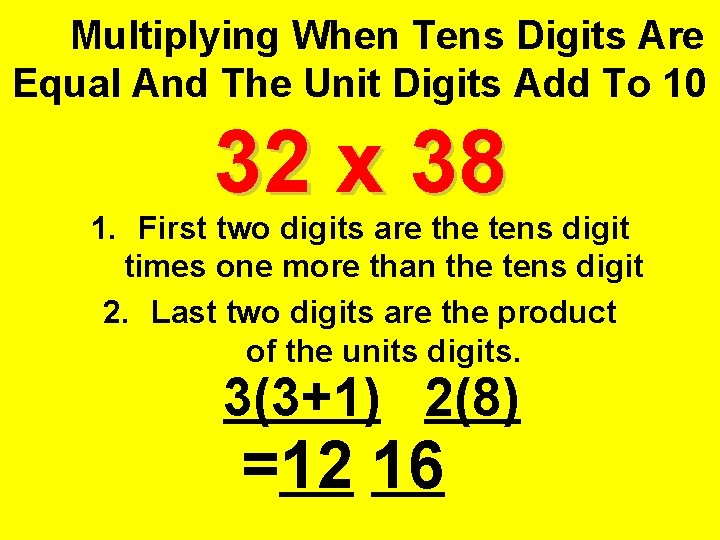
Multiplying When Tens Digits Are Equal And The Unit Digits Add To 10 32 x 38 1. First two digits are the tens digit times one more than the tens digit 2. Last two digits are the product of the units digits. 3(3+1) 2(8) =12 16
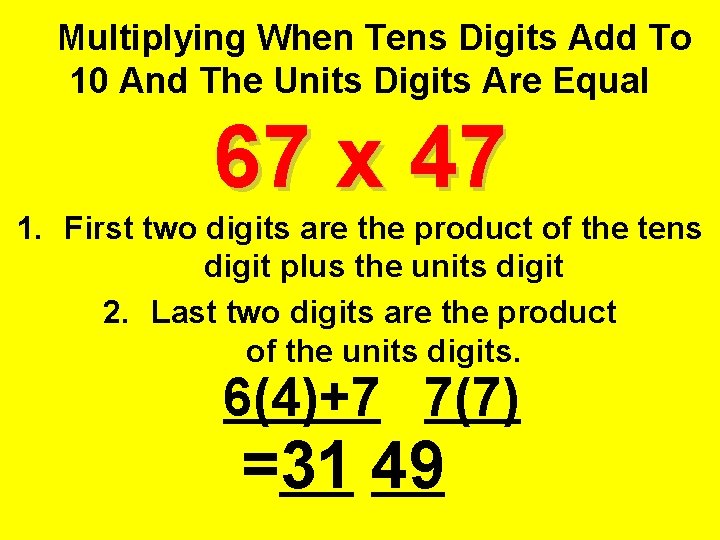
Multiplying When Tens Digits Add To 10 And The Units Digits Are Equal 67 x 47 1. First two digits are the product of the tens digit plus the units digit 2. Last two digits are the product of the units digits. 6(4)+7 7(7) =31 49
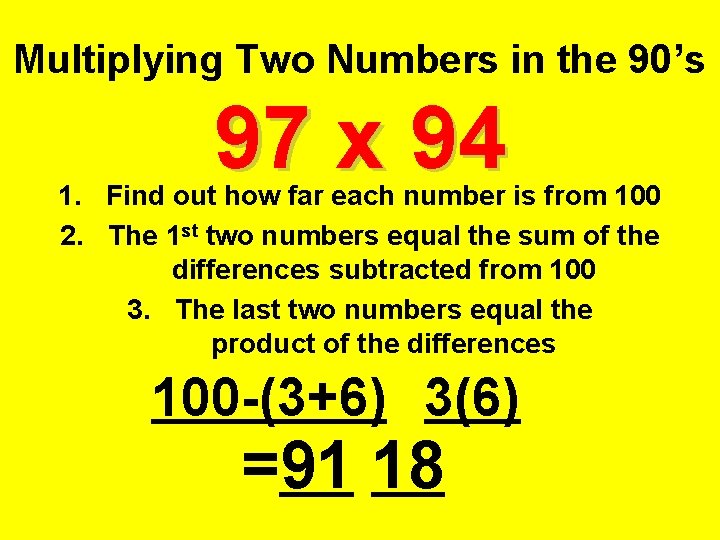
Multiplying Two Numbers in the 90’s 97 x 94 1. Find out how far each number is from 100 2. The 1 st two numbers equal the sum of the differences subtracted from 100 3. The last two numbers equal the product of the differences 100 -(3+6) 3(6) =91 18
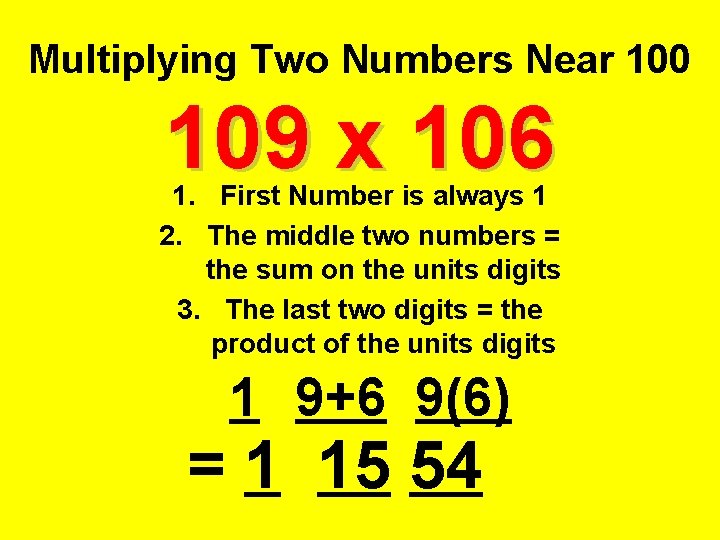
Multiplying Two Numbers Near 100 109 x 106 1. First Number is always 1 2. The middle two numbers = the sum on the units digits 3. The last two digits = the product of the units digits 1 9+6 9(6) = 1 15 54
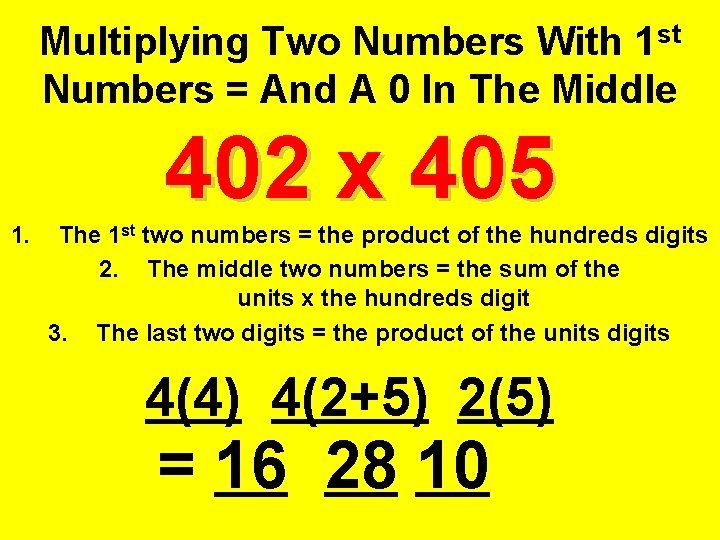
Multiplying Two Numbers With 1 st Numbers = And A 0 In The Middle 402 x 405 1. The 1 st two numbers = the product of the hundreds digits 2. The middle two numbers = the sum of the units x the hundreds digit 3. The last two digits = the product of the units digits 4(4) 4(2+5) 2(5) = 16 28 10
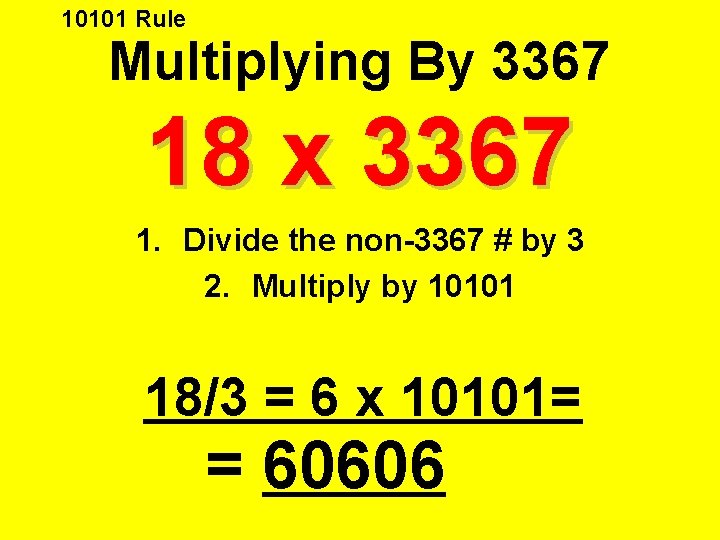
10101 Rule Multiplying By 3367 18 x 3367 1. Divide the non-3367 # by 3 2. Multiply by 10101 18/3 = 6 x 10101= = 60606
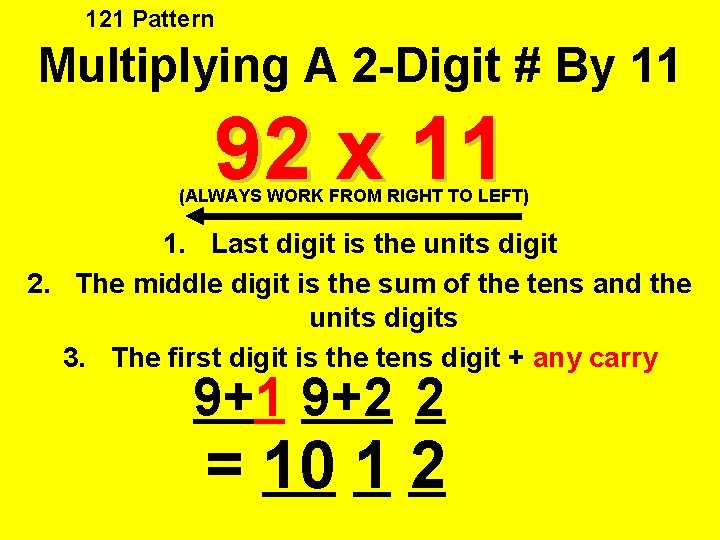
121 Pattern Multiplying A 2 -Digit # By 11 92 x 11 (ALWAYS WORK FROM RIGHT TO LEFT) 1. Last digit is the units digit 2. The middle digit is the sum of the tens and the units digits 3. The first digit is the tens digit + any carry 9+1 9+2 2 = 10 1 2
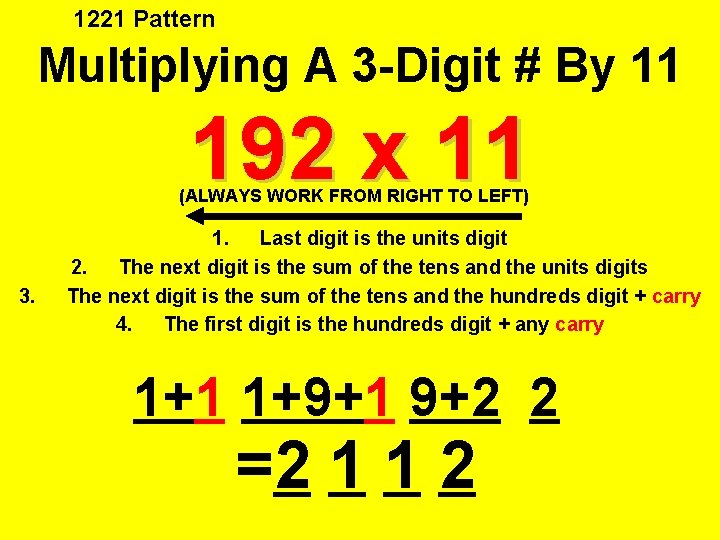
1221 Pattern Multiplying A 3 -Digit # By 11 192 x 11 (ALWAYS WORK FROM RIGHT TO LEFT) 3. 1. Last digit is the units digit 2. The next digit is the sum of the tens and the units digits The next digit is the sum of the tens and the hundreds digit + carry 4. The first digit is the hundreds digit + any carry 1+1 1+9+1 9+2 2 =2 1 1 2
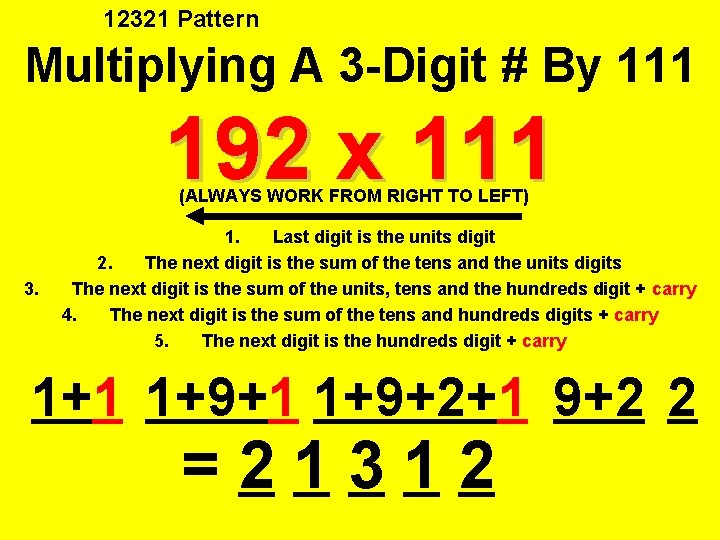
12321 Pattern Multiplying A 3 -Digit # By 111 192 x 111 (ALWAYS WORK FROM RIGHT TO LEFT) 3. 1. Last digit is the units digit 2. The next digit is the sum of the tens and the units digits The next digit is the sum of the units, tens and the hundreds digit + carry 4. The next digit is the sum of the tens and hundreds digits + carry 5. The next digit is the hundreds digit + carry 1+1 1+9+2+1 9+2 2 =21312
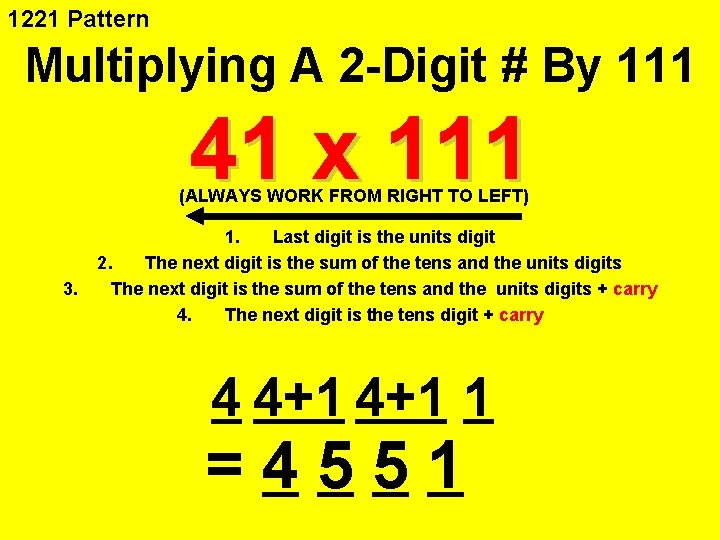
1221 Pattern Multiplying A 2 -Digit # By 111 41 x 111 (ALWAYS WORK FROM RIGHT TO LEFT) 3. 1. Last digit is the units digit 2. The next digit is the sum of the tens and the units digits + carry 4. The next digit is the tens digit + carry 4 4+1 1 =4551
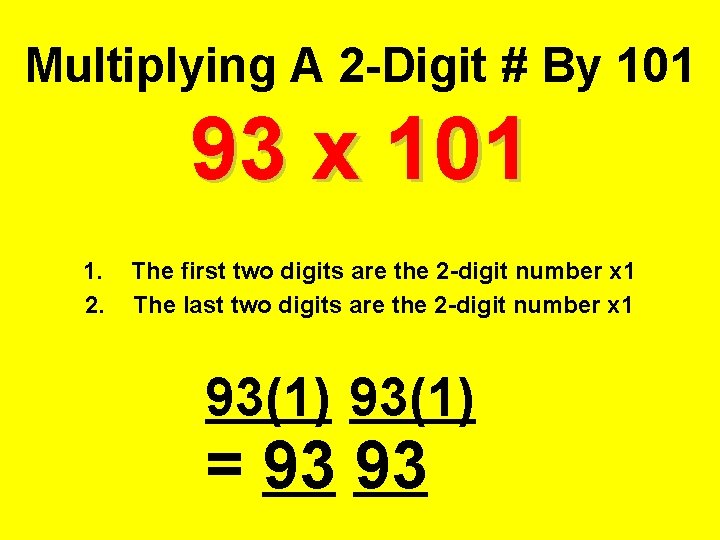
Multiplying A 2 -Digit # By 101 93 x 101 1. 2. The first two digits are the 2 -digit number x 1 The last two digits are the 2 -digit number x 1 93(1) = 93 93
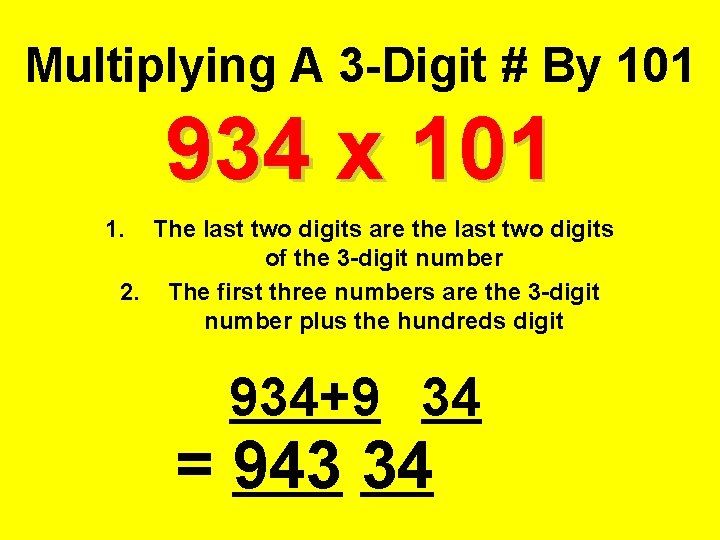
Multiplying A 3 -Digit # By 101 934 x 101 1. The last two digits are the last two digits of the 3 -digit number 2. The first three numbers are the 3 -digit number plus the hundreds digit 934+9 34 = 943 34
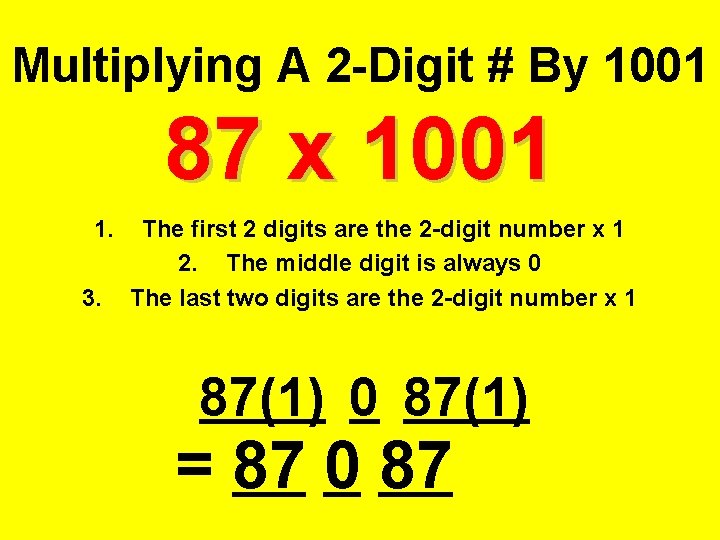
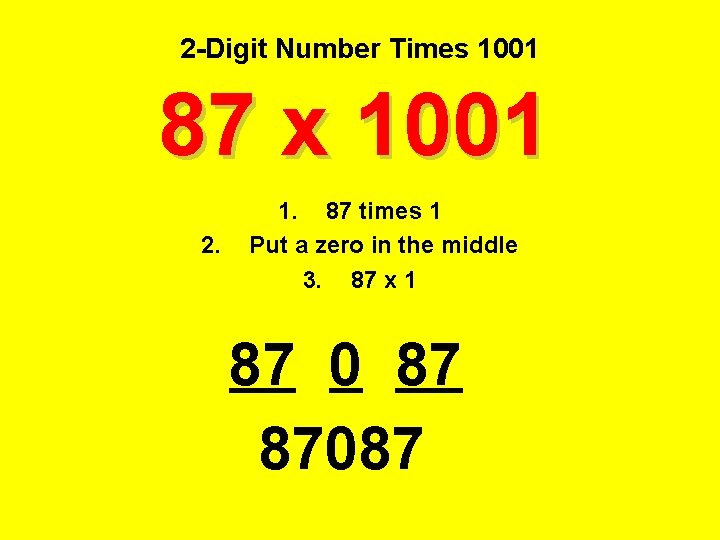
Multiplying A 2 -Digit # By 1001 87 x 1001 1. 3. The first 2 digits are the 2 -digit number x 1 2. The middle digit is always 0 The last two digits are the 2 -digit number x 1 87(1) 0 87(1) = 87 0 87
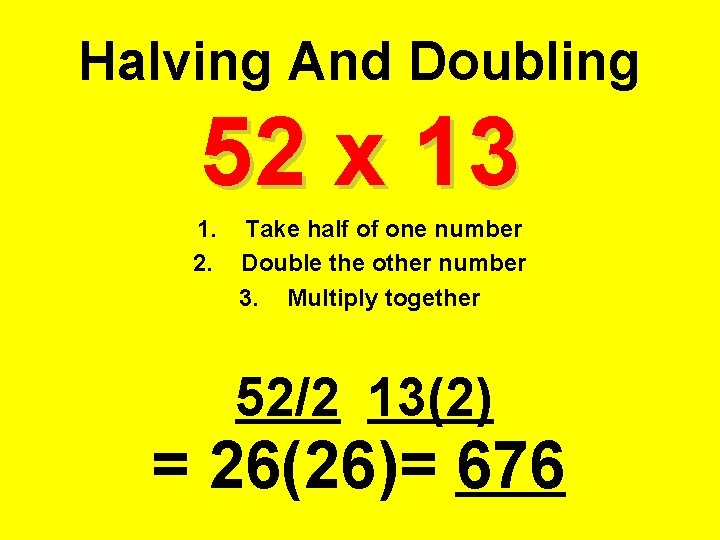
Halving And Doubling 52 x 13 1. Take half of one number 2. Double the other number 3. Multiply together 52/2 13(2) = 26(26)= 676
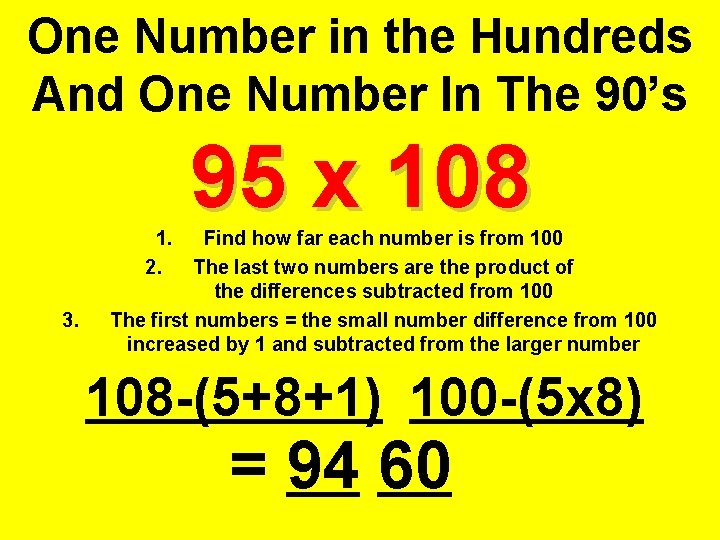
One Number in the Hundreds And One Number In The 90’s 95 x 108 3. 1. Find how far each number is from 100 2. The last two numbers are the product of the differences subtracted from 100 The first numbers = the small number difference from 100 increased by 1 and subtracted from the larger number 108 -(5+8+1) 100 -(5 x 8) = 94 60
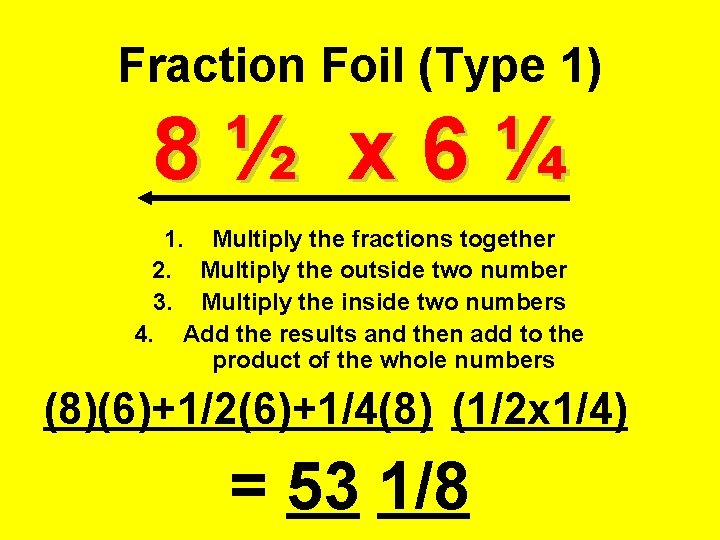
Fraction Foil (Type 1) 8½ x 6¼ 1. Multiply the fractions together 2. Multiply the outside two number 3. Multiply the inside two numbers 4. Add the results and then add to the product of the whole numbers (8)(6)+1/2(6)+1/4(8) (1/2 x 1/4) = 53 1/8
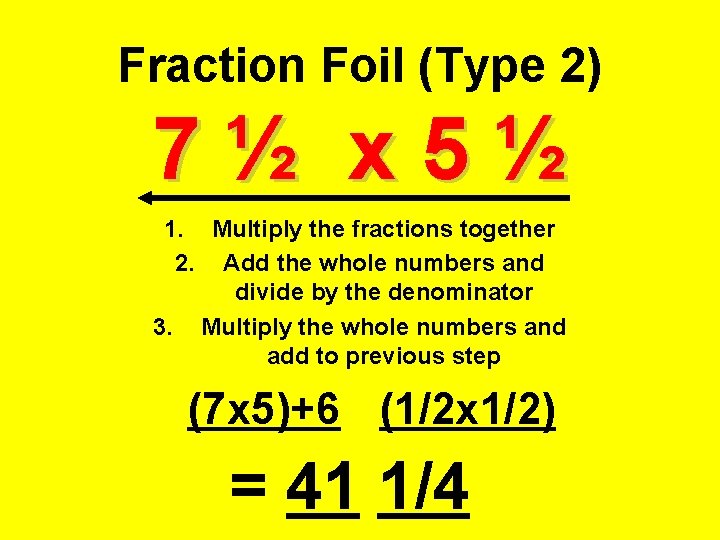
Fraction Foil (Type 2) 7½ x 5½ 1. Multiply the fractions together 2. Add the whole numbers and divide by the denominator 3. Multiply the whole numbers and add to previous step (7 x 5)+6 (1/2 x 1/2) = 41 1/4
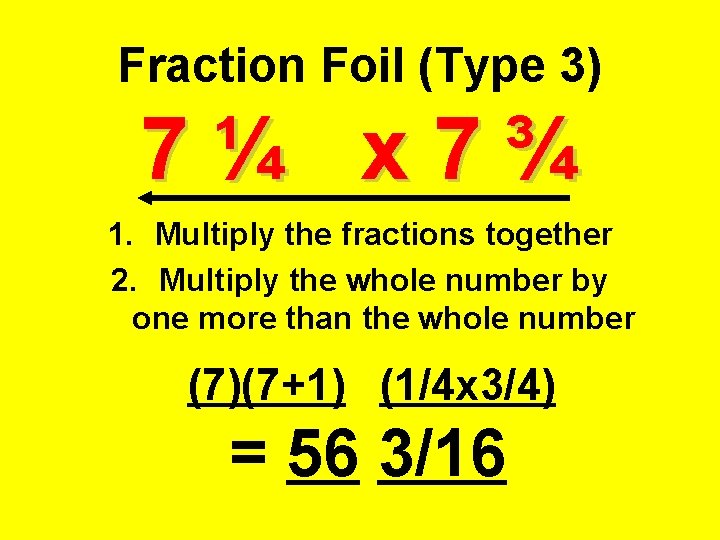
Fraction Foil (Type 3) 7¼ x 7¾ 1. Multiply the fractions together 2. Multiply the whole number by one more than the whole number (7)(7+1) (1/4 x 3/4) = 56 3/16
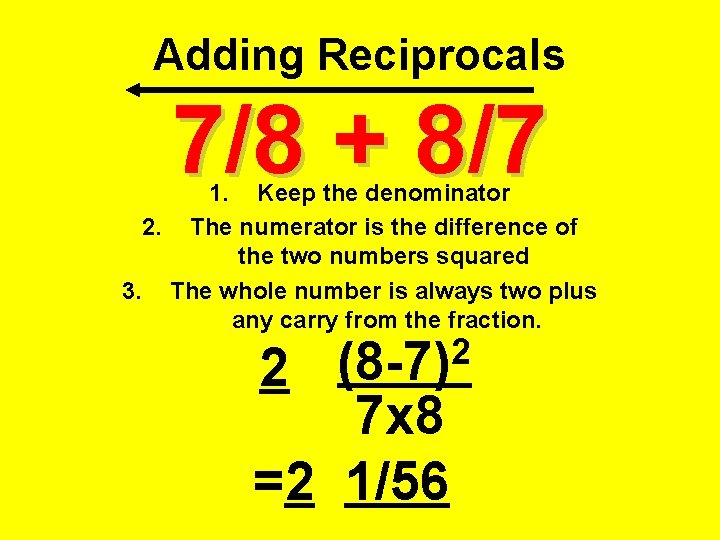
Adding Reciprocals 7/8 + 8/7 1. Keep the denominator 2. The numerator is the difference of the two numbers squared 3. The whole number is always two plus any carry from the fraction. 2 2 (8 -7) 7 x 8 =2 1/56
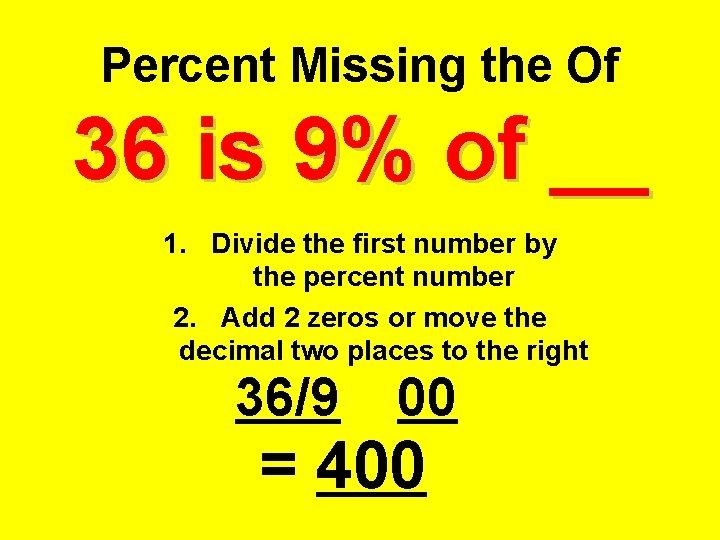
Percent Missing the Of 36 is 9% of __ 1. Divide the first number by the percent number 2. Add 2 zeros or move the decimal two places to the right 36/9 00 = 400
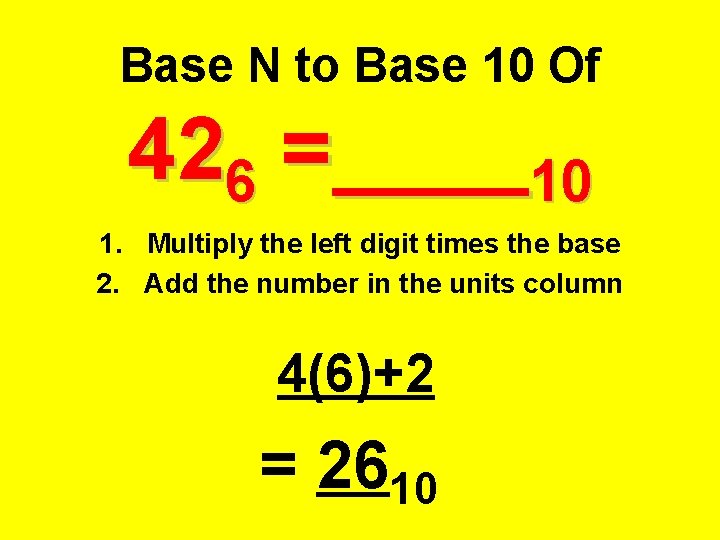
Base N to Base 10 Of 426 =____10 1. Multiply the left digit times the base 2. Add the number in the units column 4(6)+2 = 2610
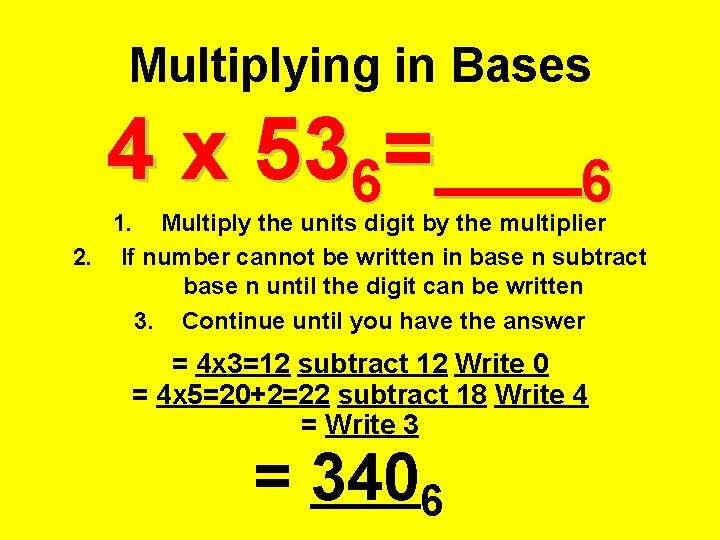
Multiplying in Bases 4 x 536=___6 1. Multiply the units digit by the multiplier 2. If number cannot be written in base n subtract base n until the digit can be written 3. Continue until you have the answer = 4 x 3=12 subtract 12 Write 0 = 4 x 5=20+2=22 subtract 18 Write 4 = Write 3 = 3406
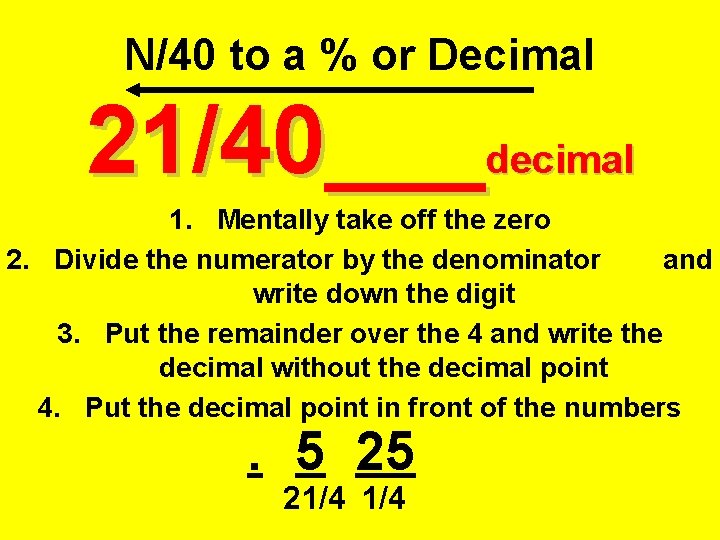
N/40 to a % or Decimal 21/40___decimal 1. Mentally take off the zero 2. Divide the numerator by the denominator and write down the digit 3. Put the remainder over the 4 and write the decimal without the decimal point 4. Put the decimal point in front of the numbers . 5 25 21/4
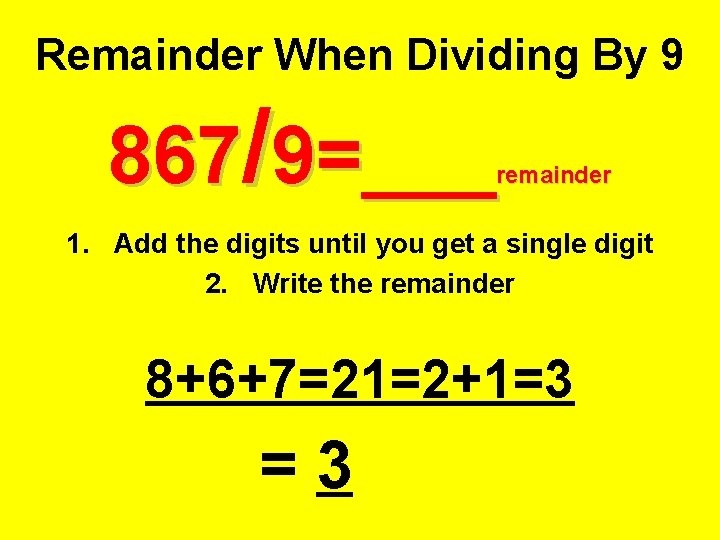
Remainder When Dividing By 9 867/9=___ remainder 1. Add the digits until you get a single digit 2. Write the remainder 8+6+7=21=2+1=3 =3
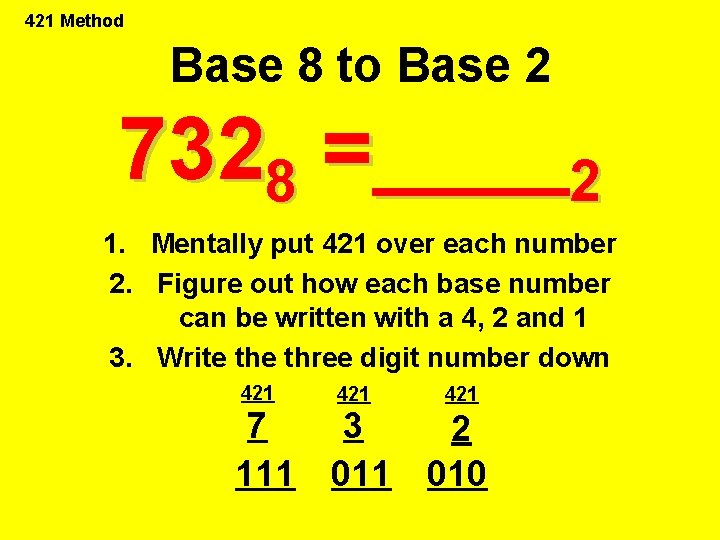
421 Method Base 8 to Base 2 7328 =____2 1. Mentally put 421 over each number 2. Figure out how each base number can be written with a 4, 2 and 1 3. Write three digit number down 421 421 7 3 2 111 010
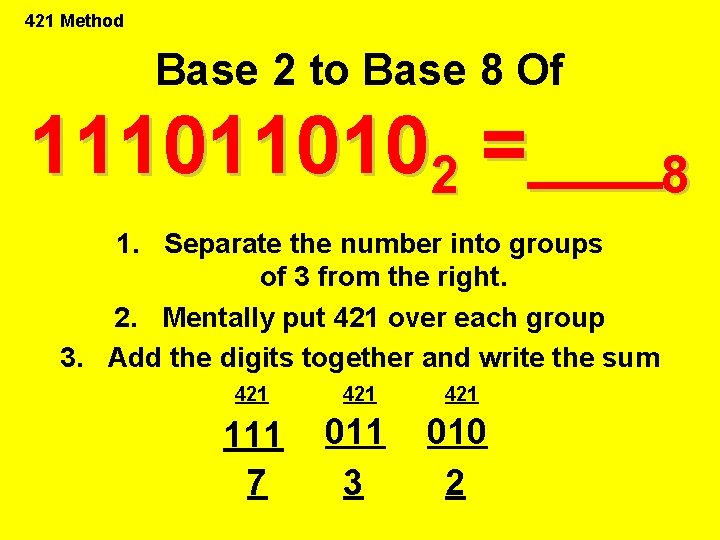
421 Method Base 2 to Base 8 Of 1110110102 =___8 1. Separate the number into groups of 3 from the right. 2. Mentally put 421 over each group 3. Add the digits together and write the sum 421 421 111 7 011 3 010 2
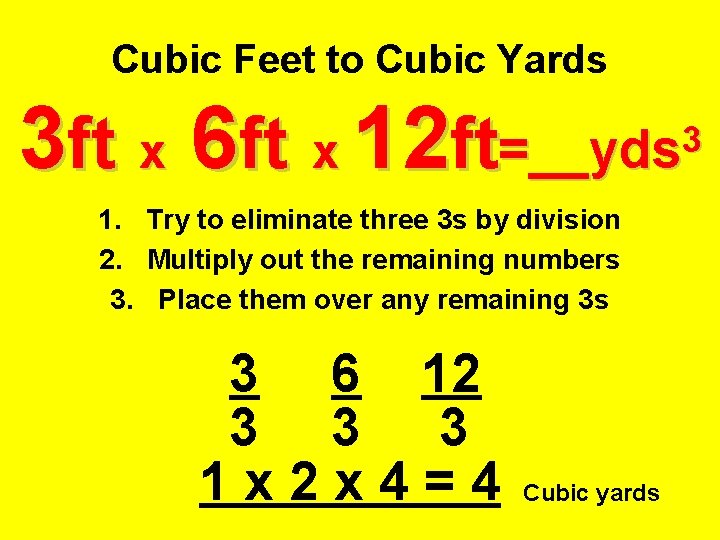
Cubic Feet to Cubic Yards 3 ft x 6 ft x 12 ft 3 =__yds 1. Try to eliminate three 3 s by division 2. Multiply out the remaining numbers 3. Place them over any remaining 3 s 3 6 12 3 3 3 1 x 2 x 4=4 Cubic yards
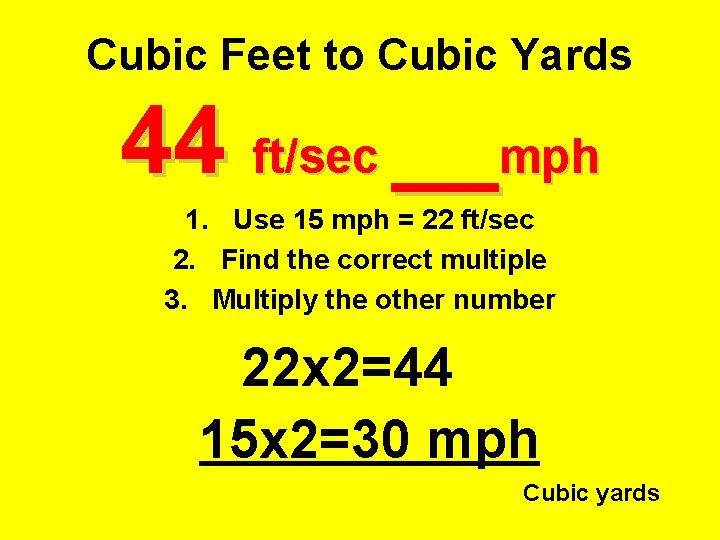
Cubic Feet to Cubic Yards 44 ft/sec __mph 1. Use 15 mph = 22 ft/sec 2. Find the correct multiple 3. Multiply the other number 22 x 2=44 15 x 2=30 mph Cubic yards
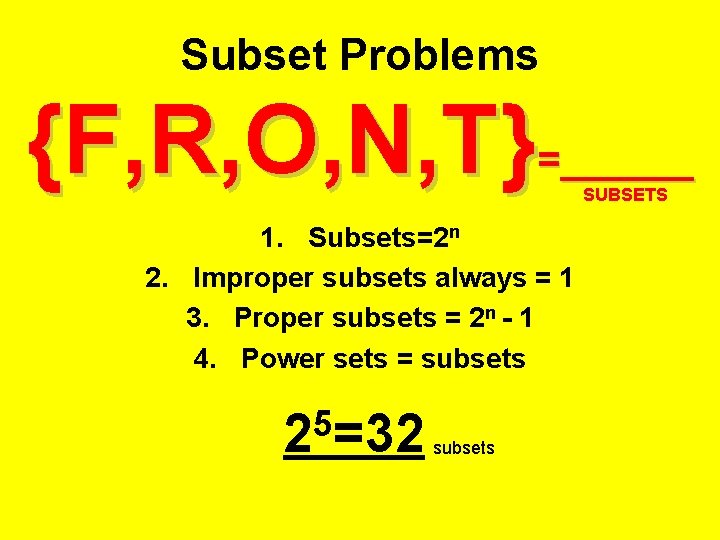
Subset Problems {F, R, O, N, T}=______ SUBSETS 1. Subsets=2 n 2. Improper subsets always = 1 3. Proper subsets = 2 n - 1 4. Power sets = subsets 5 2 =32 subsets
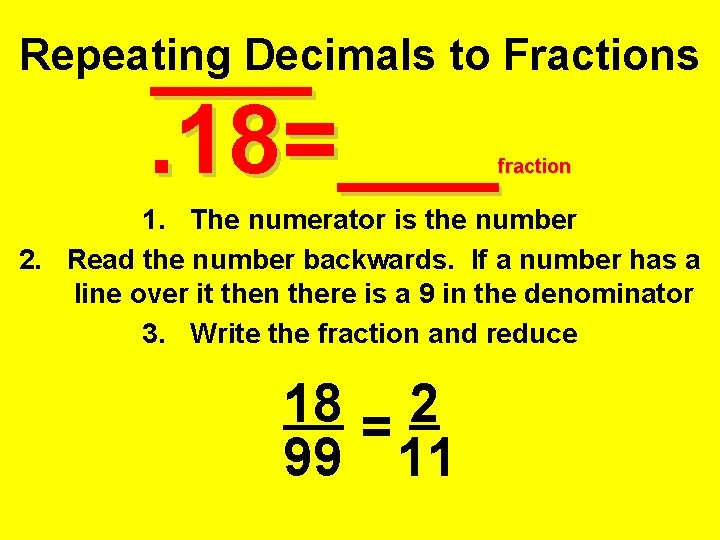
___. 18=___ Repeating Decimals to Fractions fraction 1. The numerator is the number 2. Read the number backwards. If a number has a line over it then there is a 9 in the denominator 3. Write the fraction and reduce 18 = 2 99 11
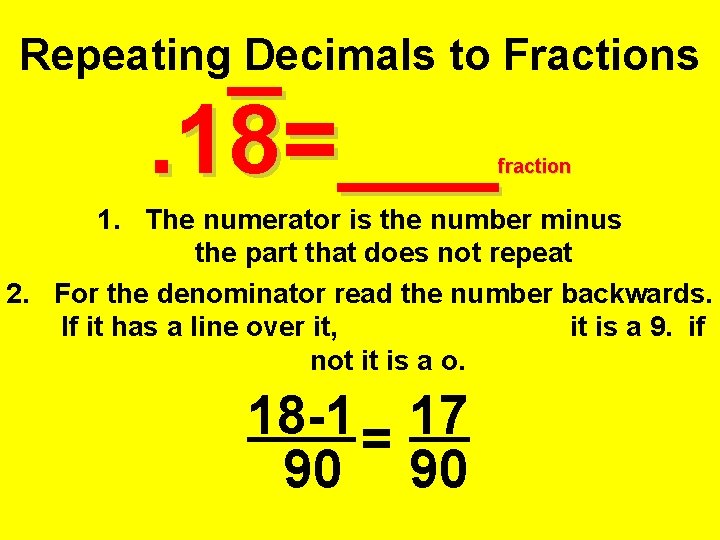
_. 18=___ Repeating Decimals to Fractions fraction 1. The numerator is the number minus the part that does not repeat 2. For the denominator read the number backwards. If it has a line over it, it is a 9. if not it is a o. 18 -1 = 17 90 90
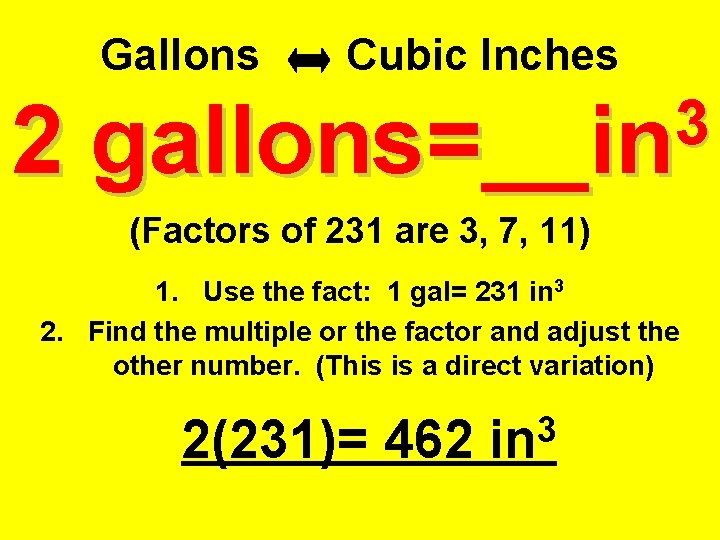
Gallons 2 Cubic Inches 3 gallons=__in (Factors of 231 are 3, 7, 11) 1. Use the fact: 1 gal= 231 in 3 2. Find the multiple or the factor and adjust the other number. (This is a direct variation) 2(231)= 462 3 in
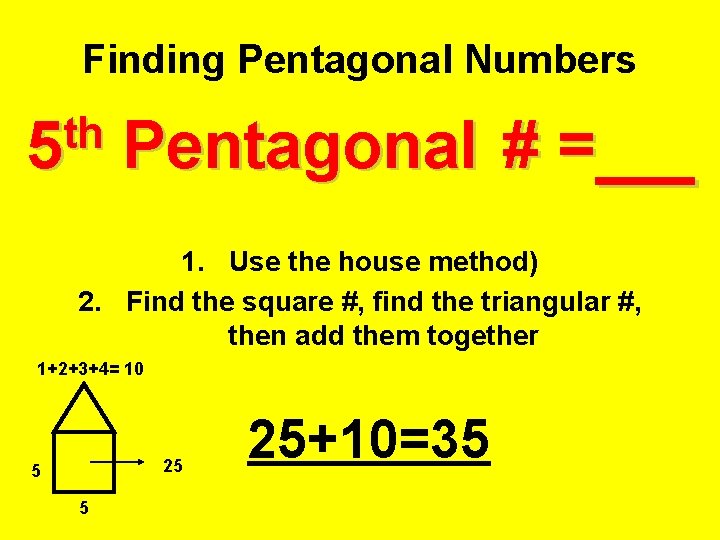
Finding Pentagonal Numbers th 5 Pentagonal # =__ 1. Use the house method) 2. Find the square #, find the triangular #, then add them together 1+2+3+4= 10 25 5 5 25+10=35
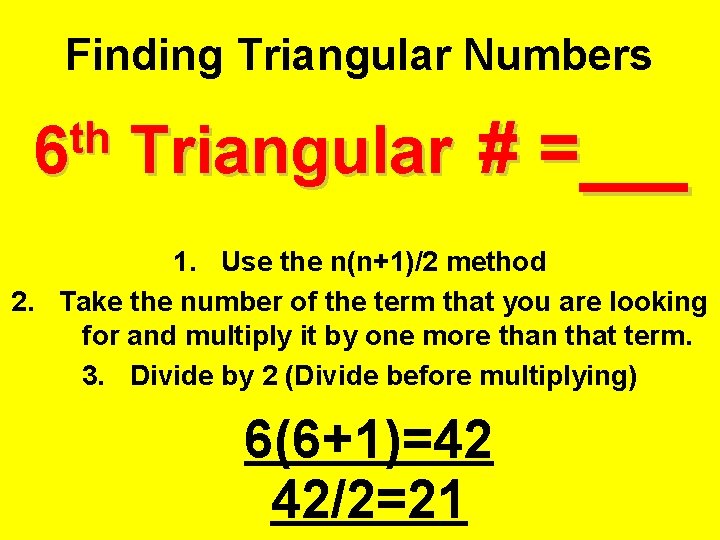
Finding Triangular Numbers th 6 Triangular # =__ 1. Use the n(n+1)/2 method 2. Take the number of the term that you are looking for and multiply it by one more than that term. 3. Divide by 2 (Divide before multiplying) 6(6+1)=42 42/2=21
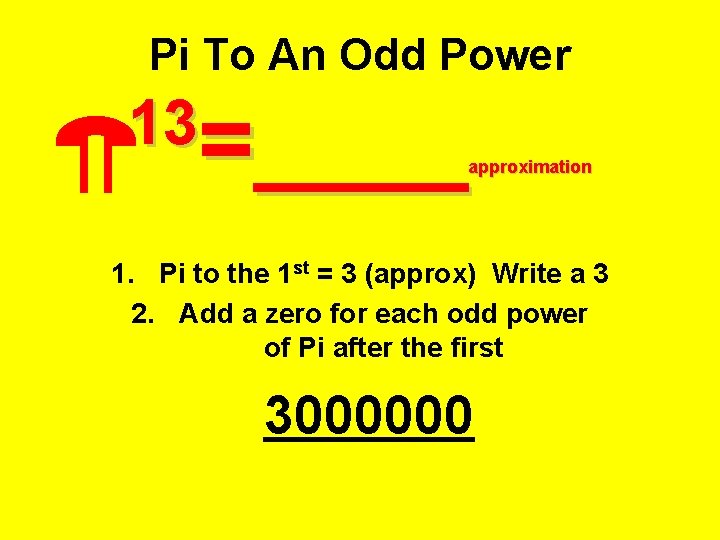
Pi To An Odd Power 13=____ approximation 1. Pi to the 1 st = 3 (approx) Write a 3 2. Add a zero for each odd power of Pi after the first 3000000
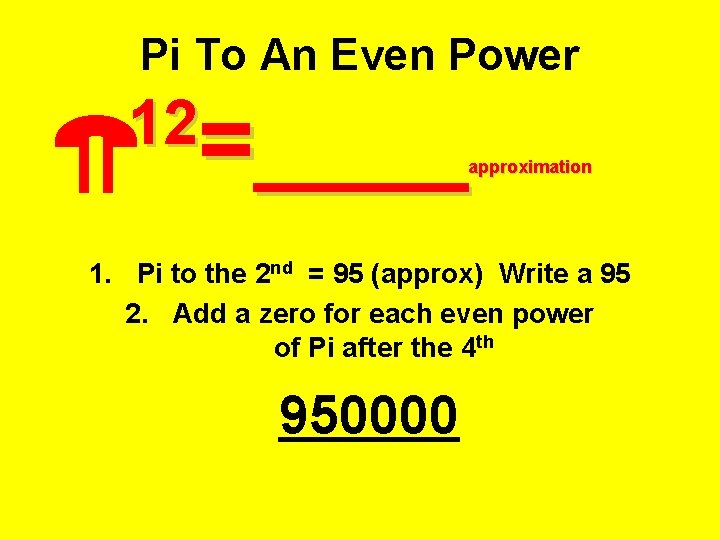
Pi To An Even Power 12=____ approximation 1. Pi to the 2 nd = 95 (approx) Write a 95 2. Add a zero for each even power of Pi after the 4 th 950000
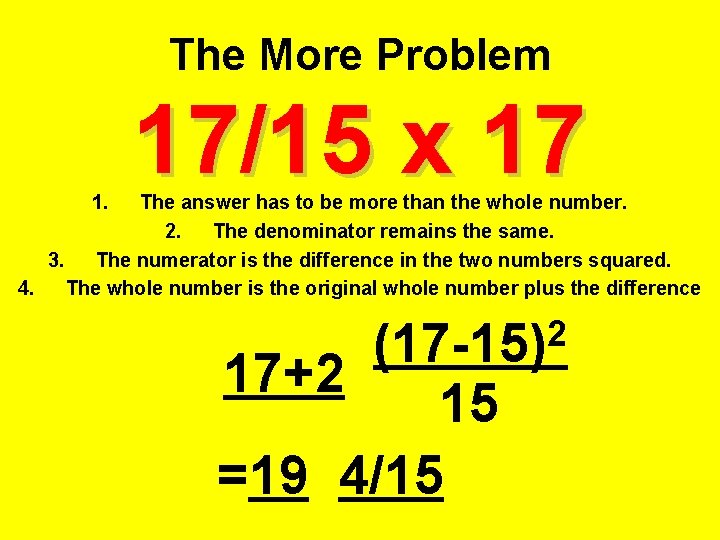
The More Problem 1. 17/15 x 17 The answer has to be more than the whole number. 2. The denominator remains the same. 3. The numerator is the difference in the two numbers squared. 4. The whole number is the original whole number plus the difference 17+2 2 (17 -15) 15 =19 4/15
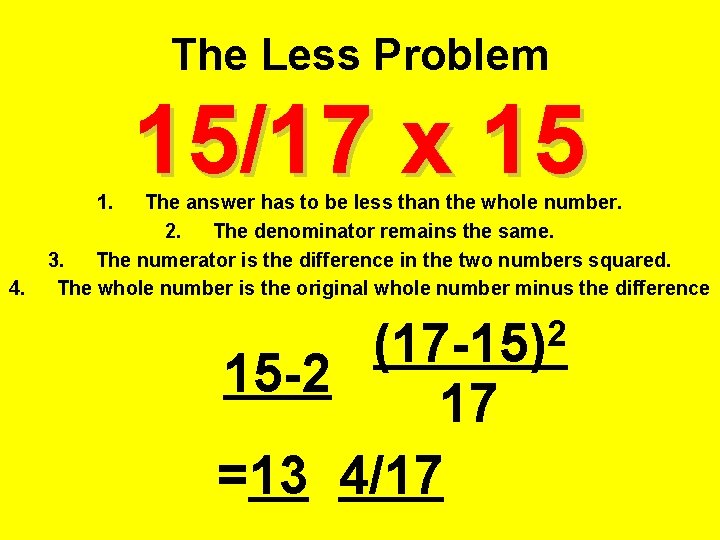
The Less Problem 1. 4. 15/17 x 15 The answer has to be less than the whole number. 2. The denominator remains the same. 3. The numerator is the difference in the two numbers squared. The whole number is the original whole number minus the difference 15 -2 2 (17 -15) 17 =13 4/17
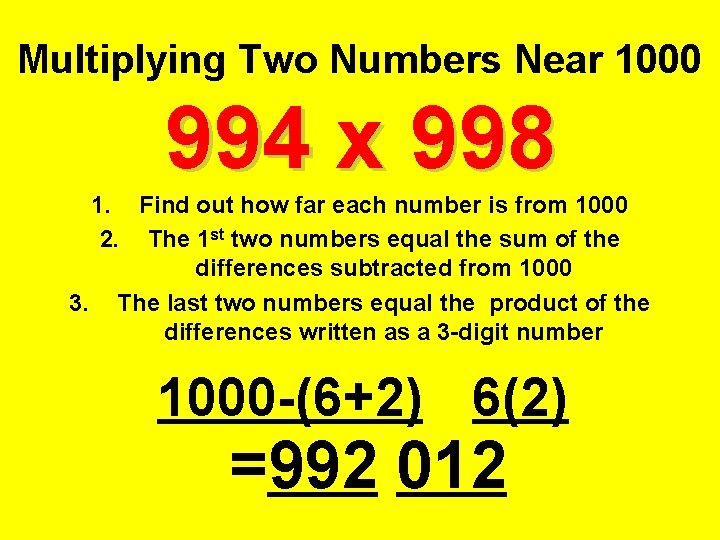
Multiplying Two Numbers Near 1000 994 x 998 1. Find out how far each number is from 1000 2. The 1 st two numbers equal the sum of the differences subtracted from 1000 3. The last two numbers equal the product of the differences written as a 3 -digit number 1000 -(6+2) 6(2) =992 012
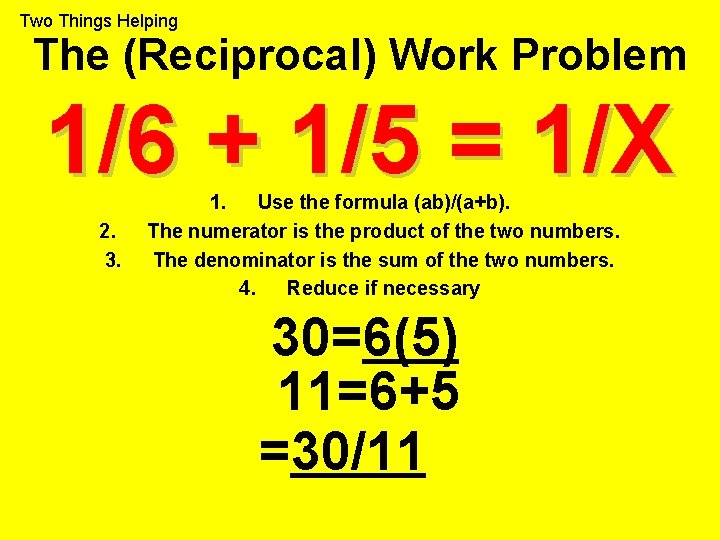
Two Things Helping The (Reciprocal) Work Problem 1/6 + 1/5 = 1/X 2. 3. 1. Use the formula (ab)/(a+b). The numerator is the product of the two numbers. The denominator is the sum of the two numbers. 4. Reduce if necessary 30=6(5) 11=6+5 =30/11
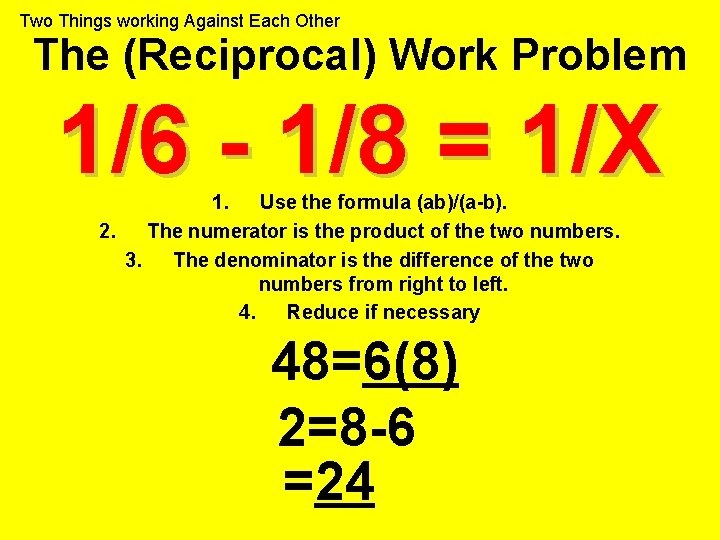
Two Things working Against Each Other The (Reciprocal) Work Problem 1/6 - 1/8 = 1/X 1. Use the formula (ab)/(a-b). 2. The numerator is the product of the two numbers. 3. The denominator is the difference of the two numbers from right to left. 4. Reduce if necessary 48=6(8) 2=8 -6 =24
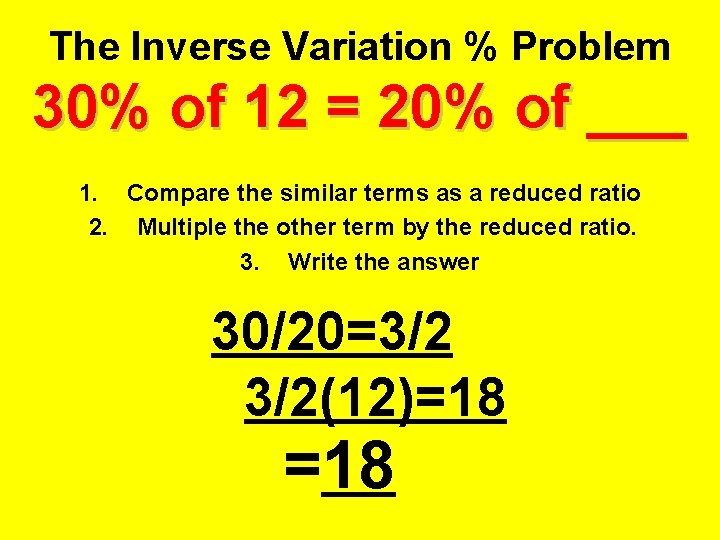
The Inverse Variation % Problem 30% of 12 = 20% of ___ 1. Compare the similar terms as a reduced ratio 2. Multiple the other term by the reduced ratio. 3. Write the answer 30/20=3/2 3/2(12)=18
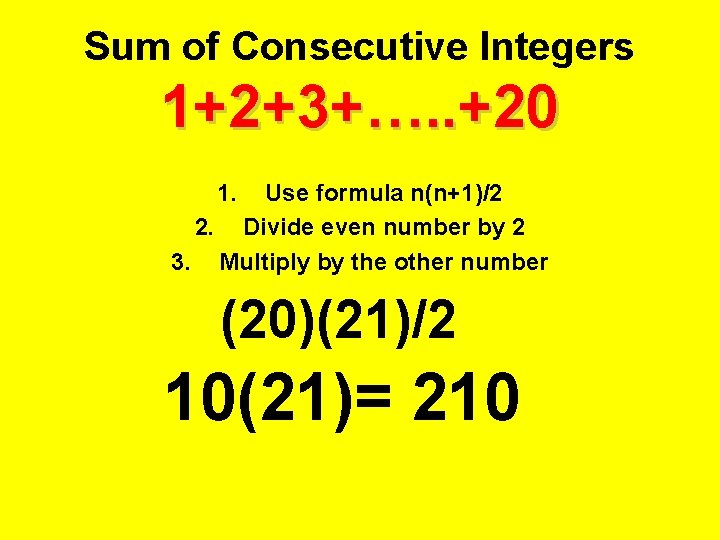
Sum of Consecutive Integers 1+2+3+…. . +20 1. Use formula n(n+1)/2 2. Divide even number by 2 3. Multiply by the other number (20)(21)/2 10(21)= 210
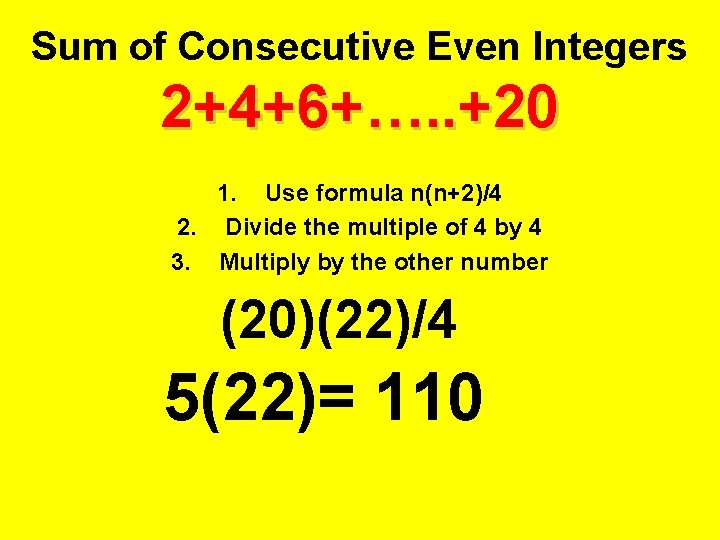
Sum of Consecutive Even Integers 2+4+6+…. . +20 1. Use formula n(n+2)/4 2. Divide the multiple of 4 by 4 3. Multiply by the other number (20)(22)/4 5(22)= 110
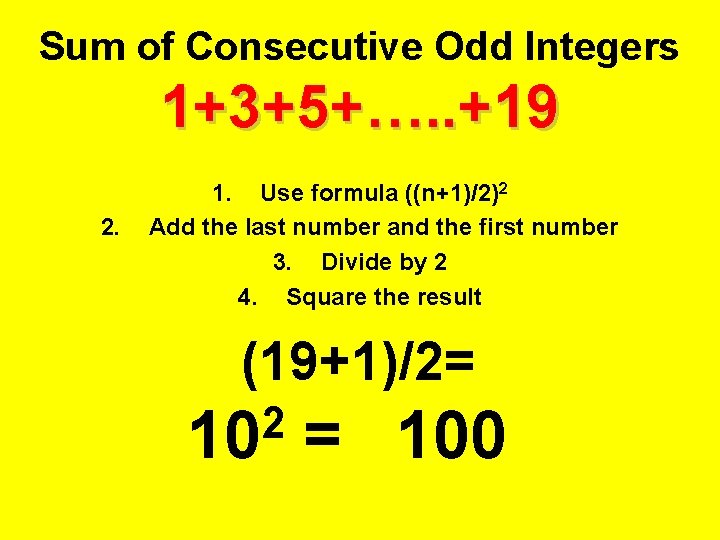
Sum of Consecutive Odd Integers 1+3+5+…. . +19 2. 1. Use formula ((n+1)/2)2 Add the last number and the first number 3. Divide by 2 4. Square the result (19+1)/2= 2 10 = 100
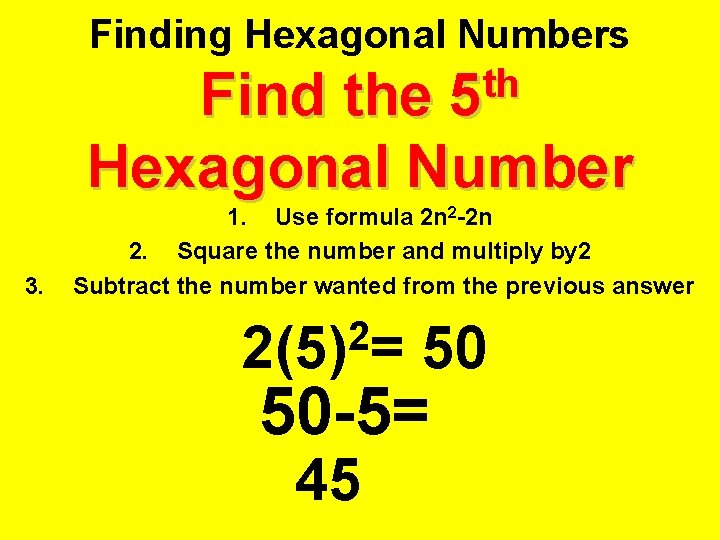
Finding Hexagonal Numbers th Find the 5 Hexagonal Number 3. 1. Use formula 2 n 2 -2 n 2. Square the number and multiply by 2 Subtract the number wanted from the previous answer 2 2(5) = 50 50 -5= 45
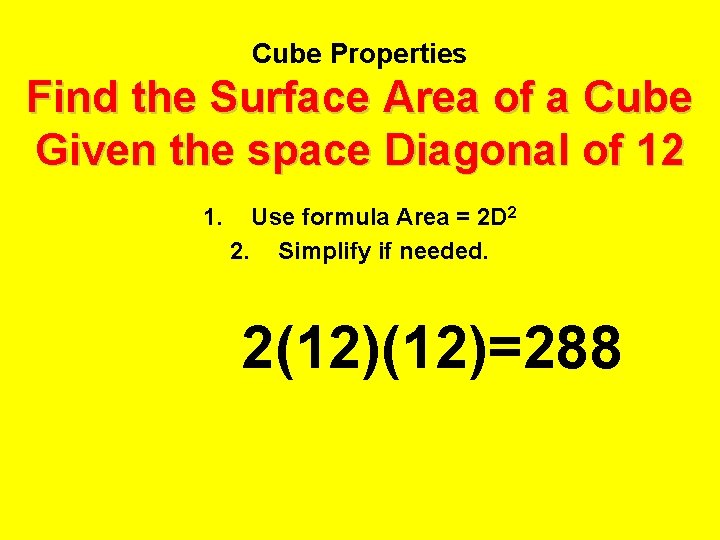
Cube Properties Find the Surface Area of a Cube Given the space Diagonal of 12 1. Use formula Area = 2 D 2 2. Simplify if needed. 2(12)=288
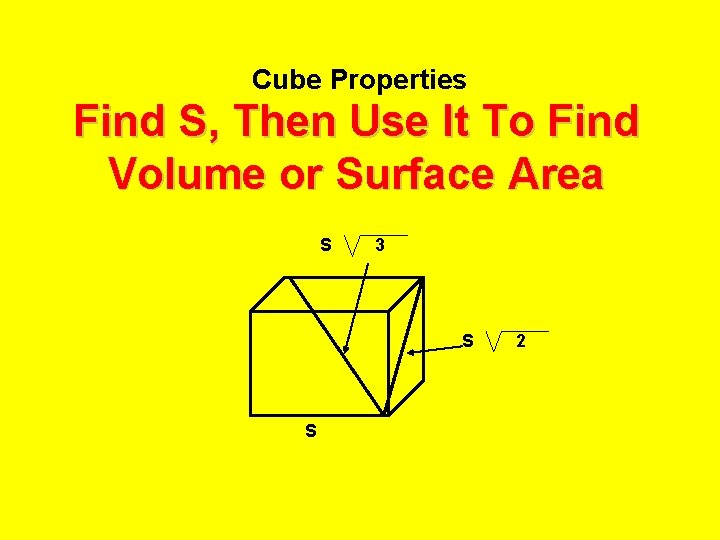
Cube Properties Find S, Then Use It To Find Volume or Surface Area S 3 S S 2
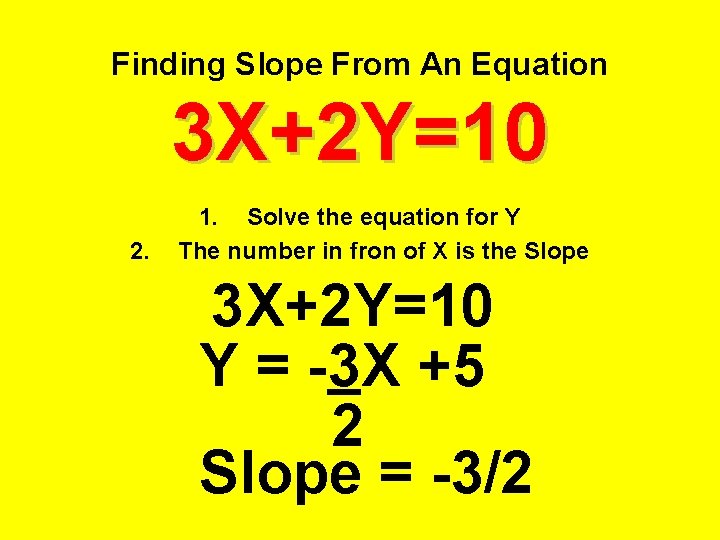
Finding Slope From An Equation 3 X+2 Y=10 2. 1. Solve the equation for Y The number in fron of X is the Slope 3 X+2 Y=10 Y = -3 X +5 2 Slope = -3/2
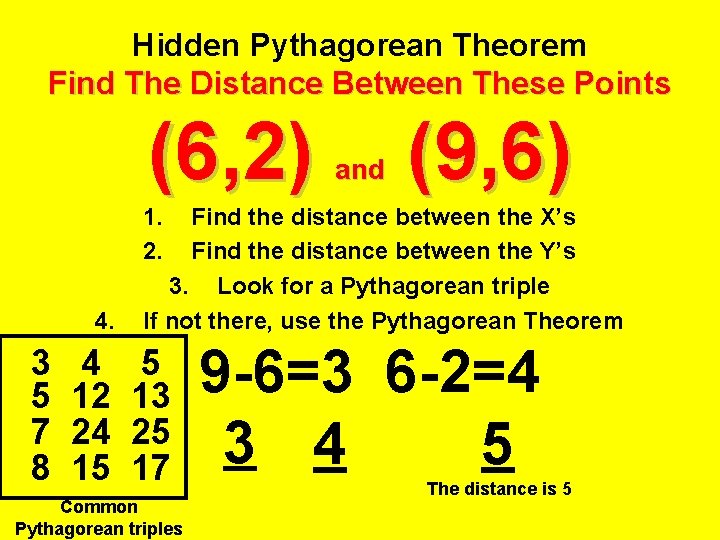
Hidden Pythagorean Theorem Find The Distance Between These Points (6, 2) and (9, 6) 1. 2. 4. 3 5 7 8 4 12 24 15 Find the distance between the X’s Find the distance between the Y’s 3. Look for a Pythagorean triple If not there, use the Pythagorean Theorem 5 13 25 17 Common Pythagorean triples 9 -6=3 6 -2=4 3 4 5 The distance is 5
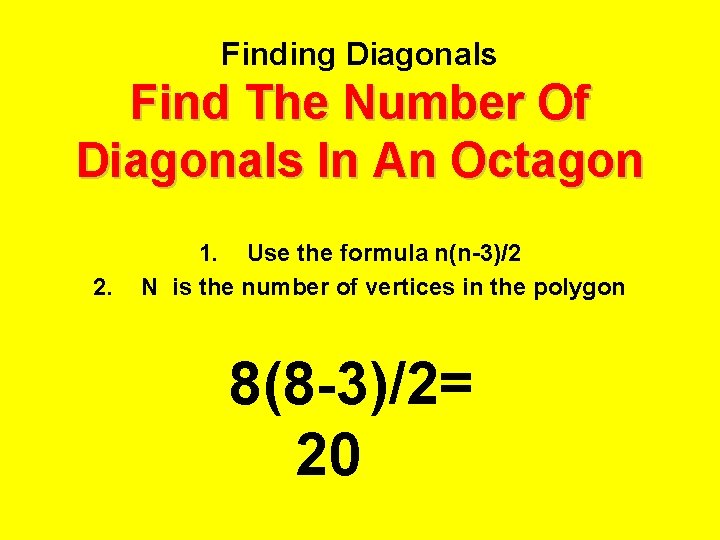
Finding Diagonals Find The Number Of Diagonals In An Octagon 2. 1. Use the formula n(n-3)/2 N is the number of vertices in the polygon 8(8 -3)/2= 20
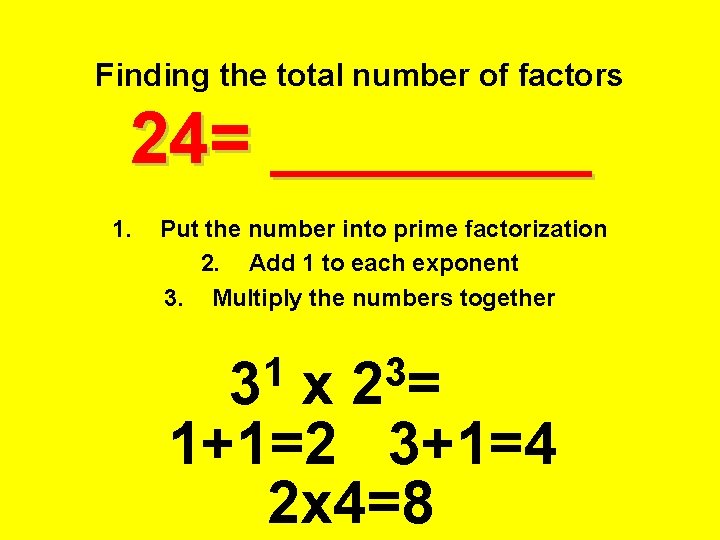
Finding the total number of factors 24= ____ 1. Put the number into prime factorization 2. Add 1 to each exponent 3. Multiply the numbers together 1 3 3 2= x 1+1=2 3+1=4 2 x 4=8
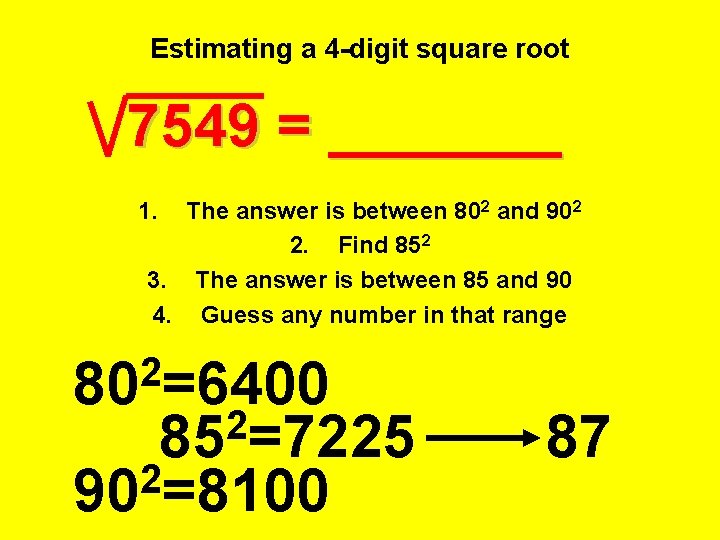
Estimating a 4 -digit square root 7549 = _______ 1. The answer is between 802 and 902 2. Find 852 3. The answer is between 85 and 90 4. Guess any number in that range 2 80 =6400 2 85 =7225 2 90 =8100 87
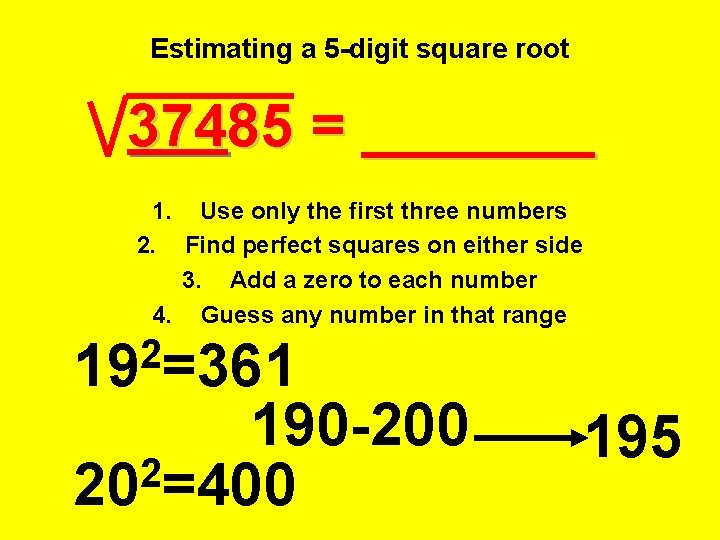
Estimating a 5 -digit square root 37485 = _______ 1. Use only the first three numbers 2. Find perfect squares on either side 3. Add a zero to each number 4. Guess any number in that range 2 19 =361 190 -200 2 20 =400 195
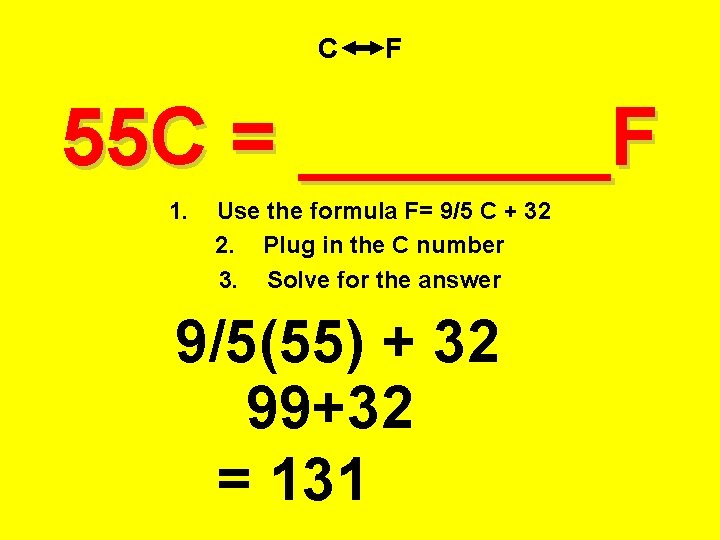
C F 55 C = _______F 1. Use the formula F= 9/5 C + 32 2. Plug in the C number 3. Solve for the answer 9/5(55) + 32 99+32 = 131
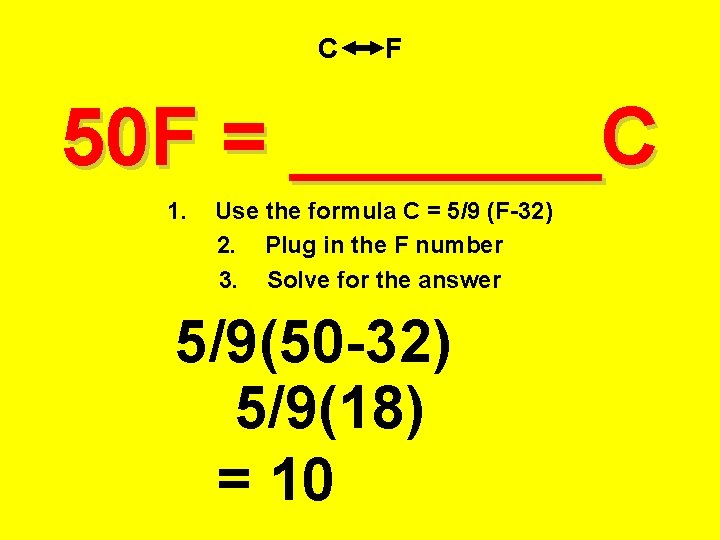
C F 50 F = _______C 1. Use the formula C = 5/9 (F-32) 2. Plug in the F number 3. Solve for the answer 5/9(50 -32) 5/9(18) = 10
2 -Digit Number Times 1001 87 x 1001 2. 1. 87 times 1 Put a zero in the middle 3. 87 x 1 87 0 87 87087
Finding The Product of the Roots 2 4 X a 2. + 5 X + 6 b c 1. Use the formula c/a Substitute in the coefficients 3. Find answer 6 / 4 = 3/2
Finding The Sum of the Roots 2 4 X +5 X+6=0 a b 2. 1. Use the formula -b/a Substitute in the coefficients 3. Find answer -5 / 4 c
Estimation 999999 Rule 142857 x 26 = 1. Divide 26 by 7 to get the first digit 2. Take the remainder and add a zero 3. Divide by 7 again to get the next number 4. Find the number in 142857 and copy in a circle 26/7 =3 r 5 5+0=50/7=7 3 714285
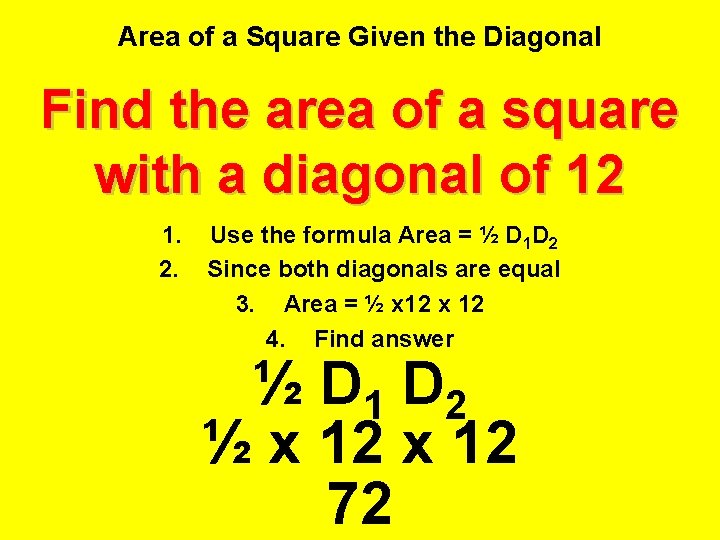
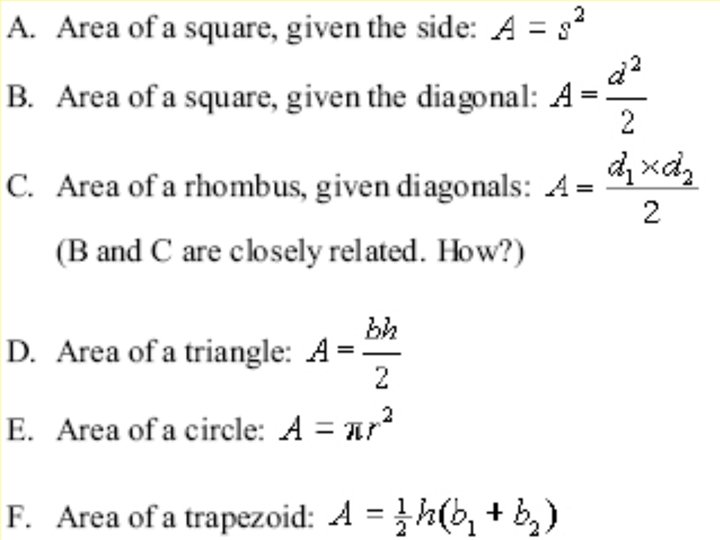
Area of a Square Given the Diagonal Find the area of a square with a diagonal of 12 1. 2. Use the formula Area = ½ D 1 D 2 Since both diagonals are equal 3. Area = ½ x 12 4. Find answer ½ D 1 D 2 ½ x 12 72
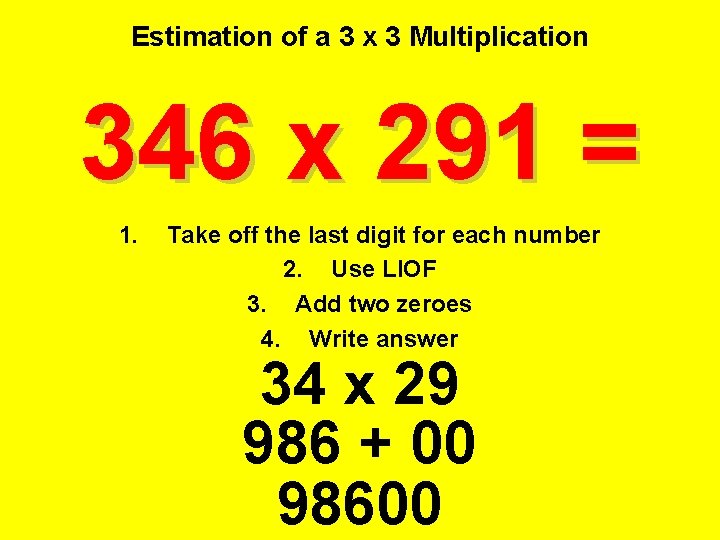
Estimation of a 3 x 3 Multiplication 346 x 291 = 1. Take off the last digit for each number 2. Use LIOF 3. Add two zeroes 4. Write answer 34 x 29 986 + 00 98600
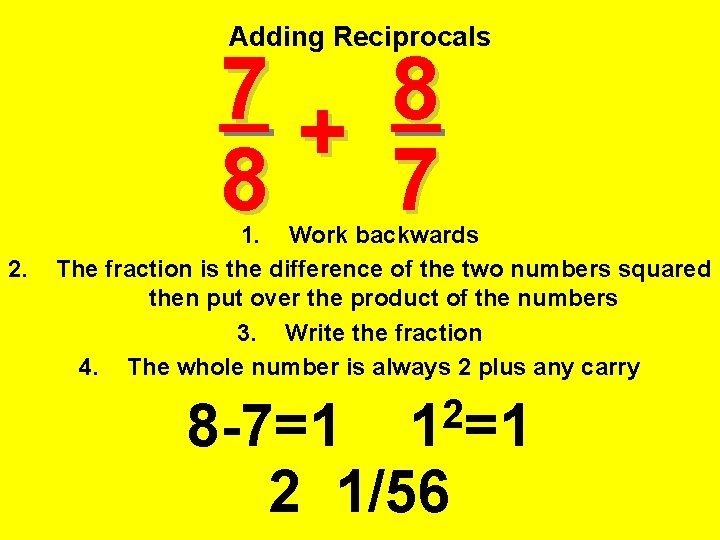
Adding Reciprocals 7+ 8 2. 8 7 1. Work backwards The fraction is the difference of the two numbers squared then put over the product of the numbers 3. Write the fraction 4. The whole number is always 2 plus any carry 2 1 =1 8 -7=1 2 1/56
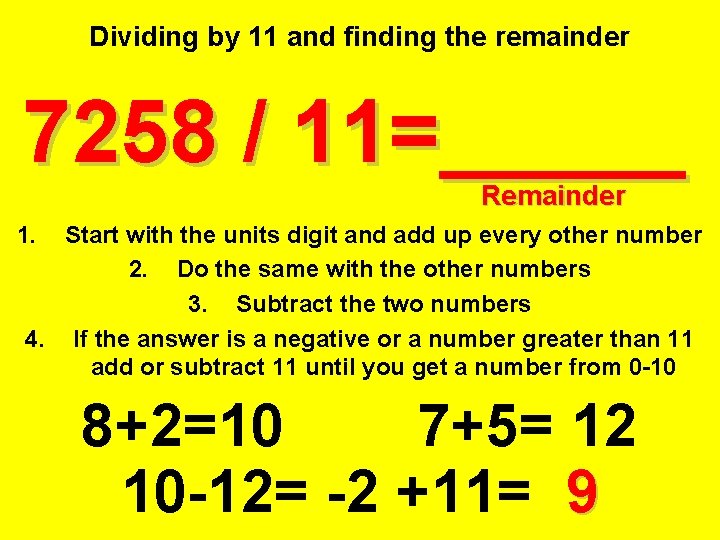
Dividing by 11 and finding the remainder 7258 / 11=_____ Remainder 1. Start with the units digit and add up every other number 2. Do the same with the other numbers 3. Subtract the two numbers 4. If the answer is a negative or a number greater than 11 add or subtract 11 until you get a number from 0 -10 8+2=10 7+5= 12 10 -12= -2 +11= 9
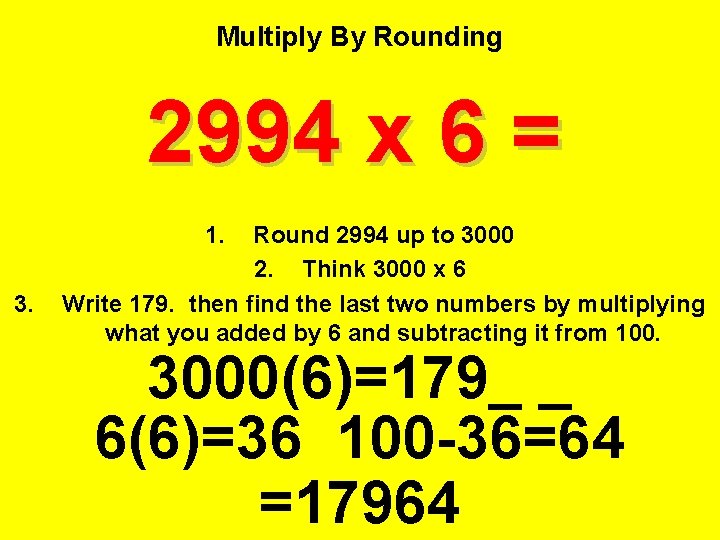
Multiply By Rounding 2994 x 6 = 1. 3. Round 2994 up to 3000 2. Think 3000 x 6 Write 179. then find the last two numbers by multiplying what you added by 6 and subtracting it from 100. 3000(6)=179_ _ 6(6)=36 100 -36=64 =17964
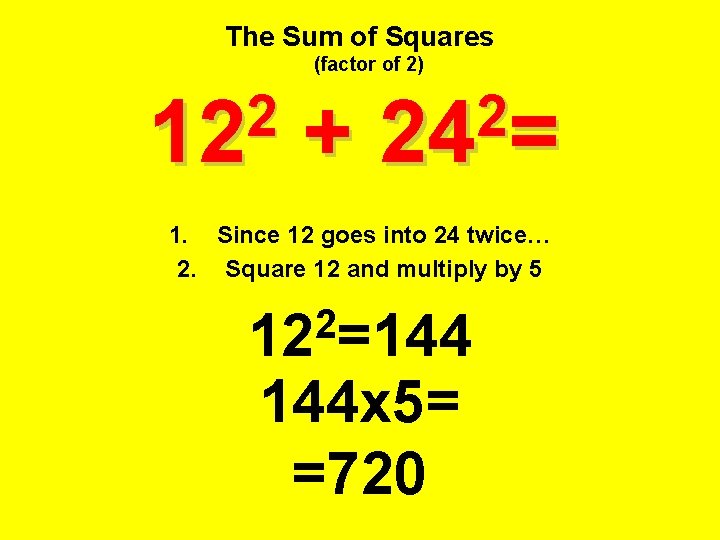
The Sum of Squares (factor of 2) 2 12 + 2 24 = 1. Since 12 goes into 24 twice… 2. Square 12 and multiply by 5 2 12 =144 144 x 5= =720
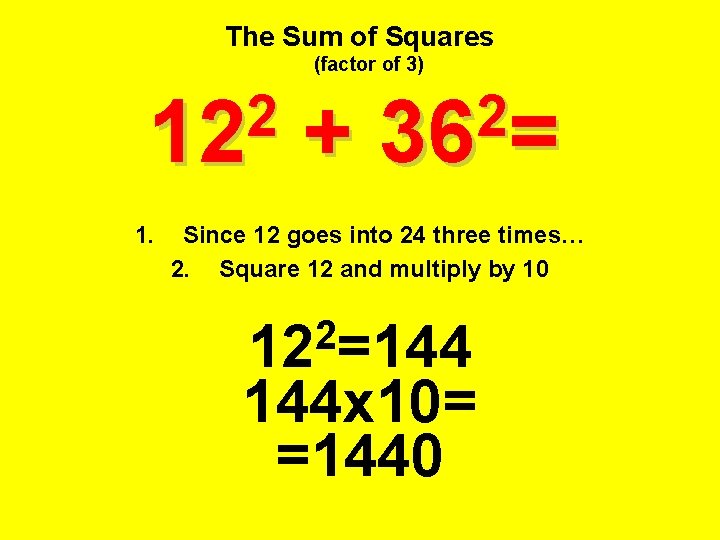
The Sum of Squares (factor of 3) 2 12 1. + 2 36 = Since 12 goes into 24 three times… 2. Square 12 and multiply by 10 2 12 =144 144 x 10= =1440
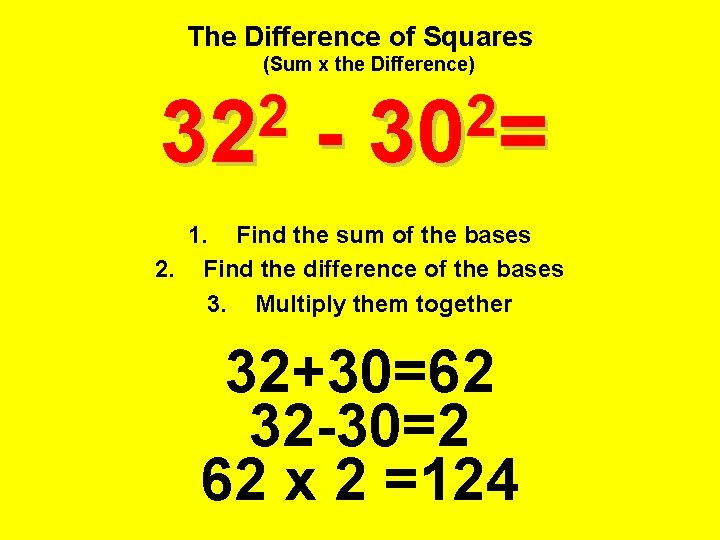
The Difference of Squares (Sum x the Difference) 2 32 - 2 30 = 1. Find the sum of the bases 2. Find the difference of the bases 3. Multiply them together 32+30=62 32 -30=2 62 x 2 =124
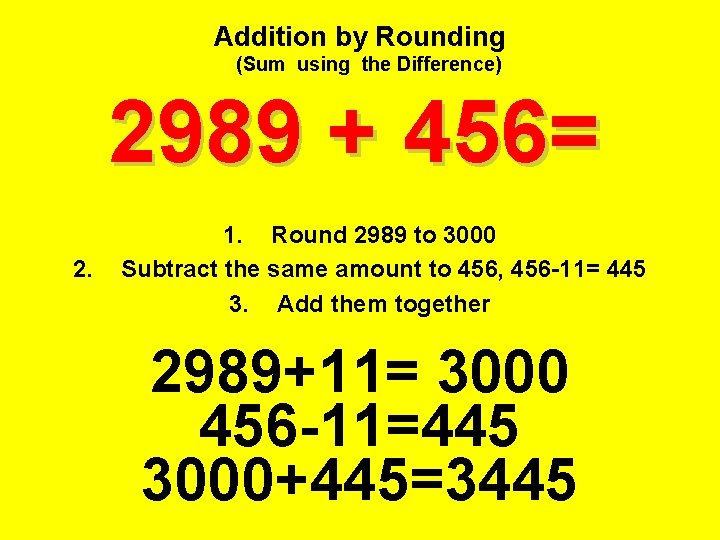
Addition by Rounding (Sum using the Difference) 2989 + 456= 2. 1. Round 2989 to 3000 Subtract the same amount to 456, 456 -11= 445 3. Add them together 2989+11= 3000 456 -11=445 3000+445=3445
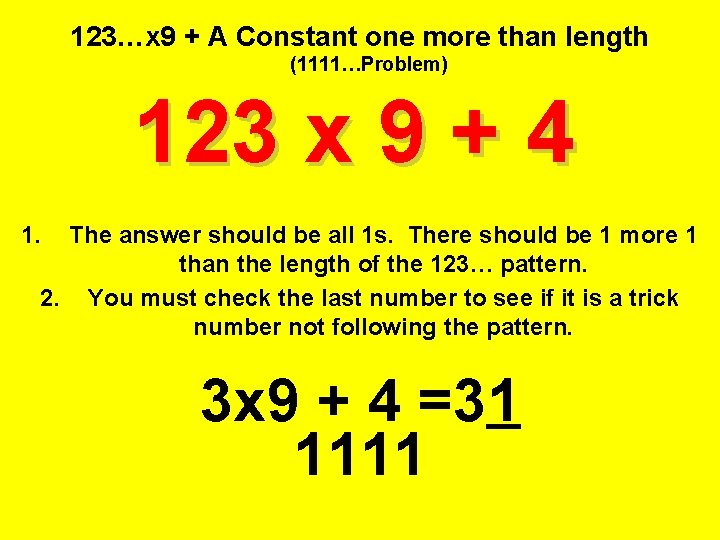
123…x 9 + A Constant one more than length (1111…Problem) 123 x 9 + 4 1. The answer should be all 1 s. There should be 1 more 1 than the length of the 123… pattern. 2. You must check the last number to see if it is a trick number not following the pattern. 3 x 9 + 4 =31 1111
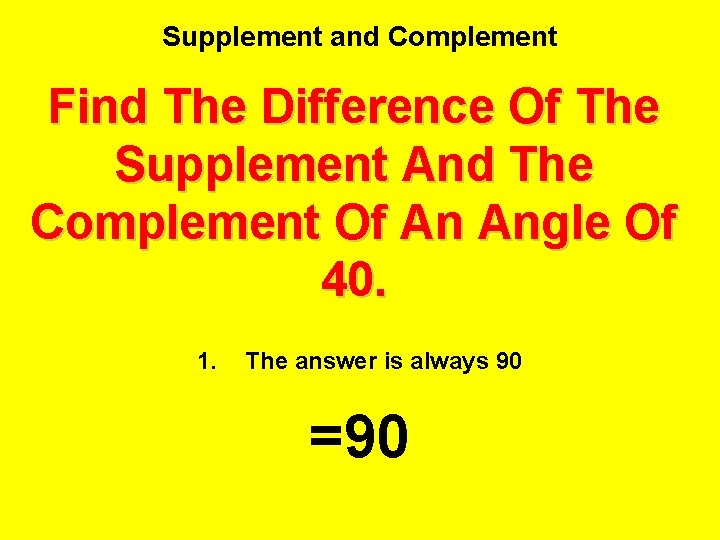
Supplement and Complement Find The Difference Of The Supplement And The Complement Of An Angle Of 40. 1. The answer is always 90 =90
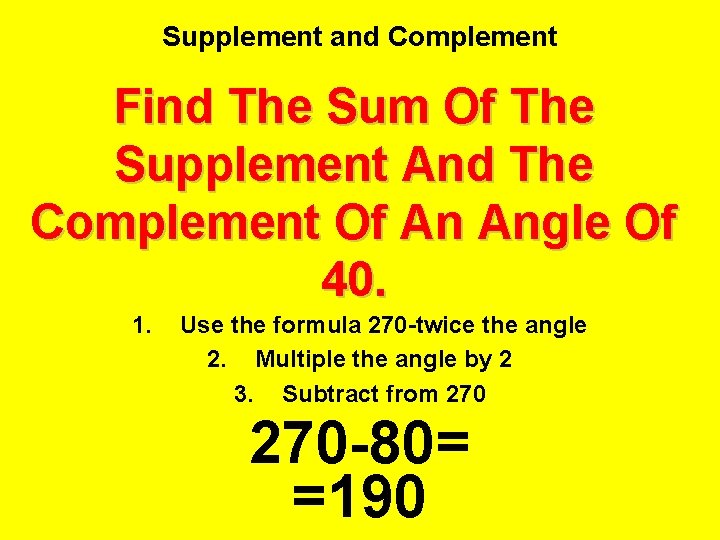
Supplement and Complement Find The Sum Of The Supplement And The Complement Of An Angle Of 40. 1. Use the formula 270 -twice the angle 2. Multiple the angle by 2 3. Subtract from 270 -80= =190
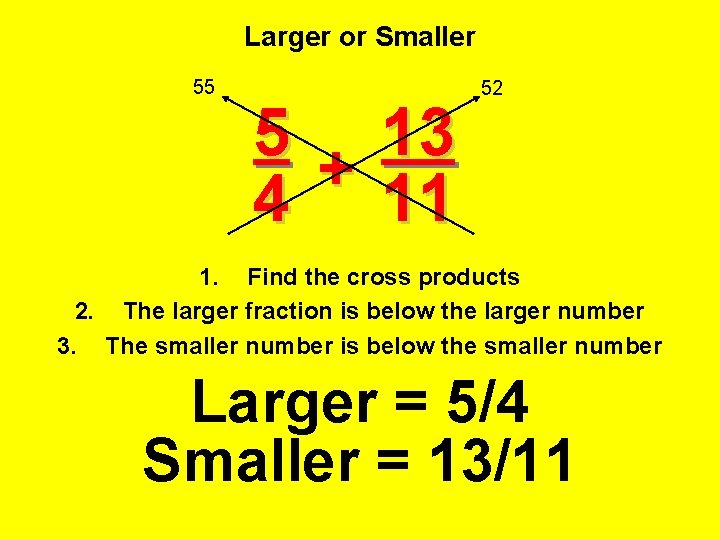
Larger or Smaller 55 5 13 + 4 11 52 1. Find the cross products 2. The larger fraction is below the larger number 3. The smaller number is below the smaller number Larger = 5/4 Smaller = 13/11
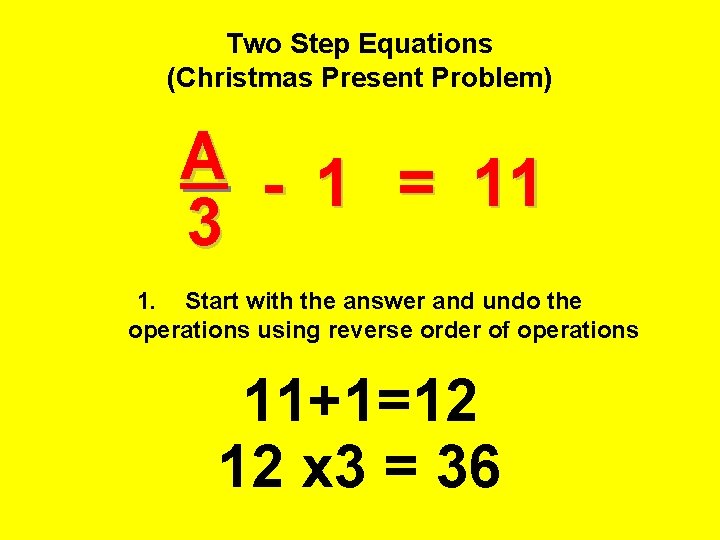
Two Step Equations (Christmas Present Problem) A - 1 = 11 3 1. Start with the answer and undo the operations using reverse order of operations 11+1=12 12 x 3 = 36
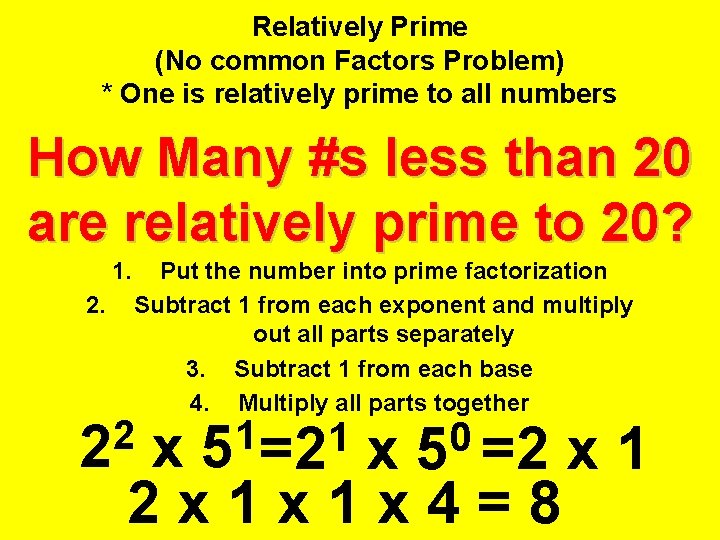
Relatively Prime (No common Factors Problem) * One is relatively prime to all numbers How Many #s less than 20 are relatively prime to 20? 1. 2. Put the number into prime factorization Subtract 1 from each exponent and multiply out all parts separately 3. Subtract 1 from each base 4. Multiply all parts together 2 2 1 1 5 =2 x x x 1 2 x 1 x 1 x 4=8 0 5 =2
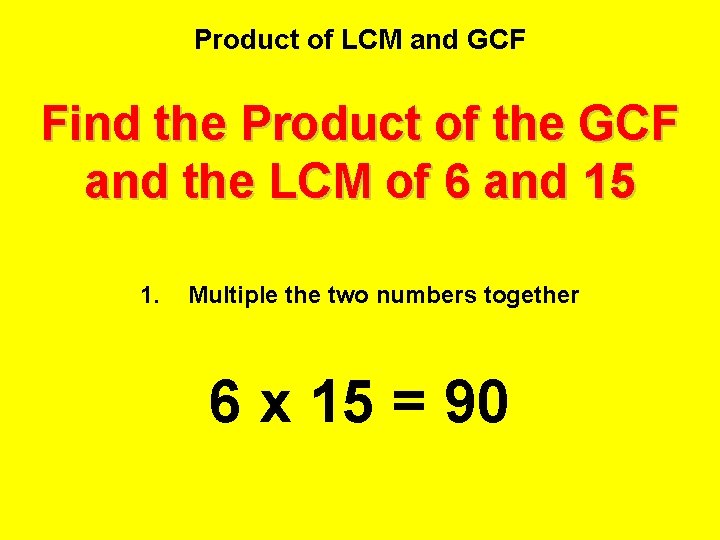
Product of LCM and GCF Find the Product of the GCF and the LCM of 6 and 15 1. Multiple the two numbers together 6 x 15 = 90
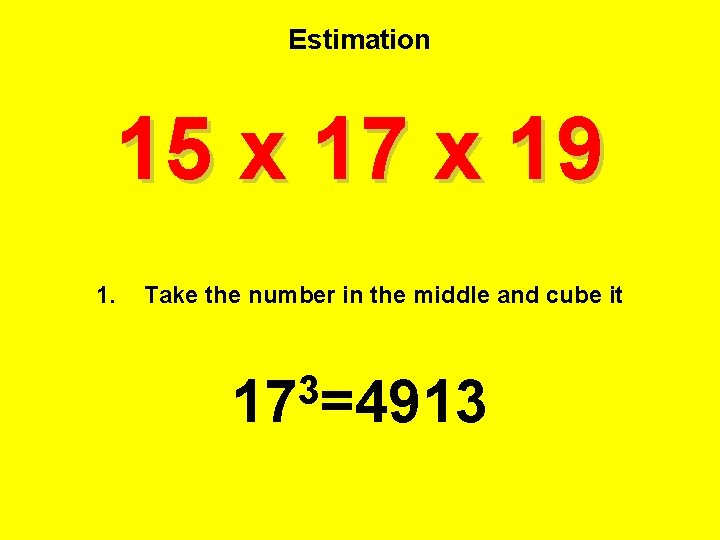
Estimation 15 x 17 x 19 1. Take the number in the middle and cube it 3 17 =4913
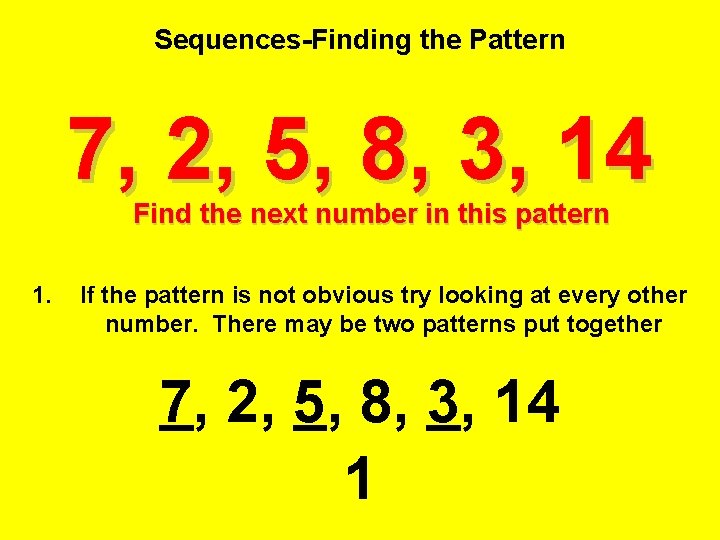
Sequences-Finding the Pattern 7, 2, 5, 8, 3, 14 Find the next number in this pattern 1. If the pattern is not obvious try looking at every other number. There may be two patterns put together 7, 2, 5, 8, 3, 14 1
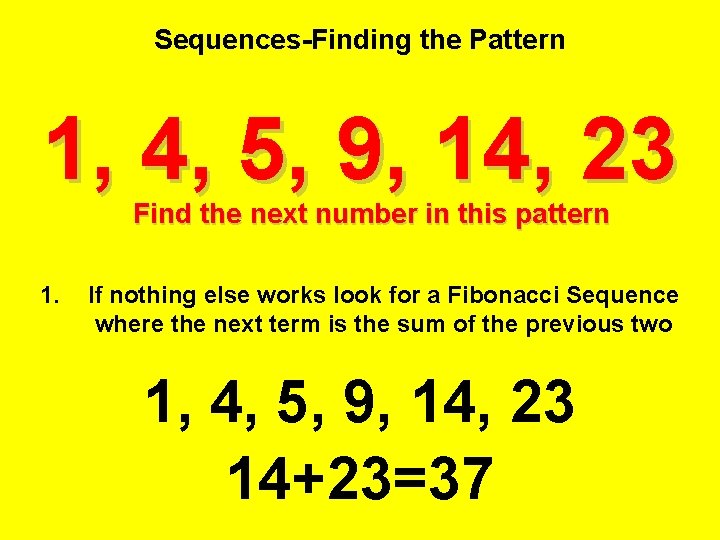
Sequences-Finding the Pattern 1, 4, 5, 9, 14, 23 Find the next number in this pattern 1. If nothing else works look for a Fibonacci Sequence where the next term is the sum of the previous two 1, 4, 5, 9, 14, 23 14+23=37
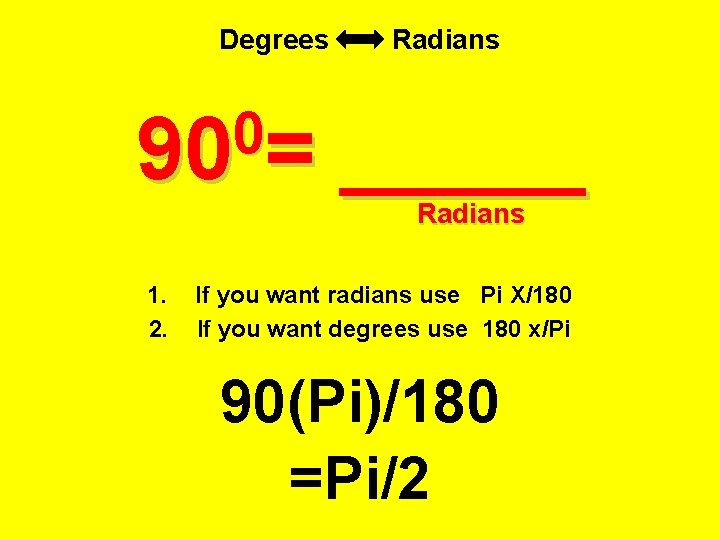
Degrees 0 90 = 1. 2. Radians _____ Radians If you want radians use Pi X/180 If you want degrees use 180 x/Pi 90(Pi)/180 =Pi/2
- Slides: 99