
This has been prepared for general use please
This has been prepared for general use, please adapt to fit your organization’s branding, templates and individual purposes Please note: indicated throughout areas where you can insert your organization’s and target employer organization’s names to tailor this material, please amend as appropriate Migraine Wellness Initiative Goals & Milestones Guide This document intends to help advocacy groups align with employer partners on the best goals and milestones based on migraine wellness program needs, timing, scale, and preferred tactics. The following worksheet slides are meant to be converted to PDF documents once reviewed and incorporated as templates for the AG to fill out with or without the employer
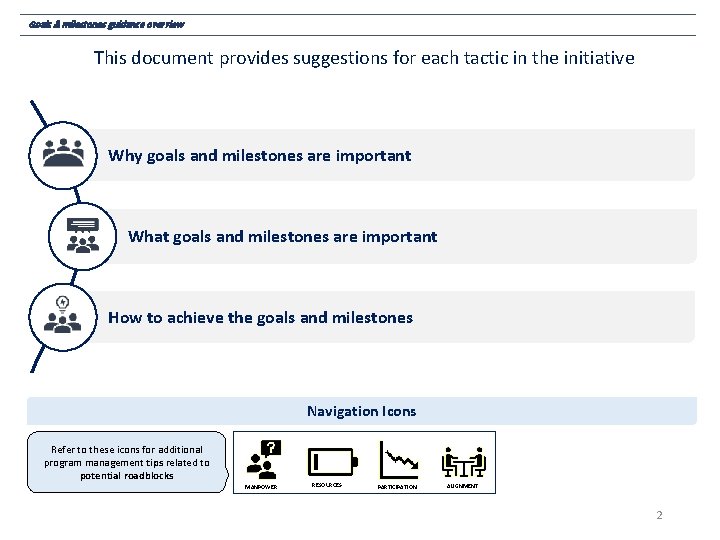
Goals & milestones guidance overview This document provides suggestions for each tactic in the initiative Why goals and milestones are important What goals and milestones are important How to achieve the goals and milestones Navigation Icons Refer to these icons for additional program management tips related to potential roadblocks MANPOWER RESOURCES PARTICIPATION ALIGNMENT 2
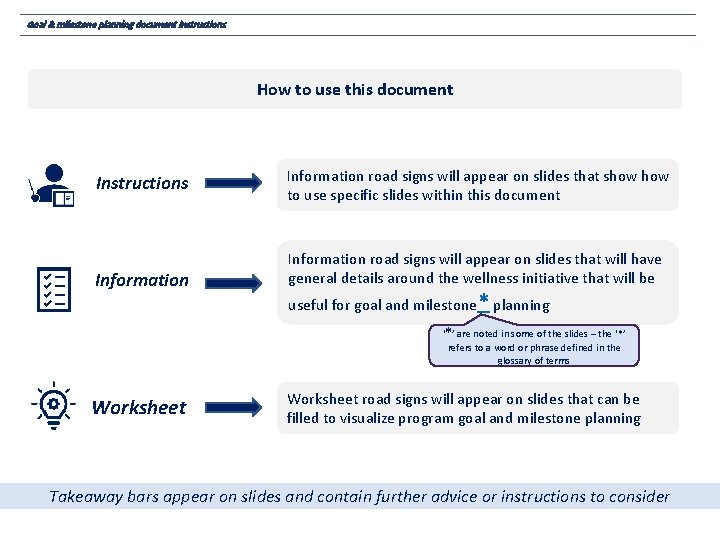
Goal & milestone planning document instructions How to use this document Instructions Information road signs will appear on slides that show to use specific slides within this document Information road signs will appear on slides that will have general details around the wellness initiative that will be useful for goal and milestone* planning ‘*’ are noted in some of the slides – the ‘*’ refers to a word or phrase defined in the glossary of terms Worksheet road signs will appear on slides that can be filled to visualize program goal and milestone planning Takeaway bars appear on slides and contain further advice or instructions to consider
Information Table of contents • Goals & milestones planning timelines • Workplace initiative proposed timeline details • Content map for goals and milestones • Road map for goals and milestones • • • Sharing goals of the advocacy group with the employer partner Evaluation of resources for goals SWOT Analysis Determining milestones Final alignment for goals, milestones, metrics, and tactics • Glossary of terms
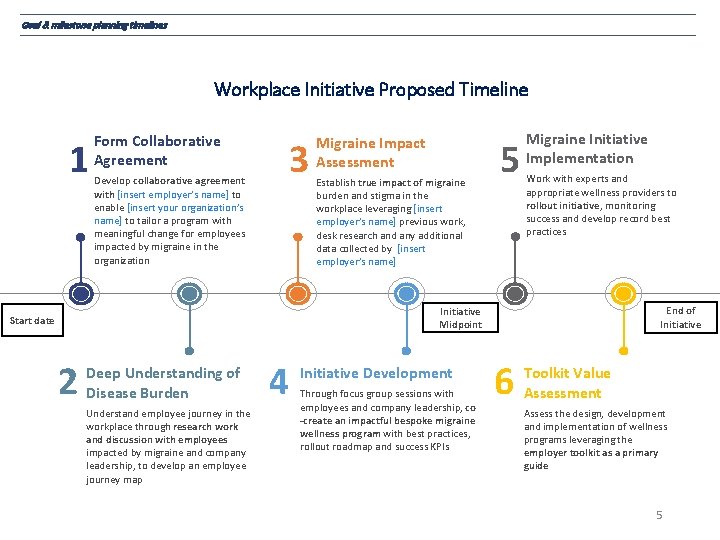
Goal & milestone planning timelines Workplace Initiative Proposed Timeline 1 Form Collaborative Agreement Develop collaborative agreement with [insert employer’s name] to enable [insert your organization’s name] to tailor a program with meaningful change for employees impacted by migraine in the organization 3 Migraine Impact Assessment Establish true impact of migraine burden and stigma in the workplace leveraging [insert employer’s name] previous work, desk research and any additional data collected by [insert employer’s name] 5 Migraine Initiative Implementation Work with experts and appropriate wellness providers to rollout initiative, monitoring success and develop record best practices End of Initiative Midpoint Start date 2 Deep Understanding of Disease Burden Understand employee journey in the workplace through research work and discussion with employees impacted by migraine and company leadership, to develop an employee journey map 4 Initiative Development Through focus group sessions with employees and company leadership, co -create an impactful bespoke migraine wellness program with best practices, rollout roadmap and success KPIs 6 Toolkit Value Assessment Assess the design, development and implementation of wellness programs leveraging the employer toolkit as a primary guide 5
Information Table of contents • Goals & milestones planning timelines • Workplace initiative proposed timeline details • Content map for goals and milestones • Road map for goals and milestones • • • Sharing goals of the advocacy group with the employer partner Evaluation of resources for goals SWOT Analysis Determining milestones Final alignment for goals, milestones, metrics, and tactics • Glossary of terms
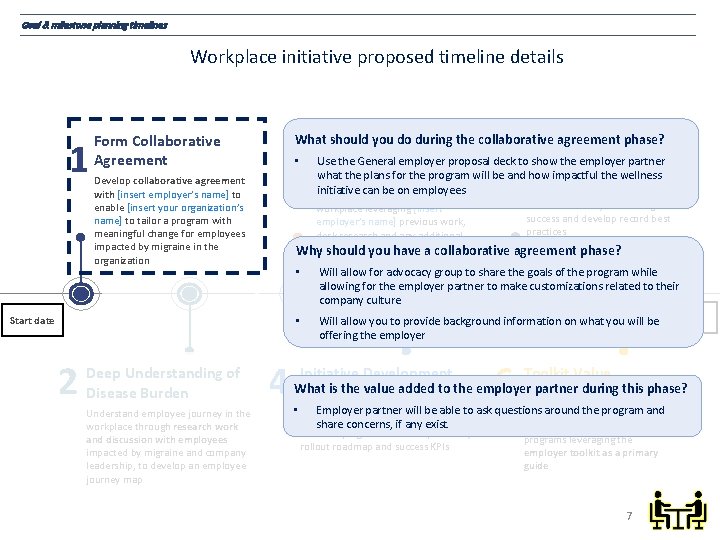
Goal & milestone planning timelines Workplace initiative proposed timeline details 1 Form Collaborative Agreement Develop collaborative agreement with [insert employer’s name] to enable [insert your organization’s name] to tailor a program with meaningful change for employees impacted by migraine in the organization What should you do during the collaborative agreement phase? Migraine Initiative Migraine Impact 3 • what the plans for the program will be and Work how impactful the wellness with experts and Establish true impact of migraine initiative be on appropriate wellness providers to burden andcan stigma in employees the rollout initiative, monitoring workplace leveraging [insert success and develop record best employer’s name] previous work, practices desk research and any additional collected by have [inserta collaborative agreement phase? Whydata should you employer’s name] Start date 2 Deep Understanding of Disease Burden Understand employee journey in the workplace through research work and discussion with employees impacted by migraine and company leadership, to develop an employee journey map 5 Use the General employer proposal deck to. Implementation show the employer partner Assessment 4 • Will allow for advocacy group to share the goals of the program while allowing for the employer partner to make customizations related to their company culture • Will allow you to provide. Midpoint background information on what you will be Initiative offering the employer End of Initiative Development 6 Toolkit Value What is focus the value addedwith to the employer partner during this phase? Through group sessions Assessment andpartner company leadership, coask questions around the program and • employees Employer will be able to Assess the design, development -create an impactful bespoke migraine share concerns, if any exist. and implementation of wellness program with best practices, rollout roadmap and success KPIs programs leveraging the employer toolkit as a primary guide 7
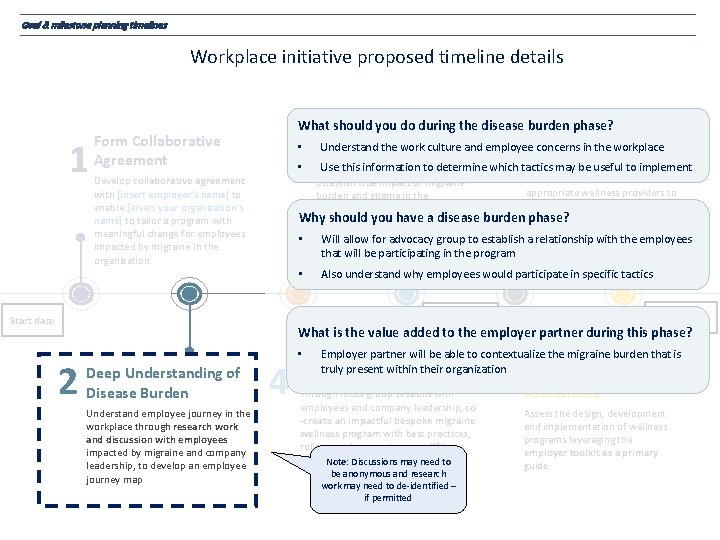
Goal & milestone planning timelines Workplace initiative proposed timeline details 1 Form Collaborative Agreement Develop collaborative agreement with [insert employer’s name] to enable [insert your organization’s name] to tailor a program with meaningful change for employees impacted by migraine in the organization What should you do during the disease burden phase? 3 • • Migraine Initiative Migraine Understand Impact the work culture and employee concerns in the workplace Implementation Assessment Use this information to determine which tactics may be useful to implement 5 Work with experts and Establish true impact of migraine appropriate wellness providers to burden and stigma in the rollout initiative, monitoring workplace leveraging [insert Why should you have a disease burden phase? success and develop record best employer’s name] previous work, practices any additional • desk Willresearch allow forand advocacy group to establish a relationship with the employees data collected by [insert that will be participating in the program employer’s name] • Also understand why employees would participate in specific tactics End of Initiative Midpoint Start date What is the value added to the employer partner during this phase? 2 Deep Understanding of Disease Burden Understand employee journey in the workplace through research work and discussion with employees impacted by migraine and company leadership, to develop an employee journey map 4 Employer partner will be able to contextualize the migraine burden that is truly present within their organization Toolkit Value Initiative Development • Through focus group sessions with employees and company leadership, co -create an impactful bespoke migraine wellness program with best practices, rollout roadmap and success KPIs Note: Discussions may need to be anonymous and research work may need to de-identified – if permitted 6 Assessment Assess the design, development and implementation of wellness programs leveraging the employer toolkit as a primary guide
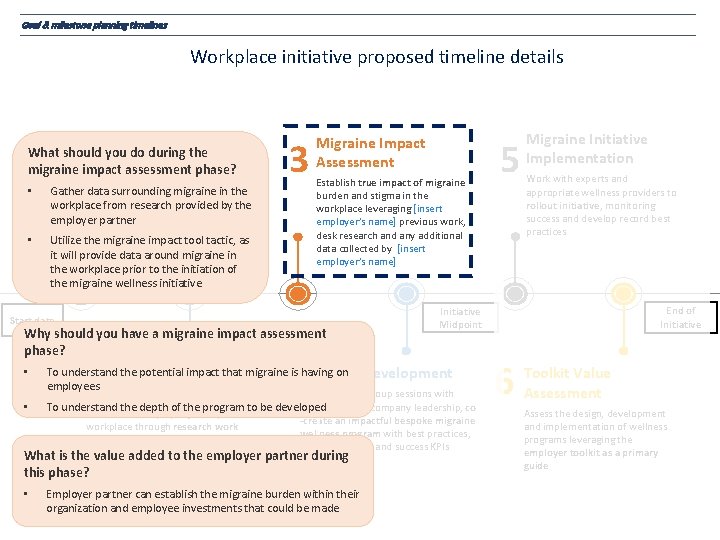
Goal & milestone planning timelines Workplace initiative proposed timeline details 1 Form Collaborative What should you do during the Agreement migraine impact assessment phase? • • Develop collaborative agreement Gather data migraine in the withsurrounding [insert employer’s name] to workplace from[insert research by the enable yourprovided organization’s employername] partner to tailor a program with meaningful change for employees Utilize the migraine impact tool tactic, as impacted by migraine in the it will provide data around migraine in organization 1 3 the workplace prior to the initiation of the migraine wellness initiative Migraine Impact Assessment Establish true impact of migraine burden and stigma in the workplace leveraging [insert employer’s name] previous work, desk research and any additional data collected by [insert employer’s name] Start date Why should you have a migraine impact assessment phase? • 2 4 To understand potential impact that having on Deepthe Understanding of migraine is Initiative employees Disease Burden Employer partner can establish the migraine burden within their organization and employee investments that could be made Work with experts and appropriate wellness providers to rollout initiative, monitoring success and develop record best practices End of Initiative Midpoint Development Through focus group sessions with • To understand the depth of the program to be developed employees and company leadership, co Understand employee journey in the -create an impactful bespoke migraine workplace through research work wellness program with best practices, and discussion with employees rollout roadmap and success KPIs by migraine and company What is theimpacted value added to the employer partner during leadership, to develop an employee this phase? journey map • 5 Migraine Initiative Implementation 6 Toolkit Value Assessment Assess the design, development and implementation of wellness programs leveraging the employer toolkit as a primary guide
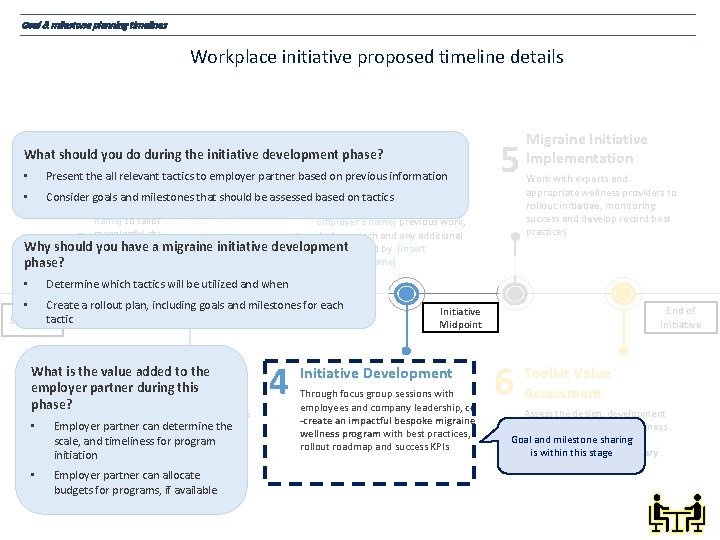
Goal & milestone planning timelines Workplace initiative proposed timeline details 1 Form Collaborative 3 Migraine Impact Assessment What should. Agreement you do during the initiative development phase? Present the all relevant tactics agreement to employer partner based on previous information Develop collaborative Establish true impact of migraine • • with [insert employer’sthat name] to be assessed based burdenon and stigma in the Consider goals and milestones should tactics • Determine which tactics will be utilized and when • Create a rollout plan, including goals and milestones for each 5 enable [insert your organization’s workplace leveraging [insert name] to tailor a program with employer’s name] previous work, meaningful change for employees desk research and any additional by migraine in theinitiative development Why should impacted you have a migraine data collected by [insert organization employer’s name] phase? tactic Start date 2 What is the value added to the of Deep Understanding employer. Disease partner during this Burden phase? Understand employee journey in the • workplace research work Employer partnerthrough can determine the and discussion with employees scale, and timeliness for program impacted by migraine and company initiation • Employer partner journey mapcan allocate budgets for programs, if available leadership, to develop an employee 4 Migraine Initiative Implementation Work with experts and appropriate wellness providers to rollout initiative, monitoring success and develop record best practices End of Initiative Midpoint Initiative Development Through focus group sessions with employees and company leadership, co -create an impactful bespoke migraine wellness program with best practices, rollout roadmap and success KPIs 6 Toolkit Value Assessment Assess the design, development and implementation of wellness Goal and milestone sharing programs leveraging the is within toolkit this stage employer as a primary guide
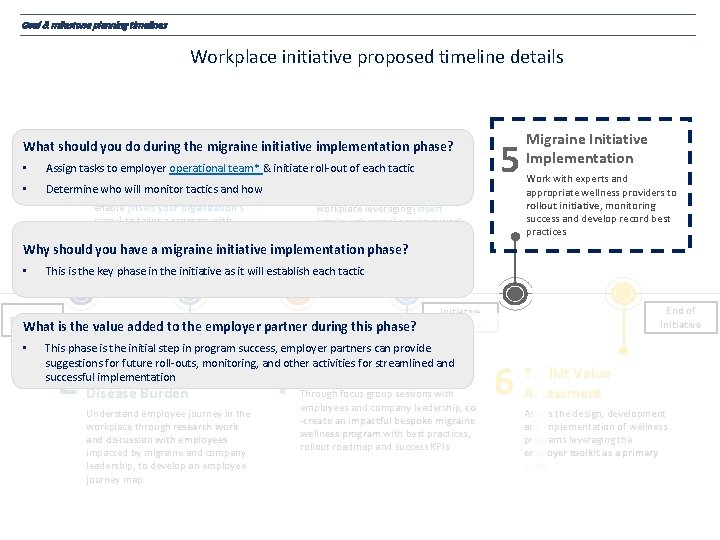
Goal & milestone planning timelines Workplace initiative proposed timeline details Collaborative Migraine Impact What should. Form you do during the migraine initiative implementation phase? • 1 Agreement 3 Assessment Assign tasks to employer operational team* & initiate roll-out of each tactic Develop collaborative agreement Establish true impact of migraine • Determinewith who[insert will monitor tactics and employer’s name] tohow burden and stigma in the enable [insert your organization’s workplace leveraging [insert name] to tailor a program with employer’s name] previous work, meaningful change for employees desk research and any additional impacted by migraine in the data collected by [insert Why should you have a migraine initiative implementation phase? organization employer’s name] 1 • 3 Work with experts and appropriate wellness providers to rollout initiative, monitoring success and develop record best practices This is the key phase in the initiative as it will establish each tactic Start date What is the value added to the employer partner during this phase? • 5 Migraine Initiative Implementation This phase is the initial step in program success, employer partners can provide suggestions for future roll-outs, monitoring, and other activities for streamlined and Deep Understanding of Initiative Development successful implementation 2 Disease Burden Understand employee journey in the workplace through research work and discussion with employees impacted by migraine and company leadership, to develop an employee journey map 4 End of Initiative Midpoint Through focus group sessions with employees and company leadership, co -create an impactful bespoke migraine wellness program with best practices, rollout roadmap and success KPIs 6 Toolkit Value Assessment Assess the design, development and implementation of wellness programs leveraging the employer toolkit as a primary guide
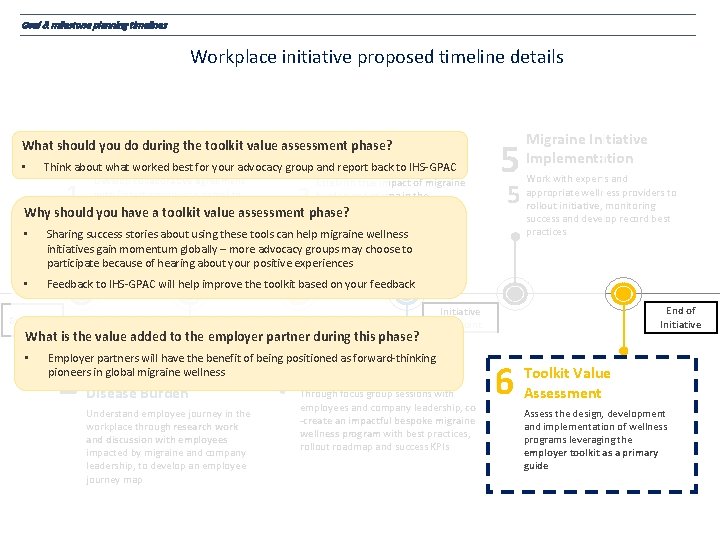
Goal & milestone planning timelines Workplace initiative proposed timeline details Migraine Impact What should. Form you do. Collaborative during the toolkit value assessment phase? • 1 3 Agreement Think about what worked best for your advocacy group Assessment and report back to IHS-GPAC Develop collaborative agreement Establish true impact of migraine with [insert employer’s name] to burden and stigma in the enable [insert your organization’s workplace leveraging [insert Why should name] you have a toolkit value assessment phase? to tailor a program with employer’s name] previous work, meaningful change forusing employees • Sharing success stories about these tools can helpdesk migraine wellness research and any additional impacted by migraine in the data collected by [insert initiatives gain momentum globally – more advocacy groups may choose to organization employer’s name] participate because of hearing about your positive experiences 1 • 3 5 Work with experts and appropriate wellness providers to rollout initiative, monitoring success and develop record best practices Feedback to IHS-GPAC will help improve the toolkit based on your feedback Start date What is the value added to the employer partner during this phase? • 5 Migraine Initiative Implementation Employer partners will have the benefit of being positioned as forward-thinking pioneers. Deep in global migraine wellness of Understanding Initiative Development 2 Disease Burden Understand employee journey in the workplace through research work and discussion with employees impacted by migraine and company leadership, to develop an employee journey map 4 End of Initiative Midpoint Through focus group sessions with employees and company leadership, co -create an impactful bespoke migraine wellness program with best practices, rollout roadmap and success KPIs 6 Toolkit Value Assessment Assess the design, development and implementation of wellness programs leveraging the employer toolkit as a primary guide
Information Table of contents • Goals & milestones planning timelines • Workplace initiative proposed timeline details • Content map for goals and milestones • Road map for goals and milestones • • • Sharing goals of the advocacy group with the employer partner Evaluation of resources for goals SWOT Analysis Determining milestones Final alignment for goals, milestones, metrics, and tactics • Glossary of terms
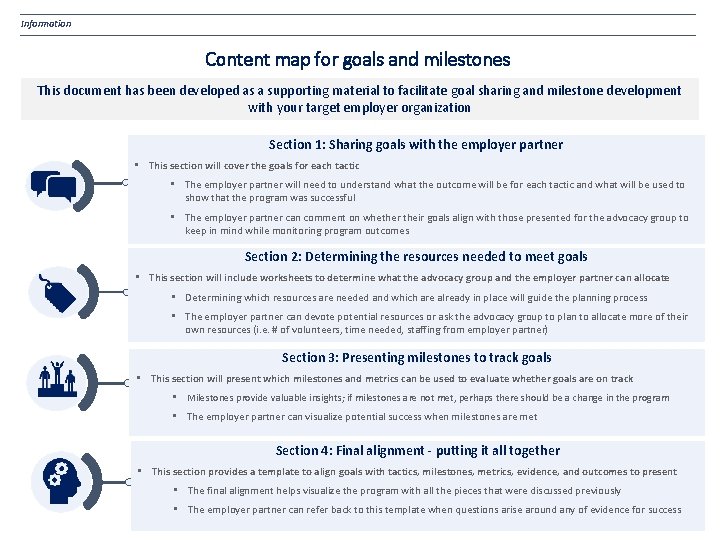
Information Content map for goals and milestones This document has been developed as a supporting material to facilitate goal sharing and milestone development with your target employer organization Section 1: Sharing goals with the employer partner • This section will cover the goals for each tactic • The employer partner will need to understand what the outcome will be for each tactic and what will be used to show that the program was successful • The employer partner can comment on whether their goals align with those presented for the advocacy group to keep in mind while monitoring program outcomes Section 2: Determining the resources needed to meet goals • This section will include worksheets to determine what the advocacy group and the employer partner can allocate • Determining which resources are needed and which are already in place will guide the planning process • The employer partner can devote potential resources or ask the advocacy group to plan to allocate more of their own resources (i. e. # of volunteers, time needed, staffing from employer partner) Section 3: Presenting milestones to track goals • This section will present which milestones and metrics can be used to evaluate whether goals are on track • Milestones provide valuable insights; if milestones are not met, perhaps there should be a change in the program • The employer partner can visualize potential success when milestones are met Section 4: Final alignment - putting it all together • This section provides a template to align goals with tactics, milestones, metrics, evidence, and outcomes to present • The final alignment helps visualize the program with all the pieces that were discussed previously • The employer partner can refer back to this template when questions arise around any of evidence for success
Information Table of contents • Goals & milestones planning timelines • Workplace initiative proposed timeline details • Content map for goals and milestones • Road map for goals and milestones • • • Sharing goals of the advocacy group with the employer partner Evaluation of resources for goals SWOT Analysis Determining milestones Final alignment for goals, milestones, metrics, and tactics • Glossary of terms
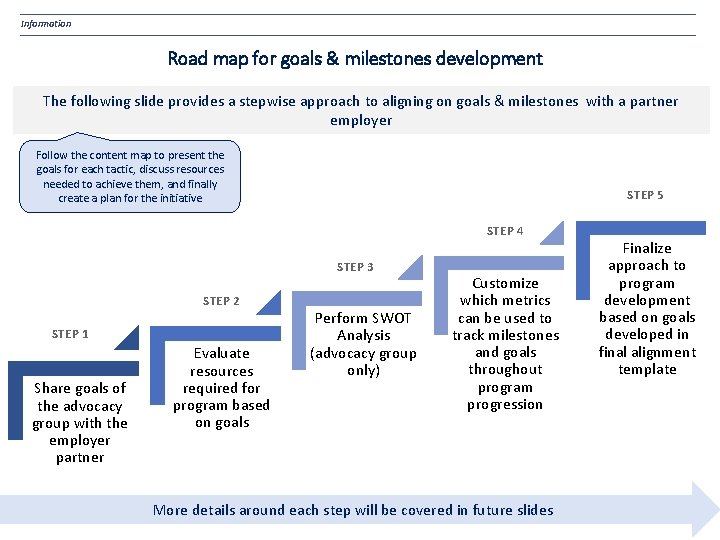
Information Road map for goals & milestones development The following slide provides a stepwise approach to aligning on goals & milestones with a partner employer Follow the content map to present the goals for each tactic, discuss resources needed to achieve them, and finally create a plan for the initiative STEP 5 STEP 4 STEP 3 STEP 2 STEP 1 Share goals of the advocacy group with the employer partner Evaluate resources required for program based on goals Perform SWOT Analysis (advocacy group only) Customize which metrics can be used to track milestones and goals throughout program progression More details around each step will be covered in future slides Finalize approach to program development based on goals developed in final alignment template
Information Table of contents • Goals & milestones planning timelines • Workplace initiative proposed timeline details • Content map for goals and milestones • Road map for goals and milestones • • • Sharing goals of the advocacy group with the employer partner Evaluation of resources for goals SWOT Analysis Determining milestones Final alignment for goals, milestones, metrics, and tactics • Glossary of terms
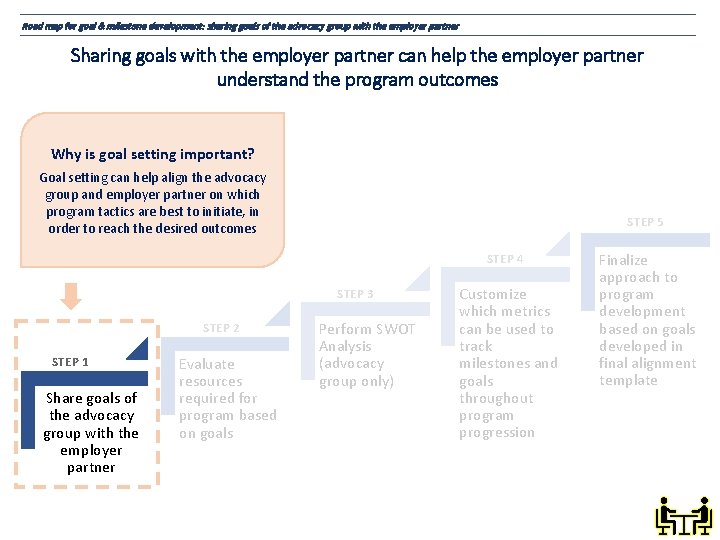
Road map for goal & milestone development: sharing goals of the advocacy group with the employer partner Sharing goals with the employer partner can help the employer partner understand the program outcomes Why is goal setting important? Goal setting can help align the advocacy group and employer partner on which program tactics are best to initiate, in order to reach the desired outcomes STEP 5 STEP 4 STEP 3 STEP 2 STEP 1 Share goals of the advocacy group with the employer partner Evaluate resources required for program based on goals Perform SWOT Analysis (advocacy group only) Customize which metrics can be used to track milestones and goals throughout program progression Finalize approach to program development based on goals developed in final alignment template
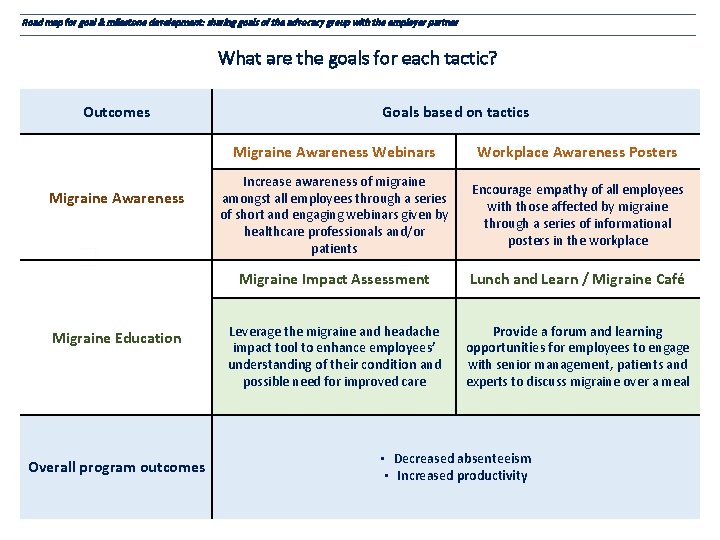
Road map for goal & milestone development: sharing goals of the advocacy group with the employer partner What are the goals for each tactic? Outcomes Migraine Awareness Migraine Education Overall program outcomes Goals based on tactics Migraine Awareness Webinars Workplace Awareness Posters Increase awareness of migraine amongst all employees through a series of short and engaging webinars given by healthcare professionals and/or patients Encourage empathy of all employees with those affected by migraine through a series of informational posters in the workplace Migraine Impact Assessment Lunch and Learn / Migraine Café Leverage the migraine and headache impact tool to enhance employees’ understanding of their condition and possible need for improved care Provide a forum and learning opportunities for employees to engage with senior management, patients and experts to discuss migraine over a meal • Decreased absenteeism • Increased productivity 19
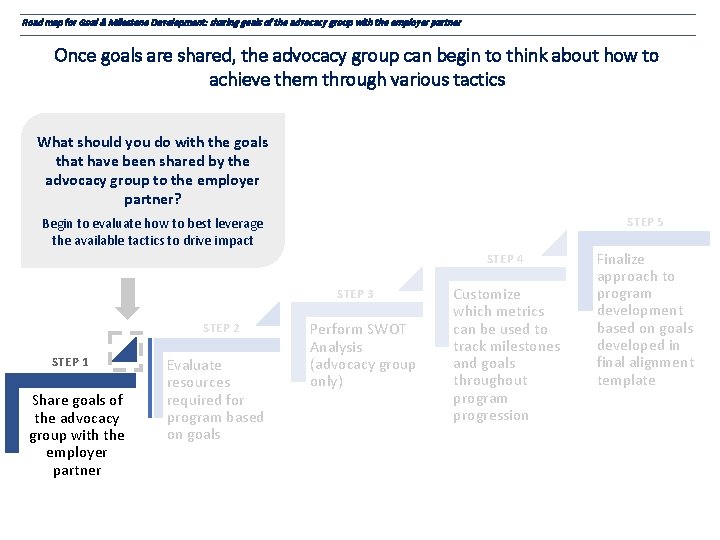
Road map for Goal & Milestone Development: sharing goals of the advocacy group with the employer partner Once goals are shared, the advocacy group can begin to think about how to achieve them through various tactics What should you do with the goals that have been shared by the advocacy group to the employer partner? STEP 5 Begin to evaluate how to best leverage the available tactics to drive impact STEP 4 STEP 3 STEP 2 STEP 1 Share goals of the advocacy group with the employer partner Evaluate resources required for program based on goals Perform SWOT Analysis (advocacy group only) Customize which metrics can be used to track milestones and goals throughout program progression Finalize approach to program development based on goals developed in final alignment template
Information Table of contents • Goals & milestones planning timelines • Workplace initiative proposed timeline details • Content map for goals and milestones • Road map for goals and milestones • • • Sharing goals of the advocacy group with the employer partner Evaluation of resources for goals SWOT Analysis Determining milestones Final alignment for goals, milestones, metrics, and tactics • Glossary of terms
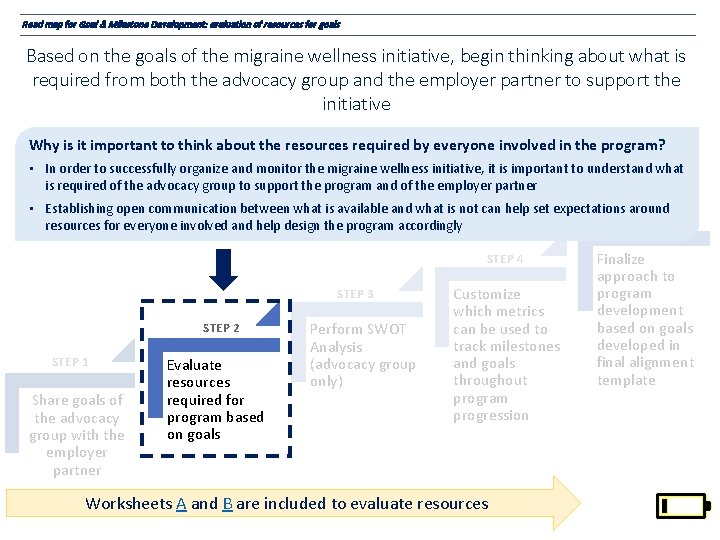
Road map for Goal & Milestone Development: evaluation of resources for goals Based on the goals of the migraine wellness initiative, begin thinking about what is required from both the advocacy group and the employer partner to support the initiative Why is it important to think about the resources required by everyone involved in the program? • In order to successfully organize and monitor the migraine wellness initiative, it is important to understand what is required of the advocacy group to support the program and of the employer partner • Establishing open communication between what is available and what is not can help set expectations around STEP 5 resources for everyone involved and help design the program accordingly STEP 4 STEP 3 STEP 2 STEP 1 Share goals of the advocacy group with the employer partner Evaluate resources required for program based on goals Perform SWOT Analysis (advocacy group only) Customize which metrics can be used to track milestones and goals throughout program progression Worksheets A and B are included to evaluate resources Finalize approach to program development based on goals developed in final alignment template
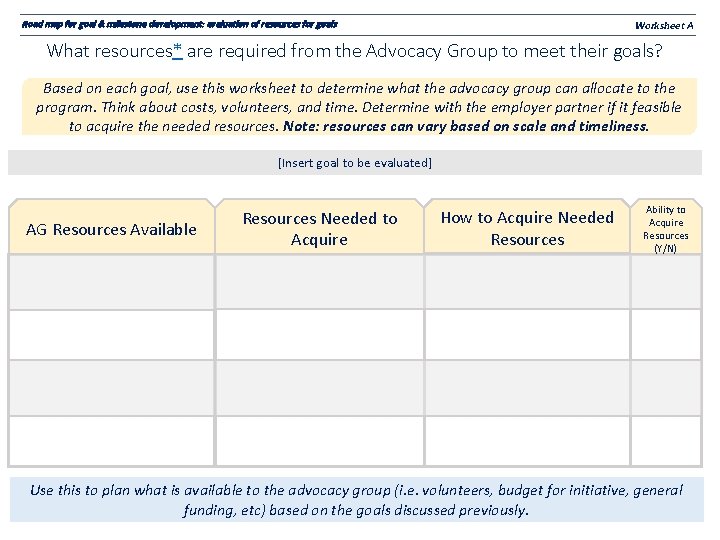
Road map for goal & milestone development: evaluation of resources for goals Worksheet A What resources* are required from the Advocacy Group to meet their goals? Based on each goal, use this worksheet to determine what the advocacy group can allocate to the program. Think about costs, volunteers, and time. Determine with the employer partner if it feasible to acquire the needed resources. Note: resources can vary based on scale and timeliness. [Insert goal to be evaluated] AG Resources Available Resources Needed to Acquire How to Acquire Needed Resources Ability to Acquire Resources (Y/N) Use this to plan what is available to the advocacy group (i. e. volunteers, budget for initiative, general funding, etc) based on the goals discussed previously.
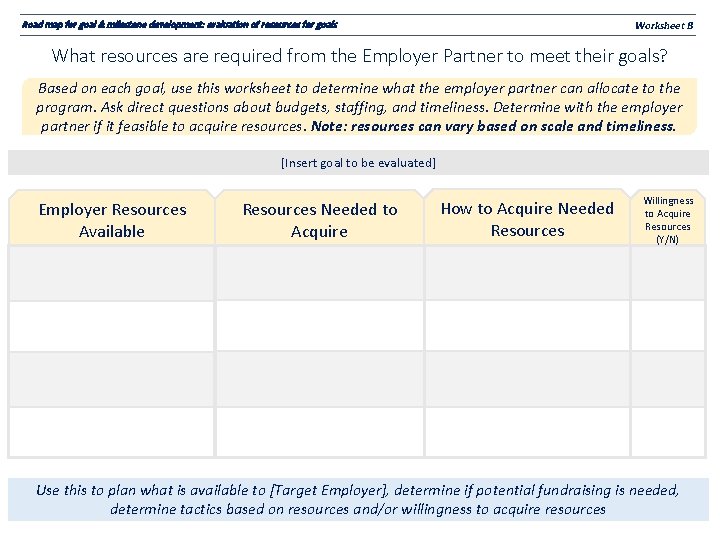
Road map for goal & milestone development: evaluation of resources for goals Worksheet B What resources are required from the Employer Partner to meet their goals? Based on each goal, use this worksheet to determine what the employer partner can allocate to the program. Ask direct questions about budgets, staffing, and timeliness. Determine with the employer partner if it feasible to acquire resources. Note: resources can vary based on scale and timeliness. [Insert goal to be evaluated] Employer Resources Available Resources Needed to Acquire How to Acquire Needed Resources Willingness to Acquire Resources (Y/N) Use this to plan what is available to [Target Employer], determine if potential fundraising is needed, determine tactics based on resources and/or willingness to acquire resources
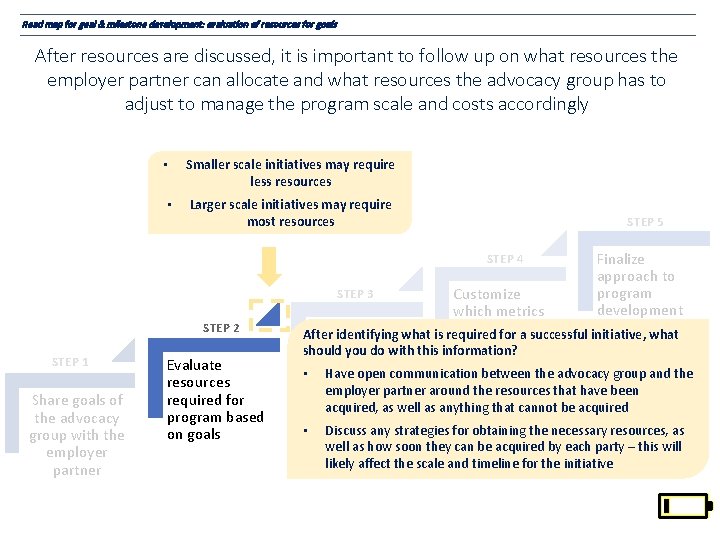
Road map for goal & milestone development: evaluation of resources for goals After resources are discussed, it is important to follow up on what resources the employer partner can allocate and what resources the advocacy group has to adjust to manage the program scale and costs accordingly • Smaller scale initiatives may require less resources • Larger scale initiatives may require most resources STEP 5 Finalize approach to STEP 3 program Customize development which metrics based onwhat goals can be for used to Perform SWOTwhat is required After identifying a successful initiative, developed in track milestones Analysis should you do with this information? final alignment and goals (advocacy group • Have open communication between the advocacy group and the template throughout only) employer partner around the resources that have been program acquired, as well as anything that cannot be acquired progression STEP 4 STEP 2 STEP 1 Share goals of the advocacy group with the employer partner Evaluate resources required for program based on goals • Discuss any strategies for obtaining the necessary resources, as well as how soon they can be acquired by each party – this will likely affect the scale and timeline for the initiative
Information Table of contents • Goals & milestones planning timelines • Workplace initiative proposed timeline details • Content map for goals and milestones • Road map for goals and milestones • • • Sharing goals of the advocacy group with the employer partner Evaluation of resources for goals SWOT Analysis Determining milestones Final alignment for goals, milestones, metrics, and tactics • Glossary of terms
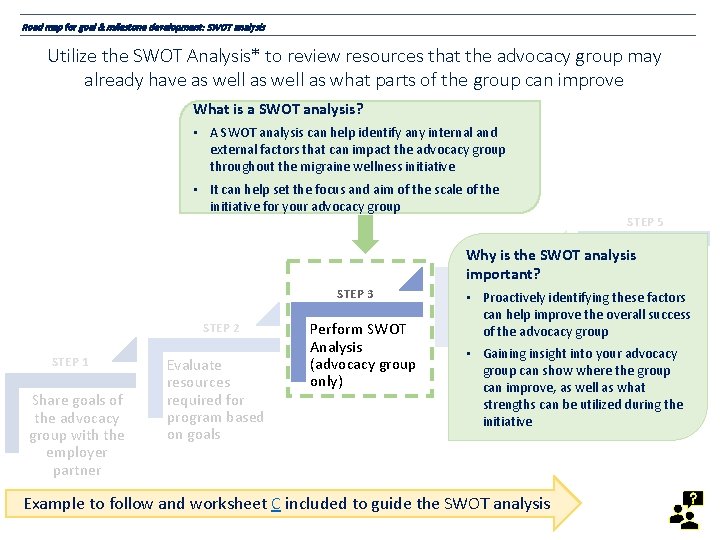
Road map for goal & milestone development: SWOT analysis Utilize the SWOT Analysis* to review resources that the advocacy group may already have as well as what parts of the group can improve What is a SWOT analysis? • A SWOT analysis can help identify any internal and external factors that can impact the advocacy group throughout the migraine wellness initiative • It can help set the focus and aim of the scale of the initiative for your advocacy group STEP 3 STEP 2 STEP 1 Share goals of the advocacy group with the employer partner Evaluate resources required for program based on goals Perform SWOT Analysis (advocacy group only) STEP 5 Why is the STEP 4 SWOT analysis Finalize important? approach to program Customize • Proactively identifying these factors development which canmetrics help improve the overall success based on goals can be used to of the advocacy group developed in track milestones • Gaining insight into your advocacy final alignment and goals group can show where the group template throughout can improve, as well as what program strengths can be utilized during the progression initiative Example to follow and worksheet C included to guide the SWOT analysis
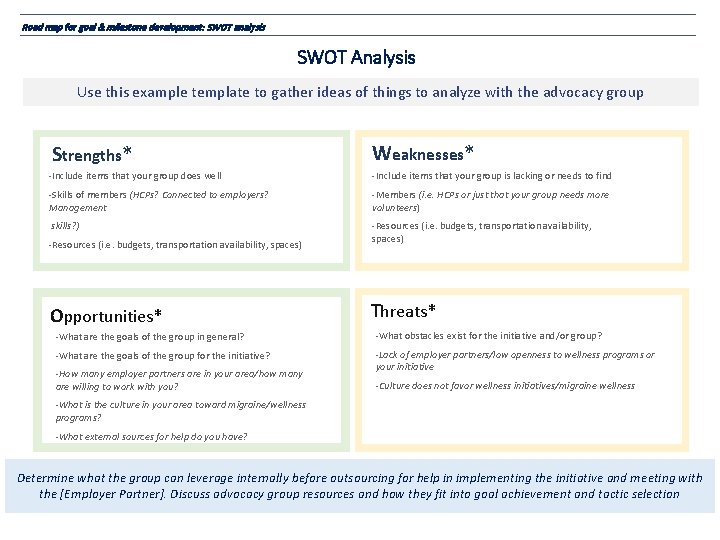
Road map for goal & milestone development: SWOT analysis SWOT Analysis Use this example template to gather ideas of things to analyze with the advocacy group Strengths* Weaknesses* -Include items that your group does well -Include items that your group is lacking or needs to find -Skills of members (HCPs? Connected to employers? Management -Members (i. e. HCPs or just that your group needs more volunteers) skills? ) -Resources (i. e. budgets, transportation availability, spaces) Opportunities* Threats* -What are the goals of the group in general? -What obstacles exist for the initiative and/or group? -What are the goals of the group for the initiative? -Lack of employer partners/low openness to wellness programs or your initiative -How many employer partners are in your area/how many are willing to work with you? -Culture does not favor wellness initiatives/migraine wellness -What is the culture in your area toward migraine/wellness programs? -What external sources for help do you have? Determine what the group can leverage internally before outsourcing for help in implementing the initiative and meeting with the [Employer Partner]. Discuss advocacy group resources and how they fit into goal achievement and tactic selection
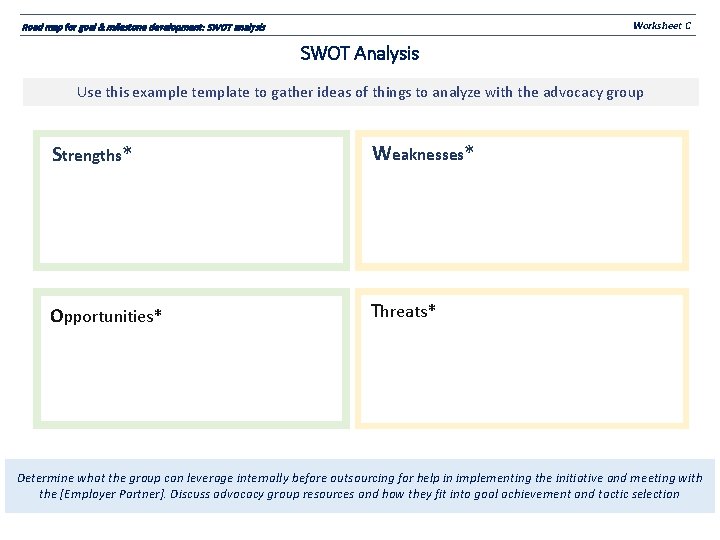
Worksheet C Road map for goal & milestone development: SWOT analysis SWOT Analysis Use this example template to gather ideas of things to analyze with the advocacy group Strengths* Weaknesses* Opportunities* Threats* Determine what the group can leverage internally before outsourcing for help in implementing the initiative and meeting with the [Employer Partner]. Discuss advocacy group resources and how they fit into goal achievement and tactic selection
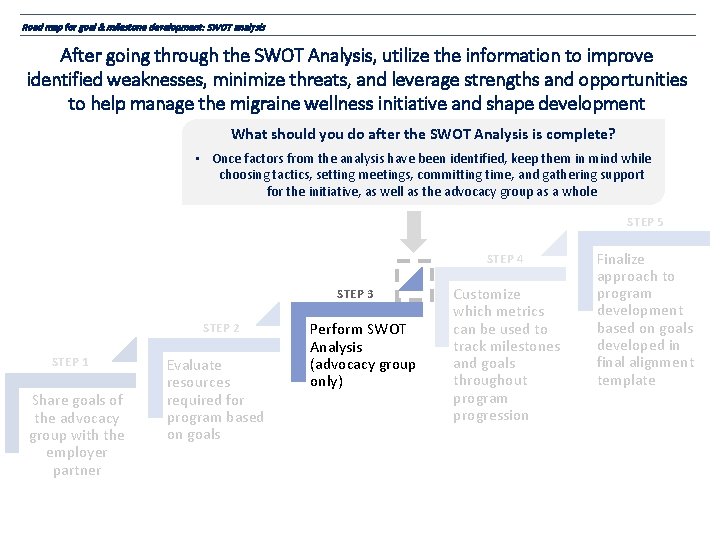
Road map for goal & milestone development: SWOT analysis After going through the SWOT Analysis, utilize the information to improve identified weaknesses, minimize threats, and leverage strengths and opportunities to help manage the migraine wellness initiative and shape development What should you do after the SWOT Analysis is complete? • Once factors from the analysis have been identified, keep them in mind while choosing tactics, setting meetings, committing time, and gathering support for the initiative, as well as the advocacy group as a whole STEP 5 STEP 4 STEP 3 STEP 2 STEP 1 Share goals of the advocacy group with the employer partner Evaluate resources required for program based on goals Perform SWOT Analysis (advocacy group only) Customize which metrics can be used to track milestones and goals throughout program progression Finalize approach to program development based on goals developed in final alignment template
Information Table of contents • Goals & milestones planning timelines • Workplace initiative proposed timeline details • Content map for goals and milestones • Road map for goals and milestones • • • Sharing goals of the advocacy group with the employer partner Evaluation of resources for goals SWOT Analysis Determining milestones Final alignment for goals, milestones, metrics, and tactics • Glossary of terms
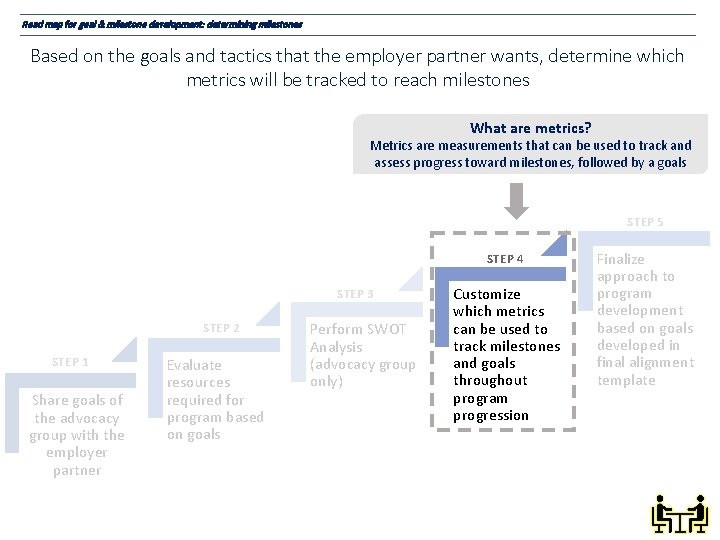
Road map for goal & milestone development: determining milestones Based on the goals and tactics that the employer partner wants, determine which metrics will be tracked to reach milestones What are metrics? Metrics are measurements that can be used to track and assess progress toward milestones, followed by a goals STEP 5 STEP 4 STEP 3 STEP 2 STEP 1 Share goals of the advocacy group with the employer partner Evaluate resources required for program based on goals Perform SWOT Analysis (advocacy group only) Customize which metrics can be used to track milestones and goals throughout program progression Finalize approach to program development based on goals developed in final alignment template
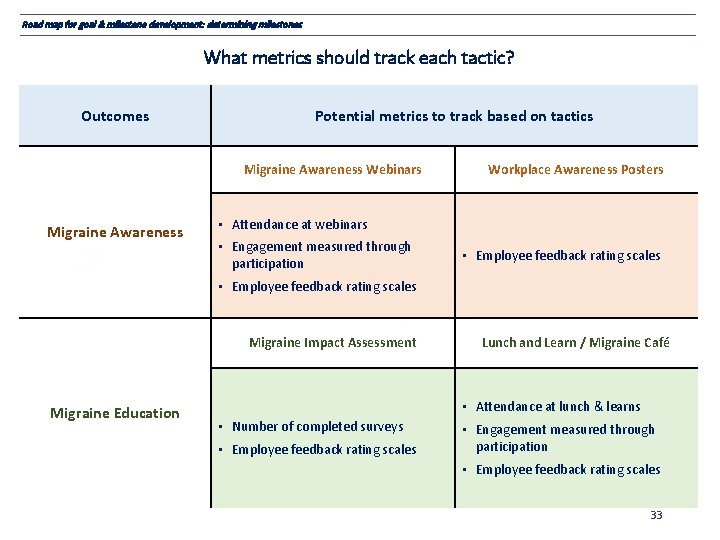
Road map for goal & milestone development: determining milestones What metrics should track each tactic? Outcomes Potential metrics to track based on tactics Migraine Awareness Webinars Migraine Awareness Workplace Awareness Posters • Attendance at webinars • Engagement measured through participation • Employee feedback rating scales Migraine Impact Assessment Migraine Education Lunch and Learn / Migraine Café • Attendance at lunch & learns • Number of completed surveys • Employee feedback rating scales • Engagement measured through participation • Employee feedback rating scales 33
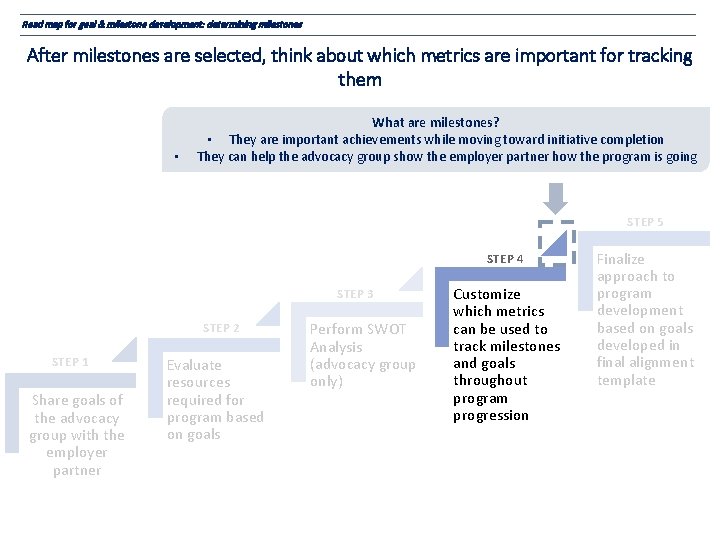
Road map for goal & milestone development: determining milestones After milestones are selected, think about which metrics are important for tracking them • What are milestones? • They are important achievements while moving toward initiative completion They can help the advocacy group show the employer partner how the program is going STEP 5 STEP 4 STEP 3 STEP 2 STEP 1 Share goals of the advocacy group with the employer partner Evaluate resources required for program based on goals Perform SWOT Analysis (advocacy group only) Customize which metrics can be used to track milestones and goals throughout program progression Finalize approach to program development based on goals developed in final alignment template
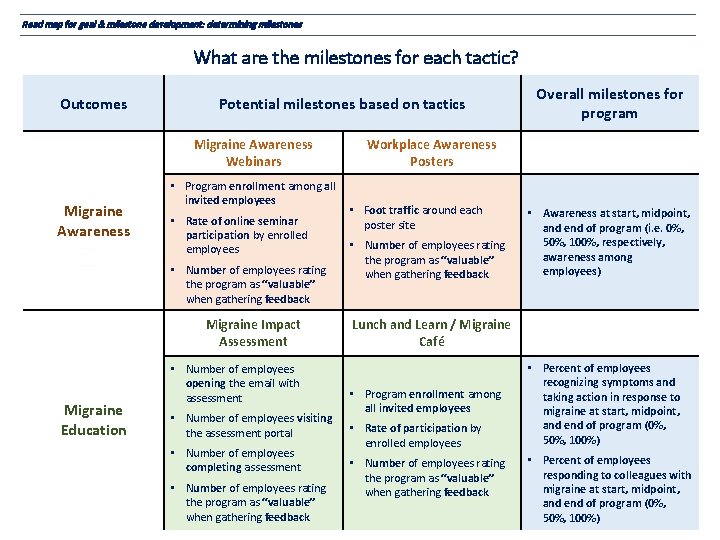
Road map for goal & milestone development: determining milestones What are the milestones for each tactic? Outcomes Potential milestones based on tactics Migraine Awareness Webinars Migraine Awareness • Program enrollment among all invited employees • Rate of online seminar participation by enrolled employees • Number of employees rating the program as “valuable” when gathering feedback Migraine Impact Assessment Migraine Education • Number of employees opening the email with assessment • Number of employees visiting the assessment portal • Number of employees completing assessment • Number of employees rating the program as “valuable” when gathering feedback Overall milestones for program Workplace Awareness Posters • Foot traffic around each poster site • Number of employees rating the program as “valuable” when gathering feedback • Awareness at start, midpoint, and end of program (i. e. 0%, 50%, 100%, respectively, awareness among employees) Lunch and Learn / Migraine Café • Program enrollment among all invited employees • Rate of participation by enrolled employees • Number of employees rating the program as “valuable” when gathering feedback • Percent of employees recognizing symptoms and taking action in response to migraine at start, midpoint, and end of program (0%, 50%, 100%) • Percent of employees responding to colleagues with migraine at start, midpoint, and end of program (0%, 35 50%, 100%)
Information Table of contents • Goals & milestones planning timelines • Workplace initiative proposed timeline details • Content map for goals and milestones • Road map for goals and milestones • • • Sharing goals of the advocacy group with the employer partner Evaluation of resources for goals SWOT Analysis Determining milestones Final alignment for goals, milestones, metrics, and tactics • Glossary of terms
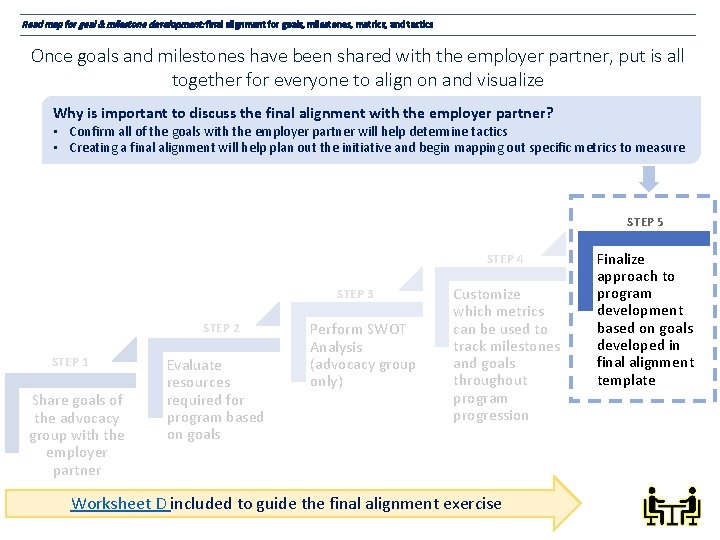
Road map for goal & milestone development: final alignment for goals, milestones, metrics, and tactics Once goals and milestones have been shared with the employer partner, put is all together for everyone to align on and visualize Why is important to discuss the final alignment with the employer partner? • Confirm all of the goals with the employer partner will help determine tactics • Creating a final alignment will help plan out the initiative and begin mapping out specific metrics to measure STEP 5 STEP 4 STEP 3 STEP 2 STEP 1 Share goals of the advocacy group with the employer partner Evaluate resources required for program based on goals Perform SWOT Analysis (advocacy group only) Customize which metrics can be used to track milestones and goals throughout program progression Worksheet D included to guide the final alignment exercise Finalize approach to program development based on goals developed in final alignment template
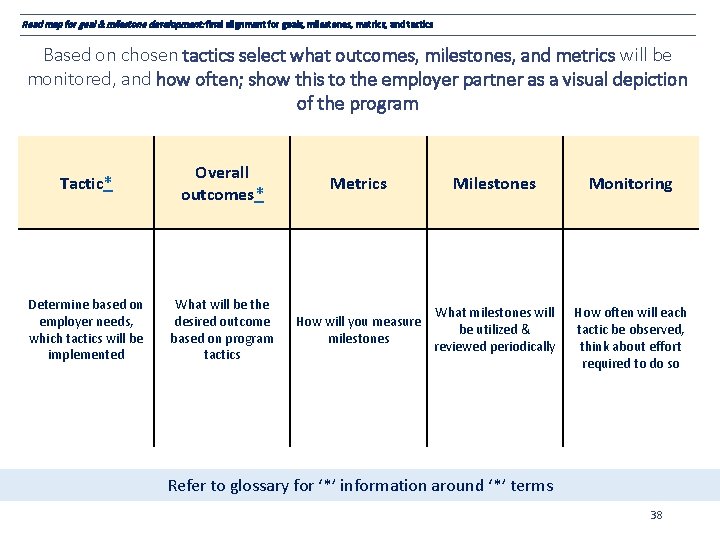
Road map for goal & milestone development: final alignment for goals, milestones, metrics, and tactics Based on chosen tactics select what outcomes, milestones, and metrics will be monitored, and how often; show this to the employer partner as a visual depiction of the program Tactic* Overall outcomes* Metrics Milestones Monitoring Determine based on employer needs, which tactics will be implemented What will be the desired outcome based on program tactics How will you measure milestones What milestones will be utilized & reviewed periodically How often will each tactic be observed, think about effort required to do so Refer to glossary for ‘*’ information around ‘*’ terms 38
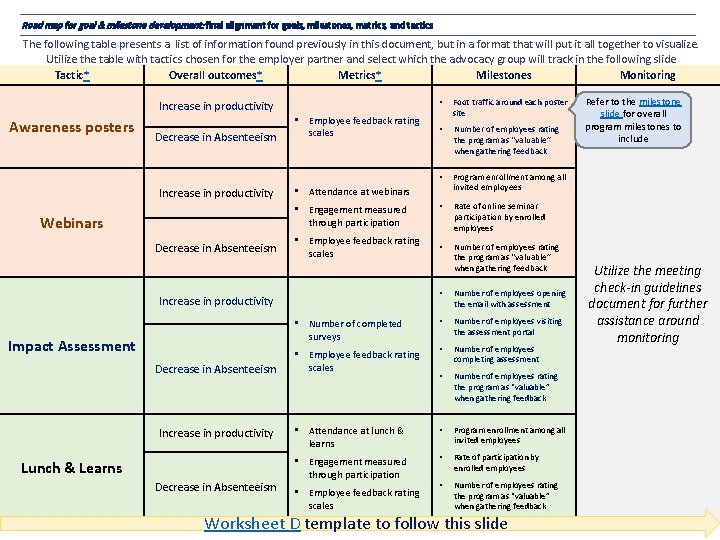
Road map for goal & milestone development: final alignment for goals, milestones, metrics, and tactics The following table presents a list of information found previously in this document, but in a format that will put it all together to visualize. Utilize the table with tactics chosen for the employer partner and select which the advocacy group will track in the following slide Tactic* Overall outcomes* Metrics* Milestones Monitoring Increase in productivity Awareness posters Decrease in Absenteeism Increase in productivity • Employee feedback rating scales Decrease in Absenteeism • Employee feedback rating scales Increase in productivity Lunch & Learns Decrease in Absenteeism Number of employees rating the program as “valuable” when gathering feedback • Program enrollment among all invited employees • Rate of online seminar participation by enrolled employees • Number of employees rating the program as “valuable” when gathering feedback Number of employees opening the email with assessment • Number of employees visiting the assessment portal • Number of employees completing assessment • Number of employees rating the program as “valuable” when gathering feedback • Attendance at lunch & learns • Program enrollment among all invited employees • Engagement measured through participation • Rate of participation by enrolled employees • Number of employees rating the program as “valuable” when gathering feedback • Number of completed surveys Decrease in Absenteeism • • Increase in productivity Impact Assessment Foot traffic around each poster site • Attendance at webinars • Engagement measured through participation Webinars • • Employee feedback rating scales Worksheet D template to follow this slide Refer to the milestone slide for overall program milestones to include Utilize the meeting check-in guidelines document for further assistance around monitoring 39
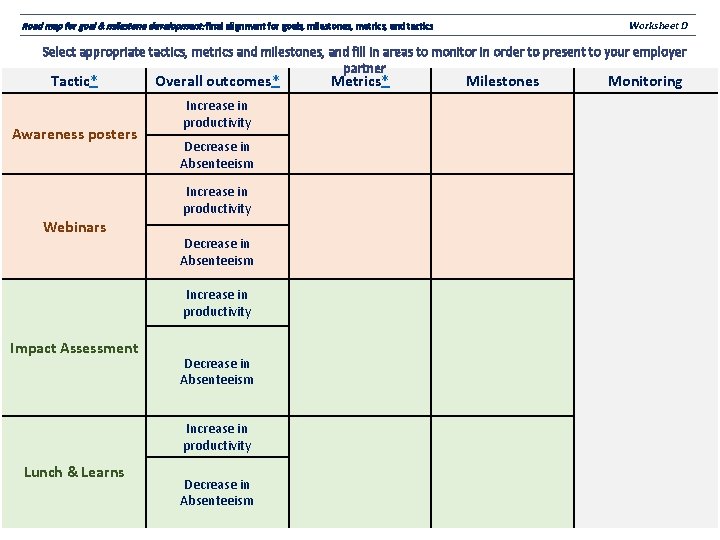
Worksheet D Road map for goal & milestone development: final alignment for goals, milestones, metrics, and tactics Select appropriate tactics, metrics and milestones, and fill in areas to monitor in order to present to your employer partner Tactic* Awareness posters Overall outcomes* Metrics* Milestones Monitoring Increase in productivity Decrease in Absenteeism Increase in productivity Webinars Decrease in Absenteeism Increase in productivity Impact Assessment Decrease in Absenteeism Increase in productivity Lunch & Learns Decrease in Absenteeism 40
Information Table of contents • Goals & milestones planning timelines • Workplace initiative proposed timeline details • Content map for goals and milestones • Road map for goals and milestones • • • Sharing goals of the advocacy group with the employer partner Evaluation of resources for goals SWOT Analysis Determining milestones Final alignment for goals, milestones, metrics, and tactics • Glossary of terms
Glossary of terms *Glossary of terms • Operational Team – group of employer partner employees tasked with partnering with the advocacy group on wellness program design and execution • Resources – what costs will be required for the initiative i. e. time commitment, money, and staffing? • Strengths – things that the advocacy group excels in or does well • Weaknesses – what is missing from the advocacy group to make the initiative successful? • Opportunities – what can the advocacy group leverage outside of their internal organization? • Threats - What is preventing the advocacy group from being successful in the initiative? • Tactic – prespecified program for the migraine wellness initiative (webinars, awareness posters, impact tool, lunch & learns) • Outcome – what is the end-goal or result to be achieved ? • Evidence – information needed to support outcomes and metrics
- Slides: 42