
This background cartoon shows imperialism every country wants
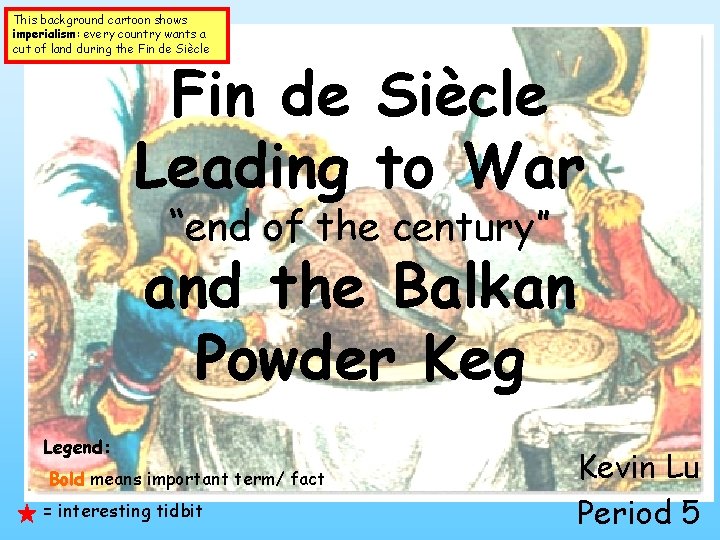
This background cartoon shows imperialism: every country wants a cut of land during the Fin de Siècle Leading to War “end of the century” and the Balkan Powder Keg Legend: Bold means important term/ fact = interesting tidbit Kevin Lu Period 5
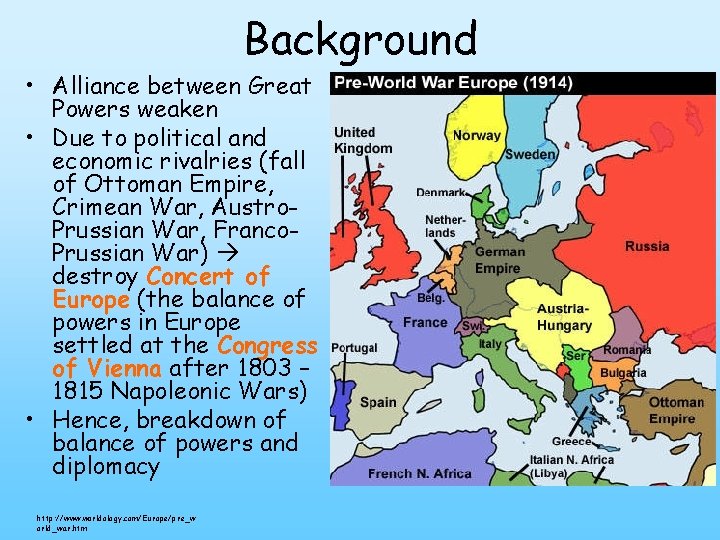
Background • Alliance between Great Powers weaken • Due to political and economic rivalries (fall of Ottoman Empire, Crimean War, Austro. Prussian War, Franco. Prussian War) destroy Concert of Europe (the balance of powers in Europe settled at the Congress of Vienna after 1803 – 1815 Napoleonic Wars) • Hence, breakdown of balance of powers and diplomacy http: //www. worldology. com/Europe/pre_w orld_war. htm
Background continued. • • Growing sense of distrust armaments territory disputes nationalism (independence, patriotism, preserve culture and religion) • each country wants to prove dominance by gaining land/ asserting spheres of influence • Culminates in formation of defensive “system of alliances” Now, let’s see the situation for the important European players before WWI
Current state: industrialized, united, careful to not upset other countries under Otto von Bismarck, but 1890, Kaiser Wilheim II take over with aggressive global ambition Triple Alliance: Germany | Austria-Hungary | Italy Germany Prelude: • before 1871 = loose confederation of independently-ruled territories; Prussia is largest (Background) • Chief minister Bismarck unites Germany - Acquires territory of Schleswig-Holstein (in Austro-Prussian War 1866) and Alsace-Lorraine (in Franco-Prussian War 1870 -1871) - Asserts pressure on Austria by excluding Austria from Zollverein Prewar: - Germany = unified, major European power - Goal after unification: security - Congress of Berlin (1878) – led by Bismarck, stabilize Balkans, restrain Russia, Ottoman Empire weakened -> key diplomacy (Chambers 822) - Form web of alliances for security, isolate France through Triple Alliance (1882) with Austria-Hungary and Italy - Reinsurance Treaty (1887) with Russia under terms: - Russian remains neutral if war between Germany and France, Germany remains neutral if war between Russia and Austria. Hungary (Chambers 823)
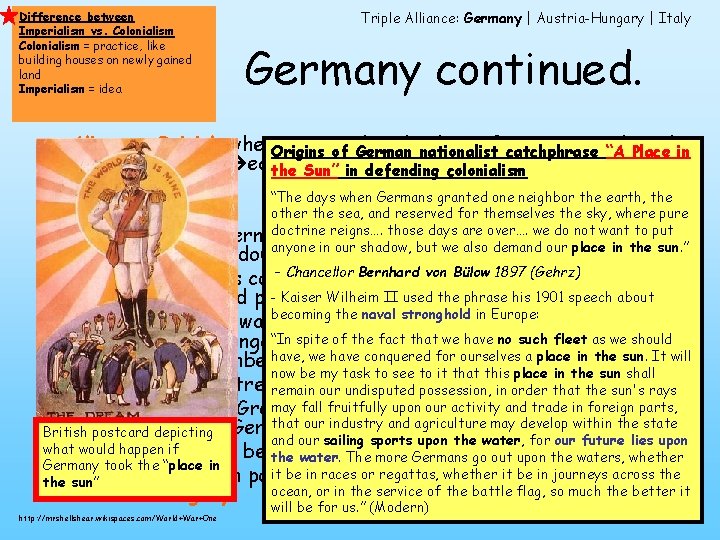
Difference between Imperialism vs. Colonialism = practice, like building houses on newly gained land Imperialism = idea Triple Alliance: Germany | Austria-Hungary | Italy Germany continued. - Alienate British when. Origins congratulate leaders of Boer Wars“A(1896) of German nationalist catchphrase Place in (Chambers 824) early sign that they will not ally the Sun” in defending colonialism “The days when Germans granted one neighbor the earth, the other the sea, and reserved for themselves the sky, where pure doctrine reigns…. those days over…. we do Bismarck not want to put German Kaiser, Wilheim IIaredismisses in anyone in our shadow, but we also demand our place in the sun. ” Bottom Line: - new belligerent 1890 things go downhill – Chancellor Bernhard von Bülow 1897 (Gehrz) - replace Bismarck’s conservative foreign policy (realpolitik) with - Kaiser(Weltpolitik) Wilheim II used the phrase his 1901 speech about “weltpolitik” (world policy) becoming the naval stronghold in Europe: - imperialism want territory, hostile demand of French spite of the fact we have noannexation such fleet as we Congo in exchange “In for agreeing tothat France’s ofshould have, we have conquered for ourselves a place in the sun. It will Morocco (Chambers 825) now be my task to see to it that this place in the sun shall - refuses to renew treaty with Russia possession, in order that the sun's rays remain our undisputed may. Britain fall fruitfully upon ourarms activityrace and trade in foreign - competes against Great in naval (begin to parts, that our industry and 1900) agriculture may develop within the state build ships after Germany Navy Law British postcard depicting and our sailing sports upon the water, for our future lies upon what would happen if army because it is bordered by France and Russia - Largest land the water. The more Germans go out upon the waters, whether Germany took the “place in it be in races or regattas, whether it except be in journeys - aggressive foreign policy alienates all countries foracross the sun” ocean, or in the service of the battle flag, so much the better it Austria-Hungary http: //mrshellshear. wikispaces. com/World+War+One will be for us. ” (Modern)
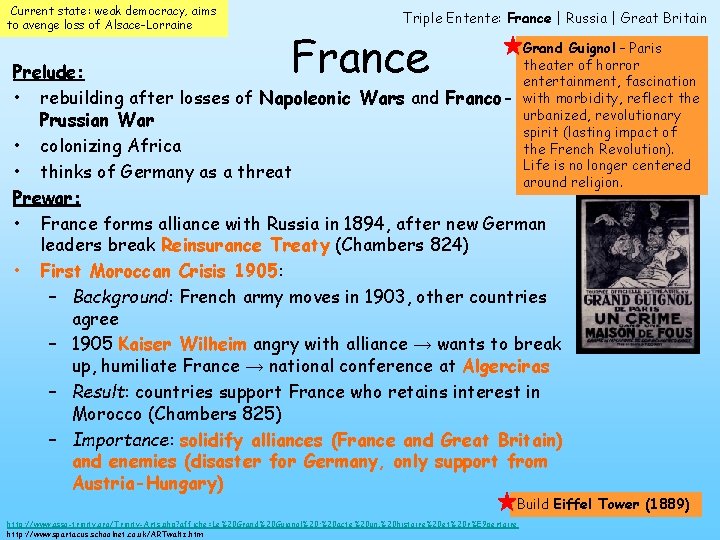
Current state: weak democracy, aims to avenge loss of Alsace-Lorraine Triple Entente: France | Russia | Great Britain France Grand Guignol – Paris theater of horror entertainment, fascination with morbidity, reflect the urbanized, revolutionary spirit (lasting impact of the French Revolution). Life is no longer centered around religion. Prelude: • rebuilding after losses of Napoleonic Wars and Franco. Prussian War • colonizing Africa • thinks of Germany as a threat Prewar: • France forms alliance with Russia in 1894, after new German leaders break Reinsurance Treaty (Chambers 824) • First Moroccan Crisis 1905: – Background: French army moves in 1903, other countries agree – 1905 Kaiser Wilheim angry with alliance → wants to break up, humiliate France → national conference at Algerciras – Result: countries support France who retains interest in Morocco (Chambers 825) – Importance: solidify alliances (France and Great Britain) and enemies (disaster for Germany, only support from Austria-Hungary) Build Eiffel Tower (1889) http: //www. asso-trinity. org/Trinity-Arts. php? affiche=Le%20 Grand%20 Guignol%20: %20 acte%20 un, %20 histoire%20 et%20 r%E 9 pertoire http: //www. spartacus. schoolnet. co. uk/ARTwaltz. htm
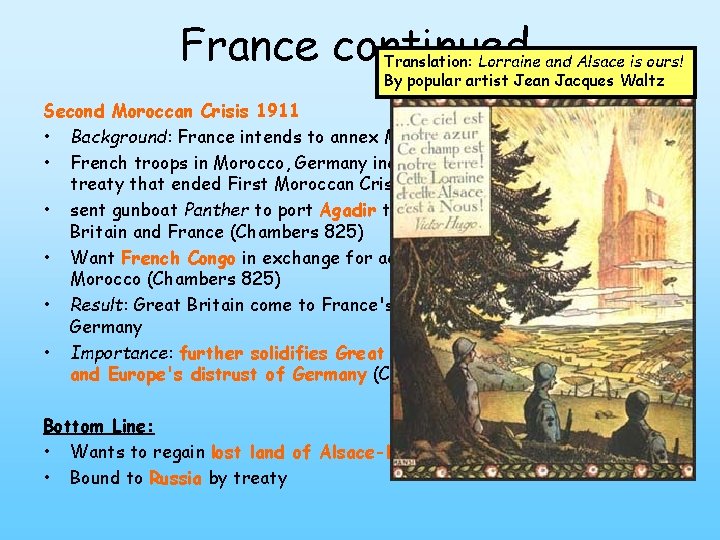
France continued. Translation: Lorraine and Alsace is ours! By popular artist Jean Jacques Waltz Second Moroccan Crisis 1911 • Background: France intends to annex Morocco • French troops in Morocco, Germany incited that France broke the treaty that ended First Moroccan Crisis • sent gunboat Panther to port Agadir to test the bond between Great Britain and France (Chambers 825) • Want French Congo in exchange for accepting France's control over Morocco (Chambers 825) • Result: Great Britain come to France's aid, some land is given to Germany • Importance: further solidifies Great Britain and France's alliance, and Europe's distrust of Germany (Chambers 825) Learn more Bottom Line: • Wants to regain lost land of Alsace-Lorraine from Germany • Bound to Russia by treaty
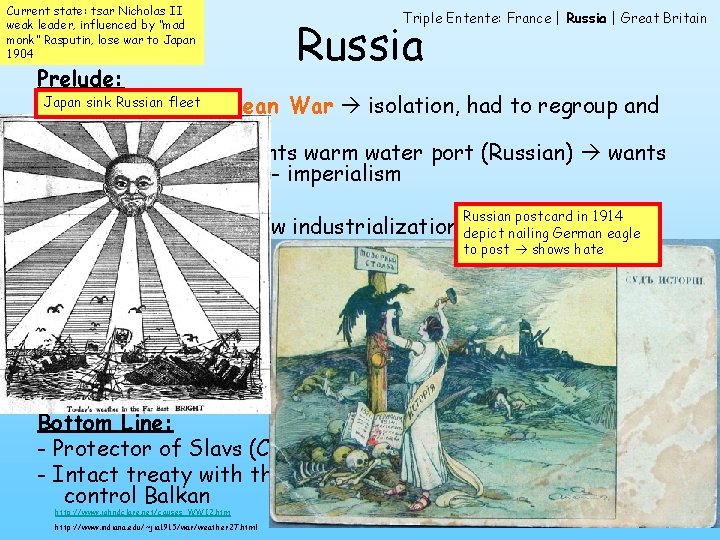
Current state: tsar Nicholas II weak leader, influenced by “mad monk” Rasputin, lose war to Japan 1904 Triple Entente: France | Russia | Great Britain Russia Prelude: sink Russianby fleet. Crimean War isolation, had to regroup and -Japan Depleted impose influence - Global ambition: wants warm water port (Russian) wants to gain Balkan lands - imperialism - vast, but divided Russian postcard in 1914 - Mostly peasants, slow industrialization depict nailing German eagle to post shows hate Prewar: - Humiliated by loss of Russo-Japanese War in 1905 - Internal revolution 1905 (caused by terrible work conditions, 11 hour work days, little wages) “Bloody Sunday” (Tsar) Read more - Largest army force in number, but lack of equipment, backwards Bottom Line: - Protector of Slavs (Chambers 827) - Intact treaty with the Serbs, can’t let Austria-Hungary control Balkan http: //www. johndclare. net/causes_WWI 2. htm http: //www. indiana. edu/~jia 1915/war/weather 27. html
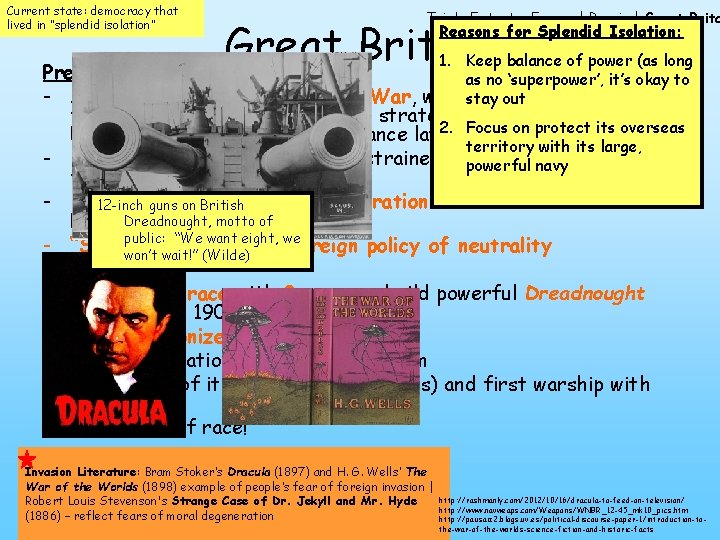
Current state: democracy that lived in “splendid isolation” Triple Entente: France | Russia | Great Britain Reasons for Splendid Isolation: 1. Keep balance of power (as long Prelude: as no ‘superpower’, it’s okay to - Aligned with France in Crimean War, wantstay to prevent Russia out from expanding it influence over strategic location of Ottoman 2. Focus on protect its overseas Empire (ironic: join Russia in alliance later) territory with its large, - prosperous middle class → unrestrained, seek to “live powerful navy life to the fullest” - period ofguns decadence and degeneration after the Industrial 12 -inch on British Dreadnought, motto of Revolution (Livesey) public: “We want eight, we - “Splendid Isolation” = foreign policy of neutrality won’t wait!” (Wilde) Prewar: - Naval arms race with Germany – build powerful Dreadnought battleship in 1906 (Chambers 825) - Revolutionize naval warfare - Tied to nationalism and imperialism - Fastest of its time (steam turbines) and first warship with big guns - Winner of race! Invasion Literature: Bram Stoker’s Dracula (1897) and H. G. Wells’ The War of the Worlds (1898) example of people’s fear of foreign invasion | Robert Louis Stevenson's Strange Case of Dr. Jekyll and Mr. Hyde (1886) – reflect fears of moral degeneration http: //rashmanly. com/2012/10/16/dracula-to-feed-on-television/ http: //www. navweaps. com/Weapons/WNBR_12 -45_mk 10_pics. htm http: //pausaiz 2. blogs. uv. es/political-discourse-paper-1/introduction-tothe-war-of-the-worlds-science-fiction-and-historic-facts
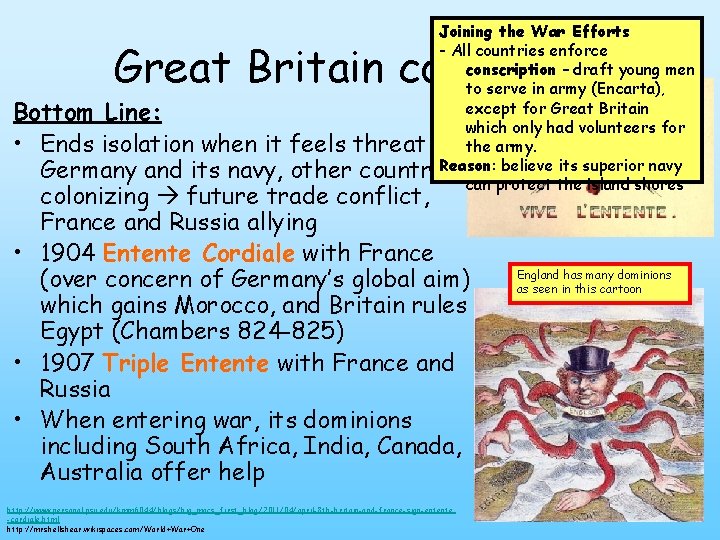
Joining the War Efforts - All countries enforce conscription – draft young men to serve in army (Encarta), except for Great Britain which only had volunteers for feels threat of the army. Reason: believe its superior navy other countries can protect the island shores Great Britain continued. Bottom Line: • Ends isolation when it Germany and its navy, colonizing future trade conflict, France and Russia allying • 1904 Entente Cordiale with France (over concern of Germany’s global aim) which gains Morocco, and Britain rules Egypt (Chambers 824 -825) • 1907 Triple Entente with France and Russia • When entering war, its dominions including South Africa, India, Canada, Australia offer help http: //www. personal. psu. edu/kmm 6044/blogs/big_macs_first_blog/2011/04/april-8 th-britain-and-france-sign-entente -cordiale. html http: //mrshellshear. wikispaces. com/World+War+One England has many dominions as seen in this cartoon
Triple Alliance: Germany | Austria-Hungary | Italy Austria-Hungary Father of Psychoanalysis, Sigmund Freud (1856 - 1939) begins his early work, realm of “unconscious mind” Prelude: • weak after loss to Prussia (Austro-Prussian War 1866) • multinational empire–each group wants independence Prewar: • 1908 Austria annexes Bosnia, anger Serbia and Russia • Form alliance with Germany because of fear of Russia Bottom Line: • fear Serbia will control land, invade unprepared, worst scenario: Russia comes to Serbia's aid Italy *Italy signed a treaty saying it only joined the war efforts in “defense”, but Italy deemed the efforts “offensive” neutral, however in 1915, join Triple Entente
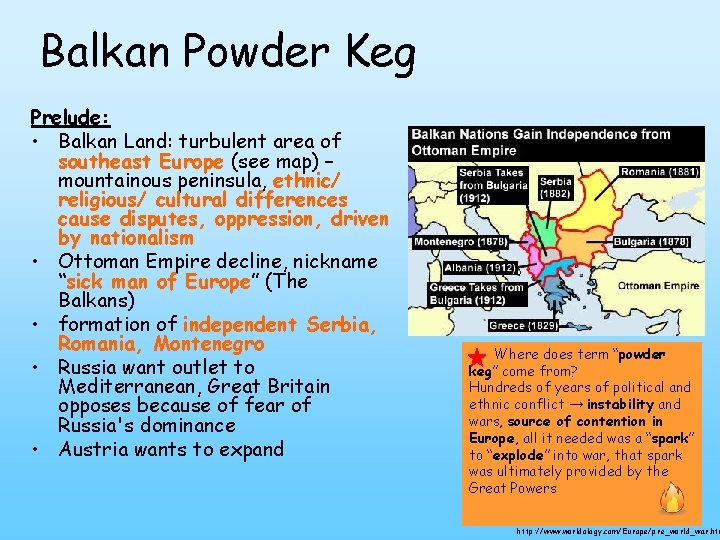
Balkan Powder Keg Prelude: • Balkan Land: turbulent area of southeast Europe (see map) – mountainous peninsula, ethnic/ religious/ cultural differences cause disputes, oppression, driven by nationalism • Ottoman Empire decline, nickname “sick man of Europe” (The Balkans) • formation of independent Serbia, Romania, Montenegro • Russia want outlet to Mediterranean, Great Britain opposes because of fear of Russia's dominance • Austria wants to expand Where does term “powder keg” come from? Hundreds of years of political and ethnic conflict → instability and wars, source of contention in Europe, all it needed was a “spark” to “explode” into war, that spark was ultimately provided by the Great Powers http: //www. worldology. com/Europe/pre_world_war. htm
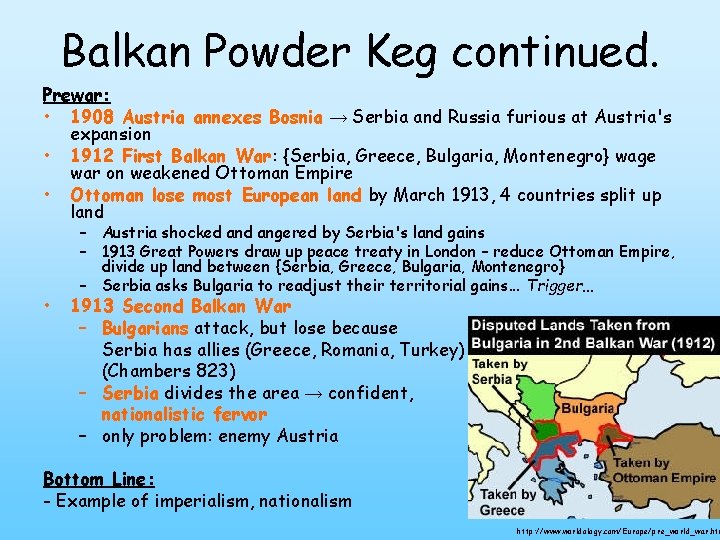
Balkan Powder Keg continued. Prewar: • 1908 Austria annexes Bosnia → Serbia and Russia furious at Austria's expansion • 1912 First Balkan War: {Serbia, Greece, Bulgaria, Montenegro} wage war on weakened Ottoman Empire • Ottoman lose most European land by March 1913, 4 countries split up land • – Austria shocked angered by Serbia's land gains – 1913 Great Powers draw up peace treaty in London – reduce Ottoman Empire, divide up land between {Serbia, Greece, Bulgaria, Montenegro} – Serbia asks Bulgaria to readjust their territorial gains. . . Trigger… 1913 Second Balkan War – Bulgarians attack, but lose because Serbia has allies (Greece, Romania, Turkey) (Chambers 823) – Serbia divides the area → confident, nationalistic fervor – only problem: enemy Austria Bottom Line: - Example of imperialism, nationalism http: //www. worldology. com/Europe/pre_world_war. htm
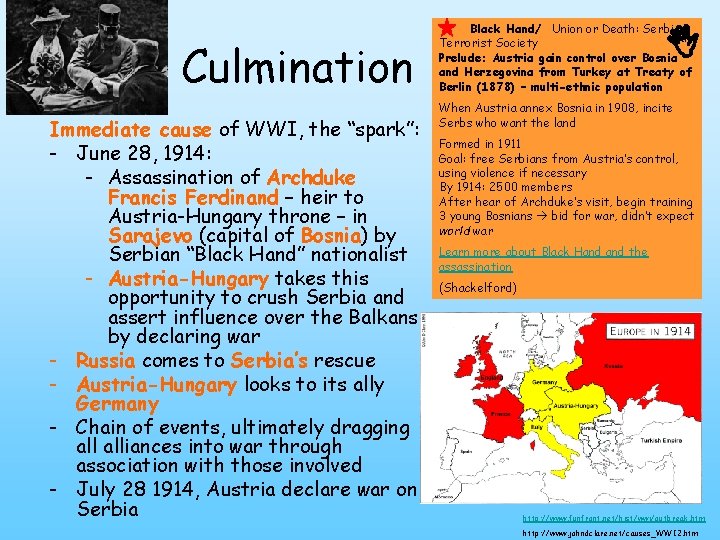
Culmination Immediate cause of WWI, the “spark”: - June 28, 1914: - Assassination of Archduke Francis Ferdinand – heir to Austria-Hungary throne – in Sarajevo (capital of Bosnia) by Serbian “Black Hand” nationalist - Austria-Hungary takes this opportunity to crush Serbia and assert influence over the Balkans by declaring war - Russia comes to Serbia’s rescue - Austria-Hungary looks to its ally Germany - Chain of events, ultimately dragging alliances into war through association with those involved - July 28 1914, Austria declare war on Serbia Black Hand/ Union or Death: Serbian Terrorist Society Prelude: Austria gain control over Bosnia and Herzegovina from Turkey at Treaty of Berlin (1878) – multi-ethnic population When Austria annex Bosnia in 1908, incite Serbs who want the land Formed in 1911 Goal: free Serbians from Austria’s control, using violence if necessary By 1914: 2500 members After hear of Archduke’s visit, begin training 3 young Bosnians bid for war, didn’t expect world war Learn more about Black Hand the assassination (Shackelford) http: //www. funfront. net/hist/wwi/outbreak. htm http: //www. johndclare. net/causes_WWI 2. htm
![Part 1 Part 2 [Click slide to continue cartoon] http: //dhaimasmart. girlshopes. com/causeofwwi/ A](http://slidetodoc.com/presentation_image_h/122740ec8d555128fa11f416796e376e/image-15.jpg "Part 1 Part 2 [Click slide to continue cartoon] http: //dhaimasmart. girlshopes. com/causeofwwi/ A")
Part 1 Part 2 [Click slide to continue cartoon] http: //dhaimasmart. girlshopes. com/causeofwwi/ A Picture is worth a thousand words: Cartoon explanation of how war started:
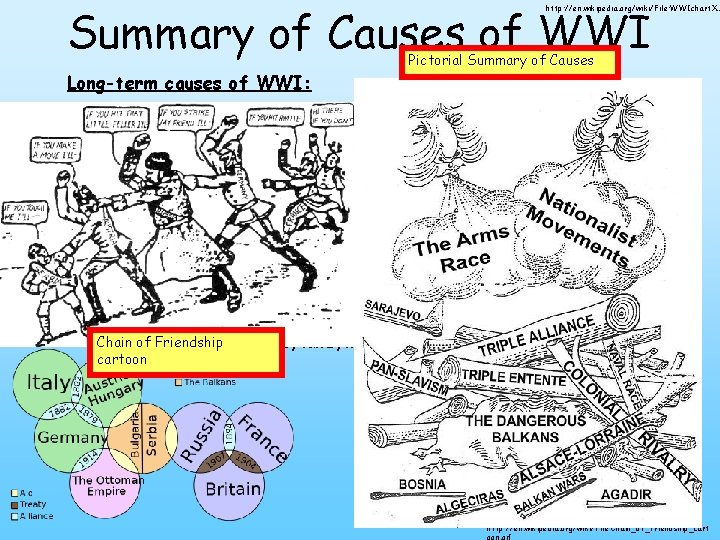
Summary of Causes of WWI http: //en. wikipedia. org/wiki/File: WWIchart. X. s Pictorial Summary of Causes Long-term causes of WWI: • • • Entangling network of alliances: Ironic that the “defensive” system of alliances that was suppose to deter war resulted in chain reaction bringing everyone to war Imperialism Nationalism (Yellow Journalism, Propaganda, Oppression of certain groups) Bitter historical grievances (i. e. France lost Alsace-Lorraine to Germany) Militarism – ready for war, 300% increase in $$$ spent on main European countries (Shellshear) Chain of Friendship Rivalry in wealth, trade, land, industry cartoon Did you know WWI was called the “Great War” during the time? “The war to end all wars” as novelist H. G. Wells put it. Pretty safe to say he was right. http: //en. wikipedia. org/wiki/File: WWI-Causes. jpg http: //en. wikipedia. org/wiki/File: Chain_of_Friendship_cart
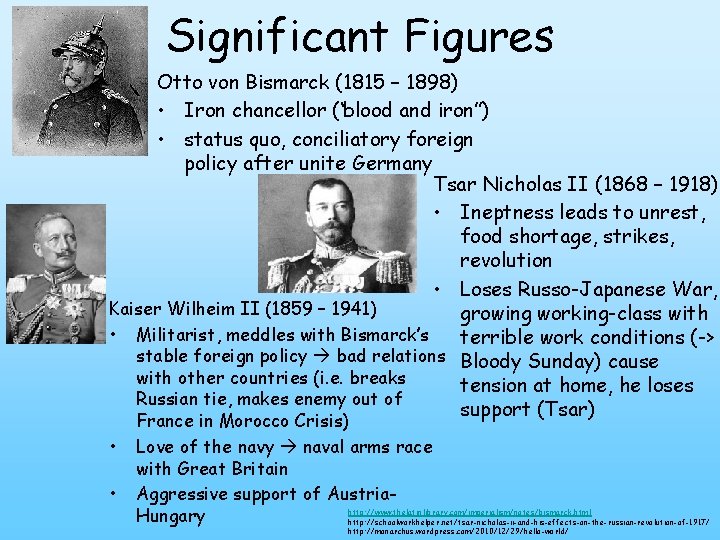
Significant Figures Otto von Bismarck (1815 – 1898) • Iron chancellor (‘blood and iron”) • status quo, conciliatory foreign policy after unite Germany Tsar Nicholas II (1868 – 1918) • Ineptness leads to unrest, food shortage, strikes, revolution • Loses Russo-Japanese War, Kaiser Wilheim II (1859 – 1941) growing working-class with • Militarist, meddles with Bismarck’s terrible work conditions (-> stable foreign policy bad relations Bloody Sunday) cause with other countries (i. e. breaks tension at home, he loses Russian tie, makes enemy out of support (Tsar) • • France in Morocco Crisis) Love of the navy naval arms race with Great Britain Aggressive support of Austriahttp: //www. thelatinlibrary. com/imperialism/notes/bismarck. html Hungary http: //schoolworkhelper. net/tsar-nicholas-ii-and-his-effects-on-the-russian-revolution-of-1917/ http: //monarchus. wordpress. com/2010/12/29/hello-world/
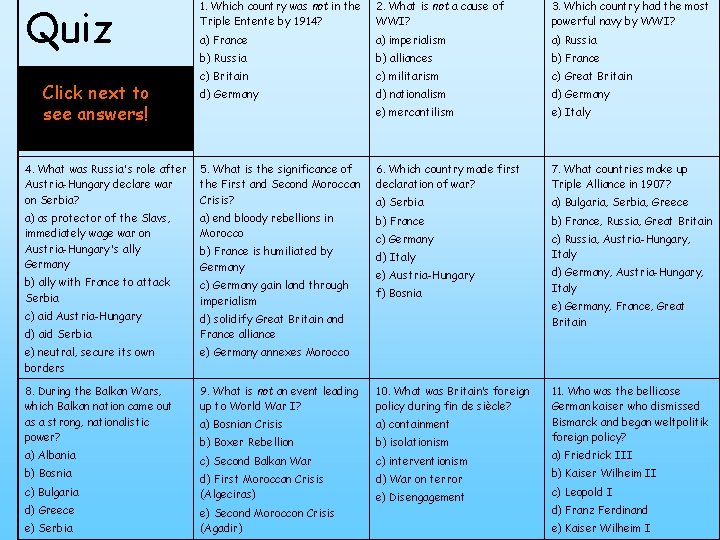
Quiz Answers: 1. d; 2. e; 3. c; 4. d; to 5. d; Click next 6. see e; 7. d; 8. e; 9. b; answers! 1. Which country was not in the Triple Entente by 1914? 2. What is not a cause of WWI? 3. Which country had the most powerful navy by WWI? a) France a) imperialism a) Russia b) alliances b) France c) Britain c) militarism c) Great Britain d) Germany d) nationalism d) Germany e) mercantilism e) Italy 10. b; 11. b; 4. What was Russia's role after Austria-Hungary declare war on Serbia? 5. What is the significance of the First and Second Moroccan Crisis? 6. Which country made first declaration of war? 7. What countries make up Triple Alliance in 1907? a) Serbia a) Bulgaria, Serbia, Greece a) as protector of the Slavs, immediately wage war on Austria-Hungary's ally Germany a) end bloody rebellions in Morocco b) France, Russia, Great Britain b) France is humiliated by Germany c) Germany d) Italy c) Russia, Austria-Hungary, Italy b) ally with France to attack Serbia c) Germany gain land through imperialism c) aid Austria-Hungary d) solidify Great Britain and France alliance d) aid Serbia e) Austria-Hungary f) Bosnia e) neutral, secure its own borders e) Germany annexes Morocco 8. During the Balkan Wars, which Balkan nation came out as a strong, nationalistic power? 9. What is not an event leading up to World War I? 10. What was Britain’s foreign policy during fin de siècle? a) Bosnian Crisis a) containment a) Albania b) Boxer Rebellion b) isolationism c) Second Balkan War c) interventionism d) First Moroccan Crisis (Algeciras) d) War on terror b) Bosnia c) Bulgaria d) Greece e) Serbia e) Second Moroccon Crisis (Agadir) e) Disengagement d) Germany, Austria-Hungary, Italy e) Germany, France, Great Britain 11. Who was the bellicose German kaiser who dismissed Bismarck and began weltpolitik foreign policy? a) Friedrick III b) Kaiser Wilheim II c) Leopold I d) Franz Ferdinand e) Kaiser Wilheim I
More Info • Really good powerpoint giving overview of Balkans from past to present: http: //cmes. arizona. edu/sites/cmes. arizona. edu/files/1. %20 The%2 0 Balkans%20 -%20 Power. Point%20 overview. pdf • Causes of WWI http: //users. humboldt. edu/ogayle/hist 111/WWI. html http: //www. schoolhistory. co. uk/gcselinks/modern/revision/wwir evision. pdf • Detailed Pre-1914 timeline http: //net. lib. byu. edu/~rdh 7/wwi/1914 m/willnick/timeline. htm • Learn more about Kaiser Wilheim II’s aggressive actions http: //www. johndclare. net/causes_WWI 3. htm
Works Cited/Bibliography “Background to the War Nobody Won: World War I, 1914 -1918. ” <http: //iws. collin. edu/kwilkison/Resources%20 for%20 Students/WWI. htm>. Web. Feb. 20 2013. Clare, John. “Background to the War. ” <http: //www. johndclare. net/causes_WWI 2. htm>. Web. 16 Feb. 2013. Chambers, Mortimer. The Western Experience. 9 th ed. New York: Knopf; [distributed by Random House, 1974. Print. Gehrz, Chris. “Germany’s Place in the Sun. ” <http: //pietistschoolman. com/2011/12/06/germanys-place-in-thesun/>. Dec. 6 2011. Web. Feb. 18 2013. Livesey, Ruth. “Fin de Siècle” <http: //www. oxfordbibliographies. com/view/document/obo-9780199799558/obo 9780199799558 -0030. xml>. Web. Feb 18 2013. “Modern History Sourcebook: Kaiser Wilhelm II: A Place in the Sun, 1901” <http: //www. fordham. edu/halsall/mod/1901 Kaiser. asp>. Web. Feb 18 2013. “Russian Where Angels Fear to Tread. ” <http: //www. historyhouse. com/in_history/russo_japanese/>. Web. 15 Feb 2013. Shackelford, Micheal. “The Black Hand. ” <http: //net. lib. byu. edu/~rdh 7/wwi/comment/blk-hand. html>. Web. Feb. 15 2013. Shellshear, “World War I. ” <http: //mrshellshear. wikispaces. com/World+War+One>. Web. Feb. 15 2013. “The Balkans – Many People, Many Problems. ” <http: //www. historians. org/projects/giroundtable/Balkans 3. htm>. Web. Feb 15 2013. “Tsar Nicholas and the Great War and the Effects on Russia. ” <http: //it. stlawu. edu/~rkreuzer/pburdick/Tsar_Nicholas_and_the_Great_War. htm>. Apr. 30 2003. Web. Feb. 20 2013. “’Weltpolitik and Its Consequences” <http: //revolutionizingawareness. com/2011/01/30/weltpolitik%E 2%80%99 -and-its-consequences/>. Jan 30 2011. Web. Feb 18 2013. Wilde, Robert. “The Anglo-Germany Naval Race. ” <http: //europeanhistory. about. com/od/worldwar 1/a/The-Anglo. German-Naval-Race. htm>. About. com Web. Feb. 15 2013. “World War I. ” <http: //www. is. wayne. edu/mnissani/WWI/encarta. htm>. Web. Feb 15 2013.
- Slides: 20