
Third Party Reimbursement By Chris Bookheimer Objectives The
Third Party Reimbursement By Chris Bookheimer

Objectives The participant will be able to identify what third party reimbursement means and name three primary sources. The participant will be able to state two third party payment models. The participant will be able to verbalize why reduced reimbursement can have an impact on nursing care in their agency/unit at the end of the seminar presentation. The participant will be able to verbalize two nursing practice changes that can be implemented into their work environment to optimize agency reimbursement at the conclusion of the seminar.

Outline

Outline Continued…

Outline conclusion
Pre-Quiz 1. 2. 3. 4. 5. 6. 7. 8. In health care reimbursement 3 rd party is the provider of care? T/F Health care as we know it was first established in 1969? T/F One example of a payment model is the affordable care act? T/F Ida Orlando developed Theory of Bureaucratic Caring? T/F Two issues related to quality and safety are _____ and _____. Two reasons for loss of reimbursement are inadequate _____ and inadequate _____. QSEN guidelines include these three recommendations for optimizing reimbursement by nurses: _________, ______. These ANA professional standards of practice can easily be applied to the third party reimbursement issue: ______, __________, _____.
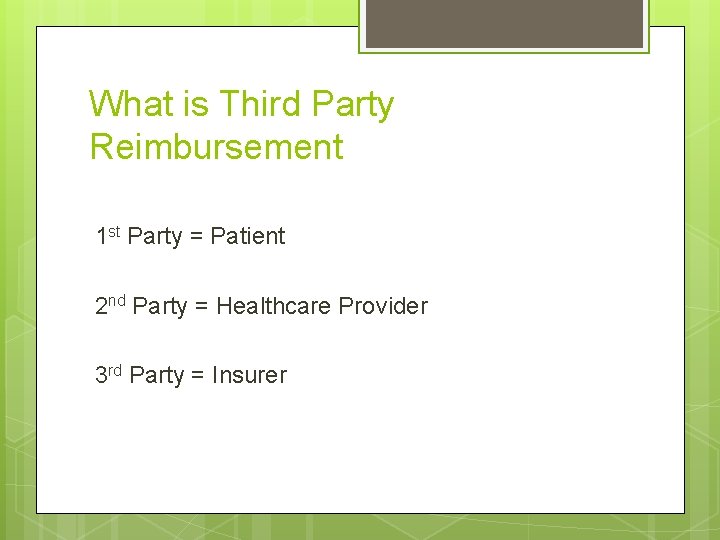
What is Third Party Reimbursement 1 st Party = Patient 2 nd Party = Healthcare Provider 3 rd Party = Insurer

History of Insurance (Casto & Layman, 2006)
Examples of Current Payment Models Accountable Medical (Korda & Eldridge, 2011) Care Organizations Home Model

Accountable Care Organizations (Hart, 2012) (Cadmus, 2011)

Medical Home Model (Korda & Eldridge, 2011)

Relevance to Nursing Nurses are the key to providing safe, quality, and cost-effective care. This is accomplished through assessment practices and care delivery practices (Hart, 2012) (Korda & Eldridge, 2011)

Theory of Bureaucratic Caring: Marilyn Anne Ray Self-Efficacy Nursing Theory: Alberta Bendura Process Theory: Ida Jean Orlando (Nursingplanet, 2012) (Parker, 2010) (Tomey & Alligood, 2009)
Health Care Environment Policies Quality Root and Safety Cause Analysis: Loss of revenue/reimbursement related to Nursing Process and Care Delivery

Policy: Affordable Care Act (Korda & Eldridge, 2011)
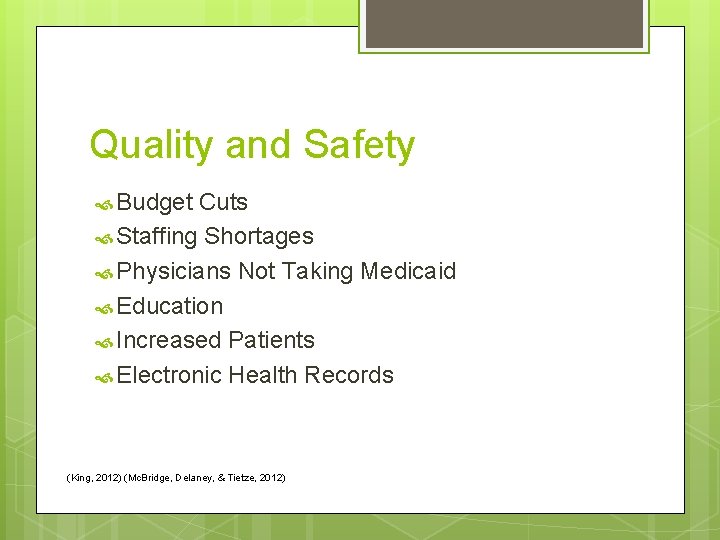
Quality and Safety Budget Cuts Staffing Shortages Physicians Not Taking Medicaid Education Increased Patients Electronic Health Records (King, 2012) (Mc. Bridge, Delaney, & Tietze, 2012)

Root Cause Analysis
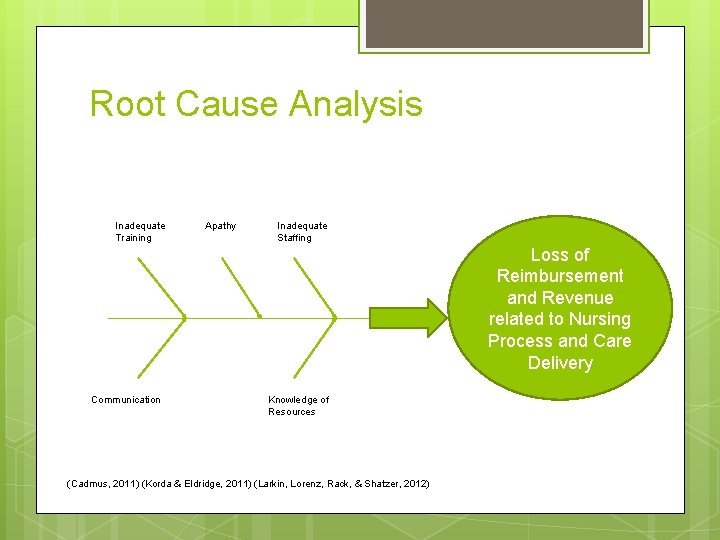
Root Cause Analysis Inadequate Training Apathy Inadequate Staffing Loss of Reimbursement and Revenue related to Nursing Process and Care Delivery Communication Knowledge of Resources (Cadmus, 2011) (Korda & Eldridge, 2011) (Larkin, Lorenz, Rack, & Shatzer, 2012)
Inferences and Implications Assessment Care Practices Delivery Practices
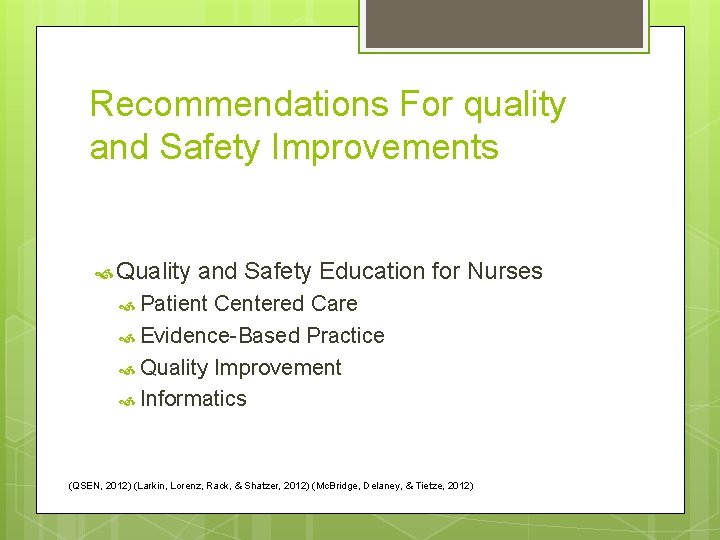
Recommendations For quality and Safety Improvements Quality and Safety Education for Nurses Patient Centered Care Evidence-Based Practice Quality Improvement Informatics (QSEN, 2012) (Larkin, Lorenz, Rack, & Shatzer, 2012) (Mc. Bridge, Delaney, & Tietze, 2012)

Recommendations Continued American Nurses Association Scope & Standards of Practice Quality of Practice Collaboration Research Resource Utilization Leadership (ANA, 2010)
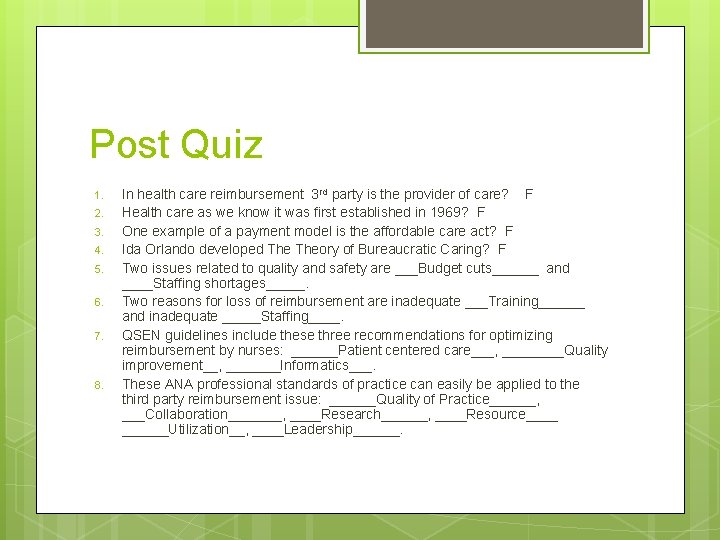
Post Quiz 1. 2. 3. 4. 5. 6. 7. 8. In health care reimbursement 3 rd party is the provider of care? F Health care as we know it was first established in 1969? F One example of a payment model is the affordable care act? F Ida Orlando developed Theory of Bureaucratic Caring? F Two issues related to quality and safety are ___Budget cuts______ and ____Staffing shortages_____. Two reasons for loss of reimbursement are inadequate ___Training______ and inadequate _____Staffing____. QSEN guidelines include these three recommendations for optimizing reimbursement by nurses: ______Patient centered care___, ____Quality improvement__, _______Informatics___. These ANA professional standards of practice can easily be applied to the third party reimbursement issue: ______Quality of Practice______, ___Collaboration_______, ____Research______, ____Resource______Utilization__, ____Leadership______.

References

References continued

References continued
- Slides: 25