
THIRD PART DEFINITIONS AND NOTATIONS NECESSITY OF STRICT











- Slides: 54
THIRD PART DEFINITIONS AND NOTATIONS
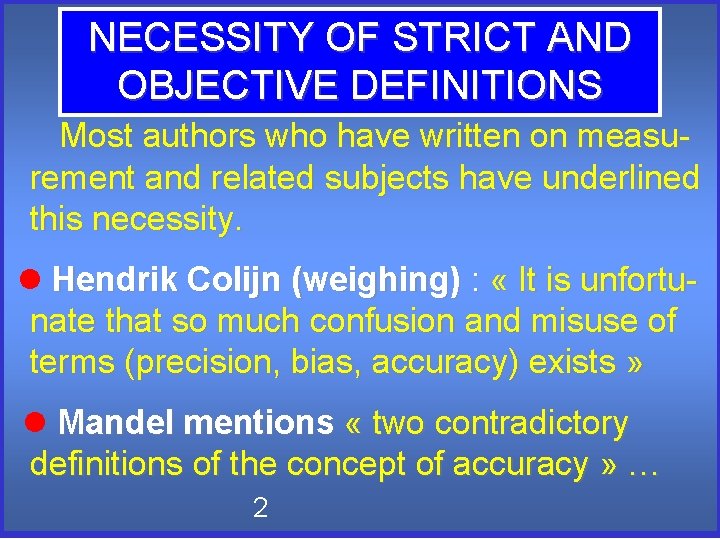
NECESSITY OF STRICT AND OBJECTIVE DEFINITIONS Most authors who have written on measurement and related subjects have underlined this necessity. l Hendrik Colijn (weighing) : « It is unfortunate that so much confusion and misuse of terms (precision, bias, accuracy) exists » l Mandel mentions « two contradictory definitions of the concept of accuracy » … 2
MATERIAL BATCHES LOT : Batch of finite, well defined size. MATERIALS : We will distinguish : Compact materials : e. g. mineral deposits, subject of « Geostatistics » a science founded by the French Georges Matheron. Particulate materials : Matter is discrete by essence, its elements can be molecules, atoms, ions, fragments. 3
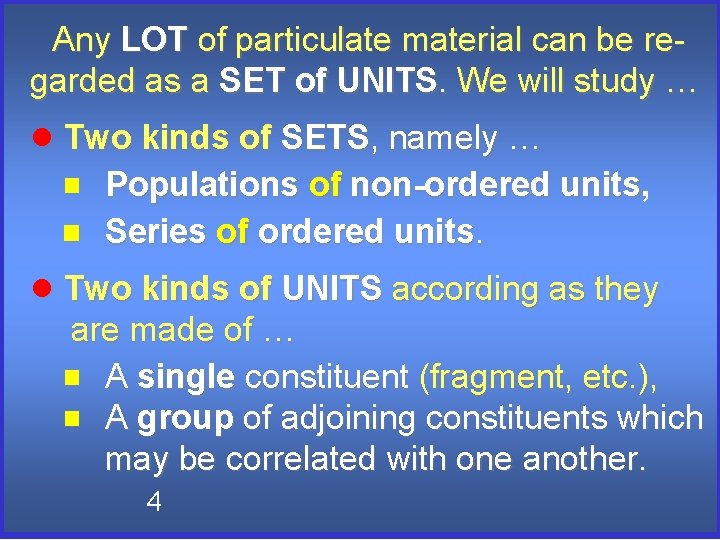
Any LOT of particulate material can be regarded as a SET of UNITS. We will study … Two kinds of SETS, namely … Populations of of non-ordered units, units Series of ordered units. Two kinds of UNITS according as they are made of … A single constituent (fragment, etc. ), A group of adjoining constituents which may be correlated with one another. 4
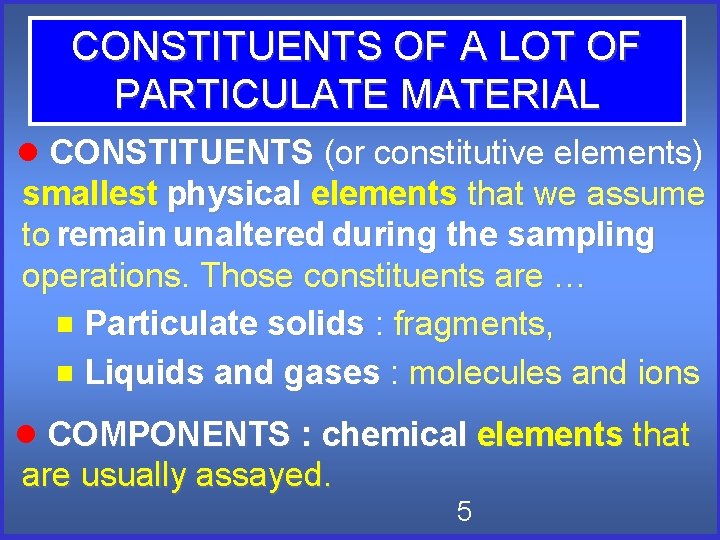
CONSTITUENTS OF A LOT OF PARTICULATE MATERIAL CONSTITUENTS (or constitutive elements) smallest physical elements that we assume to remain unaltered during the sampling operations. Those constituents are … Particulate solids : fragments, Liquids and gases : molecules and ions COMPONENTS : chemical elements that are usually assayed. 5
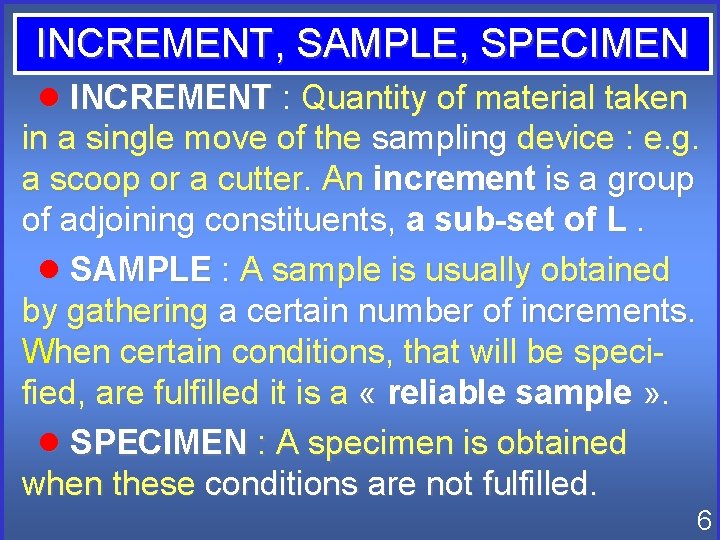
INCREMENT, SAMPLE, SPECIMEN INCREMENT : Quantity of material taken in a single move of the sampling device : e. g. a scoop or a cutter. An increment is a group of adjoining constituents, a sub-set of L. SAMPLE : A sample is usually obtained by gathering a certain number of increments. When certain conditions, that will be specified, are fulfilled it is a « reliable sample » . SPECIMEN : A specimen is obtained when these conditions are not fulfilled. 6
SAMPLES are RELIABLE while… SPECIMENS are UNRELIABLE. SAMPLING is a mass reduction which is achieved by SELECTION of several constituents. Sampling proper is an operation or sequence of operations that are supposed to provide a reliable SAMPLE. The word sampling is often misused for … SPECIMEN-TAKING is an operation or sequence of operations that provide an unreliable SPECIMEN. 7
MAJOR QUALITY REQUIRED OF A SELECTION Selection must respect the composition of the material to be sampled (proportion of various components) « as best as possible » . Sampling errors must be controlled. Obviously A THEORY OF SAMPLING IS FIRST OF ALL A THEORY OF THE SAMPLING ERRORS Qualitative and Quantitative approaches. 8
DEFINITIONS and NOTATIONS GRADE a. X of object X : it is defined as as the actual, always unknown, proportion of physical component A in object X specified by the subscript of a. X. A grade is always a dimensionless quantity. Mass of component A in object X a. X = ----------------------- Mass total of object X 9
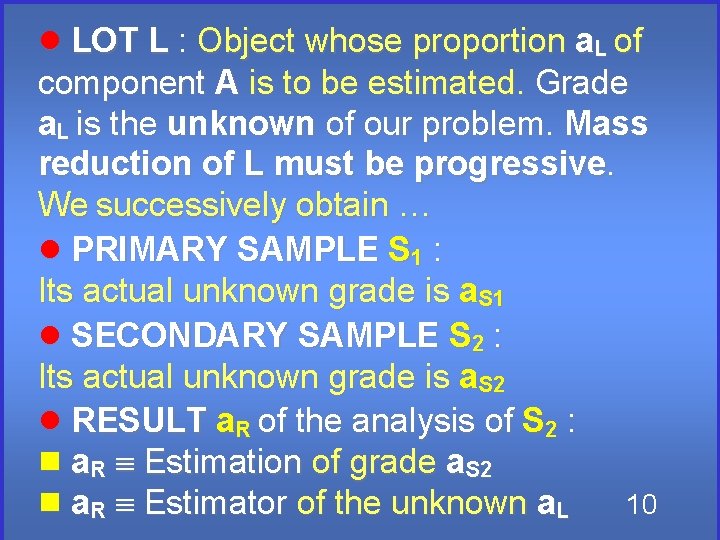
LOT L : Object whose proportion a. L of component A is to be estimated. Grade a. L is the unknown of our problem. Mass reduction of L must be progressive. We successively obtain … PRIMARY SAMPLE S 1 : Its actual unknown grade is a. S 1 SECONDARY SAMPLE S 2 : Its actual unknown grade is a. S 2 RESULT a. R of the analysis of S 2 : a. R Estimation of grade a. S 2 a. R Estimator of the unknown a. L 10
SPECIFICITIES OF PRIMARY AND SECONDARY SAMPLING PRIMARY SAMPLING : Its purpose is to generate « laboratory samples » small enough to be transported to the lab. It usually takes place in « dirty » industrial surroundings and is performed by unqualified personnel. SECONDARY SAMPLING : Its purpose is to generate one / several « assay portions » . Takes place in « clean » laboratory conditions Not always performed by qualified personnel, due to a lack of education. 11
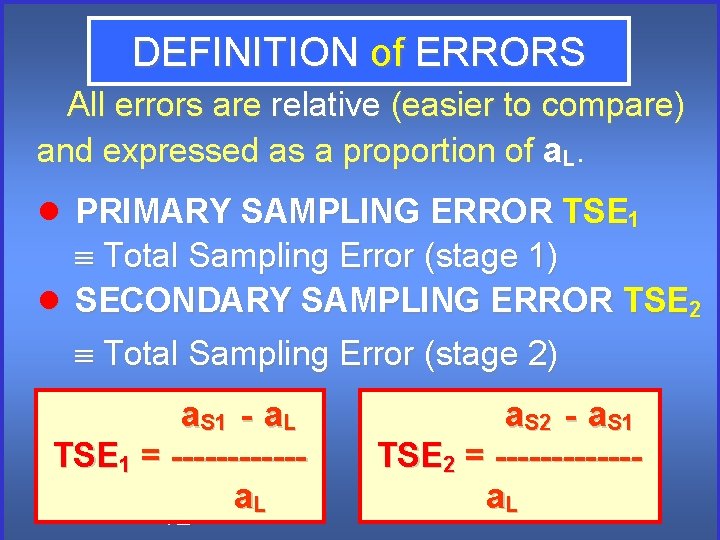
DEFINITION of ERRORS All errors are relative (easier to compare) and expressed as a proportion of a. L. PRIMARY SAMPLING ERROR TSE 1 Total Sampling Error (stage 1) SECONDARY SAMPLING ERROR TSE 2 Total Sampling Error (stage 2) a. S 1 - a. L TSE 1 = ------ a. L 12 a. S 2 - a. S 1 TSE 2 = ------ a. L
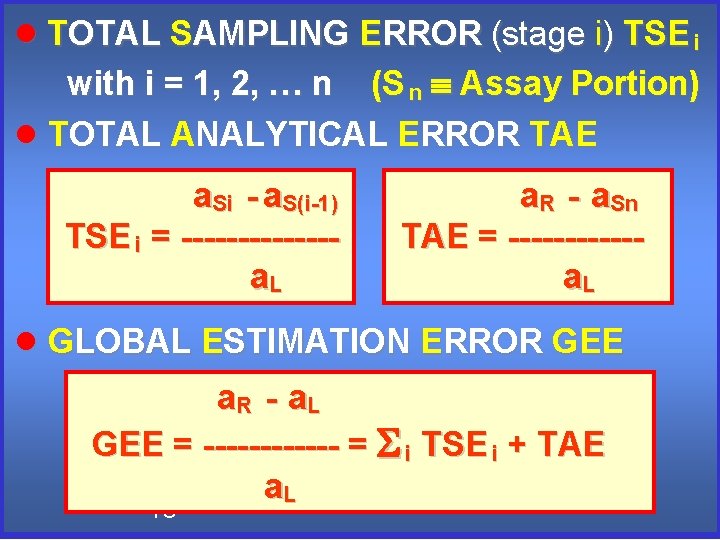
TOTAL SAMPLING ERROR (stage i) TSE i with i = 1, 2, … n (S n Assay Portion) TOTAL ANALYTICAL ERROR TAE a. Si - a. S(i-1) TSE i = ------- a. L a. R - a. Sn TAE = ------ a. L GLOBAL ESTIMATION ERROR GEE a. R - a. L GEE = ------ = S i TSE i + TAE a. L 13
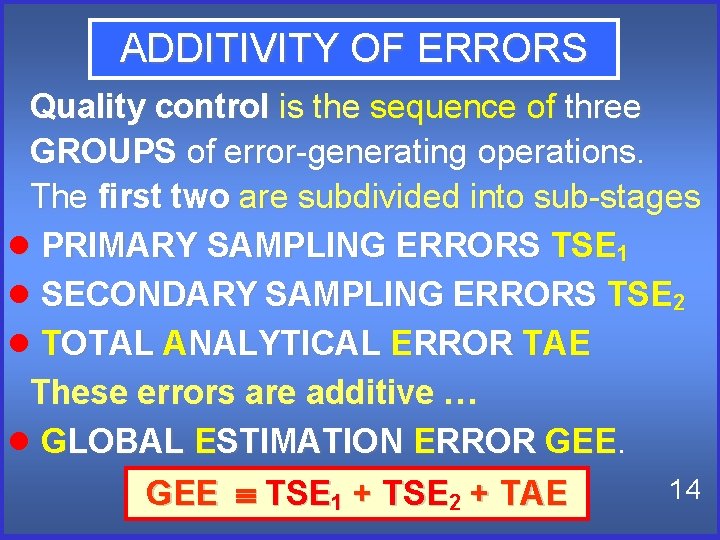
ADDITIVITY OF ERRORS Quality control is the sequence of three GROUPS of error-generating operations. The first two are subdivided into sub-stages PRIMARY SAMPLING ERRORS TSE 1 SECONDARY SAMPLING ERRORS TSE 2 TOTAL ANALYTICAL ERROR TAE These errors are additive … GLOBAL ESTIMATION ERROR GEE. 14 GEE TSE 1 + TSE 2 + TAE
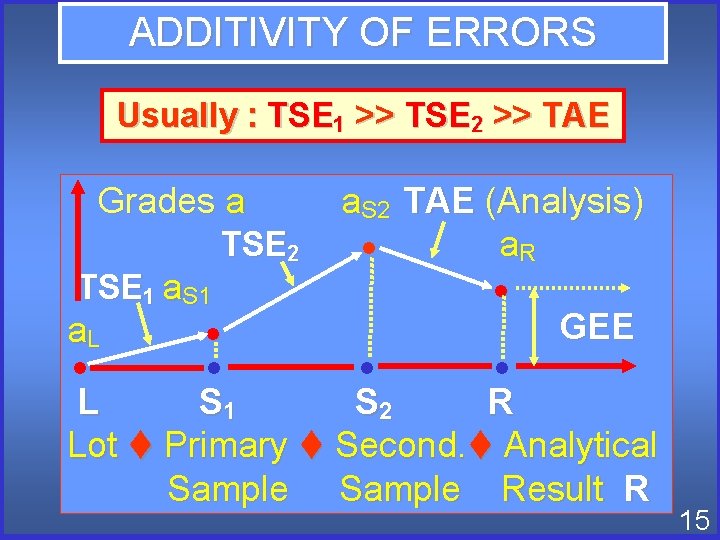
ADDITIVITY OF ERRORS Usually : TSE 1 >> TSE 2 >> TAE Grades a a. S 2 TAE (Analysis) TSE 2 a. R TSE 1 a. S 1 a. L GEE L S 1 S 2 R Lot t Primary t Second. t Analytical Sample Result R 15
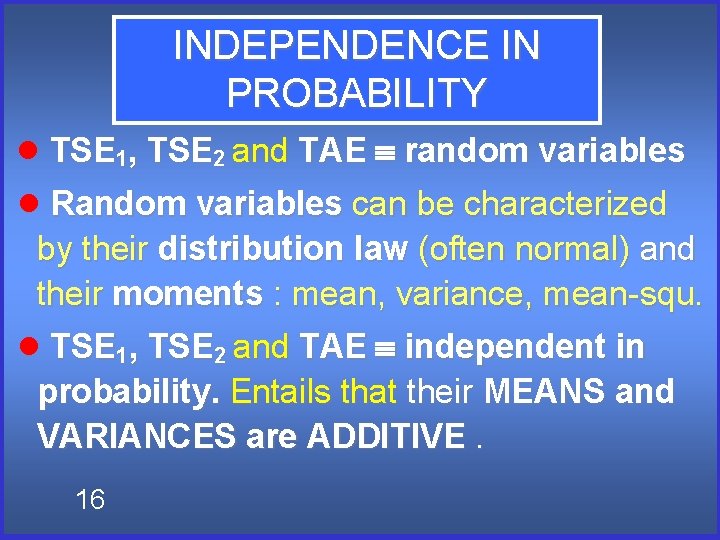
INDEPENDENCE IN PROBABILITY TSE 1, TSE 2 and TAE random variables Random variables can be characterized by their distribution law (often normal) and their moments : mean, variance, mean-squ. TSE 1, TSE 2 and TAE independent in probability. Entails that their MEANS and VARIANCES are ADDITIVE. 16
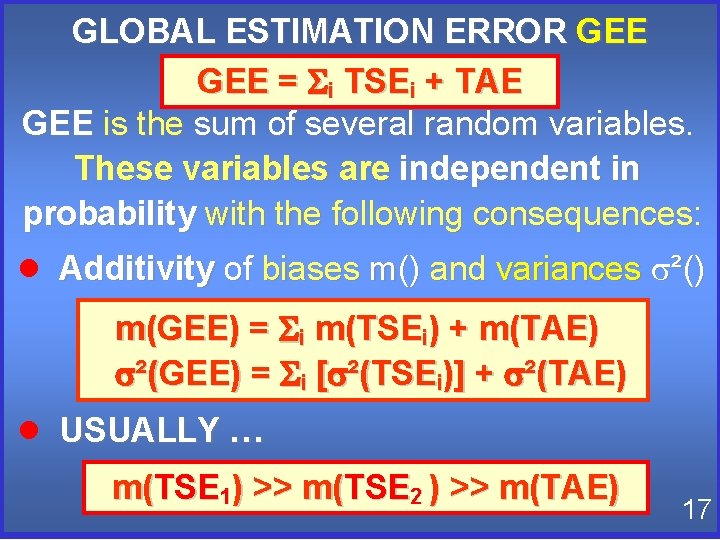
GLOBAL ESTIMATION ERROR GEE GEE = Si TSEi + TAE GEE is the sum of several random variables. These variables are independent in probability with the following consequences: Additivity of biases m() and variances s²() m(GEE) = Si m(TSEi) + m(TAE) s²(GEE) = Si [s²(TSEi)] + s²(TAE) USUALLY … m(TSE 1) >> m(TSE 2 ) >> m(TAE) 17
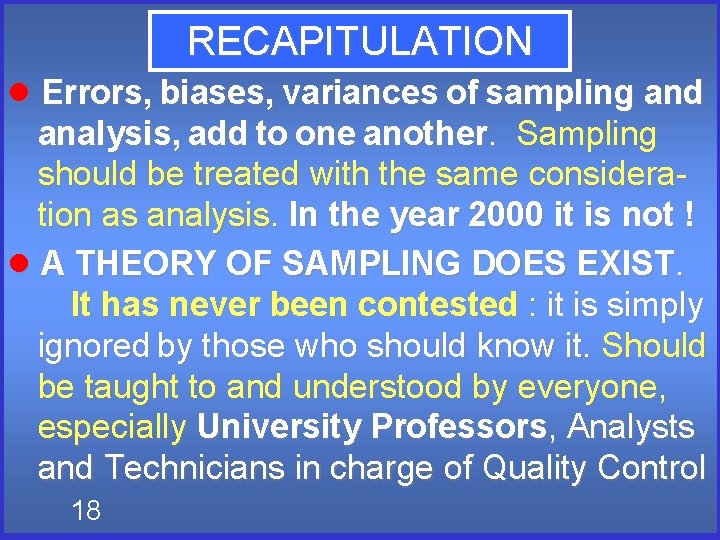
RECAPITULATION Errors, biases, variances of sampling and analysis, add to one another. Sampling should be treated with the same consideration as analysis. In the year 2000 it is not ! A THEORY OF SAMPLING DOES EXIST. It has never been contested : it is simply ignored by those who should know it. Should be taught to and understood by everyone, especially University Professors, Analysts and Technicians in charge of Quality Control 18
FOR THE SAKE OF EFFICIENCY, analysts should abcd be in charge of QUALITY CONTROL and more specifically of SAMPLING. DECISION MAKERS IN RESEARCH AND INDUSTRY should understand that sufficient investments should be attributed to sampling. E. ROTH (1997) : « Analysts should refuse to give results when they are not satisfied of the REPRESENTATIVITY of samples » (scientific definition given below) 19
DEFINITIONS HOMOGENEITY AND HETEROGENEITY OF A SET OF UNITS 20
A SET of UNITS is said to be : HOMOGENEOUS : when it is made of STRICTLY IDENTICAL units. HETEROGENEOUS : when units are NOT STRICTLY IDENTICAL. Homogeneity can be defined but can never be observed. Example of pure water made of H 20 molecules, H+, OH-, O 2 - ions and all isotopic combinations of H & O. To say nothing of alien components. 21
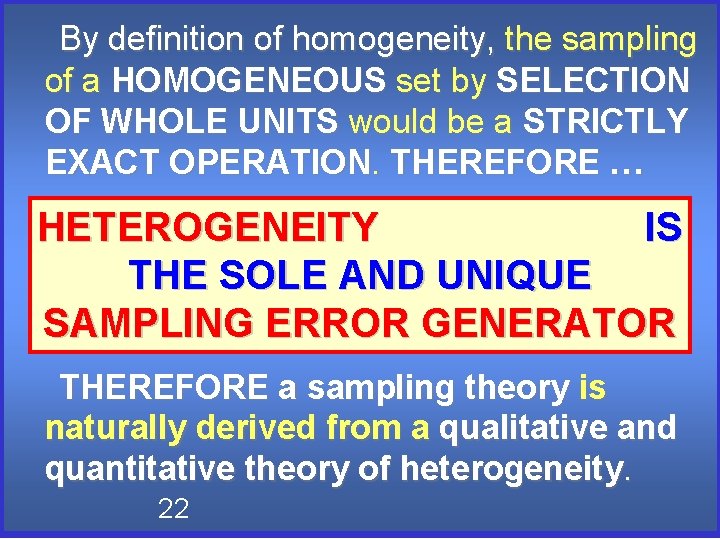
By definition of homogeneity, the sampling of a HOMOGENEOUS set by SELECTION OF WHOLE UNITS would be a STRICTLY EXACT OPERATION. THEREFORE … HETEROGENEITY IS THE SOLE AND UNIQUE SAMPLING ERROR GENERATOR THEREFORE a sampling theory is naturally derived from a a qualitative and quantitative theory of heterogeneity. 22
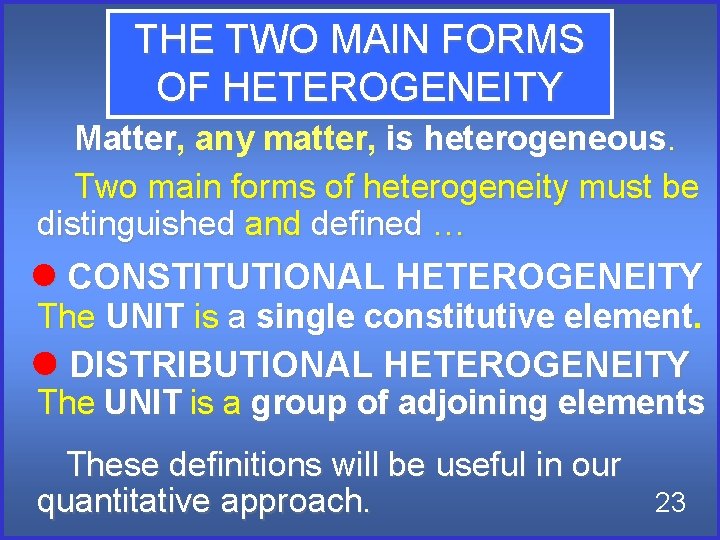
THE TWO MAIN FORMS OF HETEROGENEITY Matter, any matter, is heterogeneous. Two main forms of heterogeneity must be distinguished and defined … CONSTITUTIONAL HETEROGENEITY The UNIT is a single constitutive element. DISTRIBUTIONAL HETEROGENEITY The UNIT is a group of adjoining elements These definitions will be useful in our quantitative approach. 23
DEFINITIONS How to qualify the CONDITIONS of a Selection or a Sampling 24
CONDITIONS and RESULTS of a SELECTION Necessity of STRICT definitions in metrology. Especially re. the concepts of accuracy, precision, reproducibility and representativity (no scientific definitions of the latter so far neither in English nor in French). This necessity is underlined by numerous specialists such as Colijn (weighing) or Mandel (analysis of experimental data) … 25
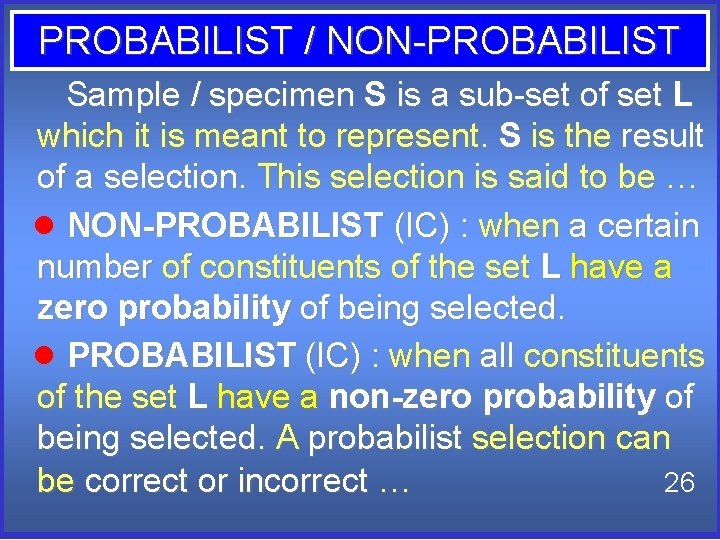
PROBABILIST / NON-PROBABILIST Sample / specimen S is a sub-set of set L which it is meant to represent. S is the result of a selection. This selection is said to be … NON-PROBABILIST (IC) : when a certain number of constituents of the set L have a zero probability of being selected. PROBABILIST (IC) : when all constituents of the set L have a non-zero probability of being selected. A probabilist selection can be correct or incorrect … 26
CORRECT / INCORRECT : when simultaneously : All constituents have an equal probability of being selected. The integrity of increments and sample is duly respected. INCORRECT : when one of these conditions, at least, is not respected. According to theoretical results, a CORRECT selection ALONE provides reliable « SAMPLES » . 27
HOW TO ACHIEVE A « CORRECT » SELECTION Correctness is the quality of a selection that gives all constituents of L an equal probability of being selected. There are two ways of achieving a correct selection : t THE CONSTITUENTS are distributed AT RANDOM throughout the domain of lot L. t THE INCREMENTS are distributed AT RANDOM throughout the domain of lot L. 28
CONSTITUENTS DISTRIBUTED AT RANDOM THROUGHOUT LOT L Definition of distributional homogeneity : IN THIS CASE ANY FRACTION OF LOT L IS A CORRECT SAMPLE OF L but due to gravity segregation, electrostatic, magnetic forces, or the like, such a distribution never exists spontaneously. It would be reached through a perfect homogenizing by mixing. The hypothesis of spontane-ous homogeneity is unrealistic. 29
INCREMENTS DISTRIBUTED AT RANDOM THROUGHOUT LOT L IN THIS CASE, THE SELECTION IS CORRECT WHATEVER THE CONSTITUENT DISTRIBUTION THROUGHOUT LOT L FREQUENT MISTAKE : the operator implicitly assumes a random distribution and takes increments from the most accessible fraction of the lot, which amounts to solving the problem by choosing to ignore its existence. 30
CORRECTNESS IN PRACTICE DEVIATIONS FROM CORRECTNESS may be the consequence … either of ignorance of the personnel in charge of sampling and quality control, or of awkwardness of the sampling operator, partly due to his own ignorance or of a deliberate will to bias the sample. Sampling, weak point of the estimation chain, plays the role of « scapegoat » . 31
HOW TO ACHIEVE A CORRECT SAMPLING MANAGEABLE LOTS (light enough to be handled in totality). The correct solution consists in homogenizing by mixing whenever possible. As an additional precaution, increments may be taken at random. NON-MANAGEABLE LOTS. Except with one-dimensional flowing lots, there is no correct solution. 32
DEFINITIONS How to qualify the RESULTS of a Selection or a Sampling 33
STRUCTURAL AND CIRCUMSTANTIAL PROPERTIES A property of a selection is said to be : STRUCTURAL : when it depends only on the properties of this selection, CIRCUMSTANTIAL : when, in addition to those, it does depend on external circumstances and especially on the composition of the material being sampled. 34
A selection can be qualified in terms of properties of the total sampling error TSE At any sampling stage the error TSE is a. S - a. L TSE = ----- a. L TSE is a random variable characterized by its distribution law and its moments : Distribution : a. L > 10 -6 : normal law a. L < 10 -6 : log-normal law 35
COMPONENTS OF THE ERROR TSE TSE is the sum of TWO major components TSE CSE + ISE CORRECT SAMPLING ERROR CSE. Observed when probability P is uniform. CSE incompressible minimum of TSE. INCORRECT SAMPLING ERROR ISE. Additional error observed when the selection probability P is NOT uniform. CSE and ISE = S of several components. 36
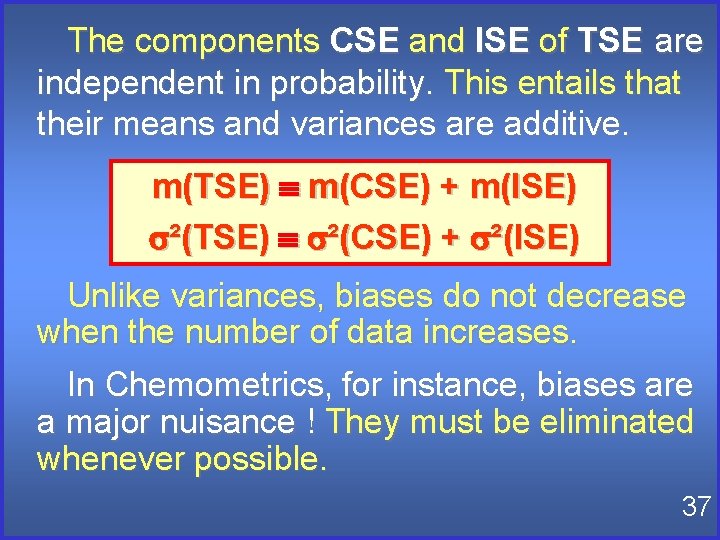
The components CSE and ISE of TSE are independent in probability. This entails that their means and variances are additive. m(TSE) m(CSE) + m(ISE) s²(TSE) s²(CSE) + s²(ISE) Unlike variances, biases do not decrease when the number of data increases. In Chemometrics, for instance, biases are a major nuisance ! They must be eliminated whenever possible. 37
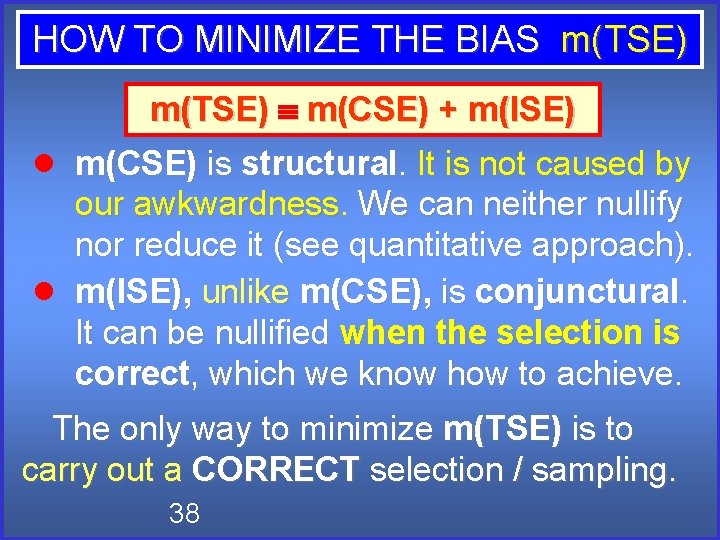
HOW TO MINIMIZE THE BIAS m(TSE) m(CSE) + m(ISE) m(CSE) is structural. It is not caused by our awkwardness. We can neither nullify nor reduce it (see quantitative approach). m(ISE), unlike m(CSE), is conjunctural. It can be nullified when the selection is correct, which we know how to achieve. The only way to minimize m(TSE) is to carry out a CORRECT selection / sampling. 38
PROPERTIES OF m(CSE) Theory shows that the mean m(CSE) is never zero. We call it « structural bias. » It is usually negligible (except with traces). Theory expresses m(CSE) in terms of the composition of the lot L. Useless except in experimental work. In practice we never try to compute m(CSE) : we just remember that it is not zero and that we can do nothing about it. 39
CONCEPT OF EXACTNESS Exactness is a property of the error TSE itself that can be defined but that is never observed. A selection would be said to be EXACT : EXACT if TSE were structurally zero, i. e. TSE 0 whatever the circumstances Never observed : TSE can never be zero. The words « exact » and « exactness » do not belong to the sampling vocabulary. 40
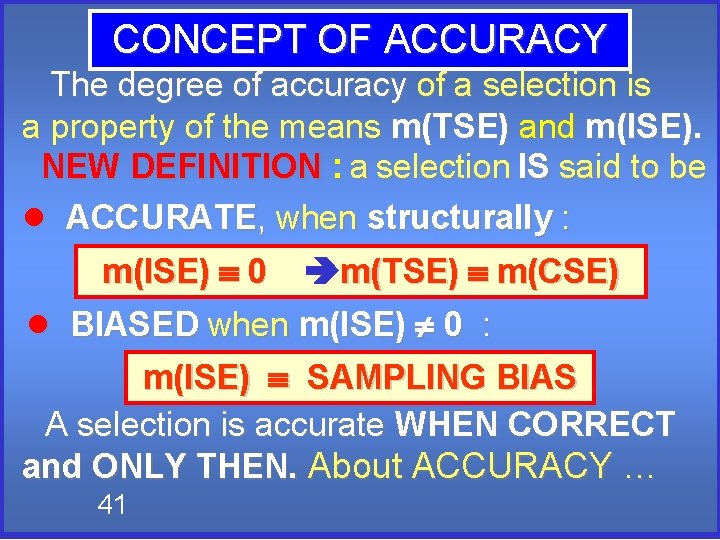
CONCEPT OF ACCURACY The degree of accuracy of a selection is a property of the means m(TSE) and m(ISE). NEW DEFINITION : a selection IS said to be ACCURATE, when structurally : m(ISE) 0 è 0 m(TSE) m(CSE) BIASED when m(ISE) 0 : m(ISE) SAMPLING BIAS A selection is accurate WHEN CORRECT and ONLY THEN. About ACCURACY … 41
Kaye, Illinois Inst. of Technology (1967) « The accuracy of many analytical results has too often been neglected with disastrous financial consequences » … « The accuracy of many analytical data reports is a mirage because unwitting negligence and false cost consciousness have ensured that a sample of powder taken with cursory swiftness has been examined with costly precision » . 42
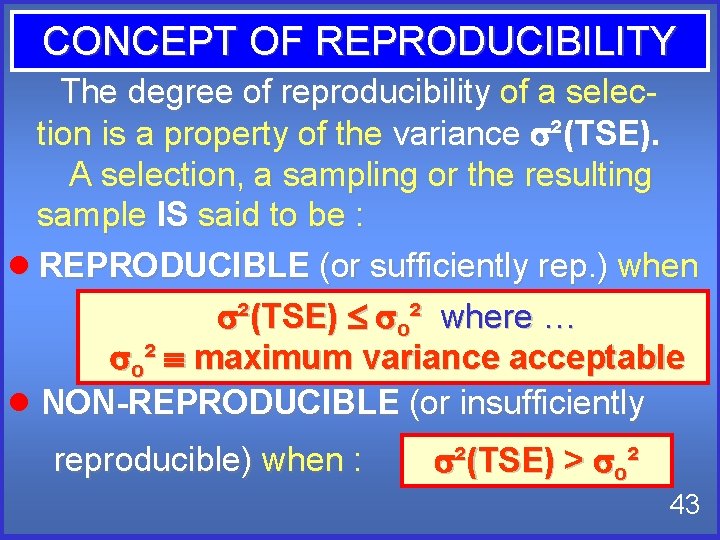
CONCEPT OF REPRODUCIBILITY The degree of reproducibility of a selection is a property of the variance s²(TSE). A selection, a sampling or the resulting sample IS said to be : REPRODUCIBLE (or sufficiently rep. ) when s²(TSE) so² where … so² maximum variance acceptable NON-REPRODUCIBLE (or insufficiently reproducible) when : s²(TSE) > so² 43
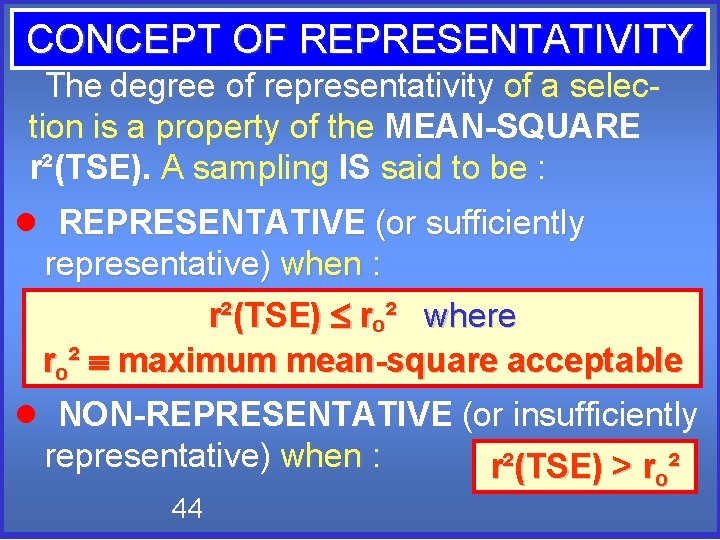
CONCEPT OF REPRESENTATIVITY The degree of representativity of a selection is a property of the MEAN-SQUARE r²(TSE). A sampling IS said to be : REPRESENTATIVE (or sufficiently representative) when : r²(TSE) ro² where ro² maximum mean-square acceptable NON-REPRESENTATIVE (or insufficiently representative) when : 44 r²(TSE) > ro²
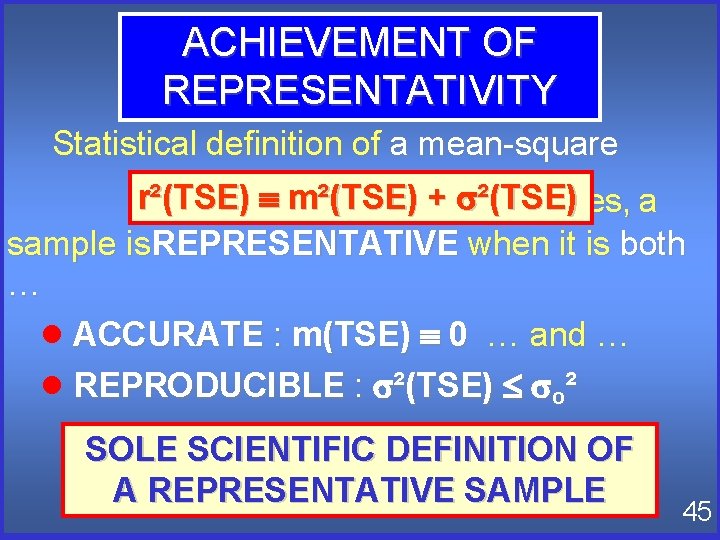
ACHIEVEMENT OF REPRESENTATIVITY Statistical definition of a mean-square m²(TSE) + s ²(TSE) r²(TSE) To all intents and purposes, a sample is. REPRESENTATIVE when it is both … ACCURATE : m(TSE) 0 … and … REPRODUCIBLE : s²(TSE) so² SOLE SCIENTIFIC DEFINITION OF A REPRESENTATIVE SAMPLE 45
NOTION OF PRECISION The French / English words « précision » and « precision » are used in both languages with a vague, ambiguous, non-scientific GLOBALLY GOOD meaning. Is it a property of the mean or one of the mean-square ? Authors disagree ! For this reason, we do not recommend their use in a scientific context. We will restrict this use to expressions such as « precision instrument, precision scales » or the like. 46
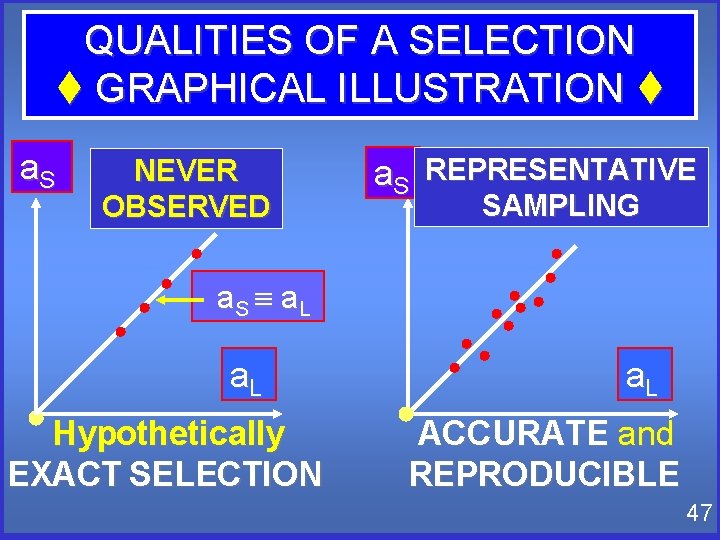
QUALITIES OF A SELECTION t GRAPHICAL ILLUSTRATION t a. S NEVER OBSERVED a. S REPRESENTATIVE SAMPLING l l l a. S a. L l l l l l a. L Hypothetically ACCURATE and EXACT SELECTION REPRODUCIBLE 47
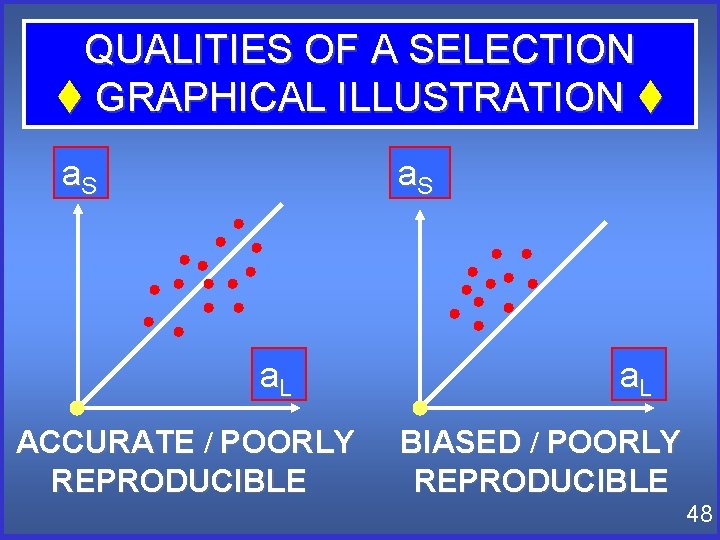
QUALITIES OF A SELECTION t GRAPHICAL ILLUSTRATION t a. S l ll l l l l l a. L ACCURATE / POORLY BIASED / POORLY REPRODUCIBLE 48
DEFINITIONS Relationships between CONDITIONS AND RESULTS of a Selection or a Sampling 49
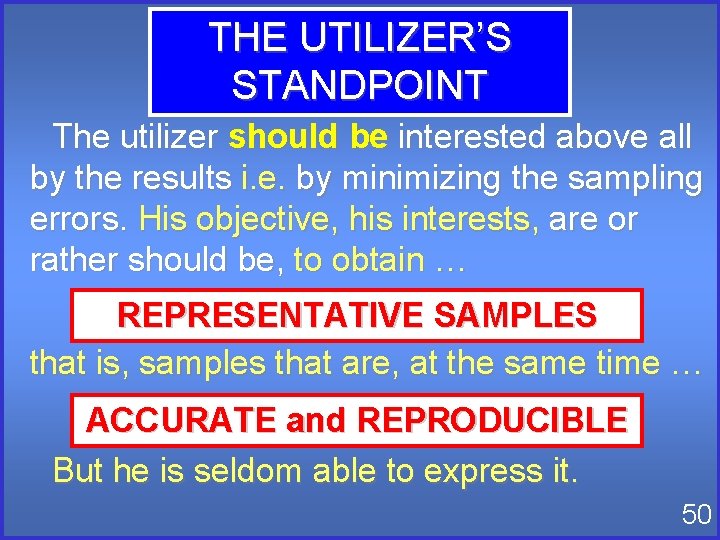
THE UTILIZER’S STANDPOINT The utilizer should be interested above all by the results i. e. by minimizing the sampling errors. His objective, his interests, are or rather should be, to obtain … REPRESENTATIVE SAMPLES that is, samples that are, at the same time … ACCURATE and REPRODUCIBLE But he is seldom able to express it. 50
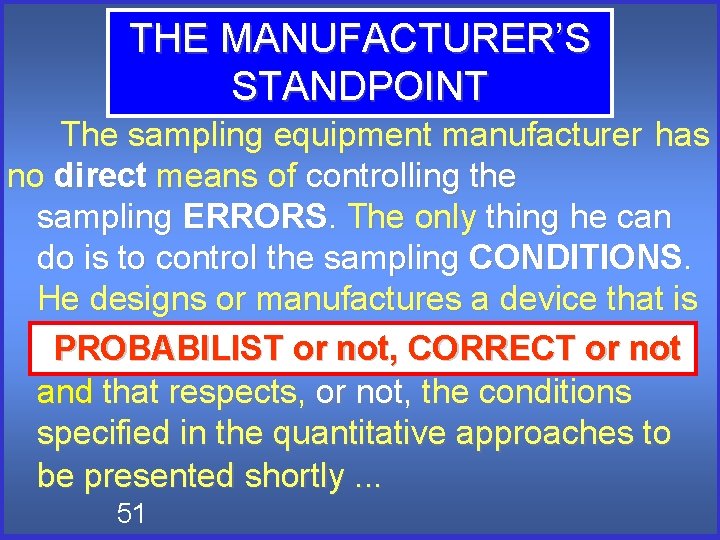
THE MANUFACTURER’S STANDPOINT The sampling equipment manufacturer has no direct means of controlling the sampling ERRORS. The only thing he can do is to control the sampling CONDITIONS. He designs or manufactures a device that is PROBABILIST or not, CORRECT or not and that respects, or not, the conditions specified in the quantitative approaches to be presented shortly. . . 51
THE THEORETICIAN’S ROLE Theory has built up a bridge between selecting conditions and sampling results It tells the utilizer what he can expect and what he must demand from a manufacturer to obtain representative samples, It tells the manufacturer what he should or should not do to achieve this purpose, Theoreticians should be asked to advise standardization in scientific matters. 52
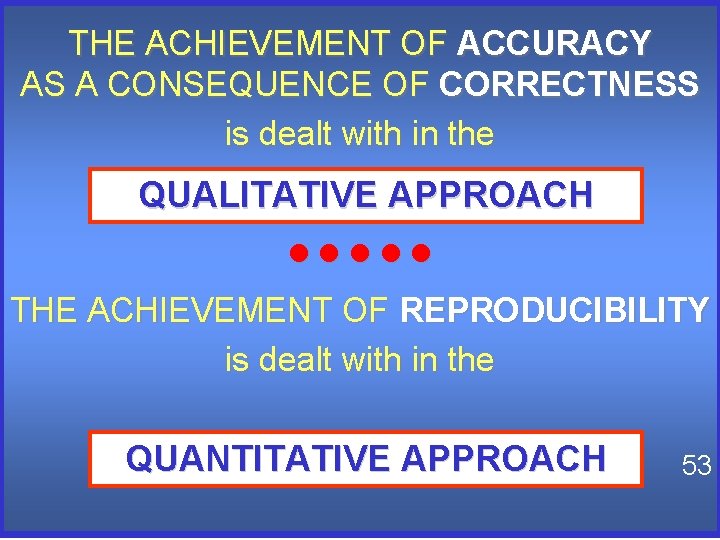
THE ACHIEVEMENT OF ACCURACY AS A CONSEQUENCE OF CORRECTNESS is dealt with in the QUALITATIVE APPROACH THE ACHIEVEMENT OF REPRODUCIBILITY is dealt with in the QUANTITATIVE APPROACH 53
RECAPITULATION The achievement of a PROBABILIST and CORRECT selection is the only way to obtain ACCURATE therefore RELIABLE SAMPLES. NON-PROBABILIST or PROBABILIST but INCORRECT selection provides nothing but BIASED, UNRELIABLE SPECIMENS on the basis of which no safe decision, especially with vital or financial consequences should be made. 54