
Thiophene 1 1 4 dicarbonyl compound with a
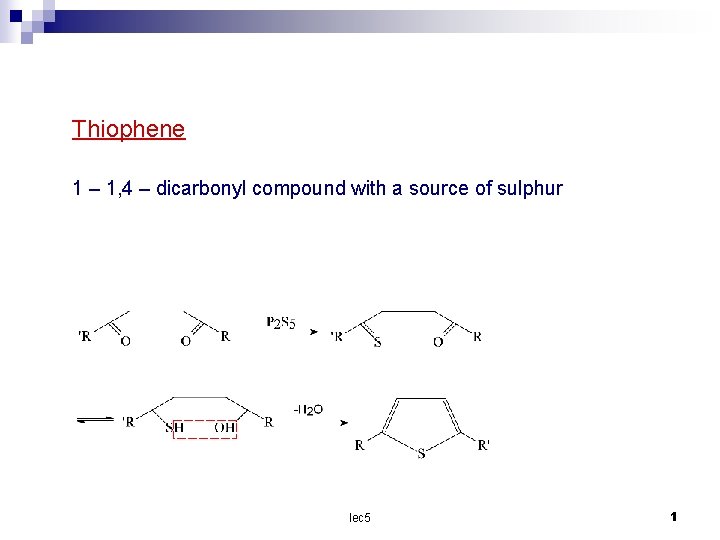
Thiophene 1 – 1, 4 – dicarbonyl compound with a source of sulphur lec 5 1
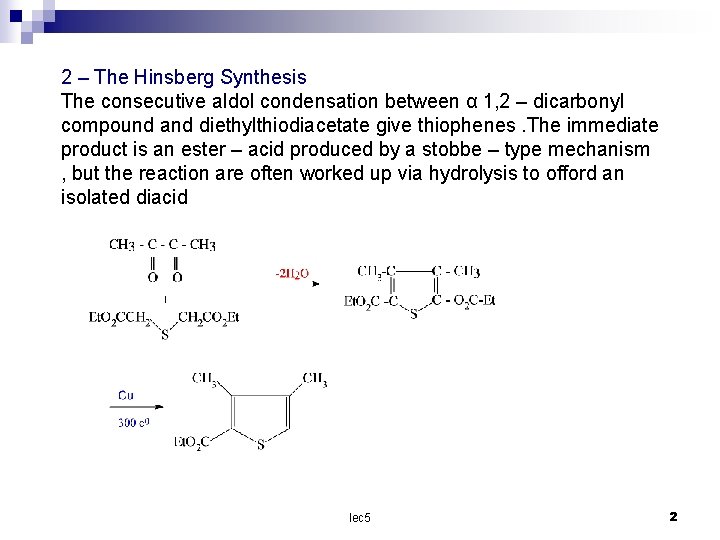
2 – The Hinsberg Synthesis The consecutive aldol condensation between α 1, 2 – dicarbonyl compound and diethylthiodiacetate give thiophenes. The immediate product is an ester – acid produced by a stobbe – type mechanism , but the reaction are often worked up via hydrolysis to offord an isolated diacid lec 5 2
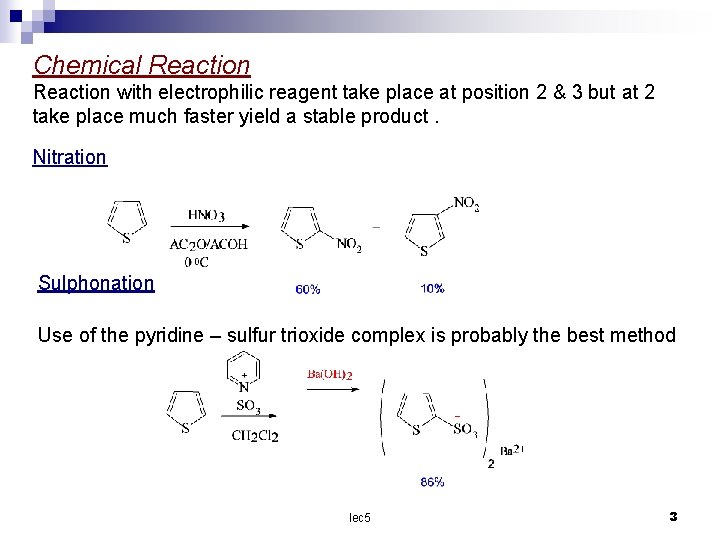
Chemical Reaction with electrophilic reagent take place at position 2 & 3 but at 2 take place much faster yield a stable product. Nitration Sulphonation Use of the pyridine – sulfur trioxide complex is probably the best method lec 5 3
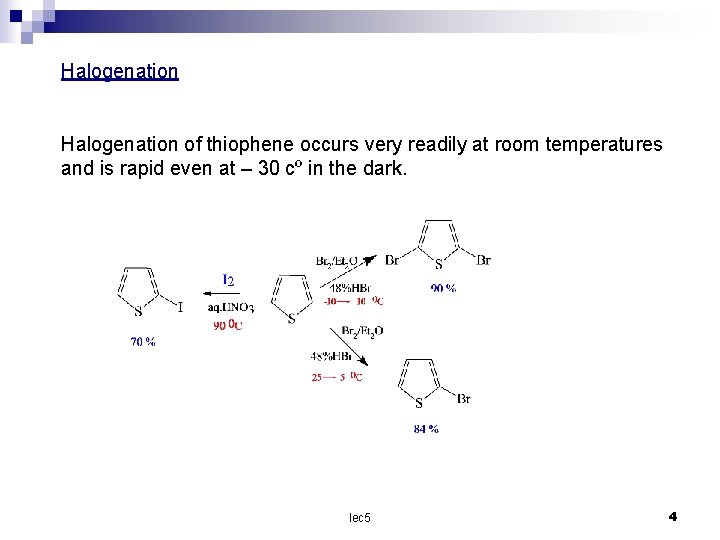
Halogenation of thiophene occurs very readily at room temperatures and is rapid even at – 30 cº in the dark. lec 5 4
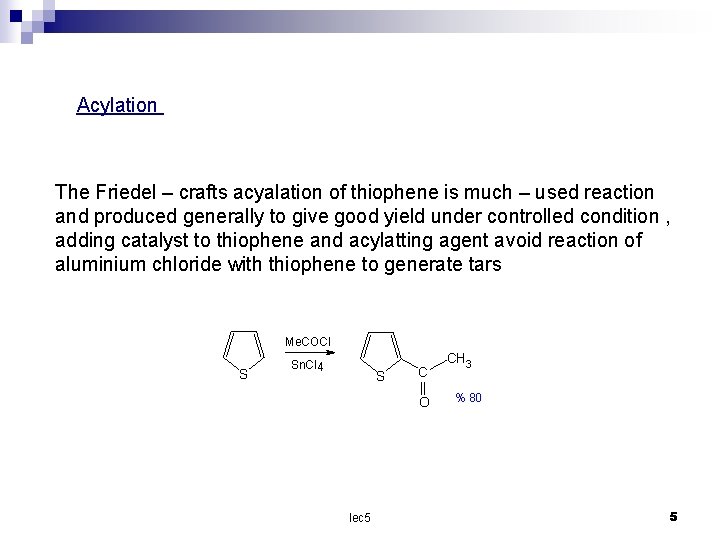
Acylation The Friedel – crafts acyalation of thiophene is much – used reaction and produced generally to give good yield under controlled condition , adding catalyst to thiophene and acylatting agent avoid reaction of aluminium chloride with thiophene to generate tars Me. COCl S Sn. Cl 4 S lec 5 C || O CH 3 % 80 5
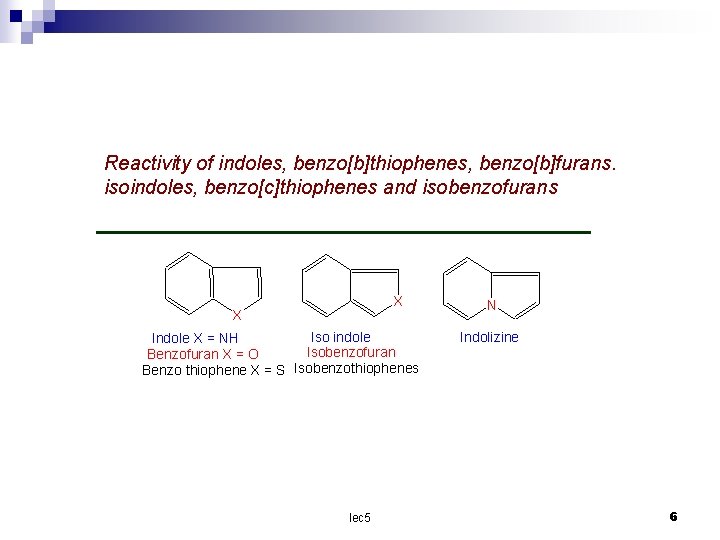
Reactivity of indoles, benzo[b]thiophenes, benzo[b]furans. isoindoles, benzo[c]thiophenes and isobenzofurans X X Iso indole Indole X = NH Isobenzofuran Benzofuran X = O Benzo thiophene X = S Isobenzothiophenes lec 5 N Indolizine 6
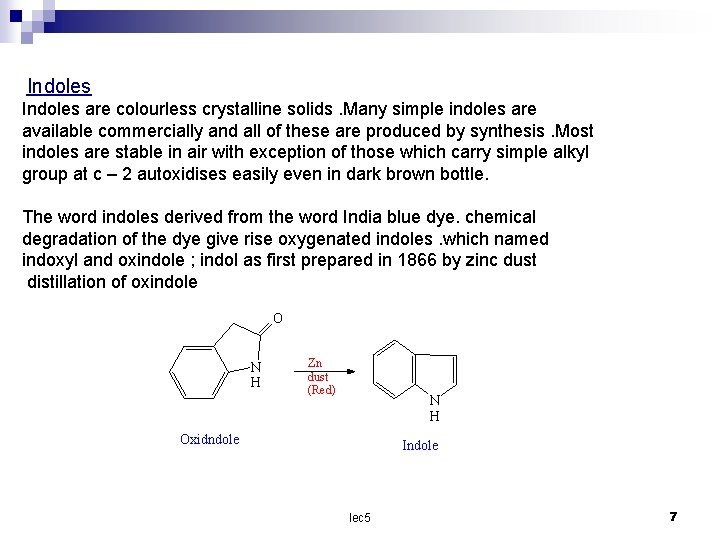
Indoles are colourless crystalline solids. Many simple indoles are available commercially and all of these are produced by synthesis. Most indoles are stable in air with exception of those which carry simple alkyl group at c – 2 autoxidises easily even in dark brown bottle. The word indoles derived from the word India blue dye. chemical degradation of the dye give rise oxygenated indoles. which named indoxyl and oxindole ; indol as first prepared in 1866 by zinc dust distillation of oxindole O N H Zn dust (Red) N H Oxidndole Indole lec 5 7
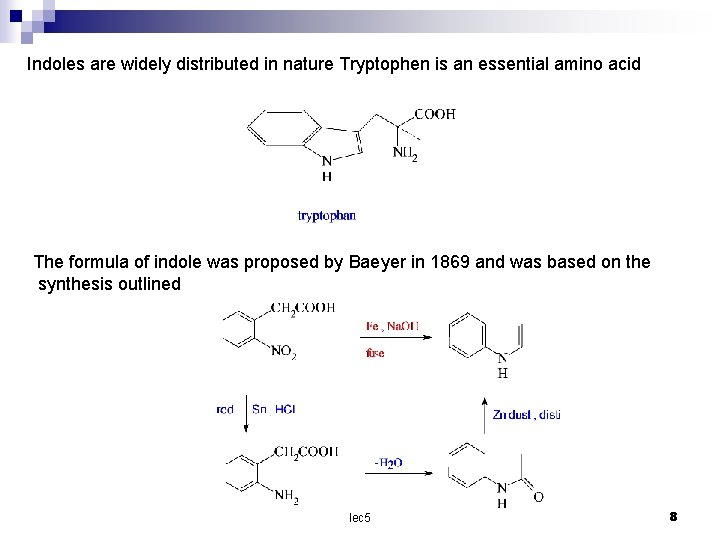
Indoles are widely distributed in nature Tryptophen is an essential amino acid The formula of indole was proposed by Baeyer in 1869 and was based on the synthesis outlined lec 5 8
The resonance energy of indole calculated from its heat of combustion is (47 – 49 ) kcal / mol the increase in resonance energy over pyrrole (23 – 27 ) is almost identical to the difference between the resonance energies of naphthalene (61) and benzene (36) lec 5 9
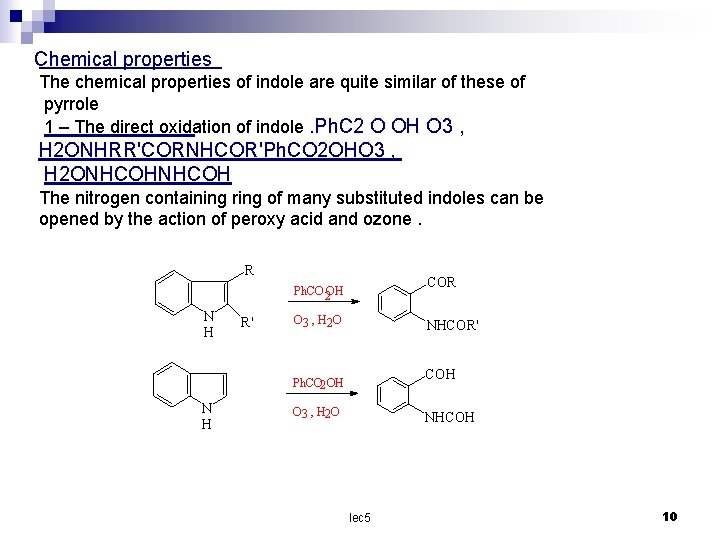
Chemical properties The chemical properties of indole are quite similar of these of pyrrole 1 – The direct oxidation of indole. Ph. C 2 O OH O 3 , H 2 ONHRR'CORNHCOR'Ph. CO 2 OHO 3 , H 2 ONHCOH The nitrogen containing ring of many substituted indoles can be opened by the action of peroxy acid and ozone. R COR Ph. CO 2 OH N H R' O 3 , H 2 O NHCOR' COH Ph. CO 2 OH N H O 3 , H 2 O NHCOH lec 5 10
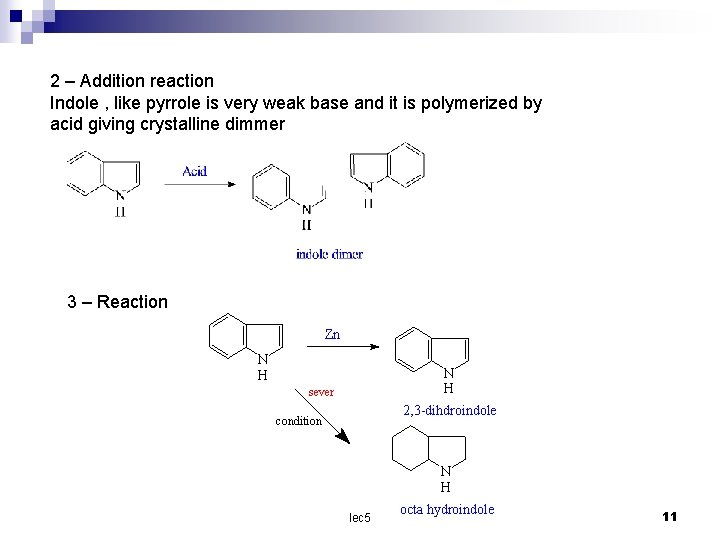
2 – Addition reaction Indole , like pyrrole is very weak base and it is polymerized by acid giving crystalline dimmer 3 – Reaction Zn N H sever 2, 3 -dihdroindole condition N H lec 5 octa hydroindole 11
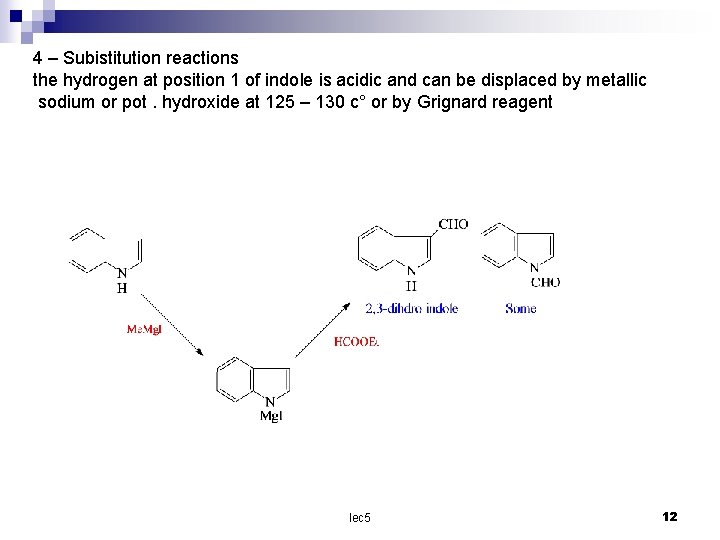
4 – Subistitution reactions the hydrogen at position 1 of indole is acidic and can be displaced by metallic sodium or pot. hydroxide at 125 – 130 c° or by Grignard reagent lec 5 12
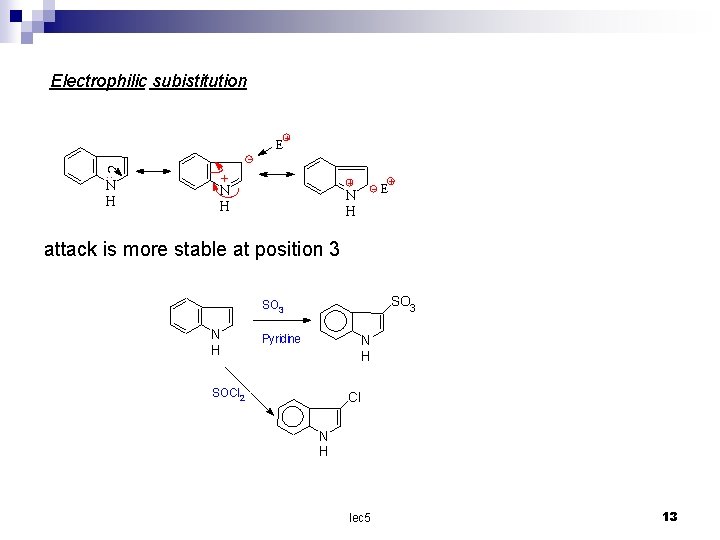
Electrophilic subistitution E . . N H + N H E N H attack is more stable at position 3 SO 3 N H Pyridine N H SOCl 2 Cl N H lec 5 13
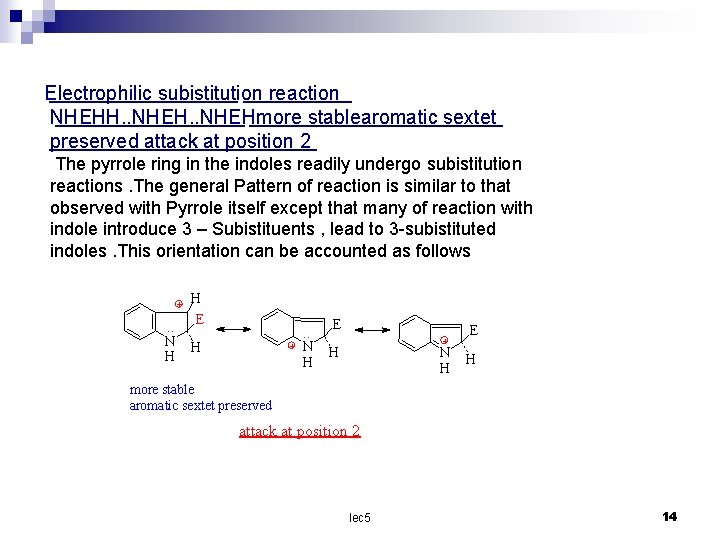
Electrophilic subistitution reaction NHEHH. . NHEHmore stablearomatic sextet preserved attack at position 2 The pyrrole ring in the indoles readily undergo subistitution reactions. The general Pattern of reaction is similar to that observed with Pyrrole itself except that many of reaction with indole introduce 3 – Subistituents , lead to 3 -subistituted indoles. This orientation can be accounted as follows H. . N H E . . N H H E E N H H H more stable aromatic sextet preserved attack at position 2 lec 5 14
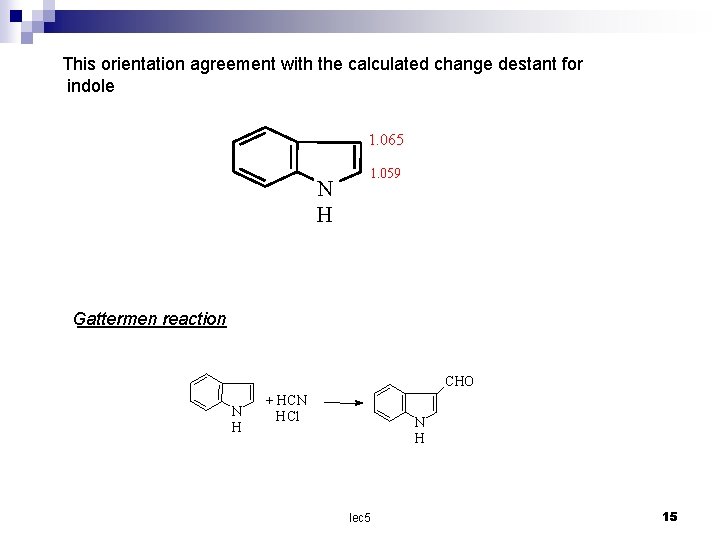
This orientation agreement with the calculated change destant for indole 1. 065 N H 1. 059 Gattermen reaction CHO N H + HCN HCl N H lec 5 15
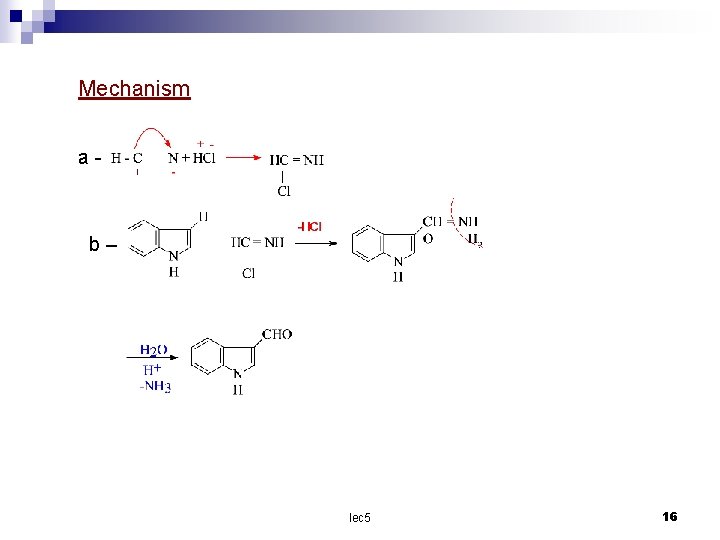
Mechanism a- b– lec 5 16
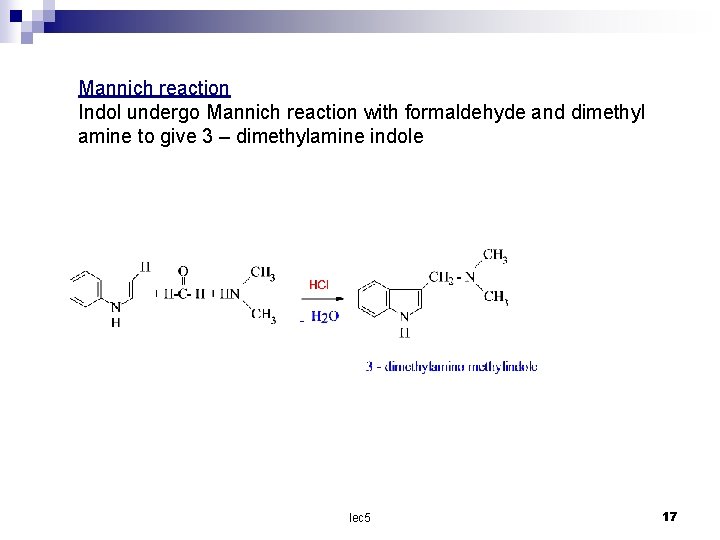
Mannich reaction Indol undergo Mannich reaction with formaldehyde and dimethyl amine to give 3 – dimethylamine indole - lec 5 17
- Slides: 17