
THINKING UPSTREAM Conceptualizing Health from a Population Perspective
- Slides: 21
THINKING UPSTREAM Conceptualizing Health from a Population Perspective
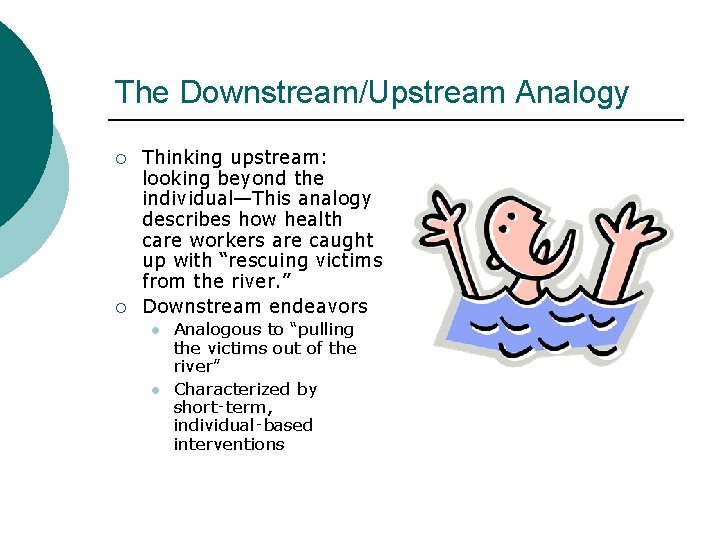
The Downstream/Upstream Analogy ¡ ¡ Thinking upstream: looking beyond the individual—This analogy describes how health care workers are caught up with “rescuing victims from the river. ” Downstream endeavors l l Analogous to “pulling the victims out of the river” Characterized by short‑term, individual‑based interventions
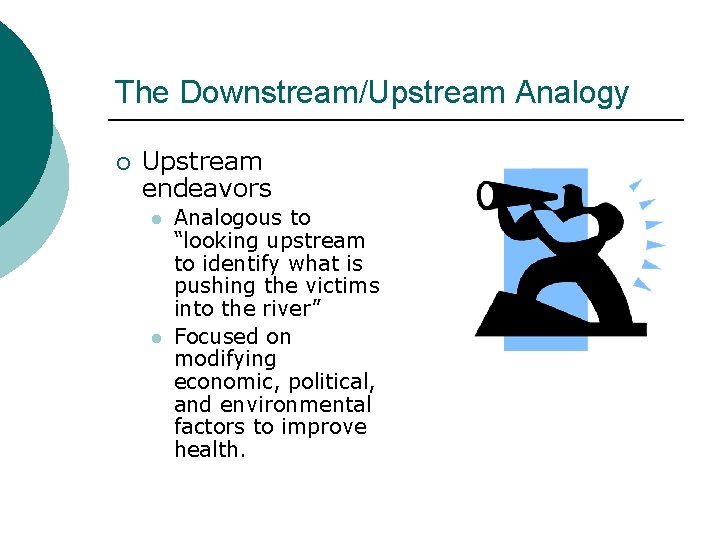
The Downstream/Upstream Analogy ¡ Upstream endeavors l l Analogous to “looking upstream to identify what is pushing the victims into the river” Focused on modifying economic, political, and environmental factors to improve health.
Issues of fit ¡ ¡ Nurses must learn to use theory appropriately. They must learn not to force-fit a situation into a theory or a theory onto a situation. To utilize theory to guide community health nursing practice, the nurse should select conceptualizations and theoretic approaches that are compatible with a population perspective.
Why theory? The goal of using theory is to guide, and thereby improve, the practice of nursing. Theory‑based practice guides data collection and interpretation in a clear and organized manner.
Microscopic Theory Approach to Community Health Problems ¡ ¡ ¡ Typically, nurses and other health care providers take a microscopic perspective that focuses exclusively on the individual and one or two problems. Interventions are planned on an individual basis. In an archery analogy, the microscopic approach targets only the bull's-eye.
Macroscopic Theory Approaches to Community Health Problems A macroscopic approach is comprehensive. ¡ The nurse considers environmental, demographic, social, and economic factors when planning interventions. ¡ The macroscopic approach targets both the bull's-eye and the surrounding concentric circles for intervention. ¡
Assessing a theory's scope in relation to community health nursing Most nursing theories focus on the individual. ¡ Unless a given theory is macroscopic and addresses health and determinants of health from a population perspective, it is of limited use to community health nurses. ¡
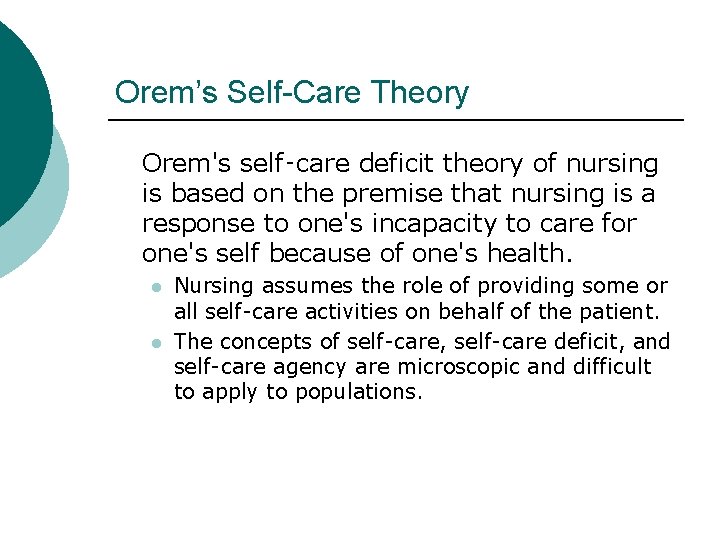
Orem’s Self-Care Theory Orem's self‑care deficit theory of nursing is based on the premise that nursing is a response to one's incapacity to care for one's self because of one's health. l l Nursing assumes the role of providing some or all self‑care activities on behalf of the patient. The concepts of self‑care, self‑care deficit, and self‑care agency are microscopic and difficult to apply to populations.
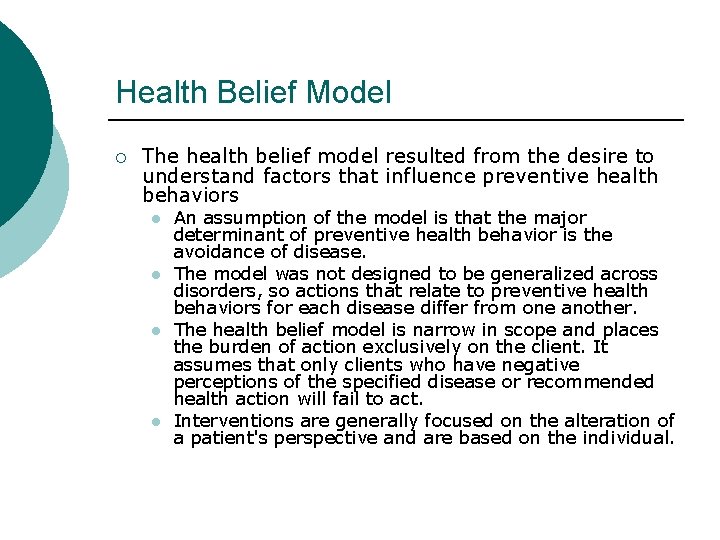
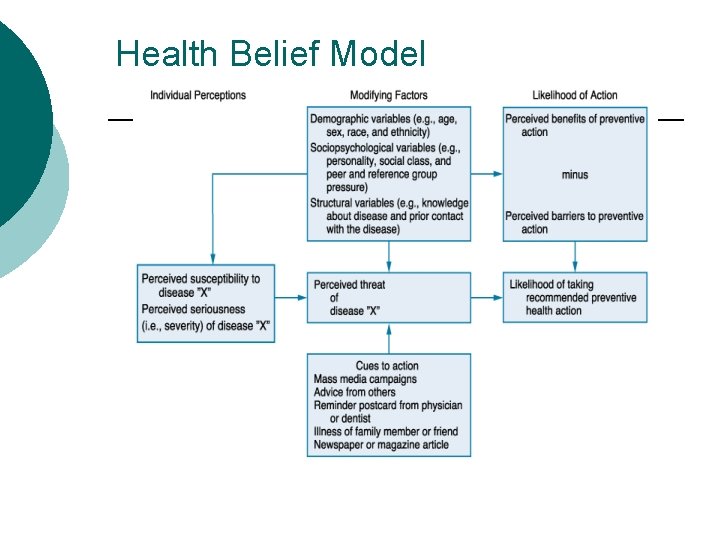
Health Belief Model ¡ The health belief model resulted from the desire to understand factors that influence preventive health behaviors l l An assumption of the model is that the major determinant of preventive health behavior is the avoidance of disease. The model was not designed to be generalized across disorders, so actions that relate to preventive health behaviors for each disease differ from one another. The health belief model is narrow in scope and places the burden of action exclusively on the client. It assumes that only clients who have negative perceptions of the specified disease or recommended health action will fail to act. Interventions are generally focused on the alteration of a patient's perspective and are based on the individual.
Health Belief Model
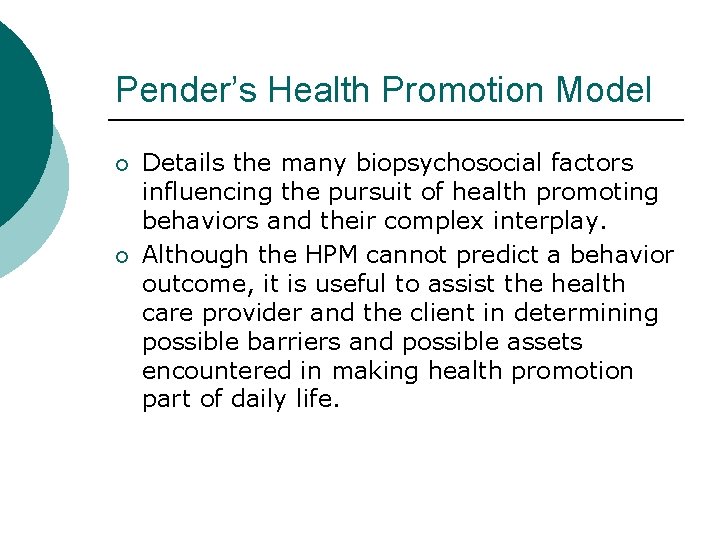
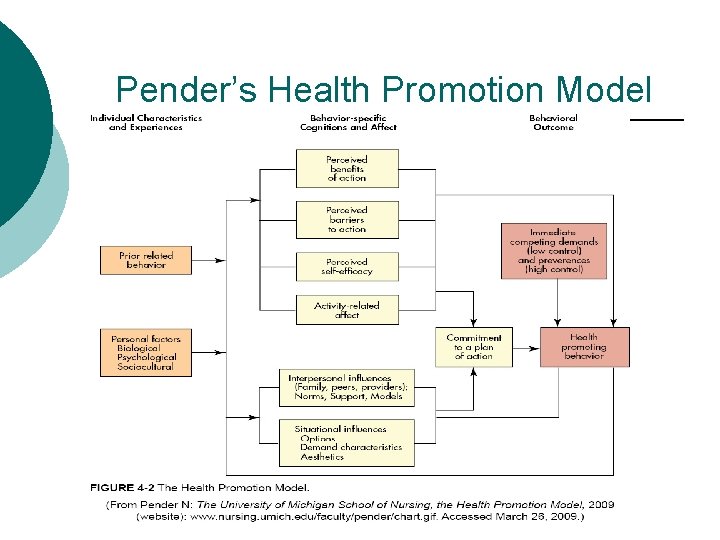
Pender’s Health Promotion Model ¡ ¡ Details the many biopsychosocial factors influencing the pursuit of health promoting behaviors and their complex interplay. Although the HPM cannot predict a behavior outcome, it is useful to assist the health care provider and the client in determining possible barriers and possible assets encountered in making health promotion part of daily life.
Pender’s Health Promotion Model
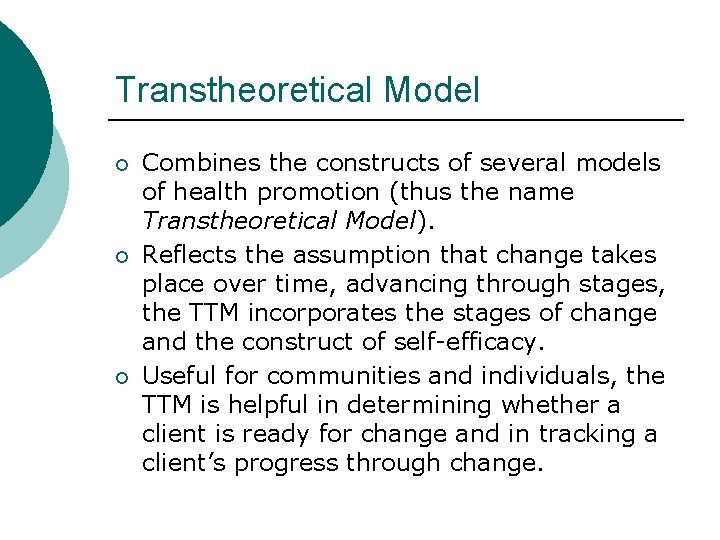
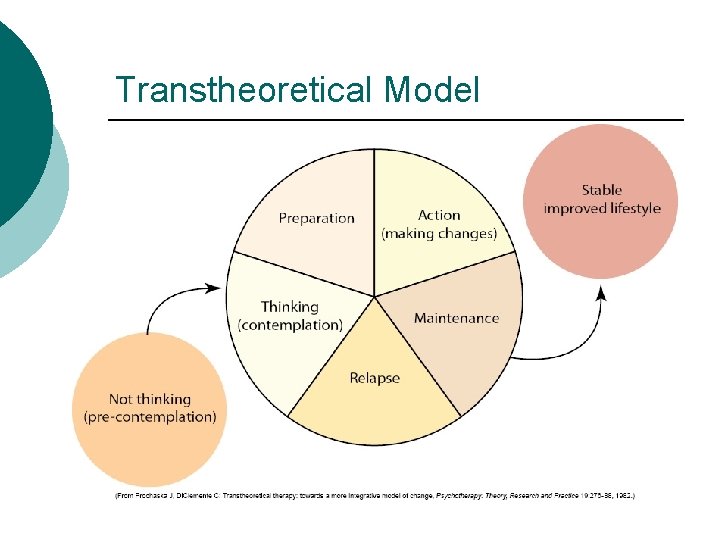
Transtheoretical Model ¡ ¡ ¡ Combines the constructs of several models of health promotion (thus the name Transtheoretical Model). Reflects the assumption that change takes place over time, advancing through stages, the TTM incorporates the stages of change and the construct of self-efficacy. Useful for communities and individuals, the TTM is helpful in determining whether a client is ready for change and in tracking a client’s progress through change.
Transtheoretical Model
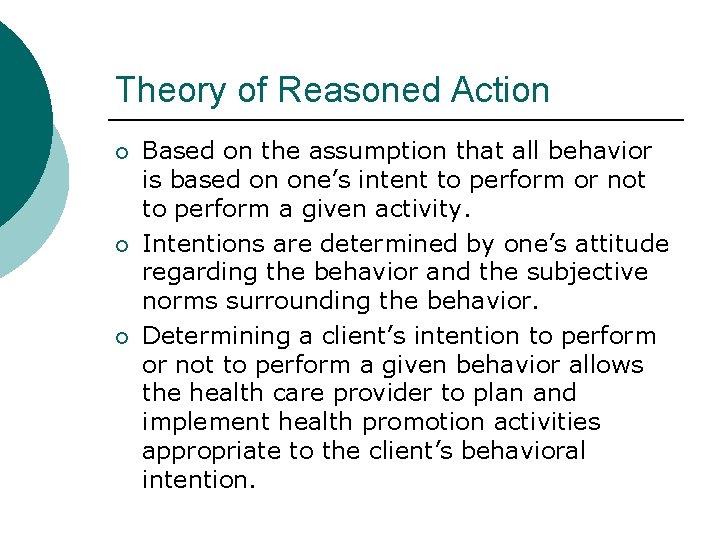
Theory of Reasoned Action ¡ ¡ ¡ Based on the assumption that all behavior is based on one’s intent to perform or not to perform a given activity. Intentions are determined by one’s attitude regarding the behavior and the subjective norms surrounding the behavior. Determining a client’s intention to perform or not to perform a given behavior allows the health care provider to plan and implement health promotion activities appropriate to the client’s behavioral intention.
Milio’s Framework for Prevention l Provides for the inclusion of economic, political, and environmental health determinants and is broad in range. l Relates the ability of an individual to improve healthful behavior to society's ability to provide options for healthy choices that are accessible and socially desirable. ¡ Impacting policy making is more effective than changing individual behavior
Milio’s Framework for Prevention l The range of choices available is shaped by government and private policy decision l Health deficits result from an imbalance between a population's health needs and its health‑sustaining resources. ¡ Affluent societies have diseases of excess such as obesity and alcoholism whereas poor societies have diseases associated with inadequate food, water, and shelter. ¡ The poor in an affluent society is the worst of all.
Milio’s Framework for Prevention l To improve health status, health-promoting choices must be readily available and less costly than health-damaging options. ¡ l We choose the least costly and easiest path. The range of health‑promoting or health‑damaging choices available to individuals is affected by their personal resources (awareness, knowledge and beliefs, money, time, and other priorities) and societal resources (availability and cost of health services, environmental protection, shelter).
Critical Social Theory l l l Is based in the belief that life is structured by social meanings that are determined through social domination. Assumes that standards of truth are determined socially. Application of critical social theory necessitates inductive reasoning in which nurses assess concepts through an ongoing process of data collection and analysis.
Critical Social Theory l Politicoeconomic interventions are seen as the most effective method of addressing the health of a population; these interventions seek to eliminate illness at the source. l Critical social theory holds that each person is responsible for creating social conditions in which all members of society are able to speak freely. Nurses are thereby challenged to expose power imbalances that prohibit people from achieving their full potential.