
Thinking Maps The Benefits of Using Thinking Maps
Thinking Maps

The Benefits of Using Thinking Maps TM • Students learn more effectively and more efficiently • Objectives are covered in less time with greater retention • Thought processes are represented similarly throughout the curriculum • Teachers can easily gauge student knowledge prior to a specific lesson • Student performance can be tracked over time • Students gain effective tools to use across their academic and working careers • Lifelong thinking tools
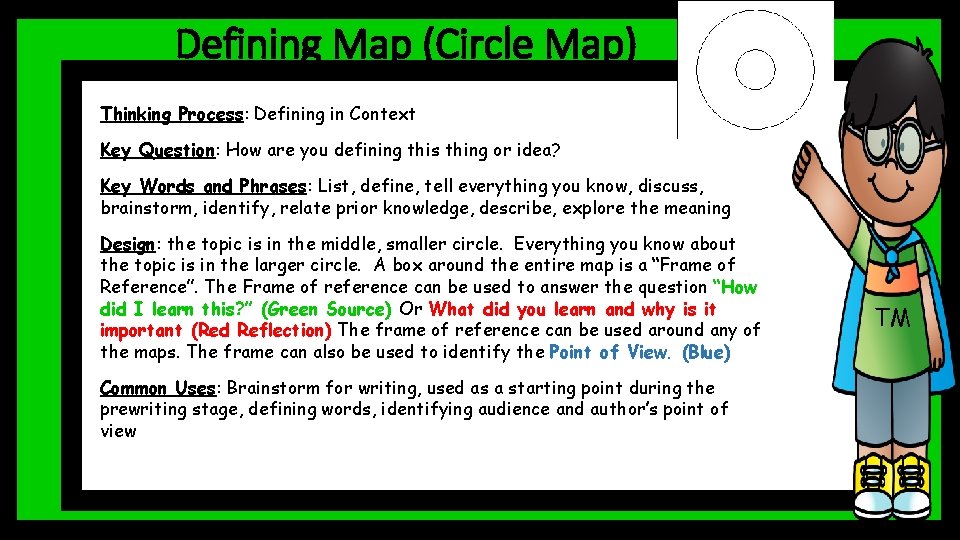
Defining Map (Circle Map) Thinking Process: Defining in Context Key Question: How are you defining this thing or idea? Key Words and Phrases: List, define, tell everything you know, discuss, brainstorm, identify, relate prior knowledge, describe, explore the meaning Design: the topic is in the middle, smaller circle. Everything you know about the topic is in the larger circle. A box around the entire map is a “Frame of Reference”. The Frame of reference can be used to answer the question “How did I learn this? ” (Green Source) Or What did you learn and why is it important (Red Reflection) The frame of reference can be used around any of the maps. The frame can also be used to identify the Point of View. (Blue) Common Uses: Brainstorm for writing, used as a starting point during the prewriting stage, defining words, identifying audience and author’s point of view TM
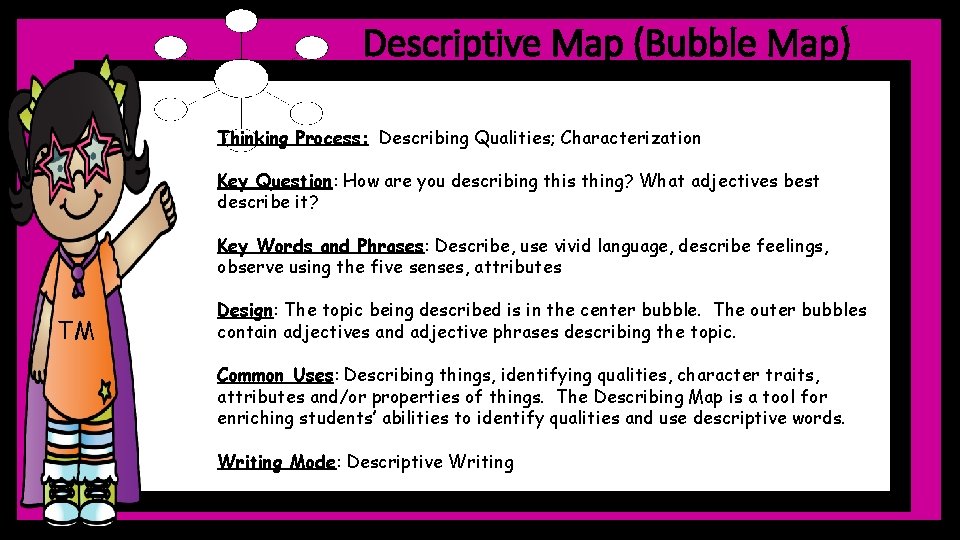
Descriptive Map (Bubble Map) Thinking Process: Describing Qualities; Characterization Key Question: How are you describing this thing? What adjectives best describe it? Key Words and Phrases: Describe, use vivid language, describe feelings, observe using the five senses, attributes TM Design: The topic being described is in the center bubble. The outer bubbles contain adjectives and adjective phrases describing the topic. Common Uses: Describing things, identifying qualities, character traits, attributes and/or properties of things. The Describing Map is a tool for enriching students’ abilities to identify qualities and use descriptive words. Writing Mode: Descriptive Writing
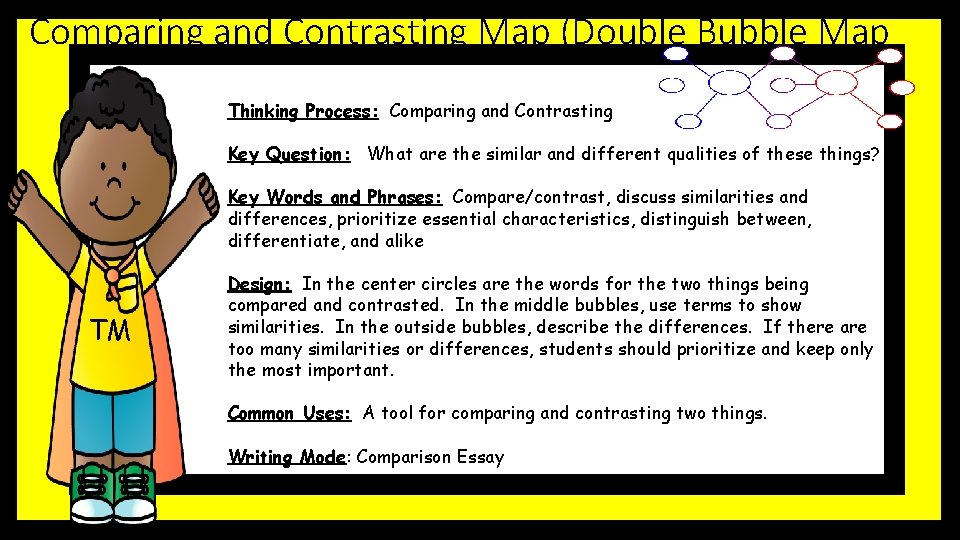
Comparing and Contrasting Map (Double Bubble Map Thinking Process: Comparing and Contrasting Key Question: What are the similar and different qualities of these things? Key Words and Phrases: Compare/contrast, discuss similarities and differences, prioritize essential characteristics, distinguish between, differentiate, and alike TM Design: In the center circles are the words for the two things being compared and contrasted. In the middle bubbles, use terms to show similarities. In the outside bubbles, describe the differences. If there are too many similarities or differences, students should prioritize and keep only the most important. Common Uses: A tool for comparing and contrasting two things. Writing Mode: Comparison Essay
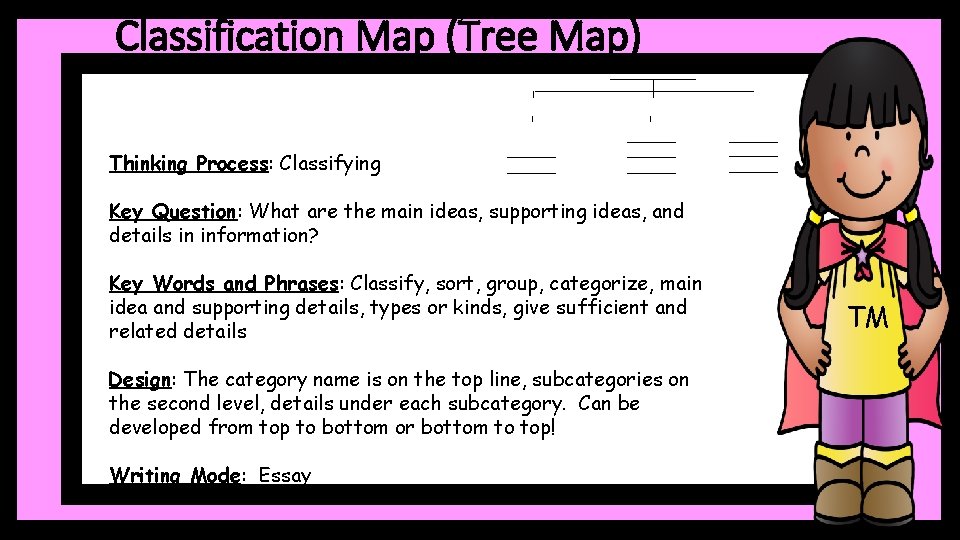
Classification Map (Tree Map) Thinking Process: Classifying Key Question: What are the main ideas, supporting ideas, and details in information? Key Words and Phrases: Classify, sort, group, categorize, main idea and supporting details, types or kinds, give sufficient and related details Design: The category name is on the top line, subcategories on the second level, details under each subcategory. Can be developed from top to bottom or bottom to top! Writing Mode: Essay TM
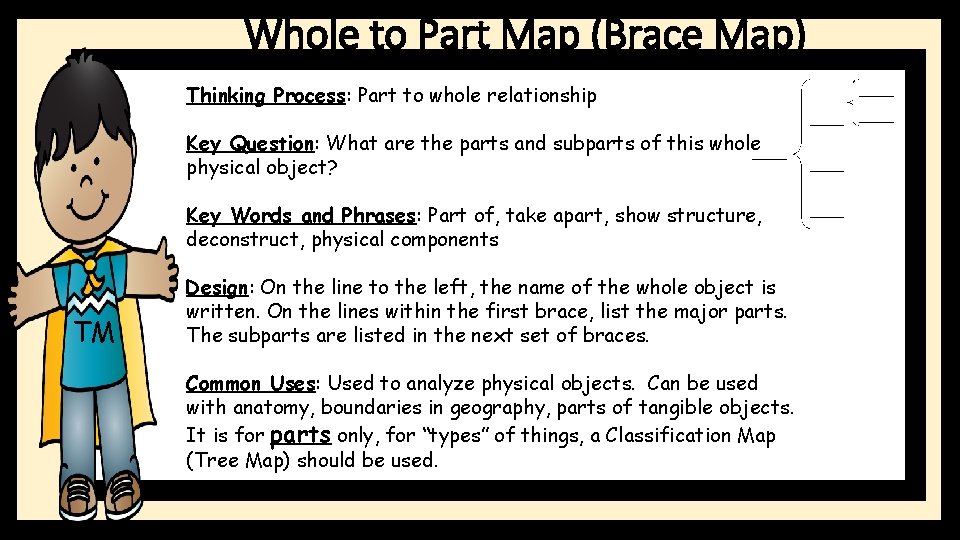
Whole to Part Map (Brace Map) Thinking Process: Part to whole relationship Key Question: What are the parts and subparts of this whole physical object? Key Words and Phrases: Part of, take apart, show structure, deconstruct, physical components TM Design: On the line to the left, the name of the whole object is written. On the lines within the first brace, list the major parts. The subparts are listed in the next set of braces. Common Uses: Used to analyze physical objects. Can be used with anatomy, boundaries in geography, parts of tangible objects. It is for parts only, for “types” of things, a Classification Map (Tree Map) should be used.
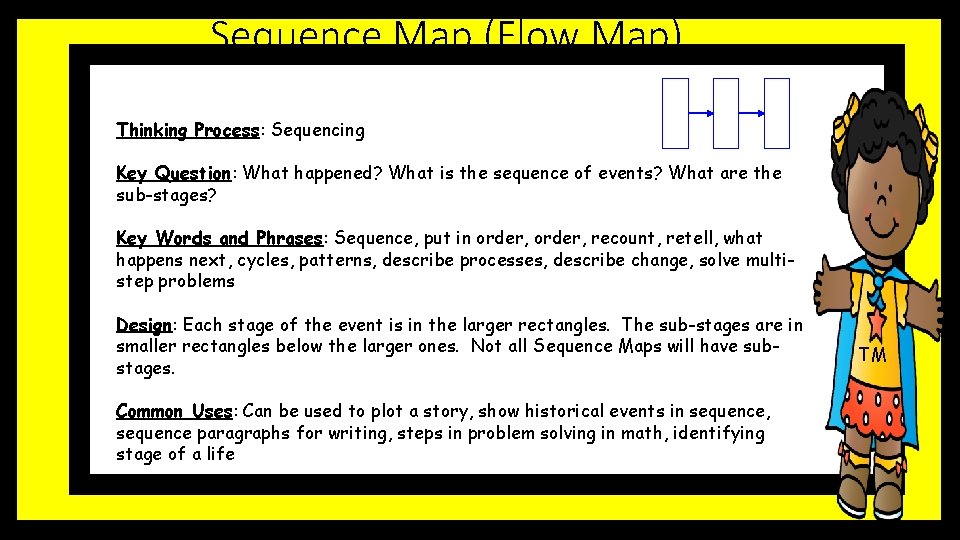
Sequence Map (Flow Map) Thinking Process: Sequencing Key Question: What happened? What is the sequence of events? What are the sub-stages? Key Words and Phrases: Sequence, put in order, recount, retell, what happens next, cycles, patterns, describe processes, describe change, solve multistep problems Design: Each stage of the event is in the larger rectangles. The sub-stages are in smaller rectangles below the larger ones. Not all Sequence Maps will have substages. Common Uses: Can be used to plot a story, show historical events in sequence, sequence paragraphs for writing, steps in problem solving in math, identifying stage of a life TM
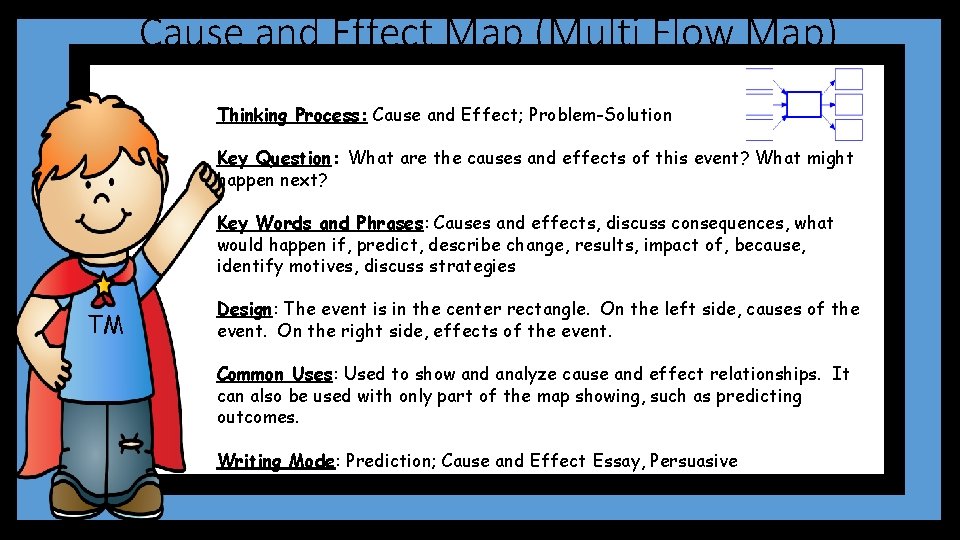
Cause and Effect Map (Multi Flow Map) Thinking Process: Cause and Effect; Problem-Solution Key Question: What are the causes and effects of this event? What might happen next? Key Words and Phrases: Causes and effects, discuss consequences, what would happen if, predict, describe change, results, impact of, because, identify motives, discuss strategies TM Design: The event is in the center rectangle. On the left side, causes of the event. On the right side, effects of the event. Common Uses: Used to show and analyze cause and effect relationships. It can also be used with only part of the map showing, such as predicting outcomes. Writing Mode: Prediction; Cause and Effect Essay, Persuasive
Analogy Map (Bridge map) Thinking Process: Identifying Relationships Key Question: What is the analogy being used? Key Words and Phrases: Identify the relationship, guess the rule, interpret symbols, metaphor, simile Design: On the map, write the relating factor. On the top and bottom of the bridge, write in the first pair of things that have this relationship. On the right side of the bridge, write the second pair with the same relationship. The line of the bridge represents the relating factor between the pair of things. TM Common Uses: Identifies similarities between relationships. The relating factor answers “How are they related? ” The Analogy Map should be able to be read as a complete sentence. Writing Mode: Reasoning by Analogy
- Slides: 10