
Thinking inside the box HighLevel Symbolic Representation HLSR
Thinking… …inside the box High-Level Symbolic Representation (HLSR) Soar Workshop Presentation Presented on 10 June 2004 by Jacob Crossman Development Team: Jacob Crossman, Robert Wray Ph. D, Christian Lebiere Ph. D Project Manager: Al Wallace Developed under funding from the Defense Modeling and Simulation Office (DMSO) Contract F 33615 -03 -C-6343 © 2004 Soar Technology, Inc. Slide
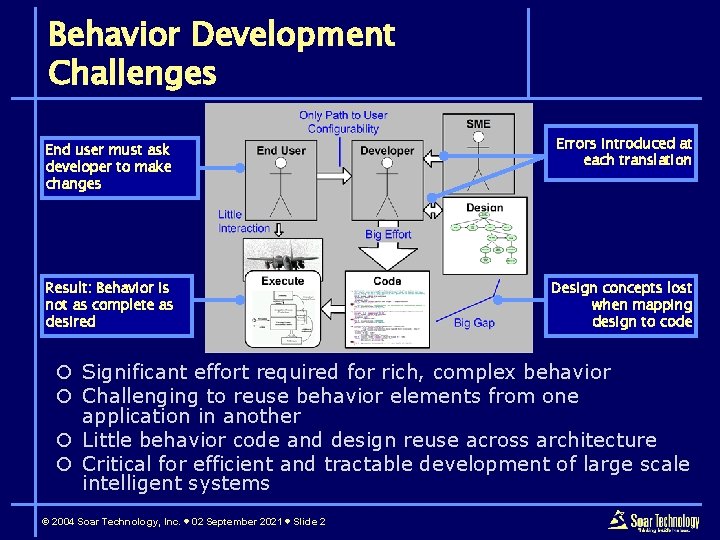
Behavior Development Challenges End user must ask developer to make changes Errors introduced at each translation Result: Behavior is not as complete as desired Design concepts lost when mapping design to code ¡ Significant effort required for rich, complex behavior ¡ Challenging to reuse behavior elements from one application in another ¡ Little behavior code and design reuse across architecture ¡ Critical for efficient and tractable development of large scale intelligent systems © 2004 Soar Technology, Inc. 02 September 2021 Slide 2
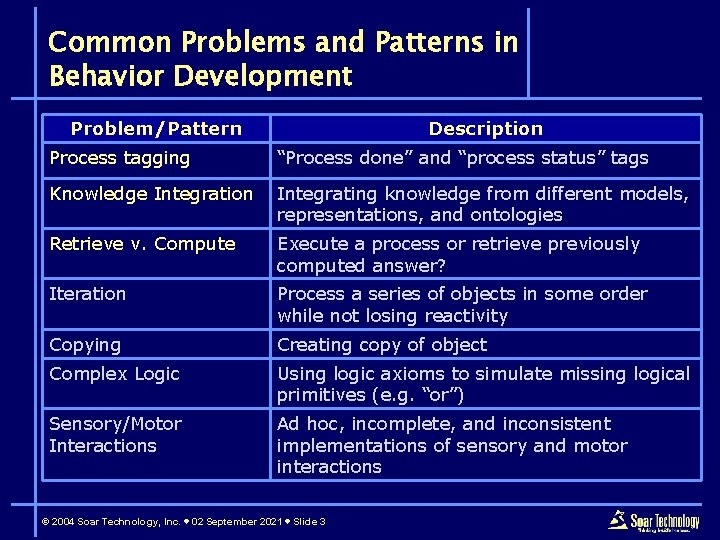
Common Problems and Patterns in Behavior Development Problem/Pattern Description Process tagging “Process done” and “process status” tags Knowledge Integration Integrating knowledge from different models, representations, and ontologies Retrieve v. Compute Execute a process or retrieve previously computed answer? Iteration Process a series of objects in some order while not losing reactivity Copying Creating copy of object Complex Logic Using logic axioms to simulate missing logical primitives (e. g. “or”) Sensory/Motor Interactions Ad hoc, incomplete, and inconsistent implementations of sensory and motor interactions © 2004 Soar Technology, Inc. 02 September 2021 Slide 3
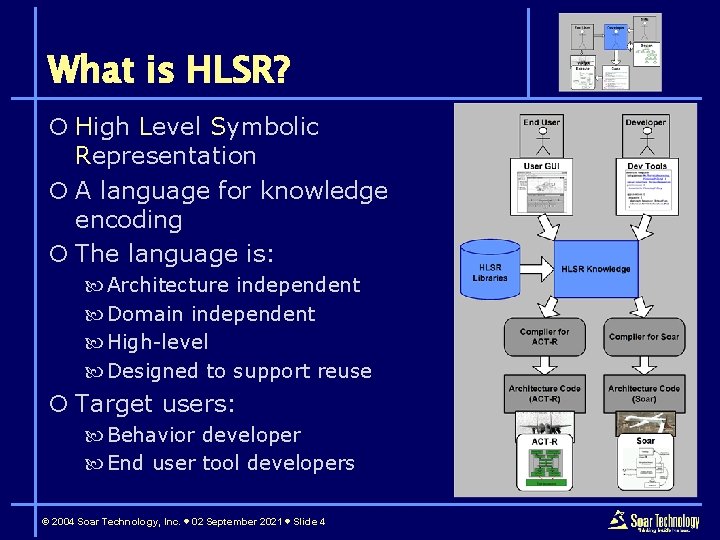
What is HLSR? ¡ High Level Symbolic Representation ¡ A language for knowledge encoding ¡ The language is: Architecture independent Domain independent High-level Designed to support reuse ¡ Target users: Behavior developer End user tool developers © 2004 Soar Technology, Inc. 02 September 2021 Slide 4
Why a language? ¡ Better tools are necessary but not sufficient Tools need appropriate architecture abstractions Each tool tends to have its own custom built abstraction Tools tend to have ad hoc and incomplete translation processes from abstraction to architecture A language formalizes and generalizes the architecture abstraction ¡ Better cognitive architectures are necessary but not sufficient Architectures are works in progress Architecture languages are cognitive “assembly languages” · Emphasize efficiency, runtime flexibility, control, and fidelity to human behavior · Do NOT emphasize SE goals like understandability, maintainability, and reuse A language allows merging of different architectural concepts while abstracting low-level details © 2004 Soar Technology, Inc. 02 September 2021 Slide 5

HLSR Requirements Balancing the requirements – a goal of HLSR ¡ Competition between and within categories Meeting all requirements fully appears impossible HLSR seeks a balanced solution ¡ Evaluation metrics help measure success © 2004 Soar Technology, Inc. 02 September 2021 Slide 6
Approach ¡ To achieve architecture requirements: Unify representation of common features Give architecture large degree of discretion in how it interprets and executes the knowledge ¡ To achieve developer requirements: Build solutions to catalog problems into HLSR ¡ To achieve reuse requirements: Borrow and adapt concepts of encapsulation and interfaces from SE © 2004 Soar Technology, Inc. 02 September 2021 Slide 7
Common Themes I: Architecture Commonality ¡ Cognitive and agent architectures share many similar concepts (even if terminology is different) Directly supported classes of knowledge representations · Beliefs, assertions, chunks · Goals, intentions · Productions, operators, transforms, plans · Preferences Knowledge states · Asserted, not-asserted · Candidate, selected, was selected Decision making processes · Least commitment · Goal driven reasoning · Conflict resolution © 2004 Soar Technology, Inc. 02 September 2021 Slide 8
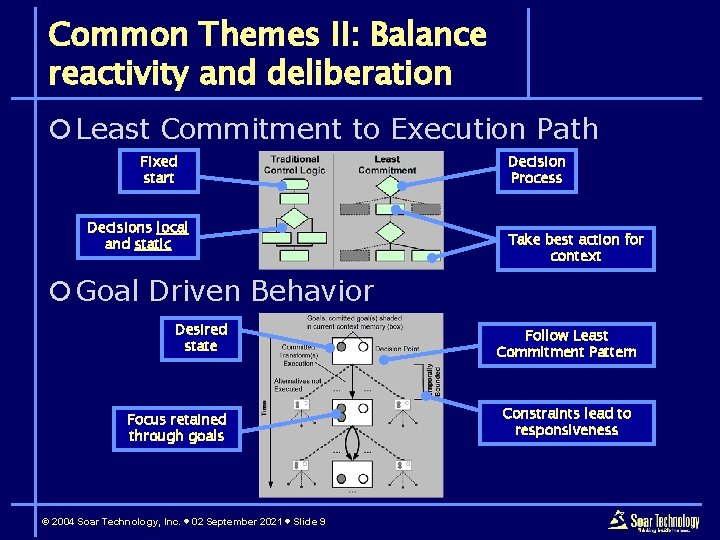
Common Themes II: Balance reactivity and deliberation ¡ Least Commitment to Execution Path Fixed start Decisions local and static Decision Process Take best action for context ¡ Goal Driven Behavior Desired state Focus retained through goals © 2004 Soar Technology, Inc. 02 September 2021 Slide 9 Follow Least Commitment Pattern Constraints lead to responsiveness
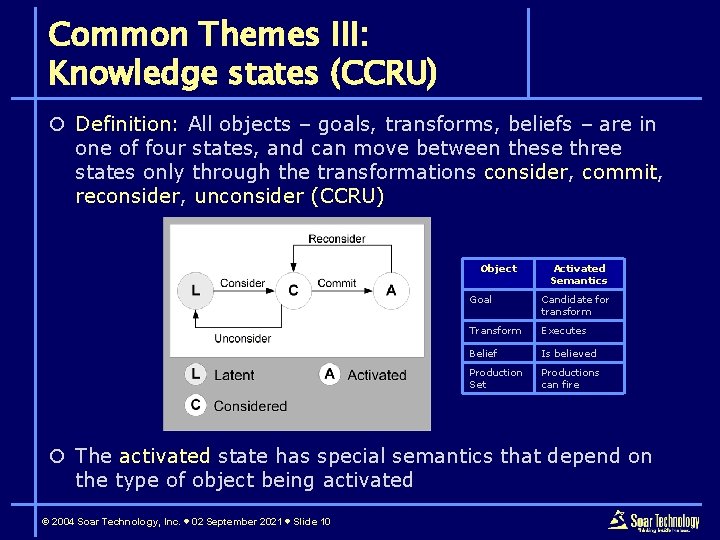
Common Themes III: Knowledge states (CCRU) ¡ Definition: All objects – goals, transforms, beliefs – are in one of four states, and can move between these three states only through the transformations consider, commit, reconsider, unconsider (CCRU) Object Activated Semantics Goal Candidate for transform Transform Executes Belief Is believed Production Set Productions can fire ¡ The activated state has special semantics that depend on the type of object being activated © 2004 Soar Technology, Inc. 02 September 2021 Slide 10
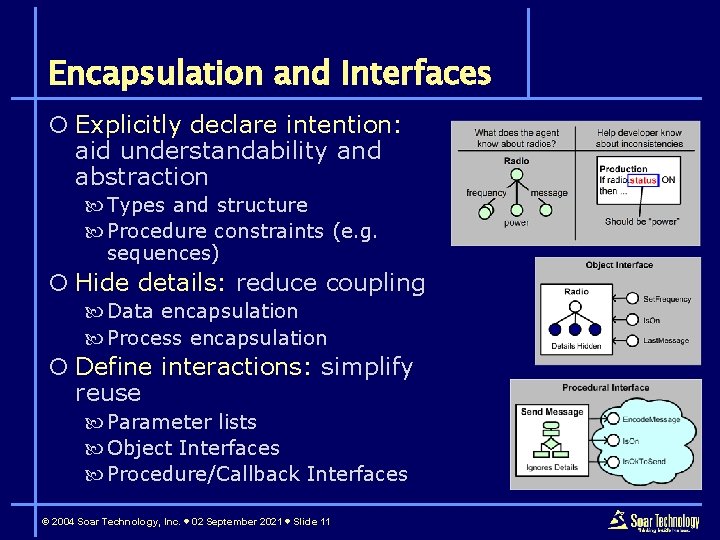
Encapsulation and Interfaces ¡ Explicitly declare intention: aid understandability and abstraction Types and structure Procedure constraints (e. g. sequences) ¡ Hide details: reduce coupling Data encapsulation Process encapsulation ¡ Define interactions: simplify reuse Parameter lists Object Interfaces Procedure/Callback Interfaces © 2004 Soar Technology, Inc. 02 September 2021 Slide 11
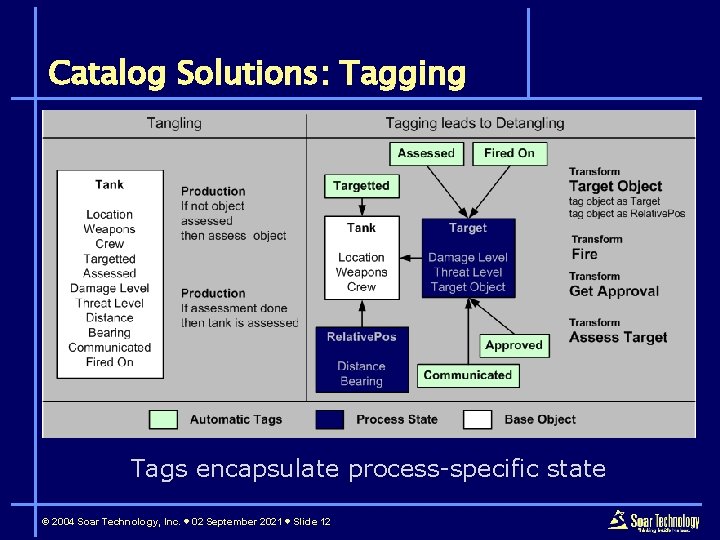
Catalog Solutions: Tagging Tags encapsulate process-specific state © 2004 Soar Technology, Inc. 02 September 2021 Slide 12
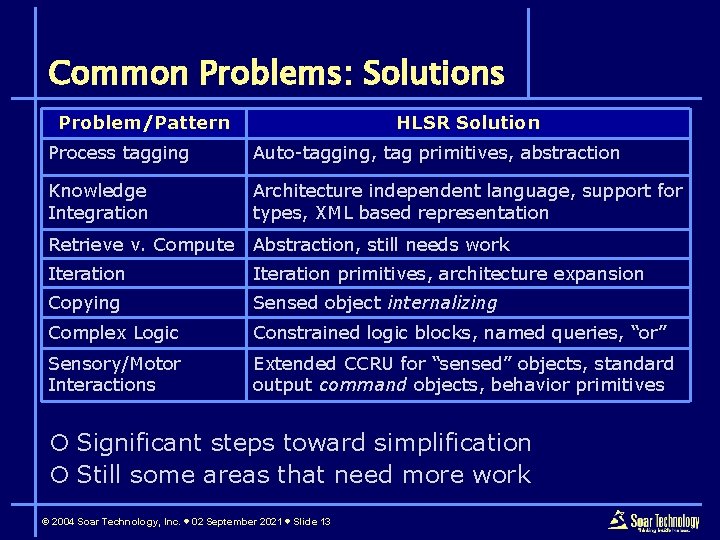
Common Problems: Solutions Problem/Pattern HLSR Solution Process tagging Auto-tagging, tag primitives, abstraction Knowledge Integration Architecture independent language, support for types, XML based representation Retrieve v. Compute Abstraction, still needs work Iteration primitives, architecture expansion Copying Sensed object internalizing Complex Logic Constrained logic blocks, named queries, “or” Sensory/Motor Interactions Extended CCRU for “sensed” objects, standard output command objects, behavior primitives ¡ Significant steps toward simplification ¡ Still some areas that need more work © 2004 Soar Technology, Inc. 02 September 2021 Slide 13
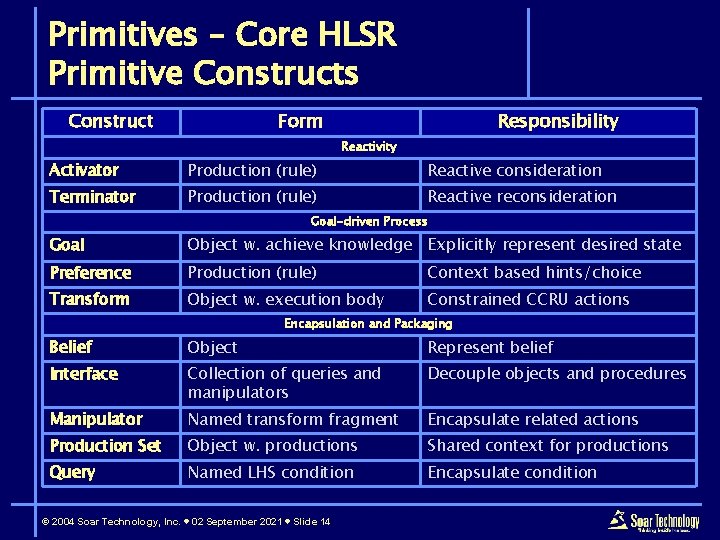
Primitives – Core HLSR Primitive Constructs Construct Form Responsibility Reactivity Activator Production (rule) Reactive consideration Terminator Production (rule) Reactive reconsideration Goal-driven Process Goal Object w. achieve knowledge Explicitly represent desired state Preference Production (rule) Context based hints/choice Transform Object w. execution body Constrained CCRU actions Encapsulation and Packaging Belief Object Represent belief Interface Collection of queries and manipulators Decouple objects and procedures Manipulator Named transform fragment Encapsulate related actions Production Set Object w. productions Shared context for productions Query Named LHS condition Encapsulate condition © 2004 Soar Technology, Inc. 02 September 2021 Slide 14
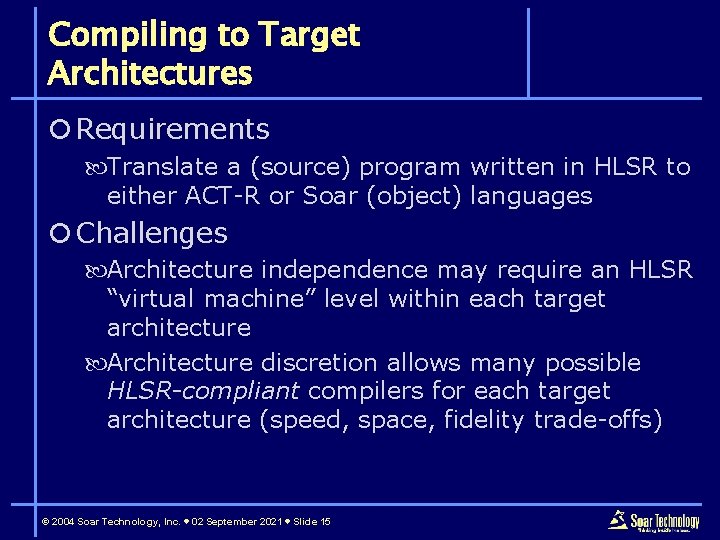
Compiling to Target Architectures ¡ Requirements Translate a (source) program written in HLSR to either ACT-R or Soar (object) languages ¡ Challenges Architecture independence may require an HLSR “virtual machine” level within each target architecture Architecture discretion allows many possible HLSR-compliant compilers for each target architecture (speed, space, fidelity trade-offs) © 2004 Soar Technology, Inc. 02 September 2021 Slide 15
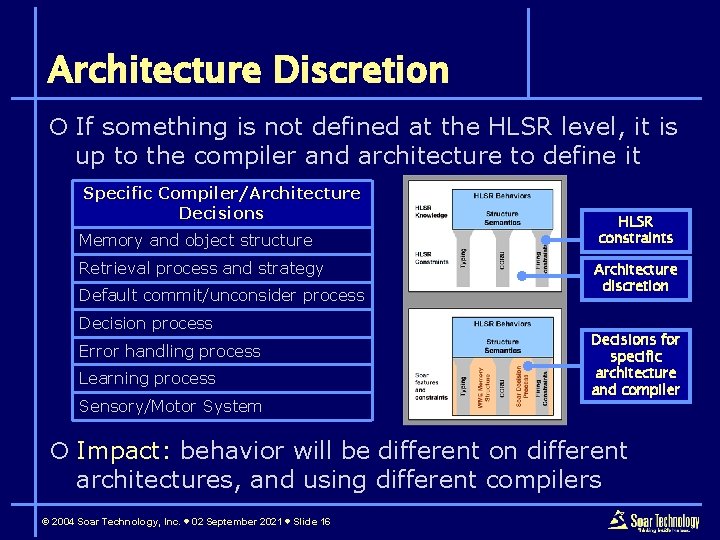
Architecture Discretion ¡ If something is not defined at the HLSR level, it is up to the compiler and architecture to define it Specific Compiler/Architecture Decisions Memory and object structure Retrieval process and strategy Default commit/unconsider process Decision process Error handling process Learning process Sensory/Motor System HLSR constraints Architecture discretion Decisions for specific architecture and compiler ¡ Impact: behavior will be different on different architectures, and using different compilers © 2004 Soar Technology, Inc. 02 September 2021 Slide 16
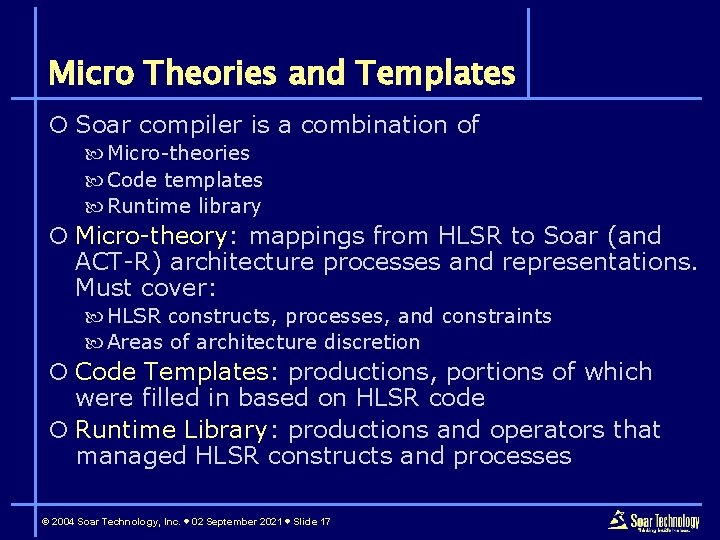
Micro Theories and Templates ¡ Soar compiler is a combination of Micro-theories Code templates Runtime library ¡ Micro-theory: mappings from HLSR to Soar (and ACT-R) architecture processes and representations. Must cover: HLSR constructs, processes, and constraints Areas of architecture discretion ¡ Code Templates: productions, portions of which were filled in based on HLSR code ¡ Runtime Library: productions and operators that managed HLSR constructs and processes © 2004 Soar Technology, Inc. 02 September 2021 Slide 17
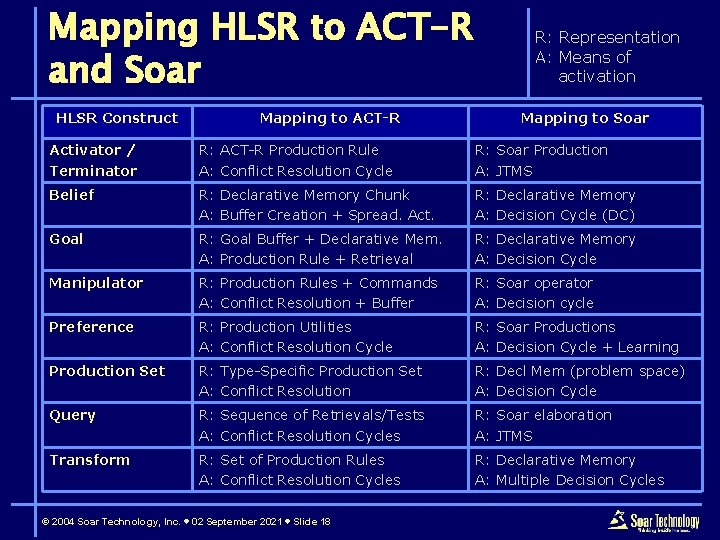
Mapping HLSR to ACT-R and Soar HLSR Construct Mapping to ACT-R R: Representation A: Means of activation Mapping to Soar Activator / Terminator R: ACT-R Production Rule A: Conflict Resolution Cycle R: Soar Production A: JTMS Belief R: Declarative Memory Chunk A: Buffer Creation + Spread. Act. R: Declarative Memory A: Decision Cycle (DC) Goal R: Goal Buffer + Declarative Mem. A: Production Rule + Retrieval R: Declarative Memory A: Decision Cycle Manipulator R: Production Rules + Commands A: Conflict Resolution + Buffer R: Soar operator A: Decision cycle Preference R: Production Utilities A: Conflict Resolution Cycle R: Soar Productions A: Decision Cycle + Learning Production Set R: Type-Specific Production Set A: Conflict Resolution R: Decl Mem (problem space) A: Decision Cycle Query R: Sequence of Retrievals/Tests A: Conflict Resolution Cycles R: Soar elaboration A: JTMS Transform R: Set of Production Rules A: Conflict Resolution Cycles R: Declarative Memory A: Multiple Decision Cycles © 2004 Soar Technology, Inc. 02 September 2021 Slide 18
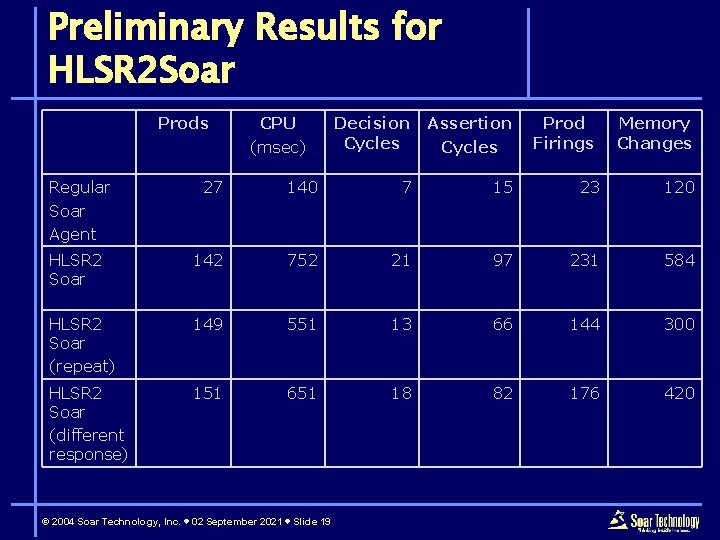
Preliminary Results for HLSR 2 Soar Prods Regular Soar Agent CPU (msec) Decision Cycles Assertion Cycles Prod Firings Memory Changes 27 140 7 15 23 120 HLSR 2 Soar 142 752 21 97 231 584 HLSR 2 Soar (repeat) 149 551 13 66 144 300 HLSR 2 Soar (different response) 151 651 18 82 176 420 © 2004 Soar Technology, Inc. 02 September 2021 Slide 19
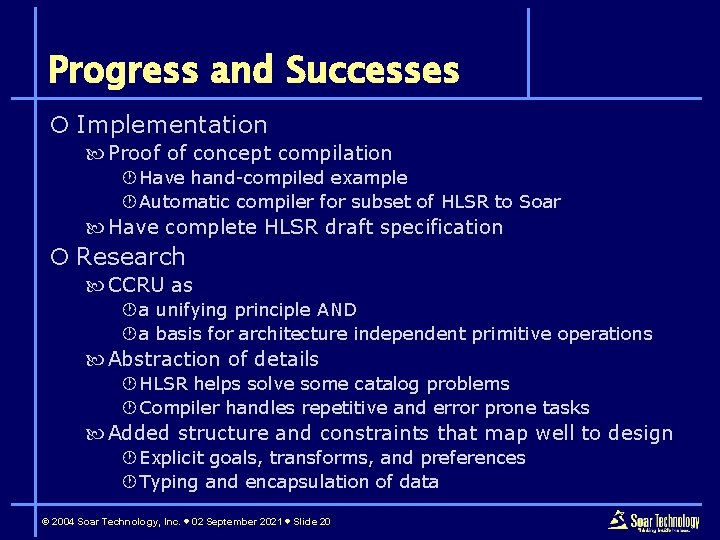
Progress and Successes ¡ Implementation Proof of concept compilation · Have hand-compiled example · Automatic compiler for subset of HLSR to Soar Have complete HLSR draft specification ¡ Research CCRU as · a unifying principle AND · a basis for architecture independent primitive operations Abstraction of details · HLSR helps solve some catalog problems · Compiler handles repetitive and error prone tasks Added structure and constraints that map well to design · Explicit goals, transforms, and preferences · Typing and encapsulation of data © 2004 Soar Technology, Inc. 02 September 2021 Slide 20
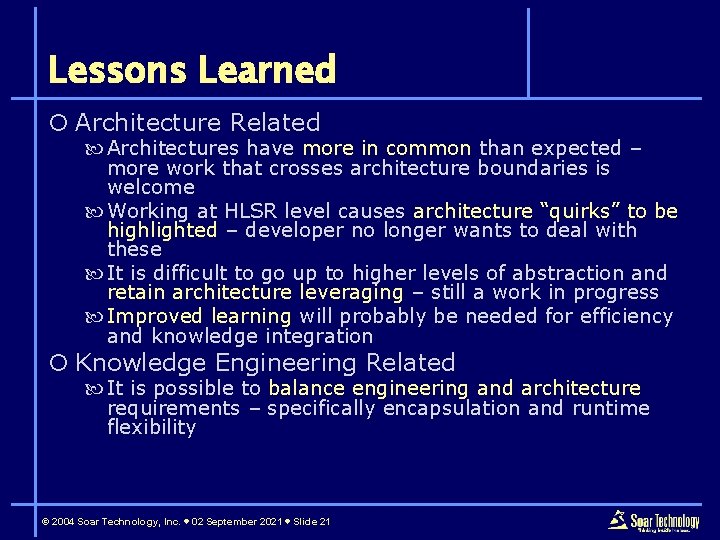
Lessons Learned ¡ Architecture Related Architectures have more in common than expected – more work that crosses architecture boundaries is welcome Working at HLSR level causes architecture “quirks” to be highlighted – developer no longer wants to deal with these It is difficult to go up to higher levels of abstraction and retain architecture leveraging – still a work in progress Improved learning will probably be needed for efficiency and knowledge integration ¡ Knowledge Engineering Related It is possible to balance engineering and architecture requirements – specifically encapsulation and runtime flexibility © 2004 Soar Technology, Inc. 02 September 2021 Slide 21
Open Research and Future Work ¡ Research Issues Learning: · When and how to integrate learning · How to integrate learning back into HLSR Some constructs difficult to compile and we don’t yet know the “best” approach Compiler optimization Don’t understand ramifications (or implications) of architecture discretion ¡ Future Work Building a full-scale compiler Testing in a large scale application Testing with other intelligent system architectures Libraries: we have the start, but need more © 2004 Soar Technology, Inc. 02 September 2021 Slide 22
Backup © 2004 Soar Technology, Inc. Slide
What’s unique about HLSR? ¡ We do not want to program intelligent systems – we want to constrain them ¡ Blend of reactivity and goal-driven process ¡ Abstraction across cognitive architectures: many more differences than computer architectures ¡ Emphasis on flexibility in program flow and internal structure © 2004 Soar Technology, Inc. 02 September 2021 Slide 24
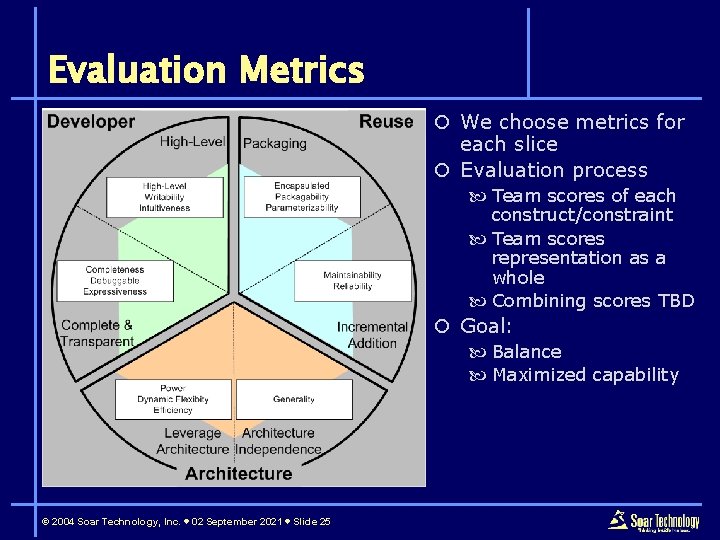
Evaluation Metrics ¡ We choose metrics for each slice ¡ Evaluation process Team scores of each construct/constraint Team scores representation as a whole Combining scores TBD ¡ Goal: Balance Maximized capability © 2004 Soar Technology, Inc. 02 September 2021 Slide 25
- Slides: 25