
Thinking and Intelligence Psychology Core Concepts Main Points




- Slides: 41
Thinking and Intelligence Psychology Core Concepts Main Points Norris Edwards 1
Thinking About Thinking “Many people would sooner die than think. In fact they do. ” Bertrand Russell “The mystery of language was revealed to me … Everything had a name, and each name gave birth to a new thought. ” Hellen Keller “Baby in my drink. ” Washoe 2
Thinking and Intelligence Cognition – Mental processes involved in thinking, knowing, perceiving, learning, and remembering, also the contents of these processes Intelligence – The mental capacity to acquire knowledge, reason, and solve problems effectively 3
What Are the Components of Thought? Thinking involves manipulation of mental representations, such as concepts, images, schemas, and scripts 4
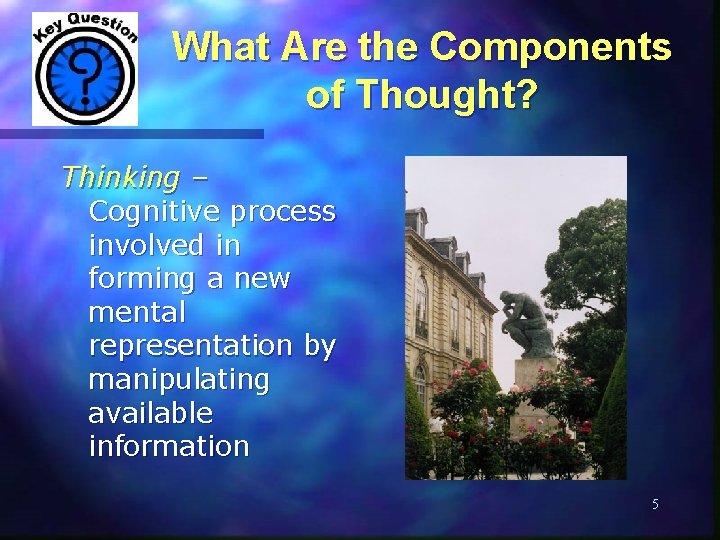
What Are the Components of Thought? Thinking – Cognitive process involved in forming a new mental representation by manipulating available information 5
Concepts – Mental representations of categories of items or ideas, based on experience 6
Concepts Natural concepts • Prototypes • Artificial concepts • Concept hierarchies 7
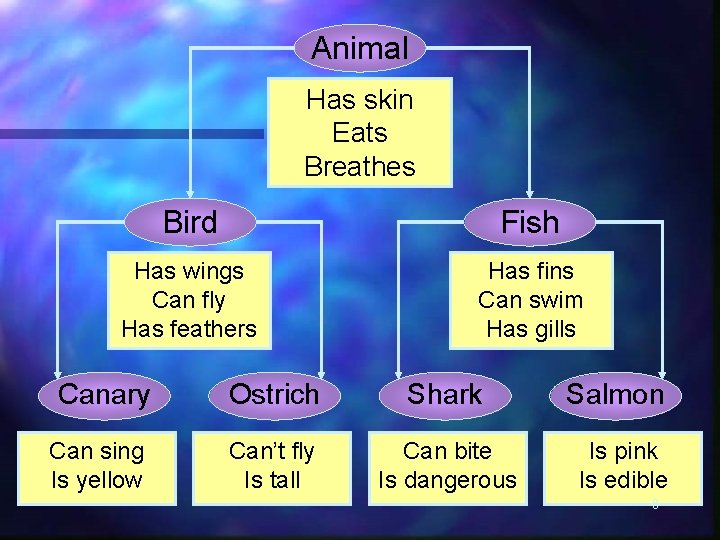
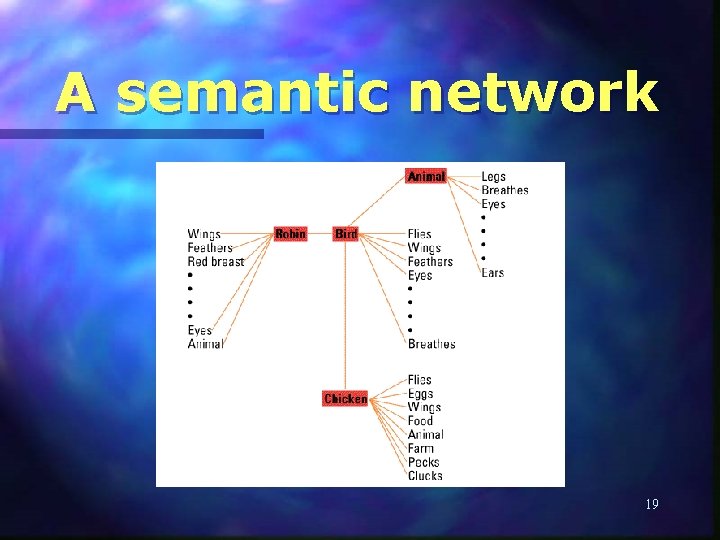
Animal Has skin Eats Breathes Bird Fish Has wings Can fly Has feathers Has fins Can swim Has gills Canary Ostrich Shark Can sing Is yellow Can’t fly Is tall Can bite Is dangerous Salmon Is pink Is edible 8
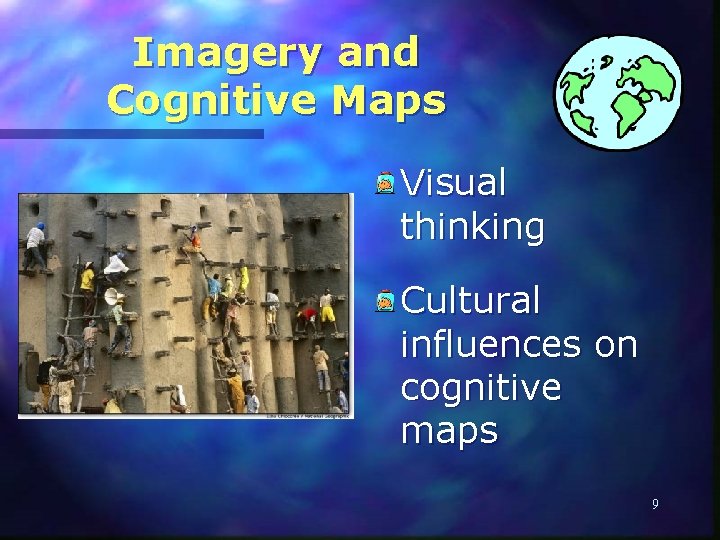
Imagery and Cognitive Maps Visual thinking Cultural influences on cognitive maps 9
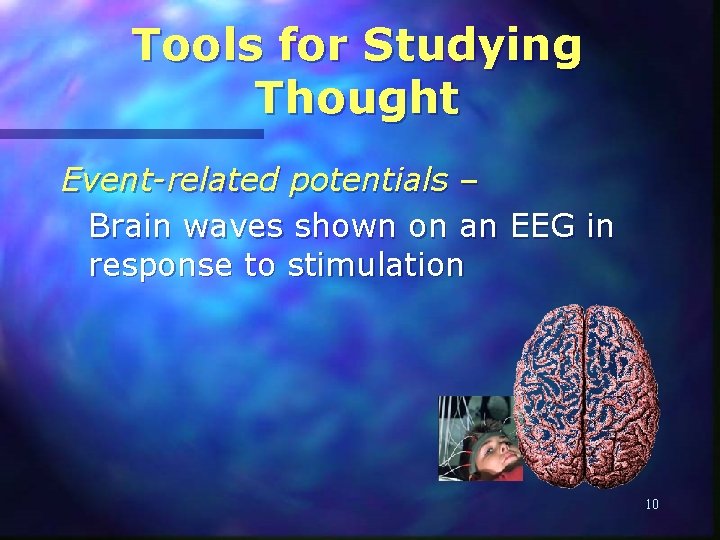
Tools for Studying Thought Event-related potentials – Brain waves shown on an EEG in response to stimulation 10
Schemas and Scripts Help you Know What to Expect Schema – Knowledge cluster or general framework that provides expectations about topics, events, objects, people, and situations in one’s life Script – Cluster of knowledge about sequences of events and actions expected to occur in particular settings 11
What Abilities Do Good Thinkers Possess? Good thinkers know how to avoid the common impediments to problem solving and decision making 12
Problem Solving Identifying the problem Selecting a strategy 13
Selecting a Strategy Algorithms – Problem-solving procedures or formulas that guarantee a correct outcome if applied correctly Heuristics – Cognitive strategies used as shortcuts to solve complex mental tasks; do not guarantee a correct solution 14
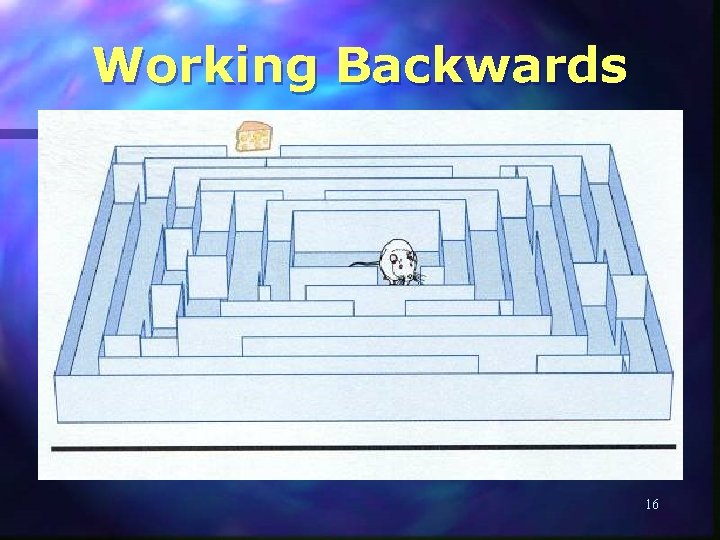
Heuristics Working backward Searching for analogies Breaking a big problem into smaller problems 15
Working Backwards 16
Obstacles to Problem Solving Mental set Self-imposed limitations Faulty heuristics 17
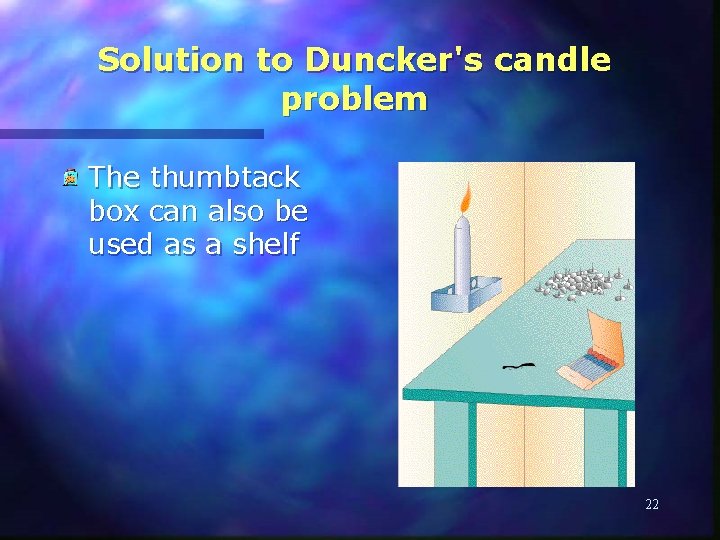
Obstacles to Problem Solving Mental set – Tendency to respond to a new problem in the manner used for a previous problem Functional fixedness – Inability to perceive a new use for an object associated with a different purpose 18
A semantic network 19
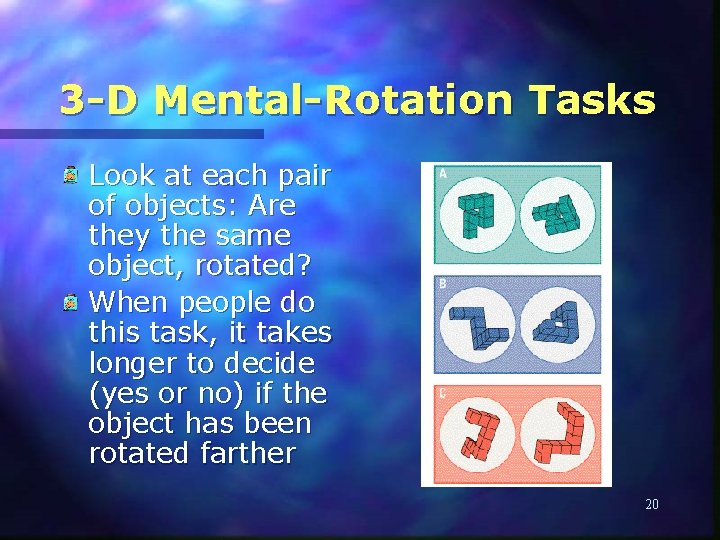
3 -D Mental-Rotation Tasks Look at each pair of objects: Are they the same object, rotated? When people do this task, it takes longer to decide (yes or no) if the object has been rotated farther 20
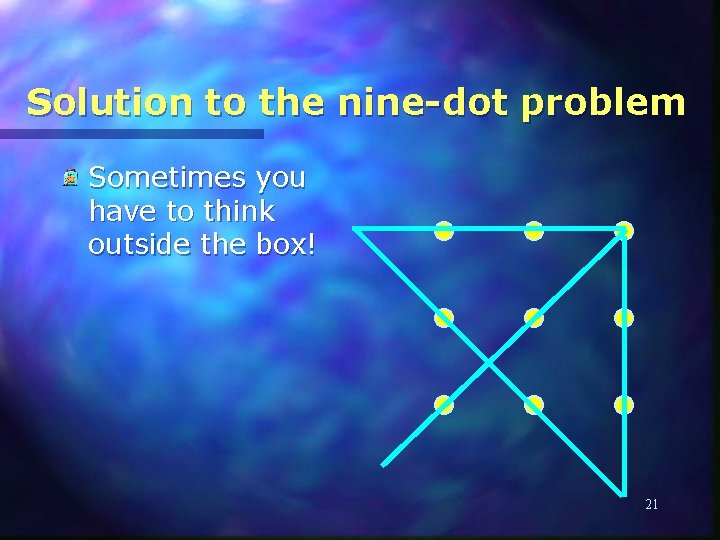
Solution to the nine-dot problem Sometimes you have to think outside the box! 21
Solution to Duncker's candle problem The thumbtack box can also be used as a shelf 22
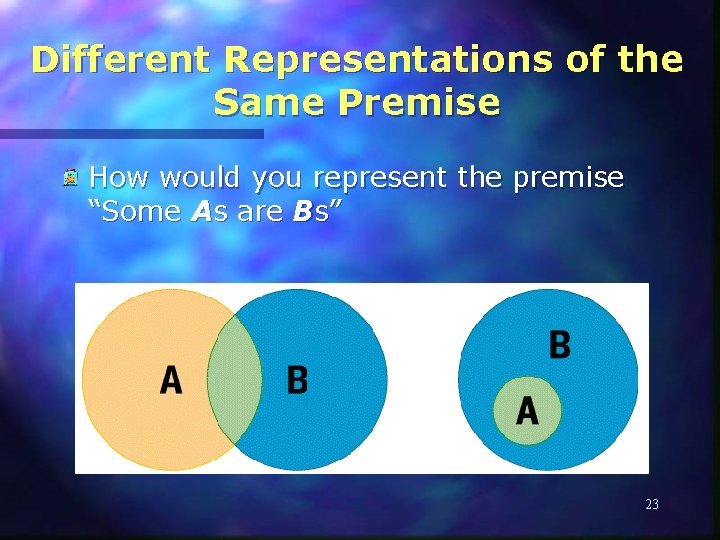
Different Representations of the Same Premise How would you represent the premise “Some As are Bs” 23
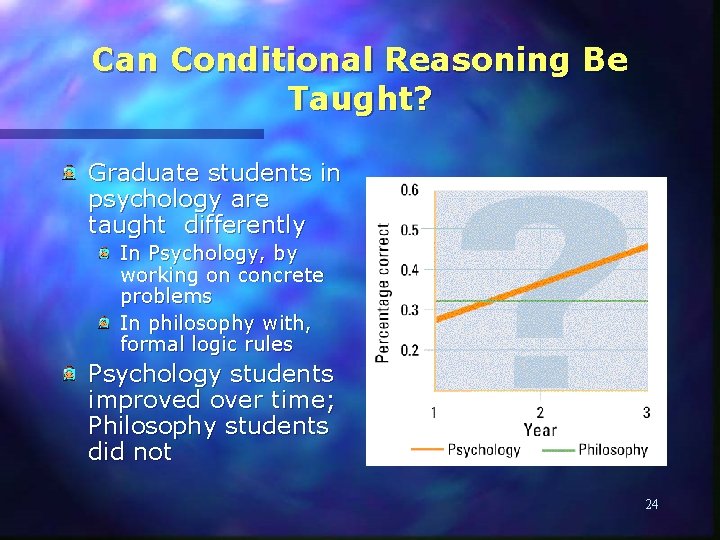
Can Conditional Reasoning Be Taught? Graduate students in psychology are taught differently In Psychology, by working on concrete problems In philosophy with, formal logic rules Psychology students improved over time; Philosophy students did not 24
The Overconfidence Effect 25
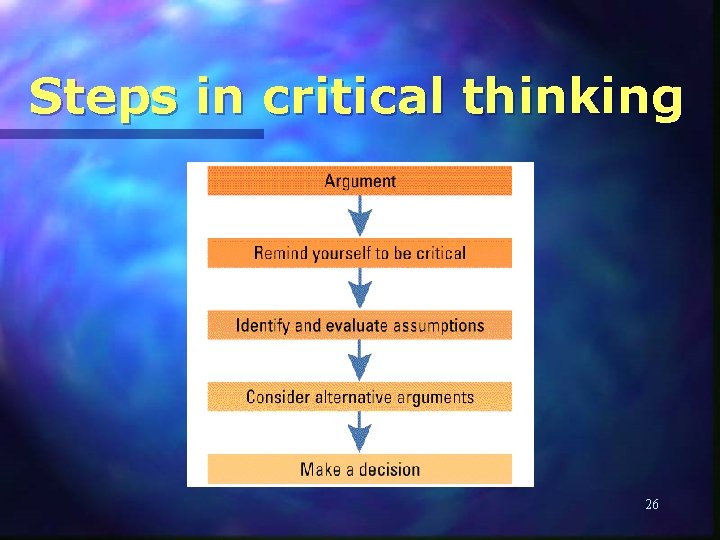
Steps in critical thinking 26
Thoughts About Intelligence It’s one of the laws of nature that half of the people have got to be below average. It’s easier to administer tests than to give everybody a try at being a medical student or a Supreme Court judge. Sandra Scarr Intelligence is purposeful invention of new procedures, or applications of old procedures, in a new context to solve a problem. Jean Piaget Common sense, isn’t. 27
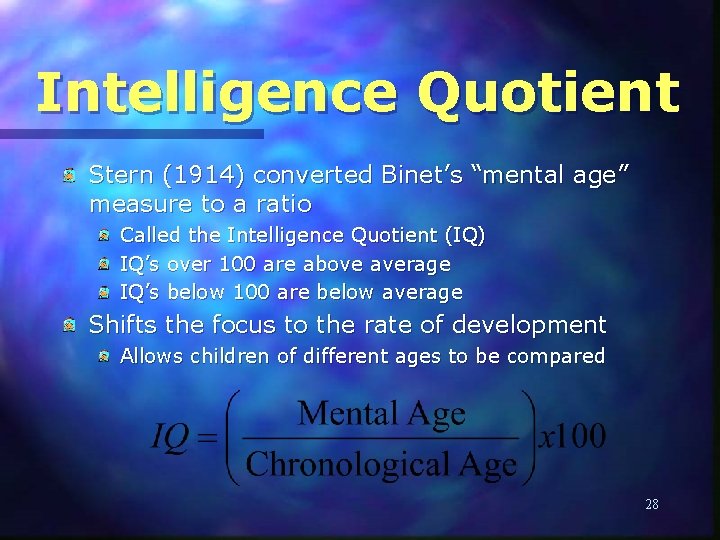
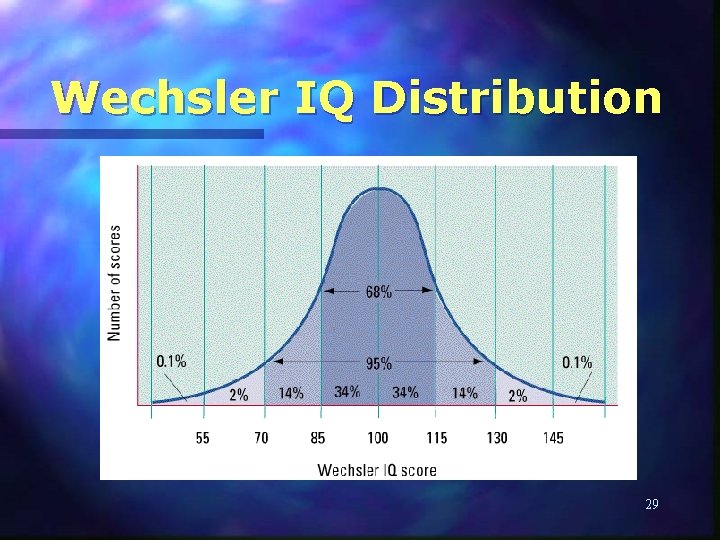
Intelligence Quotient Stern (1914) converted Binet’s “mental age” measure to a ratio Called the Intelligence Quotient (IQ) IQ’s over 100 are above average IQ’s below 100 are below average Shifts the focus to the rate of development Allows children of different ages to be compared 28
Wechsler IQ Distribution 29
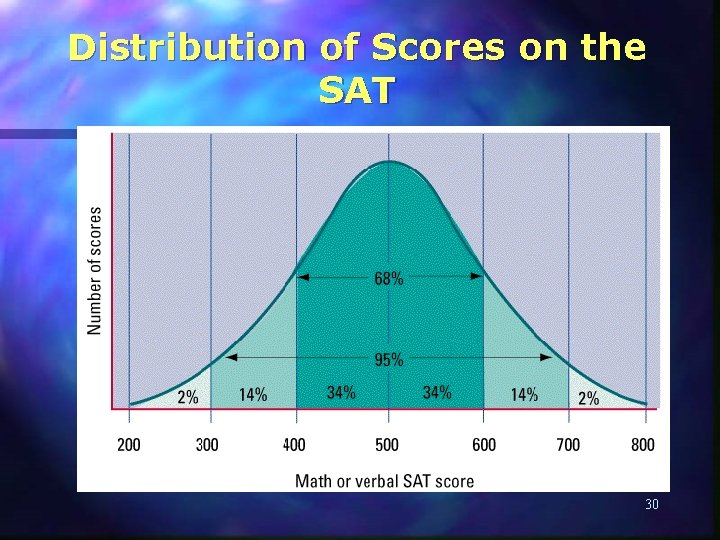
Distribution of Scores on the SAT 30
Psychometrics Reliability The extent to which a test yields consistent results over time or using alternate forms. Validity The extent to which a test measures or predicts what it’s supposed to measure. Standardization The procedure by which existing norms are used to interpret an individual’s test score. 31
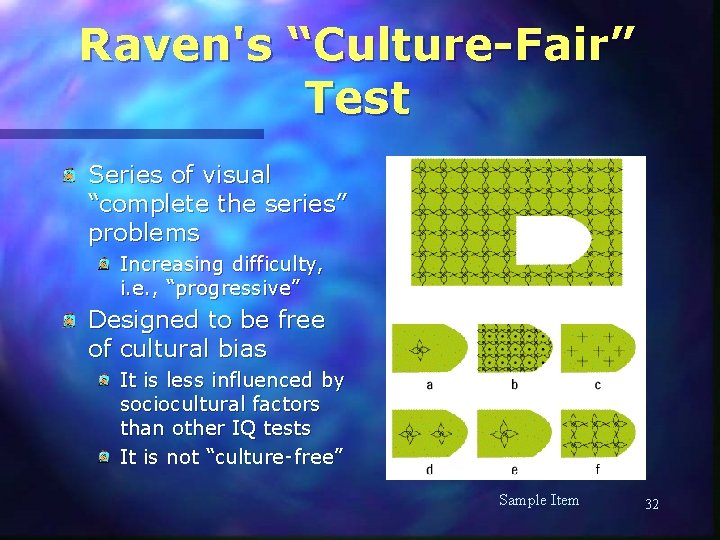
Raven's “Culture-Fair” Test Series of visual “complete the series” problems Increasing difficulty, i. e. , “progressive” Designed to be free of cultural bias It is less influenced by sociocultural factors than other IQ tests It is not “culture‑free” Sample Item 32
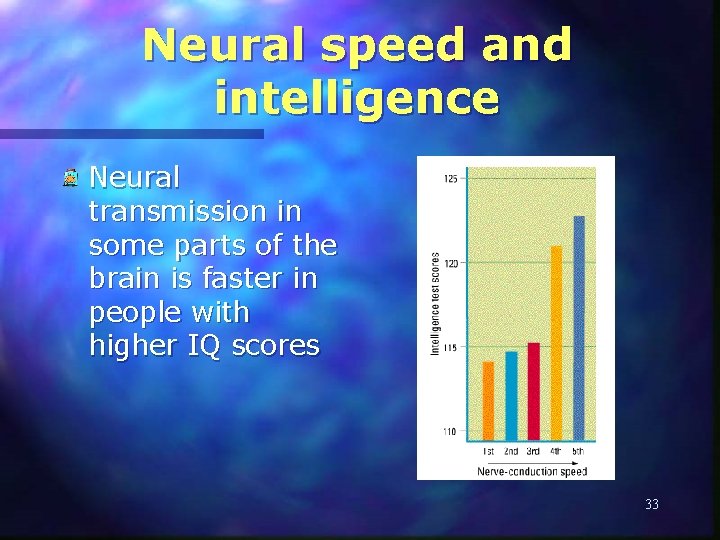
Neural speed and intelligence Neural transmission in some parts of the brain is faster in people with higher IQ scores 33
Gardner’s Multiple Intelligences Linguistic Logical-Mathemetical Spatial Musical Bodily-kinesthetic Interpersonal Intrapersonal 34
The Great Debates 35
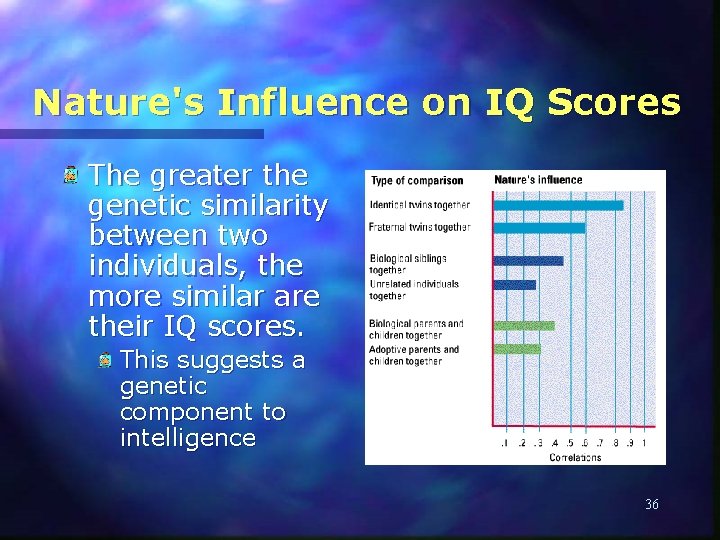
Nature's Influence on IQ Scores The greater the genetic similarity between two individuals, the more similar are their IQ scores. This suggests a genetic component to intelligence 36
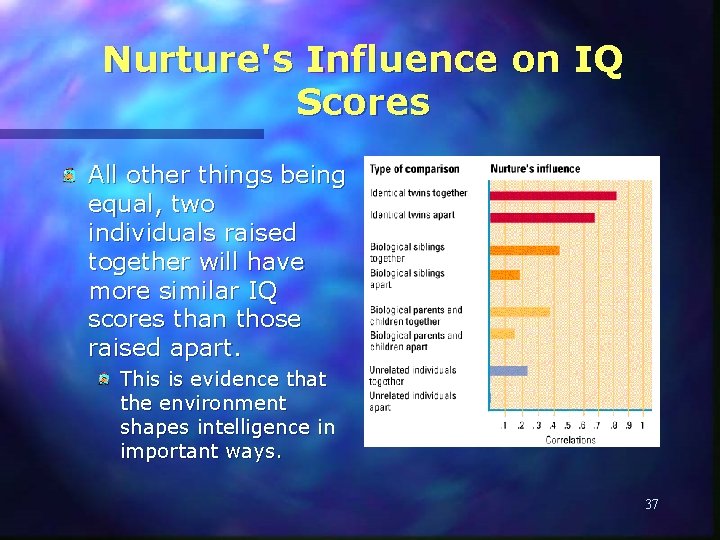
Nurture's Influence on IQ Scores All other things being equal, two individuals raised together will have more similar IQ scores than those raised apart. This is evidence that the environment shapes intelligence in important ways. 37
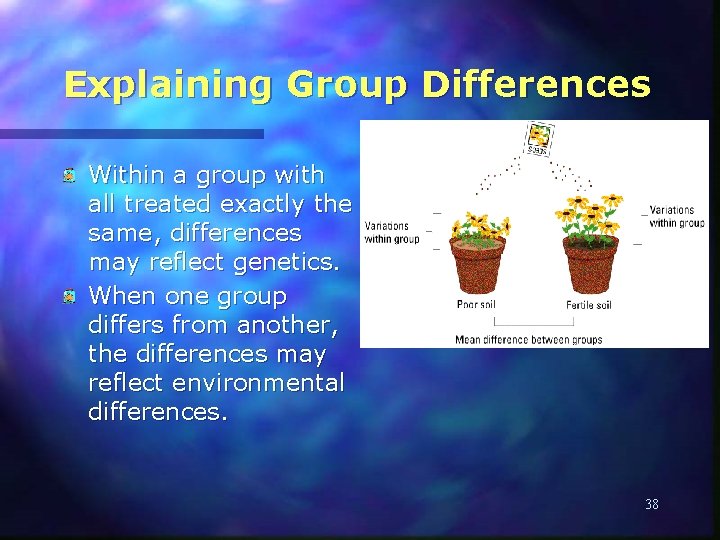
Explaining Group Differences Within a group with all treated exactly the same, differences may reflect genetics. When one group differs from another, the differences may reflect environmental differences. 38
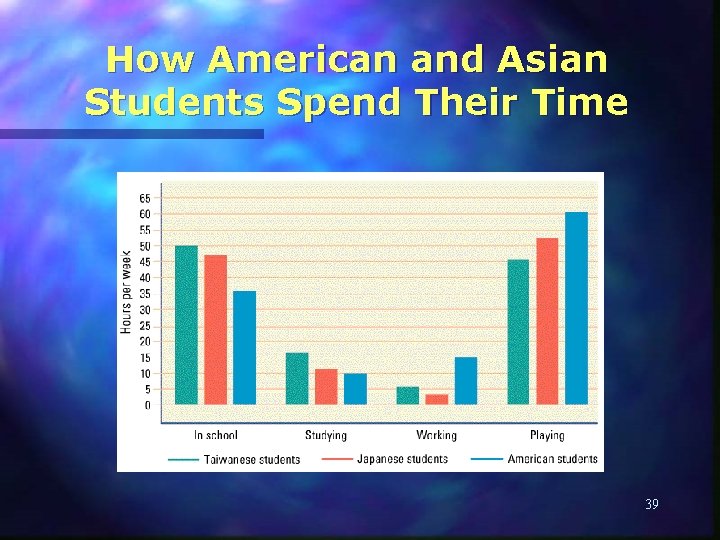
How American and Asian Students Spend Their Time 39
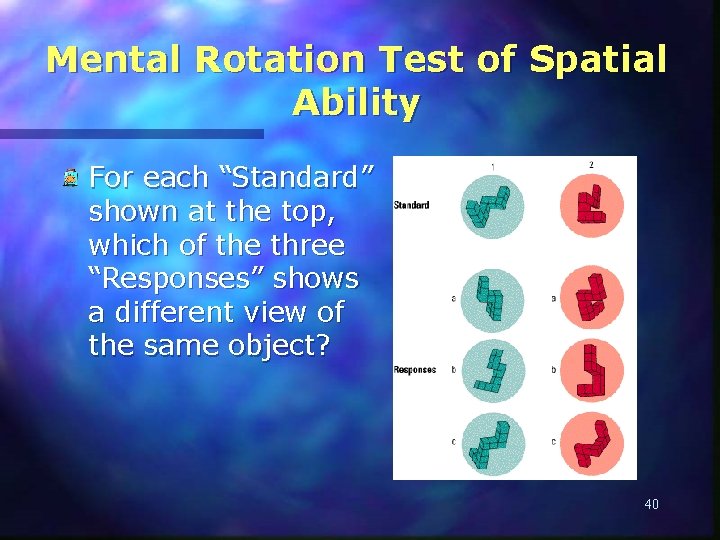
Mental Rotation Test of Spatial Ability For each “Standard” shown at the top, which of the three “Responses” shows a different view of the same object? 40
Class Discussion: How Education Influence IQ? 41