
THINKING ABOUT HAMLET 2010 www Shakespeare Help com
THINKING ABOUT HAMLET © 2010, www. Shakespeare. Help. com
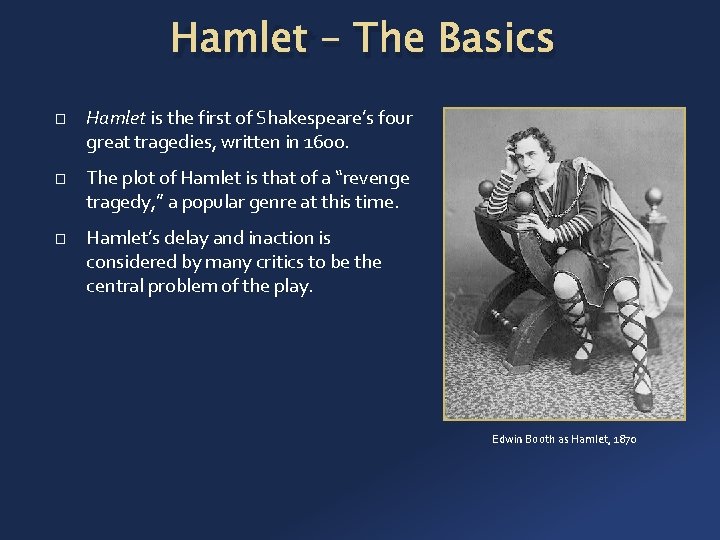
Hamlet – The Basics � � � Hamlet is the first of Shakespeare’s four great tragedies, written in 1600. The plot of Hamlet is that of a “revenge tragedy, ” a popular genre at this time. Hamlet’s delay and inaction is considered by many critics to be the central problem of the play. Edwin Booth as Hamlet, 1870
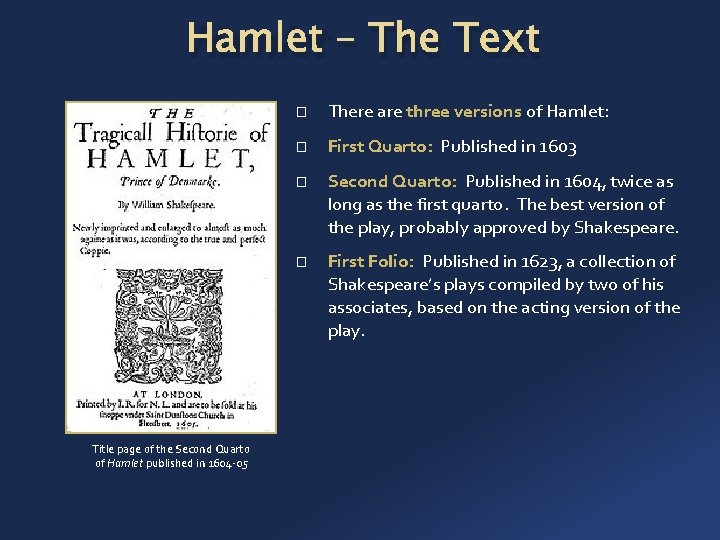
Hamlet – The Text � There are three versions of Hamlet: � First Quarto: Published in 1603 � � Title page of the Second Quarto of Hamlet published in 1604 -05 Second Quarto: Published in 1604, twice as long as the first quarto. The best version of the play, probably approved by Shakespeare. First Folio: Published in 1623, a collection of Shakespeare’s plays compiled by two of his associates, based on the acting version of the play.
Hamlet - Sources 1. Historia Danica (12 th Century), by Saxo Grammaticus. 2. Histoires Tragiques (1576), written by Francois de Belleforest. Ur-Hamlet 3. � According to a popular theory, Shakespeare's main source is believed to be an earlier play—now lost—known today as the Ur-Hamlet. � Possibly written by Thomas Kyd or even William Shakespeare himself, the Ur-Hamlet would have been in performance by 1589 and the first version of the story known to incorporate a ghost. � No copies of Ur-Hamlet exist today.
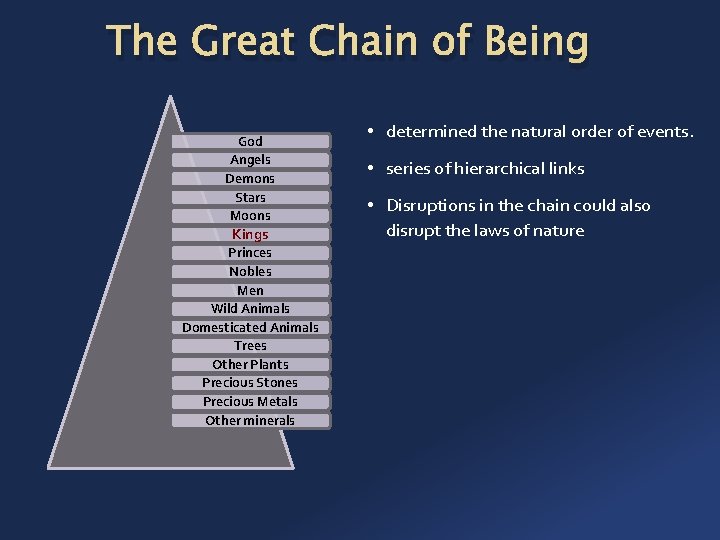
The Great Chain of Being God Angels Demons Stars Moons Kings Princes Nobles Men Wild Animals Domesticated Animals Trees Other Plants Precious Stones Precious Metals Other minerals • determined the natural order of events. • series of hierarchical links • Disruptions in the chain could also disrupt the laws of nature
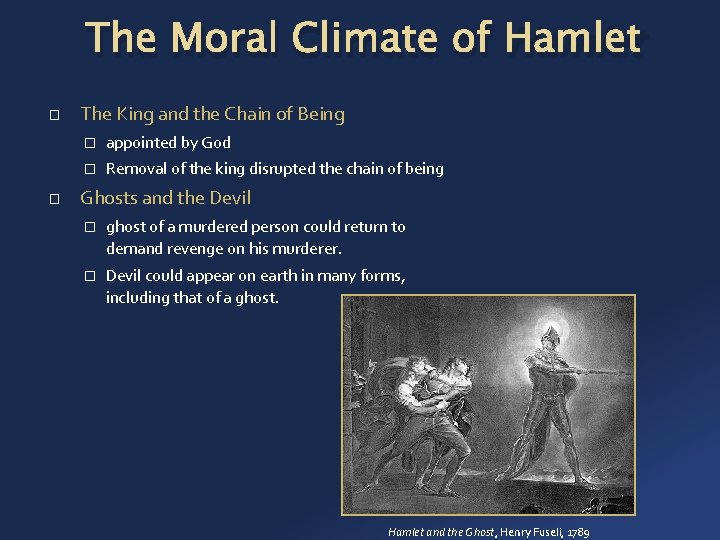
The Moral Climate of Hamlet � � The King and the Chain of Being � appointed by God � Removal of the king disrupted the chain of being Ghosts and the Devil � ghost of a murdered person could return to demand revenge on his murderer. � Devil could appear on earth in many forms, including that of a ghost. Hamlet and the Ghost, Henry Fuseli, 1789
Hamlet – Act I Quotes Who said it, and what is he/she talking about? . 1. . Fear it, my dear sister, And keep you in the rear of your affection, Out of the shot of danger and desire. 2. The serpent that did sting thy father's life Now wears his crown. 3. . meet it is I set it down That one may smile, and be a villain. At least I am sure it may be so in Denmark. 4. The time is out of joint: O cursed spite, That ever I was born to set it right!
Hamlet – Act II Quotes Who said it, and what is he/she talking about? 1. Denmark's a prison. 2. . I'll loose my daughter to him. Be you and I behind an arras then. Mark the encounter. 3. Pale as his shirt, his knees knocking each other, And with a look so piteous in purport, As if he had been loosed out of hell To speak of horrors--he comes before me. 4. The play's the thing Wherein I'll catch the conscience of the king.
Hamlet – Act III Quotes Who said it, and what is he/she talking about? 1. . the dread of something after death. . . Makes us rather bear those ills we have, Than fly to others that we know not of. 2. Do not forget. This visitation Is but to whet thy almost blunted purpose. 3. O, my offense is rank, it smells to heaven; It hath the primal eldest curse upon't. . . 4. O, I am slain!
Hamlet – Act IV Quotes Who said it, and what is he/she talking about? 1. High and mighty, you shall know I am set naked on your kingdom. Tomorrow I beg leave to see your kingly eyes. 2. There's a daisy. I would give you some violets, but they withered all when my father died. 3. . You may choose / A sword unbated, and, in pass of practice, / Requite him for your father. 4. . her garments, heavy with their drink, Pulled the poor wretch from her melodious lay, To muddy death.
Hamlet – Act V Quotes Who said it, and what is he/she talking about? . 1. Hamlet, thou art slain. . Thy mother's poisoned. I can no more. The King, the King's to blame. 2. Sweets to the sweet! Farewell. . . I thought thy bride bed to have decked, sweet maid, And not have strewed thy grave. 3. Now cracks a noble heart. Good night, sweet Prince, And flights of angels sing thee to thy rest. 4. . Let four captains Bear Hamlet like a soldier to the stage, . . . Such a sight as this Becomes the field, but here shows much amiss.
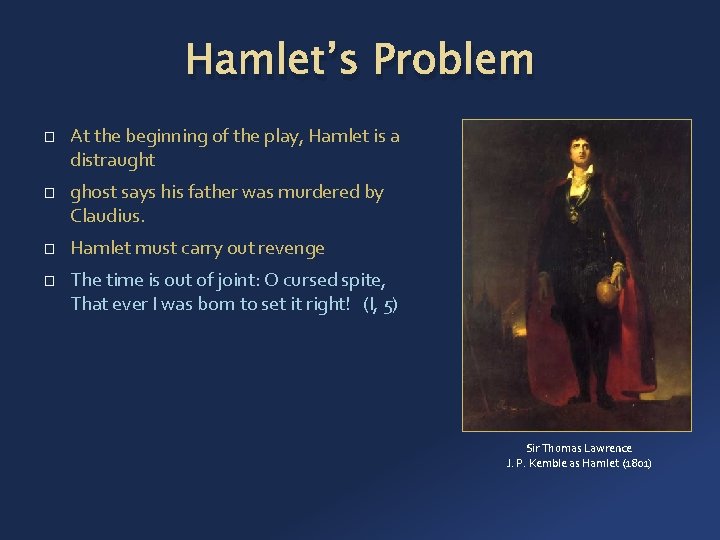
Hamlet’s Problem � � At the beginning of the play, Hamlet is a distraught ghost says his father was murdered by Claudius. Hamlet must carry out revenge The time is out of joint: O cursed spite, That ever I was born to set it right! (I, 5) Sir Thomas Lawrence J. P. Kemble as Hamlet (1801)
Hamlet’s Madness � Horatio is the first to suggest Hamlet’s madness, fearing in Act I that if Hamlet follows the ghost, it will “draw you into madness. ” (I, 4) � � � Horatio also comments on Hamlet’s “wild and whirling words” after he has seen the ghost. (I, 5) At the end of Act I, Hamlet warns Horatio and Marcellus that he will put on an “antic disposition, ” and commends them not to reveal this pretense. Hamlet never explains the purpose of his pretended madness.
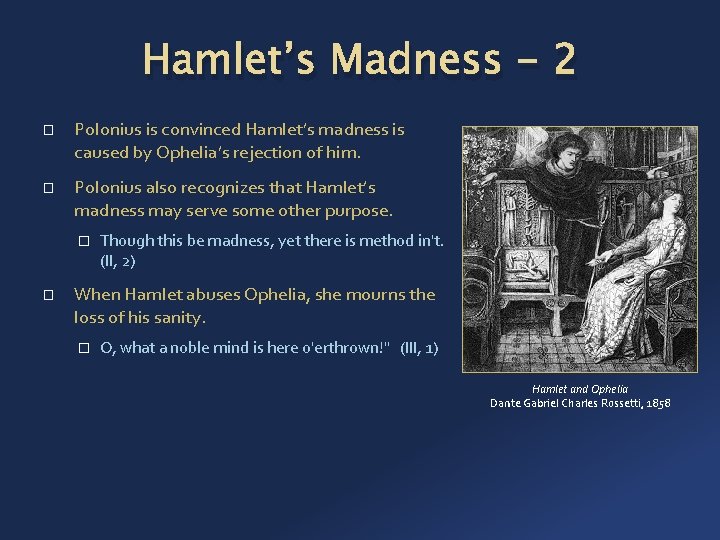
Hamlet’s Madness - 2 � � Polonius is convinced Hamlet’s madness is caused by Ophelia’s rejection of him. Polonius also recognizes that Hamlet’s madness may serve some other purpose. � � Though this be madness, yet there is method in't. (II, 2) When Hamlet abuses Ophelia, she mourns the loss of his sanity. � O, what a noble mind is here o'erthrown!" (III, 1) Hamlet and Ophelia Dante Gabriel Charles Rossetti, 1858
Hamlet’s Madness - 3 � Hamlet’s “madness” gives Claudius a good reason to send Hamlet to England. � � � I like him not, nor stands it safe with us To let his madness range. (III, 3) Gertrude is convinced that Hamlet is crazy when he sees the ghost in her chamber and she does not. � Alas, he’s mad! (III, 4) � Hamlet explains to her that he is only “mad in craft, ” Hamlet’s madness is one of the central questions of the play: Is it real or feigned?
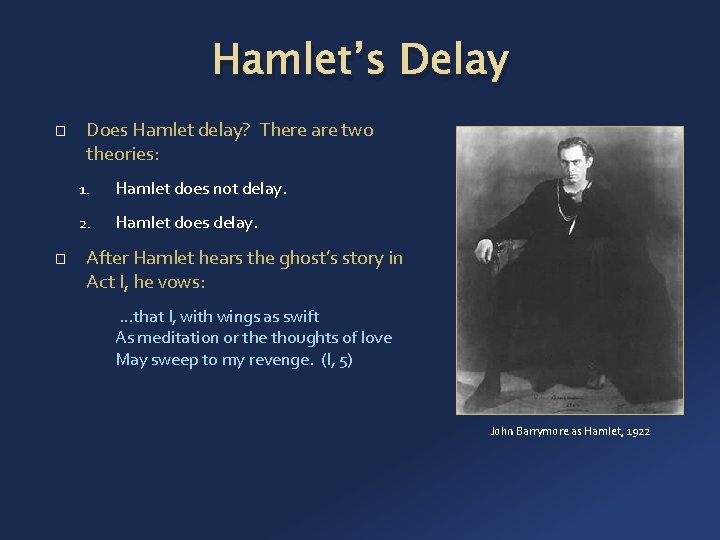
Hamlet’s Delay � � Does Hamlet delay? There are two theories: 1. Hamlet does not delay. 2. Hamlet does delay. After Hamlet hears the ghost’s story in Act I, he vows: …that I, with wings as swift As meditation or the thoughts of love May sweep to my revenge. (I, 5) John Barrymore as Hamlet, 1922
Hamlet’s Delay - 2 � In Act III, Hamlet reacts strongly to the player’s performance of Queen Hecuba’s grief for her murdered husband. � � O, vengeance! / Why, what an ass am I! (II, 2) In his “To be or not to be” soliloquy, Hamlet gives another reason for his delay: his own conscience. � Thus conscience does make cowards of us all; And thus the native hue of resolution Is sicklied o'er with the pale cast of thought… (III, 1)
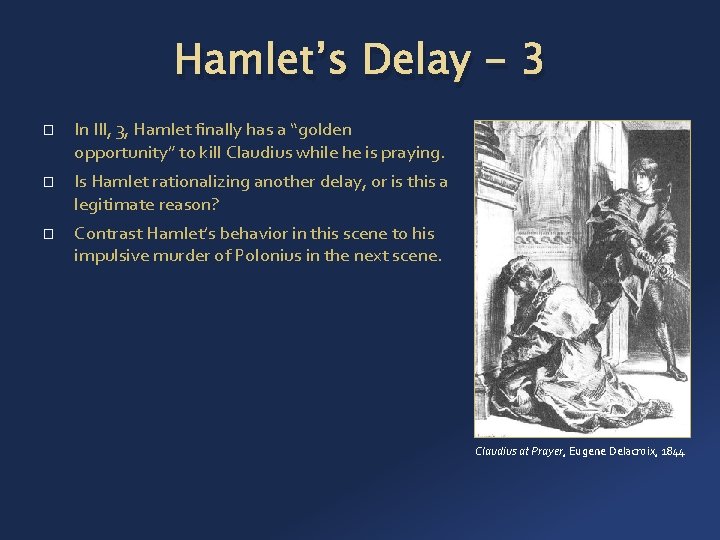
Hamlet’s Delay - 3 � � � In III, 3, Hamlet finally has a “golden opportunity” to kill Claudius while he is praying. Is Hamlet rationalizing another delay, or is this a legitimate reason? Contrast Hamlet’s behavior in this scene to his impulsive murder of Polonius in the next scene. Claudius at Prayer, Eugene Delacroix, 1844
Hamlet’s Delay - 4 In IV, 4, Hamlet speaks to a Norwegian captain in the service of Fortinbras, who is fighting for a small patch of land held by the Poles. � � � He berates himself again for not acting and “thinking too precisely on the event. ” Hamlet ends his last soliloquy, vowing: � � � Hamlet compares himself to Fortinbras, who will expose himself to “death and danger…even for an egg-shell. ” O, from this time forth, My thoughts be bloody, or be nothing worth! When Hamlet duals Laertes in the final scene, he finally kills Claudius and accomplishes his revenge.
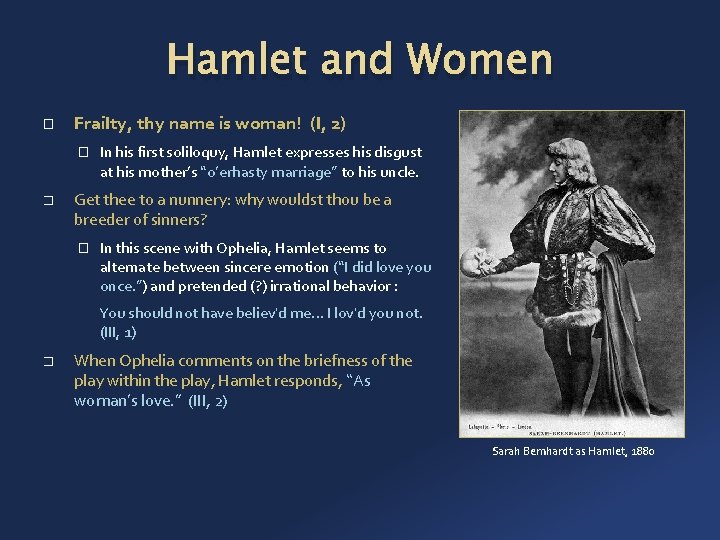
Hamlet and Women � Frailty, thy name is woman! (I, 2) � � In his first soliloquy, Hamlet expresses his disgust at his mother’s “o’erhasty marriage” to his uncle. Get thee to a nunnery: why wouldst thou be a breeder of sinners? � In this scene with Ophelia, Hamlet seems to alternate between sincere emotion (“I did love you once. ”) and pretended (? ) irrational behavior : You should not have believ'd me… I lov'd you not. (III, 1) � When Ophelia comments on the briefness of the play within the play, Hamlet responds, “As woman’s love. ” (III, 2) Sarah Bernhardt as Hamlet, 1880
Hamlet and Women - 2 � Hamlet attacks both Gertrude and Ophelia as symbols of all women and their hypocritical love. � Is Hamlet a misogynist? Are his attacks on women justified? � Gertrude is the cause of Hamlet’s disdain for women: � � O, most wicked speed to post With such dexterity to incestuous sheets! (I, 2) Hamlet is obsessed and tormented by sexual images of his mother and Claudius, imagining them, � In the rank sweat of an enseamed bed, / Stewed in corruption, honeying and making love / Over the nasty sty! (III, 4)
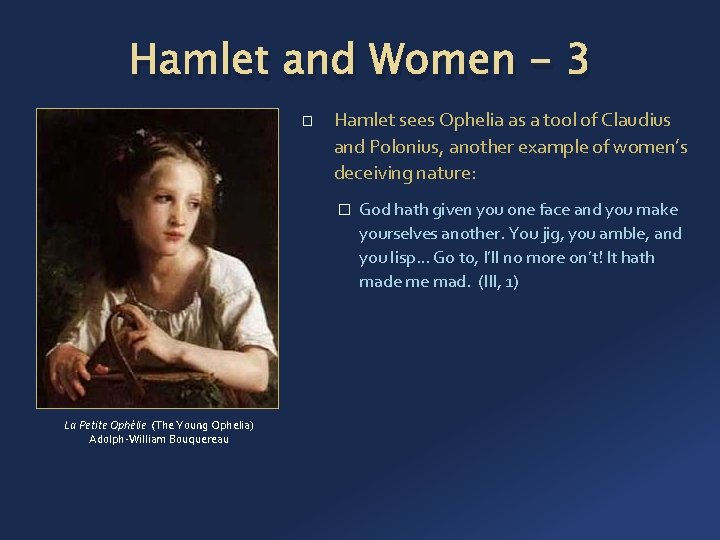
Hamlet and Women - 3 � Hamlet sees Ophelia as a tool of Claudius and Polonius, another example of women’s deceiving nature: � La Petite Ophélie (The Young Ophelia) Adolph-William Bouquereau God hath given you one face and you make yourselves another. You jig, you amble, and you lisp… Go to, I’ll no more on’t! It hath made me mad. (III, 1)
Hamlet and His Mother � � From the beginning of the play, he seems to focus more on his mother’s incestuous, lustful behavior than on the murder of his father. Hamlet’s directly confronts Gertrude in III, 4, in a climactic scene:
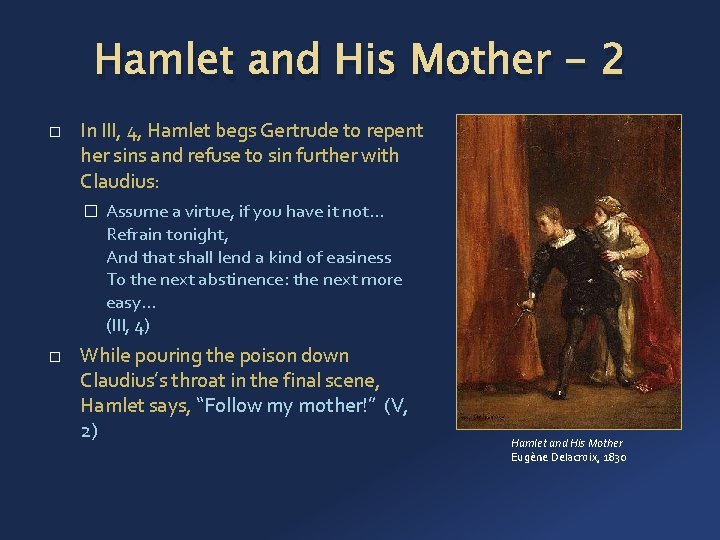
Hamlet and His Mother - 2 � In III, 4, Hamlet begs Gertrude to repent her sins and refuse to sin further with Claudius: � � Assume a virtue, if you have it not… Refrain tonight, And that shall lend a kind of easiness To the next abstinence: the next more easy… (III, 4) While pouring the poison down Claudius’s throat in the final scene, Hamlet says, “Follow my mother!” (V, 2) Hamlet and His Mother Eugène Delacroix, 1830
Hamlet and Oedipus � � � In 1910, Ernst Jones, a colleague and biographer of Freud, published an influential analysis of Hamlet titled Hamlet and Oedipus. Jones explains Hamlet's procrastination as a result of the Oedipus Complex Jones suggests that Hamlet postpones the act of revenge because of the complicated psychodynamic situation in which he finds himself.
Gertrude � � Gertrude's ambiguous role seems to be part of Shakespeare’s conscious design. Although she indicates concern for Hamlet and his welfare, she also desires the status and physical affection that her new marriage provides.
Gertrude - 2 � The Ghost denounces Gertrude’s sexual relationship with Claudius: � � Ay, that incestuous, that adulterate beast, …won to his shameful lust The will of my most seeming-virtuous queen. (I, 5) After confirming Claudius’s guilt during the play, Hamlet is obsessed with confronting his mother with her guilt, not with killing Claudius. � His thoughts are murderous and knows he must use self-control to avoid harming his mother. � Now I could drink hot blood. (Hamlet, III, 2) � I will speak daggers but use none. (Hamlet, III, 2) � These words, like daggers, enter in mine ears… (Gertrude, III, 2)
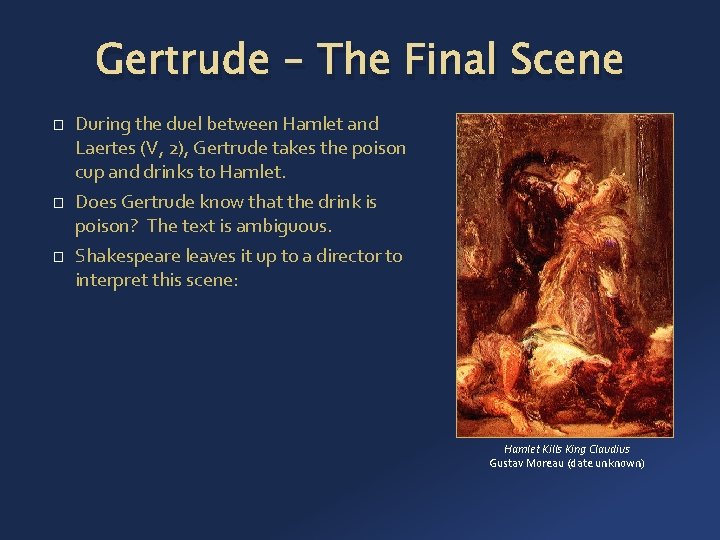
Gertrude – The Final Scene � � � During the duel between Hamlet and Laertes (V, 2), Gertrude takes the poison cup and drinks to Hamlet. Does Gertrude know that the drink is poison? The text is ambiguous. Shakespeare leaves it up to a director to interpret this scene: Hamlet Kills King Claudius Gustav Moreau (date unknown)
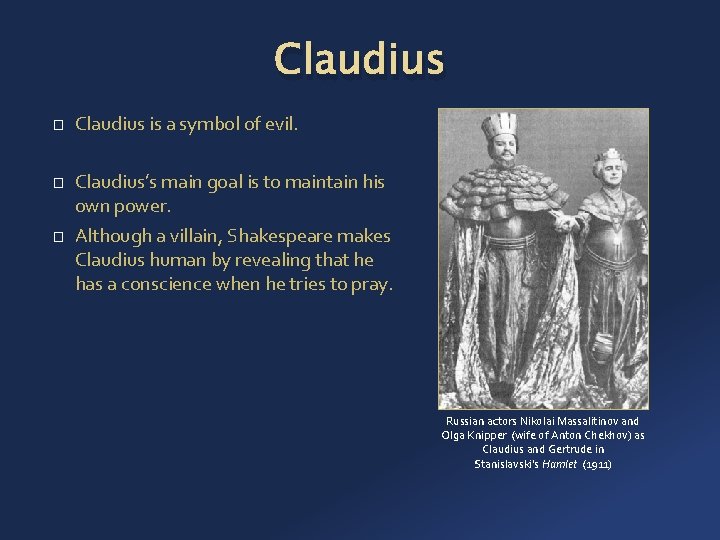
Claudius � � � Claudius is a symbol of evil. Claudius’s main goal is to maintain his own power. Although a villain, Shakespeare makes Claudius human by revealing that he has a conscience when he tries to pray. Russian actors Nikolai Massalitinov and Olga Knipper (wife of Anton Chekhov) as Claudius and Gertrude in Stanislavski's Hamlet (1911)
Claudius - 2 � As a shrewd and conniving man of action, Claudius is one of the foils to Hamlet in the play. � When Claudius learns of Polonius’s murder, he concerned for his own safety, not Gertrude’s: O heavy deed! It had been so with us, had we been there: His liberty is full of threats to all— � Claudius is ultimately undone by his own plan.
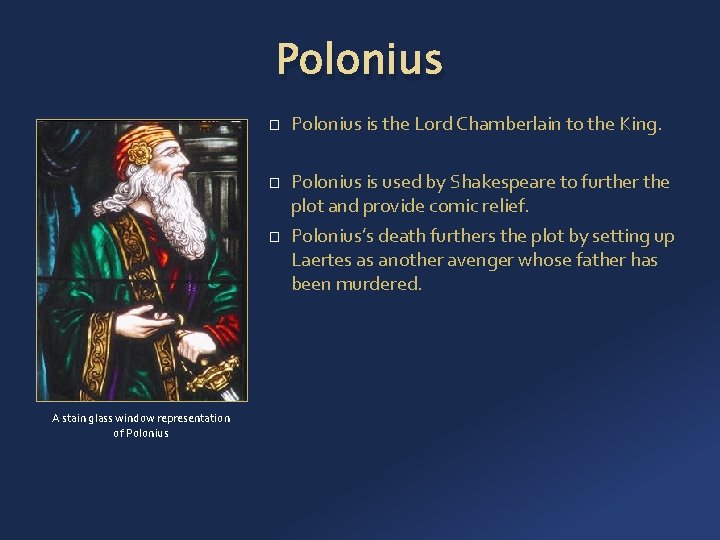
Polonius � � � A stain glass window representation of Polonius is the Lord Chamberlain to the King. Polonius is used by Shakespeare to further the plot and provide comic relief. Polonius’s death furthers the plot by setting up Laertes as another avenger whose father has been murdered.
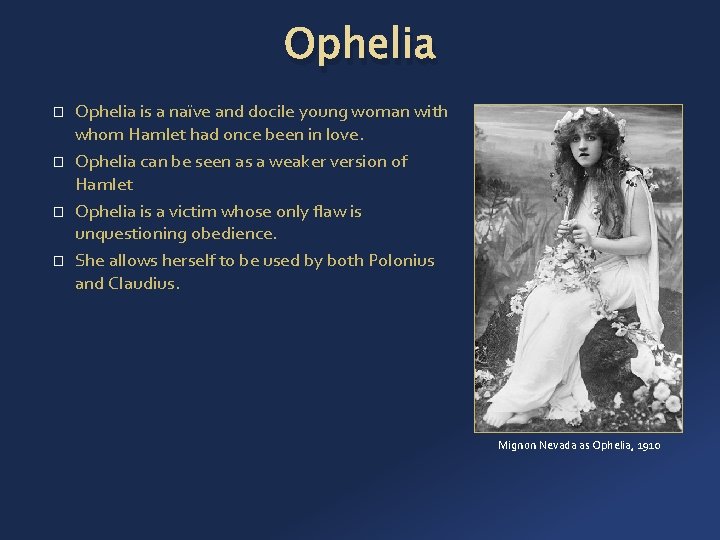
Ophelia � � Ophelia is a naïve and docile young woman with whom Hamlet had once been in love. Ophelia can be seen as a weaker version of Hamlet Ophelia is a victim whose only flaw is unquestioning obedience. She allows herself to be used by both Polonius and Claudius. Mignon Nevada as Ophelia, 1910
Ophelia’s Madness � � � Ophelia appears in IV, 5, after being driven mad. Her songs are a product of her madness, yet they repeat many of the main themes of the play. Her songs also contain hints about what caused her madness—the death of her father and Hamlet’s rejection: � He is dead and gone, lady, / He is dead and gone. (IV, 5) � We must be patient: but I cannot choose but weep, to think they should lay him i' the cold ground. (IV, 5)
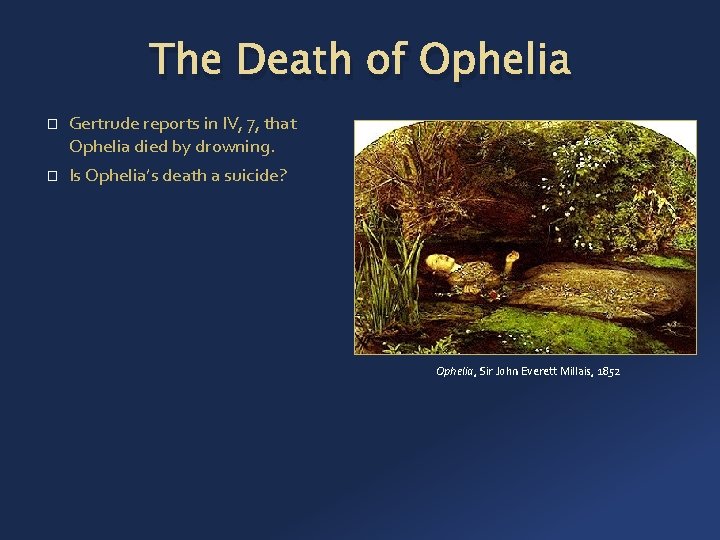
The Death of Ophelia � � Gertrude reports in IV, 7, that Ophelia died by drowning. Is Ophelia’s death a suicide? Ophelia, Sir John Everett Millais, 1852
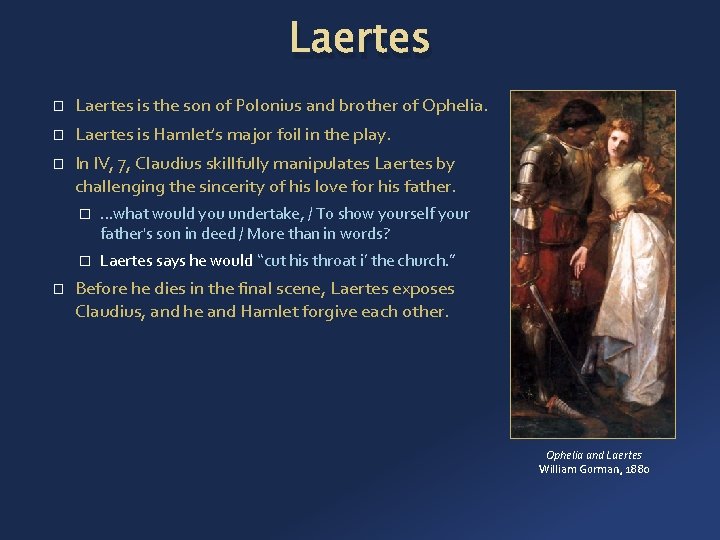
Laertes � Laertes is the son of Polonius and brother of Ophelia. � Laertes is Hamlet’s major foil in the play. � � In IV, 7, Claudius skillfully manipulates Laertes by challenging the sincerity of his love for his father. � …what would you undertake, / To show yourself your father's son in deed / More than in words? � Laertes says he would “cut his throat i’ the church. ” Before he dies in the final scene, Laertes exposes Claudius, and he and Hamlet forgive each other. Ophelia and Laertes William Gorman, 1880
The Ghost � � � The Ghost of King Hamlet, Hamlet’s father, appears three times in the play. Horatio and Hamlet both question whether the ghost is indeed the dead king, or an evil spirit that has come to deceive Hamlet. In the first production of Hamlet, it is thought that Shakespeare himself played the Ghost.
Horatio � � Horatio is Hamlet’s close friend and his only confidante. His calm, rational personality is another contrast, or foil, to Hamlet. Act I: � Horatio has been invited by Marcellus to witness the ghost’s appearance. � He is skeptical, but open-minded, and clearly shaken by the ghost’s visit. Act V: � Hamlet’s last act is to knock the cup of poison from Horatio’s hand as he tries to follow his friend in death. � Hamlet pleads with Horatio to tell his story. � Horatio’s epitaph for Hamlet is moving: Now cracks a noble heart. Good night sweet prince: And flights of angels sing thee to thy rest! (V, 2)
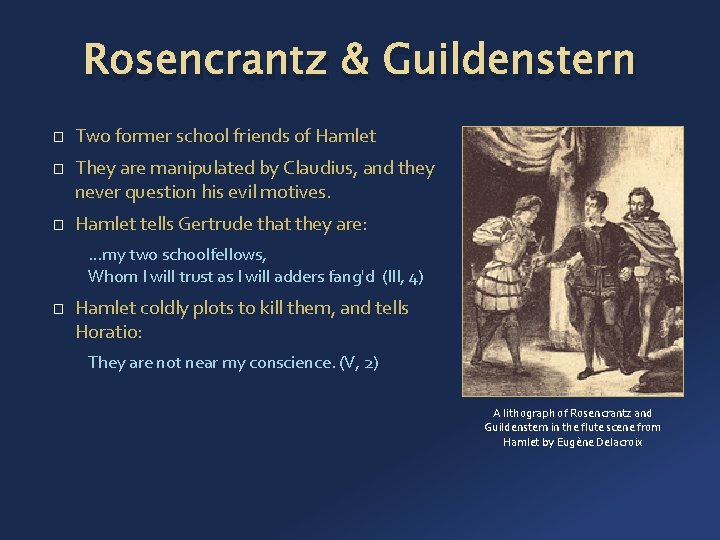
Rosencrantz & Guildenstern � � � Two former school friends of Hamlet They are manipulated by Claudius, and they never question his evil motives. Hamlet tells Gertrude that they are: …my two schoolfellows, Whom I will trust as I will adders fang'd (III, 4) � Hamlet coldly plots to kill them, and tells Horatio: They are not near my conscience. (V, 2) A lithograph of Rosencrantz and Guildenstern in the flute scene from Hamlet by Eugène Delacroix
Fortinbras � � Fortinbras is a Norwegian prince who seeks revenge for his father’s death. Fortinbras is another foil to Hamlet. � His willingness to risk all for a “patch of ground” contrasts with Hamlet’s delay and acts to “spur my dull revenge. ” (IV, 4)
Fortinbras - 2 � � In IV, 4, Hamlet compares himself to Fortinbras after talking with a Norwegian captain: � Fortinbras is willing to risk everything “even for an eggshell” and “find quarrel in a straw” for the sake of honor. � He describes his own situation in comparison: How stand I then, / That have a father kill'd, a mother stain'd… Fortinbras is stunned by the scene of destruction at the end of the play. � He points out his claim to part of Denmark, but accepts his fortune “with sorrow. ” � Take up the bodies: such a sight as this Becomes the field, but here shows much amiss. (V, 2)
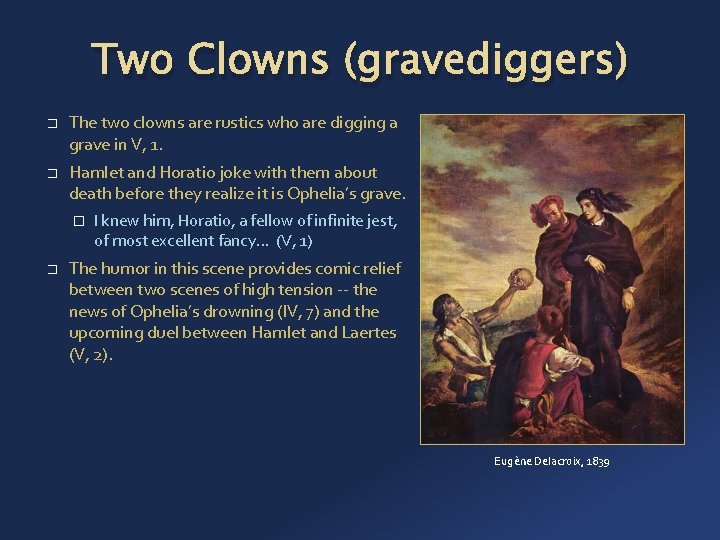
Two Clowns (gravediggers) � � The two clowns are rustics who are digging a grave in V, 1. Hamlet and Horatio joke with them about death before they realize it is Ophelia’s grave. � � I knew him, Horatio, a fellow of infinite jest, of most excellent fancy… (V, 1) The humor in this scene provides comic relief between two scenes of high tension -- the news of Ophelia’s drowning (IV, 7) and the upcoming duel between Hamlet and Laertes (V, 2). Eugène Delacroix, 1839
First Player � � In II, 2, Hamlet welcomes the players affectionately and asks for an example of a “passionate speech. ” The player gives a melodramatic but sympathetic description of the Queen Hecuba’s reaction to the murder: � � The instant burst of clamor that she made… / Would have made milch the burning eyes of heaven, / And passion in the gods. (II, 2) Moved by the player’s emotion, Hamlet condemns himself as weak and cowardly for his inaction. � He imagines if the player had his motive for action, he would “drown the stage with tears /And cleave the general ear with horrid speech. ” (II, 2)
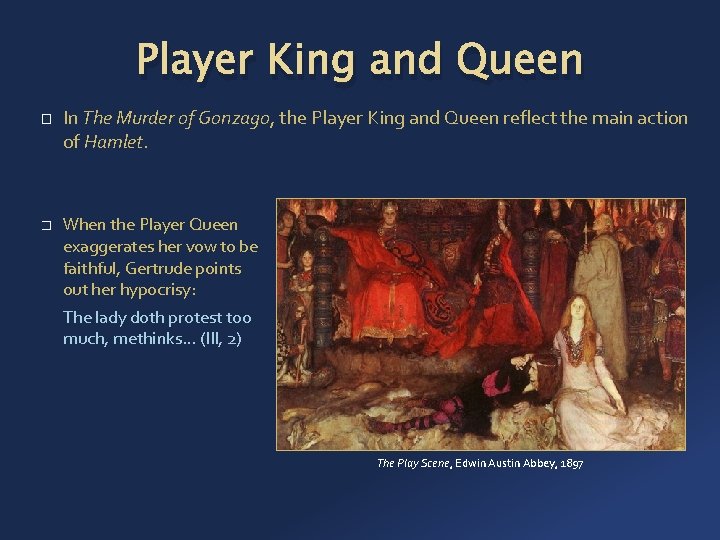
Player King and Queen � � In The Murder of Gonzago, the Player King and Queen reflect the main action of Hamlet. When the Player Queen exaggerates her vow to be faithful, Gertrude points out her hypocrisy: The lady doth protest too much, methinks… (III, 2) The Play Scene, Edwin Austin Abbey, 1897
Minor Characters � Marcellus � � � He says the oft-quoted line: Something is rotten in the state of Denmark. (I, 4) Cornelius and Voltemand Reynaldo
Minor Characters - 2 � � � Lucianus Norwegian Captain Osric
Acting � � Acting has two meanings in Hamlet. Many of the characters in Hamlet use a false appearance to hide their real motives.
Acting – 2 � � � Hamlet welcomes the players affectionately in II, 2, and has a high regard for their skill, instructing Polonius to see that they are well taken care of. His advice to the players in Act II focuses on the nature and purpose of drama. Hamlet describes the purpose of drama as “the mirror up to nature. ”
Acting – The Play within the Play � � The play-within-the-play is highly effective dramatically: Hamlet successfully uses the play-within-the-play to expose Claudius’s guilt. � Shakespeare uses this dramatic device to show that theatre can be used to hold “a mirror up to nature. ”
Corruption / Decay � � Something is rotten in the state of Denmark. (I, 4) This oft-quoted line sums up the effect of King Hamlet’s murder on the country as a whole. Images of disease and poisoning are mainly derived from the Ghost’s initial description of the murder. Upon my secure hour thy uncle stole, With juice of cursed hebenon in a vial, And in the porches of my ears did pour The leperous distillment; (I, 5) � Shakespeare uses a metaphor to compare the king’s ear to the country as a whole when the Ghost describes the false story circulated by Claudius about his death: …so the whole ear of Denmark / Is by a forged process of my death / Rankly abused… (I, 5) �
Corruption / Decay - 2 � To Hamlet, Denmark is: � � � …an unweeded garden, / that grows to seed, Things ranks and gross in nature possess it merely… (I, 2) The corruption and decay in a state ruled by the murderer of a king are reflected in the natural world. Hamlet describes the air in Denmark to Rosencrantz and Guildenstern: � …this majestical roof fretted with golden fire, why, it appears no other thing to me than a foul and pestilent congregation of vapors. (II, 2)
Corruption / Decay - 3 � Images of corruption and decay are most closely associated with Claudius’s crime and his incestuous relationship with Gertrude. � � When Hamlet confronts his mother after the play, he emphasizes the physical details of her relationship with Claudius: � � When Claudius tries to pray, he admits: O, my offence is rank, it smells to heaven (III, 3) In the rank sweat of an enseamed bed, Stew'd in corruption, honeying and making love Over the nasty sty— (III, 4) He advises his mother to repent and save herself with more images of decay: � Confess yourself to heaven; Repent what's past; avoid what is to come; And do not spread the compost on the weeds, To make them ranker. b(III, 4)
Corruption / Decay - 4 � Hamlet is obsessed with the physical effects of death on the human body. When Claudius asks Hamlet about the location of Polonius’s body, Hamlet responds that he is “at supper”: Not where he eats, but where he is eaten: a certain convocation of politic worms are e'en at him. (IV, 3) � Hamlet jokes with the gravedigger about how long it will take for a body to rot after it is buried: I' faith, if he be not rotten before he die. . . he will last you some eight year or nine year. (Gravedigger, V, 1) � When the gravedigger digs up Yoric’s skull (the king’s former jester and companion of the youthful Hamlet), Hamlet is fascinated with the physical effects of death: To what base uses we may return, Horatio! Why may not imagination trace the noble dust of Alexander, till he find it stopping a bung-hole? (V, 2) �
Ears � 1. Shakespeare uses ears and hearing as recurring images in Hamlet for two purposes: The king’s ear represents the central crime of the play, and the king’s connection to country as a whole. � King Hamlet was killed when Claudius “in the porches of my ears did pour The leperous distillment. ” (I, 5) � By murdering the king and spreading the false snakebite story, “the whole ear of Denmark is…Rankly abused. ” (I. v. 36– 38). � When confronting his mother, Hamlet holds up pictures of the dead king and of Claudius: This was your husband. Look you now, what follows: Here is your husband; like a mildew'd ear… (III, 4)
Ears - 2 2. Hamlet is filled with references to hearing and contains several scenes of characters overhearing or spying on others. � � � Hamlet in his letter to Horatio after returning to Denmark: I have words to speak in thine ear will make thee dumb. (IV, 4) The ghost to Hamlet: List, Hamlet, list, O list! (I, 5) Gertrude to Hamlet when he confronts her about her adultery: O, speak to me no more; These words, like daggers, enter in mine ears (III, 4) Claudius and Polonius both hide to overhear the conversation between Hamlet and Ophelia. Polonius hides in Gertrude’s chamber to overhear her conversation with Hamlet.
Madness � � � After seeing the ghost, Hamlet announces to Horatio and Marcellus that he will put on an “antic disposition. ” Hamlet’s madness raises a number of questions: Hamlet uses his madness to mock Polonius, as well as Rosencrantz and Guildenstern, all of whom are stooges for Claudius. � I am but mad north-west: when the wind is southerly I know a hawk from a handsaw. (II, 2)
Madness - 2 � � Do the events in the play account for Hamlet’s real emotional instability? When is Hamlet actually unstable, and when is he acting? � However, Ophelia’s story of Hamlet appearing to her seems to describe someone in real emotional distress: Pale as his shirt; his knees knocking each other; And with a look so piteous in purport As if he had been loosed out of hell To speak of horrors, --he comes before me. (II, 1)
Reason vs. Passion � � � Hamlet is in continual conflict between the two forces of reason and passion. The Elizabethans believed that man was positioned between the angels and the beasts on the Chain of Being. Shakespeare presents in the character of Hamlet a universal conflict— the struggle between reason and passion as influences on our actions.
Reason vs. Passion - 2 � � Hamlet criticizes his mother for giving in to passion, often dwelling on the sensual nature of her relationship with Claudius. � O, God! a beast, that wants discourse of reason, Would have mourn'd longer. (I , 2) � …the rank sweat of an enseamed bed, Stew'd in corruption, honeying and making love Over the nasty sty… (III, 4) While Hamlet is sometimes impulsive and passionate, as when he kills Polonius, his thoughts often prevent him from acting. � In his “To be or not to be” soliloquy, he considers suicide, but admits that fear of life after death prevents him from ending his life. � Thus conscience doth make cowards of us all. (III, 1)
Reason vs. Passion - 3 � In Hamlet’s soliloquy in IV, 4, he points out that reason is what distinguishes men from beasts: What is a man, If his chief good and market of his time Be but to sleep and feed? a beast, no more. Sure, He that made us with such large discourse, Looking before and after, gave us not That capability and god-like reason To fust in us unused. � He also admits that his tendency to think too much has prevented him from acting: …thinking too precisely on the event, A thought which, quarter'd, hath but one part wisdom And ever three parts coward, I do not know Why yet I live to say "This thing's to do, " Sith I have cause and will and strength and means To do't.
Revenge � Revenge tragedies were very popular in Elizabethan England. � � The Spanish Tragedy (1587) by Thomas Kyd was the most popular revenge tragedy (aka a “tragedy of blood”) of the day. Most revenge plays used the same formula (much like the plots of modern TV series):
Revenge - 2 � � In Hamlet, Shakespeare takes the revenge tragedy to a deeper level: Hamlet contains more than one revenge plot.
Spying � There are multiple instances of spying or eavesdropping in Hamlet. � III, 1: Claudius and Polonius spy on Hamlet and Ophelia. � II, 1: Polonius sends Reynaldo to spy on Laertes in order to discover information about his reputation. � Polonius even instructs him to slander Laertes in order to see if his insults are confirmed or denied by others: See you now; Your bait of falsehood takes this carp of truth: And thus do we of wisdom and of reach, With windlasses and with assays of bias, By indirections find directions out. (II, 1)
Spying - 2 � Claudius sends for Rosencrantz and Guildenstern to hang out with Hamlet and try to find out what “afflicts” him: � …so by your companies To draw him on to pleasures, and to gather, So much as from occasion you may glean, Whether aught, to us unknown, afflicts him thus. (Claudius, II, 2) � Hamlet knows they are Claudius’s stooges, and mocks them viciously: ROSENCRANTZ : Take you me for a sponge, my lord? HAMLET : Ay, sir, that soaks up the king's countenance, his rewards, his authorities…when he needs what you have gleaned, it is but squeezing you, and, sponge, you shall be dry again. (IV, 2)
Spying - 3 � � Polonius eavesdrops on Hamlet and Gertrude while hiding behind an arras, and is killed by Hamlet. The play-within-the-play is one of the best examples of spying on others in the play. � Hamlet devises the plan in order to observe Claudius’s behavior: I have heard / That guilty creatures sitting at a play Have …been struck so to the soul that presently They have proclaim'd their malefactions; (II, 2)
Suicide and Death � Hamlet is clearly obsessed with death after his father’s unexpected passing. � Claudius and Gertrude, both think he should moderate his grief: Thou know'st 'tis common; all that lives must die, Passing through nature to eternity. (Gertrude, I, 2) But, you must know, your father lost a father; That father lost, lost his…but to persever In obstinate condolement is a course Of impious stubbornness; 'tis unmanly grief. (Claudius, I, 2) � In his first soliloquy, Hamlet expresses his wish to die and regrets that there are moral laws against suicide. O, that this too solid flesh would melt, Thaw and resolve itself into a dew! Or that the Everlasting had not fix'd His canon 'gainst self-slaughter! (I, 2)
Suicide and Death – To Be or Not to Be � Hamlet considers suicide again in his “To be or not to be” soliloquy. � Hamlet asks the question whether it is nobler to live and suffer, or to end an unhappy life quickly: Whether 'tis nobler in the mind to suffer The slings and arrows of outrageous fortune, Or to take arms against a sea of troubles, And by opposing end them? � However, no one knows what happens after death: But that the dread of something after death, The undiscover'd country from whose bourn No traveller returns, puzzles the will And makes us rather bear those ills we have Than fly to others that we know not of? Thus conscience does make cowards of us all… (III, 1)
Suicide and Death – Alas, Poor Yoric � � � Hamlet’s conversation with the gravedigger is another examination of death Hamlet jokes with the gravedigger about how long it will take a body to rot in the ground. When the gravedigger throws up the skull of Yoric, the king’s jester, Hamlet philosophizes on the end to which all living things must come: � To what base uses we may return, Horatio! Why may not imagination trace the noble dust of Alexander, till he find it stopping a bung-hole? (V, 2) � Imperious Caesar, dead and turn'd to clay, Might stop a hole to keep the wind away. (V, 2)
- Slides: 67