
Thinking about Ecosystems Ecosystems and Biomes are large
Thinking about Ecosystems
Ecosystems and Biomes are large scale ecosystems. Its climate and plants and animals adapted to living in that climate are what make it different from other biomes. There are 6 biomes total all over the world!!! Ecosystem: A community of all living things including EXTREMELY small organisms. An ecosystem can also include nonliving elements like: soil, water, air and sunlight.
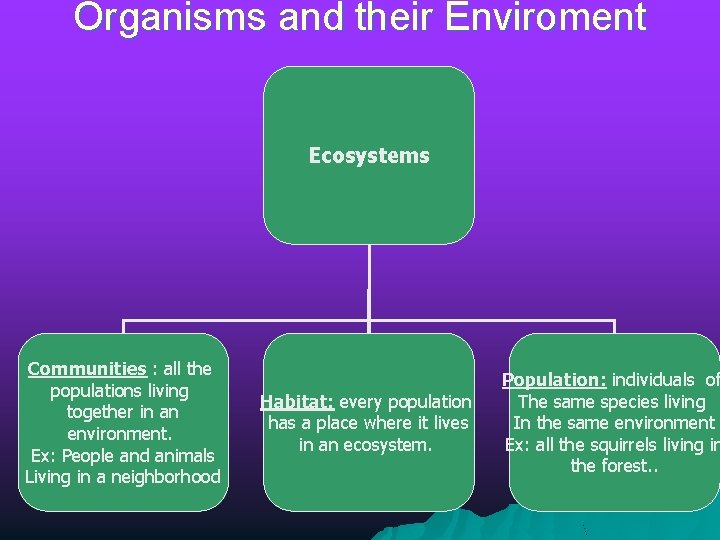
Organisms and their Enviroment Ecosystems Communities : all the populations living together in an environment. Ex: People and animals Living in a neighborhood Habitat: every population has a place where it lives in an ecosystem. Population: individuals of The same species living In the same environment Ex: all the squirrels living in the forest. .
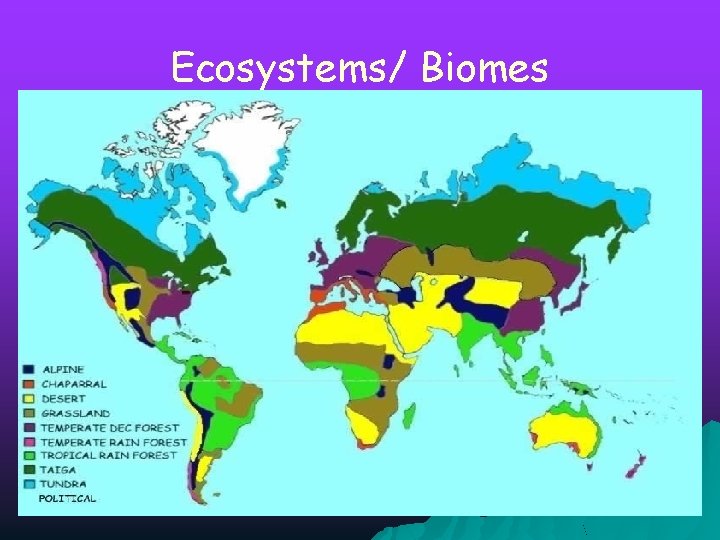
Ecosystems/ Biomes
Biome Project: 1. Each group will have to learn about the 6 different kinds of biomes. You will make your biome project on chart paper and present it to the front of the class. 2. Each person within the group must read about their biome and must write 8 -10 facts about each biome. Be sure to include the following information about each biome: • Kind of climate, weather • Types of plants and trees found there • Types of animals found there • Where it is located in the world 3. You must draw pictures and include lots of charts, diagrams, and color…Be creative!!!
Lakes/ Ponds There are living and non-living things that interact u It is made with fresh water u The water doesn’t move or is standing u Contains fish, plants, amphibians u In general the producers are found at the top and consumers found at bottom. This is because producers need the sunlight. u Producers- algae u Consumers- fish u Decomposers- bacteria, fungi u
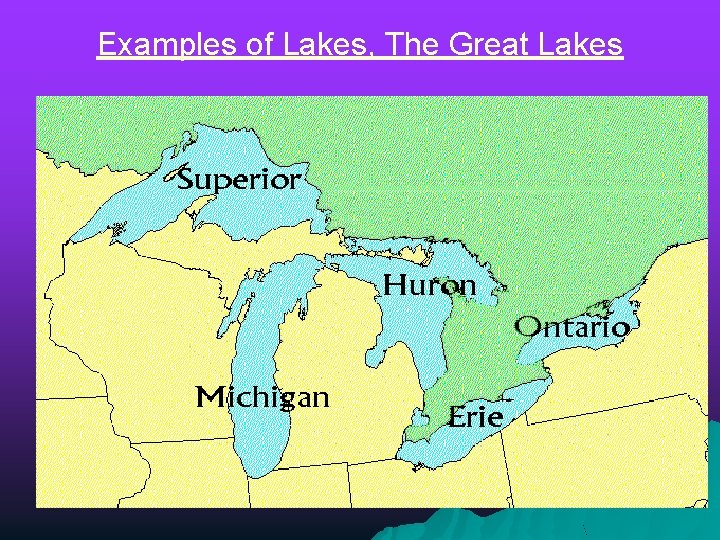
Examples of Lakes, The Great Lakes
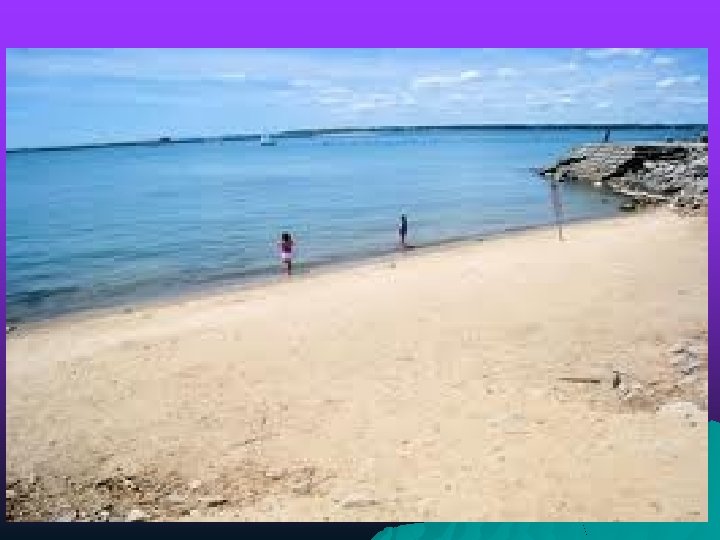
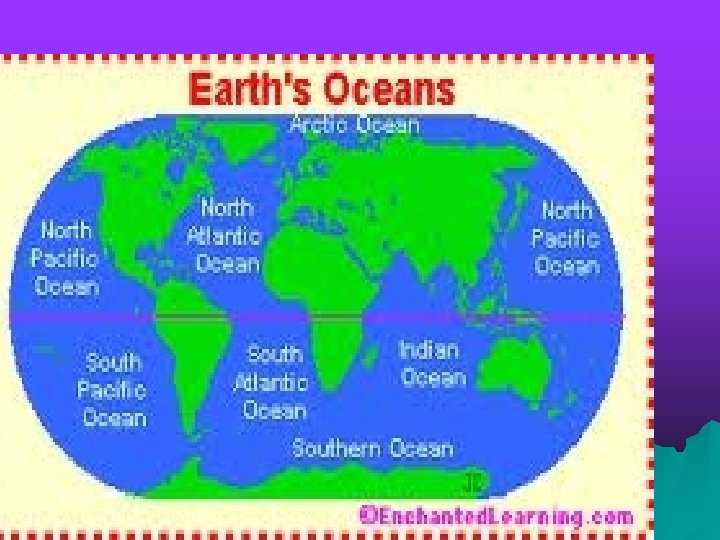
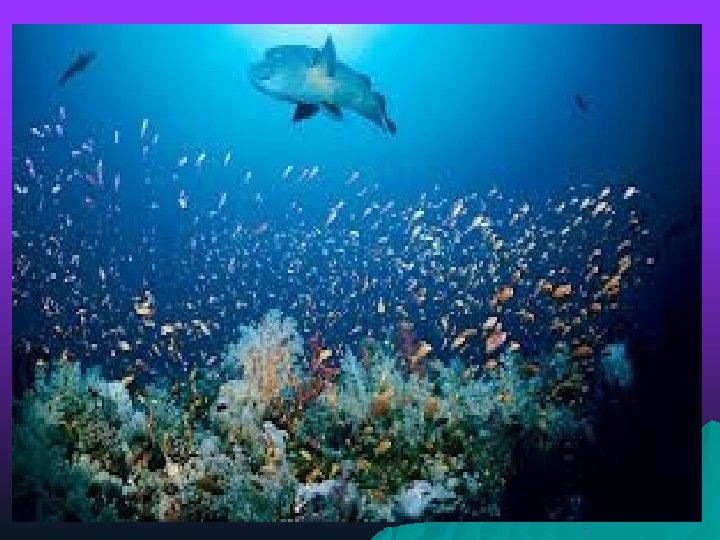
Oceans- there are 8 oceans u u u u u So big that it covers many other smaller ecosystems like coral reefs, shore, deep sea, etc! Oceans are made with Saltwater The water moves in waves, currents, and tides The further you travel from the equator, the colder the ocean becomes Biggest of the aquatic ecosystems and largest biome Over 1 millions species of plants and animals Producers- protists Consumers- fish, whales Decomposers- bacteria, fungus, marine worms, sea slugs, sea worms
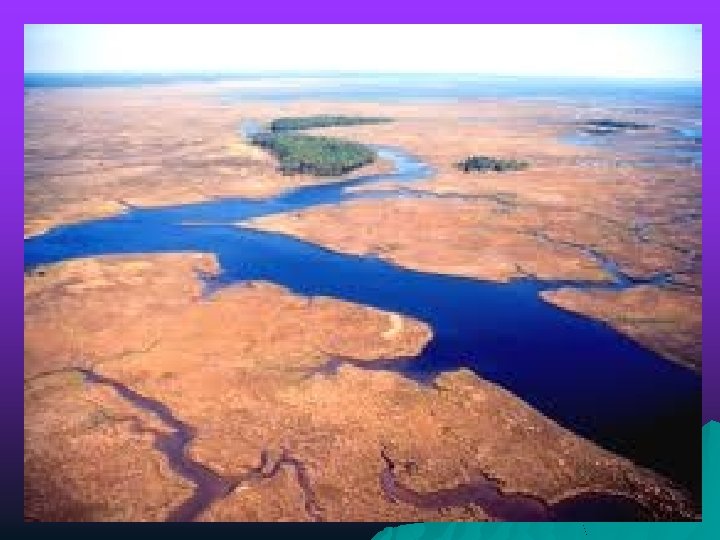
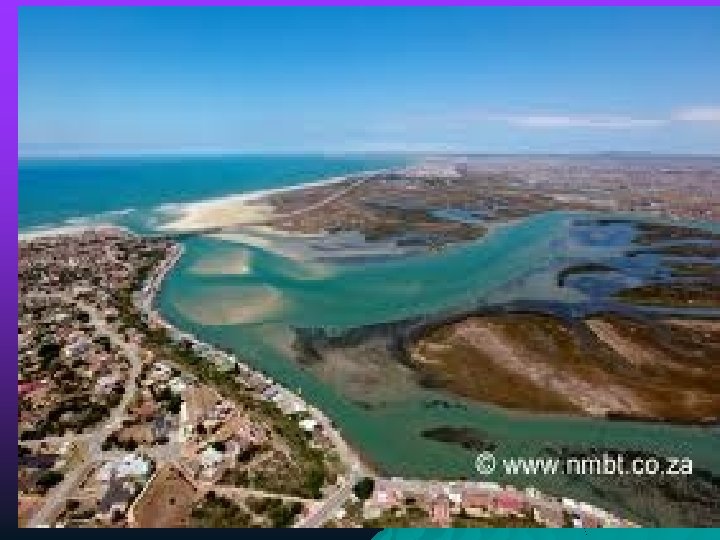
Estuaries/ Marshes u Brackish Water (meaning a mixture of saltwater and freshwater) u Where the freshwater of the river meets the saltwater of the ocean u Found where there is saltwater, near the coast. u Good place for small fish to live because it provides protection from the waves. u Producers- plants like marsh grasses, reeds, seagrass (allow animals to hide well) u Consumers- alligators, fish, snakes, dolphins u Decomposers- bacteria, worms, fiddler and blue crabs
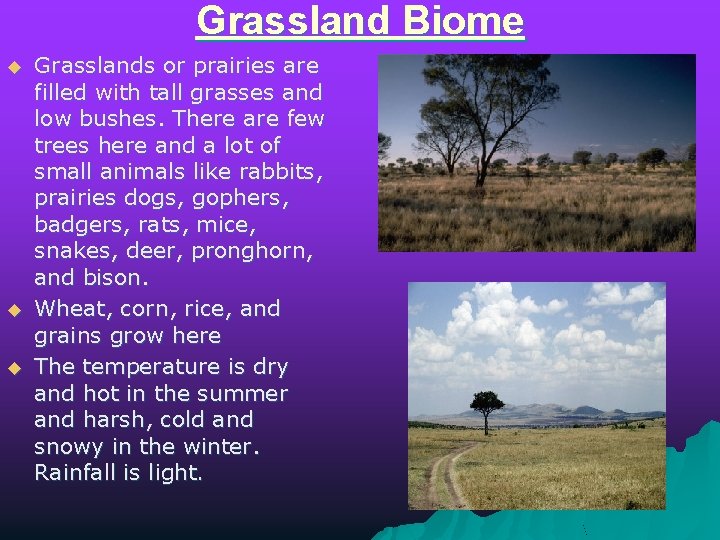
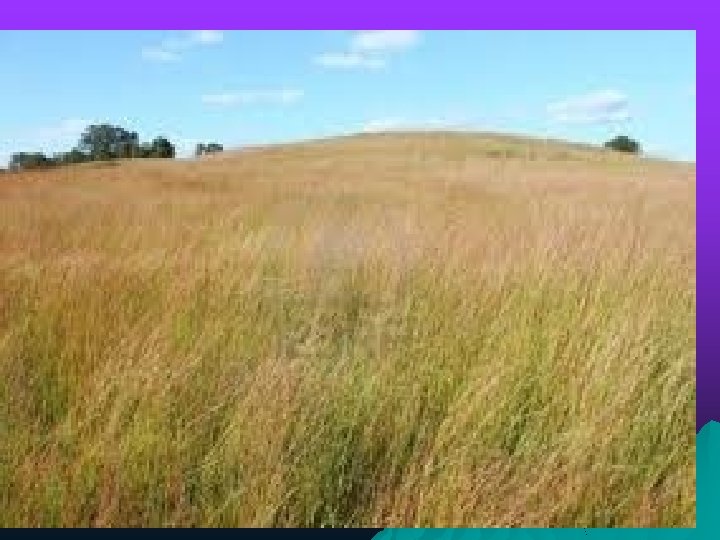
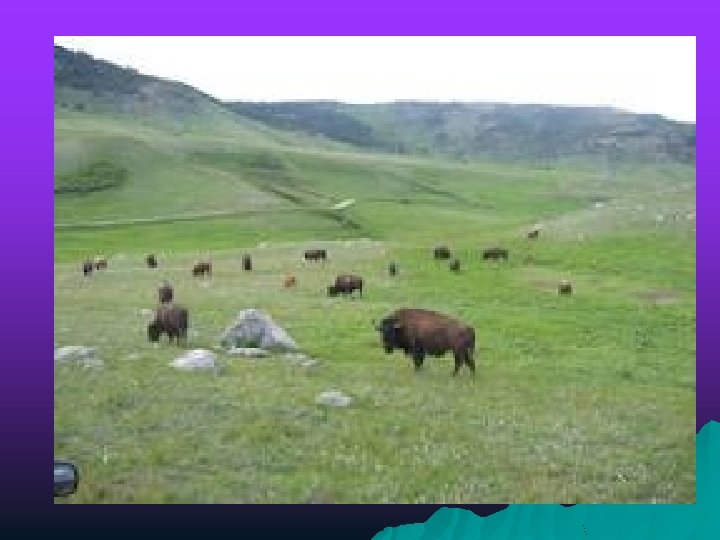
Grassland Biome u u u Grasslands or prairies are filled with tall grasses and low bushes. There are few trees here and a lot of small animals like rabbits, prairies dogs, gophers, badgers, rats, mice, snakes, deer, pronghorn, and bison. Wheat, corn, rice, and grains grow here The temperature is dry and hot in the summer and harsh, cold and snowy in the winter. Rainfall is light.
Grassland Food chain u Producers-Wheat, corn, rice, and other grains are grown here. u Consumers- rabbits, prairie dogs, badgers, snakes and bison u Decomposers- fungi, bacteria
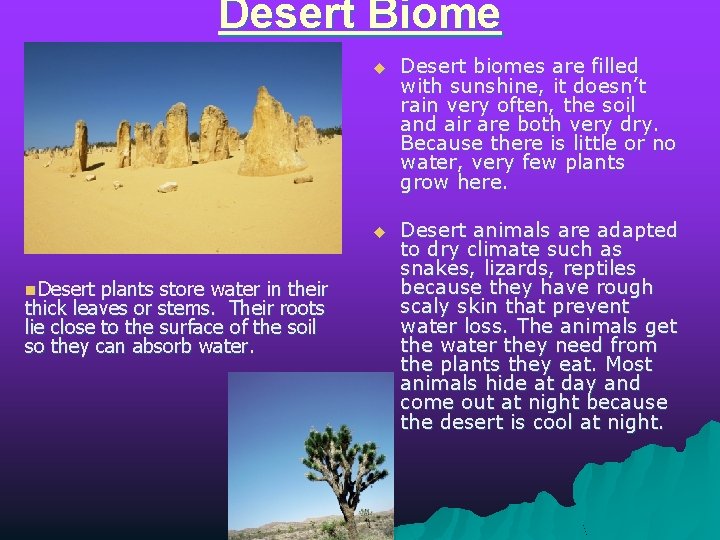
Desert Biome n. Desert plants store water in their thick leaves or stems. Their roots lie close to the surface of the soil so they can absorb water. u Desert biomes are filled with sunshine, it doesn’t rain very often, the soil and air are both very dry. Because there is little or no water, very few plants grow here. u Desert animals are adapted to dry climate such as snakes, lizards, reptiles because they have rough scaly skin that prevent water loss. The animals get the water they need from the plants they eat. Most animals hide at day and come out at night because the desert is cool at night.
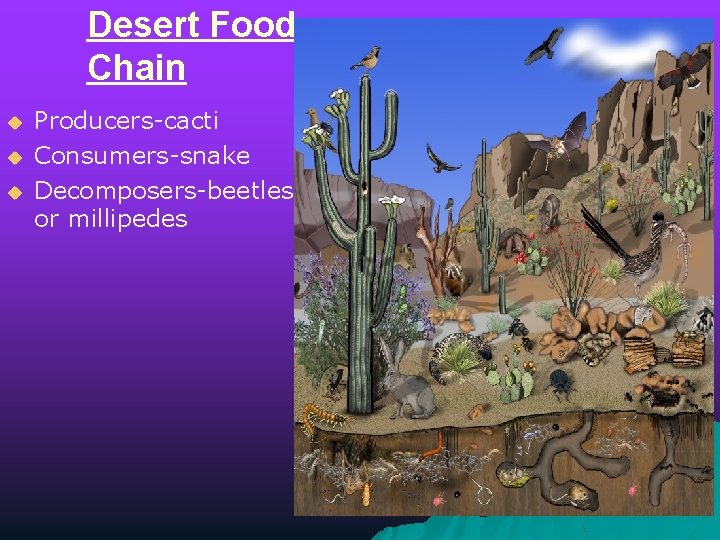
Desert Food Chain u u u Producers-cacti Consumers-snake Decomposers-beetles or millipedes
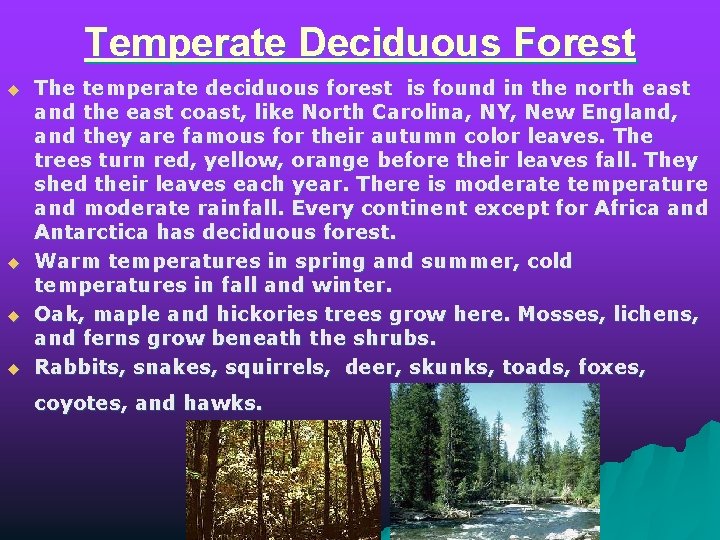
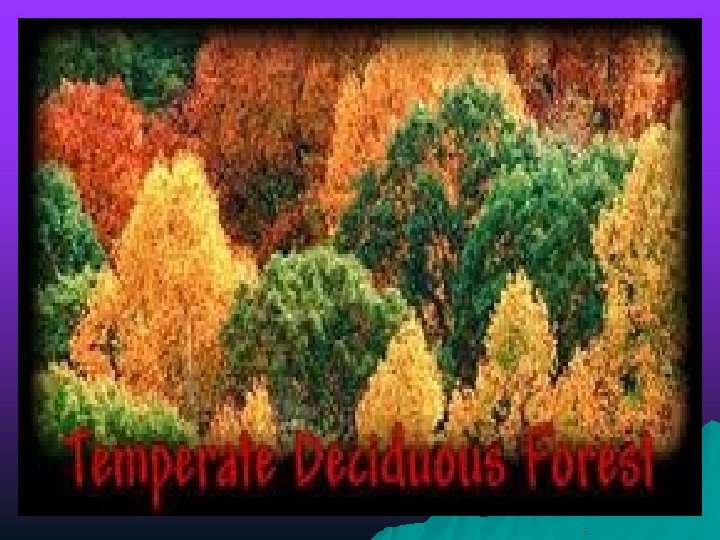
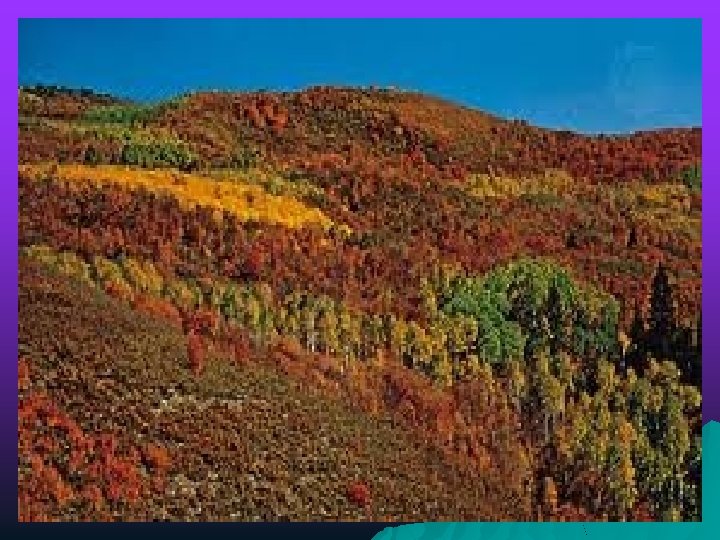
Temperate Deciduous Forest u u The temperate deciduous forest is found in the north east and the east coast, like North Carolina, NY, New England, and they are famous for their autumn color leaves. The trees turn red, yellow, orange before their leaves fall. They shed their leaves each year. There is moderate temperature and moderate rainfall. Every continent except for Africa and Antarctica has deciduous forest. Warm temperatures in spring and summer, cold temperatures in fall and winter. Oak, maple and hickories trees grow here. Mosses, lichens, and ferns grow beneath the shrubs. Rabbits, snakes, squirrels, deer, skunks, toads, foxes, coyotes, and hawks.
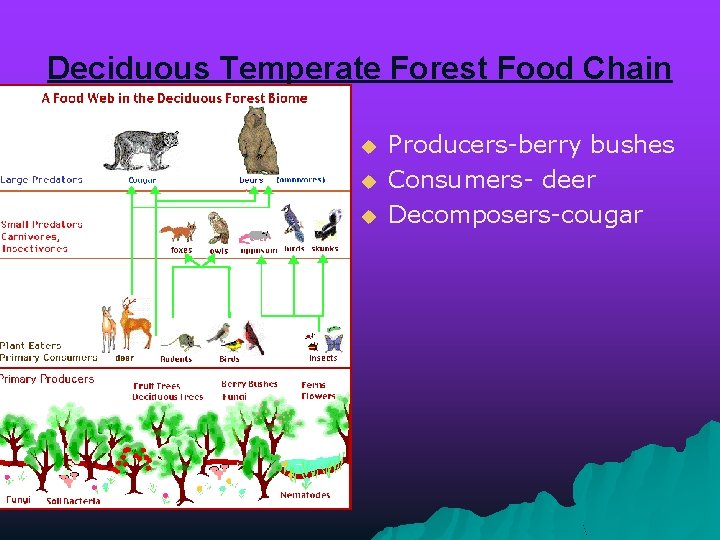
Deciduous Temperate Forest Food Chain u u u Producers-berry bushes Consumers- deer Decomposers-cougar
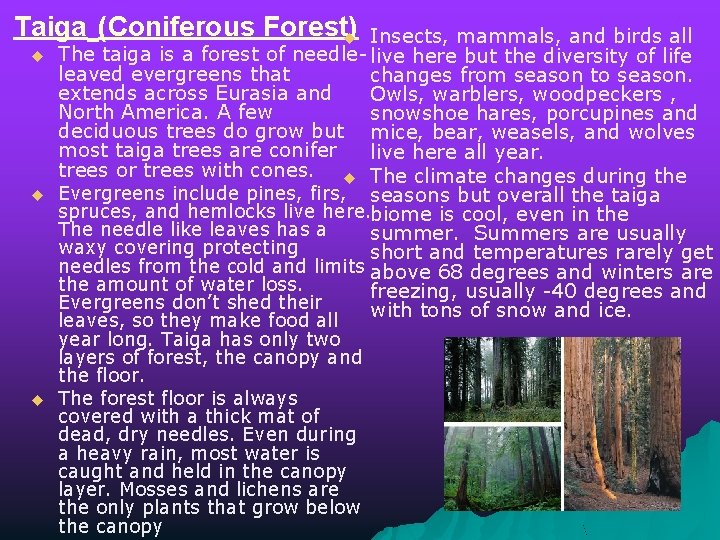
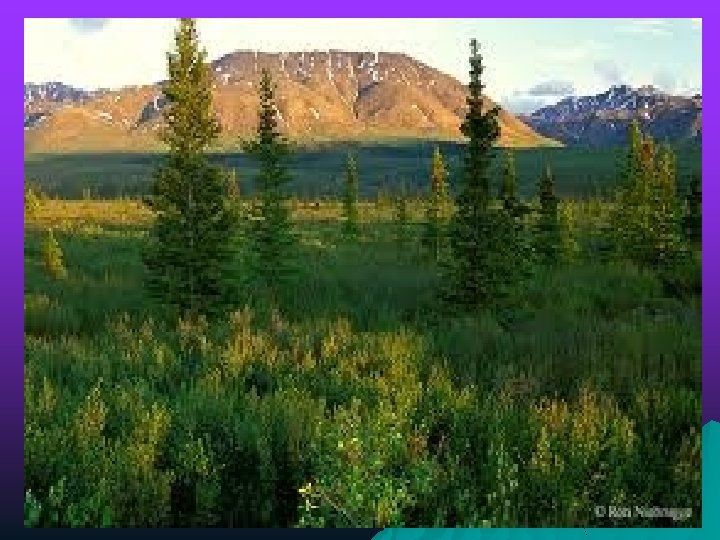
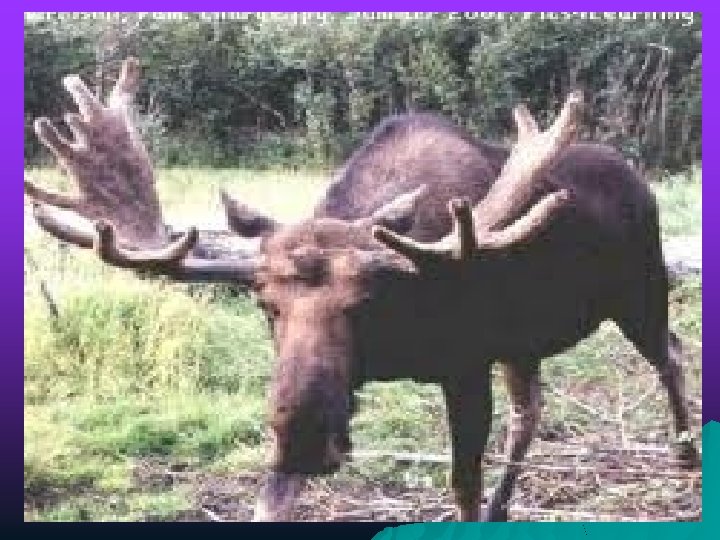
Taiga (Coniferous Forest) u u Insects, mammals, and birds all The taiga is a forest of needle- live here but the diversity of life leaved evergreens that changes from season to season. extends across Eurasia and Owls, warblers, woodpeckers , North America. A few snowshoe hares, porcupines and deciduous trees do grow but mice, bear, weasels, and wolves most taiga trees are conifer live here all year. trees or trees with cones. u The climate changes during the Evergreens include pines, firs, seasons but overall the taiga spruces, and hemlocks live here. biome is cool, even in the The needle like leaves has a summer. Summers are usually waxy covering protecting short and temperatures rarely get needles from the cold and limits above 68 degrees and winters are the amount of water loss. freezing, usually -40 degrees and Evergreens don’t shed their with tons of snow and ice. leaves, so they make food all year long. Taiga has only two layers of forest, the canopy and the floor. The forest floor is always covered with a thick mat of dead, dry needles. Even during a heavy rain, most water is caught and held in the canopy layer. Mosses and lichens are the only plants that grow below the canopy
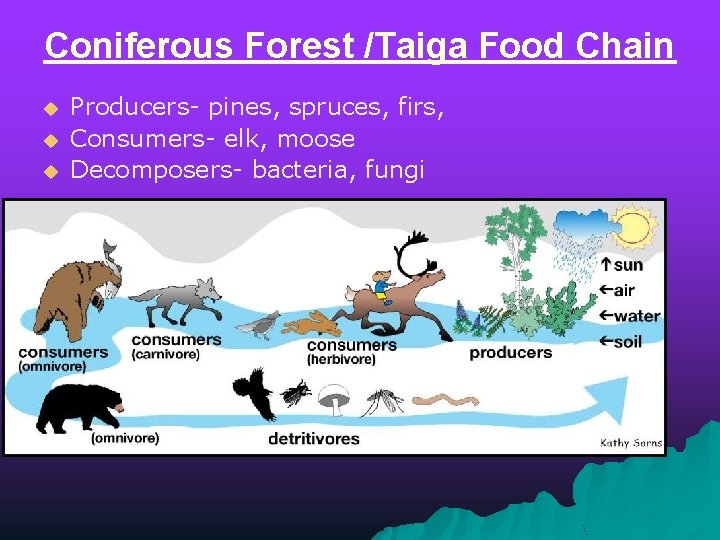
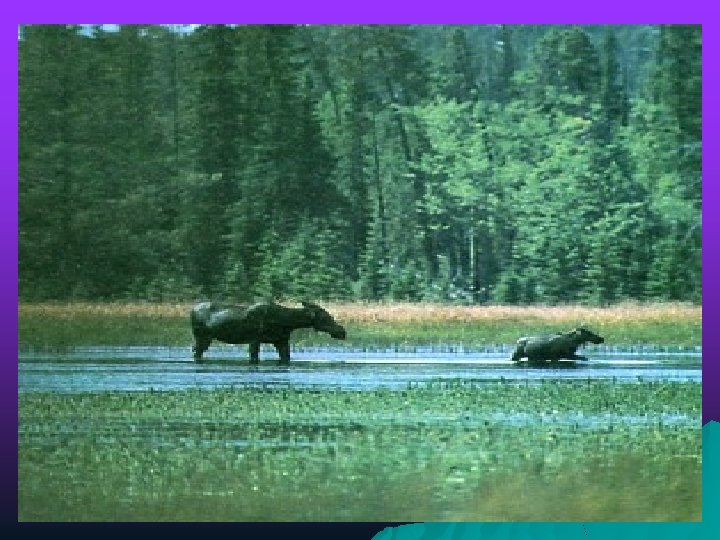
Coniferous Forest /Taiga Food Chain u u u Producers- pines, spruces, firs, Consumers- elk, moose Decomposers- bacteria, fungi
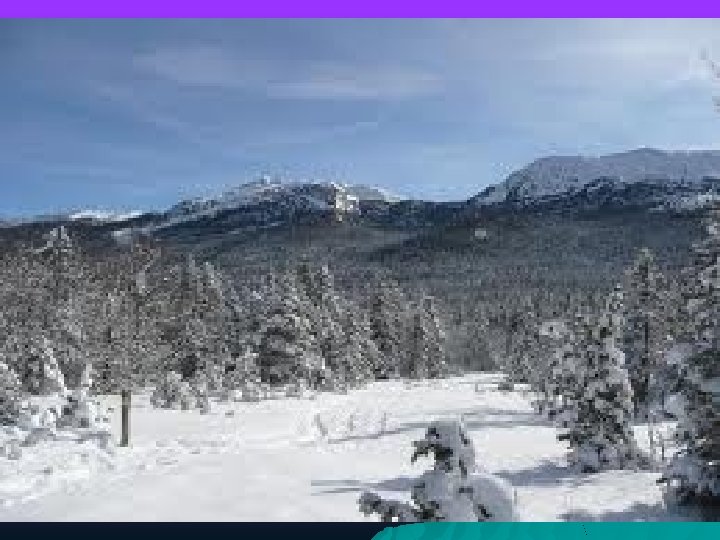
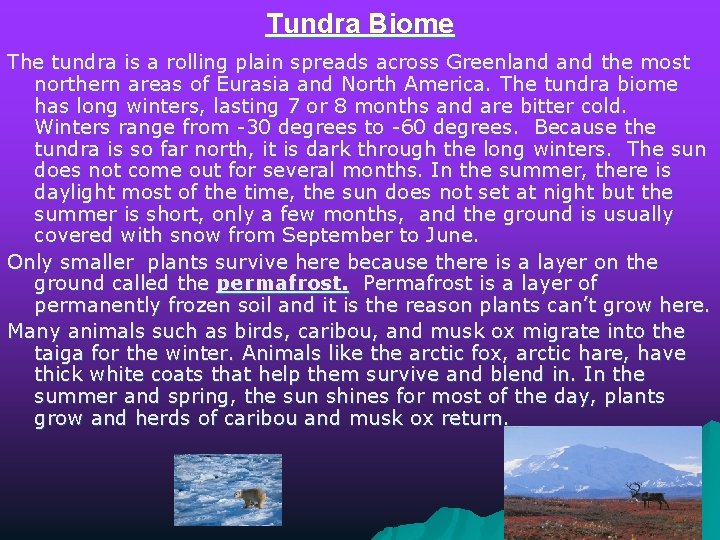
Tundra Biome The tundra is a rolling plain spreads across Greenland the most northern areas of Eurasia and North America. The tundra biome has long winters, lasting 7 or 8 months and are bitter cold. Winters range from -30 degrees to -60 degrees. Because the tundra is so far north, it is dark through the long winters. The sun does not come out for several months. In the summer, there is daylight most of the time, the sun does not set at night but the summer is short, only a few months, and the ground is usually covered with snow from September to June. Only smaller plants survive here because there is a layer on the ground called the permafrost. Permafrost is a layer of permanently frozen soil and it is the reason plants can’t grow here. Many animals such as birds, caribou, and musk ox migrate into the taiga for the winter. Animals like the arctic fox, arctic hare, have thick white coats that help them survive and blend in. In the summer and spring, the sun shines for most of the day, plants grow and herds of caribou and musk ox return.
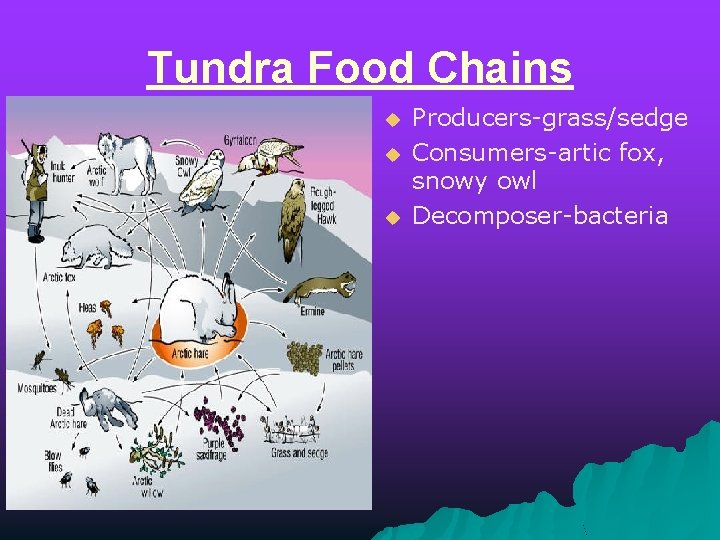
Tundra Food Chains u u u Producers-grass/sedge Consumers-artic fox, snowy owl Decomposer-bacteria
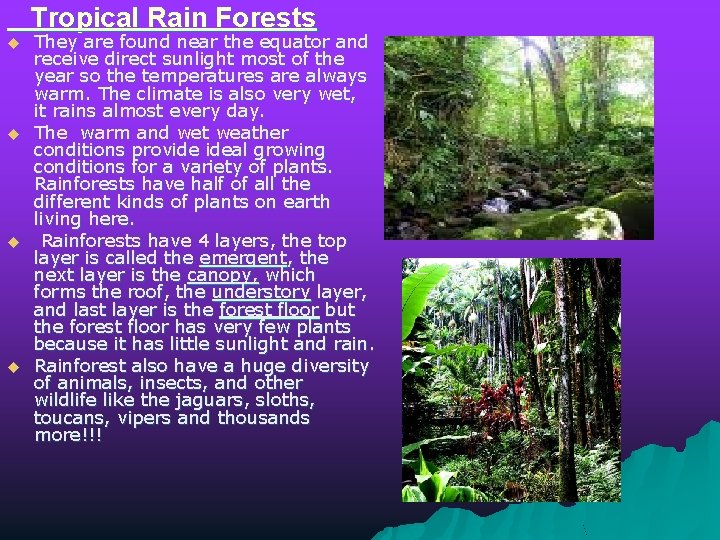
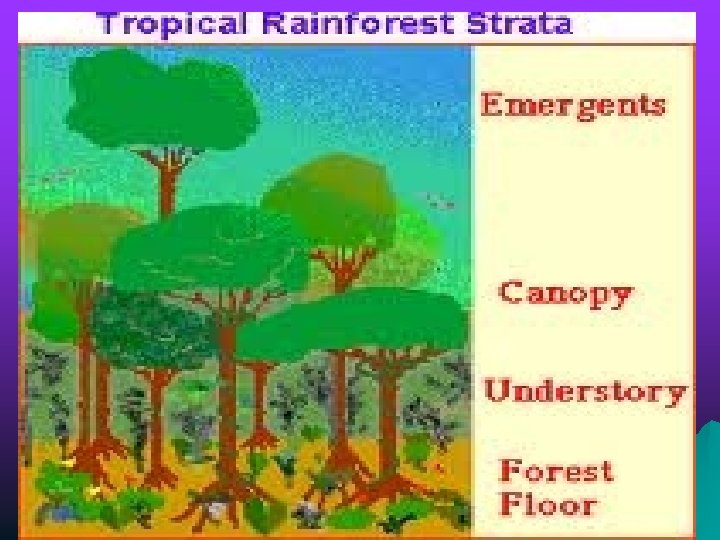
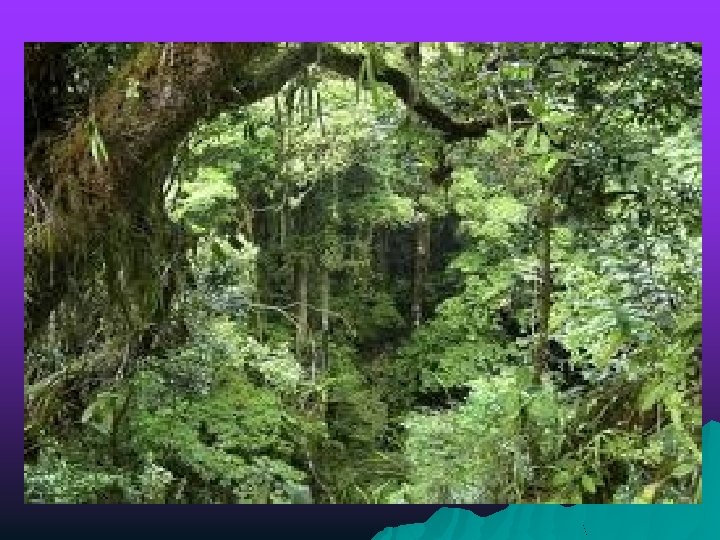
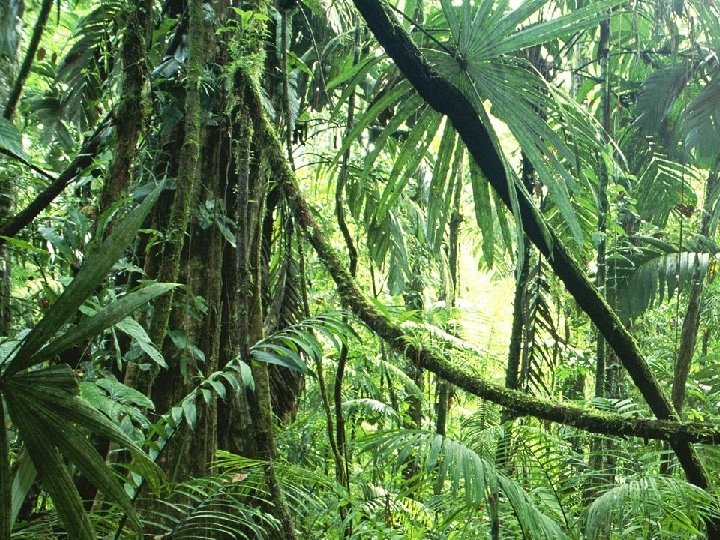
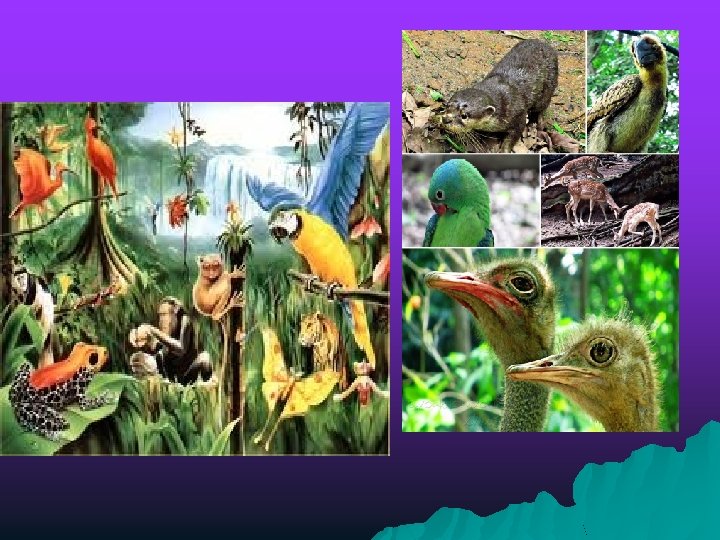
Tropical Rain Forests u u They are found near the equator and receive direct sunlight most of the year so the temperatures are always warm. The climate is also very wet, it rains almost every day. The warm and wet weather conditions provide ideal growing conditions for a variety of plants. Rainforests have half of all the different kinds of plants on earth living here. Rainforests have 4 layers, the top layer is called the emergent, the next layer is the canopy, which forms the roof, the understory layer, and last layer is the forest floor but the forest floor has very few plants because it has little sunlight and rain. Rainforest also have a huge diversity of animals, insects, and other wildlife like the jaguars, sloths, toucans, vipers and thousands more!!!
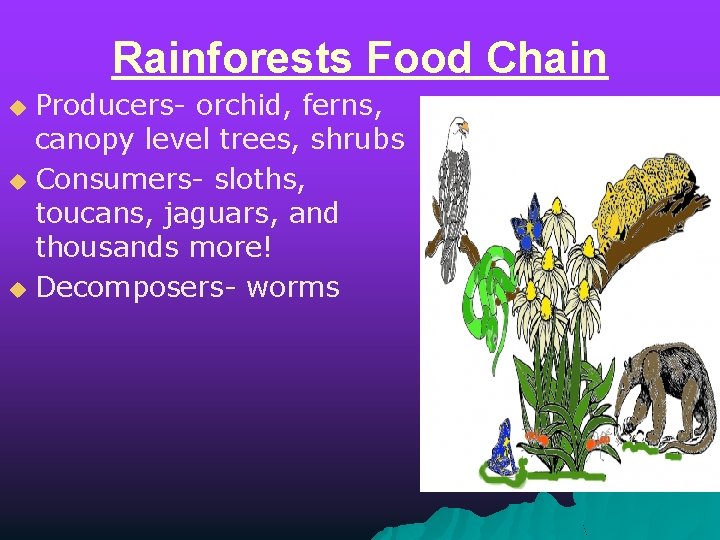
Rainforests Food Chain Producers- orchid, ferns, canopy level trees, shrubs u Consumers- sloths, toucans, jaguars, and thousands more! u Decomposers- worms u
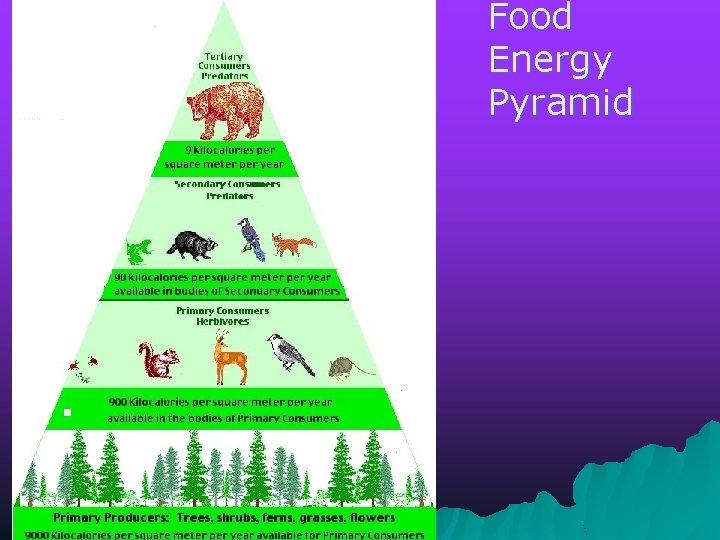
Food Energy Pyramid
3 types of forest u u u 1. Temperate forest contain trees that lose their leaves each fall. They also have animals such as bears, rabbits, snakes, and owls. Plants such as ferns and mosses. EX: North Carolina, Virginia, Similar to deciduous forest 2. Coniferous (conifer)(TAIGA FOREST are in areas in the taiga biome that have colder temperatures. They contain pine trees (trees with cones) and animals like elk, moose, beavers, and wolves Ex: cold places in the north, Alaska, Maine 3. Tropical forest- are forest found near the equator and are usually warm year around.
Practice Questions for biomes and water 1. Which factor do forest and grassland ecosystems most likely have in common? u a. the type of climate u b. the amount of trees u c. the soil composition u d. the variety in organisms
2. Which are the most common ecosystems in North Carolina? u a. estuary, grassland, rainforest u b. grassland, ocean, temperate forest u c. deciduous forest, estuary, ocean d. deciduous forest, ocean, desert
3. Which terrestrial ecosystem has warm, humid conditions and a large variety of plants and animals? u a. estuary u b. grassland u c. deciduous forest u d. tropical rainforest
4. The American grasslands are home to which types of animals? u a. elephants, lions, and zebras u b. foxes, prairie dogs, and rabbits u c. lizards, tortoises, and weasels u d. wolves, deer, and bears
5. Which best describes a freshwater ecosystem? u a. an ocean environment with living organisms u b. an inland water environment with no living organisms u c. an ocean environment with living organisms and nonliving parts u d. an inland water environment with living organisms and nonliving parts
6. Which can be concluded about the trees that grow in a temperate deciduous forest? u a. The trees require constant direct sunlight to survive. u b. The trees grow only during the warm months of the year. u c. The trees have adapted to survive the change of seasons. u d. The trees are unable to grow in climates that have constant rainfall.
u u u 7. . Compared to the large number of plant species found in a forest ecosystem, which best explains why a desert ecosystem is unable to support a greater variety of plants? a. A desert ecosystem is located too high above sea level for most plants to grow. b. here are fewer animals in a desert, which decreases the need for large varieties of plants. c. There is not enough space available in a desert ecosystem for some plant varieties to grow. d. Most plants that live in a desert ecosystem must be able to conserve water for long periods of time.
u 8. Which marine ecosystem would be best for organisms that can adapt to both salt water and fresh water? u a. estuary u b. pond u c. lake u d. river
u 9. Which type of ecosystem best removes pollutants from water? u a. estuary u b. pond u c. lake u d. river
10. Which could be a challenge for a small animal living in a grassland ecosystem? u a. The frozen ground is too hard to serve as shelter. u b. The flat terrain makes it easy for predators to spot prey. u c. The extreme temperatures require thick skin and heavy fur. u d. The high amounts of precipitation create excess water resources u
u 11. Which lists animals that live in an aquatic ecosystem? u a. black bear, deer c. prairie dogs, bison, grasshoppers u b. prairie dogs, bison, grasshoppers d. ducks, turtles, amphibians
u 12. In what type of ecosystem would you expect to find the most species? u a. desert u b. taiga u c. tundra u d. tropical rainforest
u 13. This biome includes needle- leaved evergreens trees, two layers of forest, the canopy and the forest floor, and the animals migrate in the winter. u a. grassland u B. rain forest u c. . tundra u d. taiga
14. Why do more animals live in warm, wet ecosystems than in cold, dry ones? u a. only animals with a special adaptations can live in very cold places u b. only animals with special adaptations can live near water u c. all animals can live in warm, wet ecosystems u d. No animals can live in cold or dry ecosystems u
15. Which is one major difference between a tropical rain forest and a deciduous forest? a. A tropical rain forest is larger in area than a deciduous forest. u b. A tropical rain forest receives more sunlight than a deciduous forest. u c. A tropical rain forest receives more annual rainfall than a deciduous forest. u d. A tropical rain forest has a greater number of rivers than a deciduous forest. u
Short Answer Questions: 16. What is permafrost? 17. Describe two behaviors/adaptations that animals have in the tundra or taiga biome. 18. Describe what unique features the plants have in the desert biome. 19. What biome has 24 hours of daylight in the summer and 24 hours of night time in the winter? 20. Describe the difference between a biome and an ecosystem 21. Describe the difference between a population and a community 22. Name the 3 kinds of forest
Abiotic and Biotic parts Abiotic parts are the nonliving parts of an ecosystem such as soil, the climate, and the amount of rainfall an area receives, air, sticks, gravel, etc. u Biotic parts are ALL the living parts of an ecosystem such as plants, trees, flowers, birds, and all other animals, insects, and creatures that exist. u
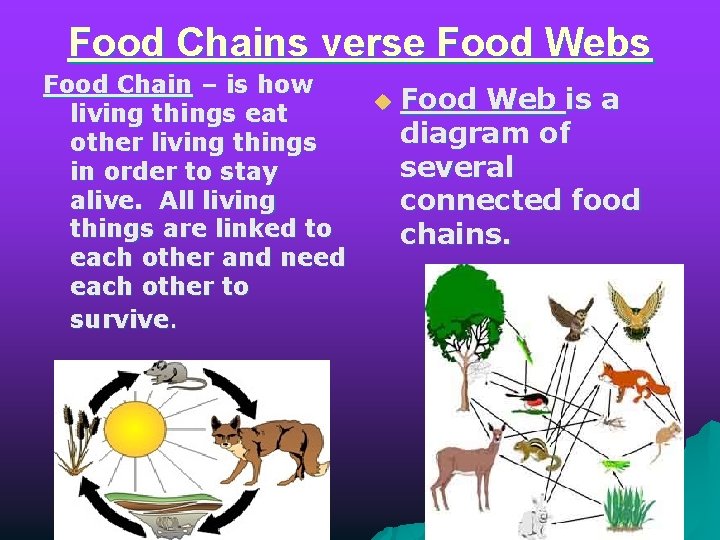
Food Chains verse Food Webs Food Chain – is how living things eat other living things in order to stay alive. All living things are linked to each other and need each other to survive. u Food Web is a diagram of several connected food chains.
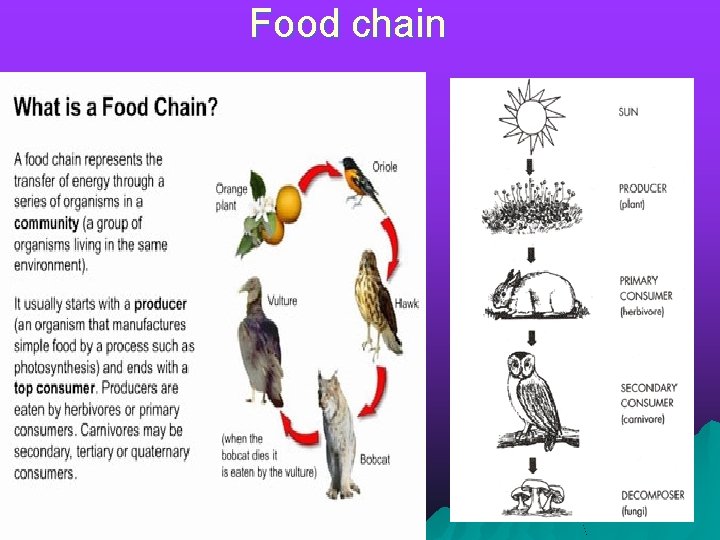
Food chain
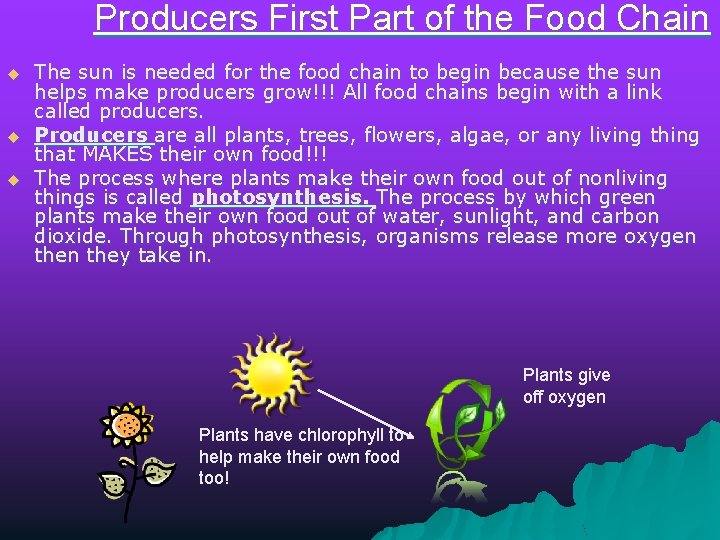
Producers First Part of the Food Chain u u u The sun is needed for the food chain to begin because the sun helps make producers grow!!! All food chains begin with a link called producers. Producers are all plants, trees, flowers, algae, or any living that MAKES their own food!!! The process where plants make their own food out of nonliving things is called photosynthesis. The process by which green plants make their own food out of water, sunlight, and carbon dioxide. Through photosynthesis, organisms release more oxygen they take in. Plants give off oxygen Plants have chlorophyll to help make their own food too!
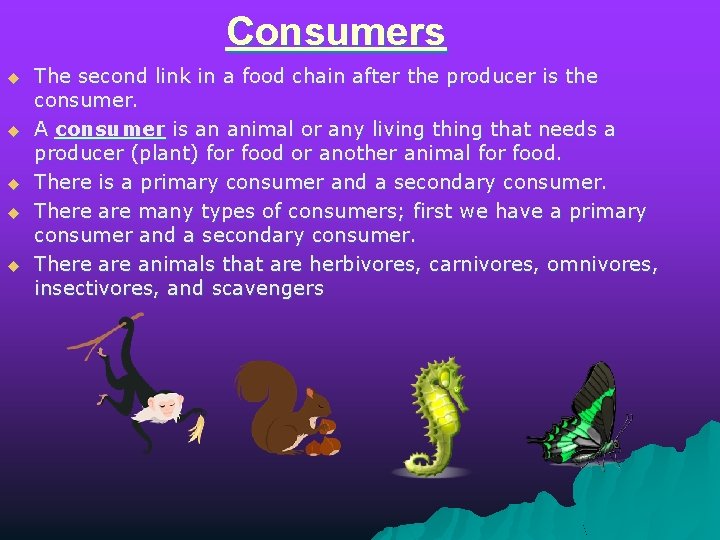
Consumers u u u The second link in a food chain after the producer is the consumer. A consumer is an animal or any living that needs a producer (plant) for food or another animal for food. There is a primary consumer and a secondary consumer. There are many types of consumers; first we have a primary consumer and a secondary consumer. There animals that are herbivores, carnivores, omnivores, insectivores, and scavengers
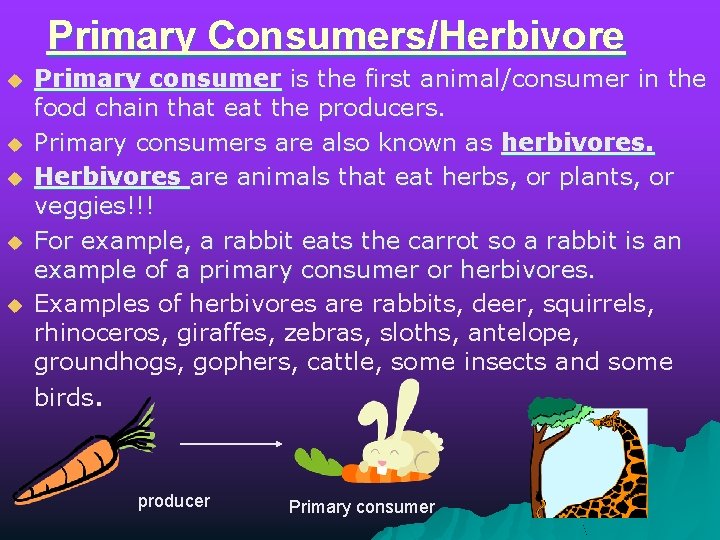
Primary Consumers/Herbivore u u u Primary consumer is the first animal/consumer in the food chain that eat the producers. Primary consumers are also known as herbivores. Herbivores are animals that eat herbs, or plants, or veggies!!! For example, a rabbit eats the carrot so a rabbit is an example of a primary consumer or herbivores. Examples of herbivores are rabbits, deer, squirrels, rhinoceros, giraffes, zebras, sloths, antelope, groundhogs, gophers, cattle, some insects and some birds. producer Primary consumer
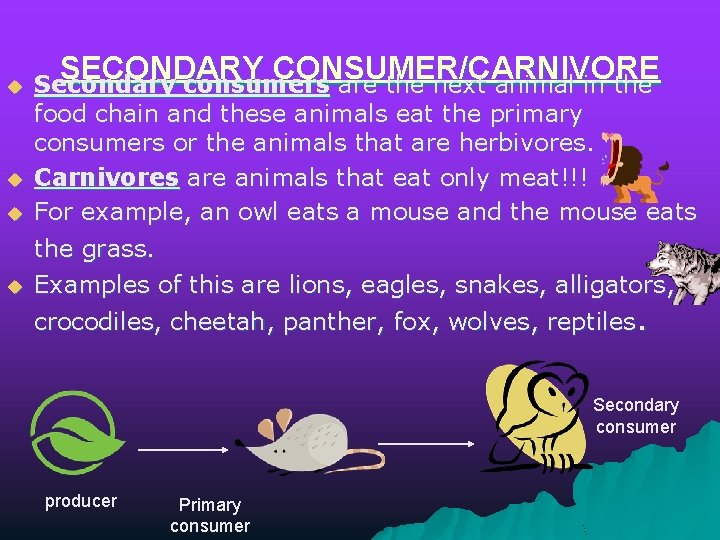
SECONDARY CONSUMER/CARNIVORE u Secondary consumers are the next animal in the u u u food chain and these animals eat the primary consumers or the animals that are herbivores. Carnivores are animals that eat only meat!!! For example, an owl eats a mouse and the mouse eats the grass. Examples of this are lions, eagles, snakes, alligators, crocodiles, cheetah, panther, fox, wolves, reptiles. Secondary consumer producer Primary consumer
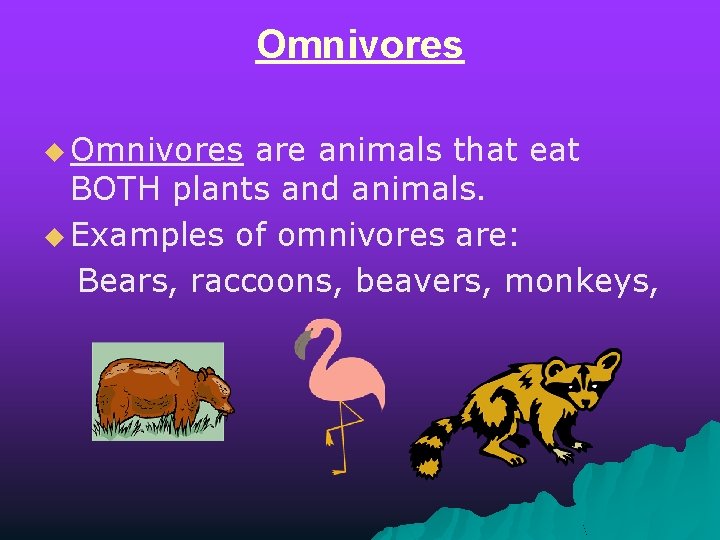
Omnivores u Omnivores are animals that eat BOTH plants and animals. u Examples of omnivores are: Bears, raccoons, beavers, monkeys,
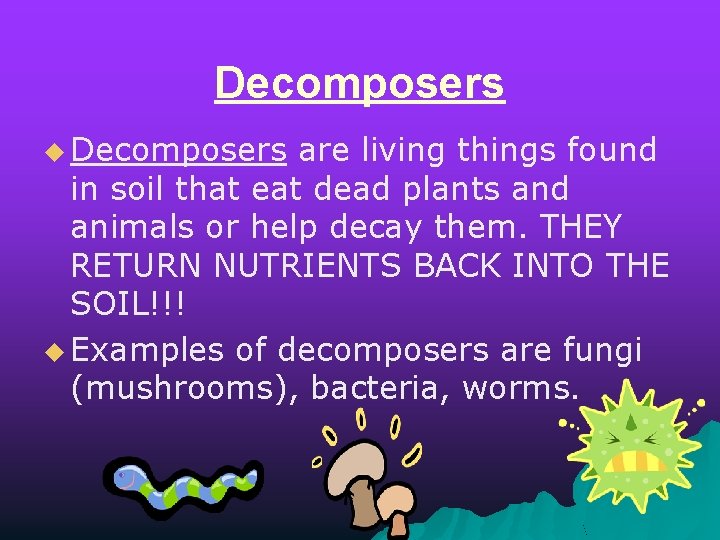
Decomposers u Decomposers are living things found in soil that eat dead plants and animals or help decay them. THEY RETURN NUTRIENTS BACK INTO THE SOIL!!! u Examples of decomposers are fungi (mushrooms), bacteria, worms.
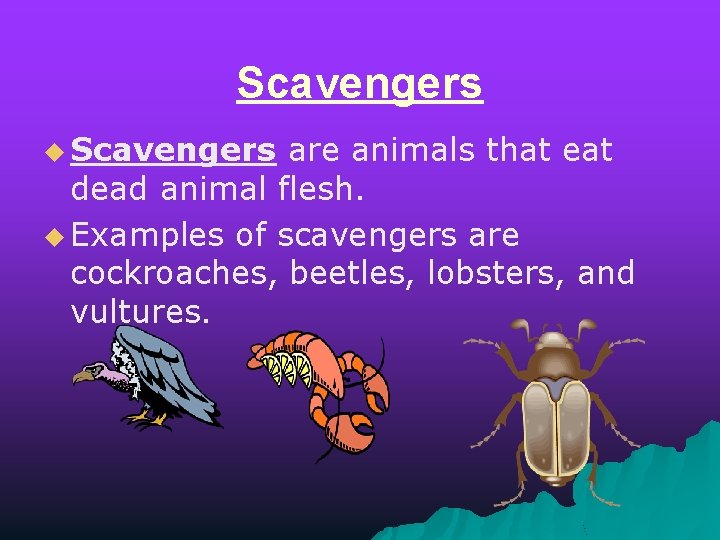
Scavengers u Scavengers are animals that eat dead animal flesh. u Examples of scavengers are cockroaches, beetles, lobsters, and vultures.
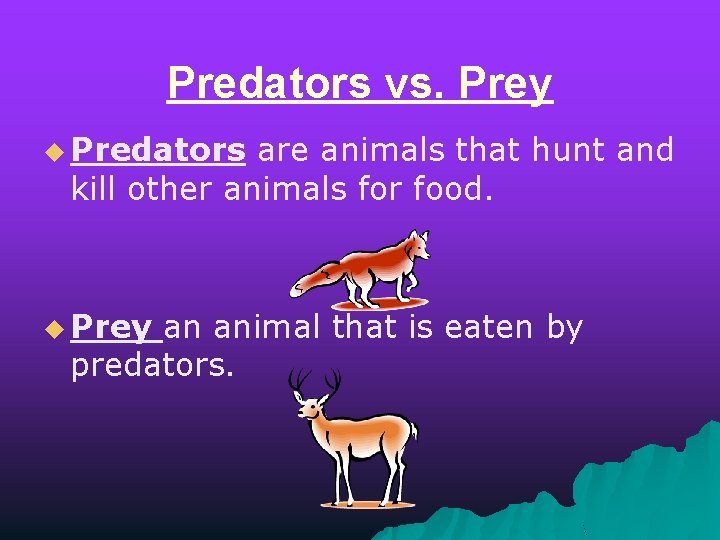
Predators vs. Prey u Predators are animals that hunt and kill other animals for food. u Prey an animal that is eaten by predators.
Niche Many different animals or populations can share the same habitat u Each animal has a certain role or job that it does in its own environment. This is called a niche. u For example, owls and eagles share the same habitat and they share the same food source but the owls hunts at night and the eagle hunts for its food in during the day. u Because of their different hunting habits, that means they both have different niches!!! u
Competition u Sometimes different populations occupy the same niche. When this happens, the populations compete for each other for resources such as food, water, shelter. Often one population will become more efficient at finding and using these resources than others. Eventually the weaker population will die out or move to a new area. Two populations can live together if they have partially overlapping niches.
Limiting Factors: u In many ways, the amount of sunlight, temperature, and soil composition determine the number of organisms that an ecosystem can support. These nonliving resources are called limiting factors because they limit the number of organisms that live in an ecosystem. u For example, a cactus plant have adaptations for living in the desert. They don’t need much rain and they can survive in sandy, dry soil. But the shallow roots of a cactus plants allows water to be absorbed quickly.
Limiting Factors in an Ecosystem u LIGHT: The sun provides energy for all living things and the amount of sunlight an ecosystem receives affects the types of organisms that live in it. Very few organisms can survive without sunlight, that’s why there are barely any plants or animals that live on the ocean floor. u Temperature: this is important because most organisms can carry out their body functions, such as digestion, only in certain temperatures. So if an area is extremely cold or hot, you will find only organisms with special adaptations to live there. u Soil Composition (what the soil is made up of): soil plays a large role in ecosystems ability to support life. Plants need nutrients, water, and sunlight in order to live and plants gets nutrients from soil so the composition of the soil affects what types of plants can grow in it. If the soil does not contain many nutrients, fewer plants will be able to survive. In turn, fewer herbivores, which depend on the plants for food will be able to survive. Omnivores and carnivores will be affected too!!!
1. Which is the term for secondary consumers in an ecosystem? u A. carnivore u B. herbivore u C. omnivore u D. producer
2. Which best describes the producers of an ecosystem? u A. They provide food to herbivores. u B. They provide hydrogen to the atmosphere. u C. They provide food to decomposers. u D. They provide carbon dioxide to the atmosphere.
3. Which organisms directly use light energy from the sun to obtain food? u A. carnivore u B. producer u C. consumer u D. decomposer
4. In a food web, how are consumers most often described? u. A. by their size u. B. by their color u. C. by the food they eat u. D. by the way they move
5. Which best explains how producers make their own food? u u A. Producers receive energy from rain and use it to produce water for their food. B. Producers receive energy from rain and use it to produce gases for their food. C. Producers receive energy from the sun and use it to produce water for their food. D. Producers receive energy from the sun and produce sugars for their food.
6. Which organism receives its energy from the sun? u A. a bee u B. a cat u C. a tree u D. a grasshopper
7. Which will most likely increase the rate of decomposition of dead plants and animals? A. a decrease in temperature u B. a decrease in the number of decomposers u C. an increase in the amount of moisture in the air u D. an increase in the amount of carbon dioxide in the air
8. Which organism would be eaten last in a food chain? u A. producer u B. decomposer u C. first level consumer u D. second level consumer
9. Which is a consumer that only eats producers? u A. bird u B. snail u C. grass u D. mushroom
10. Where are producers located on the food chain? u A. At the beginning, because they create their own food. u B. In the center, because every organism relies on producers. u C. At the end, because they rely on other organisms for energy. u D. Their position changes depending on what they are eating at that time.
11. Which group includes only decomposers? A. spider, fungi, and grass B. ladybug, spider, and deer C. sunflower, tree, and grass D. fungi, bacteria, and worms
12. What type of organisms are responsible for recycling the remains of a dead plant or animal to the soil? A. producers B. consumers C. herbivores D. decomposers
13. Which best explains the function of producers in a forest ecosystem? A. Producers provide energy for consumers in the ecosystem. B. Producers provide energy for decomposers in the ecosystem. C. Producers provide energy for other producers in the ecosystem. D. Producers provide energy for consumers and other producers in the ecosystem.
15. How is a deer in a forest ecosystem most similar to a rabbit in the same ecosystem? A. Both are decomposers B. Both are consumers. C. Both are carnivores. D. Both are producers.
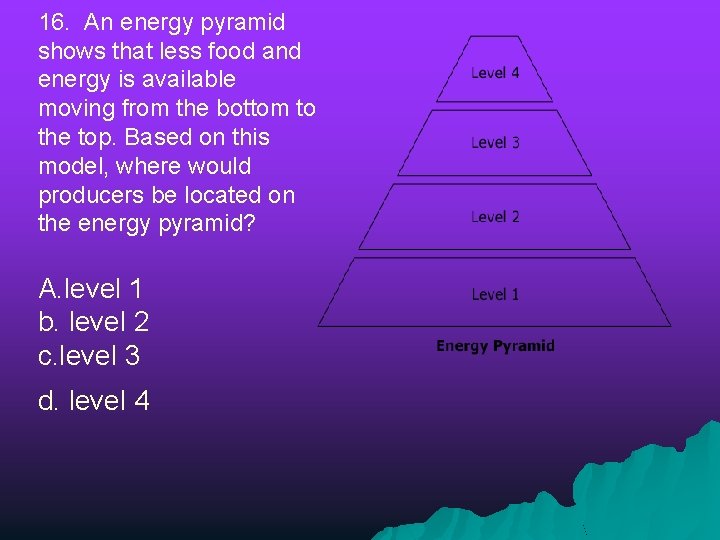
16. An energy pyramid shows that less food and energy is available moving from the bottom to the top. Based on this model, where would producers be located on the energy pyramid? A. level 1 b. level 2 c. level 3 d. level 4
17. How are consumers generally classified? A. by the amount of food they eat B. by the size of their tracks C. by the type of food they eat D. by the way they digest their food
18. Which best describes the result if the number of lilypads in a pond ecosystem increases? A. Consumers of the lilypads would increase because of a larger food source. B. The lilypads would prevent fish from absorbing the sun’s energy. C. Consumers of the lilypads would decrease because of increased competition. D. The lilypads would use the oxygen in the air, which would lower the number of consumers.
18. Which best explains why predators need other animals within an ecosystem? A. They depend on them for food. B. They depend on them for water. C. They depend on them for protection. D. They depend on them for competition.
19. An ecologist makes the following observations in her journal: drinks at 7: 00 a. m. sleeps from 8: 30 a. m. to 9: 00 a. m. eats at 10: 00 a. m. sleeps 11: 00 a. m. until noon Which is she describing? A. the niche of an organism B. the habitat of an organism C. the community of an organism D. the relationships between organisms
20. Which list best shows how energy moves through a food chain? u a. cows – grass – people u b. people – grass – cows u c. people – cows – grass u d. grass – cows – people
21. When a fox catches and eats a mouse, it gives energy from the mouse to survive. Where did this energy originally come form? u a. the atmosphere u b. the mouse’s parents u c. the Sun u d. water
22. In a food chain, the sun provides energy for a tree to grow. A deer eats leaves from the tree. After the deer dies, its body is partially eaten by a coyote. Which is the first-level consumer (primary consumer)? u a. the sun u b. the deer u c. the coyote u d. the coyote
23. Which best describes both mushrooms and worms in their ecosystems? u a. They both provide food for carnivores u b. They both provide nutrients for the soil. u c. They both provide food for herbivores. u d. They both provide nutrients during photosynthesis
24. Koala bears eat very little other than eucalyptus leaves. Which would most likely happen if this food source were destroyed? u a. Koalas would become extinct c. Koalas would find a new food source. u b. Koalas would find a new food source. d. Koalas would migrate to another area.
25. Which explains why no two populations have the same roles in an ecosystem? u a. Populations would reproduce c. Populations would become extinct. u b. Populations are not identical. d. Populations would change due to competition.
Short Answer 26. Explain the role of a niche? 27. Explain how carnivores and omnivores are alike and different? 28. Explain what would happen if all the producers in a forest died.
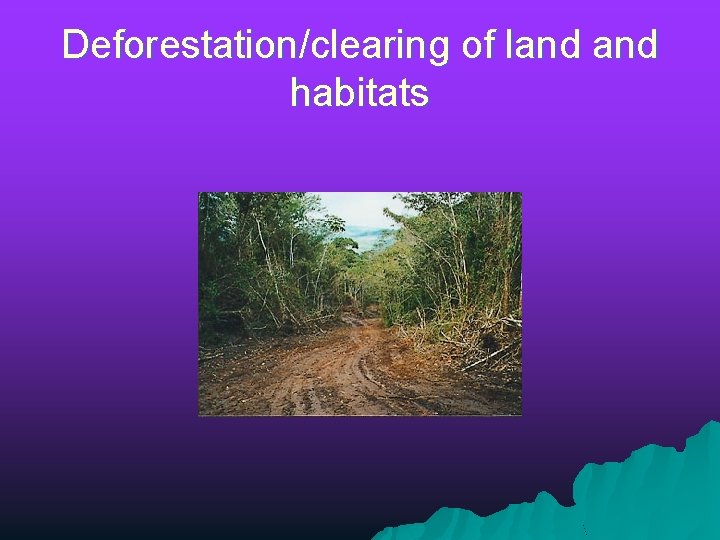
Deforestation/clearing of land habitats
Humans and Environmental Changes u u u There are many reasons why there is a decrease in animal population. Some are killed by natural causes like flood, fires, or droughts (which is when the land is dried up because of lack of rain). But most animals die due to human activity like hunting, pollution, building/deforestation Deforestation is the cutting down of trees and this kills many organisms because the trees were used for food, shelter, and the soils nutrients which help plants grow. Humans use trees for lumber, food, and paper product. Increased Nutrients: Humans use fertilizers, which are nutrients for the soil on farms and gardens. These fertilizers often run off into nearby water sources when it rains. The increase of nutrients can harm nearby ecosystems by causing too many organisms to grow. One type of plant may take over an area and as a result other plants die out. Then organisms that eat the other plants will be affected because their food source has been lost!
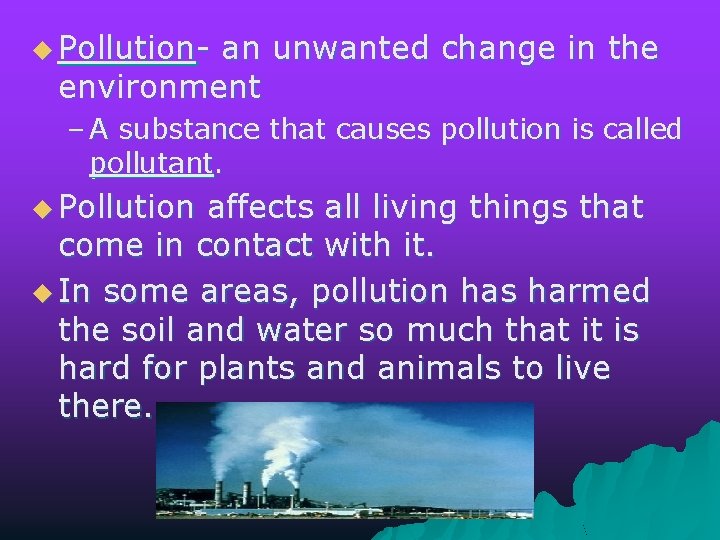
u Pollution- an unwanted change in the environment – A substance that causes pollution is called pollutant. u Pollution affects all living things that come in contact with it. u In some areas, pollution has harmed the soil and water so much that it is hard for plants and animals to live there.
u u Increased Nutrients • What happens if there are Nutrients flow through an ecosystem by natural cycles. Plants take up nutrients in the soil or water, and the nutrients cycle through many organisms as energy flows through a food chain. Eventually, as organisms die, nutrients are returned to the soil. too many nutrients in the soil or water? • You may think that if there are more nutrients in an area that more organisms can survive. • Unfortunately, too many nutrients in an ecosystem can actually cause harm.
Fertilizers u Fertilizers- nutrients for the soil – Used on farms, golf courses, and gardens These fertilizers often run off into nearby water sources when it rains. u This increase of nutrients can harm nearby ecosystems by causing too many organisms to grow. u One type of plant may take over an area and, as a result, other plants die out. u Then, the organisms that eat the other plants will be affected because their food source has been lost. u
Endangered Species: Endangered species are like fire alarms. They tell us about problems in our home we call Earth. If we listen to their alarm calls, they could help us improve our lives and the health of our planet. u Endangered species is a species of plant or animal that is in immediate danger of becoming extinct and needs protection to survive. u Threatened : A species is likely to become endangered if it is not protected u Extinct : A species of plant or animal that is no longer living. u
Ways That Species Become Endangered u u u u 1. Habitat loss or reduction from deforestation and destroying habitats 2. illegal killing or hunting to sell products/fur 3. Pesticides and fertilizers, pollution and burning of fossil fuels (gas) to produce energy, littering in oceans 4. Competition with other species, loss of food and resources, 5. Disease 6. Predation, the increase of predators in an ecosystem 7. Climate change, temperatures are warmer and ice caps melting ****When an animal is endangered that means that all living things are affected in the food chain because they depend on each other for survival. Endangered species show us that our world may not be as healthy as we think.
What can you do to help endangered species? u u u u 1. Learn as much as you can about endangered species in your area 2. Don’t pollute animals habitats 3. Don’t destroy animals habitats, be careful of forest fires 4. Don’t buy species illegally taken from the wild 5. Don’t buy products made from threatened or endangered species. 6. Recycle paper to prevent deforestation and other products ****The most hope for endangered species lies in the hands of young people like you who care enough to make a difference.
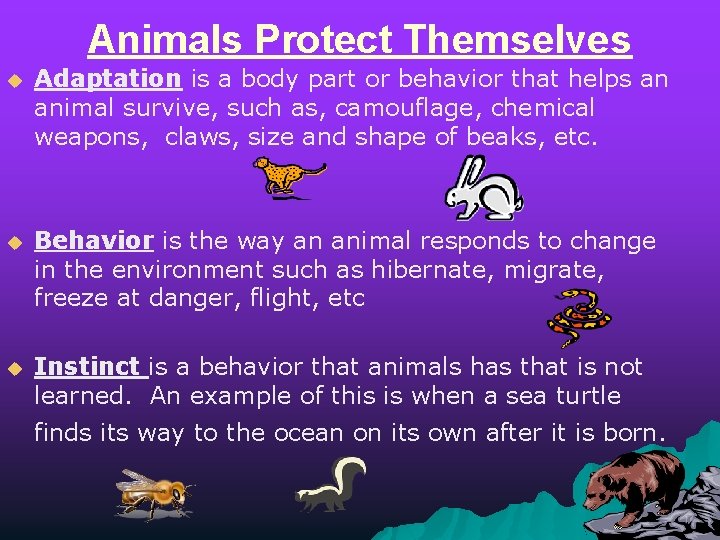
Animals Protect Themselves u Adaptation is a body part or behavior that helps an animal survive, such as, camouflage, chemical weapons, claws, size and shape of beaks, etc. u Behavior is the way an animal responds to change in the environment such as hibernate, migrate, freeze at danger, flight, etc u Instinct is a behavior that animals has that is not learned. An example of this is when a sea turtle finds its way to the ocean on its own after it is born.
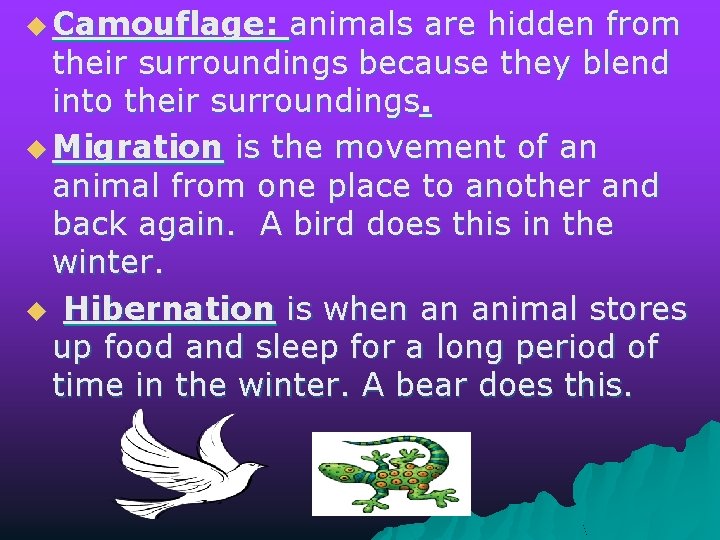
u Camouflage: animals are hidden from their surroundings because they blend into their surroundings. u Migration is the movement of an animal from one place to another and back again. A bird does this in the winter. u Hibernation is when an animal stores up food and sleep for a long period of time in the winter. A bear does this.
Chemical weapons: sprays and stingers are poisonous and can act as a powerful weapon. u Flight: having the ability to run fast helps animals get away from predators.
1. Which is one way people often destroy animal habitats? A. by building new homes B. by recycling waste products C. by producing new energy sources D. by creating new varieties of plants
2. Which would most likely happen if all the soil in an ecosystem washed away? A. Most of the plants would die. B. Most of the plants would grow in rocks. C. All animals would become carnivores. D. All animals and plants would relocate.
3. Koala bears eat very little other than eucalyptus leaves. Which would most likely happen if this food source were destroyed? A. Koalas may become extinct. B. Koalas may become carnivores. C. Koalas may remain in the area. D. Koalas may change their mating season.
4. The average temperatures rise in an area, making a lake get warmer and warmer. This makes it impossible for plankton to survive in the lake. Which is the most likely result? A. The organisms that eat plankton will begin finding different food sources. B. The plankton will quickly adapt and be able to survive in the warmer water. C. The plankton will die, but the other organisms in the ecosystem will be unaffected. The food web within the lake will change, and other D. organisms may begin to die.
5. Which would most likely increase the number of squirrels living in an area? A. cutting down trees that serve as habitats for squirrels B. planting trees that produce nuts squirrels do not eat C. reducing the number of animals that hunt and kill squirrels D. removing all of the food sources for squirrels from the area
- Slides: 113