
Thinking about Blended Learning Diana Laurillard The global

Thinking about Blended Learning Diana Laurillard
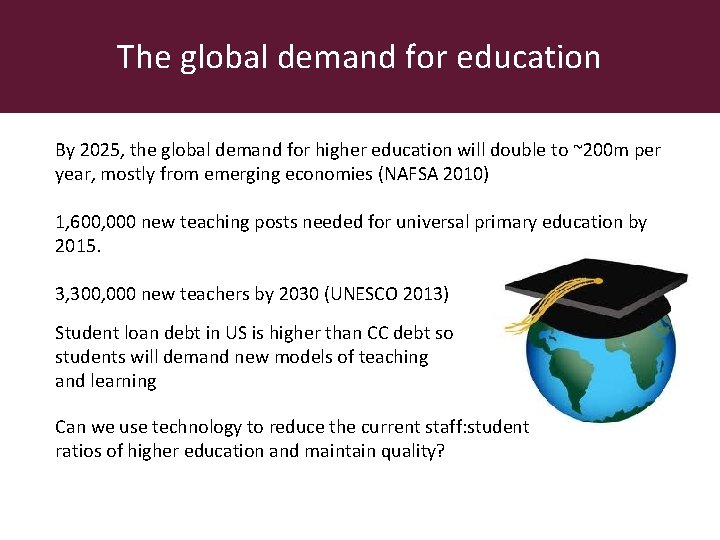
The global demand for education By 2025, the global demand for higher education will double to ~200 m per year, mostly from emerging economies (NAFSA 2010) 1, 600, 000 new teaching posts needed for universal primary education by 2015. 3, 300, 000 new teachers by 2030 (UNESCO 2013) Student loan debt in US is higher than CC debt so students will demand new models of teaching and learning Can we use technology to reduce the current staff: student ratios of higher education and maintain quality?
The overall programme aim From blended to open learning? Internet and ICT in Flemish Higher Education: - the purpose of which is the development of a systemic vision on the optimal exploitation of ICT and internet for the new learning of the 21 st century and to provide an alternative perspective aiming at formulating long term policy objectives.
10 Discussion items on Blended Learning 1. How will blended learning change HE on campus (BA, MA)? 2. Blended learning and the teacher 3. The evaluation, exams and assessment challenge 4. Open and distance learning - Lifelong learning 5. Blended learning and the institution 6. Inter institutional networking (national, European and global) 7. MOOCs 8. Implications for interaction with secondary / primary education 9. Role of government and official bodies 10. Potential for development cooperation
Blended, Online and Open Learning Blended Online Dual mode Open Blends online and f 2 f for campus students Online only, anywhere Blended + equivalent online Online with open entry (OU, MOOCs) • Online learning offers opportunity of high fixed costs and low support costs to improve per-student cost • Teaching costs must be carefully managed and planned • Learning benefits must be designed and evaluated • Technology use should start from problems, not solutions
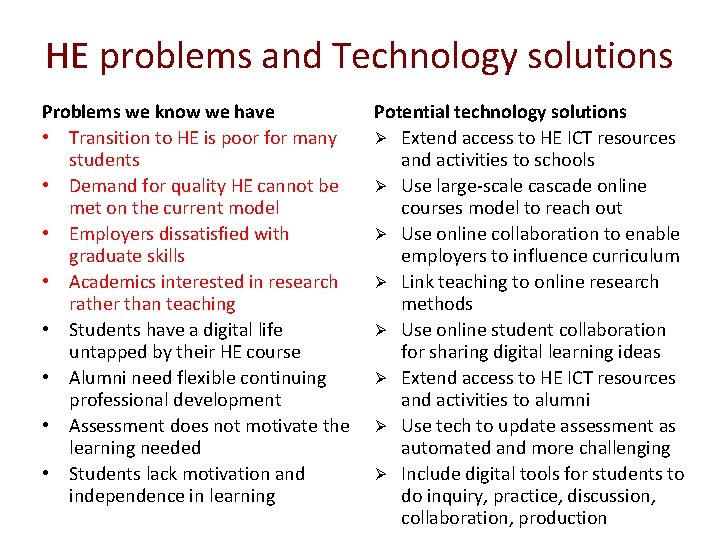
HE problems and Technology solutions Problemswe weknowwe wehave • • Transitionto to. HE HEisispoorfor formany students • • Demandfor forquality. HE HEcannotbe be meton onthe thecurrentmodel • • Employersdissatisfiedwith graduateskills • • Academicsinterestedin inresearch ratherthanteaching • • Studentshaveaadigitallife untappedby bytheir. HE HEcourse • • Alumnineedflexiblecontinuing professionaldevelopment • • Assessmentdoesnot notmotivatethe learningneeded • • Studentslackmotivationand independencein inlearning Potential technology solutions Ø Extend access to HE ICT resources and activities to schools Ø Use large-scale cascade online courses model to reach out Ø Use online collaboration to enable employers to influence curriculum Ø Link teaching to online research methods Ø Use online student collaboration for sharing digital learning ideas Ø Extend access to HE ICT resources and activities to alumni Ø Use tech to update assessment as automated and more challenging Ø Include digital tools for students to do inquiry, practice, discussion, collaboration, production
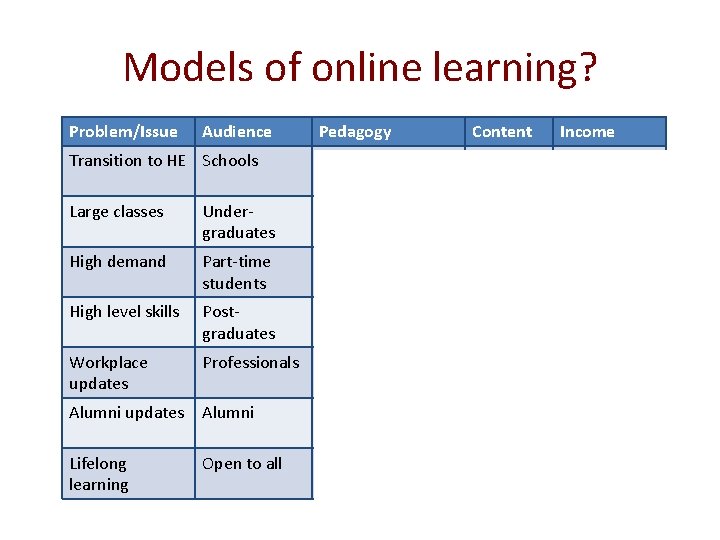
Models of online learning? Problem/Issue Audience Pedagogy Content Income Transition to HE Schools Inquiry Collaborative Repurposed Free Large classes Undergraduates All, pyramid + personal support New Fee + Govt High demand Part-time students All, pyramid + personal support New Fee + Employer High level skills Postgraduates All, high support New Fee + Govt Workplace updates Professionals MOOC, peer support Market driven Fee Alumni updates Alumni MOOC, low support Research driven Fee/Subscrip tion Lifelong learning Open to all MOOC, peer support Repurposed Free
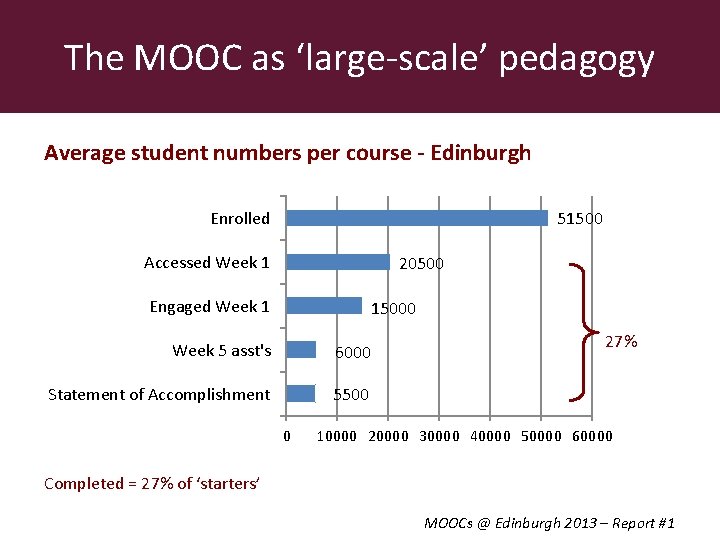
The MOOC as ‘large-scale’ pedagogy Average student numbers per course - Edinburgh Enrolled 51500 Accessed Week 1 20500 Engaged Week 1 15000 Week 5 asst's 6000 Statement of Accomplishment 5500 0 27% 10000 20000 30000 40000 50000 60000 Completed = 27% of ‘starters’ MOOCs @ Edinburgh 2013 – Report #1
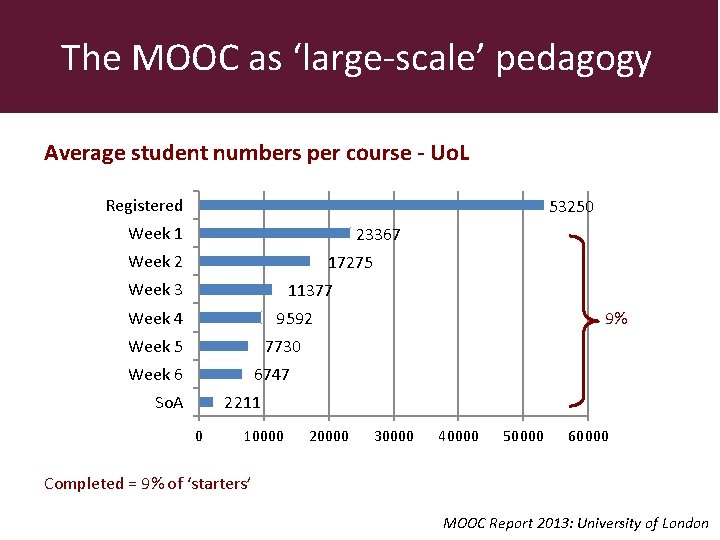
The MOOC as ‘large-scale’ pedagogy Average student numbers per course - Uo. L Registered 53250 Week 1 23367 Week 2 17275 Week 3 11377 Week 4 9592 Week 5 9% 7730 Week 6 6747 2211 So. A 0 10000 20000 30000 40000 50000 60000 Completed = 9% of ‘starters’ MOOC Report 2013: University of London
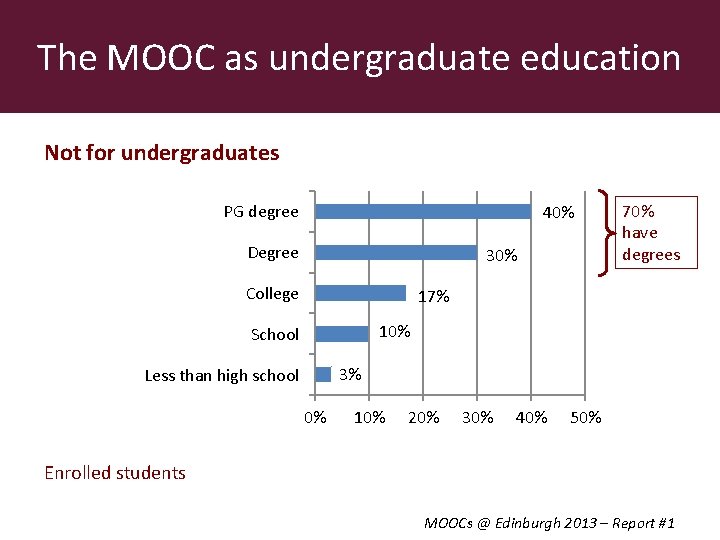
The MOOC as undergraduate education Not for undergraduates PG degree 40% Degree 30% College 70% have degrees 17% 10% School 3% Less than high school 0% 10% 20% 30% 40% 50% Enrolled students MOOCs @ Edinburgh 2013 – Report #1
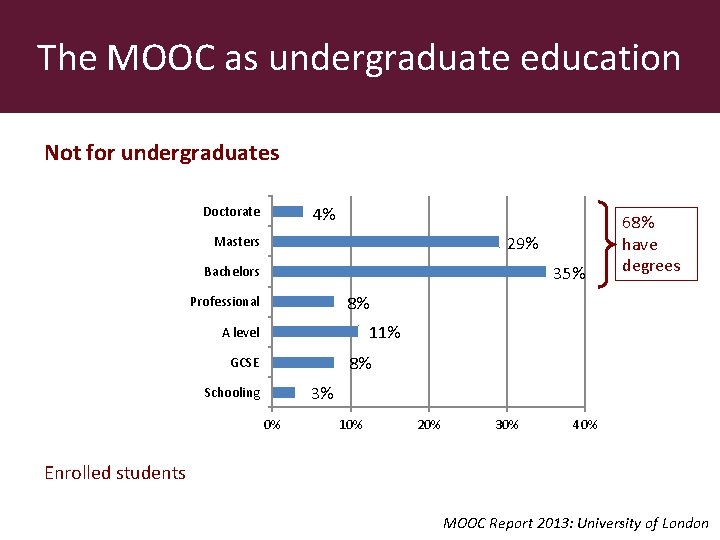
The MOOC as undergraduate education Not for undergraduates Doctorate 4% 29% Masters 35% Bachelors 68% have degrees 8% Professional 11% A level 8% GCSE 3% Schooling 0% 10% 20% 30% 40% Enrolled students MOOC Report 2013: University of London
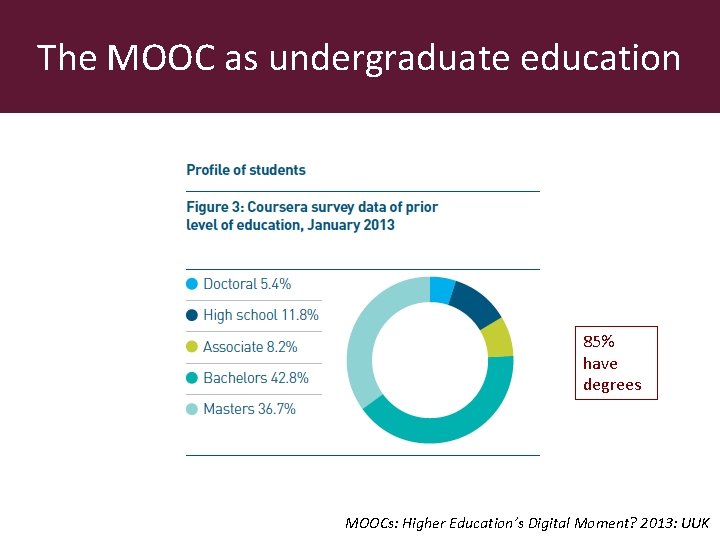
The MOOC as undergraduate education 85% have degrees MOOCs: Higher Education’s Digital Moment? 2013: UUK
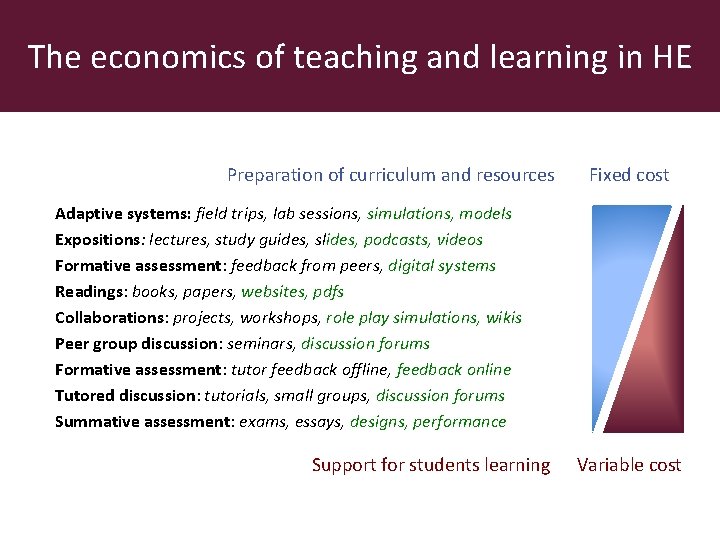
The economics of teaching and learning in HE Preparation of curriculum and resources Fixed cost Adaptive systems: field trips, lab sessions, simulations, models Expositions: lectures, study guides, slides, podcasts, videos Formative assessment: feedback from peers, digital systems Readings: books, papers, websites, pdfs Collaborations: projects, workshops, role play simulations, wikis Peer group discussion: seminars, discussion forums Formative assessment: tutor feedback offline, feedback online Tutored discussion: tutorials, small groups, discussion forums Summative assessment: exams, essays, designs, performance Support for students learning Variable cost
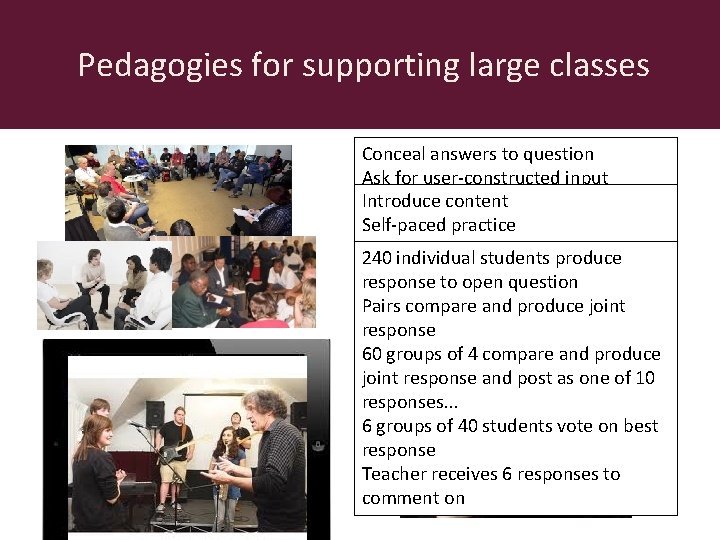
Pedagogies for supporting large classes Concealed MCQs The (virtual) Keller Plan The vicarious master class Pyramid discussion groups Conceal answers to question Ask for user-constructed input Introduce content Show multiple answers/comments Self-paced Ask studentpractice to improve answer Tutor-marked test 240 individual students produce Tutorial for 5 representative students Student becomes tutor for credit response toand open question Questions guidance represent all Until half class is tutoring the rest Pairs compare students’ needsand produce joint response 60 groups of 4 compare and produce joint response and post as one of 10 responses. . . 6 groups of 40 students vote on best response Teacher receives 6 responses to comment on
What it takes to teach with technology The teaching workload is increasing in terms of Planning for how students will learn in the mix of the physical, digital and social learning spaces designed for them Curating and adapting existing content resources Designing activities and resources for all types of active learning Personalised and adaptive teaching that improve traditional methods Providing flexibility in blended learning options Guiding and nurturing large cohorts of students Using learning technologies to improve scale AND outcomes BUT: Institutions and teachers do not typically plan for the teaching workload implied by these learning benefits nor for the need to collaborate to innovate with technology
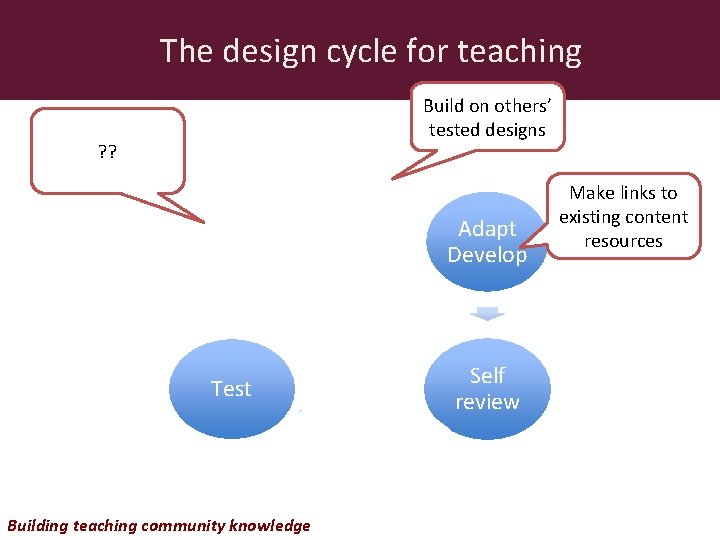
The design cycle for teaching ? ? Browse Adopt Build on others’ tested designs Publish Adapt Develop Test Self review Redesign Building teaching community knowledge Make links to existing content resources
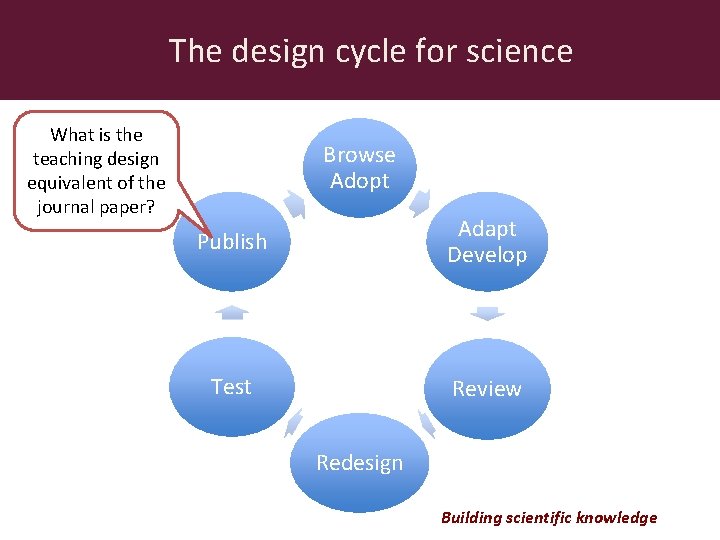
The design cycle for science What is the teaching design equivalent of the journal paper? Browse Adopt Publish Adapt Develop Test Review Redesign Building scientific knowledge
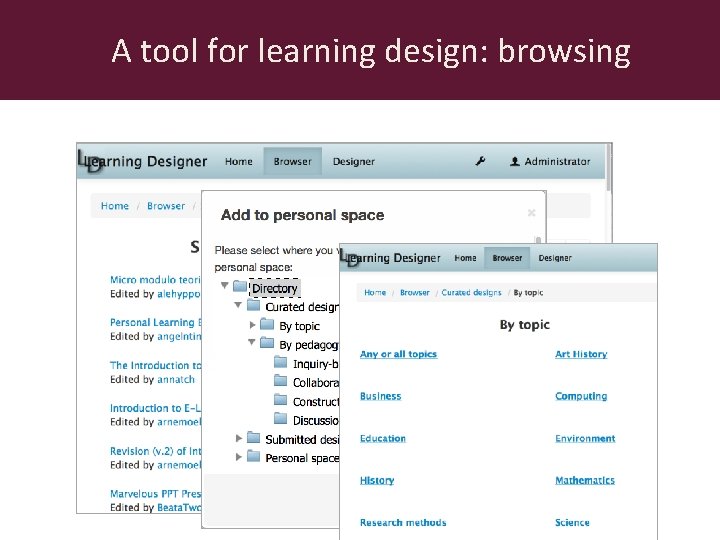
A tool for learning design: browsing
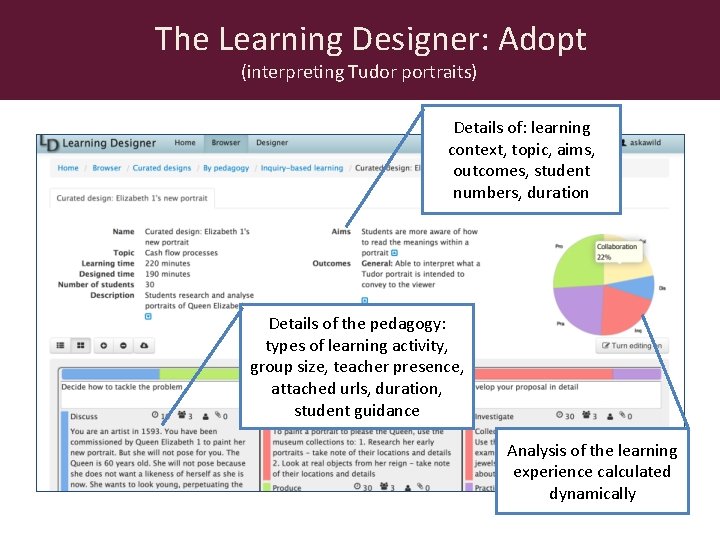
The Learning Designer: Adopt (interpreting Tudor portraits) Details of: learning context, topic, aims, outcomes, student numbers, duration Details of the pedagogy: types of learning activity, group size, teacher presence, attached urls, duration, student guidance Analysis of the learning experience calculated dynamically
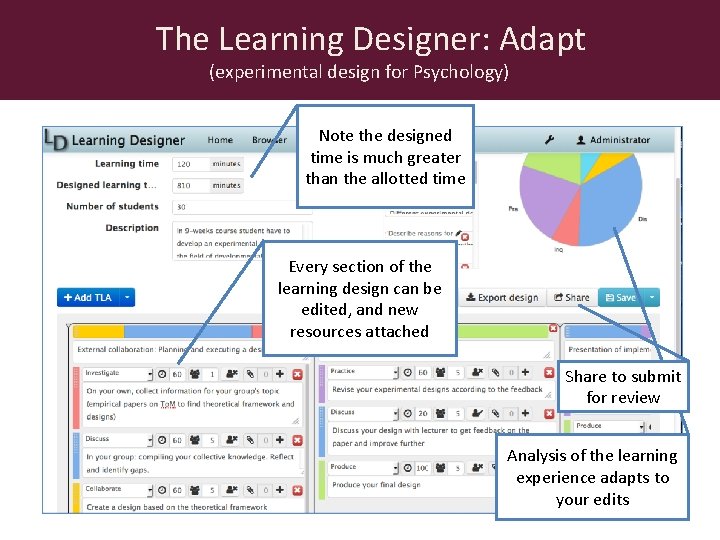
The Learning Designer: Adapt (experimental design for Psychology) Note the designed time is much greater than the allotted time Every section of the learning design can be edited, and new resources attached Share to submit for review Analysis of the learning experience adapts to your edits
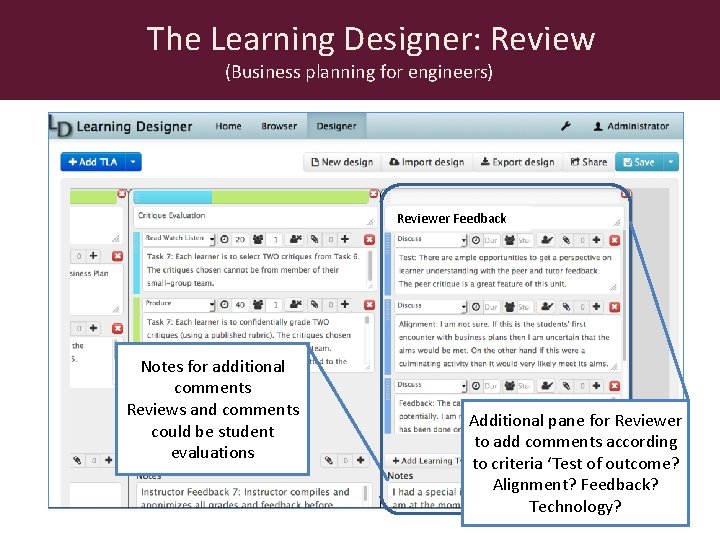
The Learning Designer: Review (Business planning for engineers) Reviewer Feedback Notes for additional comments Reviews and comments could be student evaluations Additional pane for Reviewer to add comments according to criteria ‘Test of outcome? Alignment? Feedback? Technology?
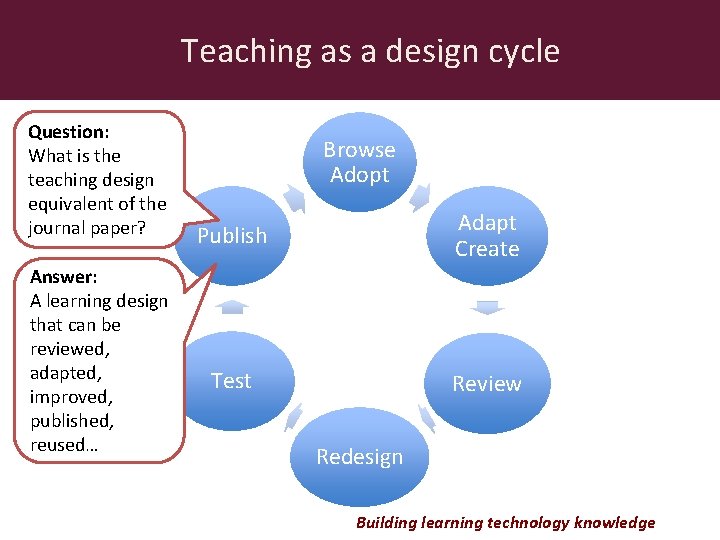
Teaching as a design cycle Question: What is the teaching design equivalent of the journal paper? Answer: A learning design that can be reviewed, adapted, improved, published, reused… Browse Adopt Publish Adapt Create Test Review Redesign Building learning technology knowledge
Balancing the benefits and costs It’s important to understand the link between the pedagogical benefits and teaching time costs of online learning – especially for the large-scale What are the new digital pedagogies that will address the 1: 25 student guidance conundrum? How to shift variable cost support to fixed cost support? Can we develop a viable business model that will make HE more effective and affordable for undergraduates?
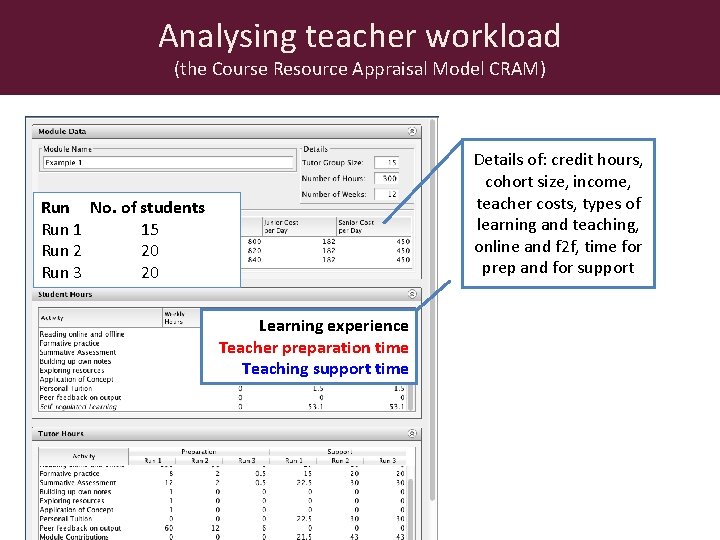
Analysing teacher workload (the Course Resource Appraisal Model CRAM) Details of: credit hours, cohort size, income, teacher costs, types of learning and teaching, online and f 2 f, time for prep and for support Run No. of students Run 1 15 Run 2 20 Run 3 20 Learning experience Teacher preparation time Teaching support time
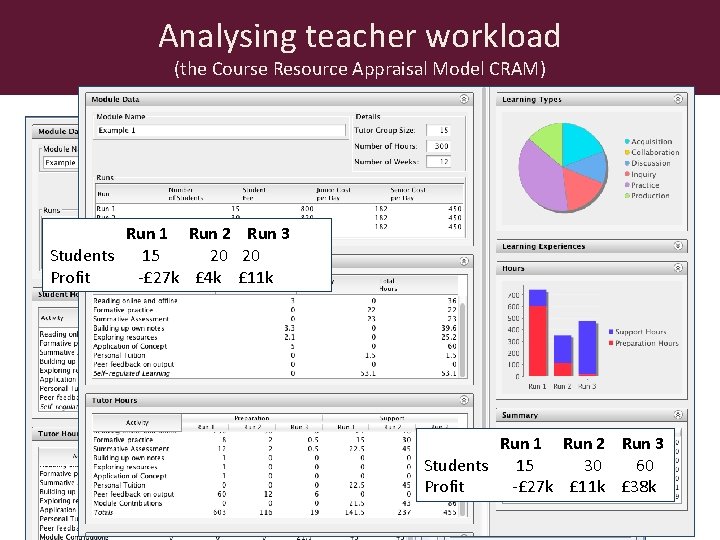
Analysing teacher workload (the Course Resource Appraisal Model CRAM) Run 1 Run 2 Run 3 Students 15 20 20 Profit -£ 27 k £ 4 k £ 11 k Run 1 Run 2 Run 3 Students 15 30 60 Profit -£ 27 k £ 11 k £ 38 k
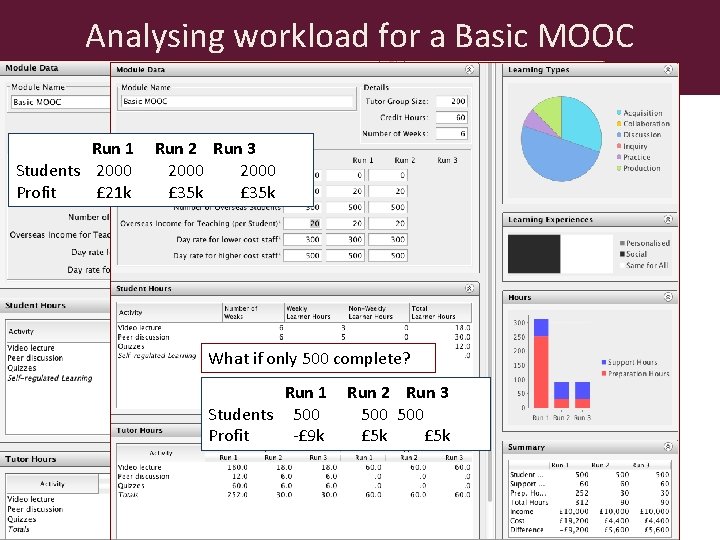
Analysing workload for a Basic MOOC (the Course Resource Appraisal Model CRAM) Run 1 Students 2000 Profit £ 21 k Run 2 Run 3 2000 £ 35 k Assuming £ 20 (? ) income for Signature Track What if only 500 complete? Run 1 Students 500 Profit -£ 9 k Run 2 Run 3 500 £ 5 k
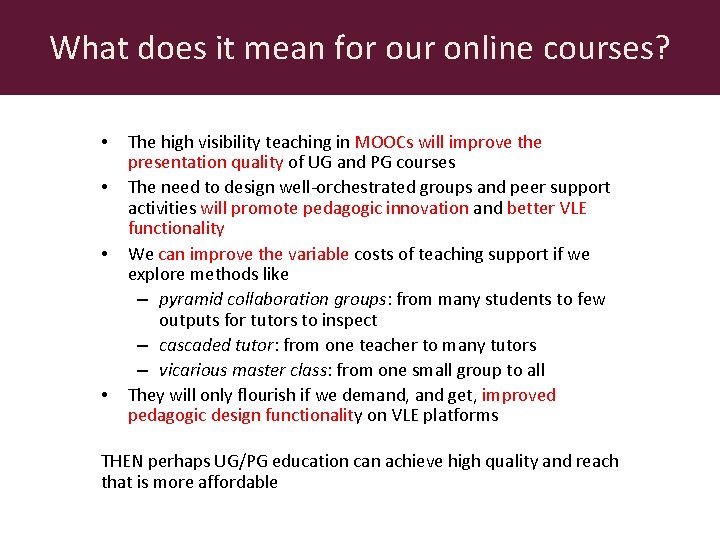
What does it mean for our online courses? • • The high visibility teaching in MOOCs will improve the presentation quality of UG and PG courses The need to design well-orchestrated groups and peer support activities will promote pedagogic innovation and better VLE functionality We can improve the variable costs of teaching support if we explore methods like – pyramid collaboration groups: from many students to few outputs for tutors to inspect – cascaded tutor: from one teacher to many tutors – vicarious master class: from one small group to all They will only flourish if we demand, and get, improved pedagogic design functionality on VLE platforms THEN perhaps UG/PG education can achieve high quality and reach that is more affordable
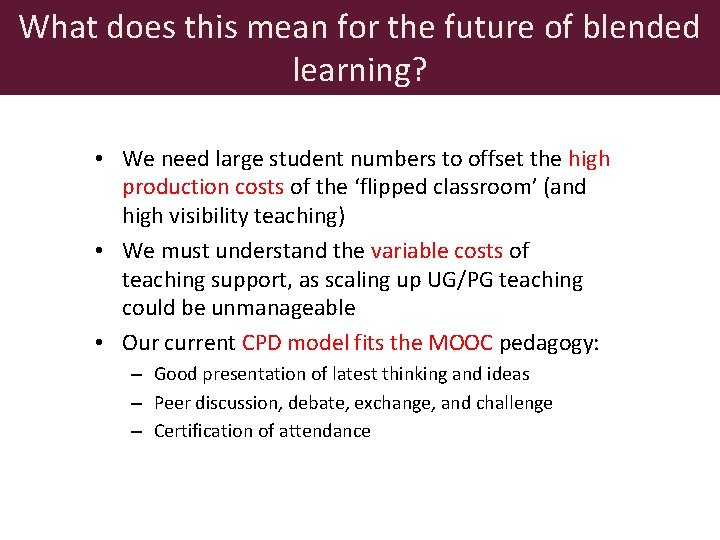
What does this mean for the future of blended learning? • We need large student numbers to offset the high production costs of the ‘flipped classroom’ (and high visibility teaching) • We must understand the variable costs of teaching support, as scaling up UG/PG teaching could be unmanageable • Our current CPD model fits the MOOC pedagogy: – Good presentation of latest thinking and ideas – Peer discussion, debate, exchange, and challenge – Certification of attendance
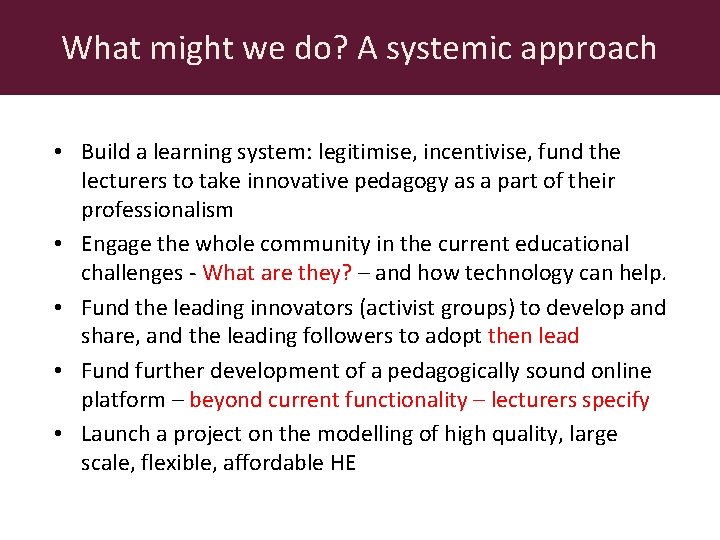
What might we do? A systemic approach • Build a learning system: legitimise, incentivise, fund the lecturers to take innovative pedagogy as a part of their professionalism • Engage the whole community in the current educational challenges - What are they? – and how technology can help. • Fund the leading innovators (activist groups) to develop and share, and the leading followers to adopt then lead • Fund further development of a pedagogically sound online platform – beyond current functionality – lecturers specify • Launch a project on the modelling of high quality, large scale, flexible, affordable HE
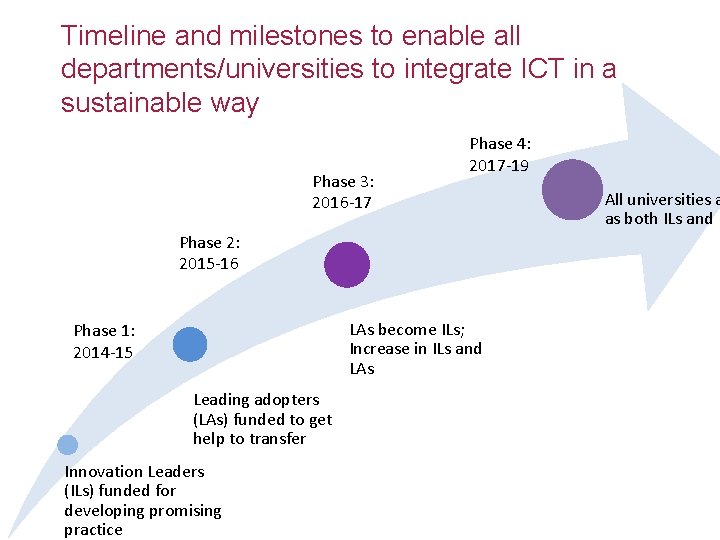
Timeline and milestones to enable all departments/universities to integrate ICT in a sustainable way Phase 3: 2016 -17 Phase 4: 2017 -19 Phase 2: 2015 -16 LAs become ILs; Increase in ILs and LAs Phase 1: 2014 -15 Leading adopters (LAs) funded to get help to transfer Innovation Leaders (ILs) funded for developing promising practice All universities a as both ILs and L
- Slides: 30