
Think Trauma Learning Objectives What Will I Learn

Think Trauma

Learning Objectives What Will I Learn Today? You will be able to define trauma and describe how it differs from everyday stress. You will learn how to view young people’s behaviors through a trauma lens. You will better understand the role of resilience in buffering the effects of traumatic events.
How would you… • How would you define trauma? • What is it that makes something traumatic as opposed to just stressful?
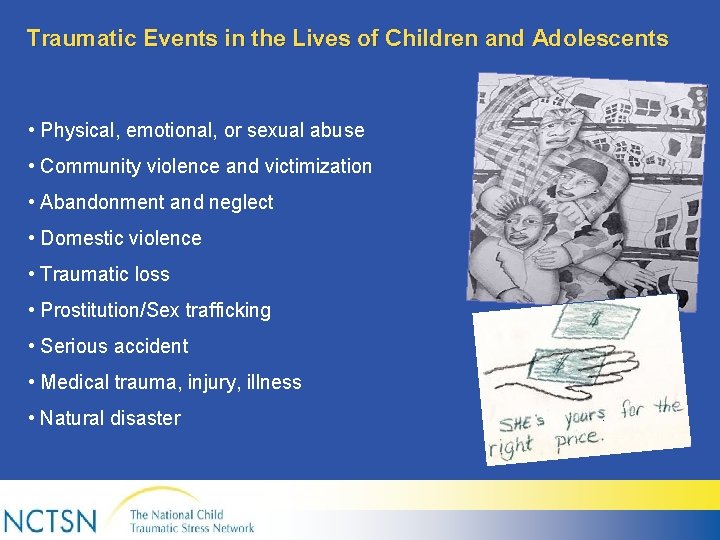
Traumatic Events in the Lives of Children and Adolescents • Physical, emotional, or sexual abuse • Community violence and victimization • Abandonment and neglect • Domestic violence • Traumatic loss • Prostitution/Sex trafficking • Serious accident • Medical trauma, injury, illness • Natural disaster
Potentially Traumatizing Events in Disciplinary or Legal Settings • Seclusion • Restraint • Routine room confinement • Strip searches/pat downs • Placement on suicide status • Observing physical altercations • Fear of being attacked by other youth • Separation from caregivers/community
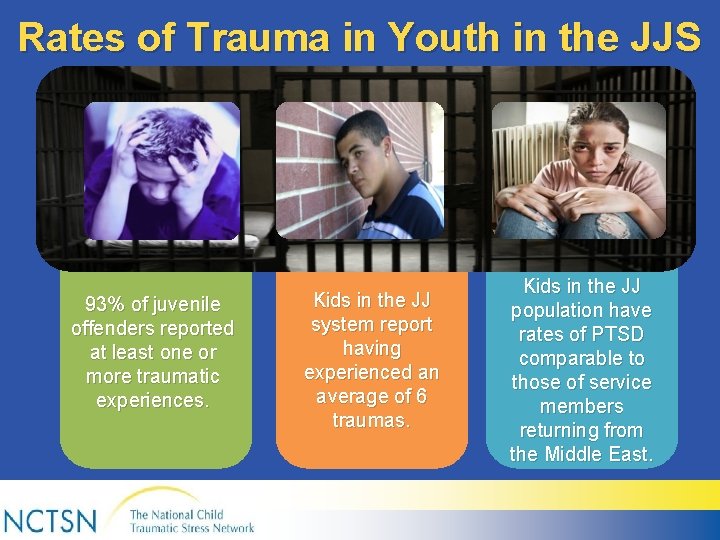
Rates of Trauma in Youth in the JJS 93% of juvenile offenders reported at least one or more traumatic experiences. Kids in the JJ system report having experienced an average of 6 traumas. Kids in the JJ population have rates of PTSD comparable to those of service members returning from the Middle East.
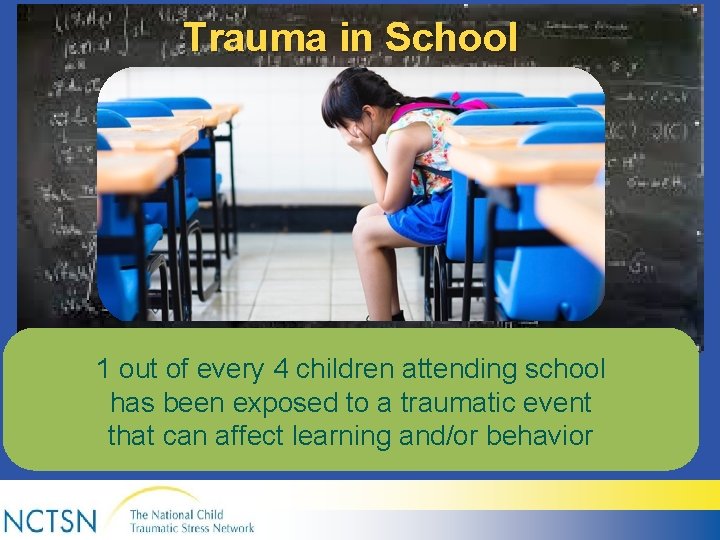
Trauma in School 1 out of every 4 children attending school has been exposed to a traumatic event that can affect learning and/or behavior
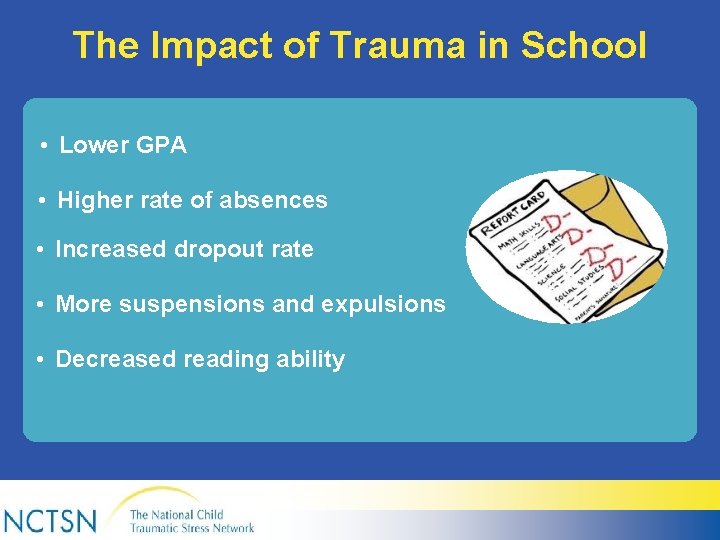
The Impact of Trauma in School • Lower GPA • Higher rate of absences • Increased dropout rate • More suspensions and expulsions • Decreased reading ability
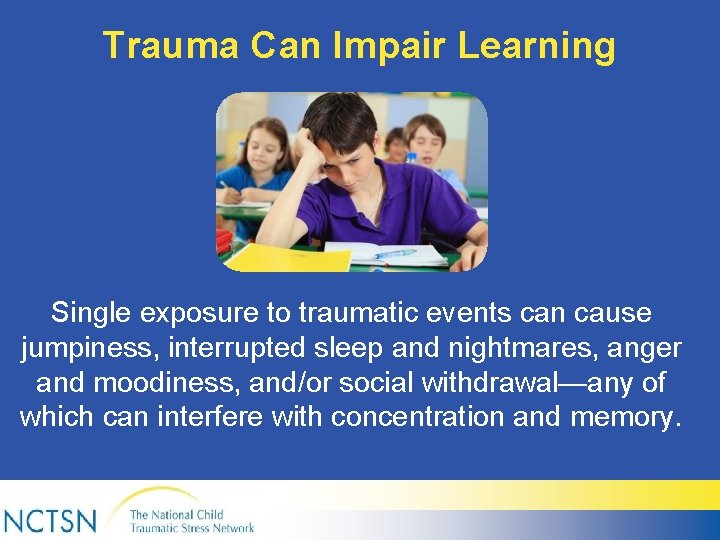
Trauma Can Impair Learning Single exposure to traumatic events can cause jumpiness, interrupted sleep and nightmares, anger and moodiness, and/or social withdrawal—any of which can interfere with concentration and memory.
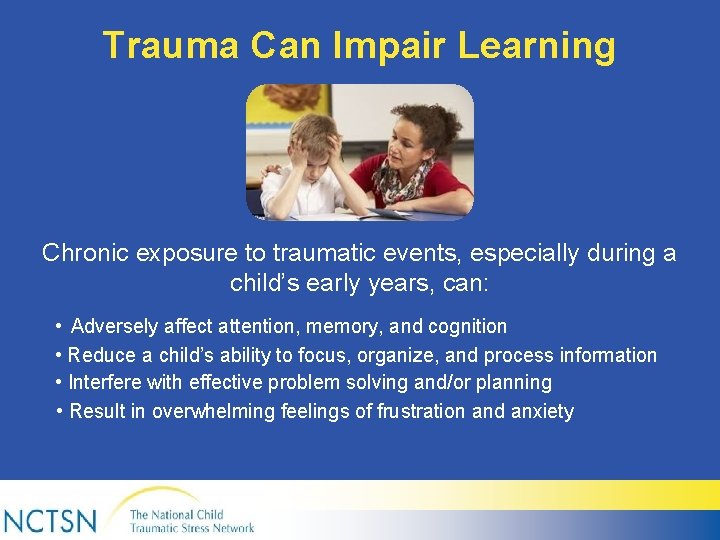
Trauma Can Impair Learning Chronic exposure to traumatic events, especially during a child’s early years, can: • Adversely affect attention, memory, and cognition • Reduce a child’s ability to focus, organize, and process information • Interfere with effective problem solving and/or planning • Result in overwhelming feelings of frustration and anxiety
Traumatized children may experience physical and emotional distress • Physical symptoms like headaches and stomachaches • Poor control of emotions • Inconsistent academic performance • Unpredictable and/or impulsive behavior • Over or under-reacting to bells, physical contact, doors slamming, sirens, lighting, sudden movements
Traumatized children may experience physical and emotional distress Intense reactions to reminders of their traumatic event: • Thinking others are violating their personal space, i. e. , “What are you looking at? ” • Blowing up when being corrected or told what to do by an authority figure • Fighting when criticized or teased by others • Resisting transition and/or change
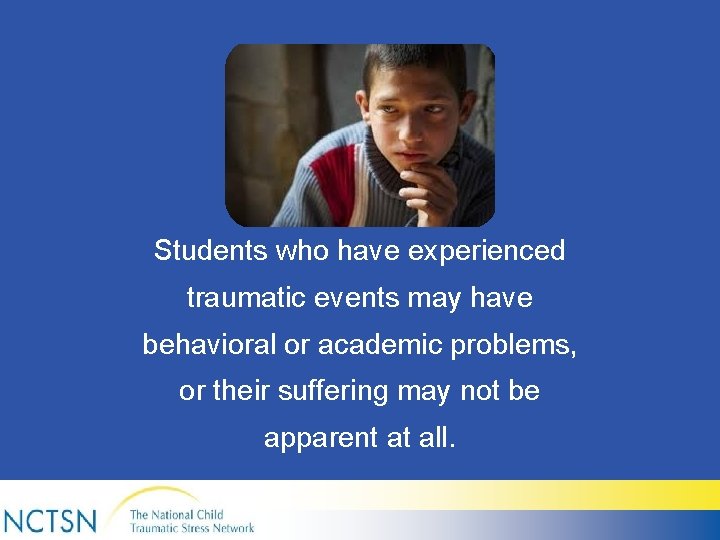
Students who have experienced traumatic events may have behavioral or academic problems, or their suffering may not be apparent at all.
How Childhood Trauma Affects Health http: //www. ted. com/talks nadine_burke_harris_how_childhood_trauma_affects_health_across_a_lifetime ? language=en
Now let’s return to the question… • What is “trauma”? • What is it that makes something traumatic as opposed to just stressful?
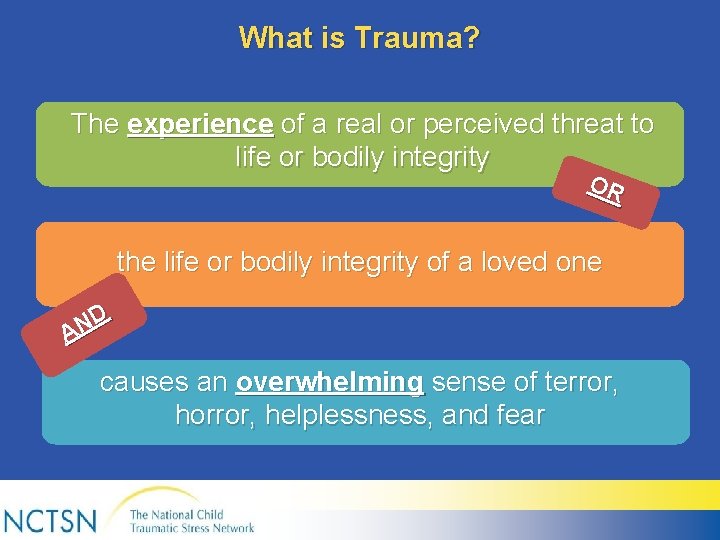
What is Trauma? The experience of a real or perceived threat to life or bodily integrity OR the life or bodily integrity of a loved one D N A causes an overwhelming sense of terror, horror, helplessness, and fear
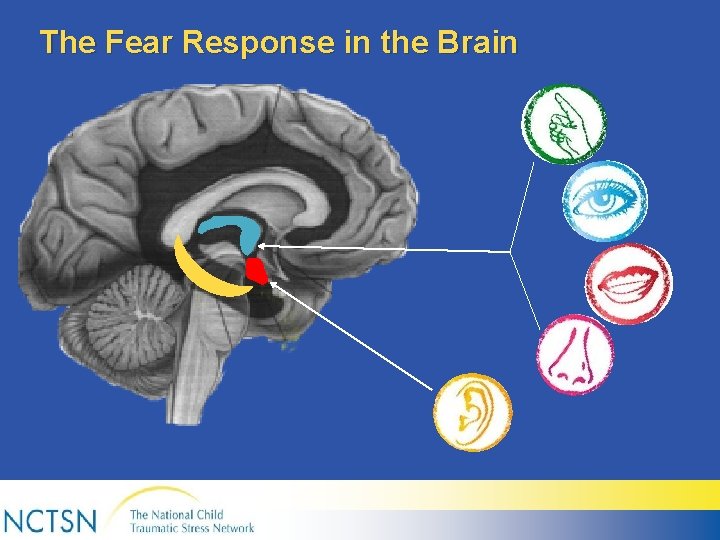
The Fear Response in the Brain
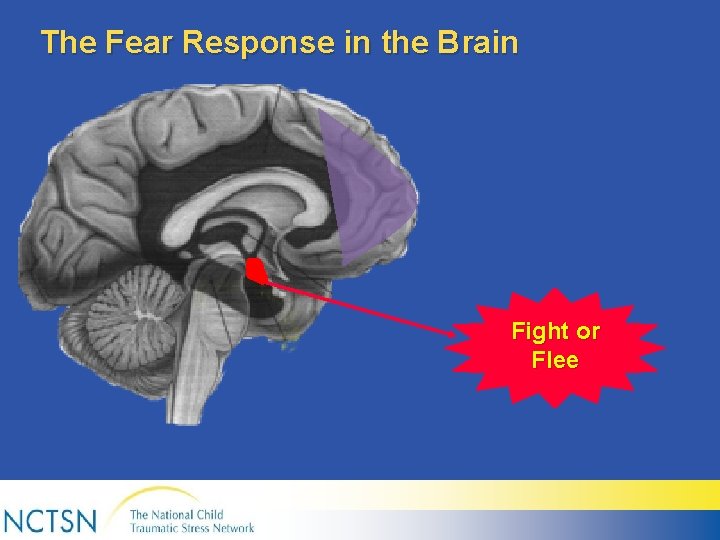
The Fear Response in the Brain Fight or Flee
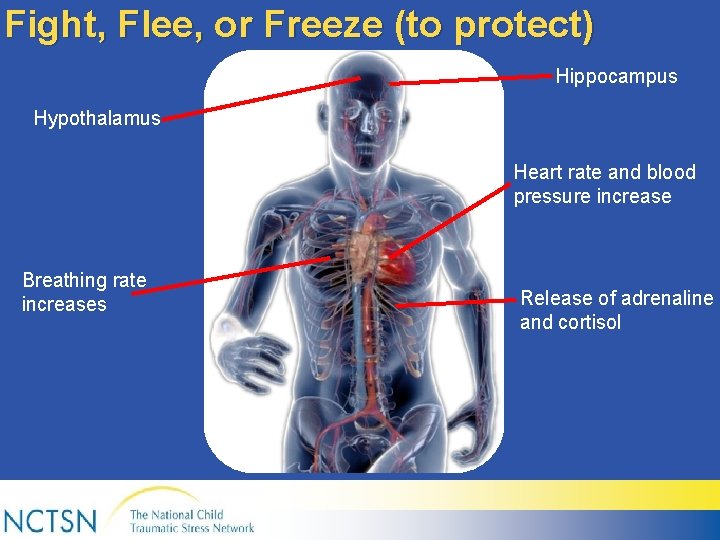
Fight, Flee, or Freeze (to protect) Hippocampus Hypothalamus Heart rate and blood pressure increase Breathing rate increases Release of adrenaline and cortisol
Trauma & Brain Development According to Dr. Bruce Perry of the Child Trauma Academy (www. childtrauma. org): • Childhood trauma can result in a chronic activation of the Hypothalamic-Pituitary-Adrenal (HPA) Axis • This chronic activation may “wear out” parts of the body, including the Hippocampus, a key area in the brain responsible for memory, cognition, and arousal • Key neurochemical systems also become sensitized, and as a result, a traumatized child may exhibit the following behaviors: Hyperactivity Tachycardia Anxiety Sleep Problems Behavioral Impulsivity Hypertension
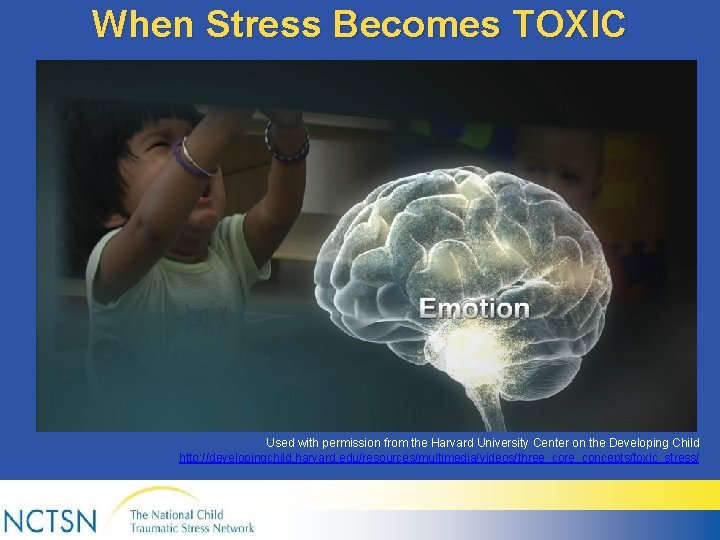
When Stress Becomes TOXIC Used with permission from the Harvard University Center on the Developing Child http: //developingchild. harvard. edu/resources/multimedia/videos/three_core_concepts/toxic_stress/
MULTIPLE TRAUMAS AND LOSSES • Most youth involved with the juvenile justice system have experienced multiple traumas, often beginning in early childhood, and recurring over a long period of time. • Many experienced trauma at the hands of those who were supposed to protect them. • This chronic trauma can derail physical, emotional, and social development. Chronic trauma influences the way youth think, feel, behave, and interact with others. It influences the way they see the world.
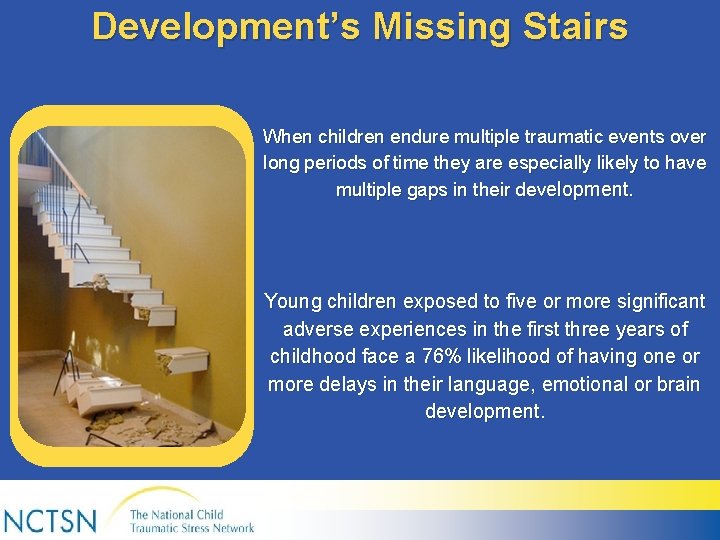
Development’s Missing Stairs When children endure multiple traumatic events over long periods of time they are especially likely to have multiple gaps in their development. Young children exposed to five or more significant adverse experiences in the first three years of childhood face a 76% likelihood of having one or more delays in their language, emotional or brain development.
Childhood Trauma Statistics • 60% of adults report experiencing abuse or other difficult family circumstances during childhood • 26% of children in the United States will witness or experience a traumatic event before they turn four • Four of every 10 children in American say they experienced a physical assault during the past year, with one in 10 receiving an assault-related injury • 2% of all children experienced sexual assault or sexual abuse during the past year, with the rate at nearly 11% for girls aged 14 to 17 • Nearly 14% of children repeatedly experienced maltreatment by a caregiver, including nearly 4% who experienced physical abuse
Childhood Trauma Statistics • More than 13% of children reported being physically bullied, while more than 1 in 3 said they had been emotionally bullied • 1 in 5 children witnessed violence in their family or the neighborhood during the previous year • In one year, 39% of children between the ages of 12 and 17 reported witnessing violence, 17% reported being a victim of physical assault and 8% reported being the victim of sexual assault • More than 60% of youth age 17 and younger have been exposed to crime, violence and abuse either directly or indirectly
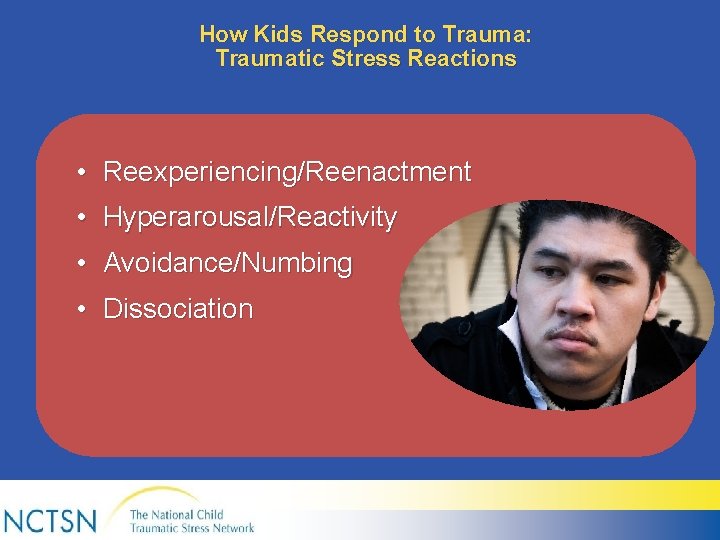
How Kids Respond to Trauma: Traumatic Stress Reactions • Reexperiencing/Reenactment • Hyperarousal/Reactivity • Avoidance/Numbing • Dissociation
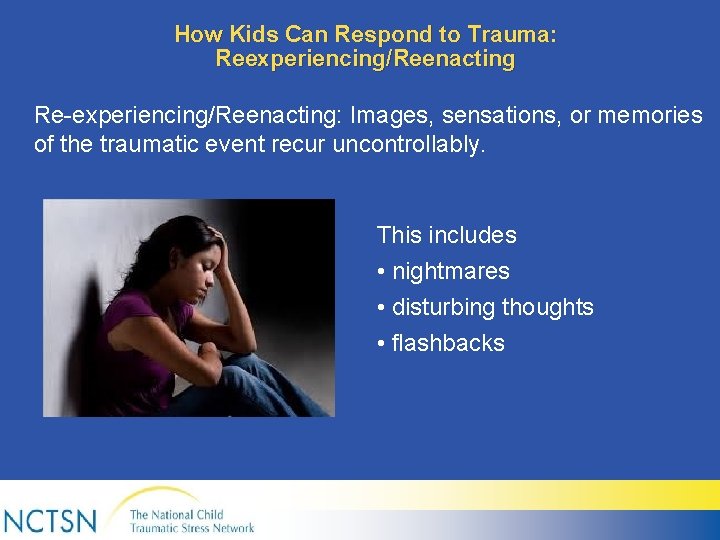
How Kids Can Respond to Trauma: Reexperiencing/Reenacting Re-experiencing/Reenacting: Images, sensations, or memories of the traumatic event recur uncontrollably. This includes • nightmares • disturbing thoughts • flashbacks
Behaviors You Often See: What Trauma Can Look Like Anger Hostility and coldness Inability to trust other people Perceiving danger everywhere Problems with change and transitions Acting guarded anxious (Kaplow, Dodge, Amaya-Jackson & Saxe, 2005; Shields & Cicchetti, 2001)
Behaviors You Often See: What Trauma Can Look Like Difficulty being redirected Physical and emotional reactivity Difficulty calming down after outbursts Difficulty letting go, holding onto grievances Regressive behaviors (behaving much younger than his/her age) Rejecting support from peers and adults (Kaplow, Dodge, Amaya-Jackson & Saxe, 2005; Shields & Cicchetti, 2001)
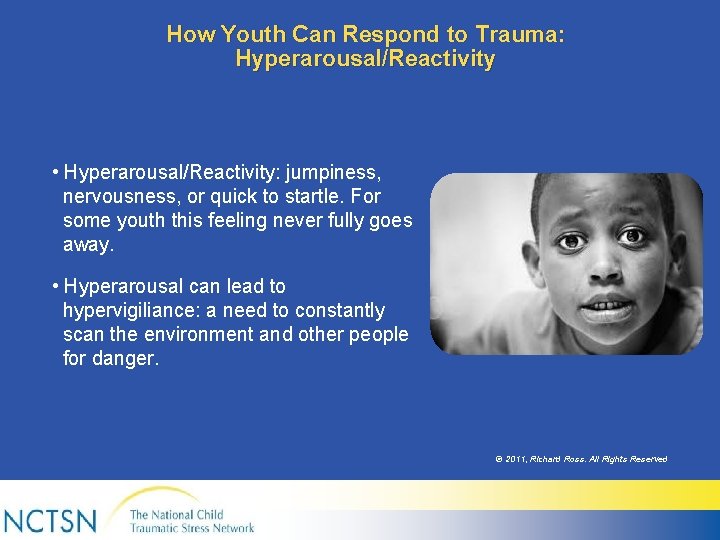
How Youth Can Respond to Trauma: Hyperarousal/Reactivity • Hyperarousal/Reactivity: jumpiness, nervousness, or quick to startle. For some youth this feeling never fully goes away. • Hyperarousal can lead to hypervigiliance: a need to constantly scan the environment and other people for danger. © 2011, Richard Ross. All Rights Reserved
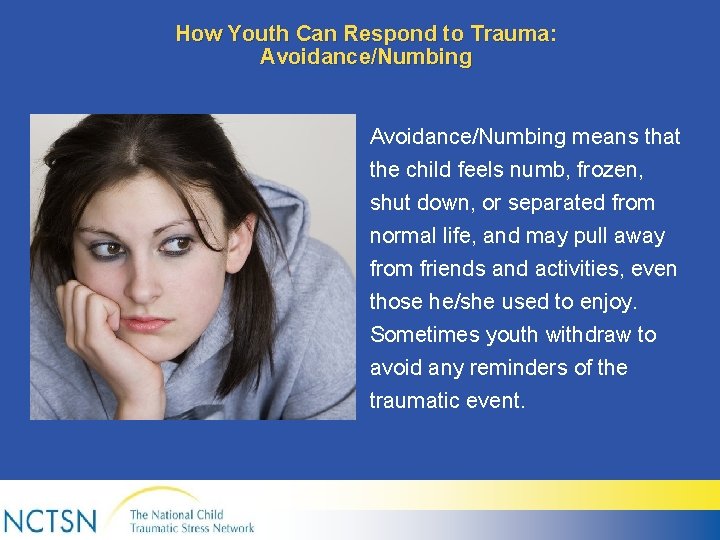
How Youth Can Respond to Trauma: Avoidance/Numbing means that the child feels numb, frozen, shut down, or separated from normal life, and may pull away from friends and activities, even those he/she used to enjoy. Sometimes youth withdraw to avoid any reminders of the traumatic event.
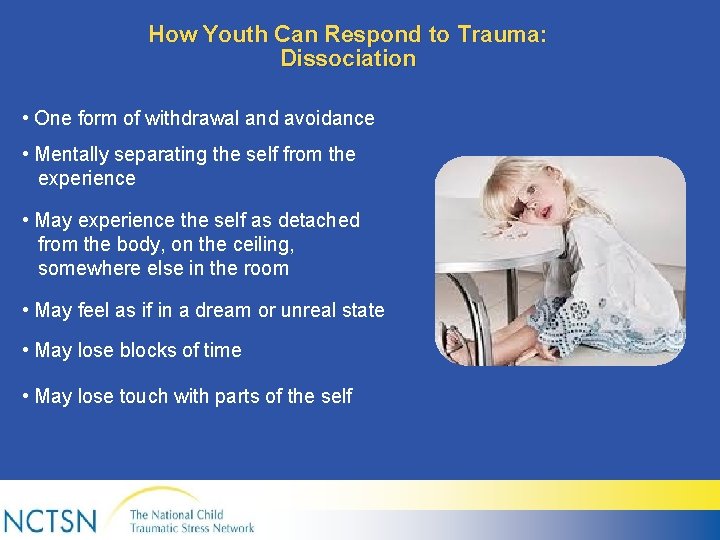
How Youth Can Respond to Trauma: Dissociation • One form of withdrawal and avoidance • Mentally separating the self from the experience • May experience the self as detached from the body, on the ceiling, somewhere else in the room • May feel as if in a dream or unreal state • May lose blocks of time • May lose touch with parts of the self
Trauma Reminders Things, events, situations, places, sensations, and even people that a youth consciously or unconsciously connects with a traumatic event
Reactions to Trauma Reminders • Reexperiencing/reenacting • Hyperarousal/reactivity • Avoidance/numbing • Dissociation
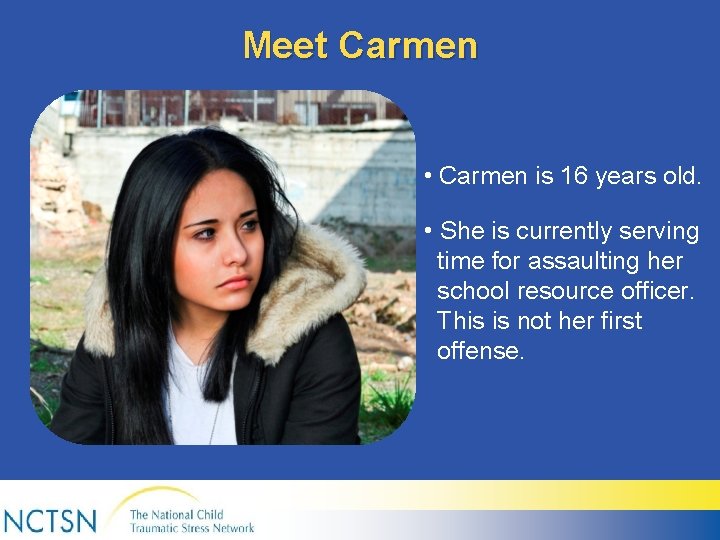
Meet Carmen • Carmen is 16 years old. • She is currently serving time for assaulting her school resource officer. This is not her first offense.
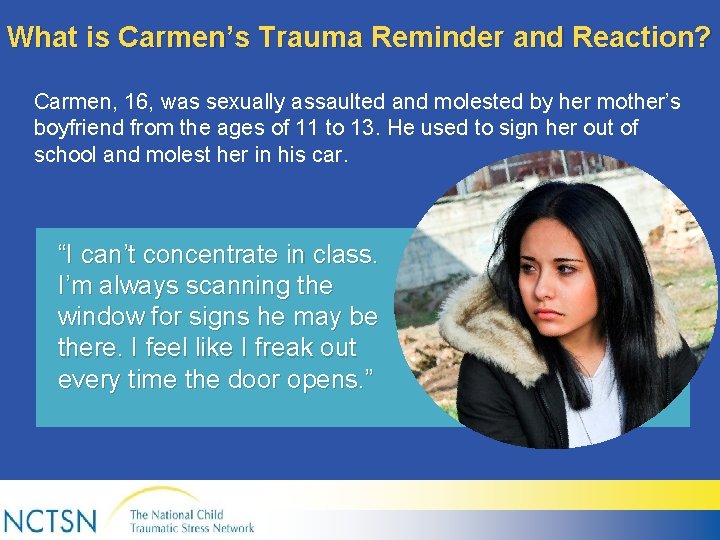
What is Carmen’s Trauma Reminder and Reaction? Carmen, 16, was sexually assaulted and molested by her mother’s boyfriend from the ages of 11 to 13. He used to sign her out of school and molest her in his car. “I can’t concentrate in class. I’m always scanning the window for signs he may be there. I feel like I freak out every time the door opens. ”
Hidden Reminders • May be very difficult to identify • Cause physical reactions without our being able to understand them • Trust, affection, and connection can be hidden reminders of pain.
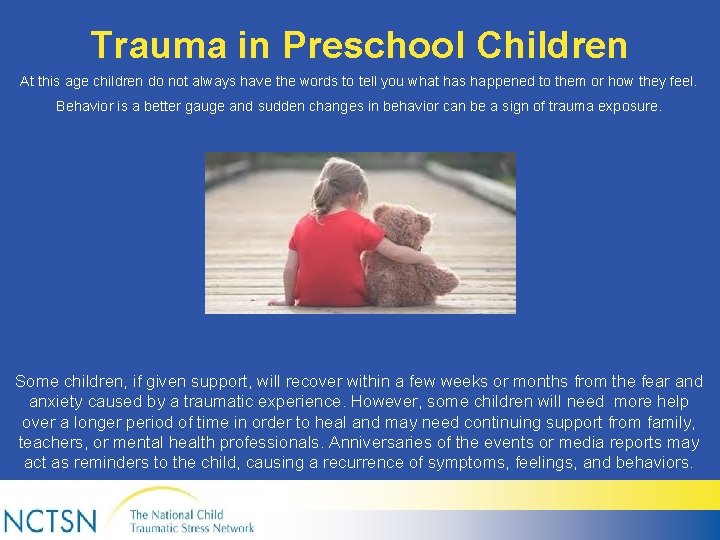
Trauma in Preschool Children At this age children do not always have the words to tell you what has happened to them or how they feel. Behavior is a better gauge and sudden changes in behavior can be a sign of trauma exposure. Some children, if given support, will recover within a few weeks or months from the fear and anxiety caused by a traumatic experience. However, some children will need more help over a longer period of time in order to heal and may need continuing support from family, teachers, or mental health professionals. Anniversaries of the events or media reports may act as reminders to the child, causing a recurrence of symptoms, feelings, and behaviors.
Trauma in Preschool Children • Separation anxiety or clinginess towards teachers or primary caregivers • Regression in previously mastered stages of development (baby talk or bedwetting/toileting accidents) • Lack of developmental progress (not progressing at same level as peers) • Re-creating the traumatic event (repeatedly talking about, “playing” out, or drawing the event) • Difficulty at naptime or bedtime (avoiding sleep, waking up, or nightmares) • Increased somatic complaints (headaches, stomachaches, overreacting to minor bumps and bruises) • Changes in behavior (appetite, unexplained absences, angry outbursts, decreased attention, withdrawal) • Over- or under-reacting to physical contact, bright lighting, sudden movements, or loud sounds (bells, slamming doors, or sirens) • Increased distress (unusually whiny, irritable, moody) • Anxiety, fear, and worry about safety of self and others • Worry about recurrence of the traumatic event • New fears (fear of the dark, animals, or monsters) • Statements and questions about death and dying
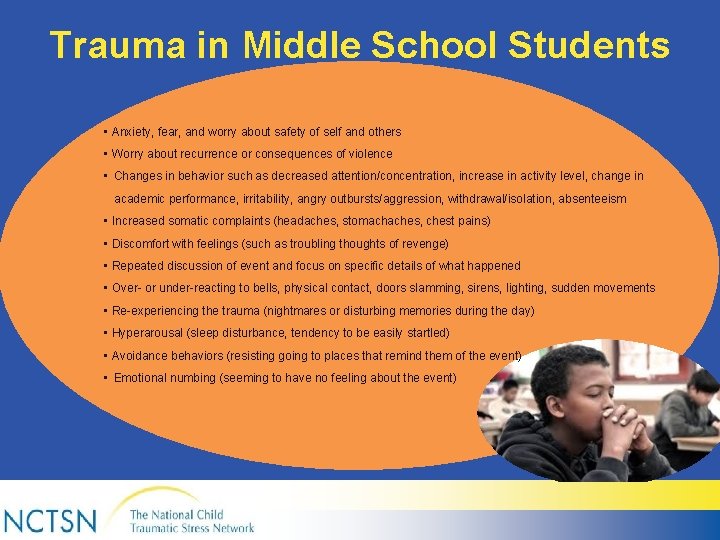
Trauma in Middle School Students • Anxiety, fear, and worry about safety of self and others • Worry about recurrence or consequences of violence • Changes in behavior such as decreased attention/concentration, increase in activity level, change in academic performance, irritability, angry outbursts/aggression, withdrawal/isolation, absenteeism • Increased somatic complaints (headaches, stomachaches, chest pains) • Discomfort with feelings (such as troubling thoughts of revenge) • Repeated discussion of event and focus on specific details of what happened • Over- or under-reacting to bells, physical contact, doors slamming, sirens, lighting, sudden movements • Re-experiencing the trauma (nightmares or disturbing memories during the day) • Hyperarousal (sleep disturbance, tendency to be easily startled) • Avoidance behaviors (resisting going to places that remind them of the event) • Emotional numbing (seeming to have no feeling about the event)
Trauma in High School Students • Anxiety, fear, and worry about safety of self and others • Worry about recurrence or consequences of violence • Changes in behavior such as withdrawal/isolation, irritability, angry outbursts/aggression, changes academic performance, decreased attention/concentration, increase in activity level, absenteeis increase in impulsivity/risky behavior • Increase in impulsivity, risk-taking behavior • Discomfort with feelings (such as troubling thoughts of revenge) • Increased risk for substance abuse • Discussion of events and reviewing of details • Negative impact on issues of trust and perceptions of others
Trauma in High School Students • Over- or under-reacting to bells, physical contact, doors slamming, sirens, lighting, sudden movements • Repetitive thoughts and comments about death or dying (including suicidal thoughts, writing, art, or notebook covers about violent or morbid topics, internet searches) • Heightened difficulty with authority, redirection, or criticism • Re-experiencing the trauma (e. g. , nightmares or disturbing memories during the day) • Hyperarousal (e. g. , sleep disturbance, tendency to be easily startled) • Avoidance behaviors (e. g. , resisting going to places that remind them of the event) • Emotional numbing (e. g. , seeming to have no feeling about the event)
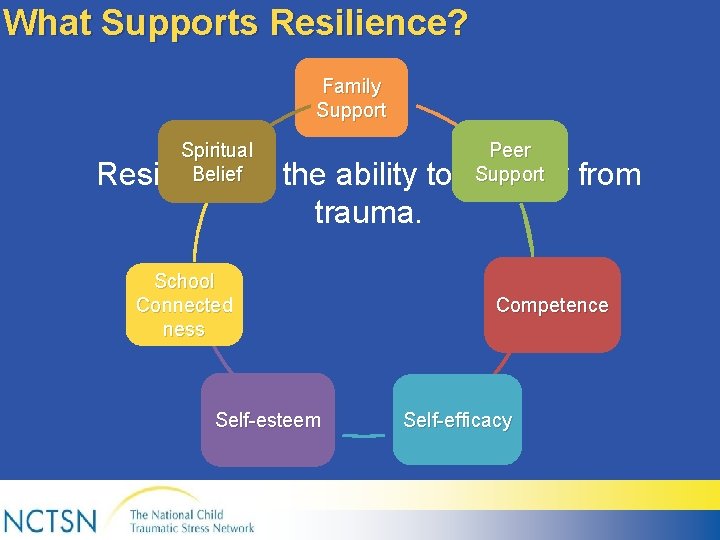
What Supports Resilience? Family Support Spiritual Belief Peer Support Resiliency is the ability to recover from trauma. School Connected ness Self-esteem Competence Self-efficacy
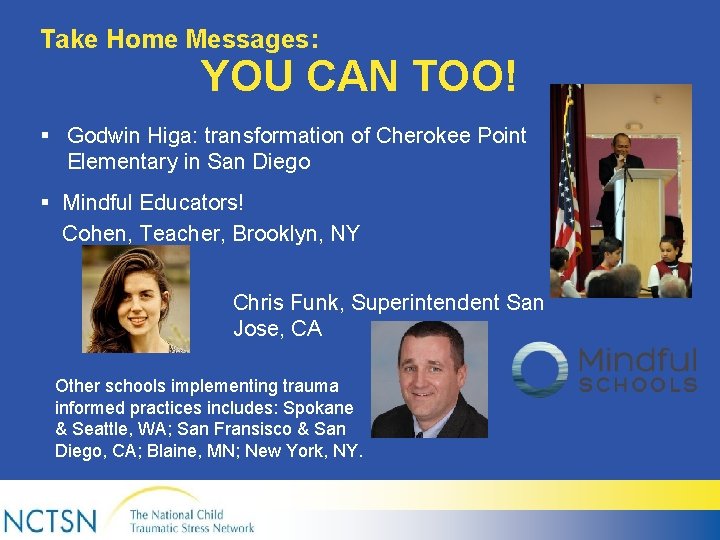
Take Home Messages: YOU CAN TOO! ▪ Godwin Higa: transformation of Cherokee Point Elementary in San Diego ▪ Mindful Educators! Allison Cohen, Teacher, Brooklyn, NY Chris Funk, Superintendent San Jose, CA Other schools implementing trauma informed practices includes: Spokane & Seattle, WA; San Fransisco & San Diego, CA; Blaine, MN; New York, NY.
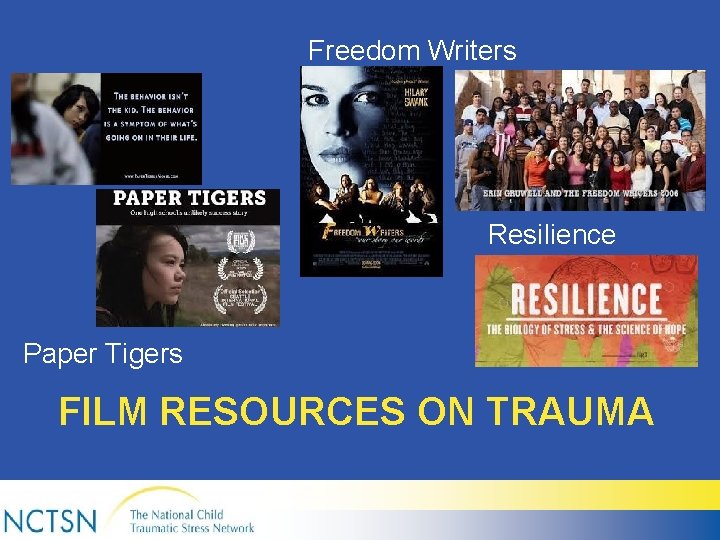
Freedom Writers Resilience Paper Tigers FILM RESOURCES ON TRAUMA
Take Home Messages Trauma affects behavior. Resiliency is possible. YOU can make a difference.
- Slides: 46