
Think Before You Dig Campaign toolkit 20 October
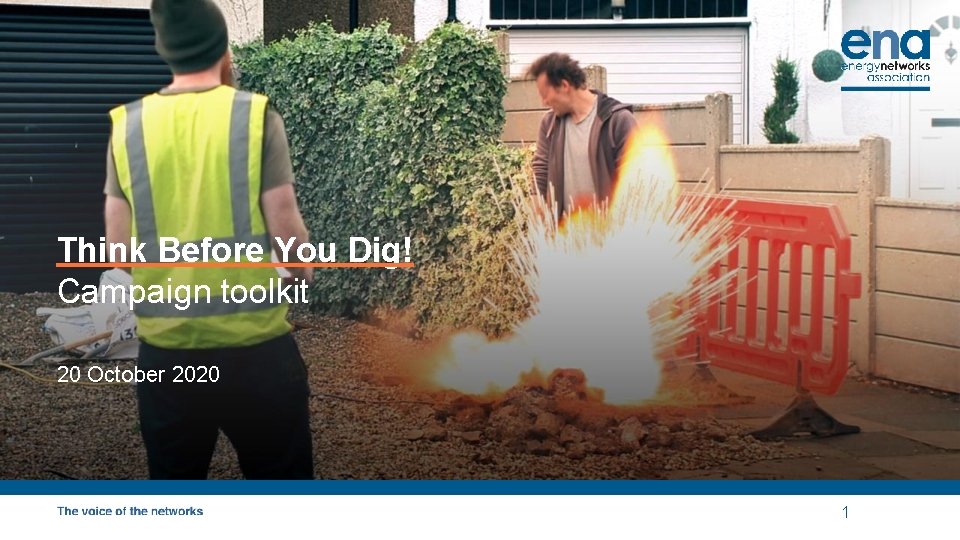
Think Before You Dig! Campaign toolkit 20 October 2020 1

Introduction Thank you for supporting the Think Before You Dig! campaign, to raise awareness of the risks of underground dangers such as electricity cables and gas pipes. Over the last five years, 354 people were seriously injured after striking underground electricity power cables. This campaign aims to encourage anyone undertaking work that involves digging to Plan, Scan, Think Before You Dig! This toolkit contains a range of information and resources to help you raise awareness of Think Before You Dig! via your channels. In support of this campaign and the toolkit we have developed the online campaign page www. energynetworks. org/thinkbeforeyoudig. 2

Introduction The campaign toolkit includes: • • Information about the campaign Key messages for Think Before You Dig! Template copy Campaign film A quote from Energy Networks Association (ENA) Template press release Key information and top-line stats from members of the public and industry workers’ awareness of underground cables • A draft email to distribute across partner networks • Additional data and information 3

About the campaign Think Before You Dig! seeks to: • Raise awareness of the risks of underground electricity cables • Motivate anyone who may come into contact with underground cables to adopt the safe behaviours of Plan, Scan, Think Before You Dig! • Follow advice and guidance from HSE 4
About the campaign Our audience The UK’s electricity network operators have joined forces to launch Think Before you Dig! - a campaign appealing to industry workers and members of the public planning any work which involves digging, to think about what services could be buried beneath, such as underground electricity cables and gas pipes, before they start work. The main target audience for this campaign is anyone whose work involves breaking the ground, such as construction workers. The secondary audience is anyone who may come into contact with underground cables, such as homeowners undertaking DIY that involves digging. 5
About the campaign Our launch Think Before You Dig! launches a comms campaign on 29 October 2020, alerting national and trade media. Throughout the campaign, Energy Networks Association will share tips and information to raise awareness of the risks of underground cables and how to dig safely. As part of the campaign, ENA is releasing an emotive safety film – urging those working in construction to consider the consequences of digging without being properly prepared. We want to work with trusted organisations, such as yourself, to help share this lifesaving information as widely as possible. 6
Key messages These are the key messages ENA will be communicating, and urges others to communicate, throughout the campaign: • You could die or be seriously injured if you come into contact with an underground electricity cable • Be aware of what is underground before starting work that involves breaking ground and plan your work accordingly • Follow the advice in the Health and Safety Executive (HSE) Guidance HSG 47 ‘Avoiding danger from underground services’ and ENA’s ‘Watch Out, Cables About’ Safety advice leaflet • The electricity network operators are responsible for ensuring energy networks across the UK are the safest, most reliable, most efficient and sustainable in the world 7

Template copy Here is some template copy about Think Before You Dig! that you may wish to use as content on your website or to share through your communication channels (newsletters, online magazines, etc. ). We have provided two versions suitable for different word counts. 8
Long copy Think Before You Dig! to reduce underground cable incidents Every year, around 70 people* in the UK are seriously injured from striking an underground electricity cable whilst digging. Nearly half of all cases (47%) were reported on public highways, construction sites and industrial buildings making tradespeople at extreme risk of serious injury in the workplace. Houses, offices, shops, factories and street furniture all have electric cables supplying them. The cables carry voltages ranging from 230 volts (domestic voltage) and over. Even domestic voltage cables can be fatal and can be buried outside homes and in driveways. The risk of danger can be considerably reduced by following some simple safety tips. When surveyed, 93%** of construction workers and industry professionals believe they always dig safely, yet nearly a third (31%) admitted to not always checking for underground electricity cables before beginning work. Worryingly, almost one in six (15%) say if they uncovered an underground electricity cable encased in concrete, they would attempt to break them out, which could put them at immediate risk of life-threatening injuries. *Data from the Health & Safety Executive **Research carried out by 3 gem on behalf of the Energy Networks Association in October 2020. Total sample size was 1, 000 people across the UK, aged 18 – 65. 9

Long copy cont. To help prevent the number of fatalities and injuries amongst tradespeople, ENA has launched a new emotive safety film, urging those working in construction to ‘Think Before You Dig’. The thought-provoking film showcases the dangers of working near underground electricity cables, following the story of a construction worker and the devastating emotional and physical impact an accident can have. To view the film please visit the Energy Networks Association website at www. energynetworks. org/thinkbeforeyoudig. In addition to the short film, ENA has also released a new set of Plan, Scan, Think Before You Dig, life-saving safety guidelines targeted towards industry professionals whose work may take place near underground electricity cables: Plan • When you are carrying out any excavations or work that involves breaking ground, plan your work carefully. Work out how you are going to locate utility equipment and avoid the risk of damaging it. • Complete a risk assessment before starting work to identify the dangers and hazards associated with excavations. • Request location details and plans from utility companies well in advance of work starting. Remember that these are a guide only – you are responsible for confirming the exact location of all equipment and avoiding damage. • By using the Linesearchbefore. Udig website (www. linesearchbeforeudig. co. uk) you will have instant access to plans for our members underground electricity equipment as well as underground equipment for other utility companies. 10

Long copy cont. Scan • Ensure everyone looks for electrical wires, cables or equipment near where they are going to work. • Checks must be made around the job for warning signs of dangers from electricity. • Remember that electrical cables may be buried in walls, floors and ceilings (especially when drilling into these locations). • Find out where the main fuse box or consumer unit is located and how to switch off the electricity in the event of an emergency. Think before you dig • Do not move or tamper with electricity supply cables or any electricity network equipment. • Always assume, that underground cables are live even when damaged. • Always operate power tools with caution. • Dig by hand with caution where you expect underground electricity cables to be laid and look out for marker tape or tiles. If you are planning to do some digging over the coming months, stay safe and plan ahead by following Energy Network Association’s ‘Plan, Scan, Think Before You Dig’ guidance. If in doubt, contact your local electricity distribution network operator before you start work or call 105 for emergencies. For more information on underground power lines and how to work safely near them, please visit the Energy Networks Association website at www. energynetworks. org/thinkbeforeyoudig. 11

Short copy Think Before You Dig! to reduce underground cable incidents Every year around 70 people* in the UK are seriously injured from striking an underground electricity cable whilst digging. Nearly half of all cases (47%) were reported on public highways, construction sites and industrial buildings making tradespeople at extreme risk of serious injury in the workplace. Houses, offices, shops, factories and street furniture all have electric cables supplying them. The cables carry voltages ranging from 230 volts (domestic voltage) and over. Even domestic voltage cables can be fatal and can be buried outside homes and in driveways. The risk of danger can be considerably reduced by following some simple safety tips. ENA has released a new set of Plan, Scan, Think Before You Dig! life-saving safety guidelines targeted towards industry professionals whose work may take place near underground electricity cables: 1. Plan ahead - Always be mindful of what services lie below ground when digging or excavating. Ask utility companies for plans in advance. 2. Assess the risks - Identify the dangers and hazards associated with excavations and put controls in place to manage them. *Data from the Health & Safety Executive 12
Short copy cont. 3. 4. 5. 6. 7. Scan and locate – Take care when digging, always locate underground cables before digging with the use of cable avoidance tools. First, use your hands – Before using any electric or mechanical excavation tool, you must consider hand-digging trial holes to expose the services Always assume, that underground cables are live even when damaged. Know who to call - In case of an emergency dial 999 and tell them electricity is involved. Call 105 if you have a safety concern related to the electricity network or if you spot damage to underground cables and substations that could put you, or someone else, in danger. Think Before You Dig! *Data from the Health & Safety Executive 13
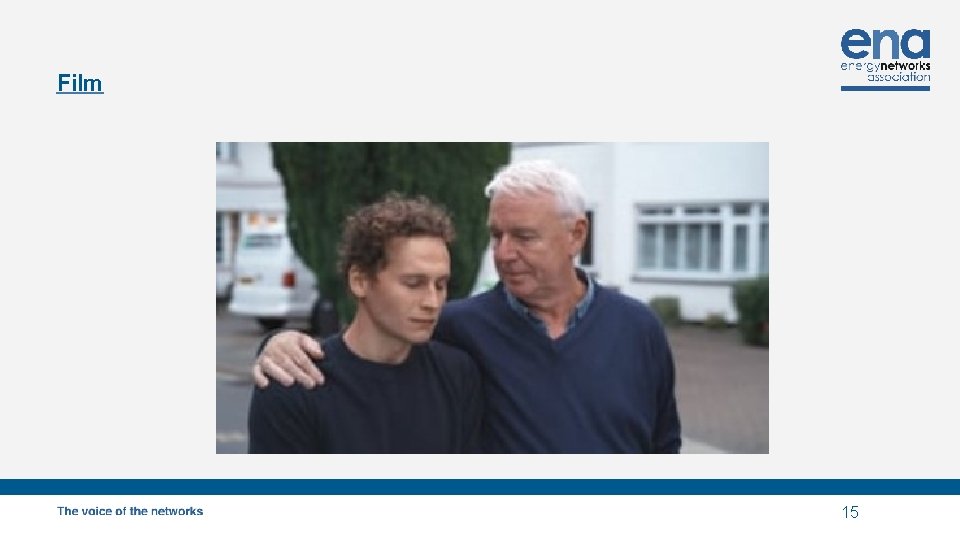
Film ENA has created a thought-provoking film that can be viewed on the campaign page www. energynetworks. org/thinkbeforeyoudig. The film is available to share via ENA’s Vimeo channel vimeo. com/472990801 Stills from the video available on request. 14
Film 15

Quotes from the Energy Networks Association The Energy Networks Association (ENA) is the organisation that represents electricity and gas network operators throughout the UK and Ireland. The following quotes from the ENA have been approved for use in any communications about the Think Before You Dig! campaign. 17
Approved ENA quotes (October 2020) Quote when targeting members of the public Peter Vujanic, Chair of ENAs Public Safety Committee says: “It’s great to see many people wanting to undertake serious DIY projects over the coming months but equally worrying to uncover the lack of basic knowledge needed to carry out this work safely. As we continue to spend more time at home, it’s the perfect opportunity to tackle some of those jobs you may have otherwise been putting off. However, our survey shows a worrying number of people could be at risk of endangering themselves by digging unsafely when doing DIY. “Underground electricity cables often go unnoticed and unthought of, with more than half of UK homeowners having never checked for them before. However, if uncovered or struck, they can be extremely dangerous. That’s why ENA is urging people to think before they dig. You must be aware of what is underground before starting work that involves breaking ground and plan your work accordingly. Stay safe and Think Before You Dig. ” 18
Approved ENA quotes (October 2020) Quote when targeting industry workers Peter Vujanic, Chair of ENA’s Public Safety Committee says: “It’s extremely concerning to hear that even though construction workers are one of the most-at-risk groups of injury involving underground electricity cables, more than one in four fail to check for cables before beginning work. With the proper education and support, these issues can be addressed and, ultimately, lives can be saved. “That is why we have created a new safety film, to help remind tradespeople of the dangers involved when working near underground electricity cables, urging those in construction and similar industries to Think Before You Dig. ” 19
Template press release You can use the press release copy on the following page if you would like to publicly highlight your support for Think Before You Dig! 20
Template press release (October 2020) <Organisation> backs call for public to Think Before You Dig! <Organisation> is supporting a new campaign that aims to reduce the number of injuries caused by striking an underground electricity cable. New research released by Energy Networks Association (ENA) reveals construction workers are risking their lives as nearly a third (31%) fail to check for underground electricity cables when digging on site. Since 2015, an average of 70 people a year are seriously injured as a result of contact with underground electricity cables. Nearly half of all cases (47%) were reported on public highways, construction sites and industrial buildings making tradespeople at extreme risk of serious injury in the workplace. When surveyed, 93% of construction workers and industry professionals believe they always dig safely, yet almost a third (31%) admitted to not always checking for underground electricity cables before beginning work. Underground services can be found and disturbed during street works, road works, excavations, drilling and piling, demolition and site remediation, site investigations and any other work that involves penetrating the ground. These cables can run at any depth below surface level and carry voltages ranging from 230 volts (domestic voltage) and upwards. 21
Template press release (October 2020) cont. Worryingly, almost one in six (15%) say if they uncovered an underground electricity cable encased in concrete, they would attempt to break them out, which could put them at immediate risk of life-threatening injuries. To help prevent the number of fatalities and injuries amongst tradespeople, ENA has launched a new emotive safety film, urging those working in construction to ‘Think Before You Dig’. The thought-provoking film showcases the dangers of working near underground electricity cables, following the story of a construction worker and the devastating emotional and physical impact an accident can have. Peter Vujanic, Chair of ENA’s Public Safety Committee says: “It’s extremely concerning to hear that even though construction workers are one of the most-at-risk groups of injury involving underground electricity cables, more than one in four fail to check for cables before beginning work. With the proper education and support, these issues can be addressed and, ultimately, lives can be saved. That is why we have created a new safety film, to help remind tradespeople of the dangers involved when working near underground electricity cables, urging those in construction and similar industries to Think Before You Dig. ” While a worrying number of construction workers admit to sometimes neglecting health and safety advice when working near underground electricity cables, the majority were confident in what to do when faced with an emergency. In the event of uncovering an underground cable, over half (56%) say they would contact their electricity network operator to ensure they are deenergised. 22
Template press release (October 2020) cont. <Name> from <organisation> said: “We supporting Think Before You Dig! as it’s important to raise awareness of the dangers of underground electricity cables. If workers are prepared, the likelihood of an accident is significantly reduced. Following the simple steps from Energy Networks Association will help ensure that they know not only how to plan ahead and avoid contact with underground electricity cables and gas pipes, but also how to react should contact be made. ” Think Before You Dig: How to stay safe working near underground electricity cables In addition to the short film, ENA has also released a new set of Plan, Scan, Think Before You Dig, life-saving safety guidelines targeted towards industry professionals whose work may take place near underground electricity cables: 1. Plan ahead - Always be mindful of what services lie below ground when digging or excavating. Ask utility companies for plans in advance. 2. Assess the risks - Identify the dangers and hazards associated with excavations and put controls in place to manage them. 3. Scan and locate – Take care when digging, always locate underground cables before digging with the use of cable avoidance tools. 4. First, use your hands – Before using any electric or mechanical excavation tool, you must consider hand-digging trial holes to expose the services 23

Template press release (October 2020) cont. 5. Always assume, that underground cables are live even when damaged. 6. Know who to call - In case of an emergency dial 999 and tell them electricity is involved. Call 105 if you have a safety concern related to the electricity network or if you spot damage to overhead power lines, underground cables and substations that could put you, or someone else, in danger. 7. Think Before You Dig! For more information on underground power lines and how to work safely near them, please visit the Energy Networks Association website at www. energynetworks. org/thinkbeforeyoudig. - Ends - 24
Awareness of underground cables survey results ENA surveyed members of the public and construction workers. Data from the survey is available on the following slide and can be used to support your outreach of the campaign. 25
Underground cables survey results Survey methodology (October 2020) Research carried out by 3 gem on behalf of the Energy Networks Association in October 2020. Total sample size was 1, 000 people across the UK, aged 18 – 65, and 500 tradespeople in the UK working in the following industries: • • Construction Paving Fencing Landscaping 26
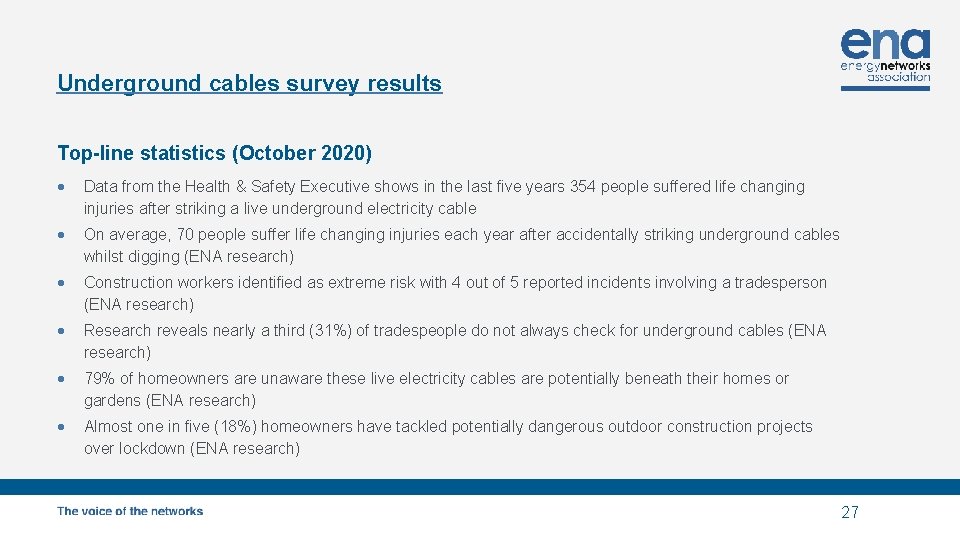
Underground cables survey results Top-line statistics (October 2020) Data from the Health & Safety Executive shows in the last five years 354 people suffered life changing injuries after striking a live underground electricity cable On average, 70 people suffer life changing injuries each year after accidentally striking underground cables whilst digging (ENA research) Construction workers identified as extreme risk with 4 out of 5 reported incidents involving a tradesperson (ENA research) Research reveals nearly a third (31%) of tradespeople do not always check for underground cables (ENA research) 79% of homeowners are unaware these live electricity cables are potentially beneath their homes or gardens (ENA research) Almost one in five (18%) homeowners have tackled potentially dangerous outdoor construction projects over lockdown (ENA research) 27
Email for partner networks We encourage you to circulate the email copy on the following page to your partner networks to explain the campaign and generate further support. 28
Email for partner networks Email subject: Think Before You Dig! to reduce underground cable incidents Dear <<insert contact name>>, <<Insert any relevant background info of conversations with the email recipient, e. g. ‘Good speaking to you earlier. As promised, here is an email to explain more about the campaign and how you might be able to help. ’>> We’ve partnered with the Energy Networks Association (ENA) to launch its new Think Before You Dig! campaign, to raise awareness of the risks of underground dangers such as electricity cables and gas pipes and encourage anyone undertaking work that involves digging to Plan, Scan, Think Before You Dig! Why? Every year around 70 people in the UK are seriously injured from striking an underground electricity cable whilst digging. Nearly half of all cases (47%) were reported on public highways, construction sites and industrial buildings making tradespeople at extreme risk of serious injury in the workplace. 29
Email for partner networks cont. Houses, offices, shops, factories and street furniture all have electric cables supplying them. The cables carry voltages ranging from 230 volts (domestic voltage) and above. Even domestic voltage cables can be fatal and can be buried outside homes and in driveways. The risk of danger can be considerably reduced by following some simple safety tips. Here at the <<insert organisation>> we want to help reduce incidents and we would really value your help as an official stakeholder in this campaign. We’re urging as many people as possible to be aware of the dangers of underground cables. A new film has been created to do just that, which you can view here at www. energynetworks. org/thinkbeforeyoudig. We would really value your support in disseminating information to your <<members/staff/members and staff>> and general contacts, who can further distribute this across your channels. We’ve prepared a stakeholder toolkit to help you share information simply and easily. All materials can be accessed via the ENA website at www. energynetworks. org/thinkbeforeyoudig. 30
Email for partner networks cont. You can get involved Use the copy and images provided to: • Share the new Think Before You Dig! film on your social media channels or internally with staff via email • Share image stills and shorter video content on your social channels • Send the Plan, Scan, Think Before You Dig! safety tips to anyone that they are relevant to Our goal is ultimately to help save lives by both raising awareness of the dangers of underground cables as well as the official safety advice for anyone undertaking work that involves breaking the ground. If you have any questions at all, please don’t hesitate to drop me an email or give me a call on <<insert phone number>>. Thank you very much in advance for any support you’re able to provide. Kind regards, <<insert name>> 31

Additional data and information ENA online public safety information • www. energynetworks. org/keeping-you-safe • www. energynetworks. org/watch-out-cables-about Additional reading • Health & Safety Executive advice on avoiding dangers when working near underground utilities www. hse. gov. uk/pubns/books/hsg 47. htm • Utility strike avoidance website www. utilitystrikeavoidancegroup. org • Linesearch ‘Before U Dig’ website www. linesearchbeforeudig. co. uk 32

Energy Networks Association 4 More London Riverside London SE 1 2 AU t. +44 (0)20 7706 5100 @Energy. Networks energynetworks. org © ENA 2020 Energy Networks Association Limited is a company registered in England & Wales No. 04832301 Registered office: 4 More London Riverside, London SE 1 2 AU
- Slides: 33