
Think about the following questions and write down

Think about the following questions and write down your answers to each one. 1. What do you think are the biggest challenges facing teachers in terms of time management? 2. What do you feel are common causes of distractions for you as a teacher? 3. Can teachers actually do their job without experiencing excessive stress? If not, why not? If so, how? 4. If you were mentoring a newly qualified teacher, what 3 time management tips would you give them? 5. Could you outline your routine or system that you use to help manage your time?
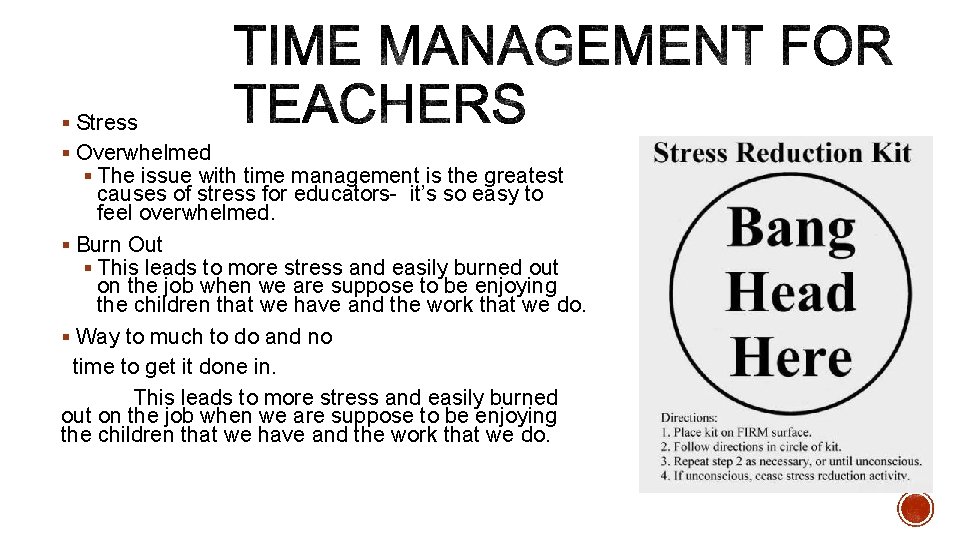
§ Stress § Overwhelmed § The issue with time management is the greatest causes of stress for educators- it’s so easy to feel overwhelmed. § Burn Out § This leads to more stress and easily burned out on the job when we are suppose to be enjoying the children that we have and the work that we do. § Way to much to do and no time to get it done in. This leads to more stress and easily burned out on the job when we are suppose to be enjoying the children that we have and the work that we do.
§ As a teacher, you need to manage three specific elements to your day: § Structured work time; which is your lesson plans, scheduled meetings, etc. …. . § Unstructured work time; which is your plans, prep time, and assessment § Then Your time § The next slide gives you a visual of the following information § Every one understands Zone 1 and what it entails so now we look at Zone 2. § Zone 2 is your small amount of time that you have to get a whole lot of things done. § Then comes Zone 3; which is your time or should be your time. § The big question is how do you manage the move from zone 2 to zone 3? § When and where does work stop and personal life begins? § Lets look at Zone 2 § When you plan, prepare, assess students work, make displays, organize paper work or any of the other jobs you do, your in zone 2. § This raises 2 questions: § How much do you do? § How well do you do it?
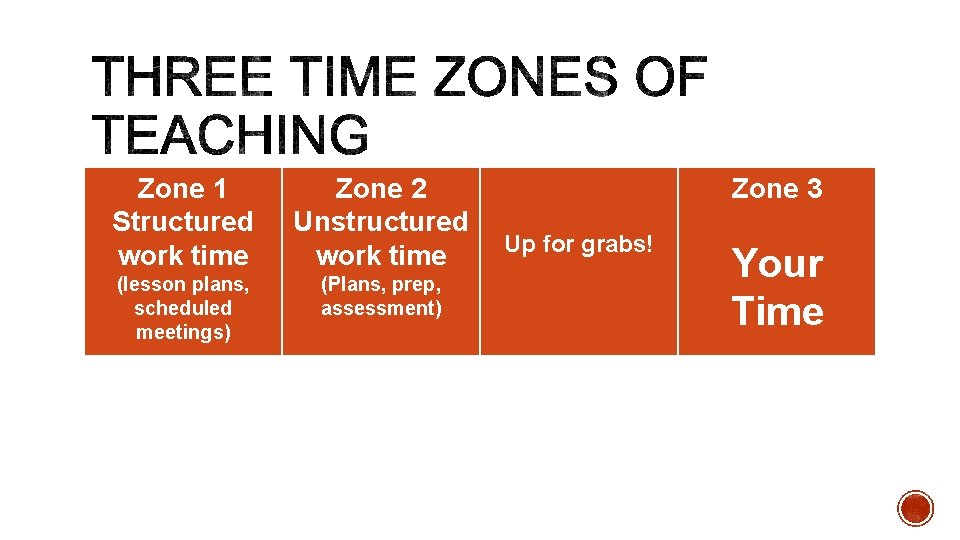
Zone 1 Structured work time Zone 2 Unstructured work time (lesson plans, scheduled meetings) (Plans, prep, assessment) Zone 3 Up for grabs! Your Time
§ Make time to plan your day. § Preferably take 10 minutes out of the end of the day to prepare for the next day of what needs to be done during zone 2 time. You can wait till the next morning but this should be the very first thing that you do if you wait till that day. § Doing this will really help you take control. § You decide on how you use your time not other people. § Break it down into chunks of time. § Work on tasks that you have to, or want to do. § Break it down into increments of time that suites you. 30 minutes or so. § Work on that goal for the allotted time and then move on to the next. § It’s ok that its not finished!!!! § Taking work home § Evenings and weekends have their own zone 2 times § There is usually less time available than it seems when we say, ” I’ll do it tonight”. How much time do you have left in an evening after you’ve done all you need to do? § Planning to work at home means Zone 2 time in school is less valued § There are more reasons to procrastinate during the day if you say I’ll do it at home. You are limiting zone 2 time each day and it is probably less than you think.
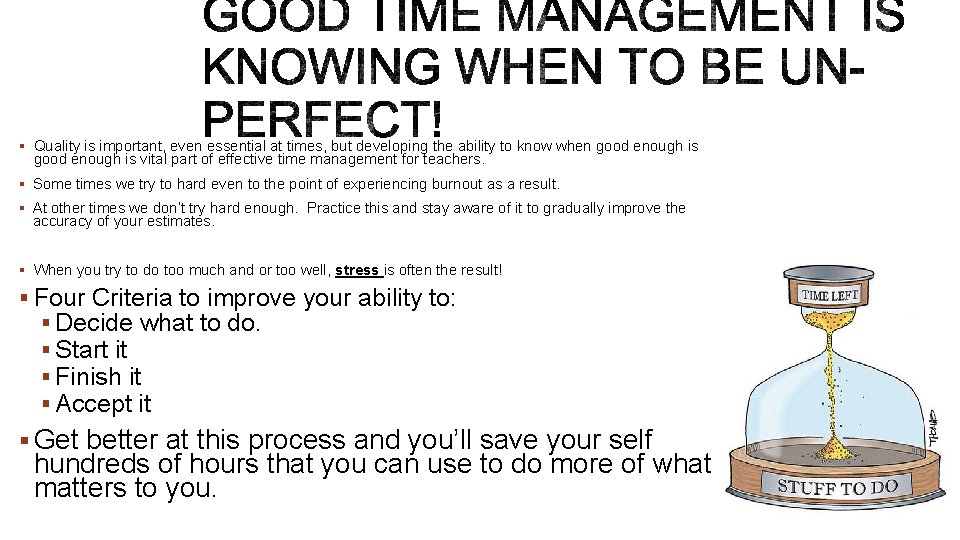
§ Quality is important, even essential at times, but developing the ability to know when good enough is vital part of effective time management for teachers. § Some times we try to hard even to the point of experiencing burnout as a result. § At other times we don’t try hard enough. Practice this and stay aware of it to gradually improve the accuracy of your estimates. § When you try to do too much and or too well, stress is often the result! § Four Criteria to improve your ability to: § Decide what to do. § Start it § Finish it § Accept it § Get better at this process and you’ll save your self hundreds of hours that you can use to do more of what matters to you.
§ The 80/20 rule or the “Pareto Principle” § The 80/ 20 rule or the “Pareto Principle” is based on the idea that a relatively small percentage of any cause (20%) creates most of the subsequent effects (80%). § What every task, project, role or goal you have, tackle it with the 80/20 rule in mind. § Five step sequence: 1. Start with the end. What is the outcome that you want? 2. When your clear about that, break it down into the actions you need to take to get there. 3. Do the actions in the most accurate order you can. 4. Keep asking what’s the next relevant action step to take 5. Repeat until complete. Your entire to do list is the 20% that produces 80% or more of results.
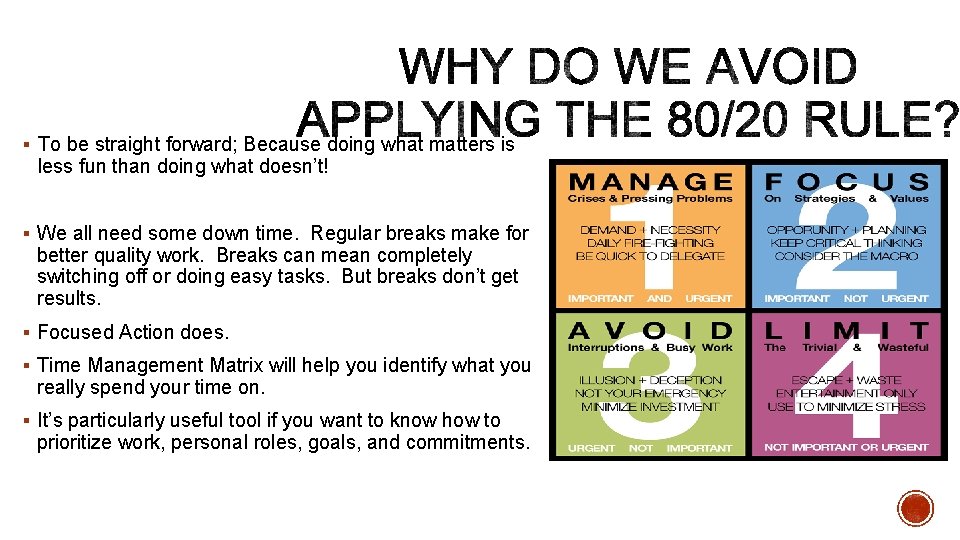
§ To be straight forward; Because doing what matters is less fun than doing what doesn’t! § We all need some down time. Regular breaks make for better quality work. Breaks can mean completely switching off or doing easy tasks. But breaks don’t get results. § Focused Action does. § Time Management Matrix will help you identify what you really spend your time on. § It’s particularly useful tool if you want to know how to prioritize work, personal roles, goals, and commitments.
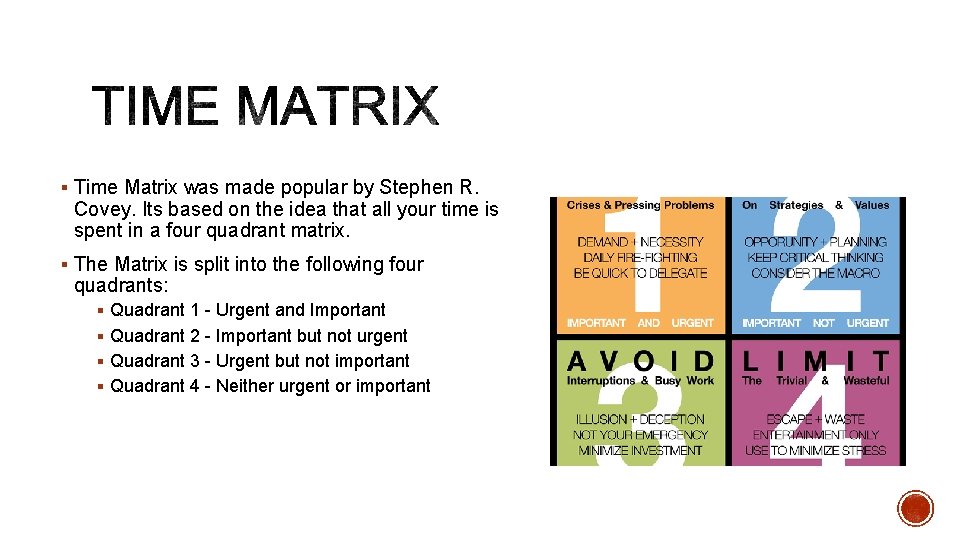
§ Time Matrix was made popular by Stephen R. Covey. Its based on the idea that all your time is spent in a four quadrant matrix. § The Matrix is split into the following four quadrants: § Quadrant 1 - Urgent and Important § Quadrant 2 - Important but not urgent § Quadrant 3 - Urgent but not important § Quadrant 4 - Neither urgent or important
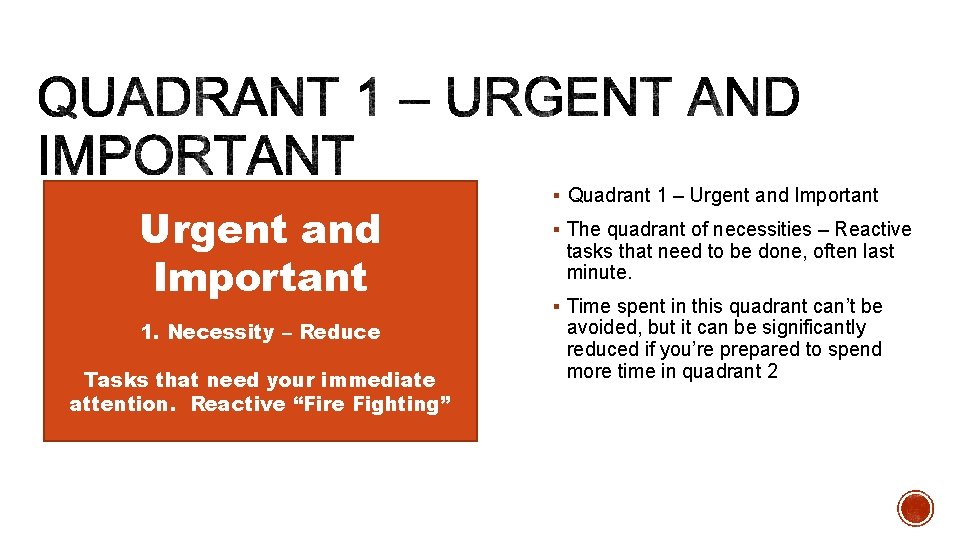
Urgent and Important 1. Necessity – Reduce Tasks that need your immediate attention. Reactive “Fire Fighting” § Quadrant 1 – Urgent and Important § The quadrant of necessities – Reactive tasks that need to be done, often last minute. § Time spent in this quadrant can’t be avoided, but it can be significantly reduced if you’re prepared to spend more time in quadrant 2
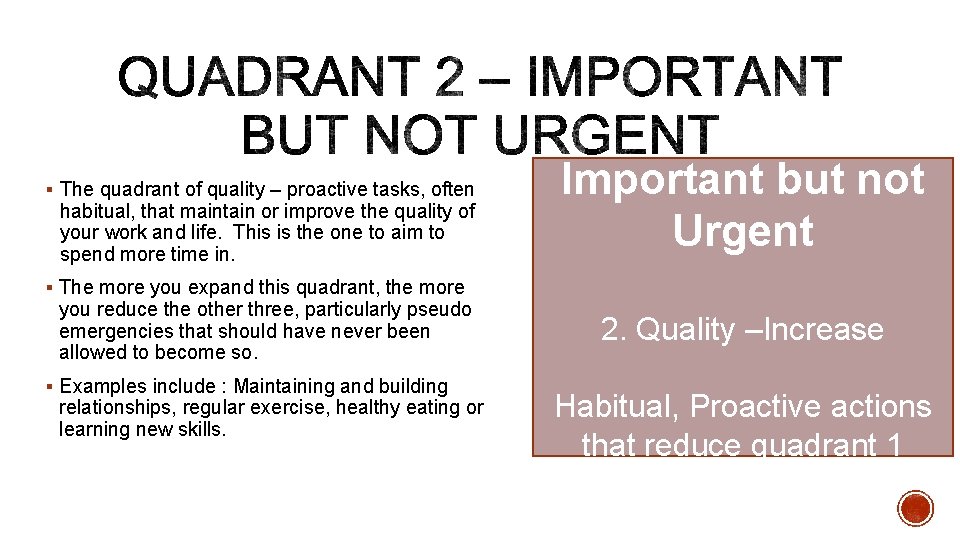
§ The quadrant of quality – proactive tasks, often habitual, that maintain or improve the quality of your work and life. This is the one to aim to spend more time in. Important but not Urgent § The more you expand this quadrant, the more you reduce the other three, particularly pseudo emergencies that should have never been allowed to become so. § Examples include : Maintaining and building relationships, regular exercise, healthy eating or learning new skills. 2. Quality –Increase Habitual, Proactive actions that reduce quadrant 1
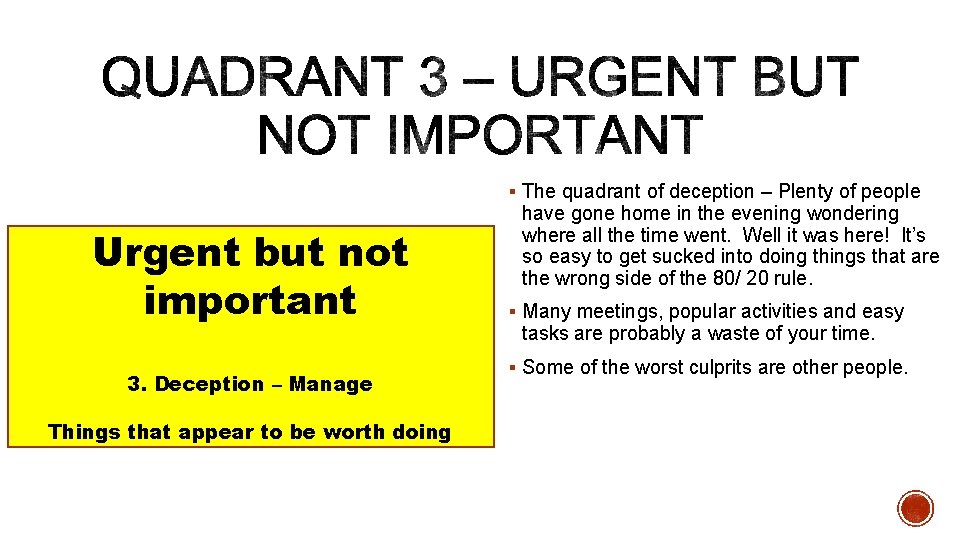
§ The quadrant of deception – Plenty of people Urgent but not important 3. Deception – Manage Things that appear to be worth doing have gone home in the evening wondering where all the time went. Well it was here! It’s so easy to get sucked into doing things that are the wrong side of the 80/ 20 rule. § Many meetings, popular activities and easy tasks are probably a waste of your time. § Some of the worst culprits are other people.
§ The quadrant of waste – you know what it is and you know when you’ve been in it. § The trick is to know when you’re in it. § Often, it starts out as restful time § Then the tipping point comes when you spend too long doing mindless things. § Wasting time is inevitable, but there are strategies that will help you waste less. Neither Urgent or Important 4. Waste – Avoid Time Wasting Activities
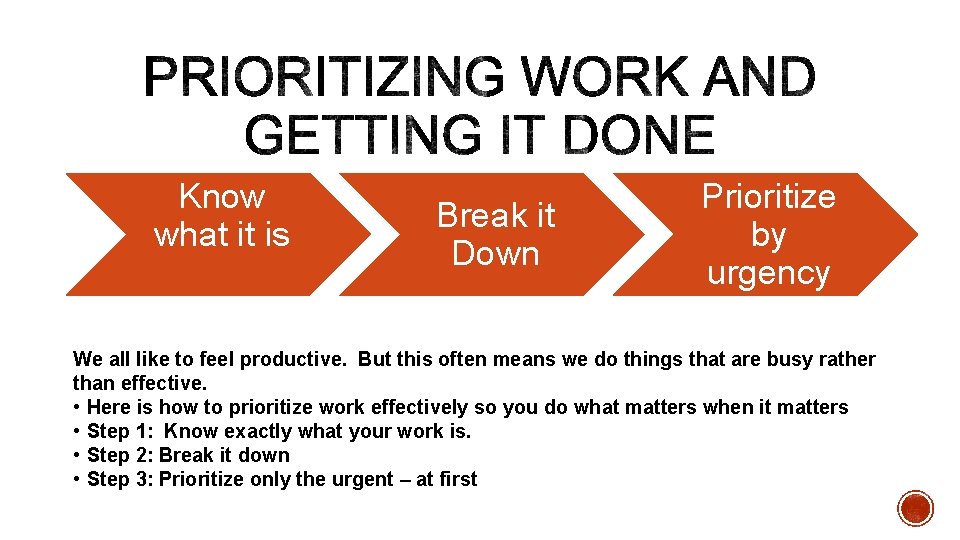
Know what it is Break it Down Prioritize by urgency We all like to feel productive. But this often means we do things that are busy rather than effective. • Here is how to prioritize work effectively so you do what matters when it matters • Step 1: Know exactly what your work is. • Step 2: Break it down • Step 3: Prioritize only the urgent – at first
§ Step 1: Know exactly what your work is. § Know what your work consist of § Make a list of everything you want to do, along with any deadlines you have. Don’t rely on your memory – get it out of your head and onto paper § This is for two solid reasons: 1. It prevents good ideas and intentions from floating away 2. The act of writing reduces the emotion and enhances the rational. In other words, writing things down forces you to ask yourself if it really is important. § You only have to list things that you want to do but could forget. Know exactly what your work is
§ Once you know what you want to do, you’ll notice that your list consist of three types of work: 1. Single Tasks 2. Recurring Tasks 3. Projects § Single Tasks § Do these tomorrow. § Yep that’s right. Tomorrow. This method of learning how to prioritize work is based on Mark Fosters DO it § § § § § tomorrow time management system. Draw a line under your list of outstanding single tasks. This is your back log. Every day, work on your finite backlog of outstanding single tasks. Start with the tasks that you deem to be most urgent. Chip away at the list daily for as long as you want. With each passing day the back log will be reduced. Within a few days you will have it clear. From today, schedule any tasks for the following day ( unless they are genuinely same day urgent). List them in under the next days date in your daily task diary. This will give you a finite list of tasks to do for the next day. Tomorrow, do those tasks. Based on all the factors at the moment of choice ( urgency, importance, time available, location, motivation, energy levels, etc. ) Which task do you want to do first? Do it, cross it off your list, then pick the next one. Your aim is to always work on that day’s scheduled tasks. If you don’t manage to complete one, add it to the following days list. SO AS A RULE OF THUMB, SINGLE TASKS GET DONE THE DAY AFTER THEY APPEAR!!!
§ Recurring tasks § Do what suits you when it suits you § Some tasks will appear on a regular, even daily basis, such as email, paper work, etc. § Should you bother listing these every day in your task diary? § There is no hard and fast rule here. If it helps you ensure you’ll do them, do so. § Projects § Do one at a time (as far as possible) § These consist of anything you consider to be more complex and time consuming than a task § List all yours, then choose a current project based on urgency, importance and impact. § Work on it daily for as long as you can. § Focus on finishing one project before you start the next. § The key is knowing how to prioritize work such as this is to set aside time each day to work on it. Dedicate some time every day until it’s done before you start the next one. Break it down
§ Much advice on how to prioritize work advocates ordering all yours tasks by A, B, or C or some other number / letter method. § DON”T § Why? Because it’s hard to motivate your self for C tasks – they just don’t seem important. In any case, left long enough those C tasks have a nasty habit of becoming urgent issues any way. Prioritize by Urgency
§ If things are on your list, you put them there because they do matter. § Instead, start by prioritizing only things that are deadline driven, particularly if something on your list is for today or tomorrow. § Everything Else? § Give it equal value and do it according to where you are and how you feel. This gives you a real sense of freedom and flexibility when it comes to the moment of choice. § Eventually you’ll get to the point at which you habitually do things as they show up, not when they blow up. Prioritizing by urgency becomes less of an issue because less is urgent.
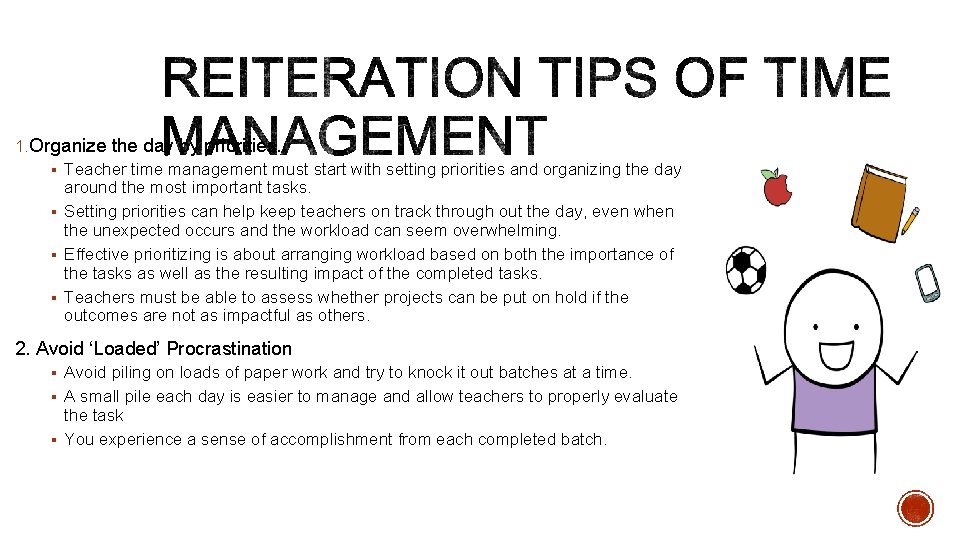
1. Organize the day by priorities. § Teacher time management must start with setting priorities and organizing the day around the most important tasks. § Setting priorities can help keep teachers on track through out the day, even when the unexpected occurs and the workload can seem overwhelming. § Effective prioritizing is about arranging workload based on both the importance of the tasks as well as the resulting impact of the completed tasks. § Teachers must be able to assess whether projects can be put on hold if the outcomes are not as impactful as others. 2. Avoid ‘Loaded’ Procrastination § Avoid piling on loads of paper work and try to knock it out batches at a time. § A small pile each day is easier to manage and allow teachers to properly evaluate the task § You experience a sense of accomplishment from each completed batch.
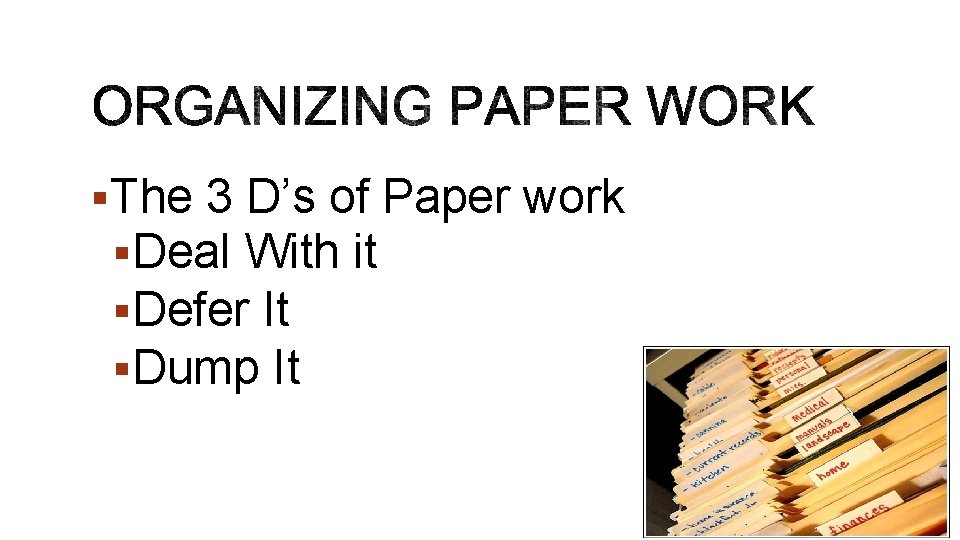
§The 3 D’s of Paper work §Deal With it §Defer It §Dump It
§ There is a limit to how much paper work you can process in one day. The best way to tackle it? One day at a time. More specifically, deal with one day’s worth of paper work each day- the day after you receive it. § Follow these steps to help you organize: 1. Deal with it. § It needs to be actioned? If it’s a bill, pay it; an invoice, file it. What ever it is, do something with it. Even reading material with no deadline gets read. If you can’t, don’t or won’t, it gets recycled into your capture tray. 2. Defer it. § Somethings can’t be dealt with until a later date. Defer them by putting them into a hanging file which corresponds to the date. Have 31 hanging files; one for each day of the month. Put tickets, meeting agenda or what ever it is you have to do in the file for that date. 3. Dump It. § Even with a pre put in filter, some junk will make it into your capture tray, and will certainly be in your back log. Bin it. § When to organize it § In stead of batch it. Make paperwork a priority at certain times. § Go through it at the start and end of the day. In between, aim to allocate a block of time to deal with it.
1. Know what matters to you 14. Ask others 2. Know your roles 3. Know your goals 15. Make the most of your most productive points in the day 4. Track your time 5. Set length limits on lists 6. Set time limits on actions 7. Plan you time 8. What’s the next action 9. Apply the 80/20 rule 10. Do what matter 11. Do less 12. Fill the gaps 13. Time Box it 16. Delegate 17. Do one task at a time 18. Fit the task to the time 19. Do the hardest task first 20. Capture 21. Keep a clean desk 22. Ready – Fire – Aim 23. Aim for good enough 24. Know what he end actually is 25. For the moment 26. Justify the end
1. Focus on changing bad habits one at a time. § Changing bad habits takes awareness and concentration, but this can soon become diluted if you attempt to tackle more than one at a time § Focus your efforts on the one habit you’ve decided to change and see it through to the end. 2. Become aware of it § You need to know it’s a bad habit before you can replace it. How do you do this? Well, a little thought and reflection go a long way, but the bottom line is the results your getting. § Analyze the effects of your way of working. Try keeping a time log to help you identify how you use your time. § You have to recognize that a habit is harmful. If you don’t what reason will there be to change anything?
§ Decide to replace it § We all have bad habits that we are aware of. For some reason we keep repeating them § Commit to your decision § You’ve identified a bad habit and you know what you want to do instead. Now comes the hard part § Motivation Putting it into Practice § Change gradually § Try doing to much to soon is a recipe for failure. It’s not necessary to completely change a habit in one go. § Do it daily § What ever new habit you want to form, doing it consistently is crucial. A good way to ensure you do this is to create a dot link page. Every day you do your new habit, join the dots § Put a limit on it § The though of changing a bad habit permanently can be overwhelming. § One way round this is to trial a habit. The general consensus of opinion is that a habit takes around 30 days to form.
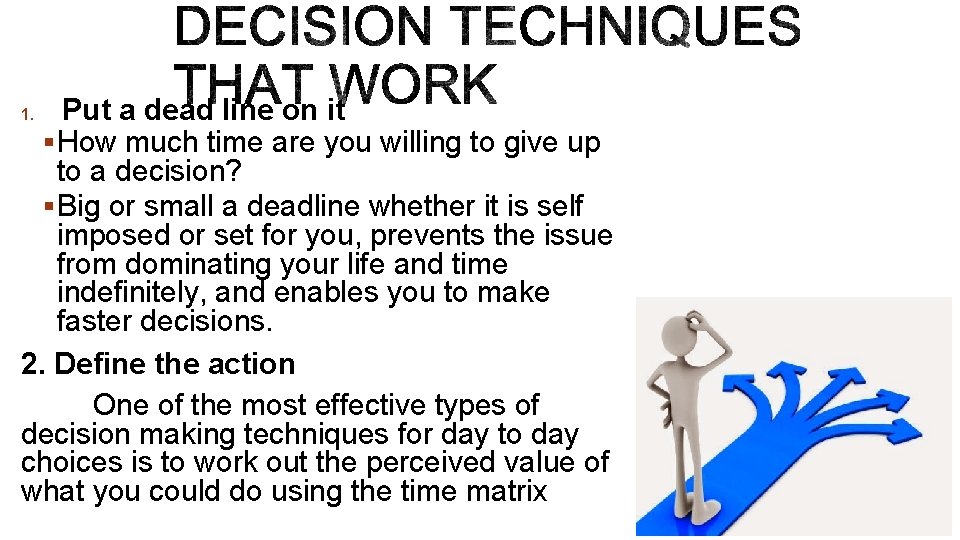
Put a dead line on it § How much time are you willing to give up to a decision? § Big or small a deadline whether it is self imposed or set for you, prevents the issue from dominating your life and time indefinitely, and enables you to make faster decisions. 2. Define the action One of the most effective types of decision making techniques for day to day choices is to work out the perceived value of what you could do using the time matrix 1.
3. Quantify the choices § Rate each of the factors effecting the options facing you. § Total them up to see which option outweighs the other. 4. Reframe from the way you look at the decision § One of the most effective types of decisions making techniques you can master is a different perspective on the situation. § The types of decision making techniques that are rooted in rationality have their uses, consult your institution- what do you feel about your choices.
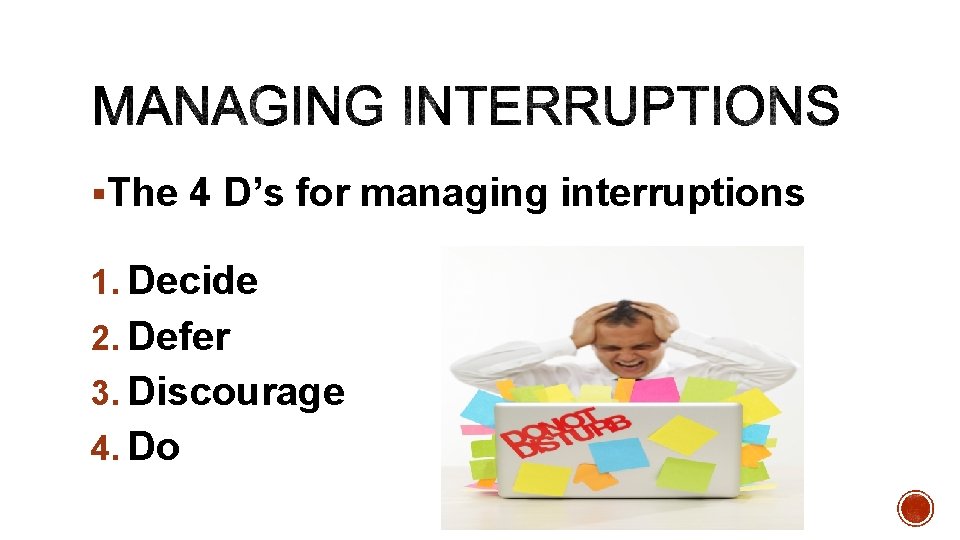
§The 4 D’s for managing interruptions 1. Decide 2. Defer 3. Discourage 4. Do
1. Decide § Some work needs 100% focus. When are you least likely to be disturbed? That’s time to do it. § For example, creating a website – this takes up most devoted attention. Do it when you are most likely not to be disturbed. 2. Defer § Fee Brave? Just say No. § Soften it with an offer to meet up later, then agree a time and stick to it; remember people judge punctuality. 3. Discourage § You can pre-empt a lot of interruptions with out even speaking. § People notice body language § Think about eye contact, posture and position before someone thinks about interrupting you. § Think you don’t know how to do this? You did it at school when the teacher asked the class a question and you didn’t want to be the one picked for the answer. 4. Do § If their ‘sales pitch’ is good enough, you may choose to listen. If they talk to long, stand up, move nearer the exit. § Another way is to break rapport. Reduce eye contact or stand rather than sit.
§ “SUCCESS IS THE SUM OF SMALL EFFORTS REPEATED DAY IN, DAY OUT!” § Robert Collier § Over coming procrastination is possible if you learn and live one simple, powerful technique. §Make it easier §Many Small actions keeps you motivated
§ Yes that is right Make it easier!!!!!! § Any role, goal, project, or action you procrastinate on will be completed if you do a little a lot! Do something daily, however small, and you’ll keep moving on with it. § The secret § Take action regularly § Reduce the resistance you feel § Regular focused action will take you to a tipping point. This is the point at which you feel on top of things or you achieved it. § Every time you achieve a quick win by taking some sort of action, you feel a sense of achievement, and you actually look forward to moving on with it again.
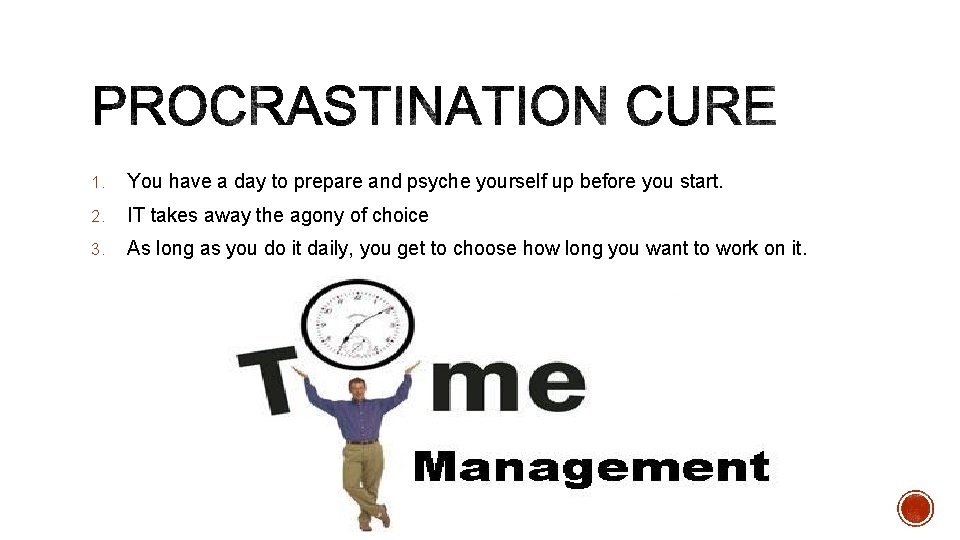
1. You have a day to prepare and psyche yourself up before you start. 2. IT takes away the agony of choice 3. As long as you do it daily, you get to choose how long you want to work on it.
§ How this works § Your given a project. Your asked on Tuesday to produce a report with a deadline two weeks later. 1. You have a day to prepare a psyche yourself up before you start. § This eliminates or at least significantly reduces, knee jerk reactions to incoming work. 2. It takes away the agony of choice § You don’t have to decide whether to work on an open project or not. You just get on with it each day for as long as you want. 3. As long as you do it daily, you get to choose how long you want to work on it. § Obviously, five minutes a day probably wouldn’t be enough. But commit to doing what you can face doing on a daily basis and you’ll boost your ability to get things done. This may mean 10 minutes one day and 90 the next. § Over coming procrastination is all about breaking down your projects into manageable bite sized chunks small enough for you to face doing them. § So how much you do is not as important as the fact that you actually do something daily. Keep the ball rolling on your project until it’s finished. § This solution provides a framework and a choice. It won’t do the work for you, but it certainly helps you get the work done.

- Slides: 35