
Think About It Explain the impact of work

Think About It } Explain the impact of work, exchange, and technology on American progress during the Era of Good Feelings.

Era of Good Feelings Unit 3 B AP U. S. History
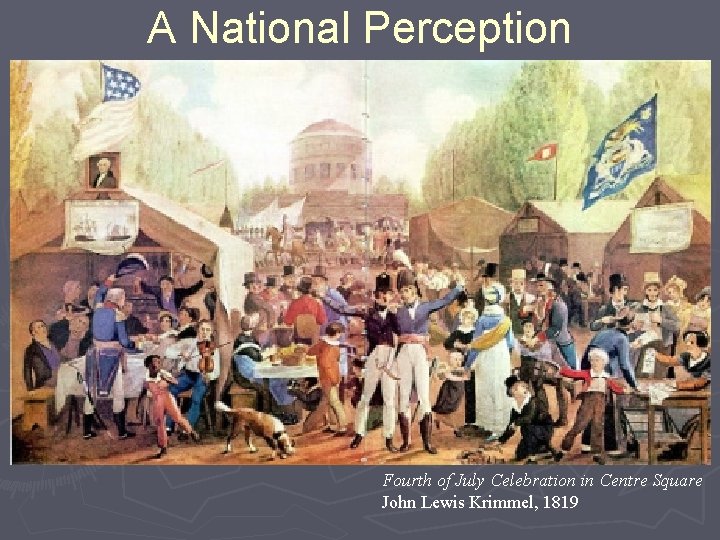
A National Perception Fourth of July Celebration in Centre Square John Lewis Krimmel, 1819
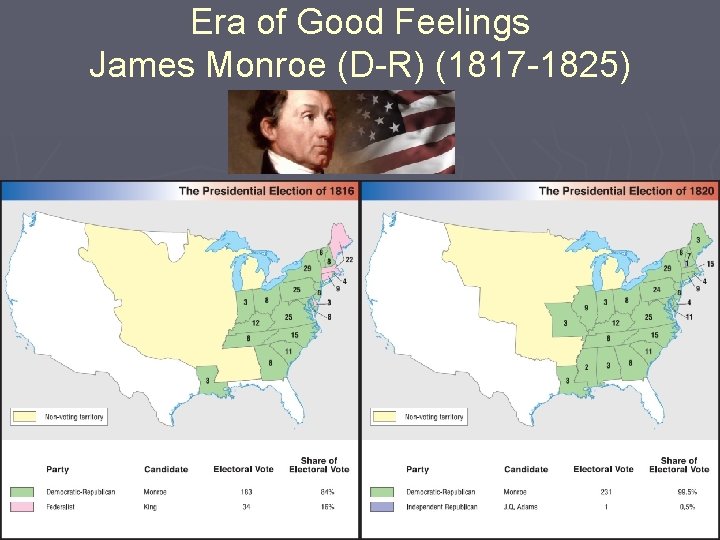
Era of Good Feelings James Monroe (D-R) (1817 -1825)
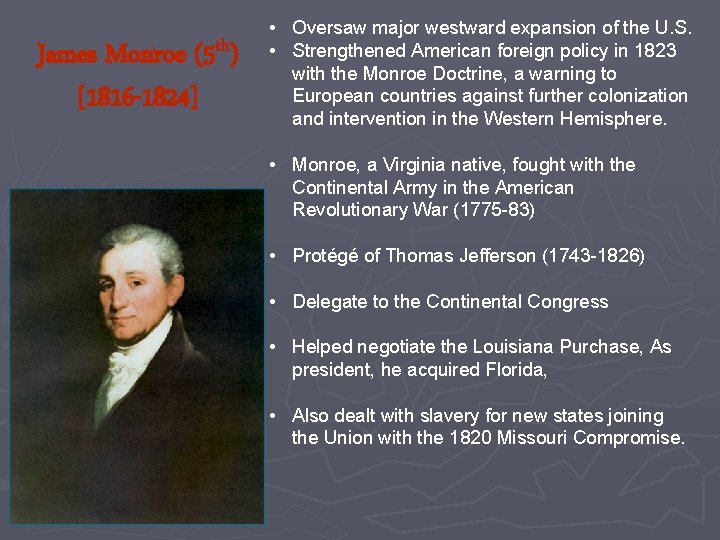
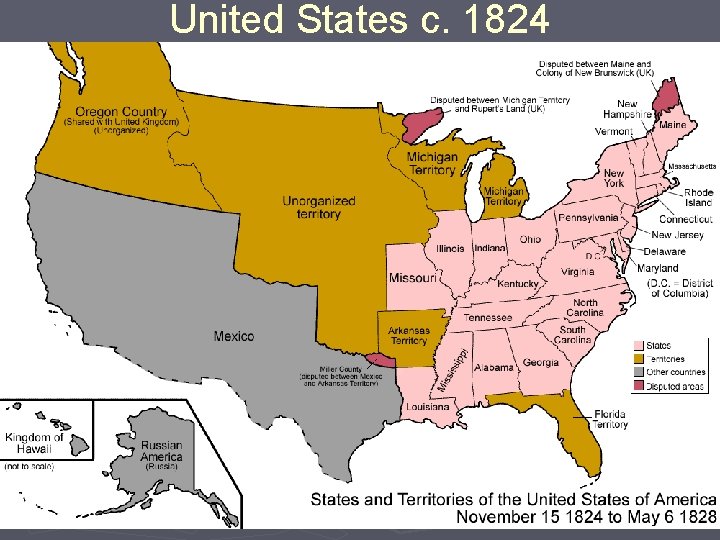
James Monroe (5 th) [1816 -1824] • Oversaw major westward expansion of the U. S. • Strengthened American foreign policy in 1823 with the Monroe Doctrine, a warning to European countries against further colonization and intervention in the Western Hemisphere. • Monroe, a Virginia native, fought with the Continental Army in the American Revolutionary War (1775 -83) • Protégé of Thomas Jefferson (1743 -1826) • Delegate to the Continental Congress • Helped negotiate the Louisiana Purchase, As president, he acquired Florida, • Also dealt with slavery for new states joining the Union with the 1820 Missouri Compromise.
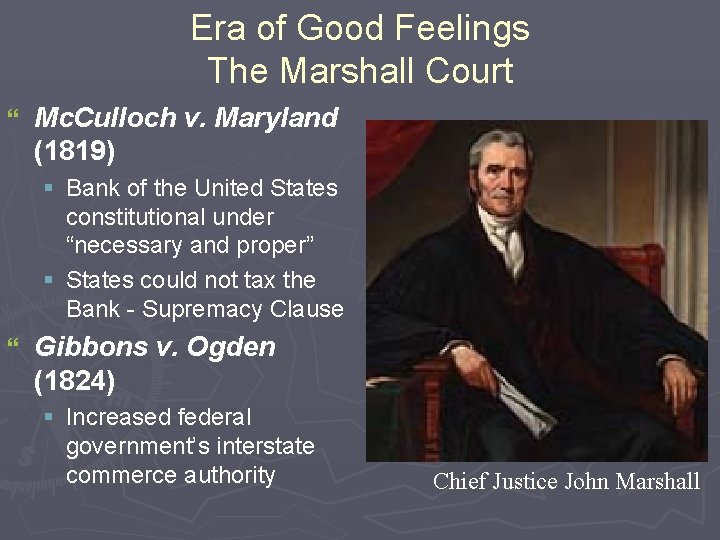
Era of Good Feelings The Marshall Court } Mc. Culloch v. Maryland (1819) § Bank of the United States constitutional under “necessary and proper” § States could not tax the Bank - Supremacy Clause } Gibbons v. Ogden (1824) § Increased federal government’s interstate commerce authority Chief Justice John Marshall
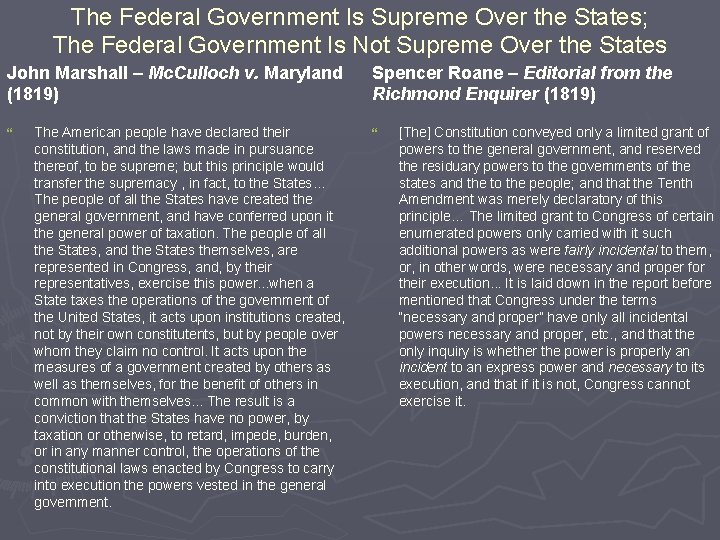
The Federal Government Is Supreme Over the States; The Federal Government Is Not Supreme Over the States John Marshall – Mc. Culloch v. Maryland (1819) } The American people have declared their constitution, and the laws made in pursuance thereof, to be supreme; but this principle would transfer the supremacy , in fact, to the States… The people of all the States have created the general government, and have conferred upon it the general power of taxation. The people of all the States, and the States themselves, are represented in Congress, and, by their representatives, exercise this power. . . when a State taxes the operations of the government of the United States, it acts upon institutions created, not by their own constitutents, but by people over whom they claim no control. It acts upon the measures of a government created by others as well as themselves, for the benefit of others in common with themselves. . . The result is a conviction that the States have no power, by taxation or otherwise, to retard, impede, burden, or in any manner control, the operations of the constitutional laws enacted by Congress to carry into execution the powers vested in the general government. Spencer Roane – Editorial from the Richmond Enquirer (1819) } [The] Constitution conveyed only a limited grant of powers to the general government, and reserved the residuary powers to the governments of the states and the to the people; and that the Tenth Amendment was merely declaratory of this principle… The limited grant to Congress of certain enumerated powers only carried with it such additional powers as were fairly incidental to them, or, in other words, were necessary and proper for their execution. . . It is laid down in the report before mentioned that Congress under the terms “necessary and proper” have only all incidental powers necessary and proper, etc. , and that the only inquiry is whether the power is properly an incident to an express power and necessary to its execution, and that if it is not, Congress cannot exercise it.
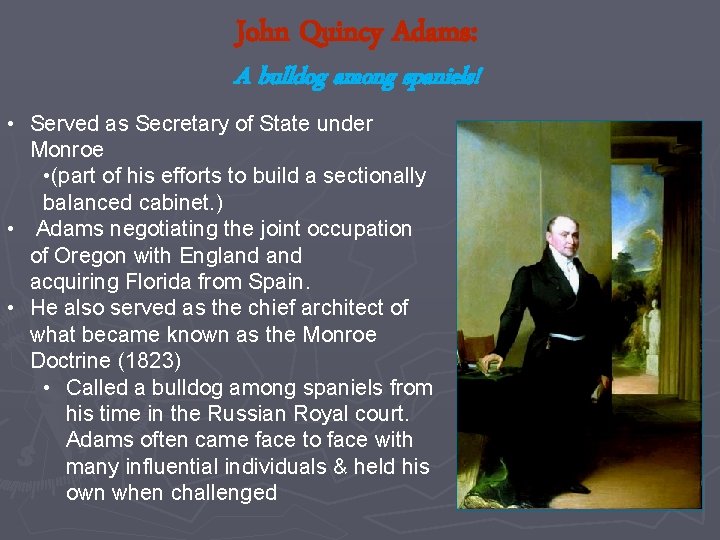
John Quincy Adams: A bulldog among spaniels! • Served as Secretary of State under Monroe • (part of his efforts to build a sectionally balanced cabinet. ) • Adams negotiating the joint occupation of Oregon with England acquiring Florida from Spain. • He also served as the chief architect of what became known as the Monroe Doctrine (1823) • Called a bulldog among spaniels from his time in the Russian Royal court. Adams often came face to face with many influential individuals & held his own when challenged
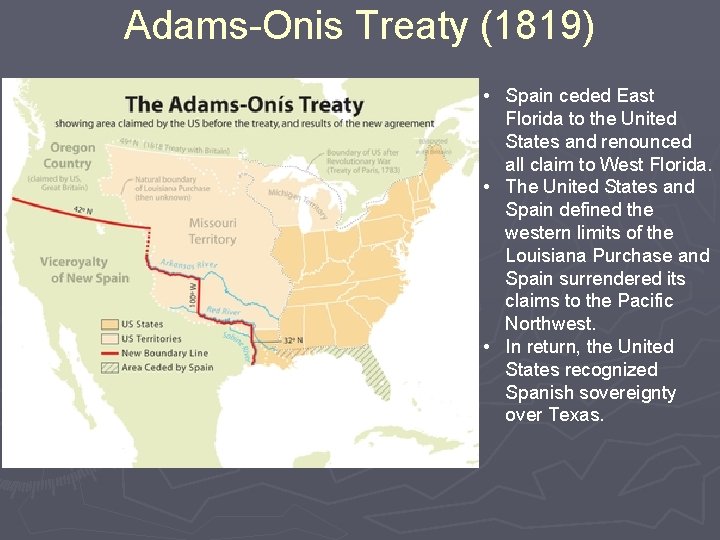
Adams-Onis Treaty (1819) • Spain ceded East Florida to the United States and renounced all claim to West Florida. • The United States and Spain defined the western limits of the Louisiana Purchase and Spain surrendered its claims to the Pacific Northwest. • In return, the United States recognized Spanish sovereignty over Texas.
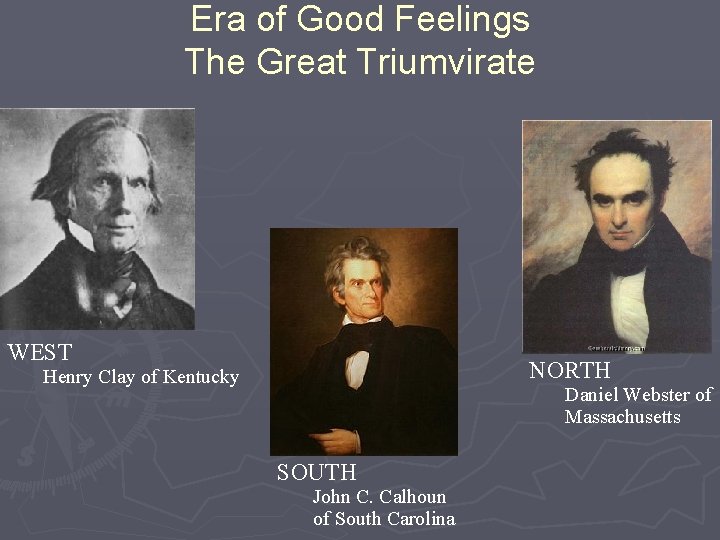
Era of Good Feelings The Great Triumvirate WEST NORTH Henry Clay of Kentucky Daniel Webster of Massachusetts SOUTH John C. Calhoun of South Carolina
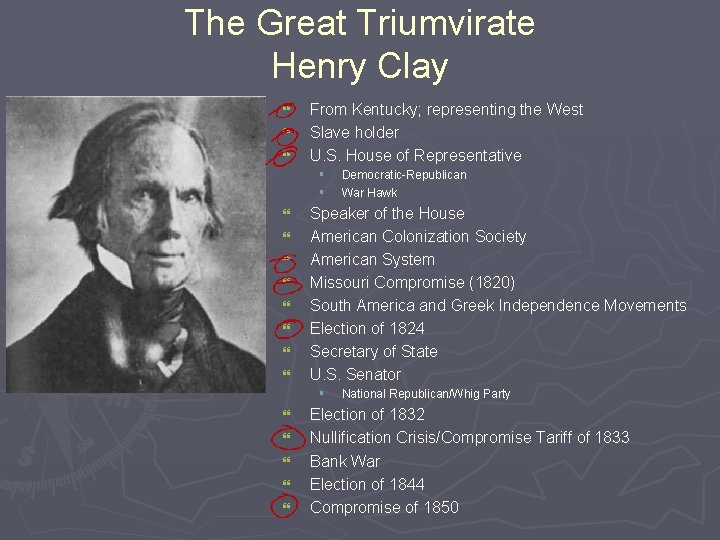
The Great Triumvirate Henry Clay } } } From Kentucky; representing the West Slave holder U. S. House of Representative § § } } } } Speaker of the House American Colonization Society American System Missouri Compromise (1820) South America and Greek Independence Movements Election of 1824 Secretary of State U. S. Senator § } } } Democratic-Republican War Hawk National Republican/Whig Party Election of 1832 Nullification Crisis/Compromise Tariff of 1833 Bank War Election of 1844 Compromise of 1850
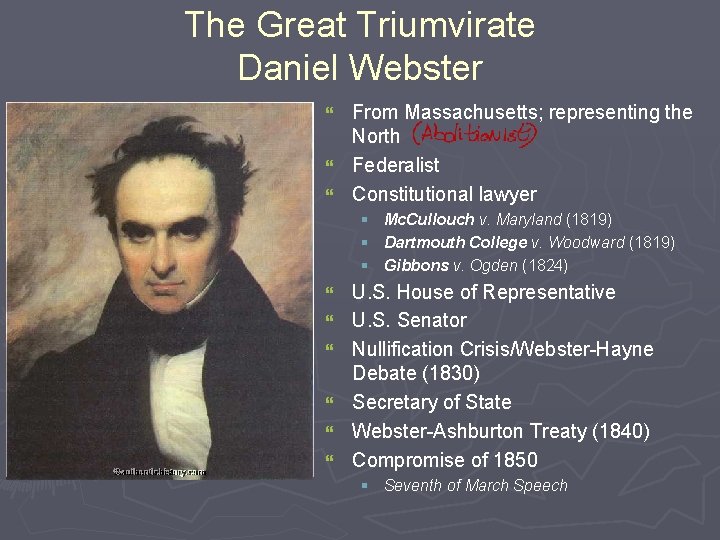
The Great Triumvirate Daniel Webster From Massachusetts; representing the North } Federalist } Constitutional lawyer } § § § } } } Mc. Cullouch v. Maryland (1819) Dartmouth College v. Woodward (1819) Gibbons v. Ogden (1824) U. S. House of Representative U. S. Senator Nullification Crisis/Webster-Hayne Debate (1830) Secretary of State Webster-Ashburton Treaty (1840) Compromise of 1850 § Seventh of March Speech
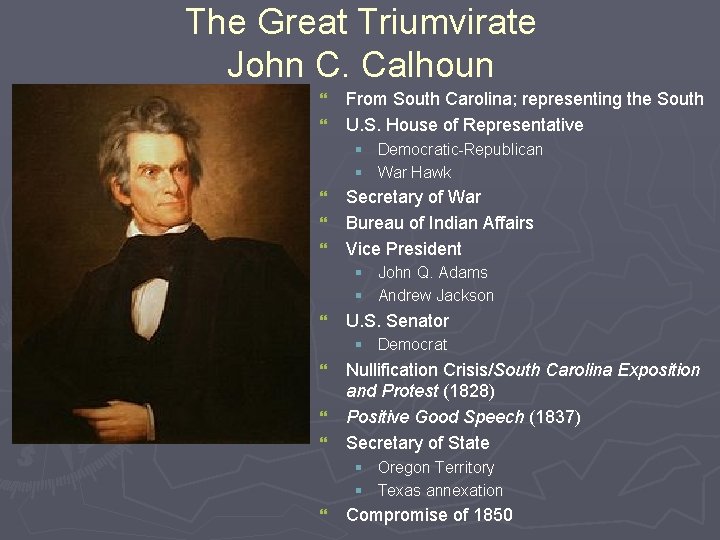
The Great Triumvirate John C. Calhoun } } From South Carolina; representing the South U. S. House of Representative § Democratic-Republican § War Hawk } } } Secretary of War Bureau of Indian Affairs Vice President § John Q. Adams § Andrew Jackson } U. S. Senator § Democrat } } } Nullification Crisis/South Carolina Exposition and Protest (1828) Positive Good Speech (1837) Secretary of State § Oregon Territory § Texas annexation } Compromise of 1850
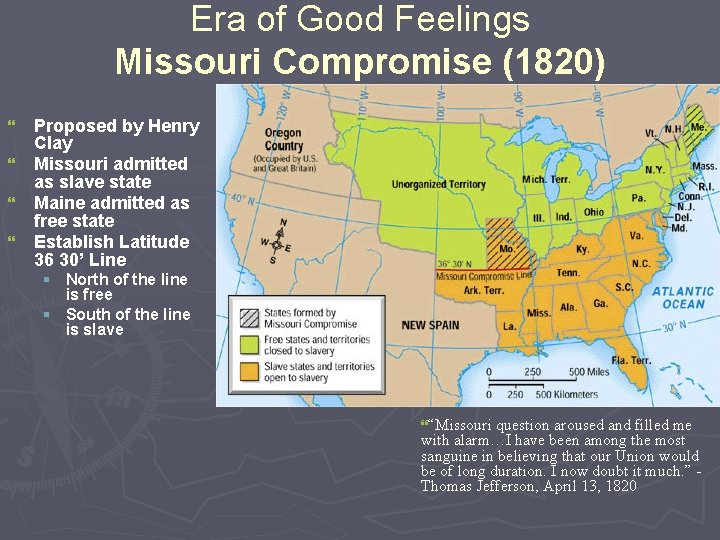
Era of Good Feelings Missouri Compromise (1820) } } Proposed by Henry Clay Missouri admitted as slave state Maine admitted as free state Establish Latitude 36 30’ Line § North of the line is free § South of the line is slave }“Missouri question aroused and filled me with alarm…I have been among the most sanguine in believing that our Union would be of long duration. I now doubt it much. ” - Thomas Jefferson, April 13, 1820
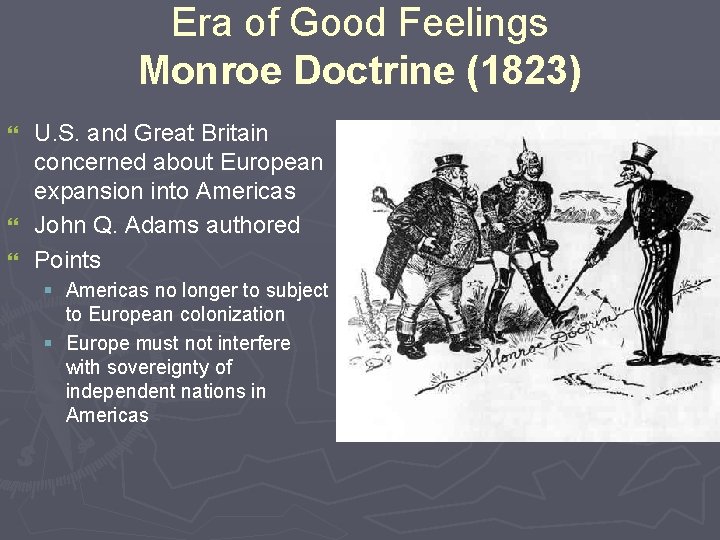
Era of Good Feelings Monroe Doctrine (1823) U. S. and Great Britain concerned about European expansion into Americas } John Q. Adams authored } Points } § Americas no longer to subject to European colonization § Europe must not interfere with sovereignty of independent nations in Americas
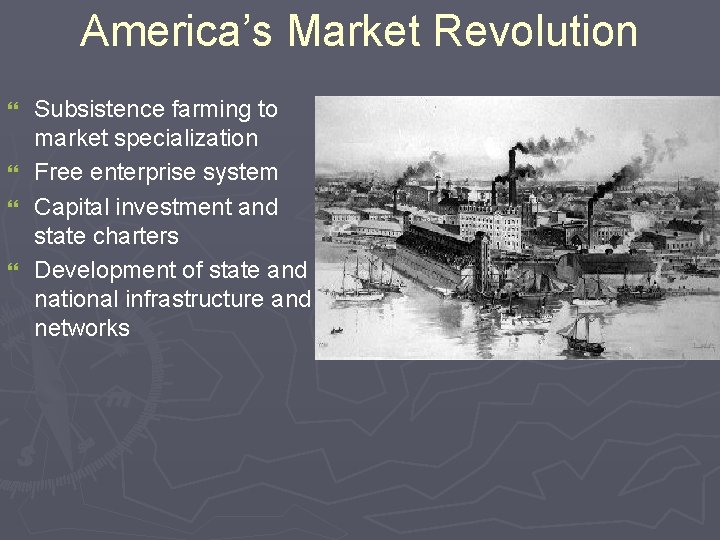
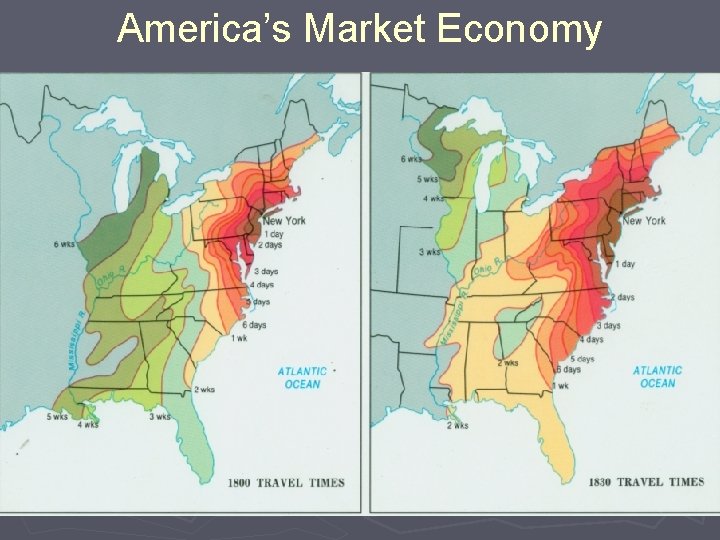
America’s Market Revolution Subsistence farming to market specialization } Free enterprise system } Capital investment and state charters } Development of state and national infrastructure and networks }
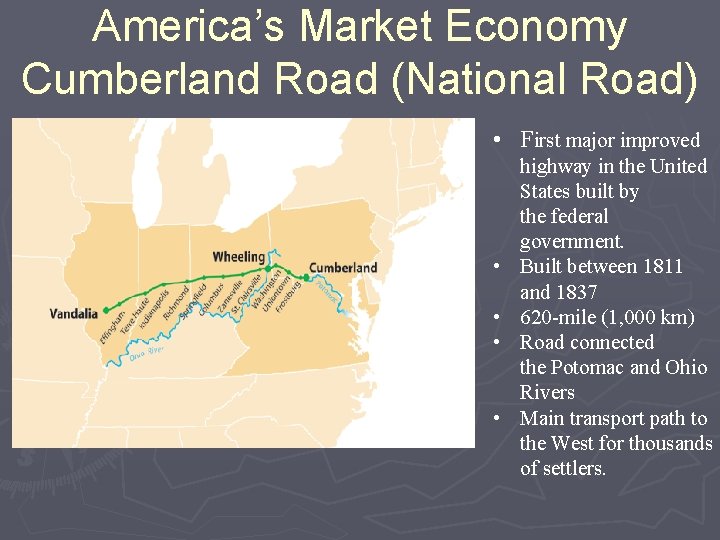
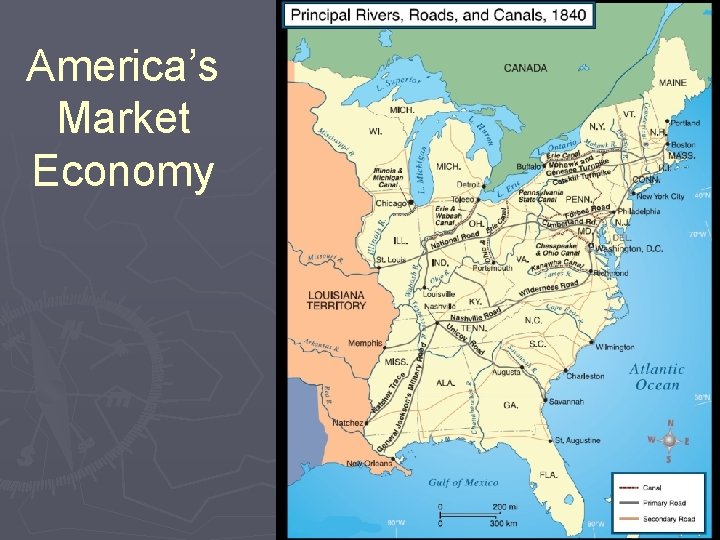
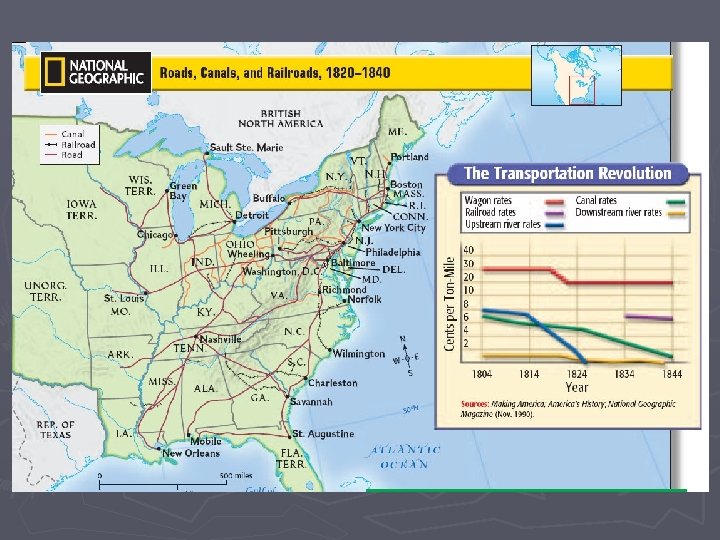
America’s Market Economy Cumberland Road (National Road) • First major improved • • highway in the United States built by the federal government. Built between 1811 and 1837 620 -mile (1, 000 km) Road connected the Potomac and Ohio Rivers Main transport path to the West for thousands of settlers.
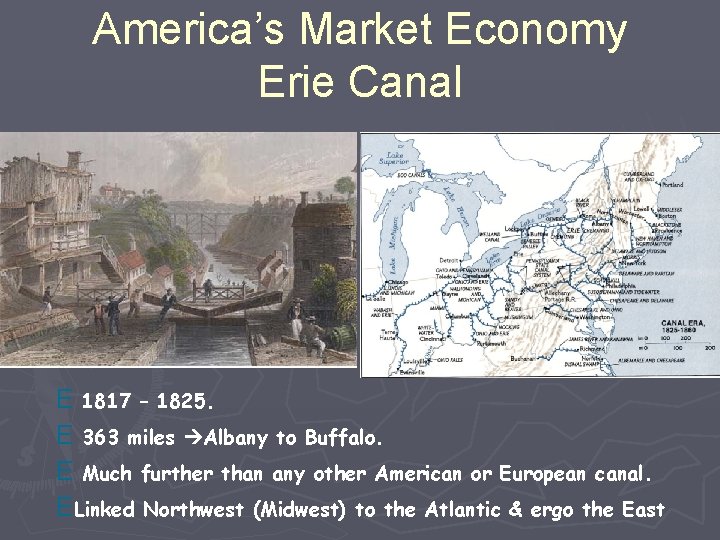
America’s Market Economy Erie Canal E 1817 – 1825. E 363 miles Albany to Buffalo. E Much further than any other American or European canal. ELinked Northwest (Midwest) to the Atlantic & ergo the East
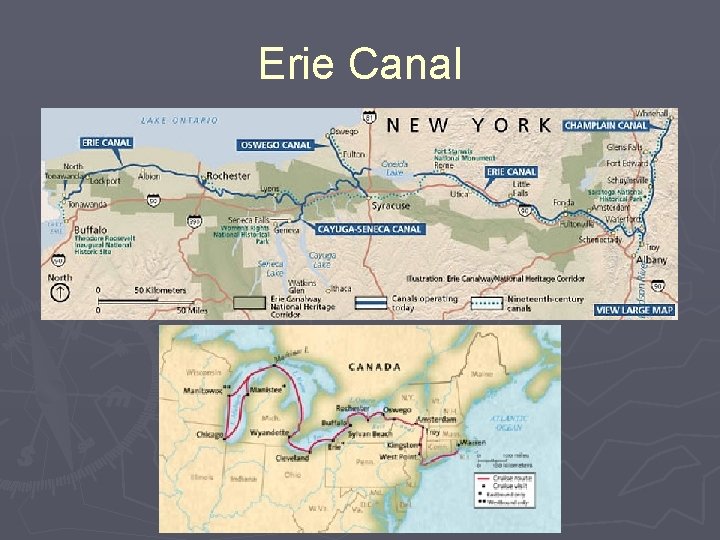
Erie Canal
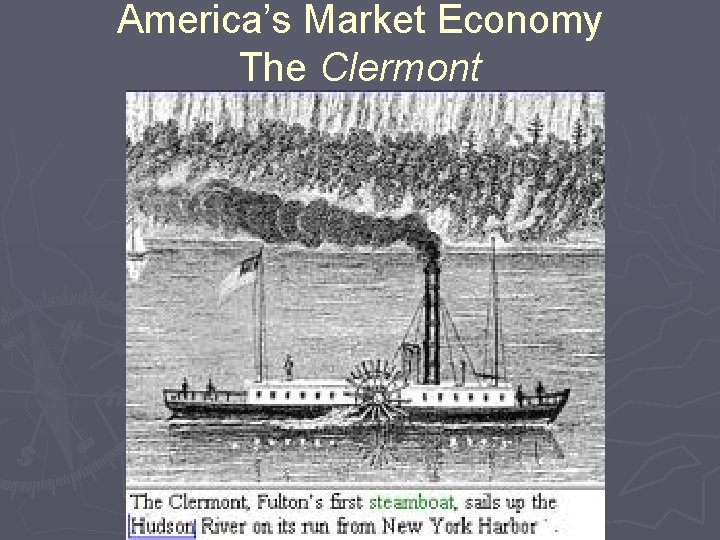
America’s Market Economy The Clermont
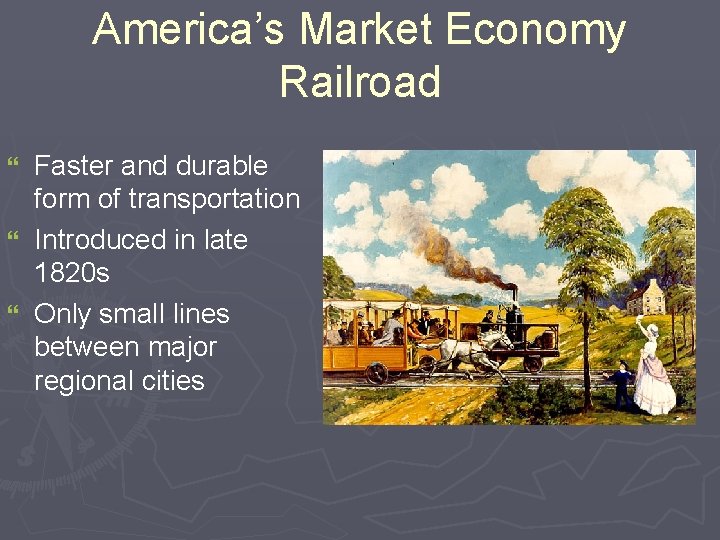
America’s Market Economy Railroad Faster and durable form of transportation } Introduced in late 1820 s } Only small lines between major regional cities }
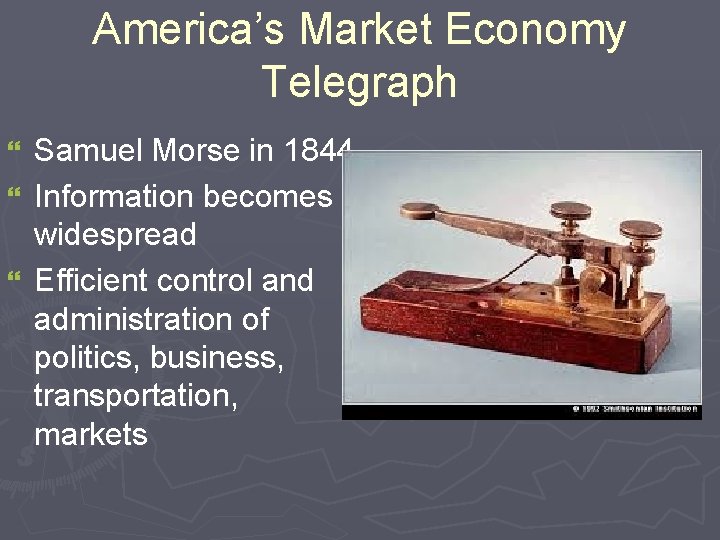
America’s Market Economy Telegraph Samuel Morse in 1844 } Information becomes widespread } Efficient control and administration of politics, business, transportation, markets }
America’s Market Economy
America’s Market Economy
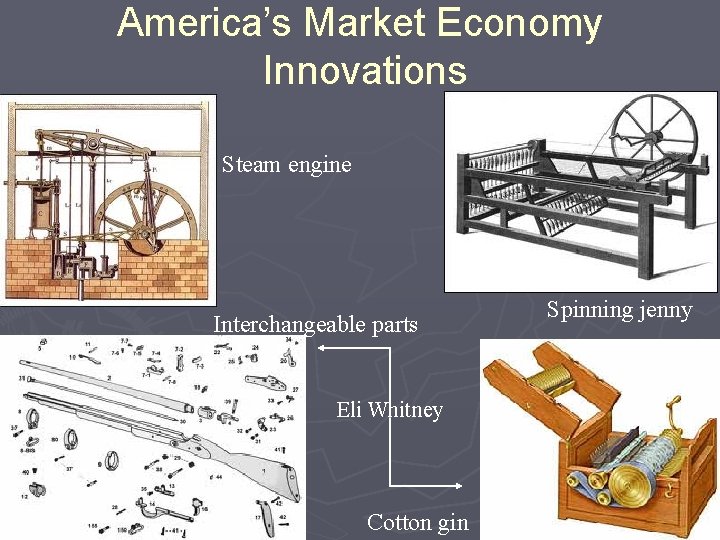
America’s Market Economy Innovations Steam engine Interchangeable parts Eli Whitney Cotton gin Spinning jenny
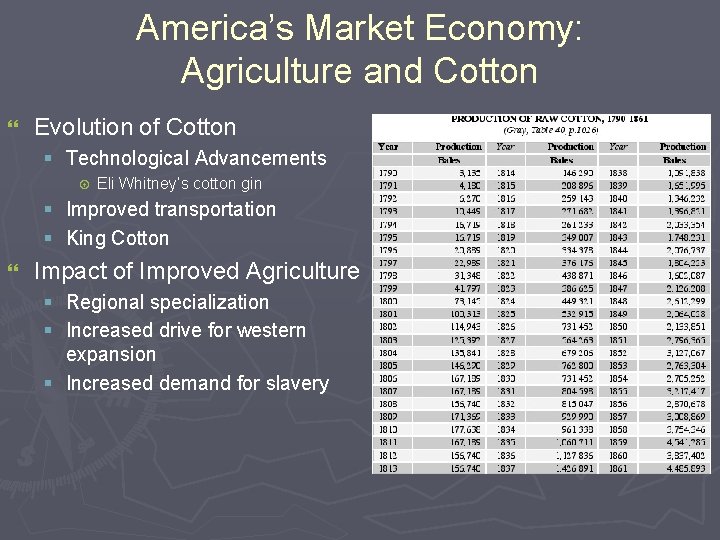
America’s Market Economy: Agriculture and Cotton } Evolution of Cotton § Technological Advancements Eli Whitney’s cotton gin § Improved transportation § King Cotton } Impact of Improved Agriculture § Regional specialization § Increased drive for western expansion § Increased demand for slavery
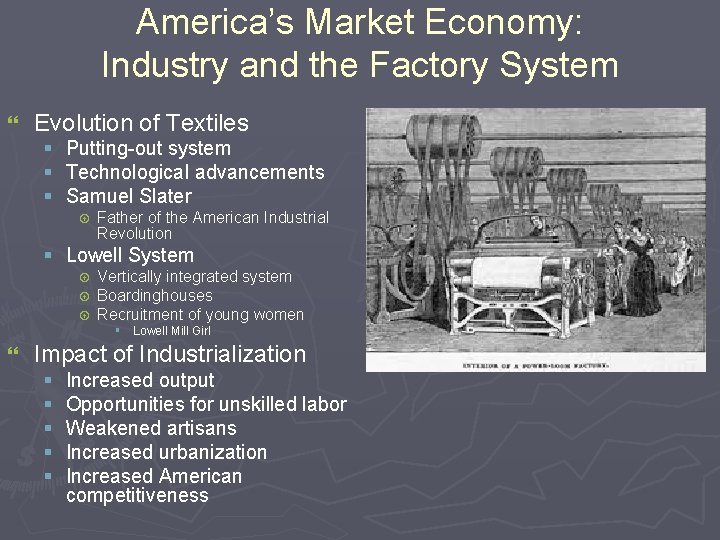
America’s Market Economy: Industry and the Factory System } Evolution of Textiles § § § Putting-out system Technological advancements Samuel Slater Father of the American Industrial Revolution § Lowell System Vertically integrated system Boardinghouses Recruitment of young women § Lowell Mill Girl } Impact of Industrialization § § § Increased output Opportunities for unskilled labor Weakened artisans Increased urbanization Increased American competitiveness
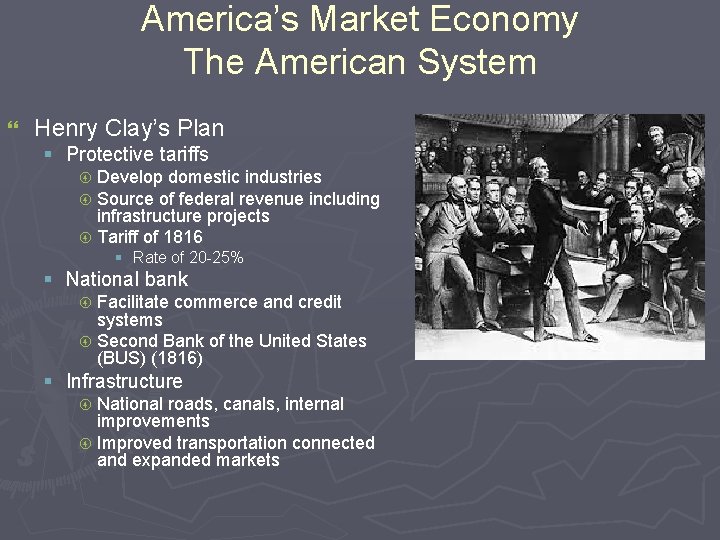
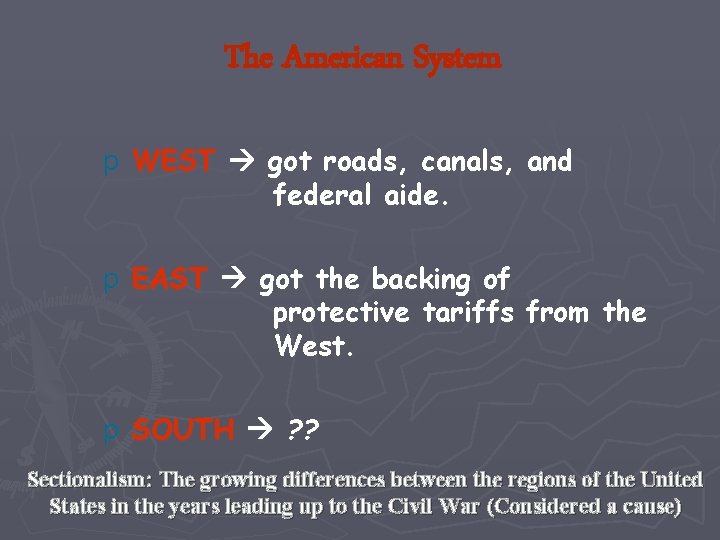
America’s Market Economy The American System } Henry Clay’s Plan § Protective tariffs Develop domestic industries Source of federal revenue including infrastructure projects Tariff of 1816 § Rate of 20 -25% § National bank Facilitate commerce and credit systems Second Bank of the United States (BUS) (1816) § Infrastructure National roads, canals, internal improvements Improved transportation connected and expanded markets
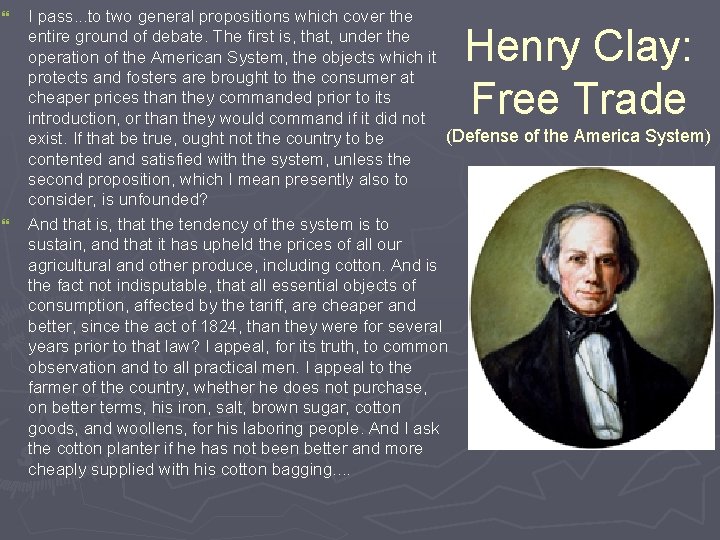
} } I pass. . . to two general propositions which cover the entire ground of debate. The first is, that, under the operation of the American System, the objects which it protects and fosters are brought to the consumer at cheaper prices than they commanded prior to its introduction, or than they would command if it did not (Defense of the America System) exist. If that be true, ought not the country to be contented and satisfied with the system, unless the second proposition, which I mean presently also to consider, is unfounded? And that is, that the tendency of the system is to sustain, and that it has upheld the prices of all our agricultural and other produce, including cotton. And is the fact not indisputable, that all essential objects of consumption, affected by the tariff, are cheaper and better, since the act of 1824, than they were for several years prior to that law? I appeal, for its truth, to common observation and to all practical men. I appeal to the farmer of the country, whether he does not purchase, on better terms, his iron, salt, brown sugar, cotton goods, and woollens, for his laboring people. And I ask the cotton planter if he has not been better and more cheaply supplied with his cotton bagging. . Henry Clay: Free Trade
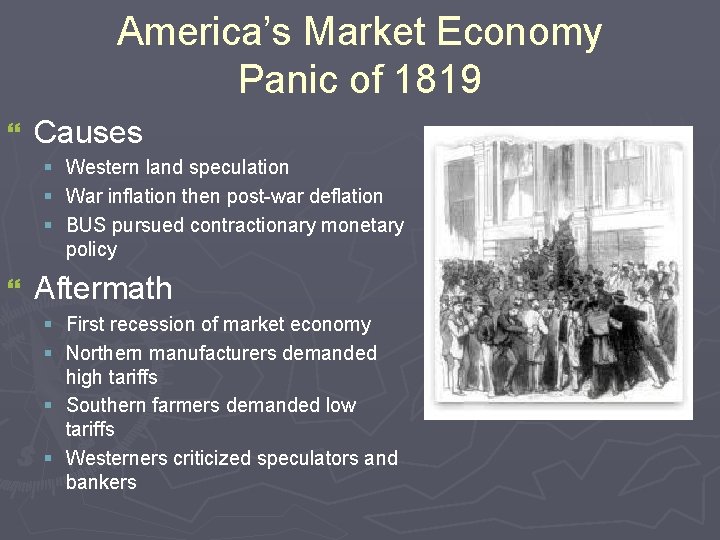
America’s Market Economy Panic of 1819 } Causes § § § } Western land speculation War inflation then post-war deflation BUS pursued contractionary monetary policy Aftermath § First recession of market economy § Northern manufacturers demanded high tariffs § Southern farmers demanded low tariffs § Westerners criticized speculators and bankers
United States c. 1824
The American System p WEST got roads, canals, and federal aide. p EAST got the backing of protective tariffs from the West. p SOUTH ? ? Sectionalism: The growing differences between the regions of the United States in the years leading up to the Civil War (Considered a cause)
- Slides: 33