
Think About It Electricity Circuit Bus Tie Substation
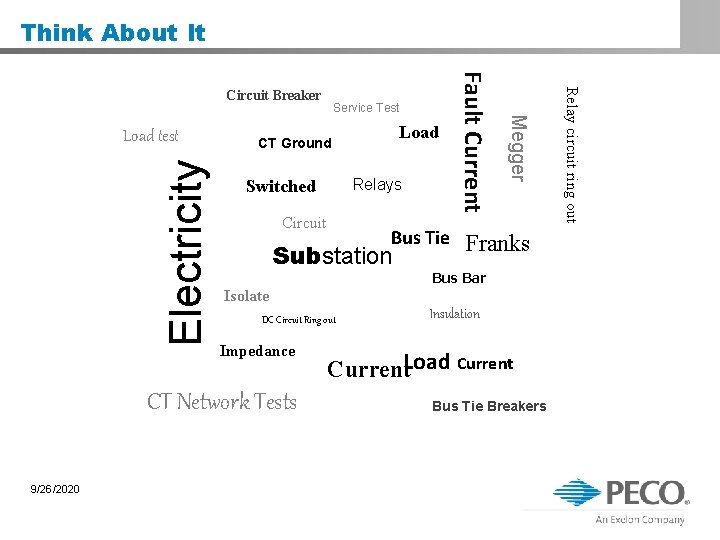
Think About It Electricity Circuit Bus Tie Substation Franks Bus Bar Isolate DC Circuit Ring out Impedance Insulation Current. Load Current Bus Tie Breakers Relay circuit ring out Relays Switched CT Network Tests 9/26/2020 Load CT Ground Megger Load test Service Test Fault Current Circuit Breaker
Transmission & Substation (T&S) Testing Relay Installation Testing © 2016 Revision Date: 02/05/2016
Course Guidelines Duration: 4 days (2 classroom, 2 lab) Break: Every 15 minutes Cell Phones: Please make sure your electronic devices are set to ‘vibrate’ Computers: Please turn off your computers Expectations: Return from breaks on time. Respect the opinions of others. Ask questions in class; no sidebars with your peers Feedback: At the end of the training, you’re required to complete a course evaluation 9/26/2020 3
Before We Begin Building Exits Restrooms Emergency Procedures Job Briefing Sheet Introductions 9/26/2020 4
Purpose Welcome to Transmission & Substation (T&S): Relay Installation Testing During this course you’ll learn: q The importance of testing protective relay equipment q The purpose of the various tests associated with protective relays q How to perform tests on protective relays at high voltage substations q Why there’s only one CT ground q The purpose of a Service test Words and/or terms not defined in this presentation are located in the Terminology section of the Participant Guide. At the end of the course, there’ll be a Q & A session and a Knowledge Check. 9/26/2020 5
Objectives After completing this course, you’ll be able to: q Explain the purpose and function of a bus tie and a bus q Perform AC and DC tests on protective relay equipment q Test protective relays and control systems in an efficient manner q Define the various CT Network tests 9/26/2020 6
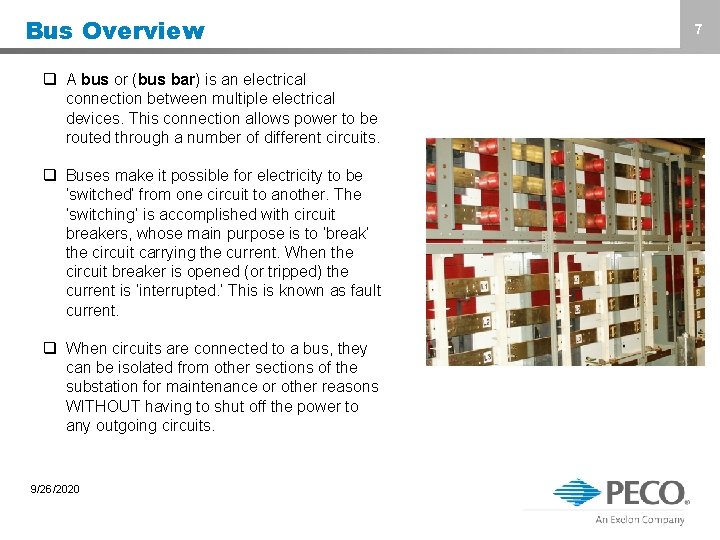
Bus Overview q A bus or (bus bar) is an electrical connection between multiple electrical devices. This connection allows power to be routed through a number of different circuits. q Buses make it possible for electricity to be ‘switched’ from one circuit to another. The ‘switching’ is accomplished with circuit breakers, whose main purpose is to ‘break’ the circuit carrying the current. When the circuit breaker is opened (or tripped) the current is ‘interrupted. ’ This is known as fault current. q When circuits are connected to a bus, they can be isolated from other sections of the substation for maintenance or other reasons WITHOUT having to shut off the power to any outgoing circuits. 9/26/2020 7
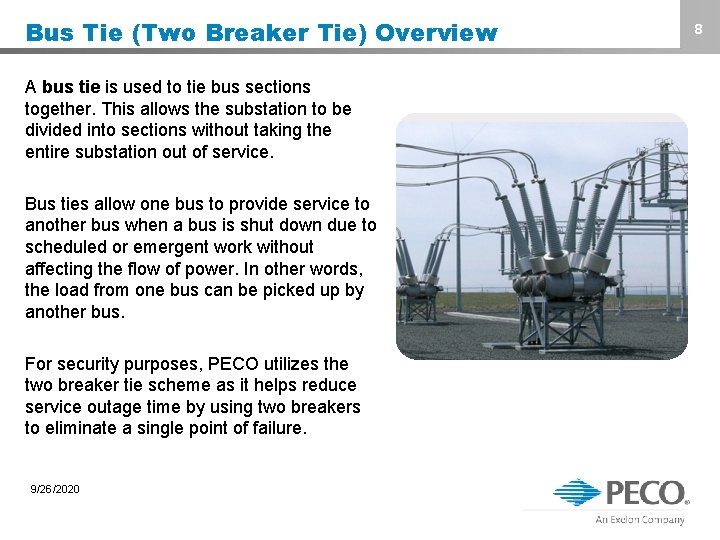
Bus Tie (Two Breaker Tie) Overview A bus tie is used to tie bus sections together. This allows the substation to be divided into sections without taking the entire substation out of service. Bus ties allow one bus to provide service to another bus when a bus is shut down due to scheduled or emergent work without affecting the flow of power. In other words, the load from one bus can be picked up by another bus. For security purposes, PECO utilizes the two breaker tie scheme as it helps reduce service outage time by using two breakers to eliminate a single point of failure. 9/26/2020 8
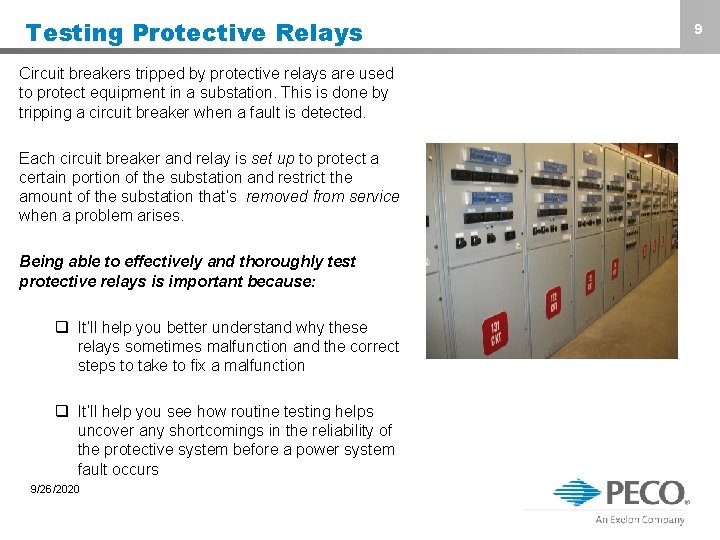
Testing Protective Relays Circuit breakers tripped by protective relays are used to protect equipment in a substation. This is done by tripping a circuit breaker when a fault is detected. Each circuit breaker and relay is set up to protect a certain portion of the substation and restrict the amount of the substation that’s removed from service when a problem arises. Being able to effectively and thoroughly test protective relays is important because: q It’ll help you better understand why these relays sometimes malfunction and the correct steps to take to fix a malfunction q It’ll help you see how routine testing helps uncover any shortcomings in the reliability of the protective system before a power system fault occurs 9/26/2020 9
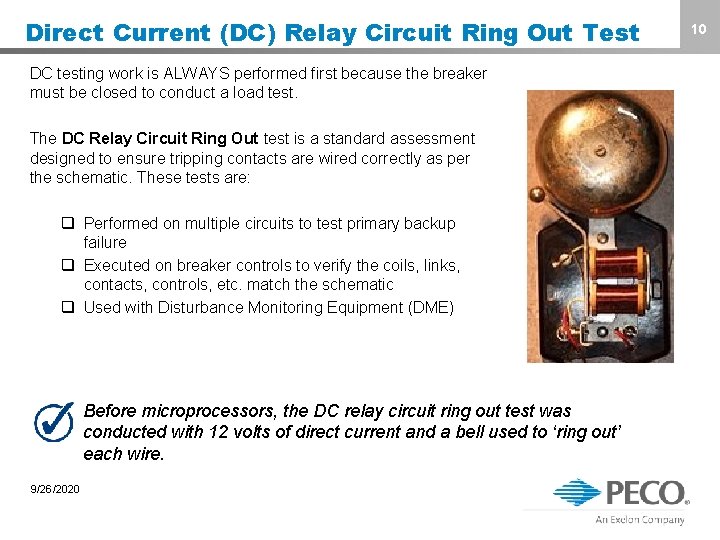
Direct Current (DC) Relay Circuit Ring Out Test DC testing work is ALWAYS performed first because the breaker must be closed to conduct a load test. The DC Relay Circuit Ring Out test is a standard assessment designed to ensure tripping contacts are wired correctly as per the schematic. These tests are: q Performed on multiple circuits to test primary backup failure q Executed on breaker controls to verify the coils, links, contacts, controls, etc. match the schematic q Used with Disturbance Monitoring Equipment (DME) Before microprocessors, the DC relay circuit ring out test was conducted with 12 volts of direct current and a bell used to ‘ring out’ each wire. 9/26/2020 10
CT Network Tests Current Transformers (CT) are electrical devices designed to step down a substation’s primary current to a usable, secondary value for relay and metering circuits. CT Network tests are used to confirm the physical condition and electrical characteristics of the CTs. With CTs, it’s necessary to verify (visually and physically) that each CT is dry, each CT’s internal connections haven’t been loosened, and each CTs major insulation structure is intact. CT Network tests include: q q Megger Impedance Load Service Apparatus technicians test the performance of the CT. Relay technicians test to ensure the CT is connected correctly and the tap is correct. 9/26/2020 11
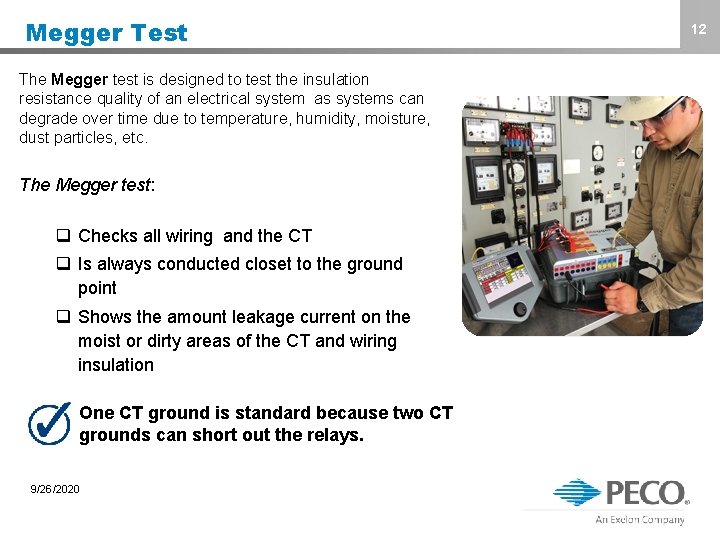
Megger Test The Megger test is designed to test the insulation resistance quality of an electrical system as systems can degrade over time due to temperature, humidity, moisture, dust particles, etc. The Megger test: q Checks all wiring and the CT q Is always conducted closet to the ground point q Shows the amount leakage current on the moist or dirty areas of the CT and wiring insulation One CT ground is standard because two CT grounds can short out the relays. 9/26/2020 12
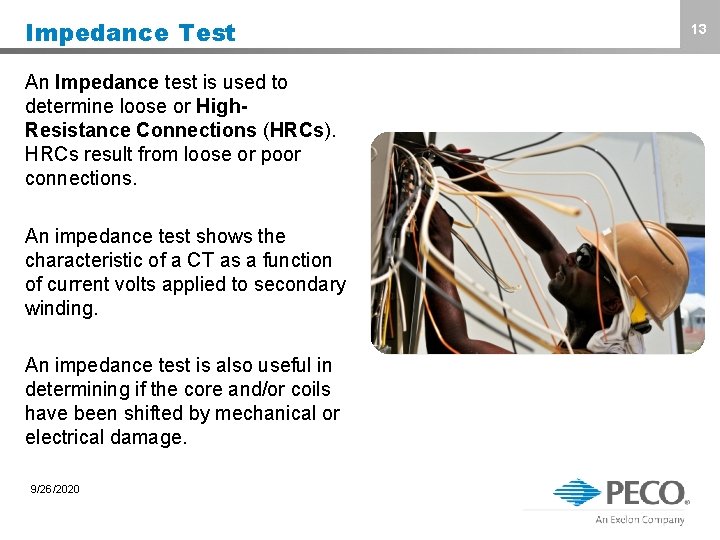
Impedance Test An Impedance test is used to determine loose or High. Resistance Connections (HRCs). HRCs result from loose or poor connections. An impedance test shows the characteristic of a CT as a function of current volts applied to secondary winding. An impedance test is also useful in determining if the core and/or coils have been shifted by mechanical or electrical damage. 9/26/2020 13
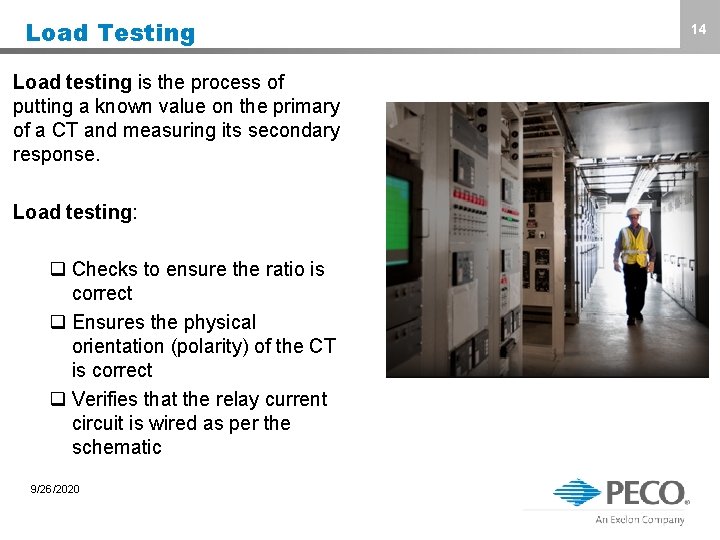
Load Testing Load testing is the process of putting a known value on the primary of a CT and measuring its secondary response. Load testing: q Checks to ensure the ratio is correct q Ensures the physical orientation (polarity) of the CT is correct q Verifies that the relay current circuit is wired as per the schematic 9/26/2020 14
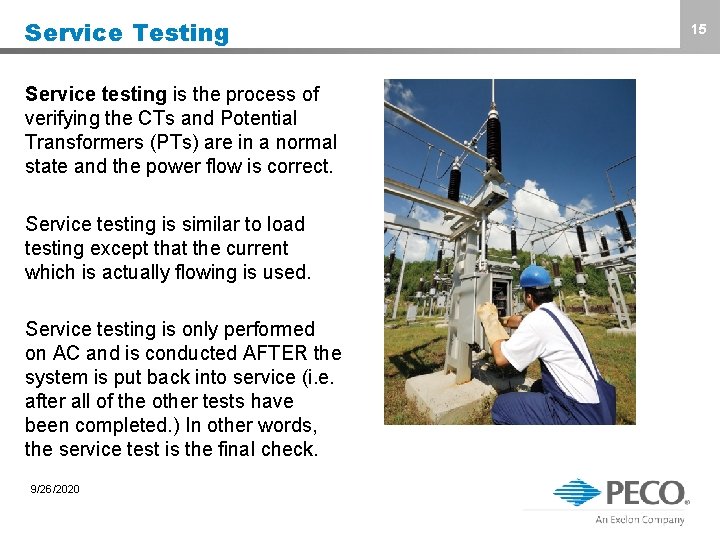
Service Testing Service testing is the process of verifying the CTs and Potential Transformers (PTs) are in a normal state and the power flow is correct. Service testing is similar to load testing except that the current which is actually flowing is used. Service testing is only performed on AC and is conducted AFTER the system is put back into service (i. e. after all of the other tests have been completed. ) In other words, the service test is the final check. 9/26/2020 15
Course Summary In this course you’ve learned about the purpose and function of AC protective relay tests including: q Megger tests q Impedance tests q Load tests q Service tests You’ve also learned about DC Relay Circuit Ring Out tests. And, we reviewed buses and bus ties. 9/26/2020 16
Any Questions? 9/26/2020 17
Think About It: Answer Franks What word or acronym did not belong in the Word puzzle on the first slide? 9/26/2020 18

Terminology Bridge - a connection to the windings. Bus - a conductor, which may be a solid bar or pipe, normally made of aluminum or copper, used to connect one or more circuits to a common interface. An example would be the bus used to connect a substation transformer to the outgoing circuits. Bus Tie – a piece of equipment in a substation used to tie bus sections together. This allows the substation to be divided into sections without taking the entire substation out of service. Bus scheme - the arrangement of overhead bus bar and associated switching equipment in a substation. . Circuit breaker – a device whose main purpose is to break the circuit carrying load current or fault current. Current Transformers (CTs) – electrical devices that step down the primary current of the substation equipment to a usable, secondary value for relay and metering circuits. Current Transformer (CT) Network tests – tests conducted to confirm the physical condition and electrical characteristics of the transformers Disturbance Monitoring Equipment - Devices capable of monitoring and recording system data pertaining to a Disturbance. Such devices include the following categories of recorders: Sequence of event recorders which record equipment response to the event. , Fault recorders, which record actual waveform data replicating the system primary voltages and currents. 9/26/2020 19
Terminology (cont’d) 20 Fault - any abnormal electric current. For example, a short circuit is a fault where current bypasses the normal load. An open-circuit fault occurs if a circuit is interrupted by some type of failure. High Resistance Connection (HRC) – a problem that results from loose or poor connections. Impedance – the ratio of voltage to current. How much impedance you get depends on how hard you are pushing to how much action you are getting. Impedance changes one combination of voltage and current with another combination of voltage and current. Impedance test - shows the characteristic of a CT as a function of current volts applied to secondary winding. Load testing – the process of putting demand on a system and measuring its response. Megger test – a test performed by a megohm meter and provides a direct reading of insulation resistance in ohms or megohms. Potential Transformers (PT) - a device designed to reduce line voltage to a proportionally lower voltage for the purpose of monitoring or relaying. 9/26/2020
Terminology (cont’d) Primary Winding – a coil forming the part of an electrical circuit such that changing current in it induces a current in a neighboring circuit. Secondary Winding - In a transformer, the winding that provides the output to the load or loads. Service testing – a test similar to load testing except that the current which is actually flowing is used. Tap – a connection point located on a transformer winding that allows a certain number of turns to be selected. Turn Ratio – The no-load voltage ratio between two windings (i. e. , primary and secondary) of a transformer. Two Breakers Bus Tie scheme – In this scheme two buses and two circuit breakers per circuit are used allowing any circuit breaker to be removed for maintenance without interruption to the corresponding circuit. Also the failure of one of the two buses does not interrupt any circuit as all the circuits can be fed from the remaining bus and isolating the failed bus. Windings - the wire or conductor which constitutes the coil. The hole in the center of the coil is the core area. Each loop of wire is called a turn. 9/26/2020 21
- Slides: 21