
Thin Lenses Chapter 15 What is a lens




- Slides: 25
Thin Lenses Chapter 15
What is a lens? n A transparent object that refracts light rays, causing them to converge or diverge to create an image
Converging Lenses n A converging lens is thicker at the middle than it is at the rim – The front of the lens is the side of the lens where the object is n Converging lenses can produce real or virtual images
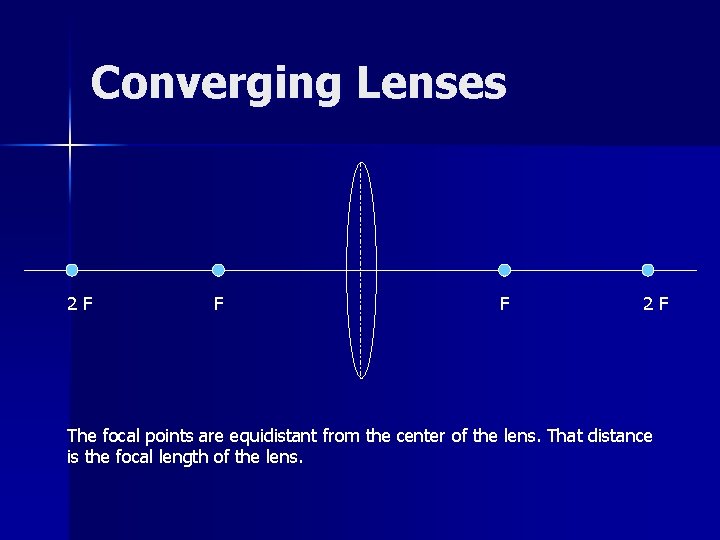
Converging Lenses 2 F F F 2 F The focal points are equidistant from the center of the lens. That distance is the focal length of the lens.
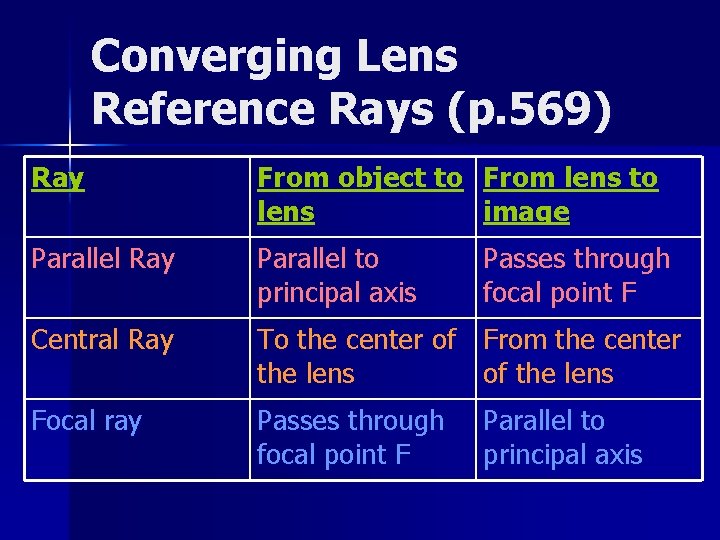
Converging Lens Reference Rays (p. 569) Ray From object to From lens to lens image Parallel Ray Parallel to principal axis Central Ray To the center of From the center the lens of the lens Focal ray Passes through focal point F Parallel to principal axis
Converging Lenses Ray 1 Ray 2 F F Ra 2 y 3 F 2 F The focal points are equidistant from the center of the lens. That distance is the focal length of the lens.
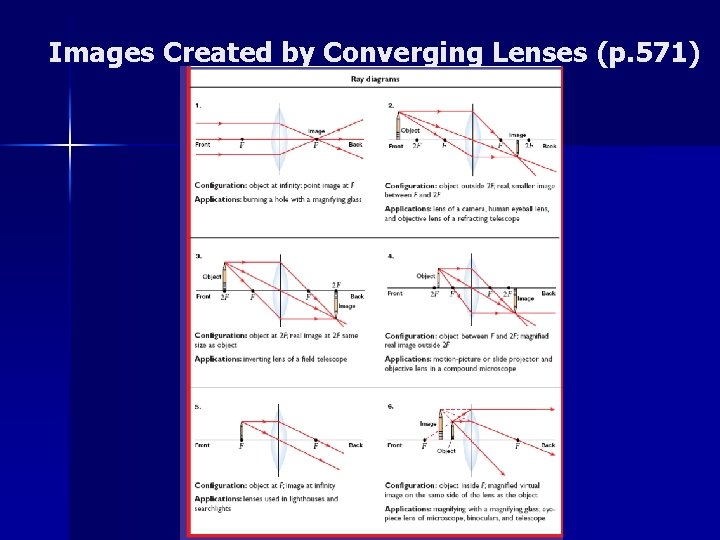
Images Created by Converging Lenses (p. 571)
Images produced by lenses (p. 570 -571) n An object infinitely far away from a converging lens will create a point image at the focal point – i. e. light from the Sun
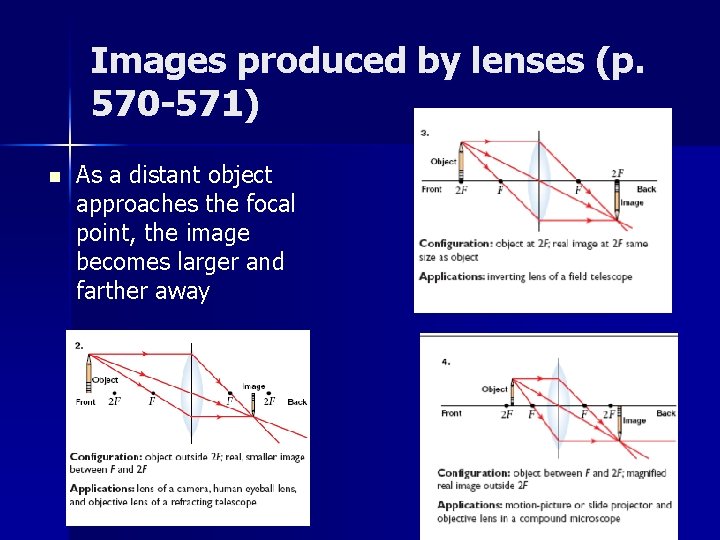
Images produced by lenses (p. 570 -571) n As a distant object approaches the focal point, the image becomes larger and farther away
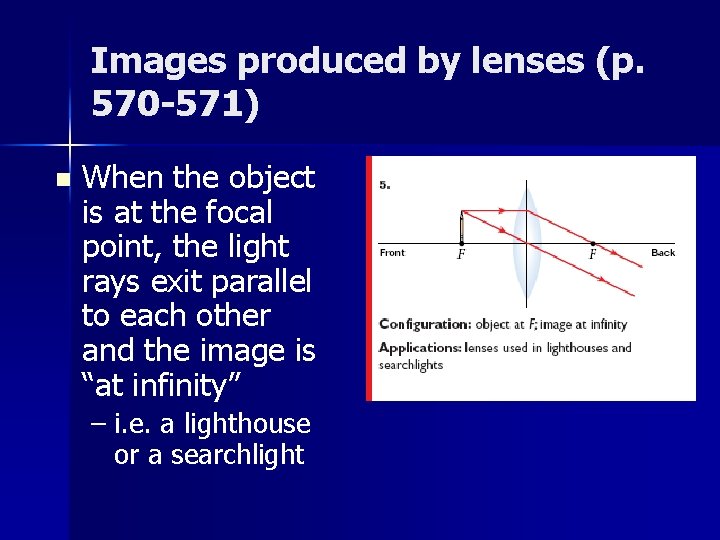
Images produced by lenses (p. 570 -571) n When the object is at the focal point, the light rays exit parallel to each other and the image is “at infinity” – i. e. a lighthouse or a searchlight
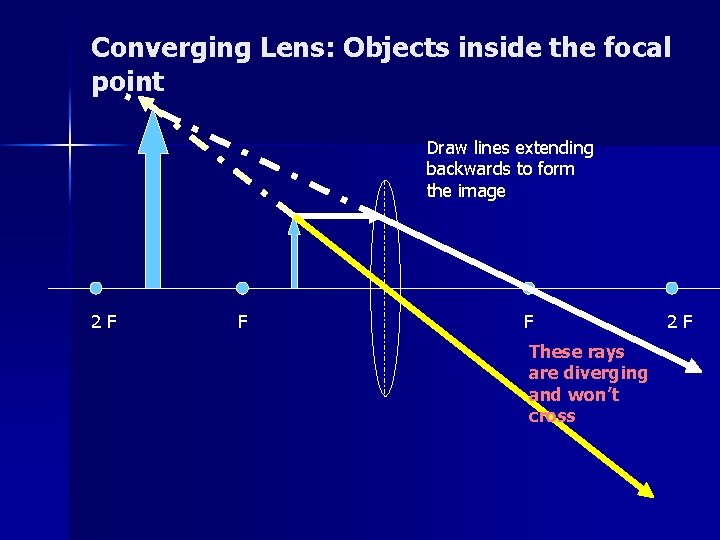
Images produced by lenses (p. 570 -571) n When the object is inside the focal point, the rays are drawn the same way but you must extend them backwards in order to find the image
Converging Lens: Objects inside the focal point Draw lines extending backwards to form the image 2 F F F These rays are diverging and won’t cross 2 F
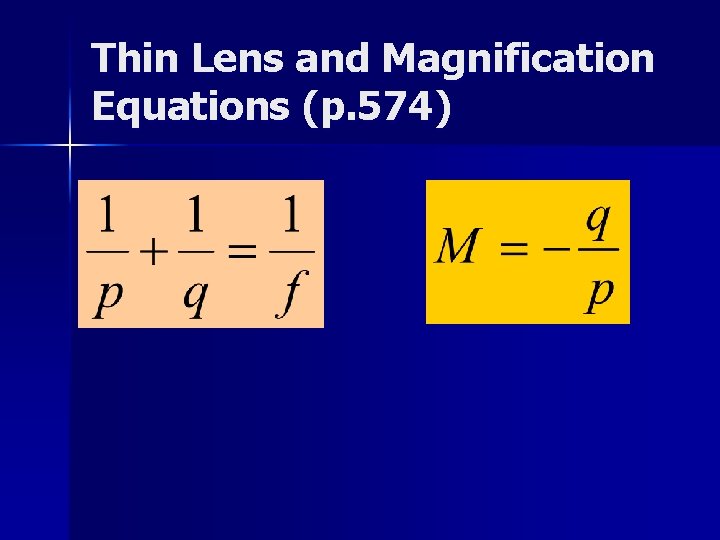
Thin Lens and Magnification Equations (p. 574)
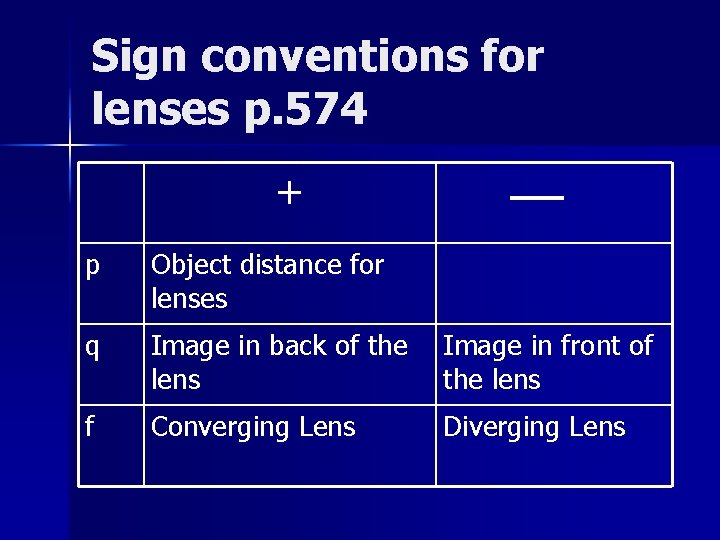
Sign conventions for lenses p. 574 + p Object distance for lenses q Image in back of the lens Image in front of the lens f Converging Lens Diverging Lens
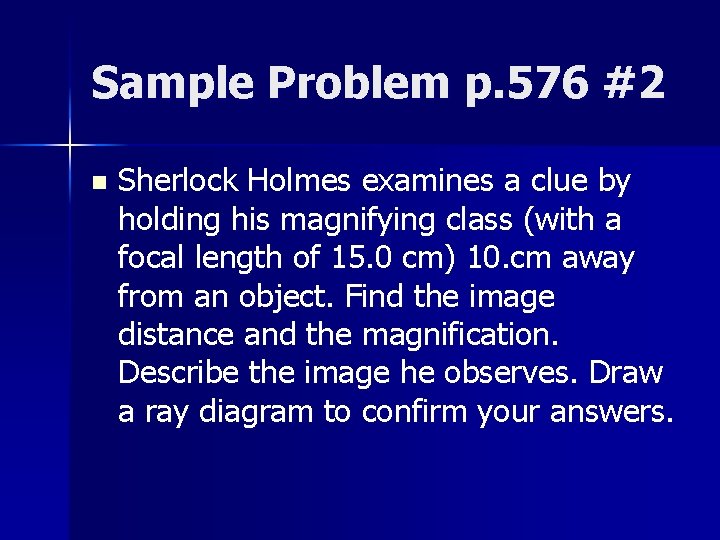
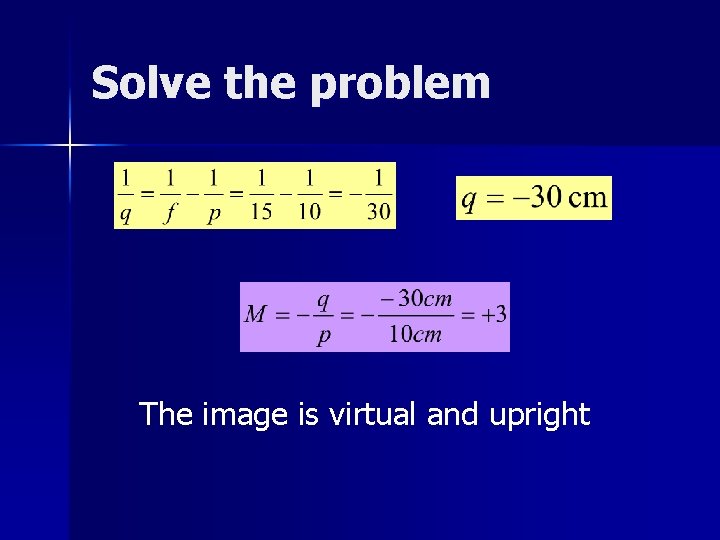
Sample Problem p. 576 #2 n Sherlock Holmes examines a clue by holding his magnifying class (with a focal length of 15. 0 cm) 10. cm away from an object. Find the image distance and the magnification. Describe the image he observes. Draw a ray diagram to confirm your answers.
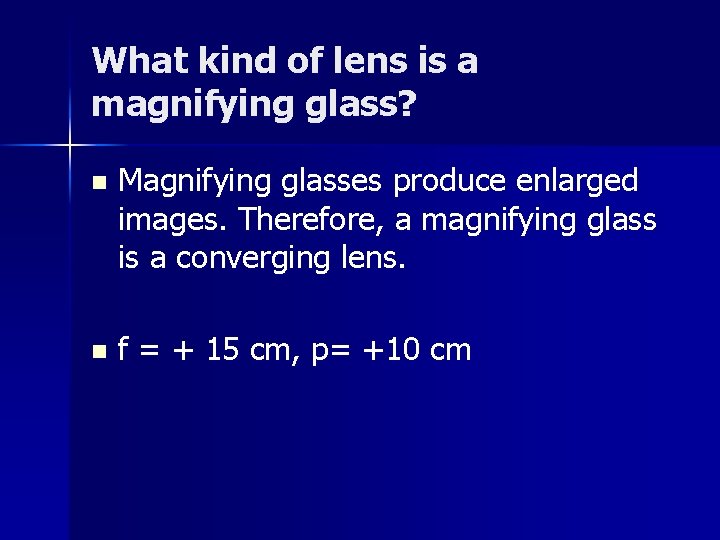
What kind of lens is a magnifying glass? n Magnifying glasses produce enlarged images. Therefore, a magnifying glass is a converging lens. n f = + 15 cm, p= +10 cm
Solve the problem The image is virtual and upright
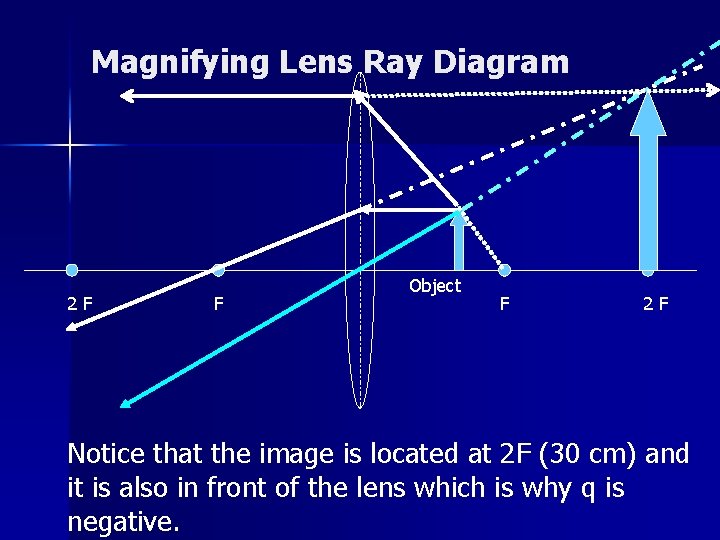
Magnifying Lens Ray Diagram 2 F F Object F 2 F Notice that the image is located at 2 F (30 cm) and it is also in front of the lens which is why q is negative.
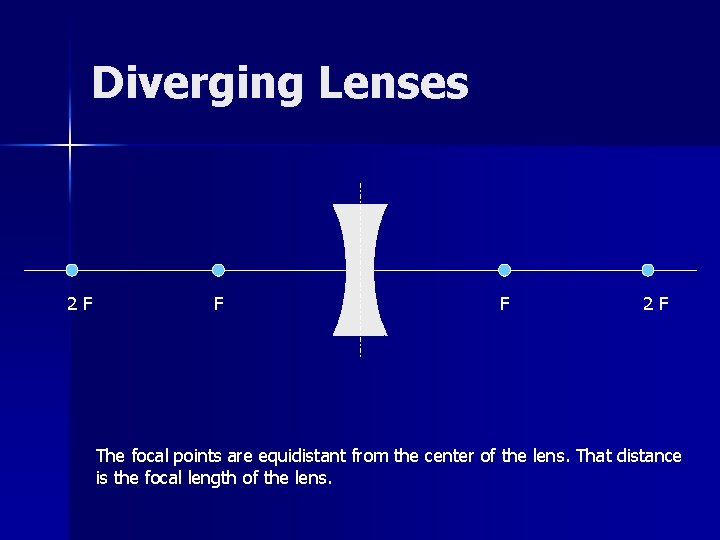
Diverging Lenses n A diverging lens is thinner at the middle than it is at the rim n A diverging lens has two focal points but only one focal length n Diverging lenses only produce virtual images
Diverging Lenses 2 F F F 2 F The focal points are equidistant from the center of the lens. That distance is the focal length of the lens.
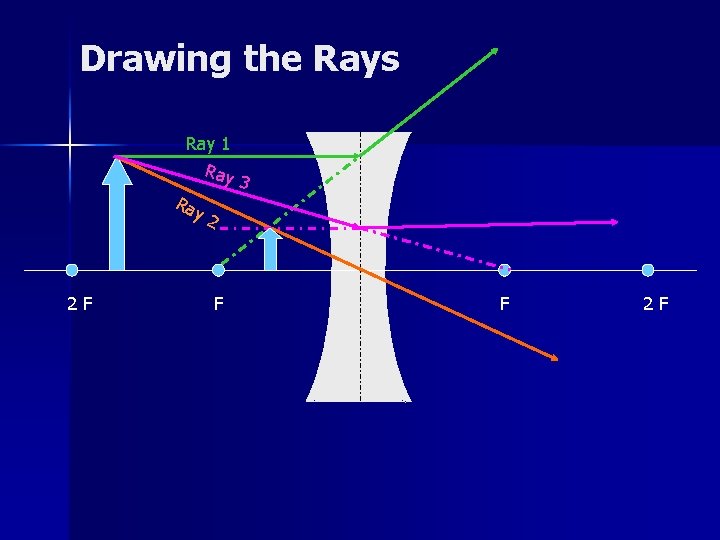
Diverging Lens Reference Rays (p. 569) Ray From object to From lens to lens image Parallel Ray Parallel to principal axis Directed away from focal point F Central Ray To the center of From the center the lens of the lens Focal ray Proceeding toward back focal point, F Parallel to principal axis
Drawing the Rays Ray 1 Ray Ra 3 y 2 2 F F F 2 F
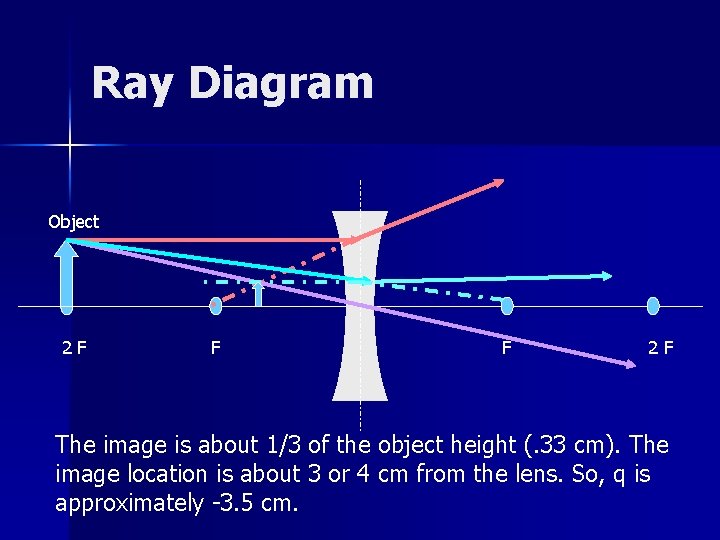
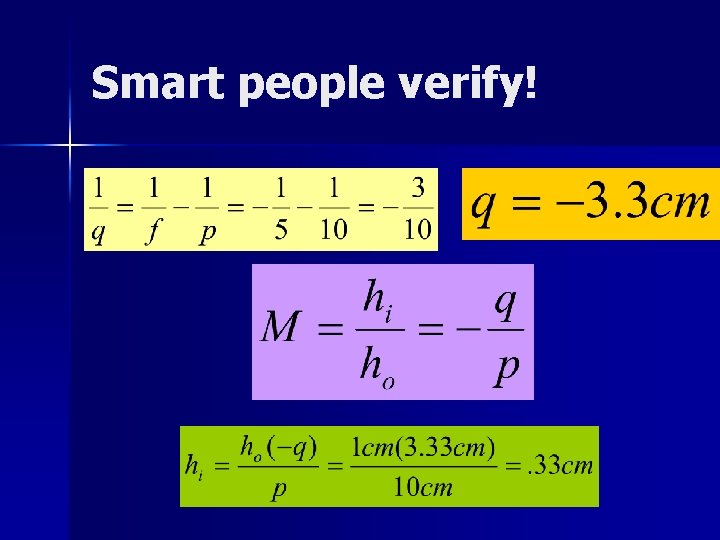
Sample Problem (p. 579 #1) n Using a ray diagram, find the position and height of an image produced by a viewfinder in a camera with a focal length of 5. 0 cm if the object is 1. 0 cm tall and 10. 0 cm in front of the lens. A camera viewfinder is a diverging lens.
Ray Diagram Object 2 F F F 2 F The image is about 1/3 of the object height (. 33 cm). The image location is about 3 or 4 cm from the lens. So, q is approximately -3. 5 cm.
Smart people verify!