
Thin Film Sensor Materials for Detection of NitroAromatic

- Slides: 19
Thin Film Sensor Materials for Detection of Nitro-Aromatic Explosives Dipali Ramdasi, Rohini Mudhalwadkar (Department Of Instrumentation And Control, Cummins College Of Engineering For Women, INDIA)
Outline • Motivation of the work • Introduction • Development of thin film sensors • Experimentation • Results • Discussion • Conclusion • Acknowledgement • References ICFMCE 2017 -THIN FILM SENSOR MATERIALS FOR DETECTION OF NITRO-AROMATIC EXPLOSIVES
Motivation of the work • Terrorist activities all over the world are aggravated • Huge loss of humans, cattle and property • Market ready sensors not available for detection of explosives • The development of simple, low cost reliable sensors for detection of explosives in developing countries like India will accelerate the research towards timely detection of explosives. Aim Developing low cost laboratory developed sensors for detection of Nitrobenzene and Nitrotoluene ICFMCE 2017 THIN FILM SENSOR MATERIALS FOR DETECTION OF NITRO-AROMATIC EXPLOSIVES
Introduction • Use of nitroaromatic explosives for destructive purpose is very common • Mixtures with Nitrobenzene and 4 Nitrotoluene have high explosive sensitivity and detonation velocity • Standard methods like Ion Mobility Spectroscopy, Mass Spectrometry, Infrared Spectroscopy and Raman Spectroscopy can be used • Metal oxide thin film sensors are also used for gas sensing due to their semiconducting behaviour, structural simplicity and low cost ICFMCE 2017 THIN FILM SENSOR MATERIALS FOR DETECTION OF NITRO-AROMATIC EXPLOSIVES
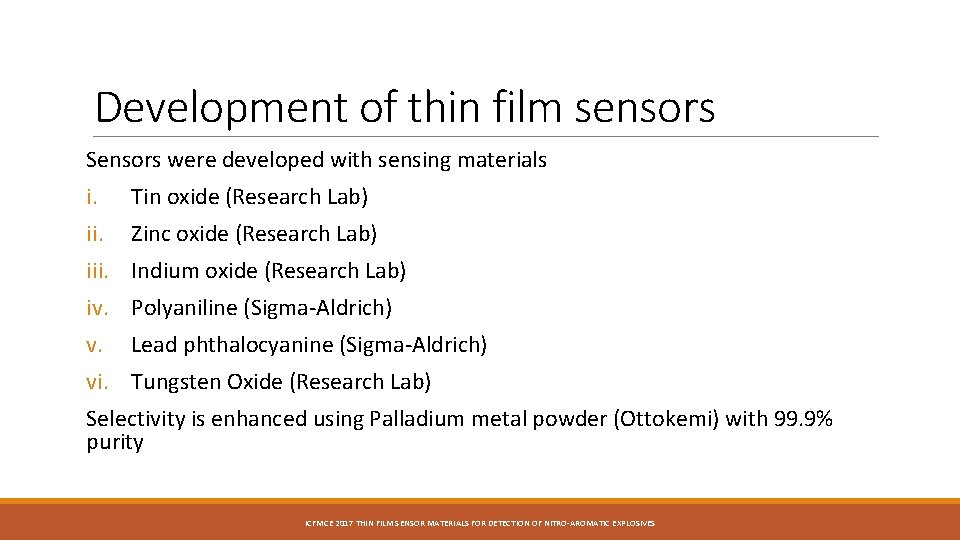
Development of thin film sensors Sensors were developed with sensing materials i. Tin oxide (Research Lab) ii. Zinc oxide (Research Lab) iii. Indium oxide (Research Lab) iv. Polyaniline (Sigma-Aldrich) v. Lead phthalocyanine (Sigma-Aldrich) vi. Tungsten Oxide (Research Lab) Selectivity is enhanced using Palladium metal powder (Ottokemi) with 99. 9% purity ICFMCE 2017 THIN FILM SENSOR MATERIALS FOR DETECTION OF NITRO-AROMATIC EXPLOSIVES
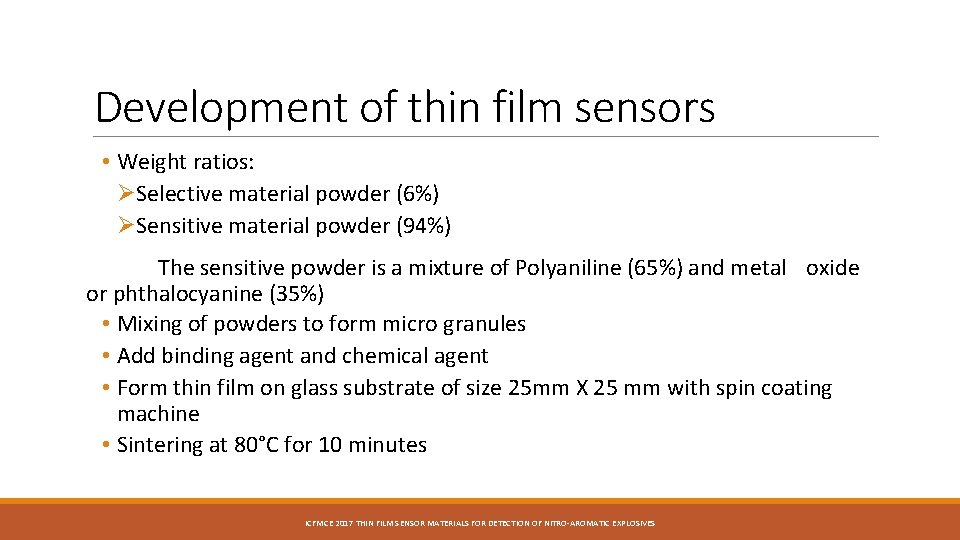
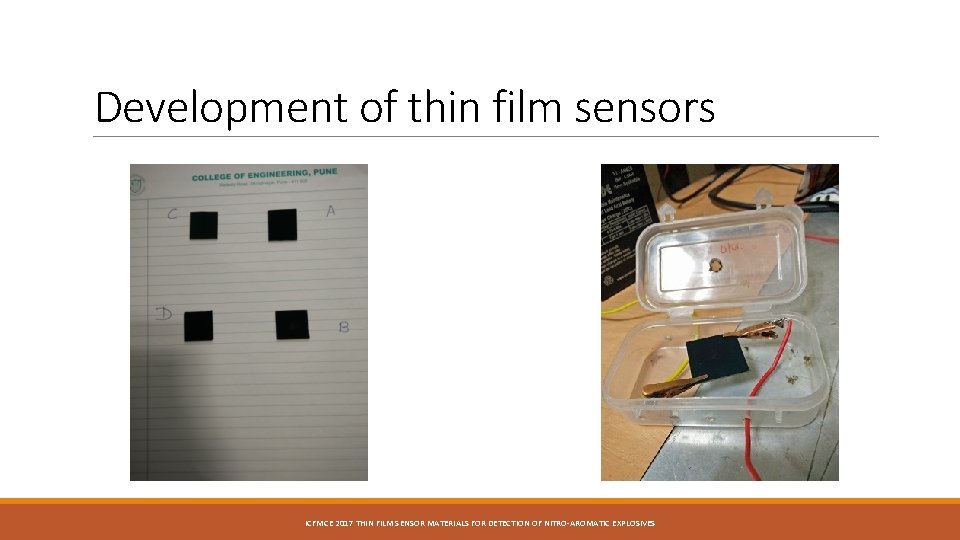
Development of thin film sensors • Weight ratios: ØSelective material powder (6%) ØSensitive material powder (94%) The sensitive powder is a mixture of Polyaniline (65%) and metal oxide or phthalocyanine (35%) • Mixing of powders to form micro granules • Add binding agent and chemical agent • Form thin film on glass substrate of size 25 mm X 25 mm with spin coating machine • Sintering at 80°C for 10 minutes ICFMCE 2017 THIN FILM SENSOR MATERIALS FOR DETECTION OF NITRO-AROMATIC EXPLOSIVES
Development of thin film sensors ICFMCE 2017 THIN FILM SENSOR MATERIALS FOR DETECTION OF NITRO-AROMATIC EXPLOSIVES
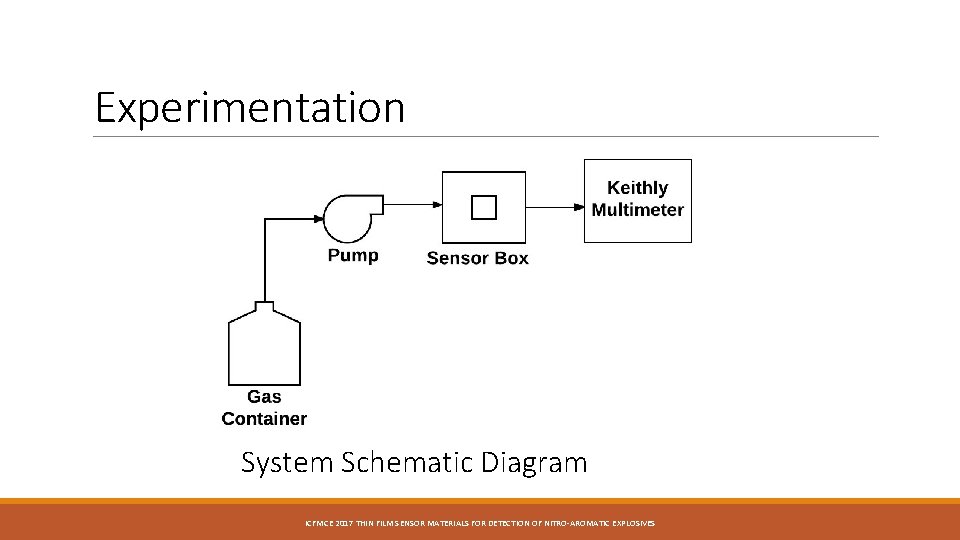
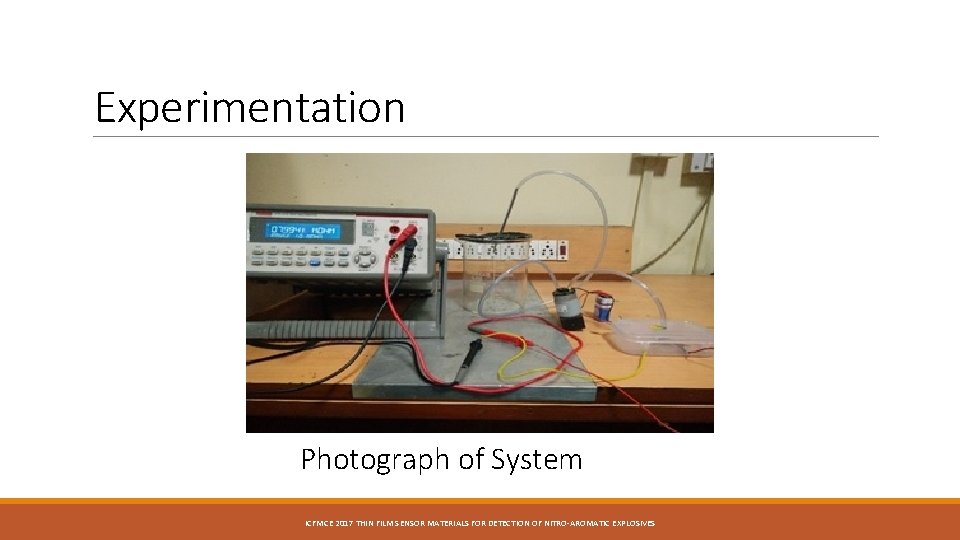
Experimentation System Schematic Diagram ICFMCE 2017 THIN FILM SENSOR MATERIALS FOR DETECTION OF NITRO-AROMATIC EXPLOSIVES
Experimentation Photograph of System ICFMCE 2017 THIN FILM SENSOR MATERIALS FOR DETECTION OF NITRO-AROMATIC EXPLOSIVES
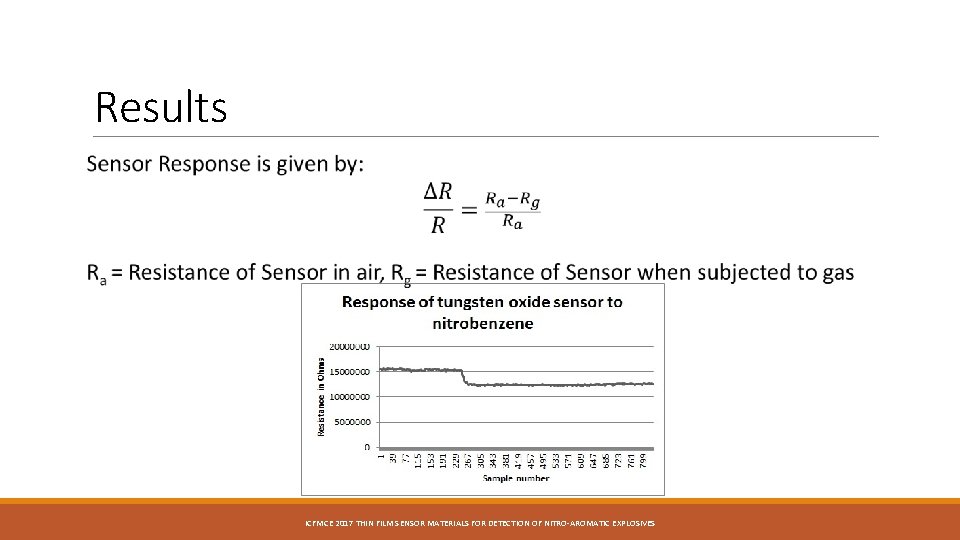
Results ICFMCE 2017 THIN FILM SENSOR MATERIALS FOR DETECTION OF NITRO-AROMATIC EXPLOSIVES
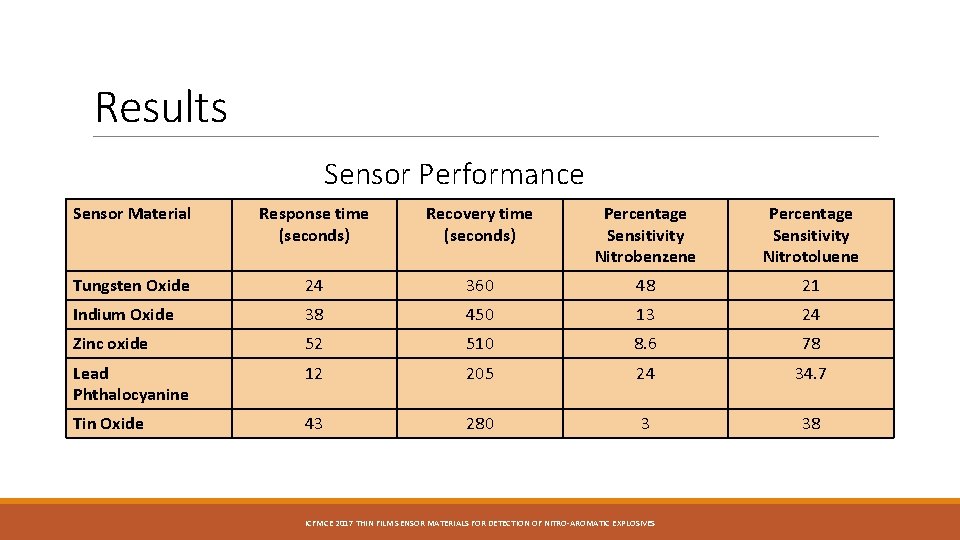
Results Sensor Performance Sensor Material Response time (seconds) Recovery time (seconds) Percentage Sensitivity Nitrobenzene Percentage Sensitivity Nitrotoluene Tungsten Oxide 24 360 48 21 Indium Oxide 38 450 13 24 Zinc oxide 52 510 8. 6 78 Lead Phthalocyanine 12 205 24 34. 7 Tin Oxide 43 280 3 38 ICFMCE 2017 THIN FILM SENSOR MATERIALS FOR DETECTION OF NITRO-AROMATIC EXPLOSIVES
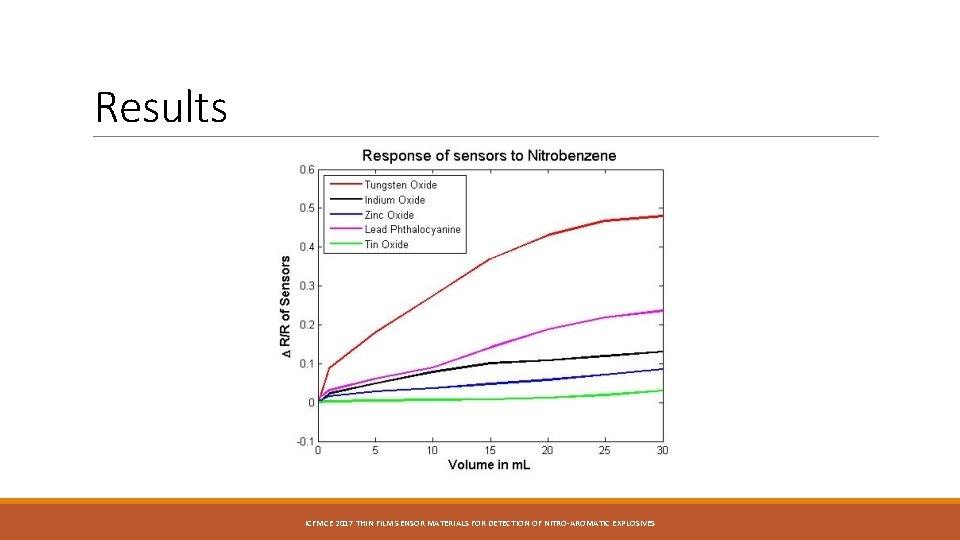
Results ICFMCE 2017 THIN FILM SENSOR MATERIALS FOR DETECTION OF NITRO-AROMATIC EXPLOSIVES
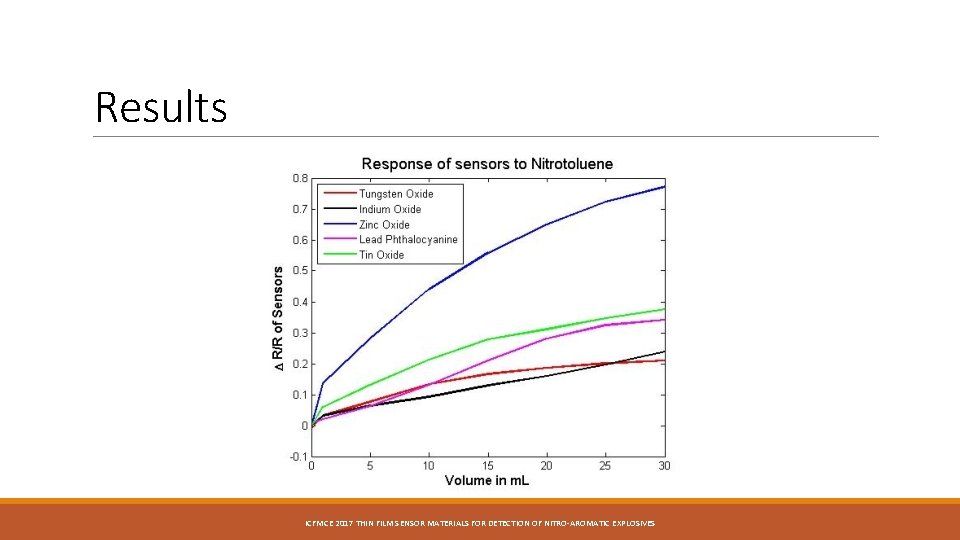
Results ICFMCE 2017 THIN FILM SENSOR MATERIALS FOR DETECTION OF NITRO-AROMATIC EXPLOSIVES
Results ICFMCE 2017 THIN FILM SENSOR MATERIALS FOR DETECTION OF NITRO-AROMATIC EXPLOSIVES
Results ICFMCE 2017 THIN FILM SENSOR MATERIALS FOR DETECTION OF NITRO-AROMATIC EXPLOSIVES
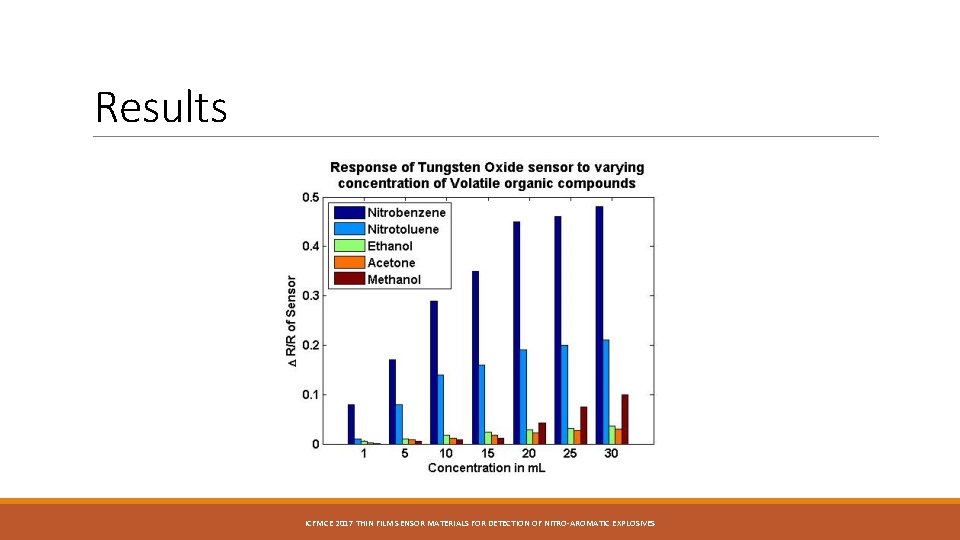
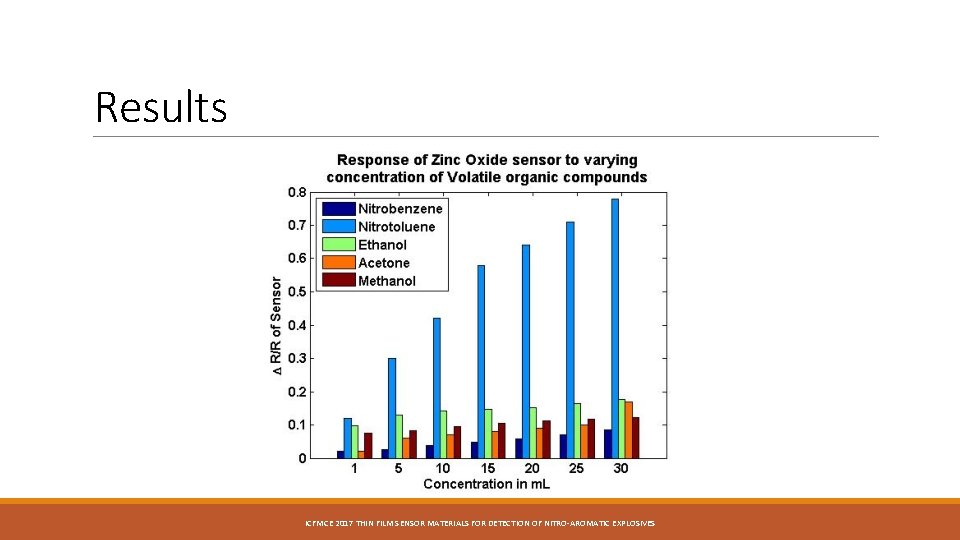
Conclusion • Five sensors with sensing material of Tin oxide, Zinc oxide, Indium oxide, Lead phthalocyanine and Tungsten Oxide exhibited a measurable sensitivity towards these compounds • Zinc oxide based sensor exhibited maximum sensitivity towards Nitrotoluene while tungsten oxide exhibited maximum sensitivity towards Nitrobenzene • Low cross sensitivity was observed for the tungsten oxide and zinc oxide sensors towards ethanol, acetone and methanol • Development of these sensors will help in the timely detection of explosives • These responses can be included in parametric models developed for explosive detection. ICFMCE 2017 -THIN FILM SENSOR MATERIALS FOR DETECTION OF NITRO-AROMATIC EXPLOSIVES
Acknowledgement This project is funded by Bhabha Atomic Research Centre, India under BRNS scheme, file number 2012/36/55/BRNS/March 2013 ICFMCE 2017 THIN FILM SENSOR MATERIALS FOR DETECTION OF NITRO-AROMATIC EXPLOSIVES
References 1. Bretherick L 2016 Bretherick's handbook of reactive chemical hazards (Elsevier) 2. Ewing R, Atkinson D, Eiceman G and Ewing G 2001 Talanta 54 -3 515 3. Hatab N, Eres G, Hatzinger P and Gu B 2010 J. Raman Spect. , 41 -10 1131 4. Primera-Pedrozo O, Soto-Feliciano Y, Pacheco-Londono L and Hernndez-Rivera S 2009 Int. J. Sens. Imag. 10(1 -2): 10 1 -13 5. Sanders N, Kothari S, Huang G, Salazar G and Cooks R 2010 J. Anal. Chem. 82 -12 5313 6. Gardner J and Yinon J 2004 Electronic noses & sensors for the detection of explosives (Kluwer Academic Publishers) 7. Toko K 2013 Biochemical sensors: mimicking gustatory and olfactory senses (CRC Press) 8. Vattappalam S, Thomas D, Augustine S and Mathew S 2015 J, Mat. Sci. Eng. : Conf. Series 73 -1 012106 ICFMCE 2017 THIN FILM SENSOR MATERIALS FOR DETECTION OF NITRO-AROMATIC EXPLOSIVES
References 9. Zeggar M, Bourfaa F, Adjimi A, Aida M and Attaf N 2016 J, Mat. Sci. Eng. : Conf. Series 108 -1 012004 10. Ramgir N, Mulla I and Vijayamohanan K 2005 Sens. and Act. B 107 -2 708 11. Bai H. and Shi G. 2007 Sensors 7 -3 267 12. Nicolas-Debarnot D. and Poncin-Epaillard F 2003 Anal. Chim. Acta 475 -1 1 13. Tomchenko A. , Harmer G, Marquis B and Allen J 2003 Sens. and Act. B 93 -1 126 14. Kanan S, El-Kadri O, Abu-Yousef I and Kanan M 2009 Sensors 9 -10 8158 15. Shishiyanu S, Shishiyanu T and Lupan O 2005 Sens. and Act. B 107 -1 379 16. Xie D, Jiang Y, Pan W, Li D, Wu Z and Li Y 2002 Sens. and Act. B 81 -2 158 ICFMCE 2017 THIN FILM SENSOR MATERIALS FOR DETECTION OF NITRO-AROMATIC EXPLOSIVES