
Thickness and Colorability of Geometric Graphs Stephane Durocher
Thickness and Colorability of Geometric Graphs Stephane Durocher Department of Computer Science University of Manitoba Ellen Gethner Debajyoti Mondal Department of Computer Science University of Manitoba University of Colorado Denver WG 2013 20/06/2013 1
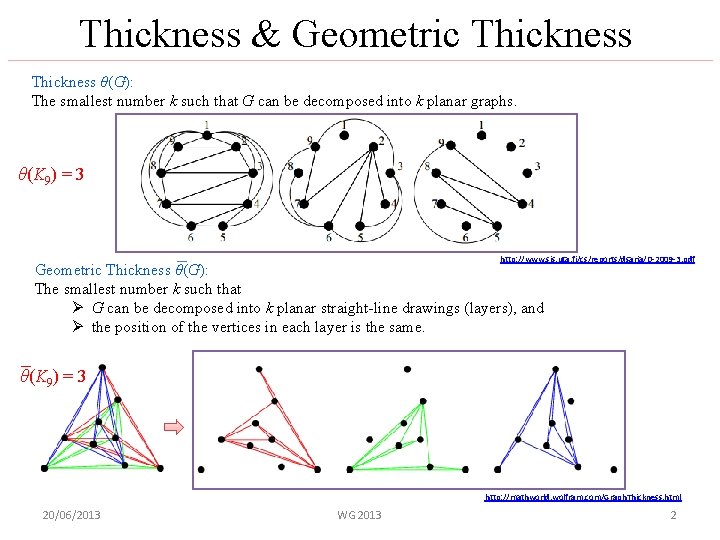
Thickness & Geometric Thickness θ(G): The smallest number k such that G can be decomposed into k planar graphs. θ(K 9) = 3 http: //www. sis. uta. fi/cs/reports/dsarja/D-2009 -3. pdf Geometric Thickness θ(G): The smallest number k such that Ø G can be decomposed into k planar straight-line drawings (layers), and Ø the position of the vertices in each layer is the same. θ(K 9) = 3 http: //mathworld. wolfram. com/Graph. Thickness. html 20/06/2013 WG 2013 2
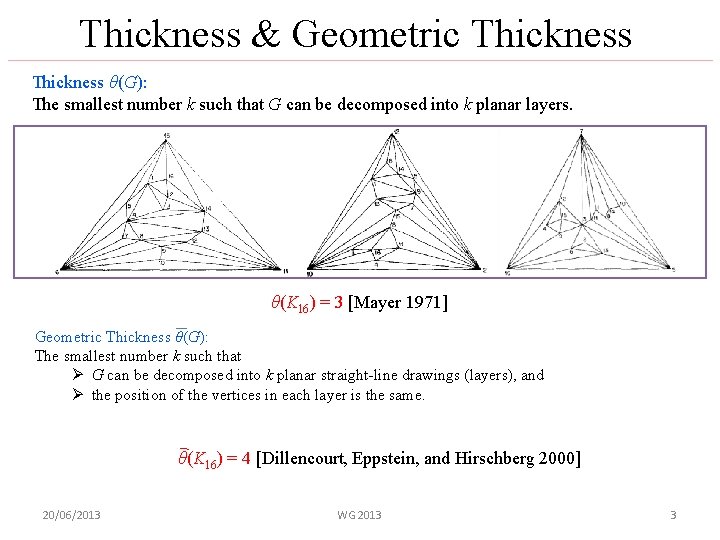
Thickness & Geometric Thickness θ(G): The smallest number k such that G can be decomposed into k planar layers. θ(K 16) = 3 [Mayer 1971] Geometric Thickness θ(G): The smallest number k such that Ø G can be decomposed into k planar straight-line drawings (layers), and Ø the position of the vertices in each layer is the same. θ(K 16) = 4 [Dillencourt, Eppstein, and Hirschberg 2000] 20/06/2013 WG 2013 3
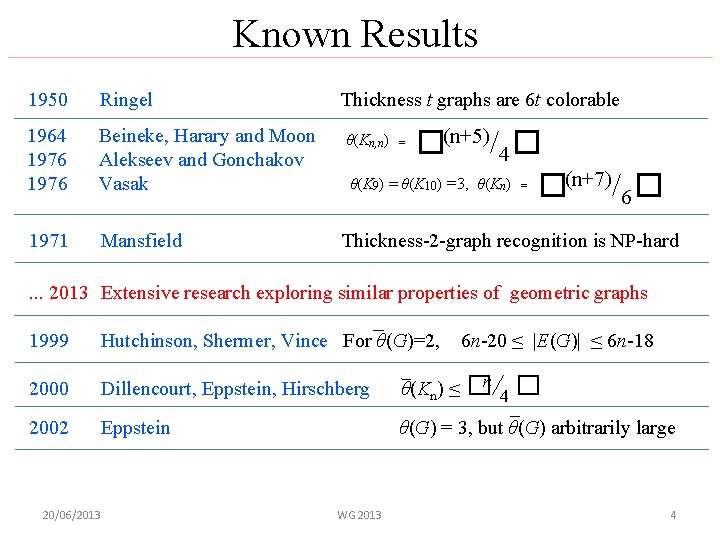
Known Results 1950 Ringel Thickness t graphs are 6 t colorable 1964 1976 Beineke, Harary and Moon Alekseev and Gonchakov Vasak 1971 Mansfield �(n+5)/4 � θ(K ) =3, θ(K ) �(n+7)/ � 6 θ(Kn, n) = 9 10 n = Thickness-2 -graph recognition is NP-hard . . . 2013 Extensive research exploring similar properties of geometric graphs 1999 Hutchinson, Shermer, Vince For θ(G)=2, 6 n-20 ≤ |E(G)| ≤ 6 n-18 2000 Dillencourt, Eppstein, Hirschberg θ(Kn) ≤ �n/4 � 2002 Eppstein 20/06/2013 θ(G) = 3, but θ(G) arbitrarily large WG 2013 4
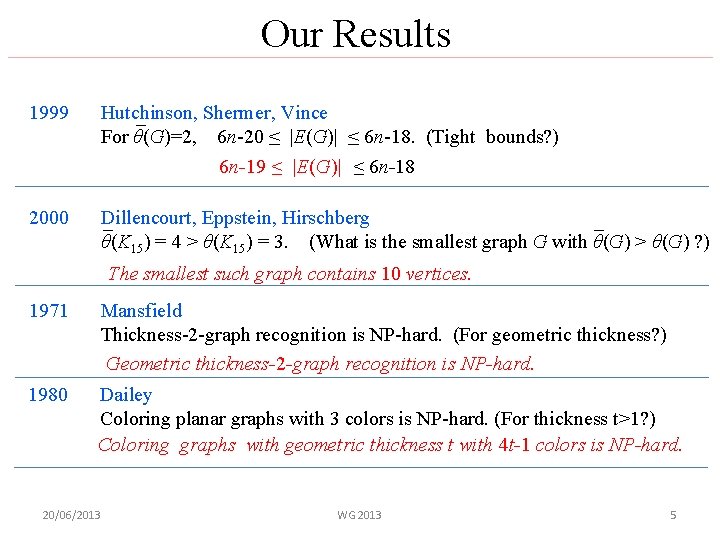
Our Results 1999 Hutchinson, Shermer, Vince For θ(G)=2, 6 n-20 ≤ |E(G)| ≤ 6 n-18. (Tight bounds? ) 6 n-19 ≤ |E(G)| ≤ 6 n-18 2000 Dillencourt, Eppstein, Hirschberg θ(K 15) = 4 > θ(K 15) = 3. (What is the smallest graph G with θ(G) > θ(G) ? ) The smallest such graph contains 10 vertices. 1971 Mansfield Thickness-2 -graph recognition is NP-hard. (For geometric thickness? ) Geometric thickness-2 -graph recognition is NP-hard. 1980 Dailey Coloring planar graphs with 3 colors is NP-hard. (For thickness t>1? ) Coloring graphs with geometric thickness t with 4 t-1 colors is NP-hard. 20/06/2013 WG 2013 5
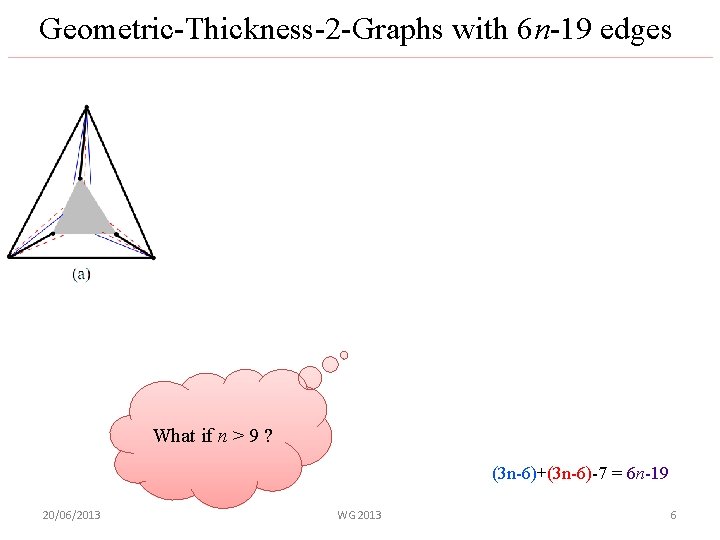
Geometric-Thickness-2 -Graphs with 6 n-19 edges K 9 -(d, e) What if n > 9 ? (3 n-6)+(3 n-6)-7 = 6 n-19 20/06/2013 WG 2013 6

Geometric-Thickness-2 -Graphs with 6 n-19 edges K 9 -(d, e) 20/06/2013 WG 2013 7
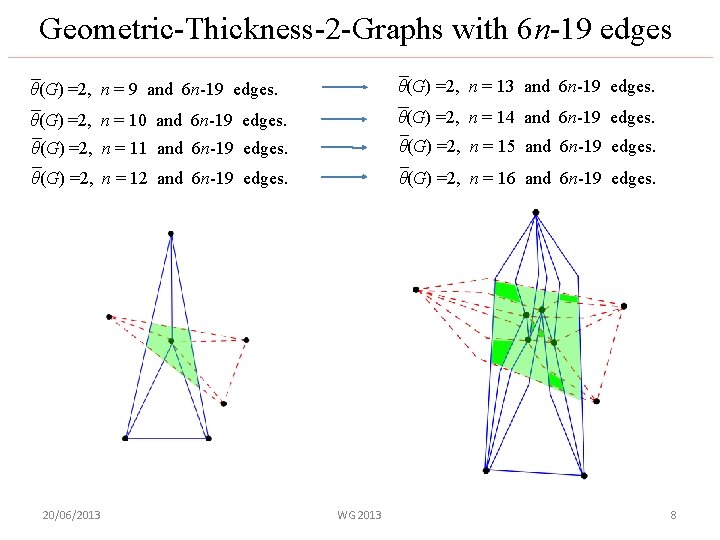
Geometric-Thickness-2 -Graphs with 6 n-19 edges θ(G) =2, n = 9 and 6 n-19 edges. θ(G) =2, n = 13 and 6 n-19 edges. θ(G) =2, n = 10 and 6 n-19 edges. θ(G) =2, n = 14 and 6 n-19 edges. θ(G) =2, n = 11 and 6 n-19 edges. θ(G) =2, n = 15 and 6 n-19 edges. θ(G) =2, n = 12 and 6 n-19 edges. θ(G) =2, n = 16 and 6 n-19 edges. 20/06/2013 WG 2013 8
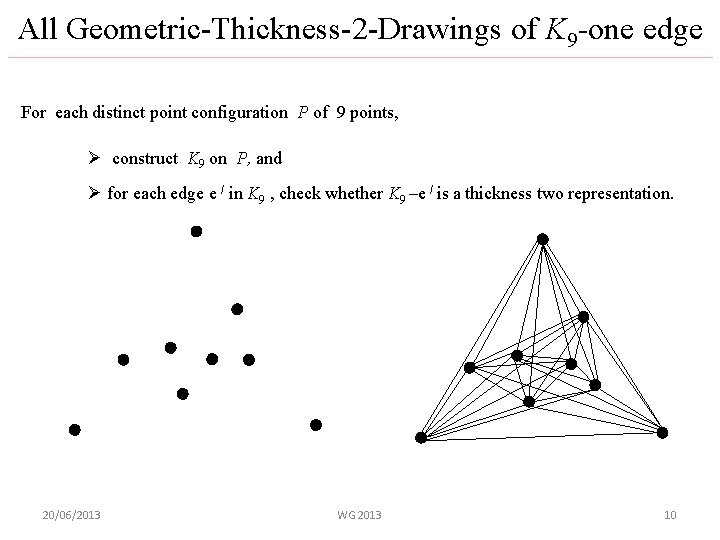
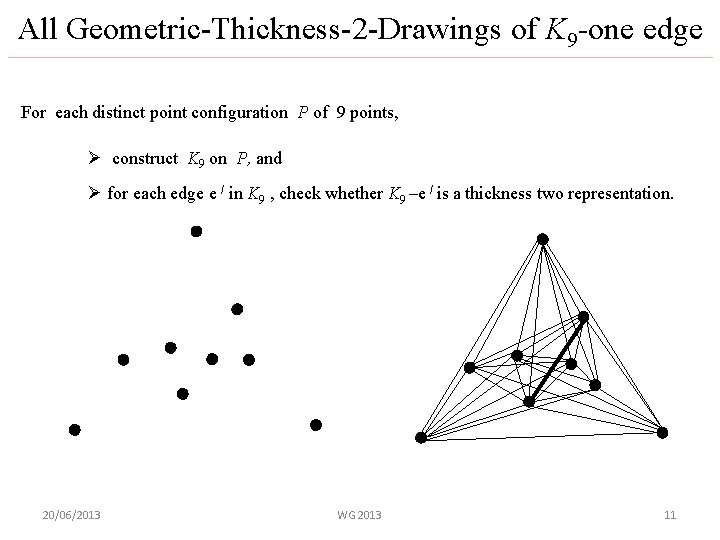
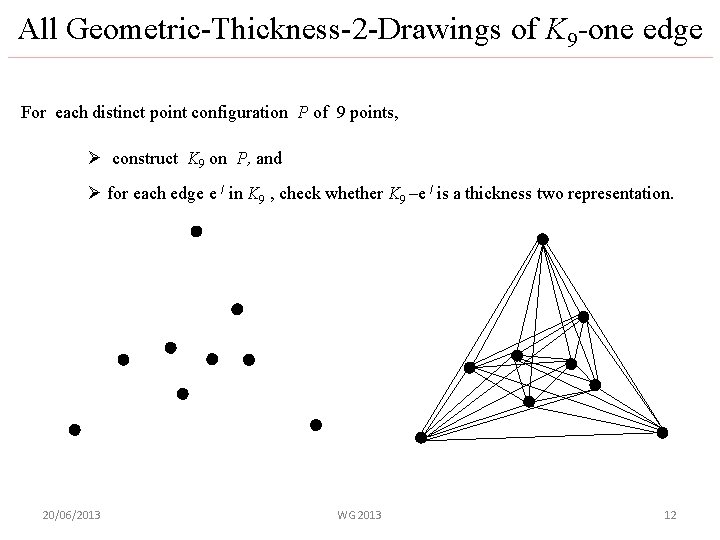
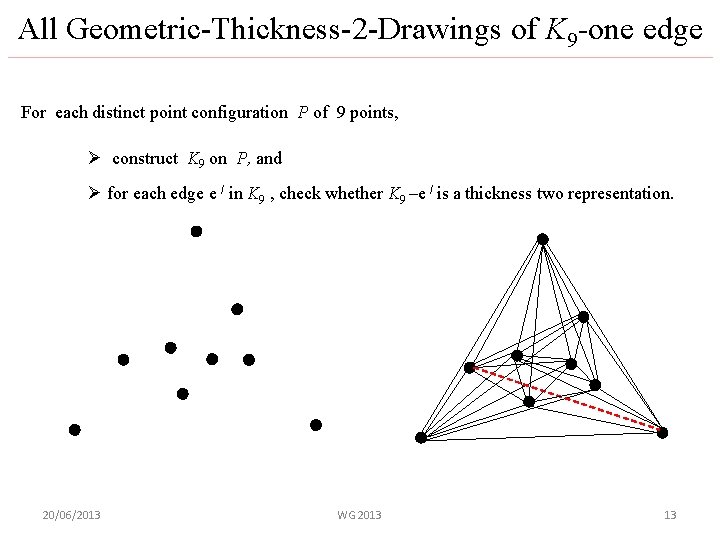
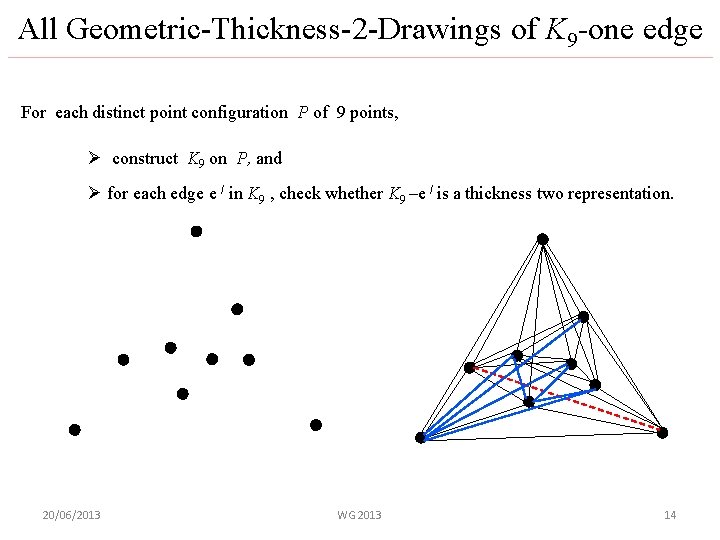
All Geometric-Thickness-2 -Drawings of K 9 -one edge For each distinct point configuration P of 9 points, Ø construct K 9 on P, and Ø for each edge e / in K 9 , check whether K 9 –e / is a thickness two representation. 20/06/2013 WG 2013 10
All Geometric-Thickness-2 -Drawings of K 9 -one edge For each distinct point configuration P of 9 points, Ø construct K 9 on P, and Ø for each edge e / in K 9 , check whether K 9 –e / is a thickness two representation. 20/06/2013 WG 2013 11
All Geometric-Thickness-2 -Drawings of K 9 -one edge For each distinct point configuration P of 9 points, Ø construct K 9 on P, and Ø for each edge e / in K 9 , check whether K 9 –e / is a thickness two representation. 20/06/2013 WG 2013 12
All Geometric-Thickness-2 -Drawings of K 9 -one edge For each distinct point configuration P of 9 points, Ø construct K 9 on P, and Ø for each edge e / in K 9 , check whether K 9 –e / is a thickness two representation. 20/06/2013 WG 2013 13
All Geometric-Thickness-2 -Drawings of K 9 -one edge For each distinct point configuration P of 9 points, Ø construct K 9 on P, and Ø for each edge e / in K 9 , check whether K 9 –e / is a thickness two representation. 20/06/2013 WG 2013 14
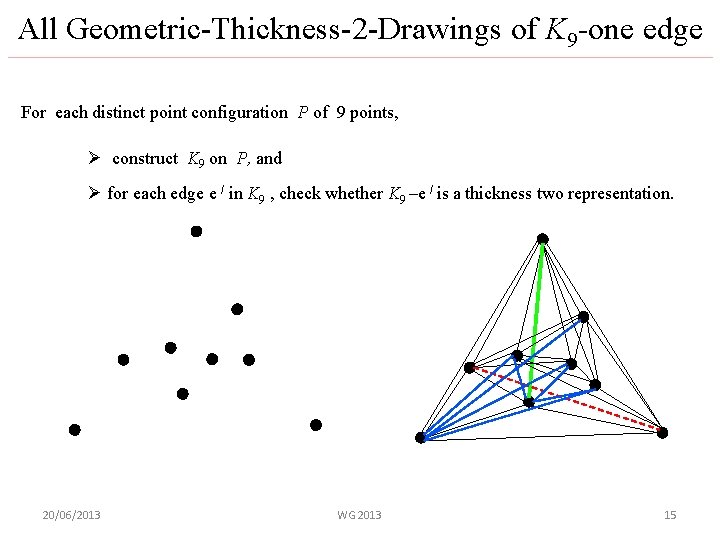
All Geometric-Thickness-2 -Drawings of K 9 -one edge For each distinct point configuration P of 9 points, Ø construct K 9 on P, and Ø for each edge e / in K 9 , check whether K 9 –e / is a thickness two representation. 20/06/2013 WG 2013 15
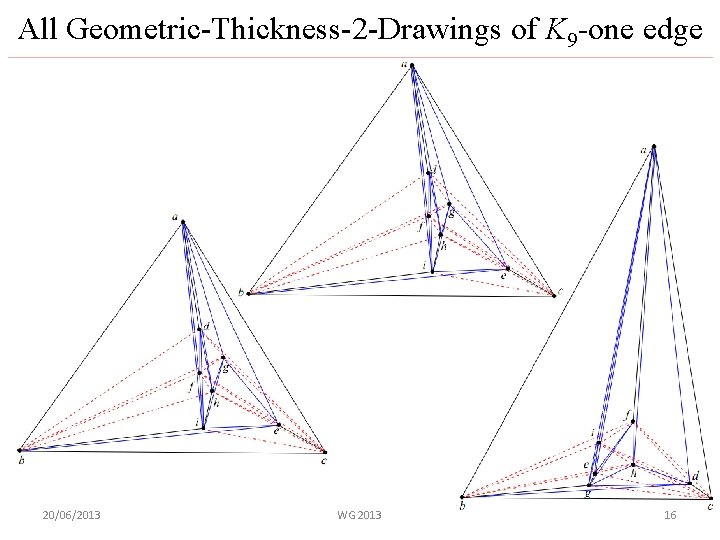
All Geometric-Thickness-2 -Drawings of K 9 -one edge 20/06/2013 WG 2013 16
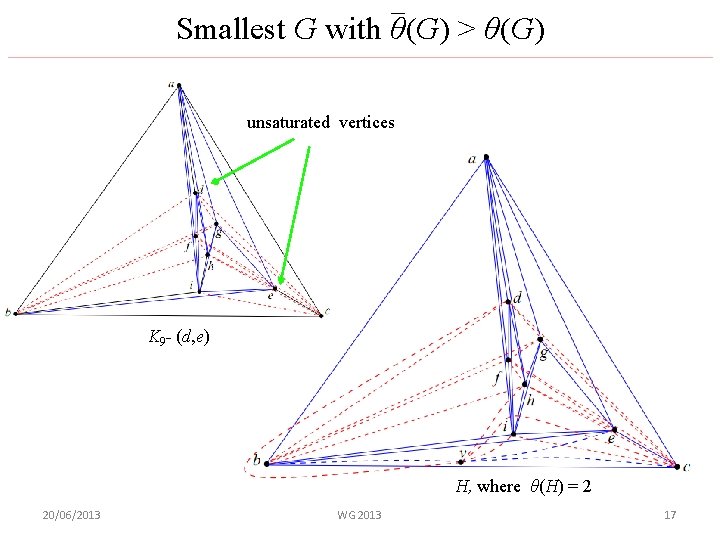
Smallest G with θ(G) > θ(G) unsaturated vertices K 9 - (d, e) H, where θ(H) = 2 20/06/2013 WG 2013 17
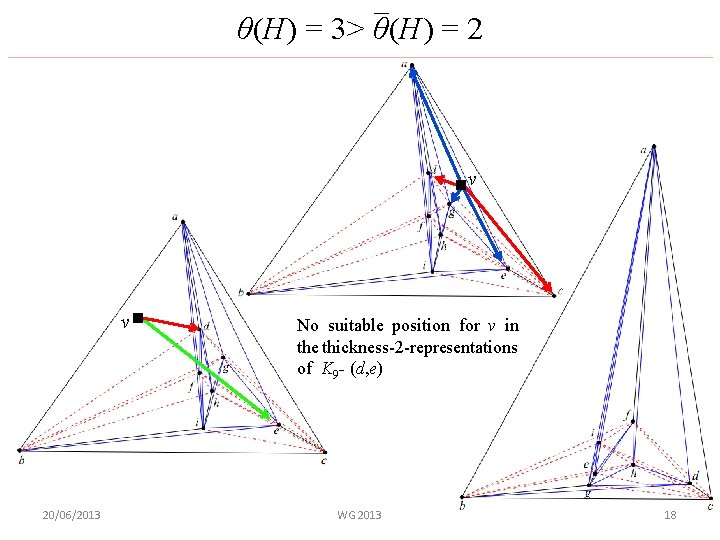
θ(H) = 3> θ(H) = 2 v v 20/06/2013 No suitable position for v in the thickness-2 -representations of K 9 - (d, e) WG 2013 18
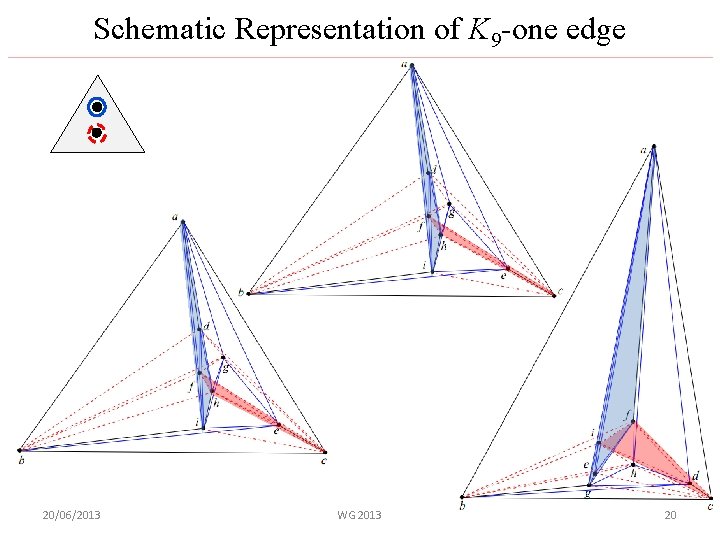
Schematic Representation of K 9 -one edge 20/06/2013 WG 2013 20
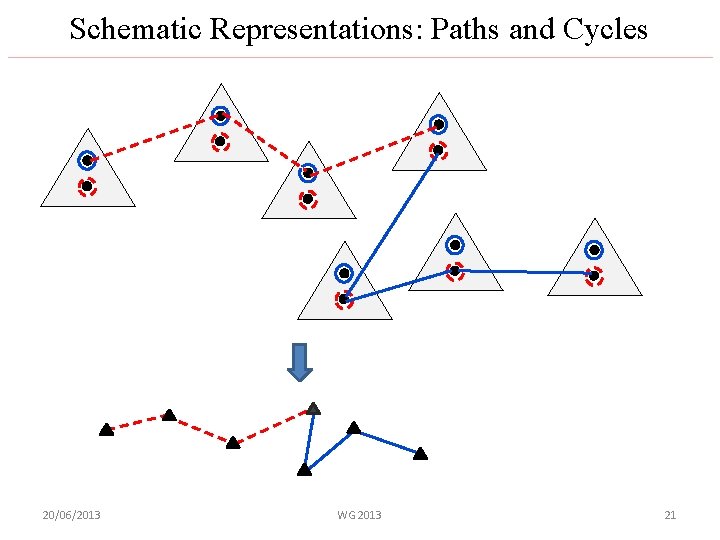
Schematic Representations: Paths and Cycles 20/06/2013 WG 2013 21
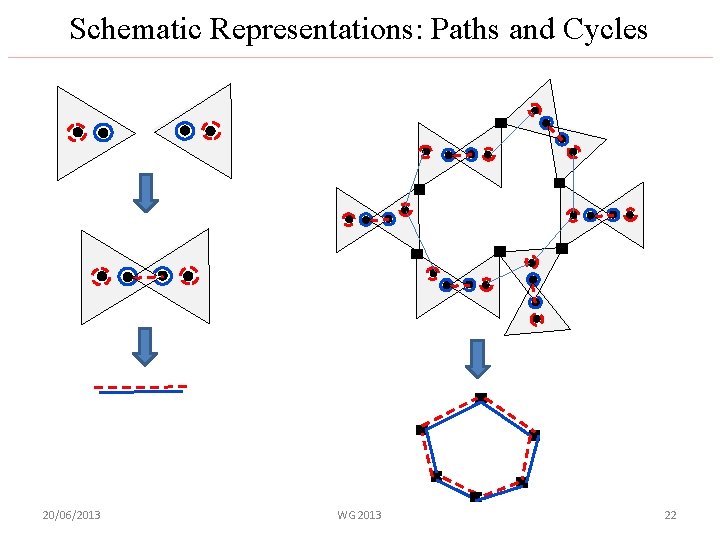
Schematic Representations: Paths and Cycles 20/06/2013 WG 2013 22
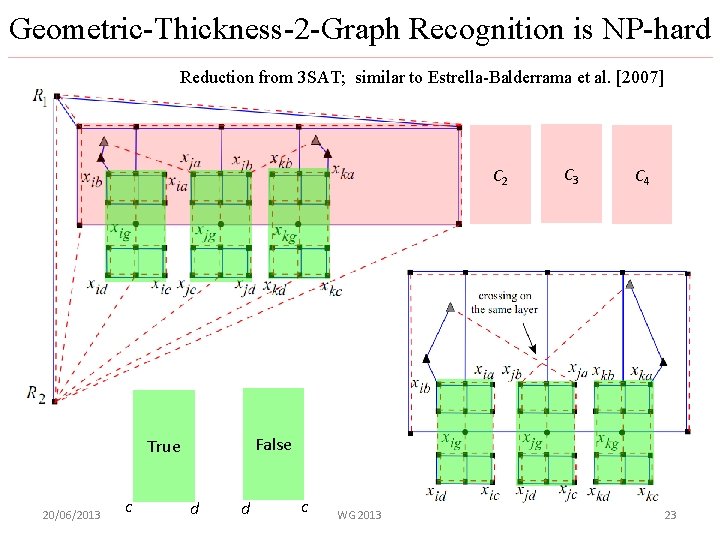
Geometric-Thickness-2 -Graph Recognition is NP-hard Reduction from 3 SAT; similar to Estrella-Balderrama et al. [2007] C 2 c C 4 False True 20/06/2013 C 3 d d c WG 2013 23
Coloring with 4 t-1 colors is NP-hard Reduction from the problem of coloring geometricthickness-t-graphs with 2 t +1 colors, which is NP-hard (skip). Without loss of generality assume that t ≥ 2. Given a graph H with geometric thickness (t-1), we construct a graph G with thickness t such that G is 4 t-1 colorable if and only if H is 2(t-1)+1 colorable. 20/06/2013 WG 2013 24
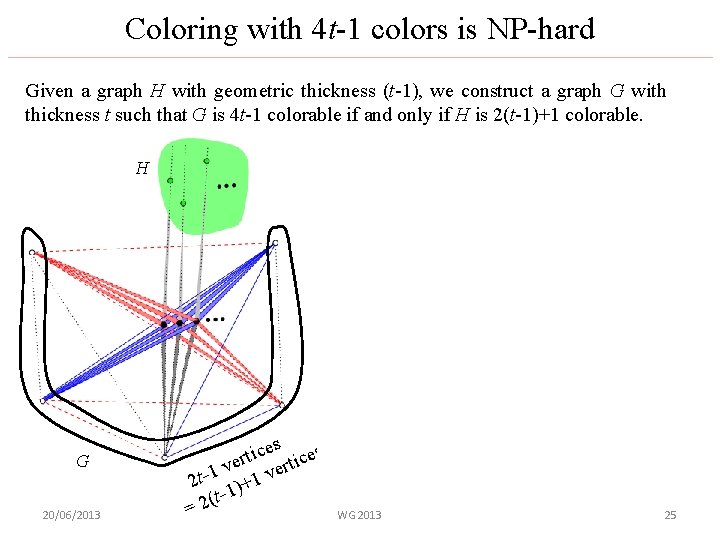
Coloring with 4 t-1 colors is NP-hard Given a graph H with geometric thickness (t-1), we construct a graph G with thickness t such that G is 4 t-1 colorable if and only if H is 2(t-1)+1 colorable. H 2 t vertices G 20/06/2013 es es c i t er ertic v 1 v t 2 t-1)+1 ( = 2 Construction of K 4 t = K 12 [Dillencourt et al. 2000] WG 2013 25
Future Research Ø Does there exist a geometric thickness two graph with 6 n-18 edges? Ø Can every geometric-thickness-2 -graph be colored with 8 colors? Ø Does there exist a polynomial time algorithm for recognizing geometric thickness-2 -graphs with bounded degree? 20/06/2013 WG 2013 26
Thank You 20/06/2013 WG 2013 27
- Slides: 25