
Thick lens Lect 2 TWO SPHERICAL SURFACES formed


- Slides: 20
Thick lens Lect. 2
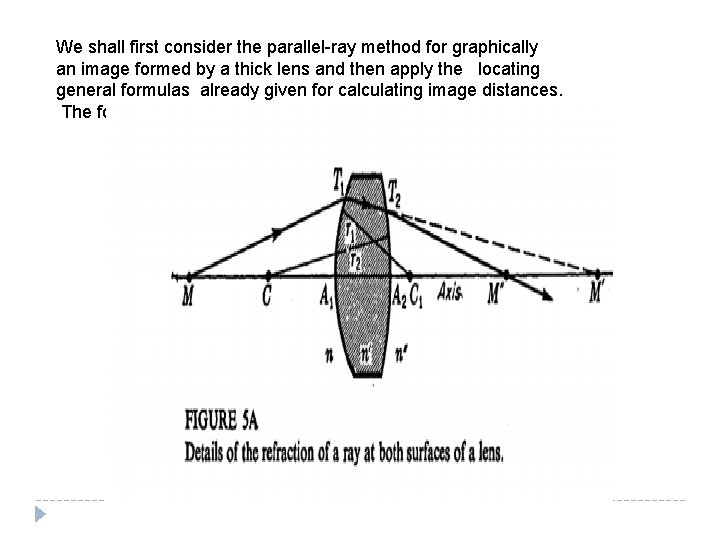
TWO SPHERICAL SURFACES formed by a thick lens and then apply the general formulas already given for calculating image distances. The formulas to be used are �
We shall first consider the parallel-ray method for graphically an image formed by a thick lens and then apply the locating general formulas already given for calculating image distances. The formulas to be used are :
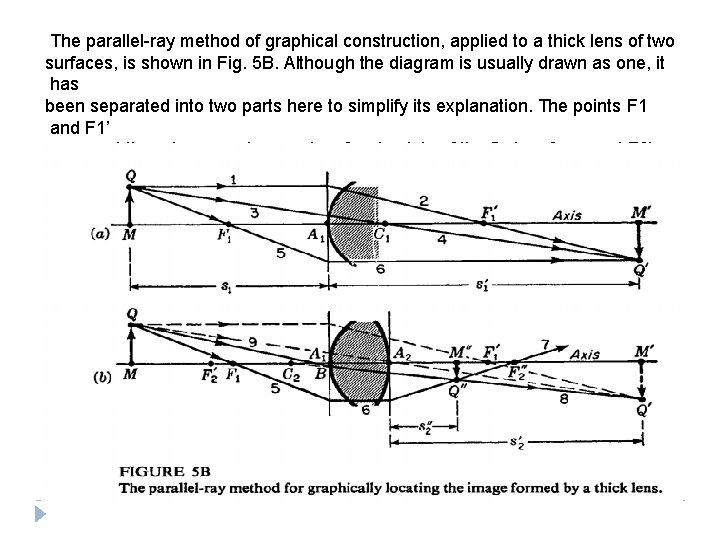
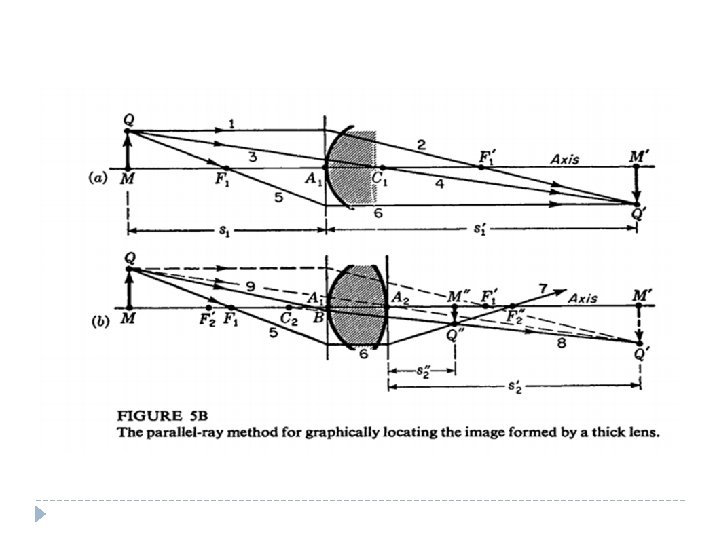
The parallel-ray method of graphical construction, applied to a thick lens of two surfaces, is shown in Fig. 5 B. Although the diagram is usually drawn as one, it has been separated into two parts here to simplify its explanation. The points F 1 and F 1’ represent the primary and secondary focal points of the first surface, and F 2' and F 2’’ represent the primary and secondary focal points of the second surface, respectively.
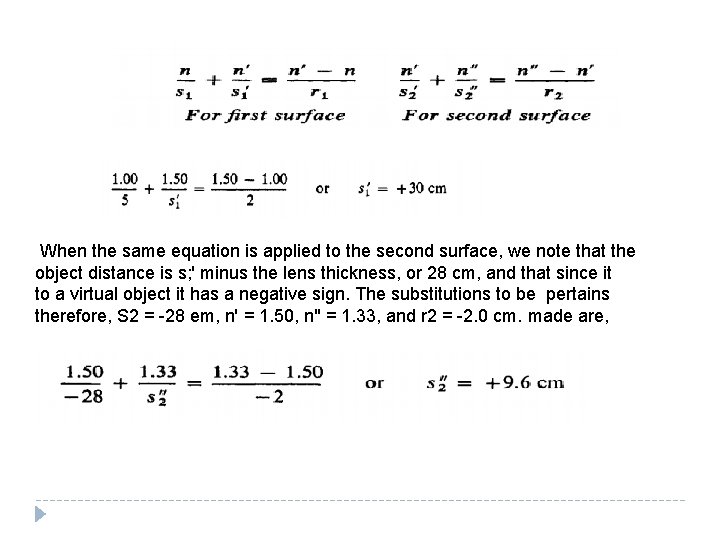
curvature of 2 EXAMPLE I An equiconvex lens 2 cm thick and having radii of cm is mounted in the end of a water tank. An object in lens 5 cm from its vertex. Find the position of air is placed on the axis of the refractive indices of 1. 00, 1. 50, and 1. 33 for air, glass, the final image. Assume and water, respectively SOLUTION The relative dimensions in this problem are approximately those shown in Fig. 5 B(b). If we apply Eq. (Sa) to the first surface alone, we find image distance to be the
When the same equation is applied to the second surface, we note that the object distance is s; ' minus the lens thickness, or 28 cm, and that since it to a virtual object it has a negative sign. The substitutions to be pertains therefore, S 2 = -28 em, n' = 1. 50, n" = 1. 33, and r 2 = -2. 0 cm. made are,
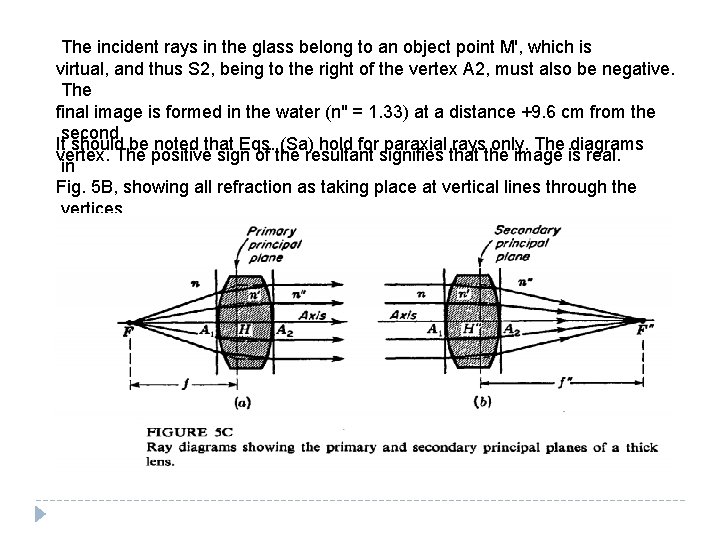
The incident rays in the glass belong to an object point M', which is virtual, and thus S 2, being to the right of the vertex A 2, must also be negative. The final image is formed in the water (n" = 1. 33) at a distance +9. 6 cm from the second It should be noted that Eqs. (Sa) hold for paraxial rays only. The diagrams vertex. The positive sign of the resultant signifies that the image is real. in Fig. 5 B, showing all refraction as taking place at vertical lines through the vertices Ai and A 2, are likewise restricted to paraxial rays.
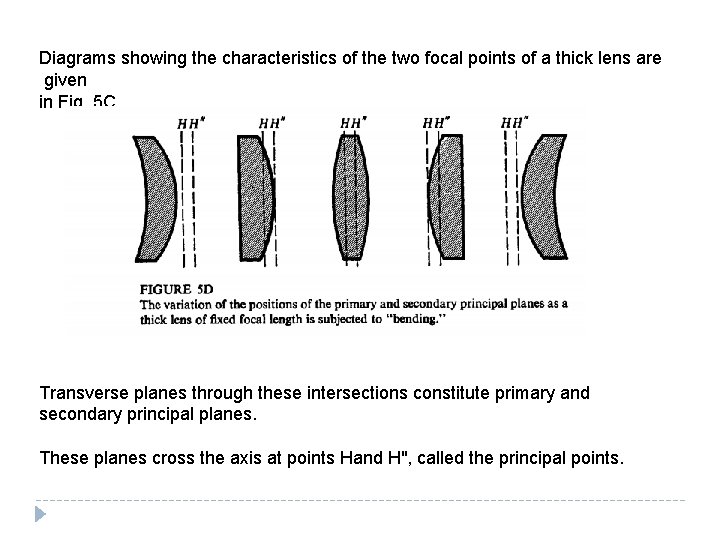
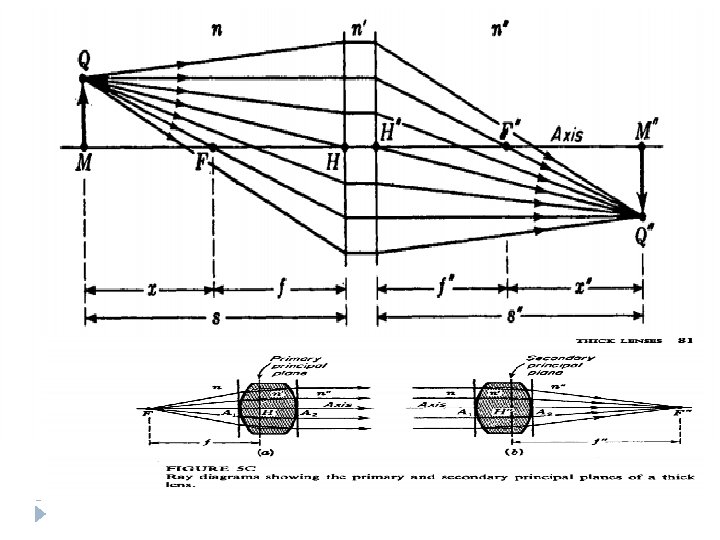
Diagrams showing the characteristics of the two focal points of a thick lens are given in Fig. 5 C. Transverse planes through these intersections constitute primary and secondary principal planes. These planes cross the axis at points Hand H", called the principal points.
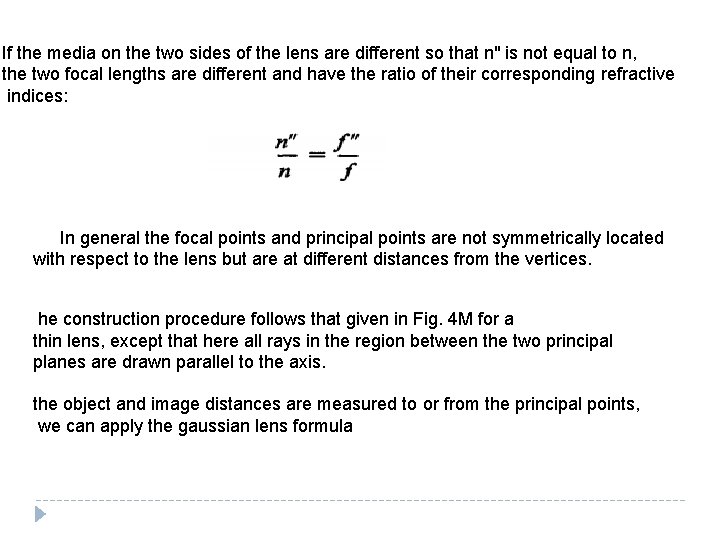
If the media on the two sides of the lens are different so that n" is not equal to n, the two focal lengths are different and have the ratio of their corresponding refractive indices: In general the focal points and principal points are not symmetrically located with respect to the lens but are at different distances from the vertices. he construction procedure follows that given in Fig. 4 M for a thin lens, except that here all rays in the region between the two principal planes are drawn parallel to the axis. the object and image distances are measured to or from the principal points, we can apply the gaussian lens formula
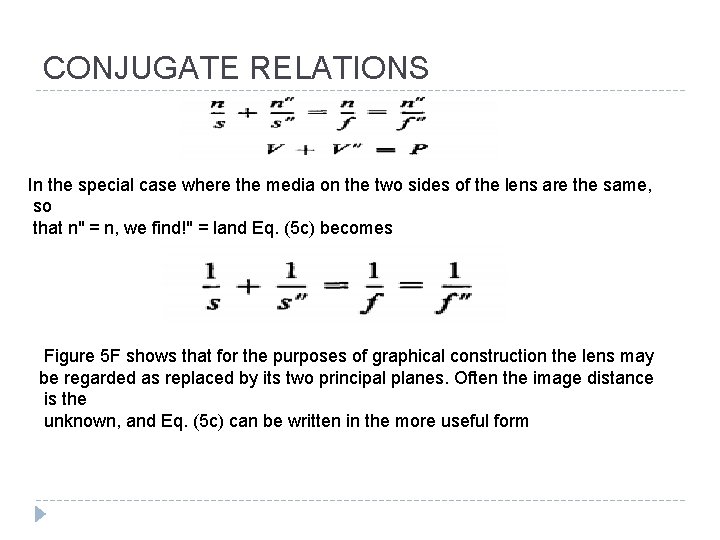
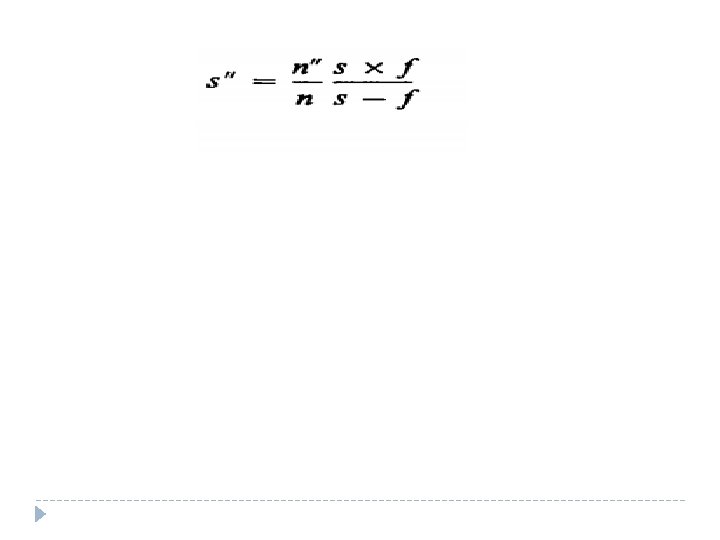
CONJUGATE RELATIONS In the special case where the media on the two sides of the lens are the same, so that n" = n, we find!" = land Eq. (5 c) becomes Figure 5 F shows that for the purposes of graphical construction the lens may be regarded as replaced by its two principal planes. Often the image distance is the unknown, and Eq. (5 c) can be written in the more useful form
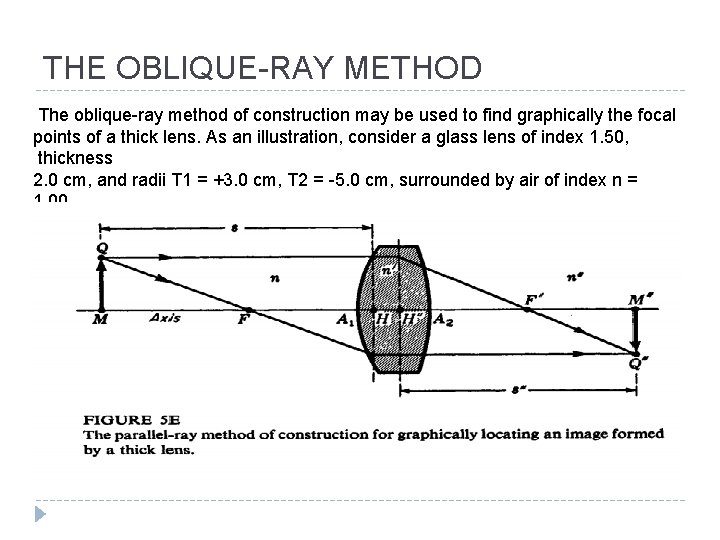
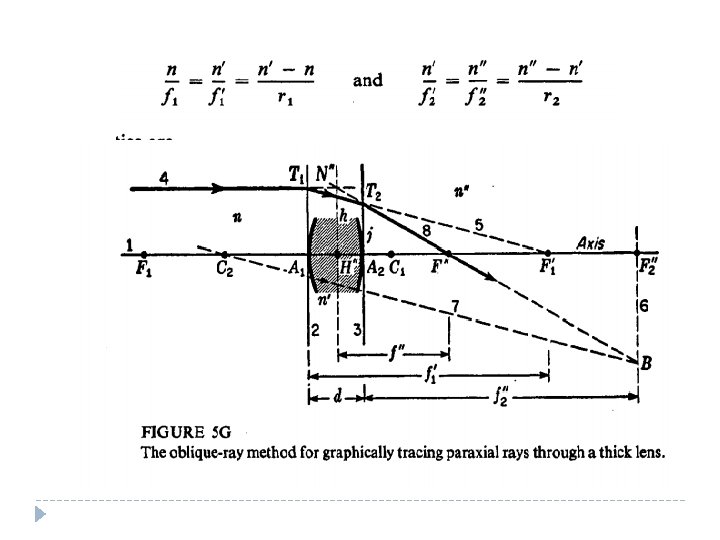
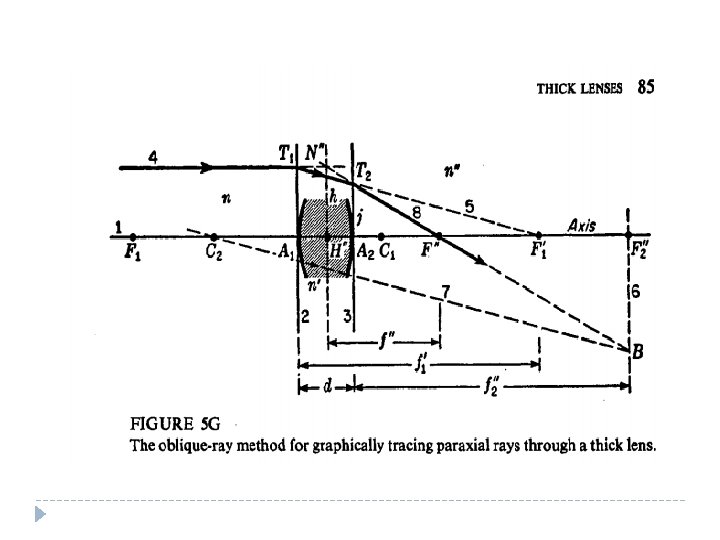
THE OBLIQUE-RAY METHOD The oblique-ray method of construction may be used to find graphically the focal points of a thick lens. As an illustration, consider a glass lens of index 1. 50, thickness 2. 0 cm, and radii T 1 = +3. 0 cm, T 2 = -5. 0 cm, surrounded by air of index n = 1. 00.
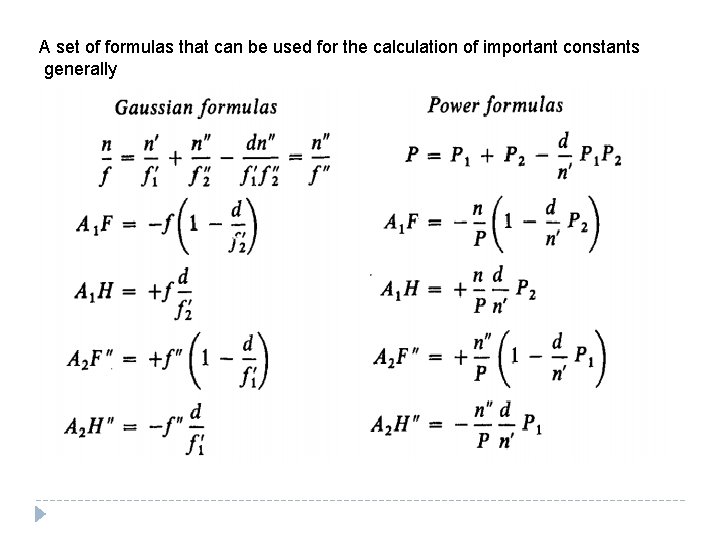
A set of formulas that can be used for the calculation of important constants generally associated with a thick lens is presented below in the form of two equivalent sets.
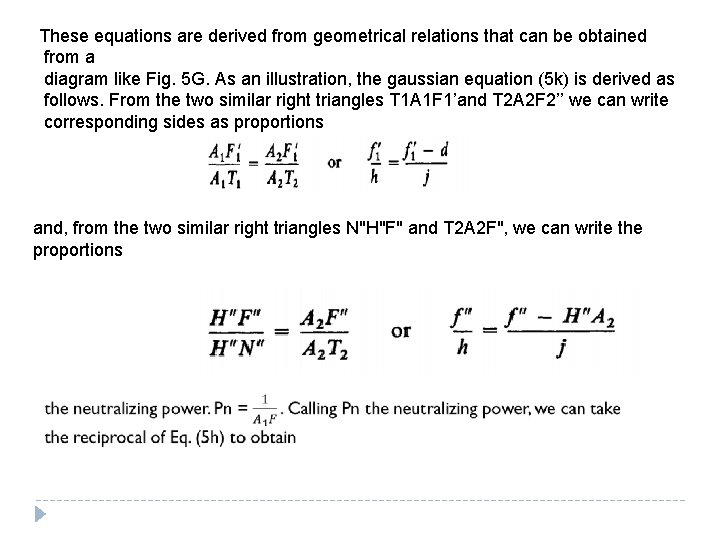
These equations are derived from geometrical relations that can be obtained from a diagram like Fig. 5 G. As an illustration, the gaussian equation (5 k) is derived as follows. From the two similar right triangles T 1 A 1 F 1’and T 2 A 2 F 2’’ we can write corresponding sides as proportions and, from the two similar right triangles N"H"F" and T 2 A 2 F", we can write the proportions
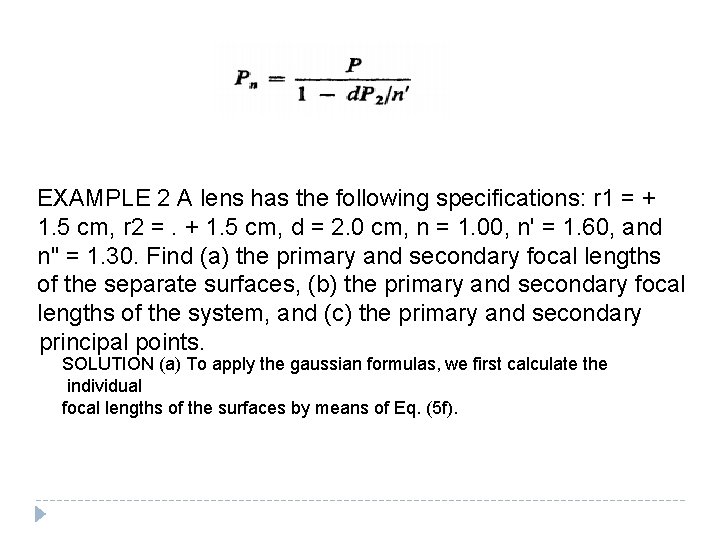
EXAMPLE 2 A lens has the following specifications: r 1 = + 1. 5 cm, r 2 =. + 1. 5 cm, d = 2. 0 cm, n = 1. 00, n' = 1. 60, and n" = 1. 30. Find (a) the primary and secondary focal lengths of the separate surfaces, (b) the primary and secondary focal lengths of the system, and (c) the primary and secondary principal points. SOLUTION (a) To apply the gaussian formulas, we first calculate the individual focal lengths of the surfaces by means of Eq. (5 f).